From the Department of Surgery, Faculty of Medicine, University of São Paulo, São Paulo/SP, Brazil.
Received for publication on August 19, 2002.
USE OF TACROLIMUS IN RESCUE THERAPY OF
ACUTE AND CHRONIC REJECTION IN LIVER
TRANSPLANTATION
Fabricio Ferreira Coelho, Rafael Ferreira Coelho, Paulo Celso Bosco Massarollo and Sérgio Mies
COELHO FF et al. - Use of tacrolimus in rescue therapy of acute and chronic rejection in liver transplantation. Rev. Hosp. Clín. Fac. Med. S. Paulo 58(3):141-146, 2003.
PURPOSE: To study the indications and results of tacrolimus as rescue therapy for acute cellular or chronic rejection in liver transplantation.
PATIENTS AND METHODS: Eighteen liver transplant recipients who underwent rescue therapy with tacrolimus between March 1995 and August 1999 were retrospectively studied. The treatment indication, patients, and graft situation were recorded as of October 31st, 1999. The response to tacrolimus was defined as patient survival with a functional graft and
histological reversal of acute cellular, or for chronic rejection, bilirubin serum levels decreasing to up to twice the upper normal limit.
RESULTS: Fourteen cases (77.8%) presented a good response. The response rate for the different indications was: (1) acute cellular + sepsis - 0/1 case; (2) recurrent acute cellular - 1/1 case; (3) OKT3-resistant acute cellular - 2/2 cases; (4) steroid–resistant acute cellular + active viral infection - 3/3 cases; (5) chronic rejection - 8/11 cases (72.7% response rate). The 4 patients who did not respond died.
CONCLUSION: Tacrolimus rescue therapy was successful in most cases of acute cellular and chronic rejection in liver transplantation.
DESCRIPTORS: Liver transplantation. Adverse effects. Immunosuppression. Tacrolimus. Therapeutic use.
After the advent of cyclosporin in 1980, the survival rate of patients un-dergoing liver transplantation (LTx) improved dramatically1. At our unit,
cyclosporin in combination with aza-thioprine and corticosteroids consti-tutes the drug of choice for immunosup-pressive therapy in LTx. With this thera-peutic regimen, about 30% of the pa-tients undergoing LTx presented epi-sodes of acute cellular rejection (ACR)2.
Recent studies have shown that up to 13% of the episodes of ACR are refrac-tory to the standard treatment with corticosteroids3. For this reason, ACR
continues to be a cause of graft loss4-6.
The most widely used agent in the treatment of steroid-resistant ACR is
OKT3, a monoclonal antibody that blocks lymphocyte-mediated cytotox-icity by binding with the CD3 receptor7. However, its use is limited
by adverse reactions, by an increased occurrence of opportunistic infectious diseases, and by lymphoproliferative disorders, as well as the high cost8,9.
More recently, tacrolimus (FK506) made its appearance as an alternative immunosuppressive drug. It became
available in Europe in 1990.10 FK506
is a macrolide compound isolated from
Streptomyces tsukubaensis and has an
immunosuppressive potential approxi-mately 100 times more powerful than cyclosporin11,12. The drug acts by
bind-ing to cytoplasmic proteins of the lymphocytes, primarily FKBP12, form-ing a complex that associates with calcineurin. Some direct or indirect substrates of calcineurin act as tran-scription factors and promote the acti-vation of genes that encode cytokine production.
Figure 1 - Liver biopsy showing the loss of small bile ducts in the portal tract. Note the deposition of hemosiderin in hepatocytes and macrophages.
Table 1 - Indications for liver transplantation in patients undergoing rescue therapy with tacrolimus for acute and chronic rejections.
Indications n
primary sclerosing cholangitis 4
hepatitis C cirrhosis 4
acute liver failure 2
ductopenic disease 1
primary biliary cirrhosis 1
alcoholic cirrhosis 1
cryptogenic cirrhosis 1
familial amyloidotic polyneuropathy 1
hemochromatosis 1
α1-antitrypsin deficiency 1
autoimmune hepatitis 1
transduction, inhibiting the formation of interleukin-2 by the T-lymphocytes and the formation of other soluble me-diators, such as interleuk3 and in-terferon-γ11,12.
The introduction of FK506 has added an alternative to OKT3 for res-cue therapy of steroid-resistant ACR. It also has opened new possibilities for the pharmacological control of chronic liver graft rejection (CR), which until that time, was treated exclusively by retransplantation13.
The purpose of this study was to analyze the indication criteria and the results of employing FK506 in rescue therapy of acute and chronic rejection in LTx.
PATIENTS AND METHODS
All 244 LTx performed at our unit between March 1995 and August 1999 were retrospectively studied. Among these, we identified and analyzed 7 cases of ACR and 11 cases of CR that had been converted to FK506 for res-cue therapy.
Eight of the 18 patients who under-went rescue therapy with FK506 were males. The mean age was 39.1 ± 15.4 years (16 to 64 years). The indications for LTx for these patients are shown in table 1.
The primary immunosuppressive therapy for all patients was based on cyclosporin, prednisone, and azathio-prine, according to the standard serv-ice protocol. According to this regi-men, 1 g of methylprednisolone was delivered intravenously at the time of revascularization, and 200 mg of pred-nisone or methylprednisolone were delivered on the immediate postopera-tive day (PO). This dosage was tapered to 40 mg/day until the maintenance dosage of 20 mg/day was achieved on the sixth PO. Azathioprine was admin-istered orally, at a daily dosage of 1 mg/kg. Cyclosporin was introduced orally between the first and third PO, 10 mg/kg, divided into 2 daily doses. The dosage was adjusted daily to achieve a target trough blood level between 300 and 350 ng/mL (monoclonal TDX). During the first year PO, the dosage of cyclosporin was progressively reduced to attain a trough blood level of approximately 100 ng/mL. During the same period, the dosage of prednisone was reduced
to 5 mg/day. ACR episodes were treated with 1 to 3 pulses of 1 g of methylprednisolone, followed by a 6-day taper from 200 to 20 mg/6-day.
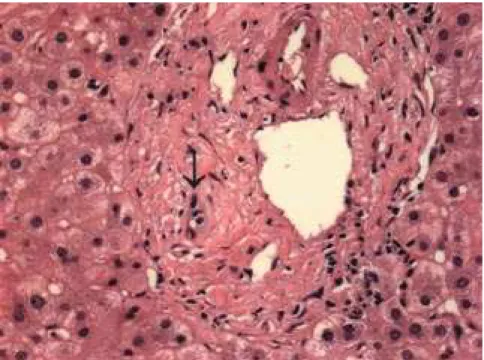
Figure 2 - Liver biopsy showing degenerative alterations in the interlobular bile ducts (arrow). Note the cytoplasmic eosinophilia, the nuclear pyknosis, and the absence of portal inflammation.
Figure 3 - Angiographic study of the liver graft showing multiple arterial strictures.
were histologically confirmed. The 11 diagnoses of CR were established us-ing one of the followus-ing three criteria: 1- characterization of ductopenia in liver biopsy14, in 5 patients (Fig. 1);
2-presence of bile duct damage in the bi-opsy,14 with normal cholangiography
and hepatic angiography, in 5 cases (Fig. 2); 3- presence of duct aggression with angiographic demonstration of
multiple intrahepatic arterial strictures in 1 case (Fig. 3).
Steroid-resistant ACR was defined as the persistence of the clinical, bio-chemical, and histopathological signs of rejection after treatment with at least 2 pulses of 1.0 g of methylpred-nisolone. OKT3-resistant ACR was de-fined as the persistence of the clinical, biochemical, and histopathological
signs of rejection after treatment with the drug for at least 10 days.
In the 18 cases studied, the follow-ing data were recorded: date of LTx, indication for rescue therapy, date of conversion, follow-up period, and pa-tient and graft situation on October 31st, 1999.
The response to FK506 was de-fined as patient survival with func-tional graft and histological reversal of ACR, or for CR, bilirubin serum lev-els decreasing to up to twice the up-per normal limit.
The patients’ actuarial survival rates were calculated using the Kaplan-Meier method.
RESULTS
Five different indications for rescue therapy with FK506T were identified: 1) ACR plus bacterial sepsis (n=1); 2) recurrent ACR (n=1); 3) OKT3-resist-ant ACR (n=2); 4) steroid-resistOKT3-resist-ant ACR plus active viral disease (n=3); 5) chronic rejection (n=11).
The patient with recurrent ACR presented 4 rejection episodes in a 4-month period. Among the 3 patients with ACR plus active viral disease, 2 presented cytomegalovirus (CMV) hepatitis, and 1 had herpetic gastroenterocolitis.
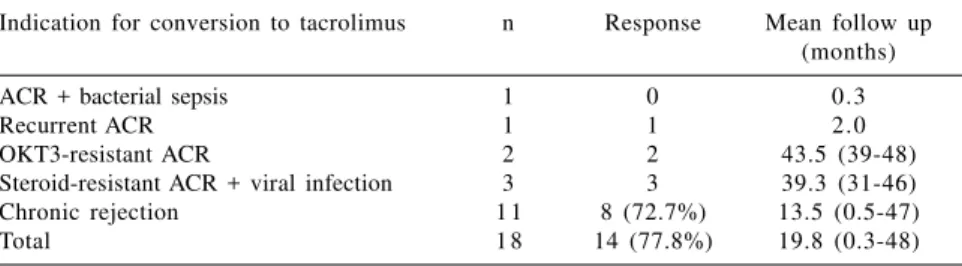
Table 2 shows the response rate to FK506 for each indication. Fourteen patients (77.8%) were considered “pa-tients who responded”. All 4 pa“pa-tients with no response died. The mean fol-low-up time after conversion to FK506 was 19.8 months, ranging from 10 days to 48 months.
Table 2 - Results: indication for conversion to tacrolimus, percentage of response and mean follow-up.
Indication for conversion to tacrolimus n Response Mean follow up (months)
ACR + bacterial sepsis 1 0 0.3
Recurrent ACR 1 1 2.0
OKT3-resistant ACR 2 2 43.5 (39-48)
Steroid-resistant ACR + viral infection 3 3 39.3 (31-46)
Chronic rejection 1 1 8 (72.7%) 13.5 (0.5-47)
Total 1 8 14 (77.8%) 19.8 (0.3-48)
ACR= acute cellular rejection.
Figure 4 - Actuarial survival of the 11 patients with chronic rejection of the liver graft undergoing rescue therapy with tacrolimus.
Figure 6 - Evolution of alkaline phosphatase serum levels in patients undergoing rescue therapy with tacrolimus for treatment of chronic rejection of the liver graft. The upper normal limit of alkaline phosphatase is 223 U/L.
Figure 5 - Evolution of total bilirubin serum levels in patients undergoing rescue therapy with tacrolimus for the treatment of chronic rejection of the liver graft. The upper normal limit of total bilirubin is 1.3 mg/dL.
Figure 7 - Evolution of alanine aminotransferase serum levels in patients undergoing rescue therapy with tacrolimus for treatment of chronic rejection of the liver graft. The upper normal limit of alanine aminotransferase is 32 U/L.
DISCUSSION
Several clinical studies have evalu-ated the effects of FK506 on rescue therapy of CR or ACR in LTx
recipi-ents15. Most have demonstrated the
beneficial effects of the drug, with a
success rate of up to 89% for steroid-resistant ACR16.
Sher et al.17 obtained a response
rate of 70.3% in patients with CR, while Platz et al.16 reported a success
rate of 88.9% in patients with steroid-resistant ACR. In the present study, the
response rate was 72.7% and 85.7% in cases of CR and ACR, respectively.
In the present study, the survival rate of the patients undergoing rescue therapy for CR was 61.5% at 2 years (Fig. 4). Sher et al.17 observed an
81.2% survival rate with the same fol-low-up, while Jonas et al.5 obtained a
76% survival rate.
In the present study, only 3 pa-tients (16.7%) were less than 18 years old; the youngest patient was 16. Thus, our results refer basically to an adult population. Other authors, however, have shown positive long-term results with FK506 rescue therapy for pediatric patients. Reyes et al. 18,
and 74.6% at the 5- and 8-year follow-up, respectively. In the cases converted due to ACR (95.5% survival at 8 years), results were better than for cases of CR (74.6%).
Considering the positive efficacy of FK506, some authors propose it as the drug of choice for steroid-resistant ACR to avoid the use of anti-lymphocyte an-tibodies11,12. Some studies have shown
that the need for retransplantation is more marked in patients undergoing OKT3 rescue therapy (15.8%) than in patients treated with FK506 (5.5%)16.
Thus, the indication for OKT3 for ster-oid-resistant ACR has been restricted, and its use has declined in several trans-plant centers16.
There are some prognostic factors related to the therapeutic success rate of FK5065,17. Jonas et al.5, studying
pa-tients with ACR, found a significant lower bilirubin level prior to the con-version in patients who responded (12.0 ± 5.6 mg% vs. 29.7 ± 5.9 mg%; P <
0.05). Sher et al.17 identified 2
inde-pendent prognostic factors in patients with CR: total bilirubin and the time elapsed between LTx and conversion. The cases of total bilirubin greater than 10 mg/dL presented a 13.8% 2-year graft survival, compared to 86.0% for patients with a level below this value. Patients converted up to 90 days after LTx had a graft survival of 51.9% com-pared to 87.7% for patients converted later. In the present study, the bilirubin level was correlated with a similar ef-fect in patients with CR. Two of the 3 patients who died presented a total
pre-conversion bilirubin level higher than 10 mg/dL. Inversely, only 2 of the 8 pa-tients who responded presented a bi-lirubin level above this value. The me-dian time elapsed between LTx and the beginning of the rescue therapy was 127 days for patients who did not re-spond (range 64 to 536 days), and 146 days for patients treated successfully (range 27 to 836 days).
Similarly to other studies17,18, the
criteria used to determine a positive response in CR were based only on clinical and biochemical data. It would, however, be interesting to clarify the effect of the conversion to FK506 on the histological and angio-graphic alterations found initially. Un-fortunately this information was not available, since the patients who re-sponded did not undergo control bi-opsies or angiographies. Perhaps the question can be clarified in a prospec-tive study about rescue therapy of CR. Regarding the biochemical evolu-tion, Sher et al.17 described a
signifi-cant drop in mean bilirubin levels in the group of patients who responded, from 7.1 mg/dL prior to conversion to 3.4 mg/dL after 2 years. In patients who did not respond the mean bi-lirubin level was 19.8 mg/dL at the time of conversion, and remained 14.0 mg/dL at the time of retransplan-tation17. Similarly, ALT was also
indi-cated as a prognostic factor, presenting a significantly larger reduction in pa-tients who responded17. In the present
study, mean total bilirubin and ALT levels dropped progressively during
treatment with FK506 (Figs. 5 and 7). A similar profile was observed with al-kaline phosphatase levels (Fig. 6). De-spite the biochemical response, the median values of these enzymes were approximately twice the upper normal limit 12 months after conversion.
MMF was combined with FK506 in 5 patients because of different rea-sons and at variable periods. In 2 cases of CR, MMF was given due to FK506 nephrotoxicity. The first patient began MMF therapy 1 month after conver-sion, and the dosage of FK506 was re-duced. An improvement of renal func-tion was observed, while rejecfunc-tion per-sisted but was controlled. In the sec-ond case, MMF and cyclosporine were given 11 months after conversion, and FK506 was withdrawn. The patient presented a recovery of renal function without rejection relapse. In 2 other patients with CR, MMF was initiated 15 and 18 days after conversion due to a poor biochemical response. In the first, a rapid biochemical improvement was observed, while the slow decline in bilirubin and enzyme levels per-sisted in the second. In time, both cases were considered patients who re-sponded. For the fifth patient who un-derwent rescue therapy because of an OKT3-resistant ACR, FK506 plus MMF were introduced simultaneously for a more powerful immunosuppres-sive regimen.
We conclude that FK506 is effec-tive in rescue therapy of most cases of acute and chronic rejection in liver transplantation.
RESUMO
COELHO FF e col. - Uso de tacrolimus na terapia de resgate de rejeições agudas e crônicas no transplante de fígado. Rev. Hosp. Clín. Fac. Med. S. Paulo 58 (3):141-146, 2003.
OBJETIVO: Estudar os critérios de indicação e o resultado do uso de tacrolimus na terapia de resgate de re-jeições agudas ou crônicas no trans-plante de fígado.
registradas a indicação do tratamento e a situação de pacientes e enxertos em 31/10/1999. Considerou-se “res-pondendores” pacientes vivos, com enxerto funcionante e regressão histo-lógica da terapia de resgate de rejei-ções agudas, ou com bilirrubina até 2 vezes o valor normal, no caso de tera-pia de resgate de rejeições crônicas.
RESULTADO: Observou-se res-posta em 14 casos (77,8%). A taxa de
resposta). Os quatro casos sem respos-ta (22,2%) evoluíram para óbito.
CONCLUSÃO: O tacrolimus é eficaz na terapia de resgate da maioria dos casos de rejeição celular aguda e crônica no transplante de fígado.
DESCRITORES: Transplante de
fígado. Efeitos adversos. Imunos-supressão. Tacrolimus. Uso tera-pêutico.
resposta nas diferentes indicações foi: (1) terapia de resgate de rejeições agu-das + sepse bacteriana - 0/1 caso; (2) terapia de resgate de rejeições agudas recorrente - 1/1 caso; (3) terapia de res-gate de rejeições agudas resistente a OKT3 - 2/2 casos; (4) terapia de res-gate de rejeições agudas resistente a corticóide + doença viral ativa - 3/3 casos; (5) terapia de resgate de rejei-ções crônicas - 8/11 casos (72,7% de
REFERENCES
1. SCHARSCHMIDT BF - Human liver transplantation: analysis of data on 540 patients from four centers. Hepatology 1984; 4(Suppl.):95S-101S.
2. MIES S, MASSAROLLO PCB, FIGUEIRA ERR et al. - Lower incidence of liver graft rejection in patients on diltiazem plus cyclosporine therapy. Transplant Proc 1998; 30:1437-1438. 3. TAIBI A, ADHAM M, DUCERF C et al. - Rescue FK506 therapy for acute rejection and early chronic rejection after liver transplantation: report of 14 cases. Transplant Proc 1998; 30:1411-1412.
4. JONAS S, BECHESTEIN WO, TULLIUS SG et al. - Indications for tacrolimus anti-rejection therapy in liver allograft recipients. Transplant Int 1996; 9 (suppl 1):S 164-170. 5. JONAS S, BECHSTEIN WO, LEMMENS HP et al. - Conversion
to tacrolimus after liver transplantation. Transplant Int 1996; 9:23-31.
6. HUNG CM, JENG LB, YEH CN et al. - Tacrolimus to rescue refractory hepatic allograft rejection: a collaborative study in Taiwan. Transplant Proc 1998; 30:3589.
7. SAMUEL D, GUGEHEIM J, CANON C, SALIBA F et al. - Use of OKT3 for late acute rejection in liver transplantation. Transplant Proc 1990; 22: 1767-1768.
8. THISTLETHWAITE RJ, STUART JK, MAYES JT et al. -Monitoring and complications of monoclonal therapy: complications and monitoring of OKT3 therapy. Am J Kidney Dis 1998; 11: 112-119.
9. SINGH N, DUMMER JS, KUSNE S et al. - Infection with cytomegalovirus and others herpes virus in 121 liver transplant recipients: transmission by donated organs and the effect of OKT3 antibodies. J Infect Dis 1988; 158: 124-131.
10. PRATSCHKE J, NEUHAUS R, TULIUS SG et al. - Treatment of cyclosporine-related adverse effects by conversion to tacrolimus after liver transplantation: long-term results. Transplant Proc 1998; 30:1419-1421.
11. KLINTMALM GB - Clinical use of FK506 in liver transplantation. Transplant Proc 1996; 28: 974-976.
12. SPENCER CM, GOA KL, GILLIS JC - Tacrolimus. An update of its pharmacology and clinical efficacy in the management of organ transplantation. Drugs 1997; 54: 925-975.
13. HUBSCHER S, NEUBERGER J - Chronic rejection of the liver allograft. In: NEUBERGER J, ADAMS D - Immunology of liver transplantation. London, Edward Arnold, 1993. p.216-229.
14. DEMETRIS AJ - Spectrum of hepatic allograft rejection and arteriopathy and the controversy of centrilobular necrosis. Liver transplantation 2000; 6:102-103.
15. PLOSKER GL, FOSTER RH - Tacrolimus- A further update of its pharmacological and therapeutic use in the management of organ transplantation. Drugs 2000; 59: 323-389.
16. PLATZ KP, MUELLER AR, ZYTOWSKY M - Management of acute steroid-resistant rejection after liver transplantation. World J Surg 1996; 20:1052-1059.
17. SHER LS, COSENZA CA, MICHEL J et al. - Efficacy of tacrolimus as rescue therapy for chronic rejection in orthotopic liver transplantation: a report of the U. S. Multicenter Liver Study Group. Transplantation 1997; 64:258-263.