
Article
Printed in Brazil - ©2016 Sociedade Brasileira de Química0103 - 5053 $6.00+0.00*e-mail: [email protected]
A Multicomponent Synthesis of 2-Amino-3-cyanopyridine Derivatives Catalyzed by
Heterogeneous and Recyclable Copper Nanoparticles on Charcoal
Reza Khalifeh* and Mahdiyeh Ghamari
Department of Chemistry, Shiraz University of Technology, 71555-313 Shiraz, Iran
An efficient and convenient method was developed for synthesis of 2-amino-3-cyanopyridine derivatives via the four-component coupling reaction between ketone, aldehyde, malononitrile, and ammonium acetate in the presence of 2 mol% copper nanoparticles on charcoal (Cu/C) catalyst. A variety of ketones and aldehydes was used to afford the corresponding products in good to excellent yields. The method is applicable to large-scale operation without any problem. The catalyst could be quantitatively recovered from the reaction mixture by simple filtration and reused at least eight times with almost consistent activity.
Keywords: 2-amino-3-cyanopyridine, Cu/C, heterogeneous catalyst, multicomponent reaction
Introduction
Pyridine moieties are common substructures in numerous natural products, pharmaceuticals, and functional materials.1-3 Polysubstituted pyridines possess important biological and pharmacological activities and could be used as potential agrochemicals, for example as herbicides.4 In addition, the molecules containing pyridine moiety are used as non linear optical materials,5 electrical materials,6 and chelating agents in metal ligand chemistry.7 Among them, 2-amino-3-cyanopyridines are known as IKK-β-inhibitors.8 They have been identified to possess multiple biological activities such as antimicrobial,9 antiviral,10 antibacterial,11 antifungal,12 antitumor,13 anti-inflammatory,14 as well as antihypertensive15 properties. Besides, they are important and useful intermediates in preparing a variety of heterocyclic compounds.12,16
The interesting biological properties of these compounds have promoted a great deal of research effort toward development of new synthetic methodologies for the preparation of 2-amino-3-cyanopyridines and their derivatives. Therefore, the synthesis of 2-amino-3-cyanopyridine derivatives continues to attract much interest in organic chemistry.
A survey of the literature shows that the major synthetic approaches that are used to prepare various types of 2-amino-3-cyanopyridine derivatives involve utilization of corresponding 2-chloro derivatives as substrates,17 chalcones on treatment with ammonium acetate via the
condensation reaction,18 as well as via a one pot four components reaction19,20 in conventional heating or under microwave irradiation, and also by some other methods.21,22
In recent efforts to develop more facile methods for the synthesis of 2-amino-3-cyanopyridines, metal-catalyzed reactions have been developed.19
In recent years, the use of heterogeneous catalysts has received considerable interest in organic synthesis. Using heterogeneous catalysts in synthetic organic routes has some advantages over their counterparts, such as great durability toward the reaction conditions, having highly active sites, recyclability and reusability of catalyst.23
Recently, we have reported copper nanoparticles on charcoal (Cu/C) as an excellent heterogeneous catalyst for synthesis of triazole, propargylamine and benzimidazole derivatives.24-26
Based on the above mentioned reports and in continuation of our efforts to develop facile and general methods for the preparation of 2-amino-3-cyanopyridine derivatives, and as a part of our studies to utilize heterogeneous catalyst for the synthesis of organic compounds,27-31 here we wish to report a heterogeneous catalyst system based on Cu/C and illustrate its application for the synthesis of 2-amino-3-cyanopyridine derivatives without any cocatalyst or activator under mild conditions.
Experimental
Instrumentation, analyses and starting material
recorded on a Bruker Avance DPX-250 spectrometer (1H NMR at 250 MHz and 13C NMR at 62.5 MHz) in pure deuterated solvents with tetramethylsilane (TMS) as an internal standard. Infrared (IR) spectra were obtained using a Shimadzu FTIR 8300 spectrophotometer. Mass spectra were determined on a Shimadzu GCMS-QP 1000 EX instrument at 70 or 20 eV. Elemental analyses were performed with a Thermo Finnigan CHNS-O 1112 series analyzer. Melting points were determined in open capillary tubes in a Büchi 535 circulating oil melting point apparatus. The purity determination of the substrates and reaction monitoring were accomplished by thin-layer chromatography (TLC) on silica gel PolyGram SILG/ UV 254 plates. Column chromatography was carried out on short columns of silica gel 60 (70-230 mesh) in glass columns (2-3 cm diameter) using 15-30 g of silica gel per
g crude mixture. Chemical materials were purchased from Fluka, Aldrich and Merck. The used activated carbon was also purchased from Merck (Art. No. 9631, 0.3-0.05 mm).
Synthesis of copper nanoparticles on charcoal (Cu/C)
The activated carbon (1.0 g) was refluxed in nitric acid solution (5.0 mol L-1, 30 mL) for 6 h, washed with deionized water until pH 6-7 and finally dried in an oven at 110 °C for 12 h under vacuum. For the synthesis of Cu/C, CuI (100 mg) was dissolved in absolute ethanol (30 mL), and stirred at reflux temperature for 4 h under nitrogen atmosphere in the presence of 1.0 g of purified activated carbon. The resulting solid was washed with ethanol (4 × 30 mL). Finally, the copper in charcoal was dried under vacuum in an oven overnight at 110 °C.24
General procedure
General procedure for the synthesis of 1-17
A 25 mL flask was filled with the mixture of substituted aldehyde (1.0 mmol), ketone (1.0 mmol), malononitrile (1.5 mmol), ammonium acetate (2.0 mmol), Cu/C nanocatalyst (2.0 mol%) and then stirred in acetonitrile (2.0 mL) at 80 °C under ambient atmosphere. Progress of the reactions was monitored with TLC using n-hexane/ ethyl acetate (10:1). After completion, the crude reaction mixture was filtered through a pad of Celite and washed with hot ethanol (3 × 10 mL). The recovered catalyst was dried under vacuum at 40 °C for 5 h and stored for another consecutive reaction run, and the combined filtrates were concentrated in vacuo and the resulting residue was purified by silica gel column chromatography employing n-hexane/ ethyl acetate (10:1) as eluent.
2-Amino-4,6-diphenylnicotinonitrile (1)
White solid; m.p. 176-177 °C; IR (KBr) νmax / cm-1 3465 (w), 3379 (w), 3306 (w), 3181 (w), 2207 (s), 1641 (s), 1585 (s), 1574 (s), 1550 (m), 1497 (w), 1452 (w), 1370 (w), 1259 (w), 759 (s), 699 (s); 1H NMR (250 MHz, CDCl
3)
d 5.38 (s, 2H), 7.22 (s, 1H), 7.46-7.66 (m, 7H), 7.99 (d, 2H, J 2.1 Hz), 8.00-8.03 (m, 1H); 13C NMR (62.5 MHz, CDCl3)d 111.3, 116.0, 117.2, 127.3, 128.2, 128.4, 128.8, 128.9, 129.7, 129.8, 130.2, 136.9, 137.4, 137.9, 150.0, 155.1, 159.8, 160.3; ESI-MS (%) 273 ([M + 2]+, 0.5), 272 ([M + 1]+, 4.6), 271 ([M+], 9.0), 167 (11.7), 149 (34.0), 129 (14.1), 113 (10.3), 97 (23.1), 73 (39.9), 57 (100.0); anal. calcd. for C18H13N3 (271.316): C, 79.68; H, 4.83; found: C, 79.81; H, 4.97.
2-Amino-4-(4-methylphenyl)-6-phenylnicotinonitrile (2)
White solid; m.p. 160-161 °C; IR (KBr) νmax / cm-1 3468 (w), 3364 (w), 3310 (w), 3237 (w), 2216 (m), 1579 (s), 1570 (s), 1548 (s), 1516 (m), 1448 (w), 1368 (w), 1284 (w), 811 (m), 766 (m), 701 (m); 1H NMR (250 MHz, CDCl3)d 2.44 (s, 3H), 5.33 (s, 2H), 7.20 (d, 1H, J 0.9 Hz), 7.26 (d, 1H,
J 0.9 Hz), 7.32 (t, 1H, J 6.9 Hz), 7.45-7.51 (m, 3H), 7.55 (d, 2H, J 8.0 Hz), 7.90-8.02 (m, 2H); 13C NMR (62.5 MHz, CDCl3)d 21.4, 111.2, 119.9, 127.3, 128.1, 128.3, 128.4, 128.8, 128.9, 129.6, 130.1, 155.0, 160.0; ESI-MS (%) 287 ([M + 2]+, 8.3), 286 ([M + 1]+, 28.8), 285 ([M+], 45.3), 233 (21.1), 206 (14.9), 149 (30.7), 133 (25.9), 111 (18.1), 91 (100.0), 69 (85.9); anal. calcd. for C19H15N3 (285.343): C, 79.98; H, 5.30; found: C, 79.85; H, 5.44.
2-Amino-4-(4-methoxyphenyl)-6-phenylnicotinonitrile (3)
White solid; m.p. 182-183 °C; IR (KBr) νmax / cm-1 3467 (w), 3309 (w), 3187 (w), 2350 (s), 2337 (m), 2207 (w), 1700 (w), 1636 (m), 1576 (m), 1517 (s), 1256 (m), 1181 (w), 1026 (w); 1H NMR (250 MHz, CDCl
3)d 3.87 (s, 3H), 5.34 (s, 2H), 7.04 (dd, 2H, J 6.7, 2.1 Hz), 7.19 (s, 1H), 7.46 (d, 2H, J 1.9 Hz), 7.48-7.50 (m, 1H), 7.61 (dd, 2H, J 6.7, 2.1 Hz), 7.98 (d, 1H, J 2.0 Hz), 7.99-8.01 (m, 1H); 13C NMR (62.5 MHz, CDCl
3)d 55.4, 110.9, 114.4, 117.5, 127.3, 128.8, 129.1, 129.6, 130.1, 138.0, 154.7, 159.7, 160.4, 160.9; ESI-MS (%) 303 ([M + 2]+, 14.5), 302 ([M + 1]+, 62.8), 301 ([M+], 100.0), 300 (21.6), 257 (13.5), 239 (14.3), 134 (19.8), 112 (17.9), 83 (86.6), 57 (92.9); anal. calcd. for C19H15N3O (301.342): C, 75.73; H, 5.02; found: C, 75.87; H, 4.87.
2-Amino-4-(4-chlorophenyl)-6-phenylnicotinonitrile (4)
(250 MHz, CDCl3)d 5.40 (s, 2H), 6.86 (s, 1H), 7.46-7.59 (m, 9H); 13C NMR (62.5 MHz, CDCl3) d 110.9, 116.9, 119.8, 127.3, 128.4, 128.8, 129.0, 129.2, 129.5, 129.7, 129.8, 130.3, 153.8, 160.0; ESI-MS (%) 307 ([M + 2]+, 41.0), 306 ([M + 1]+, 52.2), 305 ([M+], 100.0), 271 (10.1), 227 (10.8), 202 (10.4), 140 (18.4), 104 (15.7), 83 (39.8), 57 (40.6); anal. calcd. for C18H12ClN3 (305.761): C, 70.71; H, 3.96; found: C, 70.59; H, 4.12.
Methyl 4-(2-amino-3-cyano-6-phenyl-4-pyridinyl)benzoate (5)
White solid; m.p. 204-205 °C; IR (KBr) νmax / cm-1 3468 (w), 3313 (w), 3199 (w), 2206 (m), 1735 (s), 1638 (m), 1580 (m), 1545 (m), 1429 (w), 1305 (m), 1280 (m), 1257 (w), 1120 (w), 820 (w), 760 (m); 1H NMR (250 MHz, CDCl
3)
d 3.97 (s, 3H), 5.39 (s, 2H), 7.23 (dd, 2H, J 10.9, 1.8 Hz), 7.46-7.72 (m, 4H), 7.99-8.01 (m, 2H), 8.15-8.21 (m, 2H); 13C NMR (62.5 MHz, CDCl3)d 52.4, 111.1, 127.4, 128.3, 128.5, 128.9, 129.0, 130.2, 130.4, 131.3, 160.2; ESI-MS (%) 331 ([M + 2]+, 1.4), 330 ([M + 1]+, 11.4), 329 ([M+], 22.9), 305 (10.7), 295 (14.5), 271 (34.0), 149 (16.8), 129 (14.0), 111 (14.7), 85 (29.7), 69 (100.0); anal. calcd. for C20H15N3O2 (329.352): C, 72.94; H, 4.59; found: C, 72.79; H, 4.72.
2-Amino-6-phenyl-4-(3-thienyl)nicotinonitrile (6)
White solid; m.p. 213-214 °C; IR (KBr) νmax / cm-1 3478 (m), 3368 (m), 3307 (m), 3180 (m), 3101 (m), 2216 (s), 1650 (s), 1578 (s), 1559 (m), 1454 (w), 1358 (w), 1262 (w), 837 (w), 793 (s), 755 (s), 700 (s); 1H NMR (250 MHz, CDCl3)d 5.39 (s, 2H), 6.95 (s, 1H), 7.44-7.55 (m, 7H), 7.78 (s, 1H); 13C NMR (62.5 MHz, CDCl3)d 110.4, 119.3, 126.0, 126.2, 126.9, 127.0, 127.3, 128.3, 128.8, 128.9, 129.7, 130.2, 132.2, 137.3, 153.4; ESI-MS (%) 279 ([M + 2]+, 3.3), 278 ([M + 1]+, 9.3), 277 ([M+], 14.7), 246 (5.3), 229 (3.1), 168 (2.9), 151 (2.9), 57 (3.2); anal. calcd. for C16H11N3S (277.345): C, 69.29; H, 4.00; found: C, 69.44; H, 4.11.
2-Amino-4-methyl-6-phenylnicotinonitrile (7)
White solid; m.p. 121-122 °C; IR (KBr) νmax / cm-1 3470 (s), 3349 (s), 3239 (m), 3170 (m), 2208 (s), 1650 (s), 1587 (m), 1560 (m), 1454 (w), 1358 (w), 1287 (w), 1267 (w), 769 (w), 753 (w), 696 (s), 668 (m); 1H NMR (250 MHz, CDCl
3)
d 2.50 (s, 3H), 5.20 (s, 2H), 7.03 (s, 1H), 7.42-7.50 (m, 3H), 7.92 (d, 1H, J 2.1 Hz), 7.93-7.95 (m, 1H); 13C NMR (62.5 MHz, CDCl3) d 21.4, 111.9, 115.4, 119.2, 120.3, 127.2, 128.3, 128.7, 128.8, 129.6, 130.0, 135.3, 136.3, 152.6; ESI-MS (%) 211 ([M + 2]+, 14.1), 210 ([M + 1]+, 84.8), 209 ([M+], 100.0), 181 (28.2), 157 (19.1), 104 (20.2), 77 (11.6); anal. calcd. for C13H11N3 (209.247): C, 74.62; H, 5.30; found: C, 74.73; H, 5.18.
2-Amino-6-(4-chlorophenyl)-4-phenylnicotinonitrile (8)
White solid; m.p. 240-241 °C; IR (KBr) νmax / cm-1 3500 (m), 3395 (s), 2210 (s), 1660 (s), 1571 (s), 1550 (s), 1499 (w), 1458 (w), 1424 (w), 1367 (w), 1262 (m), 1088 (m), 1012 (w), 831 (s), 763 (s), 695 (s); 1H NMR (250 MHz, CDCl3)d 5.36 (s, 2H), 7.18 (d, 1H, J 0.8 Hz), 7.44 (d, 2H, J 8.1 Hz), 7.50-7.56 (m, 3H), 7.60-7.65 (m, 2H), 7.96 (d, 2H, J 8.1 Hz); 13C NMR (62.5 MHz, CDCl3)d 110.9, 117.3, 128.1, 128.6, 129.0, 129.9, 155.0, 160.1; ESI-MS (%) 307 ([M + 2]+, 24.2), 306 ([M + 1]+, 32.3), 305 ([M+], 64.1), 129 (17.2), 111 (25.3), 83 (46.0), 57 (100.0); anal. calcd. for C18H12ClN3 (305.761): C, 70.71; H, 3.96; found: C, 70.58; H, 3.87.
2-Amino-6-(4-methylphenyl)-4-phenylnicotinonitrile (9)
White solid; m.p. 165-166 °C; IR (KBr) νmax / cm-1 3473 (w), 3315 (w), 3198 (w), 2207 (s), 1625 (s), 1585 (s), 1549 (s), 1497 (w), 1454 (w), 1373 (w), 1259 (w), 825 (m), 765 (s), 699 (s); 1H NMR (250 MHz, CDCl
3)d 2.42 (s, 3H), 5.37 (s, 2H), 7.19 (s, 1H), 7.28 (d, 2H, J 9.2 Hz), 7.20-7.55 (m, 3H), 7.60-7.66 (m, 2H), 7.91 (d, 2H, J 8.1 Hz); 13C NMR (62.5 MHz, CDCl3) d 21.4, 110.9, 117.3, 127.2, 128.2, 129.6, 129.8, 135.1, 137.0, 138.6, 155.0, 159.8, 160.3; ESI-MS (%) 287 ([M + 2]+, 8.3), 286 ([M + 1]+, 28.8), 285 ([M+], 45.3), 233 (21.1), 206 (14.9), 149 (30.7), 133 (25.9), 111 (18.1), 91 (100.0), 69 (85.9); anal. calcd. for C19H15N3 (285.343): C, 79.98; H, 5.30; found: C, 79.83; H, 5.43.
2-Amino-6-(4-methoxyphenyl)-4-phenylnicotinonitrile (10)
White solid; m.p. 166-167 °C; IR (KBr) νmax / cm-1 3489 (m), 3370 (s), 2206 (s), 1617 (s), 1584 (s), 1545 (s), 1515 (s), 1428 (m), 1370 (m), 1239 (s), 1174 (s), 1031 (m), 829 (s), 766 (s), 702 (s); 1H NMR (250 MHz, CDCl
3)d 3.85 (s, 3H), 5.31 (s, 2H), 7.00 (dd, 2H, J 6.8, 2.0 Hz), 7.15 (s, 1H), 7.50-7.65 (m, 5H), 7.98 (dd, 2H, J 6.8, 2.1 Hz); 13C NMR (62.5 MHz, CDCl3)d 55.4, 110.4, 114.1, 128.1, 128.4, 128.8, 128.9, 129.7, 160.2, 161.4; ESI-MS (%) 303 ([M + 2]+, 5.9), 302 ([M + 1]+, 21.3), 301 ([M+], 40.9), 149 (20.0), 85 (21.3), 69 (100.0); anal. calcd. for C19H15N3O (301.342): C, 75.73; H, 5.02; found: C, 75.69; H, 4.89.
2-Amino-6-(2-naphthyl)-4-phenylnicotinonitrile (11)
155.1, 159.6, 160.3; ESI-MS (%) 323 ([M + 2]+, 9.2), 322 ([M + 1]+, 22.1), 321 ([M+], 46.7), 149 (15.4), 109 (11.6), 91 (23.7), 69 (100.0); anal. calcd. for C22H15N3 (321.375): C, 82.22; H, 4.70; found: C, 82.34; H, 4.57.
2-Amino-4-phenyl-5,6,7,8-tetrahydro-3-quinolinecarbonitrile (12)
White solid; m.p. 247-248 °C; IR (KBr) νmax / cm-1 3419 (s), 3349(s), 3264 (s), 2217 (s), 1654 (s), 1560 (s), 1458 (m), 1281 (m), 1170 (w), 770 (w), 710 (m), 675 (w); 1H NMR (250 MHz, CDCl3)d 1.55-1.83 (m, 4H), 2.16-2.30 (m, 2H), 2.92-2.97 (m, 2H), 5.00 (s, 2H), 7.18-7.25 (m, 2H), 7.42-7.51 (m, 3H); 13C NMR (62.5 MHz, CDCl
3)d21.8, 22.5, 27.3, 29.6, 115.4, 126.2, 128.2, 128.7, 137.0, 145.7, 146.9, 149.7, 150.1, 155.0; anal. calcd. for C16H15N3 (249.311): C, 77.08; H, 6.06; found: C, 76.93; H, 6.21.
2-Amino-6-methyl-4-phenyl-5,6,7,8-tetrahydro-3-quinolinecarbonitrile (13)
White solid; m.p. 238-239 °C; IR (KBr) νmax / cm-1 3454 (s), 3349 (s), 3234 (s), 2926 (s), 2218 (s), 1654 (s), 1565 (s), 1457 (m), 1275 (m), 1232 (w), 783 (w), 716 (s); 1H NMR (250 MHz, CDCl3)d 0.93 (d, 3H, J 6.5 Hz), 1.32-1.40 (m, 1H), 1.65-1.68 (m, 1H), 1.86-1.97 (m, 2H), 2.28-2.36 (m, 1H), 2.89-3.14 (m, 2H), 5.05 (s, 2H), 7.17-7.26 (m, 2H), 7.45-7.50 (m, 3H); 13C NMR (62.5 MHz, CDCl3)d 21.5, 28.8, 29.2, 29.6, 29.9, 115.5, 125.9, 128.6, 129.4, 137.0, 146.6, 149.8, 150.1; ESI-MS (%) 265 ([M + 2]+, 20.3), 264 ([M + 1]+, 54.1), 111 ([M+], 32.4), 83 (73.0), 55 (100.0); anal. calcd. for C17H17N3 (263.337): C, 77.54; H, 6.51; found: C, 77.65; H, 6.39.
2-Amino-6-tert-butyl-4-phenylnicotinonitrile (14)
White solid; m.p. 169-170 °C; IR (KBr) νmax / cm-1 3414 (m), 3363 (m), 3317 (m), 3209 (m), 2958 (w), 2209 (s), 1640 (s), 1575 (s), 1548 (s), 1497 (m), 1454 (m), 1253 (m), 1204 (w), 1151 (w), 766 (m), 698 (s); 1H NMR (250 MHz, CDCl3)d 1.24 (s, 9H), 5.14 (s, 2H), 6.70 (s, 1H), 7.30-7.47 (m, 5H); 13C NMR (62.5 MHz, CDCl
3)d 29.7, 36.3, 110.0, 116.8, 117.4, 128.5, 129.3, 137.4, 154.5, 159.7, 173.3; ESI-MS (%) 253 ([M + 2]+, 1.6) , 252 ([M + 1]+, 27.5), 251 ([M+], 51.9), 236 (100.0), 209 (77.2), 140 (13.8), 91 (42.9), 57 (35.4); anal. calcd. for C16H17N3 (251.326): C, 76.46; H, 6.82; found: C, 76.35; H, 6.94.
2-Amino-6-methyl-4-phenylnicotinonitrile (15)
White solid; m.p. 188-189 °C; IR (KBr) νmax / cm-1 3470 (s), 3347 (s), 3239 (m), 2227 (s), 1650 (s), 1585 (m), 1559 (m), 1287 (m), 859 (m), 752 (m), 696 (s); 1H NMR (250 MHz, CDCl3)d 2.55 (s, 3H), 5.23 (s, 2H), 6.71 (s, 1H), 7.46-7.54 (m, 5H); 13C NMR (62.5 MHz, CDCl
3)d
21.4, 116.0, 120.3, 128.3, 128.8, 129.5, 137.4, 147.7, 152.6; ESI-MS (%) 211 ([M + 2]+, 19.2), 210 ([M + 1]+, 61.2), 209 ([M+], 100.0), 181 (24.7), 156 (50.2), 129 (32.4), 104 (27.9), 77 (17.4), 51 (17.8); anal. calcd. for C13H11N3 (209.247): C, 74.62; H, 5.30; found: C, 74.71; H, 5.42.
2-Amino-6-isopropyl-4-phenylnicotinonitrile (16)
White solid; m.p. 151-152 °C; IR (KBr) νmax / cm-1 3474 (w), 3403 (s), 3364 (m), 3321 (w), 3166 (m), 2217 (s), 1653 (s), 1575 (s), 1555 (s), 1517(s), 1447 (m), 1254 (m), 1184 (w), 1072 (m), 819 (s); 1H NMR (250 MHz, CDCl
3)d 1.27 (d, 6H, J 6.9 Hz), 2.85-2.96 (m, 1H), 5.22 (s, 2H), 6.63 (s, 1H), 7.27-7.31 (m, 3H), 7.41-7.50 (m, 2H); 13C NMR (62.5 MHz, CDCl3)d 21.4, 22.0, 36.6, 111.2, 120.3, 128.0, 128.2, 128.7, 129.5, 137.4, 154.5, 159.7, 173.3; ESI-MS (%) 238 ([M + 1]+, 68.6), 237 ([M+], 86.3), 236 (98.0), 149 (45.1), 73 (41.2), 57 (100.0); anal. calcd. for C15H15N3 (237.300): C, 75.92; H, 6.37; found: C, 76.03; H, 6.51.
Methyl 6-amino-5-cyano-2-methyl-4-phenylnicotinate (17)
White solid; m.p. 181-182 °C; IR (KBr) νmax / cm-1 3435 (s), 3355 (s), 3254 (m), 2952 (w), 2220 (s), 1725 (s), 1653 (s), 1564 (s), 1438 (m), 1301 (s), 1208 (s), 1171 (m), 1051 (m), 960 (w), 757 (w), 730 (m), 710 (m), 546 (w); 1H NMR (250 MHz, CDCl
3)d 2.55 (s, 3H), 3.45 (s, 3H), 5.41 (s, 2H), 7.30-7.34 (m, 2H), 7.42-7.46 (m, 3H); 13C NMR (62.5 MHz, CDCl
3) d 19.6, 52.3, 97.5, 114.8, 115.0, 128.0, 129.5, 136.2, 145.8, 152.0, 155.7, 167.2, 184.4; anal. calcd. for C15H13N3O2 (267.283): C, 67.40; H, 4.90; found: C, 67.52; H, 4.79.
Results and Discussion
The Cu/C catalyst which had been previously synthesized and used for various organic transformations in our published works24-26 was also used in this project.
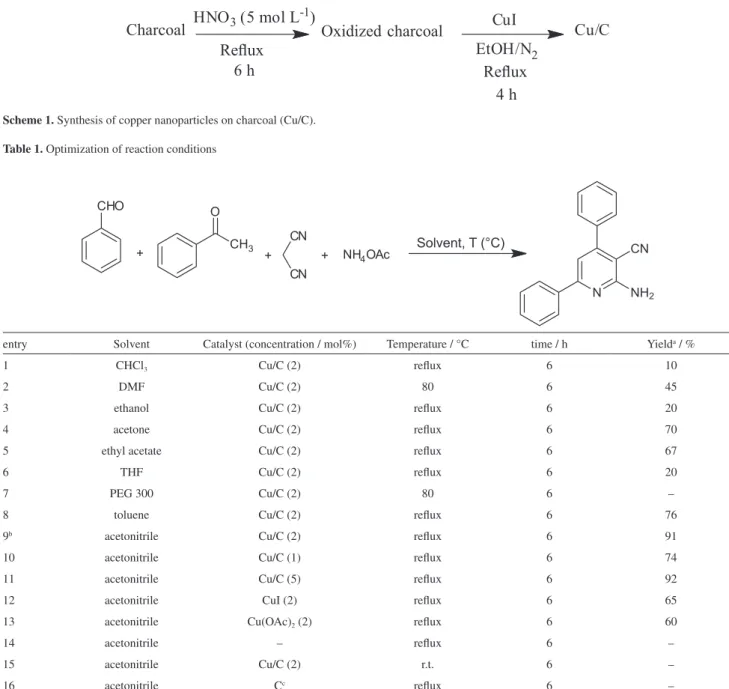
The catalyst was synthesized in two steps. In a general procedure the activated carbon was refluxed with a nitric acid solution for 6 h and washed with deionized water until pH 6-7, and then dried in an oven at 110 °C overnight under vacuum. The oxidized activated carbon was refluxed with a solution of CuI under a N2 atmosphere in absolute ethanol for 4 h, washed with ethanol, and finally dried under vacuum in an oven overnight at 110 °C (Scheme 1).
We commenced our investigation with the reaction of starting materials in chloroform as solvent in the presence of Cu/C as a catalyst. Analysis of the resulting mixture revealed that the desired product 1 was formed after 6 h in only 10% yield (Table 1, entry 1). Yield of the reaction increased upon using N,N-dimethylformamide (DMF) instead of chloroform (entry 2 vs. 1). Replacement of DMF with ethanol (entry 3) did not give an improved outcome, while the formation of product 1 was markedly improved when using the same catalyst in acetone at reflux condition (entry 4). Further condition screening suggested that when the reaction was carried out in the presence of Cu/C, upon switching the solvents from acetone to ethyl
acetate, tetrahydrofuran (THF) or polyethylene glycol 300 g mol-1 (PEG 300), the yield of desired product decreased (entries 5-7). However, when the reaction was carried out in toluene at reflux condition for 6 h, the expected product was achieved in 76% yield (entry 8). Interestingly, when model compounds were treated with 2 mol% of Cu/C in acetonitrile at reflux for 6 h, the expected reaction proceeded successfully to give product in 91% yield (entry 9). A further decrease in the catalyst loading resulted in 74% isolated yield (entry 10), but increase in the catalyst loading did not enhance the reaction yield any further (entry 11). Further optimization of the reaction conditions revealed that other Cu sources regardless of their
Charcoal HNO3(5 mol L
-1)
Reflux 6 h
Oxidized charcoal CuI
EtOH/N2
Reflux 4 h
Cu/C
Scheme 1. Synthesis of copper nanoparticles on charcoal (Cu/C).
Table 1. Optimization of reaction conditions
CHO O
CH3
N NH2
CN
+ + NH4OAc
CN CN
+
Solvent, T (°C)
entry Solvent Catalyst (concentration / mol%) Temperature / °C time / h Yielda / %
1 CHCl3 Cu/C (2) reflux 6 10
2 DMF Cu/C (2) 80 6 45
3 ethanol Cu/C (2) reflux 6 20
4 acetone Cu/C (2) reflux 6 70
5 ethyl acetate Cu/C (2) reflux 6 67
6 THF Cu/C (2) reflux 6 20
7 PEG 300 Cu/C (2) 80 6 –
8 toluene Cu/C (2) reflux 6 76
9b acetonitrile Cu/C (2) reflux 6 91
10 acetonitrile Cu/C (1) reflux 6 74
11 acetonitrile Cu/C (5) reflux 6 92
12 acetonitrile CuI (2) reflux 6 65
13 acetonitrile Cu(OAc)2 (2) reflux 6 60
14 acetonitrile – reflux 6 –
15 acetonitrile Cu/C (2) r.t. 6 –
16 acetonitrile Cc reflux 6 –
aIsolated yield; bbest reaction conditions; coxidized charcoal. DMF: N,N-dimethylformamide; THF: tetrahydrofuran; PEG 300: polyethylene glycol
Table 2. Substrate scope for the synthesis of 2-amino-3-cyanopyridine derivativesa
entry Aldehyde Ketone Product time / h Yieldb / %
1
CHO O
CH3
N NH2
CN
1
6 91
2
CHO
CH3
O
CH3
N NH2
CN CH3
2
6 86
3
CHO
OCH3
O
CH3
N NH2
CN OCH3
3
6 83
4
CHO
Cl
O
CH3
N NH2
CN Cl
4
8 90
oxidation states (either I or II) did not show better catalytic activity (entries 12 and 13). We speculate that the observed higher yields are probably due to the large surface area and more stability of the formed nanoparticles of Cu/C. In addition, CuI showed lower yield in comparison with Cu/C under these reaction conditions. It is possibly due to the disproportionation of this salt under optimization reaction condition.
When this reaction was carried out in acetonitrile at reflux condition for 6 h, without any catalyst, no desired 2-amino-3-cyanopyridine was obtained (Table 1, entry 14). Next, experiment was carried out to distinguish the effect of temperature on the reaction. As depicted in Table 1, the
desired product could not be detected at room temperature (entry 15). In addition, control experiments demonstrated that no reaction occurred in the presence of charcoal as a catalyst (entry 16).
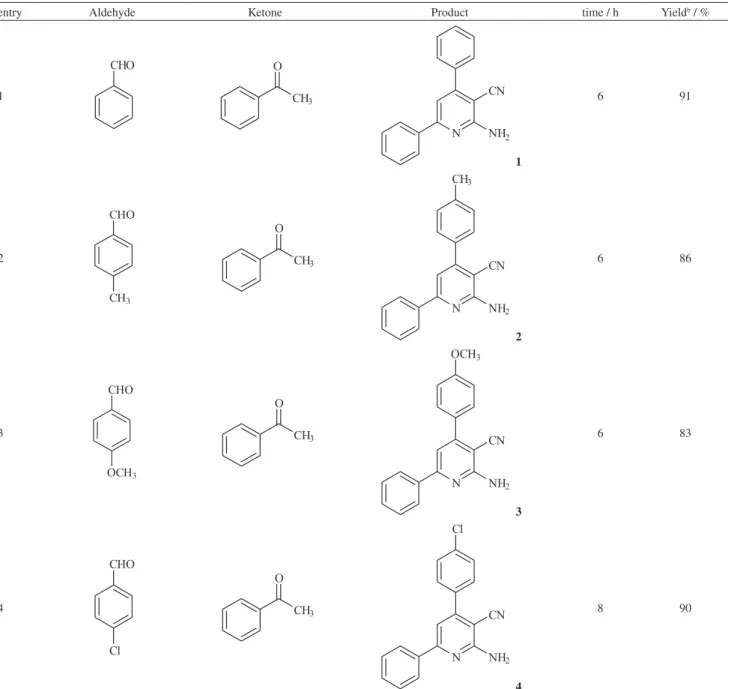
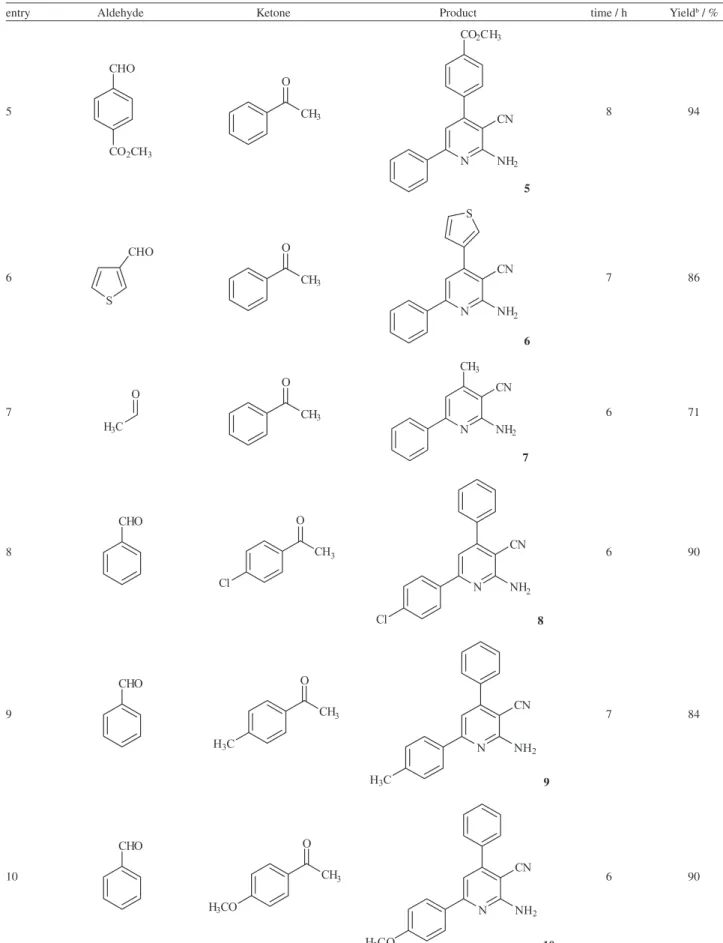
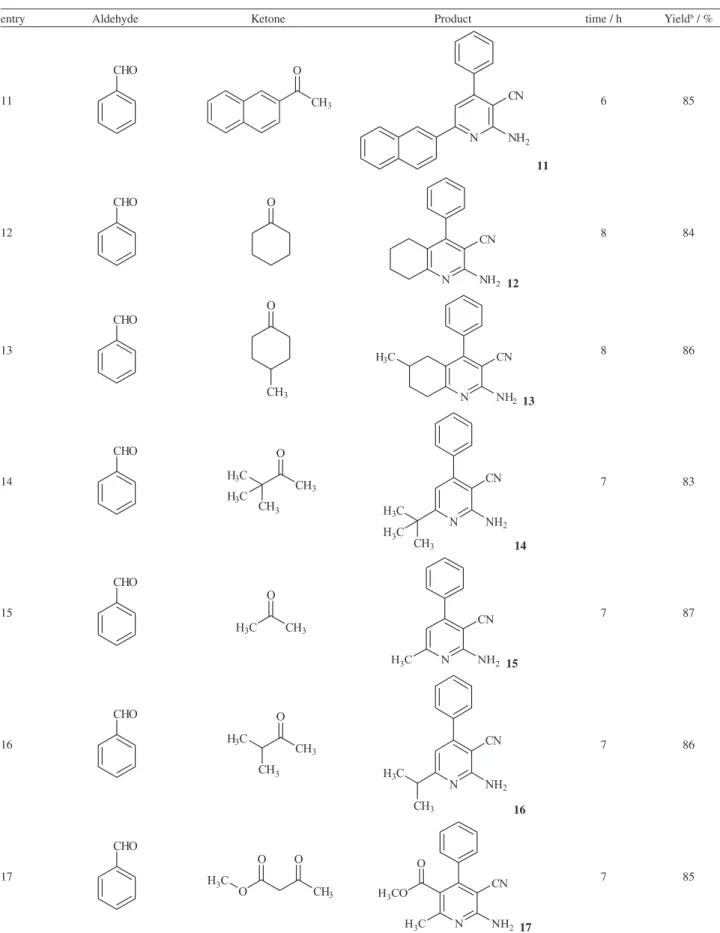
After the optimization reaction conditions, in order to examine the scope of the reaction, we treated various aldehydes and methylketones in the presence of malonitrile and NH4OAc with Cu/C in refluxing acetonitrile, and desired 2-amino-3-cyanopyridine derivatives were obtained in good to high yields (Table 2).
Table 2. Substrate scope for the synthesis of 2-amino-3-cyanopyridine derivativesa (cont.)
entry Aldehyde Ketone Product time / h Yieldb / %
5
CHO
CO2CH3
O
CH3
N NH2
CN CO2CH3
5
8 94
6
S
CHO O
CH3
N NH
2 CN S
6
7 86
7
H3C O
O
CH3
N CH3
CN
NH2
7
6 71
8
CHO O
CH3
Cl N NH
2
CN
Cl 8
6 90
9
CHO O
CH3
H3C N NH2
CN
H3C 9
7 84
10
CHO O
CH3
H3CO N NH
2 CN
H3CO 10
Table 2. Substrate scope for the synthesis of 2-amino-3-cyanopyridine derivativesa (cont.)
entry Aldehyde Ketone Product time / h Yieldb / %
11
CHO
CH3 O
N CN
NH 2
11
6 85
12
CHO O
N CN
NH2 12
8 84
13
CHO
O
CH3 N
CN
NH 2 H3C
13
8 86
14
CHO
H3C CH
3 CH3 O
H3C
N NH2
CN
H3C
CH3
H3C
14
7 83
15
CHO
H3C CH3
O
N NH2
CN
H3C
15
7 87
16
CHO
CH3 O
H3C CH3
N NH2
CN
H3C
CH3 16
7 86
17
CHO
O O
CH3 O
H3C
N NH
2 CN
H 3C H3CO
O
17
7 85
aReaction conditions: aldehyde (1.0 mmol), ketone (1.0 mmol), malononitrile (1.5 mmol), ammonium acetate (2.0 mmol), Cu/C (2 mol%), CH 3CN and
with acetophenone, malononitrile and ammonium acetate and the isolated yields range from 86 to 94% (Table 2, entries 2-5). In an effort to apply the present reaction conditions to the synthesis of heterocycles related to 2-amino-3-cyanopyridines, the feasibility of the reaction with heteroaromatic aldehyde was examined (entry 6). It is noteworthy that the reaction of 3-thiophenecarbaldehyde as a heterocyclic aldehyde proceeded well to give the desired products in 86% yield. To expand the scope of the current method, aliphatic aldehyde was also examined as a substrate. The desired product 7 was obtained with good yields (entry 7). We further explored the potential of the present protocol from the standpoint of variety of ketones. As seen from Table 2, this strategy is effective for a great diversity of ketones such as alkylaryl (entries 8-11), cyclic (entries 12 and 13), and dialkyl ketones (entries 14-17). Acetophenone with both electron-withdrawing and -donating substituting groups fairly tolerate the reaction conditions and also afford the desired products in good yields (entries 8-10), and proves the generality of the strategy elaborated. The highly conjugated ketone derivative was also an excellent substrate for this reaction, and the corresponding compound 11 was produced (entry 11). For cyclic ketones, this transformation proceeded smoothly and afforded the products in good yields. For example, the reaction of cyclohexanone or 4-methyl cyclohexanone led to the corresponding products in 84 and 86% isolated yields, respectively (entries 12 and 13). To our delight, this method could be successfully applied to dialkyl ketones. For example, the product having
t-butyl, isopropyl or methyl groups derived from the corresponding methyl ketone was formed in satisfactory yield (entries 14-16). Meanwhile, methyl acetoacetate also reacted with benzaldehyde and generated the corresponding product 17 in 85% yield (entry 17).
In addition, to evaluate the feasibility of this method on a large scale, the model reaction was performed on the 40 mmol scale and the desired product was obtained in 89% yield.
Next, we studied the reusability of the heterogeneous nano Cu/C catalyst in the model reaction (Table 3). After completion of the reaction, the catalyst was filtered from the reaction mixture, washed with hot ethanol, dried and used directly for the next round of reaction. The ease of recovery, combined with the stability of catalyst, allows the catalyst to be recycled over 8 times in reactions without any significant loss in activity.
Conclusions
In conclusion, we have reported a direct one-pot method for the construction of 2-amino-3-cyanopyridine derivatives starting from aldehydes, ketones, malononitrile, and ammonium acetate in the presence of Cu/C as a heterogeneous catalyst system, in up to 71% isolated yield. Various aldehydes and ketones were readily applied to this synthetic protocol. It is noted that in the present system the catalyst can be recycled and reused at least eight times without significant losses of activity.
Supplementary Information
Supplementary data (1H NMR, 13C NMR, mass spectra of compounds, X-ray diffraction (XRD) pattern and scanning electron microscopy (SEM) image of Cu/C) are available free of charge at http://jbcs.sbq.org.br as PDF file.
Acknowledgements
We gratefully acknowledge the support of this work by the Shiraz University of Technology Research Council.
References
1. Jones, G. In Comprehensive Heterocyclic Chemistry II, vol. 5; Katritzky, A. R.; Rees, C. W.; Scriven, E. F. V.; McKillop, A., eds.; Pergamon: Oxford, 1996.
2. Henry, G. D.; Tetrahedron2004, 60, 6043. 3. Michael, J. P.; Nat. Prod. Rep.2005, 22, 627.
4. Temple, C.; Rener Jr., G. A.; Waud, W. R.; Noker, P. E.; J. Med. Chem.1992, 35, 3686.
5. Wang, H.; Helgeson, R.; Ma, B.; Wudl, F.; J. Org. Chem. 2000,
65, 5862.
6. Kanbara, T.; Kushida, T.; Saito, N.; Kuwajima, I.; Kubota, K.; Yamamoto, T.; Chem. Lett. 1992, 21, 583.
7. Meyer, T. J.; Acc. Chem. Res. 1989, 22, 163.
8. Murata, T.; Shimada, M.; Sakakibara, S.; Yoshino, T.; Kadono, H.; Masuda, T.; Shimazaki, M.; Shintani, T.; Fuchikami, K.; Sakai, K.; Inbe, H.; Takeshita, K.; Niki, T.; Umeda, M.; Bacon, K. B.; Ziegelbauer, K. B.; Lowinger, T. B.;
Bioorg. Med. Chem. Lett. 2003, 13, 913.
9. Mungra, D. C.; Patel, M. P.; Patel, R. G.; ARKIVOC2009, xiv, 64.
10. Hammam, A. G.; EI-Hafez, N. A. A.; Midura, W. H.; Mikolajczyk, M.; Z. Naturforsch., B: J. Chem. Sci.2000, 55, 417.
11. Konda, S. G.; Khedkar, V. T.; Dawane, B. S.; J. Chem. Pharm. Res.2010, 2, 187.
Table 3. Reuse of catalyst
Run 1 2 3 4 5 6 7 8
12. Gholap, A. R.; Toti, K. S.; Shirazi, F.; Kumari, R.; Bhat, M. K.; Deshpande, M. V.; Srinivasan, K. V.; Bioorg. Med. Chem.2007,
15, 6705.
13. Zhang, F.; Zhao, Y.; Sun, L.; Ding, L.; Gu, Y.; Gong, P.; Eur. J. Med. Chem.2011, 46, 3149.
14. Murata, T.; Shimada, M.; Sakakibara, S.; Yoshino, T.; Masuda, T.; Shintani, T.; Sato, H.; Koriyama, Y.; Fukushima, K.; Nunami, N.; Yamauchi, M.; Fuchikami, K.; Komura, H.; Watanabe, A.; Ziegelbauer, K. B.; Bacon, K. B.; Lowinger, T. B.; Bioorg. Med. Chem. Lett. 2004, 14, 4019.
15. Baldwin, J. J.; Engelhardt, E. L.; Hirschmann, R.; Ponticello, G. S.; Atkinson, J. G.; Wasson, B. K.; Sweet, C. S.; Scriabine, A.;
J. Med. Chem. 1980, 23, 65.
16. May, B. C. H.; Zorn, J. A.; Witkop, J.; Sherrill, J.; Wallace, A. C.; Legname, G.; Prusiner, S. B.; Cohen, F. E.; J. Med. Chem. 2007,
50,65.
17. Shah, H. C.; Shah, V. H.; Desai, N. D.; ARKIVOC2009, ii, 76. 18. Sakurai, A.; Midorikawa, H.; Bull. Chem. Soc. Jpn. 1968, 41,
430.
19. Tang, J.; Wang, L.; Yao, Y.; Zhang, L.; Wang, W.; Tetrahedron Lett.2011, 52, 509.
20. Shi, F.; Tu, S.; Fang, F.; Li, T.; ARKIVOC 2005, i, 137. 21. Zhou, W. J.; Ji, S. J.; Shen, Z. L.; J. Organomet. Chem.2006,
691, 1356.
22. Farhanullah, F.; Agarwal, N.; Goel, A.; Ram, V. J.; J. Org. Chem.
2003, 68, 2983.
23. Yin, L.; Liebscher, J.; Chem. Rev.2007, 107, 133.
24. Sharghi, H.; Khalifeh, R.; Doroodmand, M. M.; Adv. Synth. Catal.2009, 351, 207.
25. Sharghi, H.; Khalifeh, R.; Moeini, F.; Beyzavi, M. H.; Salimi Beni, A.; Doroodmand, M. M.; J. Iran. Chem. Soc.2011, 8, S89.
26. Sharghi, H.; Khalifeh, R.; Mansouri, S. G.; Aberi, M.; Eskandari, M. M.; Catal. Lett.2011, 141, 1845.
27. Sharghi, H.; Khalifeh, R.; Heterocycles2007, 71, 1601. 28. Sharghi, H.; Khalifeh, R.; Can. J. Chem.2008, 86, 426. 29. Sharghi, H.; Khalifeh, R.; Salimi Beni, A.; J. Iran. Chem. Soc.
2010, 7, 275.
30. Khalifeh, R.; Sharghi, H.; Rashidi, Z.; Heteroat. Chem.2013,
24, 372.
31. Sharghi, H.; Khalifeh, R.; Rashidi, Z.; Mol. Diversity2013, 17, 721.
Submitted: September 3, 2015

![Poly(4-vinylpyridine) efficiently catalyzed one-pot four-component synthesis of pyrano[2,3-c]pyrazoles](data:image/gif;base64,R0lGODlhAQABAIAAAP///wAAACH5BAEAAAAALAAAAAABAAEAAAICRAEAOw==)