316 QUÍMICA NOVA, 22(3) (1999) ESTIMATING THE VALUE OF THE METAL-LIGAND BOND DISSOCIATION ENTHALPY<D> (M-L)
FOR ADDUCTS USING EMPIRICAL EQUATIONS SUPPORTED BY TG DATA
Robson Fernandes de Farias*
Departamento de Química - Universidade Federal de Roraima - 69310-270 - Boa Vista - Roraima - Brasil
Recebido em 11/12/97; aceito em 10/11/98
In this work is presented and tested (for 106 adducts, mainly of the zinc group halides) two empiri-cal equations supported in TG data to estimate the value of the metal-ligand bond dissociation enthalpy for adducts: <D> (M-O) = ti / γ if ti < 420 K and <D> (M-O) = (ti / γ ) - 7,75 . 10-2 . ti if ti > 420 K. In this empirical equations, ti is the thermodynamic temperature of the beginning of the thermal decomposition of the adduct, as determined by thermogravimetry, and γ is a constant factor that is function of the metal halide considered and of the number of ligands, but is not dependant of the ligand itself. To half of the tested adducts the difference between experimental and calculated values was less than 5%. To about 80% of the tested adducts, the difference between the experimen-tal (calorimetric) and the calculated (using the proposed equations) values are less than 15%. Keywords: metal-ligand bond enthalpy; adducts; empirical equations; thermogravimetry.
ARTIGO
INTRODUCTION
In the thermochemical study of adducts, the value of the metal-ligand bond dissociation enthalpy is estimated using the equation: <D> (M-L) = - ∆gHmo / n , were ∆gHmo is the Lewis acid (metal halide) - Lewis base (ligand) gaseous phase reaction enthalpy, calculated as ∆gHmo = ∆rHmo + ∆subHmo (MX m . nL) - n ∆subHmo (L) - ∆subHmo (M Xm ) were MXm represents a metal halide, L is the ligand and n is the number of ligands. That is, to calculate <D> (M-L) we neeed the value of ∆rHmo wich is determined calorimetricaly as described in detail elsewere1,2 the value of ∆subHmo (M Xm ) (generally found in the literature) and the values of ∆subHmo (L) (the enthalpy of sublimation or vapori-zation of the ligand) and ∆subHmo (MX m . nL). At this point, we have two problems: the value of ∆subHmo (L) generaly is not found in the literature for many ligands and so, must be meas-ured, by using vapor pressure data (for liquids), or by the Knudsen technique (for solid samples). If a measurement is not possible, the ∆subHmo (L) value must be estimated (by DSC data or another technique). The value of ∆subHmo (MX m . nL) could not be determined, since the great part of the adducts, take ther-mal degradation before sublimation3. To overcame this difficulty, the widely used assumption take the value of ∆subHmo (MX m . nL) as been equal ∆subHmo (L)3 , but this assumption could not be so correct to some compounds .
Since thermogravimetry is a very quick and easy technique to use, requering only few mg of material for one analysis, should be really useful some kind of quantitative relation be-tween thermogravimetric data and calorimetric ones.
In previous works4,6, were found some mathematical rela-tions (empirical equarela-tions) between the value of ti , that is, the thermodynamic temperature (SI unit: Kelvin) of the beginning of the thermal decomposition of adducts (as determined by thermogravimetry) and some thermochemical parameters, mak-ing possible estimate the values of ∆fHmo4 (formation enthalpy), ∆MHmo 5 (lattice enthalpy) and ∆
DHmo 6 (decomposition en-thalpy), for adducts, by using thermogravimetric data.
In this work are presented and tested for 106 adducts two empirical equations to estimate the value of <D> (M-L), the mean metal-ligand bond dissociation enthalpy, by using thermogravimetric data.
OBTAINNING THE EQUATIONS
As in previous works4-6, the adducts with dimetylformamide (dmf) and the zinc group halides7,8 were used as models to obtain the empirical equations, but with no special reasons to do this, only by a question of choice.
Searching for the possible mathematical relations between the thermochemical and the thermogravimetric data for that ad-ducts, two empirical equations were obtained, correlating the mean metal-ligand bond dissociation enthalpy <D>(M-L) and ti, the thermodynamic temperature of the beginning of the thermal decomposition of the adduct, as obtained by thermogravimetry :
<D> (M-L) = ti / γ (1)
if ti < 420 K and
<D> (M-L) = (ti / γ) - 7,75 . 10-2 . ti (2) if ti > 420 K
The γ values are function of the metal halide and of the number of ligands. The γ values for adducts with 1 and 2 ligands were obtained using the thermogravimetric and calorimetric data for dmf and zinc group halides adducts7,8. The γ values for ad-ducts with 3 ligands were obtained by extrapolation, assuming that, the increase (in percentage) in the value of γ from 2 to 3 ligands, is the same that is observed from 1 to 2 ligands. The values of γ for adducts with fractionary number of ligands, were obtained assuming that, for this adducts, the values of γ are the average values for adducts with integer number of ligands. For example, the values of γ for adducts with 1.5 ligand is consid-ered as been the average value of γ for adducts with 1 and 2 ligands. The values of γ are presented in table 1.
RESULTS AND DISCUSSION
The proposed equations were tested for a total of 106 adducts: adducts with zinc group halides and ε-caprolactam (cl)1, 2-pyrrolidone (butyrolactam-bul)2, tioacetamide (ta)9, tiobenzamide
QUÍMICA NOVA, 22(3) (1999) 317
(tb)9, methylurea (mu)10, dimethylurea (dmu)10, tetramethylurea (tmu)10, urea (u)11,12, hexamethylfosforamide (hmpa)13, triphe-nylfosfinoxide (tppo)13,14, aniline (an)15, dimethylacetamide (dma)16, and dimethylethyleneurea (dmeu)17; adducts with Sb and Bi triiodides and tetramethyltiourea (tmtu)18, dimethyltioa-cetamide (dmta)19 and dimethyltioformamide (dmtf)19 ; adducts with halides of As and pyridine (py)20, β-pycoline (β-mpy) 20 and γ-pycoline (γ-mpy)20.
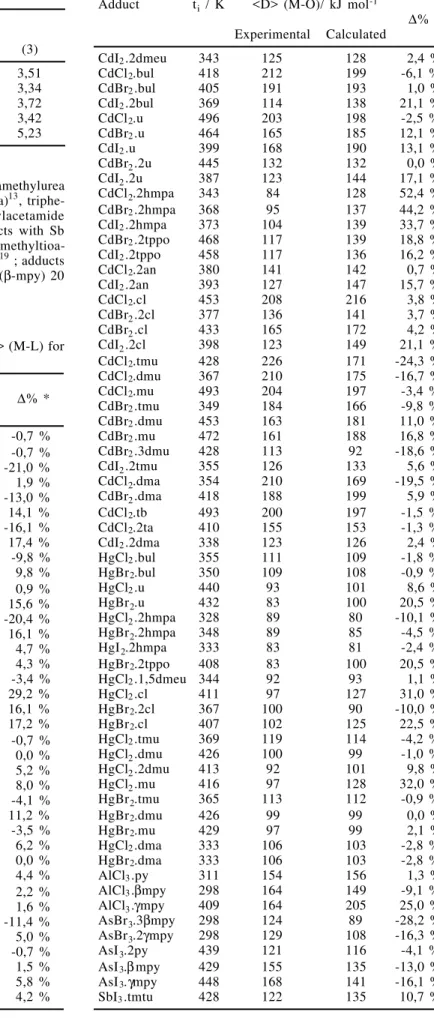
The results obtained are presented in Table 2.
Table 1. γ values for Zn group halides as a function of the number of ligands
Metal halide γ (number of ligands)
(1) (1.5) (2) (2.5) (3)
ZnCl2 2,00 2,33 2,65 3,08 3,51
ZnBr2 2,30 2,54 2,77 3,06 3,34
ZnI2 2,55 2,74 2,92 3,32 3,72
CdX2 2,10 2,40 2,68 3,05 3,42
HgX2 3,25 3,68 4,10 4,67 5,23
X = Cl, Br or I .
Table 2. Experimental and calculated values of <D> (M-L) for some adducts with Zn and As group halides
Adduct ti / K <D> (M-O)/ kJ mol-1
∆% * Experimental Calculated
ZnCl2.2dmeu 366 139 138 -0,7 %
ZnBr2.2dmeu 377 137 136 -0,7 %
ZnCl2.3cl 371 134 106 -21,0 %
ZnCl2.2cl 415 154 157 1,9 %
ZnBr2.3cl 356 123 107 -13,0 %
ZnBr2.2cl 403 128 146 14,1 %
ZnI2.3cl 368 118 99 -16,1 %
ZnI2.2cl 414 121 142 17,4 %
ZnCl2.3bul 353 112 101 -9,8 %
ZnCl2.2bul 384 132 145 9,8 %
ZnBr2.3bul 355 105 106 0,9 %
ZnBr2.2bul 391 122 141 15,6 %
ZnI2.3bul 304 103 82 -20,4 %
ZnI2.2bul 400 118 137 16,1 %
ZnCl2.2u 412 148 155 4,7 %
ZnBr2.2u 402 139 145 4,3 %
ZnI2.2u 409 145 140 -3,4 %
ZnCl2.2hmpa 388 113 146 29,2 %
ZnBr2.2hmpa 398 124 144 16,1 %
ZnI2.2hmpa 418 122 143 17,2 %
ZnCl2.2an 380 144 143 -0,7 %
ZnBr2.1,5an 393 157 157 0,0 %
ZnBr2.2tppo 498 134 141 5,2 %
ZnI2.2tppo 508 125 135 8,0 %
ZnCl2.2ta 468 147 141 -4,1 %
ZnCl22.tb 450 152 135 11,2 %
ZnCl2.2tmu 364 142 137 -3,5 %
ZnCl2.2dmu 454 145 136 6,2 %
ZnCl2.2mu 441 132 132 0,0 %
ZnBr2.2tmu 390 135 141 4,4 %
ZnBr2.2dmu 467 136 133 2,2 %
ZnBr2.2mu 441 123 125 1,6 %
ZnI2.2tmu 386 149 132 -11,4 %
ZnCl2.2dma 386 139 146 5,0 %
ZnBr2.2dma 374 136 135 -0,7 %
ZnI2.2dma 388 131 133 1,5 %
CdCl2.1,5dmeu 393 155 164 5,8 %
CdBr2.1,5dmeu 360 144 150 4,2 %
Table 2 continued
Adduct ti / K <D> (M-O)/ kJ mol-1
∆% * Experimental Calculated
CdI2.2dmeu 343 125 128 2,4 %
CdCl2.bul 418 212 199 -6,1 %
CdBr2.bul 405 191 193 1,0 %
CdI2.2bul 369 114 138 21,1 %
CdCl2.u 496 203 198 -2,5 %
CdBr2.u 464 165 185 12,1 %
CdI2.u 399 168 190 13,1 %
CdBr2.2u 445 132 132 0,0 %
CdI2.2u 387 123 144 17,1 %
CdCl2.2hmpa 343 84 128 52,4 %
CdBr2.2hmpa 368 95 137 44,2 %
CdI2.2hmpa 373 104 139 33,7 %
CdBr2.2tppo 468 117 139 18,8 %
CdI2.2tppo 458 117 136 16,2 %
CdCl2.2an 380 141 142 0,7 %
CdI2.2an 393 127 147 15,7 %
CdCl2.cl 453 208 216 3,8 %
CdBr2.2cl 377 136 141 3,7 %
CdBr2.cl 433 165 172 4,2 %
CdI2.2cl 398 123 149 21,1 %
CdCl2.tmu 428 226 171 -24,3 %
CdCl2.dmu 367 210 175 -16,7 %
CdCl2.mu 493 204 197 -3,4 %
CdBr2.tmu 349 184 166 -9,8 %
CdBr2.dmu 453 163 181 11,0 %
CdBr2.mu 472 161 188 16,8 %
CdBr2.3dmu 428 113 92 -18,6 %
CdI2.2tmu 355 126 133 5,6 %
CdCl2.dma 354 210 169 -19,5 %
CdBr2.dma 418 188 199 5,9 %
CdCl2.tb 493 200 197 -1,5 %
CdCl2.2ta 410 155 153 -1,3 %
CdI2.2dma 338 123 126 2,4 %
HgCl2.bul 355 111 109 -1,8 %
HgBr2.bul 350 109 108 -0,9 %
HgCl2.u 440 93 101 8,6 %
HgBr2.u 432 83 100 20,5 %
HgCl2.2hmpa 328 89 80 -10,1 %
HgBr2.2hmpa 348 89 85 -4,5 %
HgI2.2hmpa 333 83 81 -2,4 %
HgBr2.2tppo 408 83 100 20,5 %
HgCl2.1,5dmeu 344 92 93 1,1 %
HgCl2.cl 411 97 127 31,0 %
HgBr2.2cl 367 100 90 -10,0 %
HgBr2.cl 407 102 125 22,5 %
HgCl2.tmu 369 119 114 -4,2 %
HgCl2.dmu 426 100 99 -1,0 %
HgCl2.2dmu 413 92 101 9,8 %
HgCl2.mu 416 97 128 32,0 %
HgBr2.tmu 365 113 112 -0,9 %
HgBr2.dmu 426 99 99 0,0 %
HgBr2.mu 429 97 99 2,1 %
HgCl2.dma 333 106 103 -2,8 %
HgBr2.dma 333 106 103 -2,8 %
AlCl3.py 311 154 156 1,3 %
AlCl3.βmpy 298 164 149 -9,1 %
AlCl3.γmpy 409 164 205 25,0 %
AsBr3.3βmpy 298 124 89 -28,2 %
AsBr3.2γmpy 298 129 108 -16,3 %
AsI3.2py 439 121 116 -4,1 %
AsI3.βmpy 429 155 135 -13,0 %
AsI3.γmpy 448 168 141 -16,1 %
318 QUÍMICA NOVA, 22(3) (1999) Table 2 continued
Adduct ti / K <D> (M-O)/ kJ mol-1
∆% * Experimental Calculated
SbI3.dmta 373 112 146 30,4 %
SbI3.dmtf 373 117 146 24,8 %
BiI3.tmtu 476 147 150 2,0 %
BiI3.dmta 373 144 146 1,4 %
BiI3.dmtf 373 150 146 -2,7 %
* ∆ = [(calculated-experimental) / experimental] x 100
To calculate the values of <D> (M-L) for As group halide adducts, the values of γ used were that for zinc group halides. The fact that there are different values of γ to the different zinc halides whereas the same value of γ is valid for all the halides of cadmium and mercury, suggests that the metal-lig-and bond enthalpy in zinc halides adducts are much more sen-sitive to structural variations (because of variations in the halide radius) than in Cd and Hg adducts. Furthermore, the halide hardness presents the order Cl> Br>I, and, as reported elsewere17, the metal cation Zn2+ is more sensitive than Cd2+ and Hg2+ to variations in the hardness of the donor atom in the ligand molecule, wich is an example, in adduct chemistry, of the general thermochemical feature observed for hard and soft acid-bases interactions21.
Certainly, in the proposed equations, the correct value of ti is very important. The values of ti presented in table 2, are that provided by the respective authors1,2, 9-20.
Is necessary pay attention in two important facts : all the ligands presented are monodentate and although the equations were obtained using a ligand that coordinate through oxygen (dmf), its were used too for adducts that coordinate through sulfur and nitrogen.
The results could be summarized as follows : for half of the tested adducts, the difference between the experimental (ca-lorimetric) and the calculated values (using the proposed equa-tions) are less than 5%, which is a very good result. For about 80 % of the tested adducts the difference between experimen-tal and calculated values was less than 15% which could be considered as a good agreement for this kind of procedure.
The generally bad results obtained for adducts with hmpa and tppo (for many adducts the calculated values are greater than the experimental ones) could be, at first , understood as consequence of the esterical hyndrance, since that ligands are the bigger ones among the adducts studied,that is, the metal-ligand bond lenghts used (implicit) in the calculated values are shorter than the real bond lenghts.
The term (-7,75.10-2).t
i in equation (2), could be understood
as a correction factor to take in account the contribution of the vibrational heat capacity of the metal-ligand bond.
Since the experimental values of <D> (M-L) are estimations with an error of ± 10 or 15 kJ mol-1, and the t i values presents an error of ± 5 or 10 K depending on the experimental apparatus used and the calibration procedures, the fact that, to about 40 compounds, the difference between calculated and experimental (calorimetric) values exceeds 10% is not a bad result.
REFERENCES
1. Silva, Z. R. da, Queiroz, J. C. de, Vieira, E. F. S.; Dias, F. S.; Thermochim. Acta 1996, 285, 289.
2. Vieira, E. F. S.; Queiroz, J. C. de, Dias, F. S.;
Thermochim. Acta 1995, 256, 249.
3. Airoldi, C.; Chagas, A. P.; Coord. Chem. Rev. 1992, 119, 29.
4. Farias, R. F. de; An. Assoc. Bras. Quím. 1997, 46, 172. 5. Farias, R. F. de; Quím. Nova 1997, 20, 478.
6. Farias, R. F. de; Quím. Nova 1998, 21, 437. 7.
7. Oliveira, O. A. de, Doctor's Thesis, Universidade Estadual de Campinas, UNICAMP, Campinas, SP, 1981.
8. Oliveira, O. A. de, Airoldi, C.; Chagas, A. P.; Inorg.
Chem. 1983, 22,136.
9. Airoldi, C.; Digiampietri, E. A.; J. Chem. Thermodyn.
1992, 24, 33.
10. Assunção, F. P.; Doctor's Thesis, Universidade Estadual de Campinas, UNICAMP, Campinas, SP, 1980.
11. Santos, M. R. M. C.; Master's Thesis, Universidade Estadual de Campinas, UNICAMP, Campinas, SP, 1985. 12. Santos, M. R. M. C.; Airoldi, C.; Thermochim. Acta 1988,
125, 295.
13. Queiroz, J. C. de, Doctor's Thesis, Universidade Estadual de Campinas, UNICAMP, Campinas, SP, 1983.
14. Queiroz, J. C. de, Airoldi, C.; Chagas, A. P.; J. Chem.
Thermodyn. 1986, 18, 709.
15. Silva, U. G. da Jr.; Master's Thesis, Universidade Federal do Rio Grande do Norte, UFRN, Natal, RN, 1996. 16. Simoni, J. de A.; Doctor's Thesis, Universidade Estadual
de Campinas, UNICAMP, Campinas, SP, 1978.
17. Farias, R. F. de, Oliveira, O. A. de, Quím. Nova 1996, 19, 100.
18. Santos, L. C. R. dos, Oliveira, S. F. de, Espínola, J. G. P.; Airoldi, C.; Thermochim.; Acta 1992, 206, 13.
19. Santos, L. C. R. dos, Oliveira, S. F. de, Espínola, J. G. P.;
J. Chem. Thermodyn. 1993, 25, 1319.
20. Dustan, P. O.; Airoldi, C.; J. Chem. Eng. Data 1988, 33, 93.