
Brazilian Journal of Physics, vol. 37, no. 1, March, 2007 9
On the Franc¸a and Hama Analysis of Elastic Hadron Scattering
M. J. Menon
Instituto de F´ısica Gleb Wataghin Universidade Estadual de Campinas, UNICAMP
13083-970 Campinas, SP, Brazil Received on 29 September, 2006
After reviewing the main aspects of the model-independent analysis on elastic proton-proton scattering, devel-oped by Franc¸a and Hama in the seventies, we argue that the work can be considered a paradigm for empirical analysis on elastic hadron interactions (the inverse problem). We discuss some further developments, conse-quences and results that have been recently obtained on the subject and which have been based on the original strategy by Franc¸a and Hama.
Keywords: Elastic scattering; Hadron-induced high-energy interactions
I. INTRODUCTION
Elastic hadron-hadron scattering has always been a topical problem in Particle Physics. As a soft scattering state it can not be treated by standard QCD methodology in both pertur-bative and non-perturpertur-bative contexts. In the former case the increase of the coupling at large distances (small momentum transfer) forbids perturbative techniques and in the latter case, lattice QCD or other non-perturbative approaches, are still not able to treat soft scattering without local model inputs, that is on a pure QCD formalism. In the phenomenological context, particular data sets can be described by a large variety of mod-els, but we do not have a widely accepted global approach able to describe all the available data, with truthful connections or basis on microscopic concepts: the underlying field theory of hadronic interactions.
In this context, model independent analysis play a crucial role in the investigation of connections between experimental data and first principles and theorems in Field Theory, pro-viding useful information for the development of adequate calculational schemes. Lorentz invariance, unitarity, analyt-icity and crossing constitute the pillars of a field theory for scattering states and in this context the impact parameter and eikonal pictures, directly connected with unitarity, are a nat-ural arena for unitarized phenomenology. Therefore, the in-verse approach, aimed to extract model-independent informa-tion on the eikonal and profile funcinforma-tions certainly play a fun-damental role in hadron interactions.
In this workshop, celebrating the 70th anniversary of Pro-fessor Yogiro Hama, we think it is important to recall, mainly for the “new generation”, some fundamental results he ob-tained, together with Professor Humberto Franc¸a, in the area of elastic hadron scattering, more than 30 years ago [1]. Also important is to recall some consequences of this work and some recent developments, which were based on their results and strategies.
To this end, in Sec. II we first contextualize the paper [1] in the late seventies and then review some topical aspects and re-sults present there. In Sec. III we discuss some consequences of that publication and further developments that have been obtained by our group. The conclusions and some final re-marks are the contents of Sec. IV.
II. THE FRANC¸ A AND HAMA ANALYSIS
A. Impact parameter and eikonal pictures
The most important physical quantity that characterizes the elastic scattering is the differential cross section:
dσ
dq2 =π|ReF(s,q 2) +i
ImF(s,q2)|2, (1)
whereF is the scattering amplitude,sandq2=−tthe Man-delstam variables. In the impact parameter picture this ampli-tude is expressed as the Fourier transform of the Profile func-tionΓ(Fraunhofer diffraction) [2]
F(s,q) =i
∞
0
bdbJ0(qb)Γ(s,b), (2)
wherebis the impact parameter andJ0is the zero order Bessel
function (azimuthal symmetry assumed). In the eikonal repre-sentation the profile is given in terms of the the eikonal func-tionχby
Γ(s,b) =1−eiχ(s,b) (3) and unitarity allows to connect the profile and inelastic overlap function,Ginel[2]:
2ReΓ(s,b) =|Γ(s,b)|2+G
in(s,b). (4)
10 M. J. Menon
B. Historical context
In the seventies the eikonal models where characterized by two competing ideas, which can be pedagogically discussed from the following suitble expression for the eikonal [3]:
Imχ(s,b) =f(s)g(b
R), (5)
whereRhas dimensions of lenght. On the one hand, Factoriz-ing Eikonal models [4] assumedR= constant, so that
Imχ(s,b) = f(s)g(b). (6) On the other hand, Geometrical Scaling models [5] assumed f(s)= constant andRrelated to the total cross section byR=
R(s)∝σtot(s); in this case,
Imχ(s,b) =g( b
σtot(s)) (7)
which implies in an uniform expansion ofχ(s,b). It should be stressed that both competing approaches were able to describe satisfactorily the experimental data available at that time.
In November 1978, Franc¸a and Hama submitted a novel model-independent analysis on elastic pp interaction [1], which, for the first time, indicated the breakdown of the fac-torizing hypothesis, suggesting also the violation of the geo-metrical scaling [1].
C. Fitting and data
In their work, the imaginary part of the scattering amplitude where parametrized as a sum of exponentials inq2:
ImF(s,q) =ImF(s,0)
n
∑
i=1
αie−βiq2. (8)
The omission of the real part contribution could be explained by dispersion relations and the small value of the ratio be-tween real and imaginary parts in the forward direction.
As commented before, in the inverse approach, the point is to fit the experimental data by means of parametrization (8) and Eq. (1), and then to extract the profile and eikonal function. With assumption of purelly imaginary amplitude, it is the imaginary part of the eikonal that can be extracted. In what follows, we shall use the same symbolχin both cases.
A first important aspect of the analysis is the carefull com-pilation of the experimental data then available on proton-proton differential cross sections. That was a difficult task mainly due to normalized and unnormalized data, as discussed in detail in Sect. II of [1]. The selection and compilation pro-vided 6 sets of data at the energies√s=19.5, 23, 30.7, 44.9, 53 and 62 GeV. A second aspect concerns the fit procedure, which, at that time, were performed without any computer
code, like MINUIT or other code, but by direct determination of exponential contributions in the plot and in different inter-vals of momentum transfer [6]. With this procedure a good description of all data was obtained with 6 exponential factors in parametrization (8) and therefore 13 free parameters at each energy (see Table I in [1]).
D. Results and “advices”
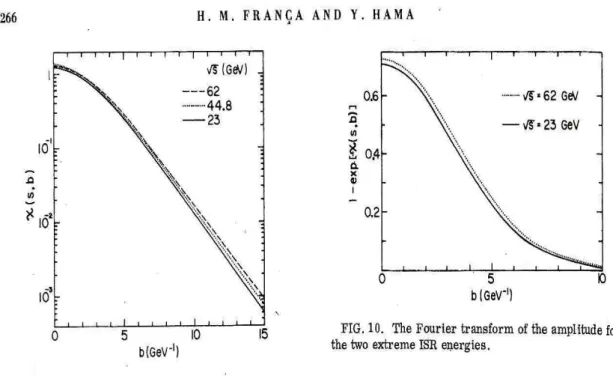
By inverting Eqs. (2) and (3) the profile and eikonal were then extracted in a model-independent way. A plot of the eikonal as a function of the energy at 6 different values of the impact parameter, provided the followingfundamental empir-ical result:
χ(s,b) =χf(b) +ln(s/s0)χ0(b). (9)
Therefore, the immediate conclusion is the breakdown of the factorization hypothesis. Moreover, as shown in Fig, 1 (ex-tracted from [1]) the obtained eikonal and profile, as function of the impact parameter at different energies, indicated a non-uniform expansion, suggesting the violation of the geometri-cal sgeometri-caling.
This focus on the eikonal, instead of the overlap function is a fundamental aspect of the approach, as clearly explained by the authors (our emphasis in what follows): “In some earlier works18,23a peripheral increase of the total cross section has
been pointed out. In all of them, however, the discussion goes around the overlap function and does not refer to the eikonal. It is clear that even when the energy variation of the eikonal is central, the one corresponding to the overlap function may appear peripheral. Thus,the ambiguity should be removed by discussing directly the opacity, if one intends to consider the internal structure of the interacting hadrons.”
In the conclusions of the paper, the authors explicitly stress the violation of factorization and call the attention to the nonuniform increase of the eikonal (our emphasis): “In short, whilethe factorization hypothesis for the eikonal is definitely discarded, provided the assumptions introduced in Sec. III are valid, the soundness of thegeometrical scaling hypothe-sisremains inconclusive, althoughthere are indications of its breakdown”.
III. FURTHER RESULTS AND CONSEQUENCES
Certainly the conclusions quoted above, based on a precise model-independent analysis, represented a fruitful and impor-tant advance in the phenomenological context. However, as exemplified in what follows, the paper did not receive the due attention for a long time.
A. Some further results
Brazilian Journal of Physics, vol. 37, no. 1, March, 2007 11
FIG. 1: Results for the eikonal (left) and the profile function from the model-independent analysis by Franc¸a and Hama. Figures extracted from [1].
on the importance of the eikonal information, one year lat-ter, Amaldi and Schubert put efforts on the extraction of the overlap function, concluding that the geometrical scaling hy-pothesis was valid at the ISR energy region (23 - 62 GeV): “This impact parameter analysis has smaller errors than any other previously made, and confirms the good agreement with the geometrical scaling model...” [3]. The analysis by Amaldi and Schubert also treated the factorizing hypothesis and led to the same conclusion previously reached by Franc¸a and Hama, but without reference to their publication. As it is well known, the scaling hypothesis was definitely discarded in 1984 when it was discovered the increase in the ratio between elastic and total cross section from≈0.17 at the ISR to ≈0.22 at the SppS¯ [7] and that was the end of the geometrical scaling in the elastic sector.
It may also be interesting to note that 15 years after [1] it was “introduced” by H¨ufner, Povh and W¨alde a phenomeno-logical parametrization for the eikonal in the form [8]
χ(s,b) =χ0(b) +ηln(s/s0)χ1(b), (10)
which is the same model-independent result by Franc¸a-Hama. Once more, unfortunately there was no reference to their pre-vious result.
B. Some consequences
During the eighties and also nineties new experimental data provided useful information on several aspects of the elastic hadronic interactions. Among these, data taken frompp scat-tering at√s= 27.5 GeV in the region 3.5≤q2≤14 GeV2[9]
indicated the constance of the slope of the differential cross section in the region of large momentum transfer (above≈4 GeV), as illustrated in Fig. 2. Moreover, data from theSppS¯ allowed the investigation of ¯ppscattering up to 1.8 TeV and have shown that the contribution of the forward real part could reach≈13 %.
In the late nineties, based on these novel information and in-spired by the empirical approach developed by Franc¸a-Hama, we started the investigation of the inverse problem in elastic scattering. In a first step we treated only pp scattering for which we introduced the following complex parametrization [10]
F(s,q2) = ρ(s)
α1+α2
n
∑
j=1
αj
2
∑
j=1
αje−βjq
2
+i n
∑
j=1
αje−βjq
2
,(11)
12 M. J. Menon
4 5 6 7 8 9 10
q2 (GeV)2
10−11
10−9
10−7 10−5
d
σ
/dq
2 (mb/GeV
2 )
23.5 27.5 30.7 44.7 52.8 62.5
FIG. 2: Differential cross section data onppscattering in the region of large momentum transfer. The curve represents a fit with one ex-ponential term.
CERN-MINUIT code. A typical fitting is illustrated in Fig. 3. By means of a semi-analytical method [10] we were able to extract information on the eikonal in the momentum transfer space showing the existence of a zero (change of signal) at q2=7±2 Gev2[10].
0.0 2.0 4.0 6.0 8.0 10.0 12.0 14.0 q2
(GeV 2
) 10−20
10−16 10−12
10−8 10−4 100 104
108 1012 1016
d
σ
/dq
2 (mb/GeV 2 )
19.5 GeV
23.5 GeV
30.7 GeV
44.7 GeV
52.8 GeV
62.5 GeV
FIG. 3: Description of theppelastic scattering by means of parame-trization (11) [10].
After that, we extended the analysis to ¯ppscattering [11] and in all these results the uncertainties from the fit parameters have been propagated to the impact parameter and momentum transfer spaces. In [11] we also present a critical review, with detailed discussions, on model-independent analysis of elastic hadron scattering.
These analysis have been constantly improved and led, re-cently, to an almost model-independent approach, where the dependence of each free fit parameter with the energy is in-ferred on empirical basis [12].
IV. CONCLUSIONS AND FINAL REMARKS
We have presented a short review on the seminal paper by Franc¸a-Hama on elastic scattering. We discussed the impor-tance and implication of the results not only in the context of the seventies but also recently.
I would like to invite the reader, in special the “new gener-ation”, to consult the original manuscript, paying attention on some particular aspects such as the careful compilation and discussion on the experimental data then available, the accu-rate analysis, the precision of the information extracted, the conditions then available and in the exact solution and phys-ical interpretation given by the authors. In this sense I think this paper is a paradigm for the inverse problem in elastic scat-tering.
But that is not all. There are lots of things to learn from this special paper and I refer not only to the physics quoted above. It also shows that not even the community is prepared or interested to understand and/or give the adequate respect to a novel result.
Acknowledgments. It is a pleasure to congratulate Pro-fessor Yogiro Hama for his 70th anniversary and to express my deeply thankfull for the seeds launched and also for all the support to our group at Unicamp. Financial support by FAPESP (Contract No.04/10619-9).
[1] H. M. Franc¸a and Y. Hama, Phys. Rev. D19, 3261 (1979). [2] V. Barone, E, Predazzi, High-Energy Particle Diffraction
(Spring-Verlag, Berlin, 2002).
[3] U. Amaldi, K. R. Schubert, Nucl. Phys. B166, 301 (1980). [4] H. Cheng, J. K. Walker, and T. T. Wu, Phys. Lett. B44, 97
(1973); F. Hayot and U. P. Sukhatme, Phys. Rev. D10, 2183 (1974).
[5] J. Dias de Deus, Nucl. Phys. B59, 231 (1973); A. J. Buras and J. Dias de Deus, Nucl. Phys. B71, 481 (1974).
[6] Y. Hama, private communication.
[7] M. Bozzo et al. Phys. Lett. B147, 392 (1984).
[8] J. H¨ufner, B. Povh, and E. W¨alde, Z. Phys. C63, 631 (1994). [9] W. Faissler et al, Phys. Rev. D23, 33 (1981).
[10] P. A. S. Carvalho, M. J. Menon, Phys. Rev. D56, 7321 (1997). [11] P. A. S. Carvalho, A. F. Martini, and M. J. Menon, Eur. Phys. J.
C39, 359 (2005).
![FIG. 3: Description of the pp elastic scattering by means of parame- parame-trization (11) [10].](https://thumb-eu.123doks.com/thumbv2/123dok_br/18982729.457646/4.892.84.444.545.798/fig-description-elastic-scattering-means-parame-parame-trization.webp)
