Quim. Nova, Vol. 39, No. 1, 19-25, 2016
Artigo
http://dx.doi.org/10.5935/0100-4042.20150171
*e-mail: [email protected]
#alternative e-mail: [email protected]
SYNTHESIS AND BIOLOGICAL ACTIVITY OF NEW SERIES OF ORGANOTIN(IV) ESTERS WITH N,N-DIACETYLGLYCINE
Muhammad Ashfaqa,#, Muhammad Mahboob Ahmedb, Salama Shaheena, Rukhsana Tabussama and Gildardo Riverac,*
aDepartment of Chemistry, The Islamia University of Bahawalpur, Bahawalpur, Pakistan bInstitute of Chemical Sciences, Bahauddin Zakariya University, Multan, Pakistan
cCentro de Biotecnología Genómica, Instituto Politécnico Nacional, Reynosa, 88710, México
Recebido em 27/05/2015; aceito em 14/09/2015; publicado na web em 11/11/2015
A bioactive N,N-diacetylglycine (NNDAG) and new organotin(IV) complexes (OTCs) (1-7) were synthesized. Spectroscopic techniques were employed to characterize NNDAG and OTCs. FTIR was employed to verify N,N protection of glycine by acetyl groups. The disappearance of υ(OH) at 3000-2600 cm-1 showed de-protonation of free ligand. The ∆υ 150<200 cm-1 of OTCs 4-7
veriied bidentate coordination with tetrahedral geometry. The ∆υ of OTCs 1 and 3 was <200 cm-1 exhibiting trans-octahedral
geometry while OTC 2 dimer was assigned a unique sinusoidal view. The 1H NMR spectra of OTCs veriiedtheir synthesis by
de-protonation of NNDAG and no chemical shift was found downield for carboxylic acid proton. The 13C, 119Sn NMR and Mass
spectrometric data also supported FTIR and 1H NMR descriptions. The OTCs 4, 5, 6 and 7 (500 ppm) proved twice as active against Escherichia coli as the standard antibiotic enoxacin (1000 ppm). The promising property of the OTCs (4, 5, 6 and 7) is clearly due to their tetrahedral. The OTCs 4 and 5 exhibited excellent activity against M. minimum and good activity against T. castaneum. LD50
of all the compounds were determined and OTCs 4, 5 and 7 were found to be active.
Keywords: N,N-diethylglycine; organotin(IV); complexes; antibacterial; insecticide.
INTRODUCTION
Organotin(IV) complexes (OTCs) have been investigated on ac-count of broad spectrum of their uses in daily ield of life. Particularly, organotin(IV) esters have been given importance on account of their applications in the ields of pesticide, antibacterial, and antitumor agents, wood preservatives, among others.1-4
On the other hand, amino acids and their derivatives show antio-xidant activity and enhanced hormonal immunity which inhibits lactic acid level. Interestingly, glycine acts as antioxidant as well as impro-ves hormonal immune system. Therefore, ligand N,N-diacetylglycine has been synthesized on the basis of potential of glycine described in the literature.3-5
The organotin(IV) esters have been given special attention in the recent years due to their excellent pharmacological importance.5,6 Moreover, organotin esters of amino acids and N-protected amino acids have been reported as biocides for example, tricyclohexyltin(IV) alaninate is used as fungicide and bactericide and trialkyltin(IV) derivatives of both amino acids and N-acetylamino acids play as intermediate role for the synthesis of peptides.7-9 In the last two decades very little literature is found on the organotin(IV) esters of N-protected amino acids.10-14 On account of broad spectrum of ap-plications of organotin(IV) carboxylates as well N-protected amino acids and interesting inding of our earlier research work here we report the spectroscopic characterization, and preliminary biological investigation of OTCs of N,N-diacetylglycine.15-17 The toxicity bio-assays were also studied in addition to antibacterial and insecticidal bioassays of all 1-7 OTCs against Escherichia coli, Pseudomonas aeruginosa, Klebsiella pneumonia and Salmonella typhi strains with clinical interest and Monomorium minimum, mealybug and tribolium castaneum pests insects, respectively.18
EXPERIMENTAL
Materials and instruments
Glycine, di-n-butyltin(IV) oxide, triphenyltin(IV) chloride, tricyclohexyltin(IV) chloride and triethylamine of Merck Chemicals were used as such. The di- and tri-benzyltin(IV) chloride were prepared according to reported procedure.19 All organic solvents were dried as per reported procedures.20 The FTIR spectra were carried out on a JASCO 302-ghgA spectrometer by KBr sampling technique from 4000-400 cm-1. Finnigan MAT 12 spectrometer was used to record EI-MS spectra for the determination of % m/z. Bruker AM 400 NMR was used to record 1H, 13C and 119Sn spectra at HEJ Institute of Chemical Sciences, University of Karachi. The chemical shifts were reported relative to (CH3)4Si and (CH3)4Sn signal used as internal standards. Enoxacin as reference drug was used to determine antibacterial activity using disc diffusion method. Half maximal lethal dose (LD50) of compounds was determined by Brine Shrimp hatching method as reported.21
Synthesis of N,N-diacetylglycine (NNDAG)
Glycine 5 g (66.7 mmol) and acetyl chloride 10.0 mL (133.4 mmol) were added in 100.0 mL dioxane and reluxed for 6 hours of reaction time. The solvent was removed under vacuum and the product was obtained in n-hexane (Scheme 1).22
N
3
O
4
2 1
O
OH
Yield: 60%, m.p.: 220 oC, Solubility: H2O, CH3OH, CH3CH2OH, and CHCl3. CHN analysis (%) antipyrene: C, 45.2 (45.2); H, 5.7 (5.7) and N, 8.7 (8.8), theoretical values are given in the parenthesis. FTIR (KBr) cm-1: OH: 3000-2600 b; CO (acetyl): 1770 mw; CO (carbonyl): 1730asym,sp, 1610sym msp; C_O (ether linkage): 1080 sp. 1H NMR (CDCl
3) δ: OH: 9.7 s; H-2: 3.90 s; H-3: 2.35 s.
13C NMR (CDCl3) δ: C-1: 169.22; C-2: 42.45; C-3: 171.90; C-4: 21.68. MS m/z: [HO2CCH2N(COCH3)2]
+ M+ 159 (10%); [OCCH
2N(COCH3)2] +
142 (15%); [CH2N(COCH3)2].+ 114 (100%); [CH2N- (COCH3)]+ 71 (27%); [CH2NCH3)]
+ 56 (38%); [CH 2N]
+28 (45%).
Synthesis of organotin(IV) complexes
Diorganotin(IV) complexes (1 and 2) have been synthesized by taking dibutyltin(1V) oxide and N,N-diacetylglycine in 2:1 (monomer) and 1:l (dimer) molar ratios in ethanol and toluene (3:1, v/v) with the azeotropical removal of water. The appropriate mo-lar ratio (2:1/1:1) of silver salt of NNDAG and the corresponding organotin(IV) chloride were reluxed for 6 h in chloroform to syn-thesized compounds 3-7. The solvent were removed under vacuum. The synthesized compounds were recrystallized in different solvents. OTCs have been synthesized by adopting the procedures as cited in literature and given in Scheme 2.2,15-17,23
The compounds are soluble in organic solvents and stable on room temperature. The analytical data is accordance to the proposed stoichiometric ratio of complexes.
Dibutyltin(IV)-di-N,N-diacetylglycine(monomer) (1): [(C4H9)2Sn{O2CCH2N(COCH3)2}: N,N-diacetylglycine 1 g (6.29 mmol) was reacted with dibutyltin(IV) oxide 0.47 g (3.14 mmol) in 2:1 ratio in 66.0 mL ethanol and 33.0 mL toluene. Recrystallized in chloroform and ethanol in 1:2 ratio. Yield: 78%. m.p.: 202-204 oC. Solubility: CH3OH, CH3CH2OH, CHCl3 and CCl4. CHN analysis (%) antipyrene: C, 43.7 (43.7); H, 6.2 (6.2) and N, 5.8 (5.10), theoretical values are given in the parenthesis. FTIR (KBr) υ(cm-1): CO(acetyl): 1765 mw; CO (carbonyl): 1620asym,sp, 1470sym msp; ∆υ:150; C
_O(ether linkage): 1025 sp; Sn–C: 517 w; Sn–O: 498 sp. 1H NMR (CDCl3) δ: H-2: 3.82 s; H-4: 2.35 s; H-a: 1.04 t (7); H-b: 1.59 m; H-c: 1.26 m; H-d: 0.90 t (7). 13C NMR (CDCl3) δ: C-1: 172.73; C-2: 40.10; C-3: 168.50; C-4: 21.78; C-a: 23.50; C-b: 27.13; C-c: 26.48; C-d: 13.55. 119Sn NMR (CH3)4Sn:-190.35. MS m/z: [(C4H9)2Sn{O2CCH2N(CH3CO)2}2].+ M+ 5 4 8 ( 4 % ) ; [ ( C
4H9) S n { O2C C H2N ( C H3C O )2}2] + 4 9 1 ( 5 3 % ) ; [ ( C4H9)2S n { O2C C H2N ( C H3C O )2} ]+ 3 9 0 ( 1 0 0 % ) ;
[ ( C4H9)2S n { C H2N ( C H3C O )2} ]. + 3 4 6 ( 3 7 % ) ; [ S n { O2C -CH2N(CH3CO)2}2]
.+ 400 (21%); [Sn{CH
2N(CH3CO)2}2]
+ 312 (27%); [(C4H9)2Sn]+232 (15%); [(C4H9)Sn]+ 175 (30%); [Sn/SnH]+ 119/120 (5%); [CH3CH2- CH2]
+ 43 (55%); [CH 3CH2]
+ 29 (33%); [CH 3]
+ 15 (14%).
Dibutyltin(IV)-di-stannoxane-di-N-acetylglycine (dimer) (2): [{(C4H9)2SnO2- CCH2N(COCH3)2}2O]2: N,N-diacetylglycine1 g (6.29 mmol) was reacted with dibutyltin(IV) oxide 0.94 g (6.29 mmol) in 2:1 ratio in 66.0 mL ethanol and 33.0 mL toluene. Recrystallized in chloroform and n-hexane in 1:2 ratio. Yield: 72%. m.p.: 220 oC. Solubility: CH
3OH, CH3CH2OH, CHCl3 and CCl4. CHN analysis (%) antipyrene: C, 41.3 (41.3); H, 6.4 (6.4) and N, 3.4 (3.4). FTIR (KBr) υ(cm-1): CO (acetyl): 1755 w; CO (carbonyl): 1608asym,sp, 1455sym msp; υ∆: 143; C_O(ether linkage): 1018 sp; Sn–C: 522 m; Sn–O: 490 sp. 1H NMR (CDCl
3) δ: H-2: 4.00 s; H-4: 2.36 s; H-a: 1.91 t (7); H-b: 1.61 m; H-c: 1.27 m; H-d: 0.94 t (7). 13C NMR (CDCl
3) δ: C-1: 173.73; C-2: 41.19; C-3: 170.44; C-4: 22.51; C-a: 29.50; C-b: 27.59; C-c: 26.63; C-d: 14.10. 119Sn NMR (CH3)4Sn: -210.4, -216.2. MS m/z: [{(C4H9)2SnO2CCH2N(CH3CO)2}2 O ]2+ M+; [ ( C4H9)2S n O2C C H2N ( C H3C O )2]+ 3 9 0 ( 5 8 % ) ; [ ( C4H9)2S n C H2N ( C H3C O )2]
. +3 4 6 ( 3 8 % ) ; [ ( C 4H9) SnO2CCH2N(CH3CO)2]+ 333(16%); [SnO2CCH2N(CH3CO)2].+ 276 (34%); [SnCH2N(CH3CO)2]
+ 232 (45%); [(C 4H9)2Sn]
+ 229 (100%); [Sn/SnH]+ 119/120 (13%); [CH
3CH2CH2]+ 43 (70%); [CH3CH2]+ 29(27%); [CH3]
+ 15 (42%).
Dibenzyltin(IV)-di-N,N-diacetylglycine (3): [(C6H5CH2)2Sn{O2C CH2N(COCH3)2}2]: N,N-diacetylglycine 1 g (6.29 mmol) and AgNO3 1.06 g (6.29 mmol) were reacted with dibenzyltin(IV) chloride 1.16 g (3.14 mmol) in 2:1 ratio in 100.0 mL chloroform. Recrystallized in chloroform and benzene in 1:2 ratio. Yield: 79%. m.p.: 166 oC. Solubility: DMSO, CH3OH, CH3CH2OH, CHCl3 and CCl4. CHN anal-ysis (%) antipyrene: C, 50.5 (50.5); H, 4.9 (4.9) and N, 4.5 (4.5). FTIR (KBr) υ(cm-1): CO (acetyl): 1760 m sp; CO (carbonyl): 1635
asym,sp, 1462sym msp; ∆υ: 173; C
_O (ether linkage): 1032 m;Sn–C: 515 m; Sn–O: 505 w. 1H NMR (CDCl
3) δ: H-2: 3.80 s; H-4: 2.10 s; H-a: 2.87 s; H-c: 7.05 t (7); H-d: 7.37 m; H-e: 7.80 t (7). 13C NMR (CDCl
3) : C-1: 171.34; C-2: 39.23; C-3: 169.89; C-4: 21.62; C-a: 20.14; C-b: 136.19; C-c: 127.60; C-d: 130.34; C-e: 125.53. 119Sn NMR (CH
3)4Sn: -127.5. MS m/z (%): [(C6H5CH2)2Sn{(O2CCH2N(CH3CO)2}2]+ M+ 616 (7%); [(C
6H5CH2)Sn{O2CCH2N(CH3CO)2}2] + 525 (77%); [(C6H5CH2)2Sn{O2CCH2N(CH3- CO)2}].+458 (100%);
Bu
2SnO + 2R
/COOH
Bu
2Sn(OOCR
/)
2(
cpd.1
)
4Bu
2SnO +4R
/COOH
[{Bu
2Sn(OOCR
/)}
2O]
2(
cpd.2
)
2R
2SnCl
2+2R
/COOH+2AgNO
3(R
/COO)
2SnR
2+ 2AgCl
(
cpd. 3
)
3
SnCl + R
/COOH + AgNO
3(R
/COO)SnR
3+ AgCl
(
cpd.4-7
)
R
/= (CH
3CO)
2NCH
2-, Bu = CH
3CH
2CH
2CH
2-e d c b
d c b a
d c b a
R =
a
a b
c d
,
,
,
[Sn{O2CCH2N(CH3CO)2}2]+ 434 (10%); [(C6H5CH2)2Sn- {CH2N(CH3CO)2}]
+ 414 (57%); [Sn{CH
2N(CH3CO)2}2]
+ 346 (41%); [(C6H5CH2)2Sn].+ 300 (15%); [(C6H5CH2)Sn]+ 209 (55%); [Sn/SnH]+ 119/120 (10%); [C6H5CH2]
+ 91 (48%); [C 6H5]
+ 77 (18%).
Tribenzyltin(IV)-N,N-diacetylglycine (4): [(C6H5CH2) 3-SnO2CCH2N(COCH3)2]: N,N-diacetylglycine 1 g (6.29 mmol) and AgNO3 1.06 g (6.29 mmol) were reacted with tribenzyltin(IV) chloride 2.64 g (6.29 mmol) in 1:1 ratio in 100.0 mL chloroform. Recrystallized in chloroform and ethanol in 1:2 ratio. Yield: 82%. m.p.: 191 oC. Solubility: (C2H5)2O, CH3CH2OH and CHCl3. CHN analysis (%) antipyrene: C, 58.9 (58.9); H, 5.3 (5.3) and N, 2.5 (2.5) the calculated values are in the parenthesis. FTIR (KBr) υ(cm-1): CO (acetyl): 1753 m w; CO (carbonyl): 1660 asym,sp, 1488sym msp;
∆υ: 188; C_O (ether linkage): 1050 m; Sn–C: 510 m; Sn–O: 498 w. 1H NMR (CDCl
3) δ: H-2: 3.92 s; H-4: 2.25 s; H-a: 2.64 s; H-c: 7.73 t (7); H-d: 7.29 m; H-e: 7.91 t. 13C NMR (CDCl3) δ: C-1: 168.66; C-2: 40.25; C-3: 170.35; C-4: 21.57; C-a: 19.87; C-b: 138.10; C-c: 129.18; C-d: 128.43; C-e: 124.93. 119Sn NMR (CH3)4Sn: -142.71. MS m/z: [(C6H5- CH2)3SnO2CCH2N(COCH3)2]
+ M+ 549 (7%); [(C6H5CH2)2SnO2-CCH2N(COCH3)2]+ 458 (100%); [(C6H5CH2)3Sn]+ 391 (72%); [(C6H5- CH2)SnO2- CCH2N(COCH3)2]
.+ 367 (50%); [SnO2CCH2N(COCH3)2].+ 276 (40%); [(C6H5CH2)2-Sn]+300 (57 %); [SnCH2N- (COCH3)2]
+ 232 (45%); [(C
6H5CH2)- Sn]
+ 209 (52%); [Sn/ SnH]+ 119/120 (8%), [CH2N(COCH3)2]+ 114 (38%); [C6H5CH2]+ 91 (34%); [C6H5]
+ 77 (12%); [CH
2N- (COCH3)]
+71 (30%).
Tributyltin(IV)-N,N-diacetylglycine (5): [(C4H9)3SnO2CCH2 N-(COCH3)2]: N,N-diacetylglycine 1 g (6.29 mmol) and AgNO3 1.06 g (6.29 mmol) were reacted with tributyltin(IV) chloride 2.04 g (6.29 mmol) in 1:1 ratio in 100.0 mL chloroform. Recrystallized in chlo-roform. Yield: 85%. m.p.: 105 oC. Solubility: CH
3OH, CH3CH2OH, CHCl3 and THF. CHN analysis (%) antipyrene: C, 48.2 (48.2); H, 7.8 (7.8) and N, 3.1 (3.1). FTIR (KBr) υ(cm-1): CO (acetyl): 1765 m w; CO (carbonyl): 1674asym,sp, 1515sym msp; ∆υ: 159; C_O (ether linkage): 1043 m; Sn–C: 517 m; Sn–O: 505 w. 1H NMR (CDCl
3) δ: H-2: 3.77 s; H-4: 2.55 s; H-a: 0.76 t; H-b: 1.39 m; H-c: 1.25 m; H-d: 0.88 t (7). 13C NMR (CDCl
3) δ: C-1: 172.95; C-2: 40.11; C-3: 170.61; C-4: 21.71; C-a: 16.50; C-b: 27.12; C-c: 26.30; C-d: 13.56. 119Sn NMR (CH3)4Sn: 123.7. MS m/z: [(C4H9)3SnO2CCH2N(COCH3)2]
+
M+ 447 (4%); [C4H9)2SnO2CCH2N(COCH3)2]+390 (100%); [C4H9)SnO2CCH2 N(COCH3)2]
+333 (35%); [C 4H9)3Sn]
+ 289 (85%); [SnO2- CCH2N(COCH3)2].+276 (39%); [(C4H9)2Sn]+ 233 (22%); [SnCH2N(COCH3)2]
.+232 (49%); [(C 4H9)Sn]
+ 175 (45%); [CH2N(COCH3)2]+114 (37%); [Sn/SnH]+ 119/120 (5%); [CH2N(COCH3)]
+71 (17%); [CH 3CH2]
+ 29 (25%); [CH 3]
+ 15 (8%).
T r i p h e n y l t i n ( I V ) - N , N - d i a c e t y l g l y c i n e (6) : [(C6H5)3SnO2CCH2N(COCH3)2]: N,N-diacetylglycine 1 g (6.29 mmol) and AgNO3 1.06 g (6.29 mmol) were reacted with triphenyltin(IV) chloride 2.42 g (6.29 mmol) in 1:1 ratio in 100.0 mL chloroform. Recrystallized in chloroform and ether in 1:2 ratio. Yield: 78%. m.p.: 126 oC. Solubility: (C
2H5)2O, CH3CH2OH, CHCl3 and THF. CHN analysis (%) antipyrene: C, 56.7 (56.7); H, 4.5 (4.5) and N, 2.7 (2.7), the calculated values are in the parenthesis. FTIR (KBr) υ(cm-1): CO (acetyl): 1745 m w; CO (carbonyl): 1656
asym,sp, 1471sym msp; ∆υ: 185; C_O (ether linkage): 1027 m; Sn–C: 547 m; Sn–O: 512 w. 1H NMR (CDCl
3) δ: H-2: 3.80 s;H-4: 2.78 s; H-b: 7.64. t (7); H-c: 7.28 m; H-d: 7.15 t (7). 13C NMR (CDCl
3) δ: C-1: 172.26; C-2: 40.73; C-3: 170.45; C-4: 21.37; C-a: 135.61; C-b: 133.54; C-c: 131.18; C-d: 130.39. 119Sn NMR (CH
3)4Sn: -99.29. MS m/z: [(C6H5)3SnO2CCH2N(COCH3)2]
+ M+ 507 (5%); [(C
6H5)2SnO2CCH 2-N(COCH3)2]+ 430 (100%); [(C6H5)SnO2CCH2N(COCH3)2]+ 353
(21%); [(C6H5)3Sn]+ 349 (25%); [SnO2CCH2N(COCH3)2]+ 276 (32%); [(C6H5)2Sn]
+ 272 (30%); [SnCH
2N(COCH3)2]
.+ 232 (38%); [CH2N(COCH3)2]+ 114 (43%); [(C6H5)Sn]+ 195 (36%); [Sn/SnH]+ 119/120 (17%); [(C6H5)]
+ 77 (24%).[CH
2N-(COCH3)]
+71 (17%).
Tricyclohexyltin(IV)-N,N-diacetylglycine (7): [(C6H11) 3-SnO2CCH2N(CH3CO)2]: N,N-diacetylglycine 1 g (6.29 mmol) and AgNO3 1.06 g (6.29 mmol) were reacted with tricylohexyltin(IV) chloride 2.64 g (6.29 mmol) in 1:1 ratio in 100.0 mL chloroform. Recrystallized in chloroform. Yield: 76%. m.p.: 112 oC. Solubility: (C2H5)2O, CH3OH, CH3CH2OH and CHCl3. CHN analysis (%) antipyrene: C, 54.7 (54.7); H, 7.8 (7.8) and N, 2.6 (2.6). FTIR (KBr) υ(cm-1): CO (acetyl): 1747 mw; CO (carbonyl): 1645
asymsp, 1490sym msp; ∆υ: 155; C
_O (ether linkage): 1035 m; Sn–C: 540 m; Sn–O: 518 w. 1H NMR (CDCl
3) δ: H-2: 3.76 s; H-4: 2.81 s; H-a: 1.14. t (7); H-b: 1.35 m; H-c: 1.55 m; H-d: 1.81m. 13C NMR (CDCl3) δ: C-1: 172.17; C-2: 39.35; C-3: 168.71.; C-4: 21.57; C-a: 22.69; C-b: 28.89; C-c: 26.44; C-d: 25.50. 119Sn NMR (CH
3)4Sn: 9.1. MS m/z: [(C6H11)3SnO2CCH2N(COCH3)2]+ M+ 525 (3%); [(C6H11)2SnO2CCH2N- (COCH3)2]
+ 442 (100%); [(C 6H11)3Sn]
+ 367 (75%); [(C6H11)SnO2CCH2N(COCH3)2]+ 340 (44%); [(C6H11)2Sn]+ 284 (52%); [SnO2CCH2N(COCH3)2]
+ 276 (30%); [SnCH
2N- (COCH3)2] .+
232 (22%); [CH2N(COCH3)2]+ 114 (27%); [C6H11Sn]+ 201 (42%); [Sn/SnH]+ 119/120 (15%); [C
6H11]
+ 83 (30%); [CH
2N(COCH3)] +
71 (11%).
Bioactivity studies
Antibacterial bioassay
For the purpose antibacterial activity, glassware was sterilized at 150 °C for 20 minutes before use. The microbial specimens were accumulated as swabs of pus, blood, urine, sputum, siemen etc. from the Bahawal Victoria Hospital (BVH) of Bahawalpur. E. coli, P. aeruginosa, K. pneumonia and S. typhi were isolated and used for the purpose of antibacterial activity. MacConkey agar (10.0 g) and C.L.E.D mediums (10.0 g) in 250.0 mL distilled water and autocla-ved which is used for preparation of Petri plates. The strains were inoculated and incubated at 37 °C. The ligand and OTCs methanolic solutions of 200 and 500 ppm were prepared. The pregnant discs were soaked in test solutions and dried and autoclaved as well. All the prepared petri plates were, incubated at 37 °C for 24 h.
Insecticidal bioassay
Monomorium minimum, mealybug and tribolium castaneum insects were selected to determine % toxicity rate as per reported method.15 While in vitro LD
50 values were analyzed by Probit sta-tistical method.21
Brine shrimp bioassay
The lethality assays on the OTCs were carried out. LD50 was determined according to the literature.24
RESULTS AND DISCUSSIONS
FTIR study
FTIR successfully employed to verify 2:1 molar ratio of acetyl chloride and glycine respectively. The 3500-3100 cm-1 region was remained transparent for N-H moiety that is the indication of N,N-protection of glycine by acetyl groups whereas the OH broad band appeared at 3000-2600 cm-1 and C–H stretching of CH
3 of acetyl group occurred at 2961 cm-1. The important υ(CO)
sym.υ(CO)asym.
the literature.24 The reaction among {R2Sn- (IV)}2+/{R3Sn(IV)}+ and ligand was conirmed by the absence of the broad band of υ(OH) at 3000-2600 cm-1 showing the de-protonation of free ligand and pres-ence of υ(Sn–O) in the range of 520-400 cm-1 given the indication of ligand metal complexation.25-29 The involvement of the COO group in the coordination can be concluded by the shifting of υ(COO) band of the complexes to lower wave number as compared to that of the free li-gand.30 The difference between the υ(COO)
asym and υ(COO)sym bands,
∆υ(COO) of bidentate carboxylate group is below 200 cm-1 while unidentate carboxylate is above 200 cm-1.31 The characteristic υ(COO) asym and υ(COO)sym vibrations of the carboxylic group appeared at 1655 ± 20 and 1490 ± 20 cm-l, respectively, for tri-organotin(IV) complexes 4-7. The ∆υ(COO) vibrations values are about 170 ± 15 cm-l indicating the covalent bonding of the metal-oxygen bond.32 The increasing of asymmetric and decreasing of symmetric stretch-ing values of compounds than ligand while ∆υ in the complexes was also larger than the ∆υ of ligand, suggested that SnR3 groups are bidentate coordinated to the oxygen of COO group of NNDAG which is also similar to the reported general pattern of coordination:
υasym(OTCs) < υasym(ligand)υsym(OTCs) < υsym (ligand)∆υ(OTCs) > ∆υ (ligand).
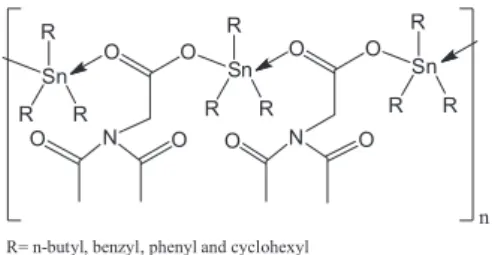
16,33,34 The Sn-C stretching frequency at 510, 517, 547, and 540 cm-l for benzyl, butyl, phenyl and cyclohexyl groups suggested the presence of all three organic groups in the equatorial positions of the polymeric trigonal bipyramidal structure in Figure 1.34,35
The characteristic υ(CO)asym. and υ(CO)sym. vibration of mono-meric compounds 1 and 3 appeared at 1620±15 and 1462±8 cm-l, re-spectively,33-35 while ∆υ value of CO was < 200 cm-1 exhibit bidentate bonding to NNDAG with trans-octahedral geometry (Figure 2).16,36 Very sharp band at 634 cm-1 of compound 2 recommend Sn-O-Sn-O ring dimeric networking with endo and exo Sn(IV) atoms that proposed the hexa coordination geometry given in Figure 3 and the general observed pattern for υCO in accordance with literature is as follow: υasym(comp.)<υasym(lig.), <υsym(comp.) <υsym(lig.), ∆υ(comp.)>∆υ (lig.). 15,16,36 1H NMR study
The CH3CO protons of NNDAG resonated at 2.30-1.5 ppm and O–H proton shifted at downield region 11.3 ppm indicating the N,N-protected of glycine. Interestingly no N–H chemical shift was observed in the 1H NMR spectra of ligand. It is facile and more convenient route that can be used to protect glycine at NN site is not found in the literature. The 1H NMR study of OTCs (1–7) successfully veriiedtheir synthesis by de-protonation of NNDAG ligand and no chemical shift was found at downield for carboxylic acid proton. All data is given in experimental part. The –CH2 chemical shifting is found at 3.71-4.00 ppm while CH2 of benzyl at 2.64-2.87 ppm is seen as reported.16,36-39 The proton signal of phenyl, cyclohexyl and aromatic proton of benzyl were found at range 7.32-8.23 ppm. Two molar stoichiometric ratio of NNDAG was used to synthesize OTCs 1, and 3 are conirmed by 1H NMR data and the literature evidences supported octahedral geometry (Figure 2).31,40
In case of compounds 2 the endo- and exocyclic Sn(IV) centers were dificult to identify as reported in literature because there is no distinct signals of butyl group attached to endo- and exocyclic tin(IV) centers giving the equal status to endo and exo tin(IV) cen-ters.16,17,41,42 It is obviously due to six coordination sites of each endo and exotin(IV) atom with chemically equivalent nature. Hence it might be purposed that dimer have a ladder topology with sinusoidal view from one unit to other that linked with each other through oxygen atom of carboxylate of one unit to Sn(IV) atom of other unit as we reported previously and shown in Figure 3.15,31
For triorganotin(IV) compounds (TOTCs) 4-7, the 1H NMR spectra (data can be seen in experimental part) show the chemical shift that verifying the tetrahedral structure in CDCl3 solvent and established the coordination of oxygen of carboxylic group to tin(IV) centers (Figure 4) with support of literature as well.41,42
13C NMR study
The 13C NMR spectra of NNDAG data can be seen in experi-mental part. According to Scheme 1, all the carbon atoms 1, 2, 3, 4 were resonated at the speciied chemical shifts as reported in the literature.16,17,31 The C-1of COOH gave 13C signal at 169.22 ppm and whereas the C-4 of CH3 at 21.68 ppm is conirming the synthesis of NNDAG. All the OTCs have COO values at down ield up to 173.73 ppm as well conirmed carboxylate carbon (C-1) bonding to tin(IV) atom. The 13C chemical shift of butyl, phenyl, benzyl and cyclohexyl (C-a, C-b, C-c, C-d, C-e) were observed at range 13.55-27.13, 130-140 and 22-30 ppm, respectively.16,17,41
Sn
O O
Sn
Sn Sn
O
O
O O
C
O
C
O
C Bu
Bu
O C O
Bu
R R
R
R
Bu Bu
Bu Bu Bu
R = (CH3CO)2NCH2
-Sn
O O
Sn
Sn Sn
O
O
O O
C
O
C
O
C Bu
Bu
O C O
Bu
R R
R
R
Bu Bu
Bu Bu Bu
Figure 3. Sinusoidal view of compound 2 exhibiting weakly bonded two dimer units
O
O O
O
N
O O
Sn
Bu
Bu N
O
O
Figure 2. Octahedral geometry of monomer 1, and 3
O O
Sn
R R
R
N
O O
Sn
R R
R
O O
N
O O
Sn
R R
R
n
R= n-butyl, benzyl, phenyl and cyclohexyl
Figure 1. Polymeric trigonal bipyramidal structure of tri-organotin(IV) complexes (4-7)
N
O O
O
O Sn
R
R R
R= n-butyl, benzyl, phenyl and cyclohexyl
119Sn NMR study
The 119Sn chemical shifts of the tribenzyl-, tributyl-, triphenyl-, and tricyclohexyl-tin(IV) carboxylates were at -142.71, 123.7, -99.29, and 71.21 ppm indicating a tetrahedral environment. 43,44 While dibutyl- and dibenzyl-tin(IV) complexes exhibited 119Sn chemical shift at -190.35 and -238.32 ppm respectively conirming the trans octahedral arrangement (Figure 2).45 While pair of 119Sn resonance peaks of equal intensities at -210.4 and -216.2 were conirming the endo- and exo-cylic status of tin(IV) respectively that substantiated the sinusoidal view of compound 2 given in Figure 3.15,23
Mass spectral study
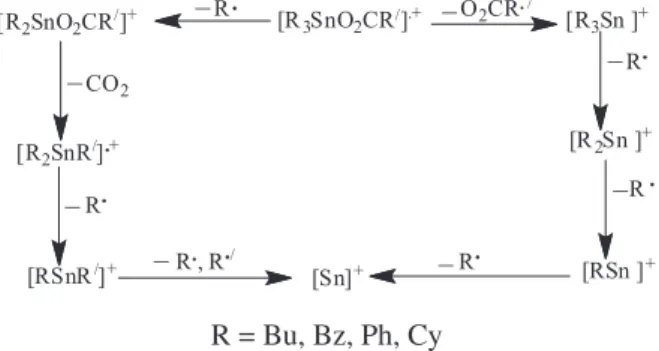
Molecular ion peak at m/z 159 is the actual mass of ligand NNDAG is true evidence of existence of two moles of acetyl groups at N terminal of glycine is the most important step toward synthesis of NNDAG through this new and facile route to protect N terminal. In the organotin(IV) derivatives major fragmentation was observed due to the loss of the ligand moiety from the tin(IV) derivatives. Successive loss of R groups (Bu, Bz, Ph) during fragmentation was happened until the Sn4+ ion was resulted. In an alternative route, R groups were eliminated irst and next one molecule of CO2 removed as per revealed in literature.
23,46 Further, the remain-ing substituents were defragmented on same pattern as given in Schemes 3 and 4.
Antibacterial activity
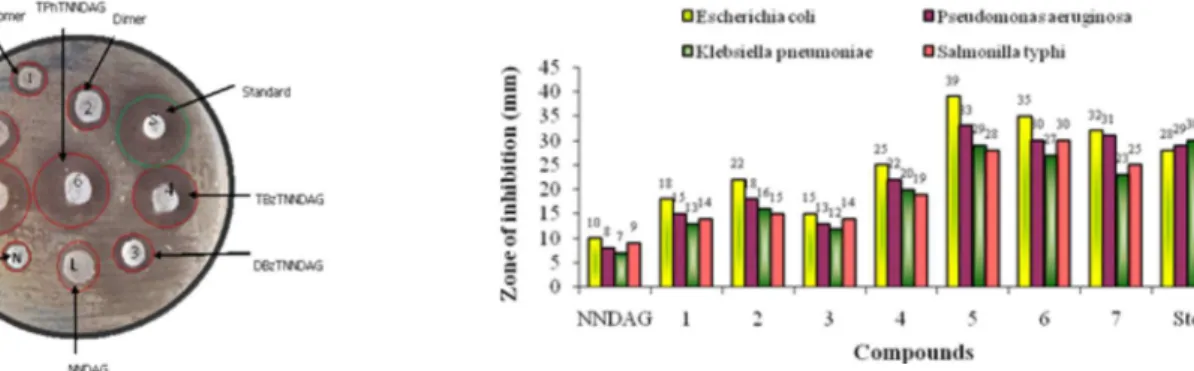
The results related to antibacterial activity is given in Table 1. The OTCs 4, 5, 6 and 7 (500 ppm) is promising more than two fold activity than the standard antibiotic enoxacin (1000 ppm). The compounds 1, 2 and 3 relected good activity at 500 ppm dose whereas the NNDAG is too less promise as given in selected petri plate of E. coli (Figure 5) and the comparative zone of inhibition of OTCs 1-7 versus bacterial strains is given in Figure 6. It is obvious that promising property of OTCs (4, 5, 6 and 7) is due to tetrahedral geometry of tin(IV) atom that bears CO oxygen free for coordinate with corresponding metal ions of enzymatic system of strains as well the tin(IV) metal ions has more vacant coordination site to block the metabolites to protein synthesis along with ribosomal sub units of bacterial strains.47-50 From this study following trend of OTCs may be concluded for the antibacterial inhibition: TOTCs (alkyl) > TOTCs (aryl) > dimer > monomer > ligand.
Insecticide activity
The OTCs 4 and 5 have excellent activity against M. minimum and T. castaneum but remained insigniicant against Mealy bug. The LD50 value and the results are given in Table 2.
Cytotoxicity study
Cytotoxicity was evaluated using brine shrimp lethality assay (Table 3). LD50 of all compounds were carried out against brine shrimp larvae using standard statistical procedure Probit analysis. OTCs 4, 5 and 7 were found to be active.
[R2Sn (O2CR/)2].+ O2CR [R2SnO2CR/]+
R.
[RSn (O2CR/)2]+
[R2SnR/].+
CO2
CO2
CO2
[R2SnR/(O2CR/)].+
CO2 CO2R
./ R.
[RSnR/]+
[R2SnR/]+
[R SnR/
2].+
[SnR/]+
2R. R.
R., R./
R./
_
_
_
_
_
_
_
_
_
_ _
_ /
[Sn]+
R = Bu, Bz,
Scheme 4. Fragmentation pattern of diorganotin(IV) complexes
[R3SnO2CR/].+ O2CR
. /
[R3Sn ]+
R.
[R2SnO2CR/]+
CO2
R.
R.
R., R./
[R2SnR/].+ [R2Sn ]
+
[RSn ]+ [RSnR/]+
R.
R. _
_
_
_ _
_ _ _
[Sn]+
R = Bu, Bz, Ph, Cy
Scheme 3. Fragmentation pattern of triorganotin(IV) complexes
Table 1. Antibacterial bioassay
Compounds (500 ppm)
E. coli P. aeruginosa K. pneumoniae S. typhi
Inhibition (mm) Results Inhibition (mm) Results Inhibition (mm) Results Inhibition (mm) Results
NNDAG 10 + 8 + 7 + 9 +
1 18 ++ 15 ++ 13 ++ 14 ++
2 22 +++ 18 ++ 16 ++ 15 ++
3 15 ++ 13 ++ 12 ++ 14 ++
4 25 +++ 22 +++ 20 ++ 19 ++
5 39 ++++ 33 +++ 29 +++ 28 +++
6 35 ++++ 30 +++ 27 +++ 30 +++
7 32 ++++ 31 ++++ 23 ++ 25 ++
*Standard 28 +++ 29 +++ 30 +++ 34 ++++
CONCLUSIONS
A new series of monomeric organotin(IV) esters 1, 3 dimeric organotin(IV) esters 2 and triorganotin(IV) esters 4-7, were synthe-sized with N,N-diacetylglycine. All the complexes were more active than the ligand and some were even more active than standard used. The following trend may be concluded for the antibacterial inhibi-tion; OTCs (alkyl) > OTCs (aryl) > monomeric organotin(IV) esters > monomer organotin(IV) esters > ligands, the bacterial strains were inhibited as: E. coli > P. aeruginosa > K. pneumonia > S. typhi. While the rate of toxicity and LD50 values have following order: T. castaneum > M. minimium > Mealybug in cotton plant. LD50 against Brine Shrimp larvae were found to be active for dimer and inactive
for monomer while OTCs esters have very narrow range of LD50 values of 3-10 μg/mg.
ACKNOWLEDGEMENTS
The authors are thankful to Department of Chemistry (Inorganic Ph. D. Lab) The Islamia University of Bahawalpur-Pakistan for providing all research facilities. HEJ Research Institute, University of Karachi for spectroscopic analysis and Quaid-e-Azam Medical College Bahawalpur for antibacterial activities are gratefully ac-knowledged. Gildardo Rivera Sánchez wish to thank the inancial support received from the Comisión de Operación y Fomento de Actividades Académicas (COFAA-Instituto Politécnico Nacional), Table 3. Brine shrimp LD50 bioassay
Compounds % Death at dose (μg/mg) LD50 Results
1000 700 400 100 10
NNDAG 20 20 10 - - - +
1 40 30 20 20 20 - ++
2 90 80 70 70 60 7.94 ++++
3 30 30 10 10 10 - ++
4 90 80 80 80 60 3.16 ++++
5 100 100 100 90 70 3..98 ++++
6 100 100 70 70 50 10.00 ++
7 90 90 90 90 60 3.16 +++
where: ++++ = more signiicant, +++ = signiicant – = no activity.
Table 2. Insecticidal bioassay
*Compounds
Type of insects (% Death) μg/mg
Monomorium minimum Tribolium castaneum Mealy bug
1000 700 400 100 10 LD50 Result 1000 700 400 100 10 LD50 Result Result
NNDAG 10 10 10 - - - - 10 10 - - -
-1 80 70 60 40 30 140.48 + 80 60 60 40 20 100.00 +
-2 100 100 80 70 20 28.18 ++ 60 60 40 40 30 350.80 ++
-3 80 80 80 80 40 35.48 ++ 90 90 60 60 10 79.43 ++
-4 100 100 90 80 60 6.60 ++ 90 80 70 70 40 35.48 ++
-5 100 100 90 70 50 1.00 +++ 100 100 80 60 30 28.18 +++
-6 90 90 60 30 30 39.81 ++ 70 70 50 50 20 141.48 ++
-7 90 80 80 80 30 39.81 ++ 80 70 50 40 20 100.00 ++
-* compounds and lour are in w/w % ratio; where: - = no result, + = insigniicant, ++ = signiicant, +++ = more signiicant, ++++ = most signiicant.
and the Programa de Estímulos al Desempeño de los Investigadores (EDI-Instituto Politécnico Nacional).
REFERENCES
1. Chandrasekhar, V.; Nagendran, S.; Baskar, V.; Chem. Rev.2002,235, 1. 2. Gielen, M.; Appl. Organomet. Chem.2002,16, 481.
3. Zafarullah, M.; Li, W. Q.; Sylvester, J.; Ahmad, M.; Cell. Mol. Life Sci. 2003, 60, 6.
4. Hadjikakou, S. K.; Hadjiliadis, N.; Coord. Chem. Rev.2009, 253, 235. 5. Kovala-Demertzi, D.; J. Organomet. Chem.2006,691, 1767. 6. Pellerito, L.; Nagy, L.; Coord. Chem. Rev.2002, 224, 111.
7. Tian, L.; Liu, X; Zheng, X.; Sun, Y; Yan, D.; Tu, L; Synth. React. Inorg., Met.-Org., Nano-Met. Chem.2007, 37, 507.
8. Hong, M.;Yin, H.;Zhang, X.;Li, C.; Yue, C.; Cheng, S.; J. Organomet. Chem.2013, 724, 23.
9. Charles, E.; Carraher, Jr.; Roner, M.R.; J. Organomet. Chem. 2014, 75, 67.
10. Abbas, S.; Hussain, M.; Ali, S.; Parvez, M.; Raza, A.; Haider, A.; Iqbal J.; J. Organomet. Chem.2013, 724, 255.
11. Sedaghat, T.; Aminian, M.; Bruno, G.; Rudbari, H.A.; J. Organomet. Chem.2013, 737, 26.
12. Arjmand, F.; Parveen, S.; Tabassum, S.; Pettinari, C.; Inorg. Chim. Acta 2014, 423, 26.
13. Oliveira, K.N.D.; Andermark, V.; Onambele, L.A.; Dahl, G.; Prokop, A.; Ott, I.; Eur. J. Med. Chem., 2014, 87, 794.
14. Win,Y. F.; Choong, C. S.; Dang, J. C.; Iqbal, M. A; Quah, C. K.; Kanuparth, S. R.; Haque, R. A.; Ahamed, M. B. K.; Teoh S. G.; C. R. Chim.2015, 18, 137.
15. Ashfaq, M.; Ahmed, M. M.; Shaheen, S.; Oku, H.; Mehmood, K.; Khan, A.; Niazi, S. B.; Ansari, T. M.; Jabbar A.; Khan, M. I.; Inorg. Chem. Commun.2011,14, 5.
16. Ashfaq, M.; Khan, M. I.; Baloch, M. K.; Malik, A.; J. Organomet. Chem.2004,689, 238.
17. Ashfaq, M.; J. Organomet. Chem. 2006,691, 1803. 18. Hou, X. W.; Fields, P. G.; J. Econ. Entomol.2003,96, 1005.
19. Sisido, K.; Takeda, Y.; Kinugawa, Z.; J. Am. Chem. Soc. 1961,83, 538. 20. Furniss, B.; Hannaford, A. J.; Smith, P. W. G.; Tatchell, A. R.; Vogel’s
Text Book of Practical Organic Chemistry, 5th ed., ELBS Longman
Group: UK, 1989.
21. Holecek, J.; Handlir, K.; Nadvornik, M.; Lycka, A.; J. Organomet. Chem.1986,315, 299.
22. de Sousa, G. F.; Ellena, J.; Maltac V. R. S.; Ardissond, J. D.; J. Braz. Chem. Soc.2009, 20, 144.
23. Hans, K.; Pervez, M.; Ashfaq, M.; Anwar, S.; Badshah, A.; Majeed, A.;
Acta Crystallogr., Sect. E: Crystallogr. Commun. 2002,58, m466. 24. Khan, M. I.; Baloch, M. K.; Ashfaq, M.; Gul, S.; J. Braz. Chem. Soc.
2009, 20, 341.
25. Costa, R. F. F.; Rebolledo, A. P.; Matencio, T.; Calado, H. D. R.; Ardisson, J. D.; Cortés, M. E.; Rodrigues, B. L.; Beraldo, H.; J. Coord. Chem. 2005,58, 1307.
26. Khan, M. I.; Baloch, M. K.; Ashfaq, M.; J. Enzyme Inhib. Med. Chem. 2007,22, 343.
27. Khan, M. I.; Baloch, M. K.; Ashfaq, M.; Rehmat, M.; Main Group Met. Chem.2006,29, 201.
28. Mendham, J.; Denney, R. C.; Barnes, J. D.; Thomas, M.; Vogel’s Text Book of Quantitative Chemical Analysis, 6th ed., Pearson Education Pvt.
Ltd.: Singapore, 2003.
29. Sharma, N.; Prem, P.; Sharama, V.; Bhatt, S.S.; Chaudhry, S. C.; Synth. React. Inorg. Met.-Org. Chem.1997,27, 1381.
30. Hussain, H.; Ahmad, V. U.; Green, I. R.; Krohn, K.; Hussain, J.; Badshah, A.; ARKIVOC2007, 14, 289.
31. Ashfaq, M.; Majeed, A.; Rauf, A.; Khanzada, A. W. K; Shah, W. U; Ansari, M. I.; Bull. Chem. Soc. Jpn.1999, 72, 2073.
32. Roge. G.; Huber. F.; Preut, H.; Silvestri, A.; Barbieri. R.; J. Chem. Soc. Dalton Trans.1983, 595.
33. Kemmer, M.; Ghys, L.; Gielen, M.; Biesemans, M.; Tiekink, E. R. T.; Willem, R.; J. Organomet. Chem. 1999,582, 195.
34. Song, X.; Xie, Q.; Fang, X.; Heteroatom Chem.2002,13, 592. 35. Khan, M. I.; Baloch, M. K.; Ashfaq, M.; Appl. Organomet. Chem.2006,
20, 463.
36. Kovala-Demertzi, D.; Dokorou, V. N.; Jasinski, J. P.; Opolski, A.; Wiecek, J.; Zervou, M.; Demertzis, M. A.; J. Organomet. Chem.2005,
690, 1800.
37. Azadmeher, A.; Amini, M. M.; Hadipour, N.; Khavasi, H. R.; Fun, H. K.; Chen, C.; J. Appl. Organomet. Chem. 2008,22, 19.
38. Domazetis, G.; Magee, R. J.; James, B. D.; J. Organomet. Chem.1979,
173, 357.
39. Pruchnik, F. P.; Banbula, M.; Ciunik, Z.; Latocha, M.; Skop, B.; Wilczok, T.; Inorg. Chem. Acta2003,356, 62.
40. Angiolini, L.; Caretti, D.; Mazzocchetti, L.; Salatelli, E.; Femoni, C.; J. Organomet. Chem.2004,689, 3301.
41. Gielen, M.; Bouhdid, A.; Willem, R.; Bregadze, V. I.; Ermanson, L. V.; Tiekink, E. R. T.; J. Organomet. Chem. 1995,501, 277.
42. Saraswati, B. S.; Mason, J.; Polyhedron1986,5, 1449.
43. Shahzadi, S.; Shahid, K.; Ali, S.; Bakhtiar, M.; Turk. J. Chem.2008, 32, 333.
44. Shahid, K.; Ali, S.; Shahzadi, S.; Badshah, A.; Khan, K. M.; Maharvi, G. M. Synth. React. Inorg. Met-Org. Chem. 2003,33, 1221.
45. Gielen, M.; Joosen, E.; Mancilla, T.; Jurkschat, K.; Willem, R.; Roobol, C. Bernheim, J.; Atassi, G.; Huber, F.; Hoffmann, E.; Preut, H.; Mahieu, B.; Main Group Met. Chem.1995,18, 27.
46. Masood, M. T.; Ali, S.; Danish, M.; Mazhar, M.; Synth. React. Inorg. Met. Org. Chem.2002,32, 9.
47. Terao, K.; Uchiumi, T.; Endo, Y.; Ogata, K.; Eur. J. Biochem.1988,174, 459.
48. Li, J.; Zhao, G.; Xiong, C.; Ma, Y.; Synth. React. Inorg. Met. Org. Chem. 2001,31, 85.
49. Gielen, M.; Lelieveld, P.; de Vos, D.; Pan, H.; Willem, R.; Siesemans, M.; Fiebig, H. H.; Inorg. Chem. Acta. 1992,196, 115.