Printed in Brazil - ©2005 Sociedade Brasileira de Química 0103 - 5053 $6.00+0.00
Short Report
* e-mail: [email protected]
Long-Range Correlations (
nj
C,H
n > 3 ) in the HMBC Spectra of
3-(4-Oxo-4
H
-chromen-3-YL)-acrylic Acid Ethyl Esters
Ramiro Araya-Maturana*,a, José A. Gavín-Sazatornilb,Jorge Heredia-Moyaa, Hernán Pessoa-Mahanaa and Boris Weiss-Lópezc
a
Departamento de Química Orgánica y Fisicoquímica, Facultad de Ciencias Químicas y Farmacéuticas, Universidad de Chile, Casilla 233, Santiago 1, Chile
b
Instituto Universitario de Bio-Orgánica, Universidad de La Laguna, Spain c
Departamento de Química, Facultad de Ciencias Universidad de Chile
Um estudo sistemático das correlações de longo alcance em espectros de HMBC foi feito para uma série de ésteres etílicos do ácido cis- e trans-3-(4-oxo-4H-chromen-3-il) acrílico e os derivados 5-hydroxilados. Os resultados foram comparados com os já observados para espectros IMPEACH-MBC e CIGAR-HIMPEACH-MBC. Um acoplamento incomum do tipo 5J
C,H entre prótons metilicos e o Cα do
grupo carbonilico foi observado nesses sistemas, assim como no crotonato etílico. A atribuição completa dos espectros 1H e 13C RMN foi realizada.
A systematic study about the long-range correlations observed in the HMBC spectra of a series of cis and trans 3-(4-oxo-4H-chromen-3-yl)-acrylic acid ethyl esters, and 5-hydroxy derivatives, was carried out. The results were compared with those observed in IMPEACH-MBC and CIGARHMBC spectra. An uncommon 5J
C,H between the methyl protons and the Cα to the carbonyl
group was observed in these systems as well as in ethyl chrotonate. The complete assignments of the 1H and 13C NMR spectra are provided.
Keywords: 1H and 13C NMR , HMBC, CIGAR-HMBC, IMPEACH-MBC, 5J
C,H, acrylic acid ethyl esters, chromone
Introduction
The Heteronuclear Multiple Bond Correlation (HMBC)1,2 NMR experiment has probably been the most widely used 2D heteronuclear NMR method in the field of structural elucidation of complex organic molecular structures. Nowadays, it has become one of the most popular techniques for multiple-bond (or long-range) heteronuclear chemical shift correlation. It provides a wealth of structural information, and eventually the full assignment, through long-range correlation signals for 13C,1H spin pairs. It can span quaternary carbons or heteronuclei, providing a way to link different molecular fragments into a complete structure.3-5 The use of HMBC together with Heteronuclear Multiple Quantum Coherence, HMQC,6 or Heteronuclear Single Quantum Correlation, HSQC,7 has proved to be extremely useful in the total structure elucidation and
NMR spectral assignments of numerous complex organic molecules.
The HMBC experiment was highly improved since the application of pulsed field gradients (PFG) in the early 1990’s. High quality spectra, without artefacts, are obtained in standard conditions, allowing the analysis of very small but informative cross peaks. Today the advantages offered by the incorporation of pulsed field gradients into high-resolution NMR pulse sequences, combined with advanced software tools available to acquire and process multidimensional NMR experiments, has allowed to record and process the HMBC sequence with PFG just by clicking a button or executing a predefined macro, making it available to the non-experienced NMR user.8
of antibiotic distamicyn A9, along with another examples of this kind of correlations ( nJ
C,H n > 3 ) subsequently reported, validate HMBC as a technique that allow to obtain more valuable structural information.10 Moreover, a frequent source of contradictions in computer-assisted structure elucidation programs, has been the observation of correlations in COSY and in long-range heteronuclear shift-correlation experiments, which corresponds to four or more bonds.11
With regard to the observation of nJ
C,H n>3, two extreme opinions have been argued: the first position emphasizes the disadvantages associated with the increase in the number of H,C correlation peaks for which the number of bonds is uncertain, even worst if the cross-peaks intensities are low, as usually occurs. Because of this, the valuable information that might be obtained through heteronuclear long-range correlations, across four or more bonds, has been generally discarded. It is important to mention, even though it is obvious, that if the number of intervening bonds assigned to a cross-peak is different from the actual value, wrong connectivities will be made. Moreover, these correlations can be crucial in structural elucidation.9,12,13 The other position focuses on the large amount of structural information that can be obtained with a larger number of long-range correlation peaks, which can be translated to bonding network, despite the lack of discrimination. The pulse sequences: D-HMBC,14 3D-HMBC,15 CT-HMBC,16 ACCORD-HMBC,17 IMPEACH-MBC18 and CIGAR-HMBC,19 which sample a great number of long-range coupling constants, were developed based on the last point of view.
The tuning of the HMBC experiment is achieved by setting the ∆2 preparation period, the so called long-range delay, to a sufficiently long time to allow the small long-range proton-carbon couplings to evolve and produce the antiphase displacement of vectors required for the subsequent generation of heteronuclear multiple quantum coherence, and is calculated from ∆2 = 1 / (2
nJ C,H).
5 Since
molecules have a range of nJ
CH values, typically from 2 to 15 Hz,4,5∆
2 should be at least 100ms. In practice a delay shorter than the theoretical value is employed in order to avoid the 1H magnetization to decay during this delay, particularly for large molecules. For routine applications
∆2 is usually set from 60 to 80 ms.
3-5 This delay significantly
attenuate cross-peaks intensities arising from values of nJ CH which are far away from the average value.
Since small molecules tend to have slower relaxation rates, longer delays can be successfully used in the search for connectivities through smaller couplings. A maximum of 200 ms has been recommended to detect cross-peaks arising from four bonds correlations, which are described
as most likely to occur when the coupling pathway contains unsaturations or when it has the planar zig-zag (W coupling) configuration,4 as commonly observed in long-range proton-proton coupling. However these generalizations might induce to confusion. For example values of ∆2 between 50 to 400 ms to record HMBC spectra of phenolic compounds, has been reported,20 moreover the observation of five bonds correlations by using standard value of ∆2 (65 or 80 ms) in HMBC spectra of quinones has also been reported.12,13,21 In a similar way, several examples of 4J
CH has been observed in a great variety of molecules and coupling pathways.10
Generally the choice of ∆2 is made on arbitrary basis rather than from knowledge of the actual value of the couplings. On this basis, a first approximation to observe a greater number of long-range correlations is to perform several HMBC experiments with different long-range delays and using a deeper threshold in the contour plot. Hereby new correlations could be observed and some of the already observed ones might disappear. Alternatively, some of the new pulse sequences focused on long-range delay optimisation, of which CIGAR-HMBC has been described as the best,5 can be used.
In order to explore this subject in a systematic way and hence to obtain further information that can be used for a more effective choice of ∆2 values, we selected compounds
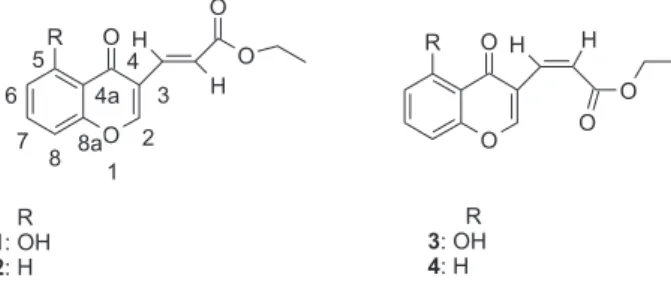
1-4 (Figure 1) to study the long range correlations that can be observed at different ∆2 values. The selection of these structures was made considering that the oxygen atom of the heterocyclic moiety and the quaternary carbons impose an assignment relying on long-range correlations. Additionally, it is interesting because the chromone system has received attention due to the possibility of aromatic character of the heterocyclic moiety.22 On the other hand, from a synthetic point of view, the π system of the acrylic ester conjugated with heterocyclic double bond conform an attractive push-pull diene with E or Z configuration that has been used in cycloadditions.23 In this paper we present a study to obtain a criterion that allows a more appropriate choice of ∆2 in this type of molecular systems. For this purpose, several HMBC experiments increasing
∆2 long-range delays were carried out to observe the necessary nJ
CH correlations for the assignments. In this manner we have assigned the 13C NMR spectra of these compounds by the concerted use of 1H-detected one bond heteronuclear multiple quantum coherence HMQC,6 or HSQC,7 and long-range heteronuclear multiple bond connectivity, HMBC.1,2
Experimental
General procedure for preparation of chromones 1-4
The chromones 1-4 were prepared starting from the corresponding 3-formylchromone,24 through a Wittig reaction according to the following experimental conditions: one equivalent of carboethoxymethylene-triphenylphosphorane was added to a solution of 0.5 g of the corresponding 3-formylchromone in 10 mL of toluene and the mixture heated to reflux for 2h. The triphenylphosphine oxide formed in the reaction was removed through vacuum filtration and then rotatory evaporation of the solvent from the filtrate affords a mixture of cis and trans acrylic acid ethyl esters derivatives. Purification by column chromatography through silica gel using ethyl acetate/hexane 1: 2 as eluent and further crystallization from a mixture of ethyl acetate/hexane yields the corresponding pure compounds 1-4 as white needles. trans-5-hydroxy-3-(4-oxo-4H -chromen-3-yl)-acrylic acid ethyl ester 1 was obtained with 55% yield (m.p. 158.5-159.5 ºC), Anal. Calc. For C14H12O5: C, 64.61; H, 4.65 Found: C, 64.40; H, 4.42. IR (KBr) νmax/cm
-1: 3442,
1706, 1652, 1296, 1267, 1170. cis -5-hydroxy-3-(4-oxo-4H-chromen-3-yl)-acrylic acid ethyl ester 3 was obtained with 40% yield (m.p. 69.5-70 ºC). Anal. Calc. For C14H12O5: C, 64.61; H, 4.65 Found: C, 64.10; H, 4.47. IR (KBr)
νmax/cm
-1: 3440, 1703, 1655, 1265, 1196, 1158. trans -3-(4-oxo-4H-chromen-3-yl)-acrylic acid ethyl ester 2 was obtained with a 50% yield (m.p. 111.5-112.5 ºC lit. 96-98 ºC23). cis-3-(4-oxo-4H-chromen-3-yl)-acrylic acid ethyl ester 4 was obtained with a 49 % yield (m.p. 66,5 - 67.5 ºC).
NMR Spectra
1H and 13C NMR spectra were recorded using a Bruker
AVANCE 300 and a Bruker AVANCE 400 spectrometers operating at 300.13 and 400 MHz (1H) or 75.47 and 100 MHz (13C) respectively. All measurements were carried out at a probe temperature of 300 K, using solutions of 1-4
(20-30 mg mL-1 in CDCl
3 containing tetramethylsilane as internal standard). All two dimensional spectra were acquired, in both spectrometers, with a Bruker inverse 5
mm Z gradient probe. HMQC spectra were recorded using the standard Bruker software. These spectra were collected with 512 x 512 data points, with eight scans acquired for every 256 increments in t1, and the ∆1 delay was set to 3.45 ms. Spectral widths of 3000 Hz and 18000 Hz were used in the F2 (1H) and F
1 (
13C) domains, respectively.
HMBC, CIGAR-HMBC and IMPEACH-MBC spectra were obtained using the standard pulse sequence from the Bruker software. The spectral widths were 3900 Hz (F2) and 18000Hz (F1). The ∆2 delay in the HMBC pulse sequence was varied from 65 to 390 ms. Data was processed using an
Table 2. 13C NMR Chemical shift assignments (ppm TMS) for
chromones 1-4
Atom 1 2 3 4
C-2 157.88 157.40 159.18 158.28
C-3 118.10 119.40 117.41 118.73
C-4 181.48 176.00 181.24 176.08
C-4a 110.90 124.30 110.71 123.86
C-5 161.25 126.30 161.98 126.15
C-6 112.24 125.90 111.70 125.44
C-7 135.78 133.90 135.65 133.79
C-8 107.12 118.20 107.27 118.19
C-8a 155.67 155.60 156.13 155.99
C-9 134.11 135.20 132.14 133.88
C-10 122.42 122.30 121.21 120.60
CH2 60.57 57.70 60.53 60.39
CH3 14.21 10.10 14.08 14.11
CO (ester) 167.06 167.40 166.01 166.17
Table 1. 1H NMR Chemical shift assignments (ppm TMS) for
chromones 1 -4
Atom 1 2 3 4
H-2 8.10 8.12 9.10 9.13
H-5 - 8.28 - 8.26
H-6 6.85 7.45 6.82 7.43
H-7 7.56 7.70 7.55 7.69
H-8 6.93 7.49 6.93 7.49
H-9 7.38 7.42 7.05 7.16
H-10 7.21 7.28 6.12 6.10
CH2 4.30 4.26 4.20 4.19
CH3 1.34 1.33 1.30 1.29
OH 12.49 – 12.41 –
exponential decay window in F2, with 1b = 5Hz, and a qsine window function in F1.
Results and Discussion
The 1H-NMR spectra of compounds 1 and 3 display two doublets corresponding to an AB system with J 15.9 Hz, characteristics of trans double bond (1), and J 12.8 Hz for the cis compound (3). The H-10 proton doublet, δ 7.21 for compound 1, is shifted to lower field respect to compound 3 (δ 6.12), probably due to the anisotropic effect of C-4 carbonyl group in the s-trans conformation of the diene moiety. Both compounds exhibit three signals for the aromatic protons: two doublets and an apparent triplet, besides the two characteristic triplet and quartet of the ethyl chain. The singlet corresponding to the heterocyclic proton appears at very low field, as reported before for this class of heterocyclic systems,23,25 due to oxygen substitution and the conjugation effect of the carbonyl group (C-4), although the postulated aromatic character of heterocyclic ring of the chromone22 may also contribute. The absolutes magnetic shielding at the rings centers and at the carbon nuclei has been previously reported.22 The H-2 resonance in compound 3 (δ 9.10) is shifted to low field with respect to compound 1 (δ 8.10), probably due to the anisotropic effect of the carbonyl ester group in the s-cis conformation.
The protonated carbons can be easily assigned through an HMQC or HSQC experiments, except in the case of C-6 and C-8 because H-6 and H-8 exhibit similar chemical shifts and multiplicities. Therefore, these carbons together with the quaternary centers must be assigned through long-range correlations.
The HMBC spectra of both compounds obtained with a 300 MHz spectrometer and using a standard long-range delay of 65 ms, displayed a three bond correlation between the hydroxyl proton and C-6, and did not correlate with C-8, allowing the discrimination between them. A three bond correlation between the same proton and C-4a is also observed allowing discrimination between C-4a and C-3. The 3J
C,H between H-10 with C-3 and the 2J
C,H between this carbon with H-2 assures these assignments.
The HMBC spectrum of compound cis (3), with ∆2 = 65 ms, shows seven 4J
C,H correlations, of which only four of them take place through a W coupling path: H-10 with C2, H-6 with C-4, H-8 with C-4 and OH with C-7. The other three correlations occur between a proton and the carbon located at the para position: H-6 with C-8a, H-7 with C-4a and H-8 with C-5. With the purpose of confirming that these cross-peaks are real and not artifacts, we performed duplicate experiments in a 400 MHz spectrometer. The
HMBC spectrum for the cis compound 3 displays the same cross-peaks in both spectrometers. The 300 MHz HMBC spectrum with ∆2 = 65 ms of compound trans1 shows only four 4J
C,H correlations: the hydroxyl proton with C-7, H-7 with C-4a, OH with C-4 and H-8 with C-4. However in the spectrum recorded at 400 MHz the correlation between OH and C-4 is not observed. However other four correlations were observed: H-6 with C-8a, H-8 with C-5, H-10 with C-2 and H-9 with C-4a. At present we have no explanation for these differences.
The 300 MHz spectra of both compounds, with a little increment in ∆2 (130 ms), lead to observation of several additional 4J
C,H correlations, (12 cross-peaks). Interestingly, a long-range correlation across five bonds between the methyl protons with C-10 is also observed. This is a very long-range correlation through a coupling path with a high degree of conformational freedom. As far as we know10 this kind of long-range correlation has not been reported before. In the 400 MHz HMBC spectrum of compound 1, with
∆2 = 130 ms, only the same correlations obtained using ∆2 = 65 ms were observed. However the HMBC spectrum of compound 3 showed a 4J
C,H correlation between the OH and C-4, but the cross-peaks due to H-7 with C-4a and H-8 with C-5 disappeared. In the spectra of both compounds, 1 and 3, the 5J
C,H correlations were not observed, but in the 400 MHz spectra of both compounds with ∆2 = 195 ms the
5J
C,H correlations between CH3 and C-10 can be observed, beside eleven 4J
C,H other correlations. In the 300 MHz HMBC spectrum (∆2 = 195 ms) of compound 1 thirteen 4J
C,H correlations are shown, in addition to a 5J
C,H correlation. For compound cis twelve 4J
C,H correlations are observed, beside two 5J
C,H: CH3 with C-10 and H-10 with C-4a.
The IMPEACH-MBC experiment (∆2 = 50-200 ms,
J 2.5-10 Hz) of compound trans shows several although not all correlations observed in the series of HMBC experiments. This experiment shows the 4J
C,H correlations between the aromatic protons with carbon atoms in the
para positions: H-8 with C-4, H-10 with C-2 and H-9 with C-4, but is unable to show correlations of the ethyl chain with Cα. A CIGAR-HMBC (∆2 = 50-200 ms, J 2.5-10 Hz) of the same compound shows two additional 5J
C,H:CH3 with C-10and OH with C-8 ,but several artifacts are obtained, mainly for H-2.
constants of 9.4 and 1.6 Hz, and H-8 appears at δ 7.49 as a broad doublet with J 8.5 Hz.
The conjugation of the carbonyl group shifts the aromatic protons H-5 and H-7 to low field and the conjugation of the heterocyclic oxygen atom shifts the H-6 and H-8 to high field. In this way was possible to discriminate between H-5 and H-8 or H-6 and H-7, together with the reported chemical shifts of chromone derivatives. H-2 appears at 8.12 ppm and 9.13 ppm for molecules 2
and 4 respectively, in a similar way as compounds 1 and 3. The standard HMBC spectrum (∆2 = 65 ms) of compound
2 displays only one 4J
C,H correlation (H-8 with C-4), however the HMBC spectrum of compound 4 shows four 4J
C,H correlations: H-8 with C-4, H-6 with C-8a, H-2 with C-10, and H-10 with C-2. Increments of ∆2 allows to observe a bigger number of these 4J
C,H as discussed previously for compounds 1 and 3. Using ∆2 = 130 ms or larger, the
5J C,H correlation between the methyl protons with C-10 is observed for both compounds, in a similar way as compounds 1 and 3.
The HMBC spectrum of ethyl chrotonate shows the correlation between the methyl protons (δ 1.89) and Cαto carbonyl with ∆2 = 65 ms, indicating that this very long-range coupling is a general characteristic for the unsaturated ester moiety.
Conclusions
From this study, an additional HMBC spectrum using a long ∆2 delay (200 – 300 ms) is recommended in order to obtain valuable structural information through long range correlations (nJ
C,H n > 3). An uncommon 5J
C,H between the methyl protons and Cα to carbonyl, as well as several 4J
C,H through no W coupling paths, were observed in these systems.
Acknowledgments
The authors are pleased to acknowledge financial assistance from FONDECYT grant 1030916 and CYTED (RIDEST). J.H.-M. is gratefull to DAAD for his fellowship.
References
1. Bax, A.; Summers, M.F.; J. Am. Chem. Soc. 1986, 108, 2093. 2. Bax, A.; Marion, D.; J. Magn. Reson.1988, 78, 186.
3. Braun, S.; Kalinowski, H.-O.; Berger, S.; 150 and More Basic NMR Experiments, Wiley-CCH: Weinheim, 1998.
4. Claridge, T.D.W.; High-Resolution NMR Techniques in Organic Chemistry, Tetrahedron Organic Chemistry Series, Pergamon: Oxford, 1999.
5. Reynolds, W.F.; Enríquez, R.G.; J. Nat. Prod. 2002, 65, 221. 6. Bax, A.; Subramanian, S.; J. Magn. Reson. 1986, 67, 565. 7. Bodenhausen,G.; Ruben, D.J.; Chem. Phys. Lett. 1980, 69,
185.
8. Parella, T.; Magn. Reson. Chem.1998, 36, 467.
9. Williamson, D.S.; Smith, R.A.; Nagel, D.L.; Cohen, S.M.; J. Magn. Reson.1989, 82, 605.
10. Araya-Maturana, R.; Delgado-Castro, T.; Cardona, W.; Weiss-López, B.E.; Curr. Org. Chem., 2001, 5, 89.
11. Martin, GE.; Hadden, CE.; Russell, D.J.; Kaluzny, B.D.; Guido. J.E.; Duholke, W.K.; Stiemsma, B.A.; Thamann, T.J.; Crouch. R.C.; Blinov, K.; Elyashberg. M.; Martirosian, E.R.; Molodtsov, S.G.; Williams. A.J.; Schiff, P.L.; J. Het. Chem. 2002, 39, 1241.
12. Araya-Maturana, R.; Delgado-Castro, T.; Cardona, W.; Jullian, C.; Magn. Reson. Chem. 2000, 38, 135.
13. Araya-Maturana, R.; Cassels, B.K.; Delgado-Castro, T.; Hurtado-Guzman, C.; Jullian, C.; Magn. Reson. Chem. 1999, 37, 312.
14. Furihata, K.; Seto, H.; Tetrahedron Lett. 1995, 36, 2817. 15. Furihata, K.; Seto, H.; Tetrahedron Lett. 1996, 37, 8901. 16. Furihata, K.; Seto, H.; Tetrahedron Lett. 1998, 39, 7337. 17. Wagner, R.; Berger, S.; Magn. Reson. Chem.1998, 36, S44. 18. Hadden, C.E.; Martin, G.E.; Krishnamurthy, K.K.; J. Magn.
Reson. 1999, 140, 274.
19. Hadden, C.E.; Martin, G.E.; Krishnamurthy, K.K.; Magn. Reson Chem.2000, 38, 143.
20. Li, X.-C.; Elsohly, H.N.; Hufford, C.D.; Clark, A.M.; Magn. Reson. Chem.1999, 37, 856.
21. Tapia, R.A.; Prieto, Y.; Pautet, F.; Fenet, B.; Fillion, H.; Magn. Reson. Chem.2002, 40, 165.
22. Polly, R.; Taylor, P.R.; J. Phys. Chem. A. 1999, 103, 10343. 23. Bodwell, G.J.; Hawco, K.M.; daSilva, R.P.; Synlett2003, 179. 24. Nohara, A.; Umetani, T.; Sanno, Y.; Tetrahedron1974, 30,
3553.
25. Araya-Maturana, R.; Heredia-Moya, J.; Pessoa-Mahana, H.; Weiss-López, B.; Synthetic Commun. 2003, 33, 3225.
Received: December 8, 2003