Article
Revisiting the Kinetics and Mechanism of Bromate-Bromide Reaction
Carlos Eduardo S. Côrtesa and Roberto B. Fariab*
a
Departamento de Química Geral e Inorgânica, Instituto de Química, Universidade Federal Fluminense, Morro do Valonguinho s/n, 24210-150, Niterói - RJ, Brazil
b
Departamento de Química Inorgânica, Instituto de Química, Universidade Federal do Rio de Janeiro, CP 68563, 21945-970, Rio de Janeiro - RJ, Brazil
A reação bromato-brometo, em meio de ácido perclórico, foi observada numa faixa de acidez até então não estudada. A reação foi acompanhada através da medida da absorvância no ponto isosbéstico para as espécies Br2 e Br3- (λ = 446 nm). Observou-se um comportamento de primeira
ordem para o bromato e para o brometo e um comportamento de segunda ordem para o H+, levando
à lei de velocidade ν = k[BrO3-][Br-][H+]2. Esta lei de velocidade sugere um mecanismo envolvendo
duas protonações sucessivas do íon bromato, formando o H2BrO3+, que então reage com o íon brometo.Estes resultados discordam de outros estudos que verificaram um comportamento de segunda ordem para o íon brometo, bem como um comportamento de primeira ordem para o H+, que levaram
a propor a existência de intermediários tais como H2Br2O3 e HBr2O3-. O comportamento de segunda
ordem observado para o H+ na faixa de concentração 0,005 ≤ [H+] ≤ 2,77 mol L-1 permite afirmar
que o pKa do ácido brômico, HBrO3, deve ser menor do que -0,5 a 25 °C, diferentemente de todas as propostas existentes até agora na literatura para o valor deste pKa.
The bromate-bromide reaction was investigated in an acidity range not studied yet. The reaction was followed at the Br2/Br3- isosbestic point (λ = 446 nm). It was observed a first-order behavior for
bromate and bromide ions and a second-order behavior for H+ ion that results in the rate law
ν = k[BrO3-][Br-][H+]2. This rate law suggests a mechanism involving two successive protonation
of bromate followed by the interaction of the intermediate species H2BrO3+ with bromide. These
results disagree with the obtained by other authors who observed a second-order behavior for the bromide and first-order for H+, and have proposed intermediate species like H
2Br2O3 and HBr2O3-.
The second-order for [H+] observed in the range 0.005 ≤ [H+] ≤ 2.77 mol L-1 sets down that the pK a
of bromic acid, HBrO3, must be lower than -0.5 (T = 25 °C), different from all other values for this pKa proposed in the literature.
Keywords: bromic acid, pKa, bromate, bromide, kinetics
Printed in Brazil 0103 - 5053 $6.00+0.00
*e-mail: [email protected]
Introducion
Judson and Walker1 were the first to study the reaction
between bromate and bromide (equation 1) and concluded that it follows a fourth-order rate law (equation 2).
BrO3- + 5Br- + 6H+→ 3Br
2 + 3H2O (1)
-d[BrO3-]/dt = k[BrO3-][Br-][H+]2 (2)
This rate law was confirmed by several authors2-8 which
observed that the rate constant decreases with the increase of the ionic strength, I, for I ≤ 1 mol L-1 and increases with the
increase of I for I > 1 mol L-1. In addition, the possibility of a fifth-order rate law at high ionic strength with second-order on bromide was pointed out by some authors5.
Rábai et al.9 were the first to use ultraviolet spectroscopy
to follow this reaction at the Br2/Br3- isosbestic point. They measured the initial rate for a wide range of bromide concentration (0.1 < [Br-] < 2.0 mol L-1) at low concen-trations of H+ and bromate. To explain the observed
behavior, especially at high [Br-], they proposed a rate law with three terms, as indicated in equation 3, and a mechanism with six elementary steps including the intermediate species H2BrO3+, HBr
2O3- and H2Br2O3.
-d[BrO3-]/dt = k′[BrO
3-][Br-][H+]2 + + k′′[BrO3-][Br-]2[H+] + k′′′[BrO
Burgos et. al.10 followed this reaction at the λmax of Br2, using UV-Vis spectroscopy. They found a significant increase in the rate constant of this reaction at high values of ionic strength especially when it was controlled by NaClO4. Domínguez et al.8 have followed this reaction at the λmax of Br3- in a wide range of ionic strengths. They found a decrease, followed by an increase in the rate constant with the increase of the ionic strength.
In this work we extend the [H+] to the high acidity range of 0.005 to 2.77 mol L-1, at low concentrations of bromate
and bromide. The obtained kinetic results posed some questions to the rate law proposed by Rabay et al.9 and allowed
us to establish that the pKa of HBrO3 must be lower than -0.5.
Experimental Section
Analytical grade chemicals NaBrO3 (Riedel-deHaën), HClO4 (Merck), NaClO4 (Riedel-deHaën; Vetec), and NaBr (Grupo Química) were used without further purification. Water used had 18 MΩ resistivity and was obtained by a Milli-Q Plus purification system.
Kinetics experiments were carried out by two methods. The first method (to be assumed when not indicated) employed the UV-Vis diode array spectrophotometer HP 8452-A and Suprasil standard quartz cuvette with 1.00 cm optical path (Hellma 110-QS). After the reagents were transferred to the cuvette using a fast delivering digital pipette (Transferpette), the cuvette was closed tightly with a round Teflon plug. The total volume of the solution in the cuvette was 2.0-3.0 mL. The cuvette containing a 3 x 5 mm Teflon coated cylindrical stirring-bar was placed inside a jacketed cuvette holder equipped with a water powered magnetic stirrer. The stirring rate was about 900 rpm and no vortices were observed inside the cuvette. Experimental points were taken at each 0.1 s for the faster experiments. The estimated dead time after mixing the reagents was about 2 s. The second method was the stopped-flow technique performed by the use of the Hi-Tech Dual Mixing Microvolume Stopped-Flow SF-61DX2. For both methods the temperature was maintained at 25.0 ± 0.1 °C by a circulating bath and the ionic strength of all solutions was adjusted with NaClO4.
The reaction was followed at λ = 446 nm that corresponds to the isosbestic point of the mixture of Br2 and Br3- (ε = 111 L mol-1 cm-1). The extinction coefficient
at the isosbestic point was obtained by fitting a second degree polynomial to the experimental absorbance data for Br2 and Br3- obtained by Raphael in 2 mol L-1 perchloric
acid solution11. Our value for the extinction coefficient
(ε = 111 L mol-1 cm-1) of the isosbestic point of Br 2 and
Br3- is in the middle of the values found by Lengyel et.
al.12 (ε = 130 L mol-1 cm-1, λ = 441 nm, in perchloric acid
solution) and Rábai et al.9 (ε = 83 L mol-1 cm-1; λ = 544 nm
cannot be right because bromine solutions do not absorb at this wavelength13).
In the case of HP results the initial rate of reaction, ν0, was determined by fitting a second degree polynomial, at2
+ bt + c, to the total bromine concentration versus time curve. The coefficient b is the initial rate. In the case of stopped-flow experiments, ν0 was determined by linear regression fitting to the initial time experimental data. All experimental kinetic data presented here are the average of a minimum of five determinations.
Data treatment and curve fitting for kinetic data were carried out by using the LOTUS 1-2-314.
Results and Discussion
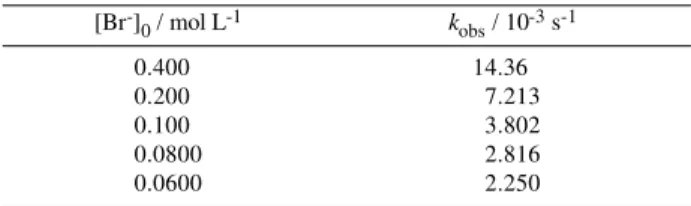
Table 1 presents the first-order rate constants obtained at different bromide concentrations, keeping constant the initial bromate concentration, acid concentration and ionic strength. Since the bromide and acid concentration are both much higher than bromate concentration, a pseudo-first-order condition is satisfied and pseudo-first-pseudo-first-order rate constants could be obtained from plots of log (At+∆t - At) × t (Guggenheim method)15. These plots have shown
excellent linear behavior, confirming the first-order for bromate. The plot log kobs × log [Br-]
0 produced a good
straight line (R2 = 0.998) with slope 0.984 ± 0.022,
indicating a first-order behavior for the bromide too.
Table 1. First-order rate constants for the determination of the bromide order. Constrains: [BrO3-]
0 = 1.00 × 10⁻³ mol L-1; [HClO4]0 = 0.1137 mol L-1; I = 0.55 mol L-1 (adjusted with NaClO
4); T = 25.0 °C. [Br-]
0 / mol L-1 kobs / 10-3 s-1
0.4000 14.3600
0.2000 7.213
0.1000 3.802
0.0800 2.816
0.0600 2.250
Table 2 presents the initial rate values for a wide range of [H+]. The initial bromate and bromide concentrations
were adjusted to allow a convenient time scale to follow the reaction.
Plots of log ν0 × p[H], where p[H] = -log [H+], from
data in Table 2 (which is equivalent to a pH-rate profile16,
plot of log kobs × p[H]) present slopes very close to -2 for all four sets of experiments (see Table 3). These results point out the second-order in [H+] as stated by equation 2.
Figure 1. pH-rate profile of Table 2 data as a plot of log (ν0/[Br-] 0[Br(V)]0) × p[H]. (!) [BrO3-]
0 = 1.00 × 10⁻³ mol L-1, [Br-]0 = 1.00 × 10⁻¹ mol L-1,
I = 0.201 mol L-1; (O) [BrO
3-]0 = 7.00 × 10⁻⁴ mol L-1, [Br-]0 = 5.00 × 10⁻² mol L-1, I = 1.05 mol L-1; (∆) [BrO
3-]0 = 2.00 × 10⁻⁴ mol L-1, [Br-]0 = 1.00 × 10⁻³ mol L-1, I = 3.50 mol L-1; (∇) same as (O) but using stopped-flow technique. T = 25.0 °C.
Table 3. Slope of the linear fitting for the plots of logνo× p[H]. (T = 25.0 °C).
[BrO3-]
0/ [Br-]0/ I/ [H+]0/ Slope log
mol L-1 mol L-1 mol L-1 mol L-1(a) ν
0×p[H] 1.00 × 10⁻³ 1.00 × 10⁻¹ 0.201 0.00500 - 0.100 -2.03 ± 0.03 7.00 × 10⁻⁴ 5.00 × 10⁻² 1.05 0.0361 - 0.572 -2.01 ± 0.06 2.00 × 10⁻⁴ 1.00 × 10⁻³ 3.50 1.032 - 2.772 -2.02 ± 0.14 7.00 × 10⁻⁴ 5.00 × 10⁻² 1.05 0.105 - 1.03 -2.02 ± 0.03(b) (a) adjusted using HClO4; (b) stopped-flow results
Table 2. Initial rate values at 25.0 °C. [BrO3-]
0/ [Br-]0/ I/ [H+]0/ (a) ν0/ mol L-1 mol L-1 mol L-1 mol L-1 (10-6 mol L-1s-1)
1.00 × 10⁻³ 1.00 × 10⁻¹ 0.201 0.00500 0.00467
0.0100 0.01790
0.0150 0.04700
0.0250 0.11200
0.0500 0.47300
0.0750 1.07000
0.100 2.13000
7.00 × 10⁻⁴ 5.00 × 10⁻² 1.05 0.0361 0.107
0.0516 0.242
0.0734 0.513
0.0988 0.917
0.148 2.600
0.197 4.130
0.247 6.900
0.296 9.000
0.347 10.10
0.572 26.00
2.00 × 10⁻⁴ 1.00 × 10⁻³ 3.50 1.032 0.760
1.296 1.370
1.552 1.990
1.772 2.980
2.004 3.600
2.406 4.530
2.772 5.530
7.00 × 10⁻⁴ 5.00 × 10⁻² 1.05 0.105 1.32( b)
0.200 4.49( b)
0.301 9.53 (b)
0.409 16.6 (b)0
0.500 27.8 (b)0
0.600 41.6 (b)0
0.691 55.3 (b)0
0.800 75.5 (b)0
0.900 98.0 (b)0
1.03 124 (b)
(a) adjusted using HClO4; (b) stopped-flow results
Considering the mechanism below (equations 4 to 6) the reactive species against bromide is H2BrO3+.
H2BrO3+ H+ + HBrO
3 (4)
HBrO3 H+ + BrO
3- (5)
H2BrO3+ + Br- products (6)
Using this scheme and considering that the rate-determining step is reaction 6, the rate of reaction, ν, can be given as a function of the total bromine(V) concentration.
[Br(V)] = [H2BrO3+] + [HBrO
3] + [BrO3- ] (7)
( )
2 1 1 2 2 3 2 ] [ ] [ ] ][ [ ] [ K K H K H H V Br BrO H + + = + ++ + (8)ν = k3 [H2BrO3+][Br-] (9)
( )
2 1 1 2 2 3 ] H [ ] H [ ] H ][ V Br ][ Br [ K K K k + + = + − + + ν (10)Where K1 = k1/k-1 and K2 = k2/k-2. At very low H+ concentration equation 10 turns into equation 11 that is identical to equation 2, with the fourth-order rate constant, k, equal to k3/K1K2.
( )
2 12 3[Br ][BrV][H ]
K K
k − +
=
ν (11)
Applying logarithm in both sides one gets equations 12 and 13.
log ν = log {k3[Br-][Br(V)]/K
1K2} + 2 log [H+] (12)
log ν = log {k3[Br-][Br(V)]/K
1K2} - 2 p[H] (13)
In this way, the linear behavior with slope equal -2 observed in Figure 1 and Table 3 indicates that the order with respect to H+ is 2. Most importantly, the H+ concentration is indeed
very low compared with K1 and K2, otherwise the approximation that turns equation 10 into equation 11 would not be valid. This indicates that in our reaction medium
k1
k-1
k2
k-2
we cannot have any protonation equilibrium involving an acid with pKa higher than, approximately, -0.5 and puts an upper limit for the pKa of HBrO3 (pK2).
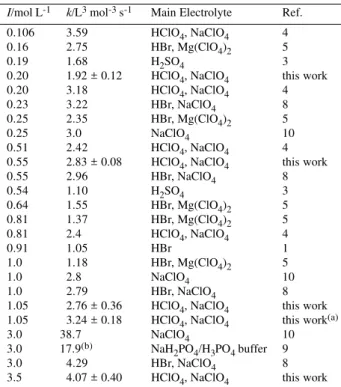
Table 4 shows the fourth-order rate constant, k, at different ionic strengths together with other authors results. Our k values were calculated using the data in Tables 1 and 2 and based on the rate law given by equation 2.
HBr2O3- + Br-→ products (19)
Indeed, their results present an order in [H+] in the range of 1.67 to 1.83. In this way, their results do not agree with the rate law of equation 3. Additionally, we were not able to reproduce their calculated results for the initial rate using their rate constants
k′ = 4.37 L3 mol-3 s-1, k′′ = 0.014 L3 mol-3 s-1 and k′′′ = 0.56 L4 mol-4 s-1. From their data we calculated
rate constants equal to k′ = 17.9 L3 mol-3 s-1,
k′′ = 0.019 L3 mol-3 s-1 and k′′′ = 2.84 × 10⁻⁴ L4 mol-4 s-1 that are quite different from their values, especially for
k′ and k′′′.
On the other hand, we can state that our results support the mechanism represented by equations 4 to 6 that propose that H2BrO3+ is the reactive species to Br-. In addition, our results did not support the proposal of the existence of the intermediates HBr2O3- and H2Br2O3.
As can be seen in Table 4, our values for the fourth-order rate constant are in good agreement with the values obtained by most other authors, especially those of Domínguez and Iglesias8. At high I values our results show an increase in the rate constant with the increase of the ionic strength as has been observed by many authors, but not the very strong increase observed by Burgos et al.10. We are not
able to explain the reason for this disagreement.
Based on the linear behavior shown in the Figure 1 for all sets of experimental data, we concluded that if there is some fast protonation equilibrium (equations 4 and 5) before the determining step, the pKa of these acids cannot be in the p[H] range investigated in this work (-0.44 < p[H] < 2.3). This result is in disagreement with the HBrO3 pKa
values proposed by other authors (see Table 5).
A comparison of the known bromic acid pK2 values (see Table 5) shows that they are very different from each other. We have no indication on how the pK2 value of 0.7 found in the Pourbaix’s Atlas17 was determined. The other
pK2 values of 1.87 and -0.292 were both determined by kinetic experiments and are depend on the proposed mechanism for the reaction. On the other hand, our kinetic results do not allow to determine the pK2 value, but show that all other values in Table 5 are unacceptable. Unfortunately, all attempts we have made to follow this reaction at a still more acid medium did not give us reproducible results, showing that the reaction is too fast to be followed, even by stopped-flow technique.
Table 5. pKa values for bromic acid.
pK2 T/°C Ref.
0.700 - 17
1.870 27 18
-0.292 40 19
Table 4. Selected values of the fourth-order rate constant, k, for reaction 1. T = 25.0 °C.
I/mol L-1 k/L3 mol-3 s-1 Main Electrolyte Ref.
0.106 3.59 HClO4, NaClO4 4
0.16 2.75 HBr, Mg(ClO4)2 5
0.19 1.68 H2SO4 3
0.20 1.92 ± 0.12 HClO4, NaClO4 this work
0.20 3.18 HClO4, NaClO4 4
0.23 3.22 HBr, NaClO4 8
0.25 2.35 HBr, Mg(ClO4)2 5
0.25 3.0 NaClO4 10
0.51 2.42 HClO4, NaClO4 4
0.55 2.83 ± 0.08 HClO4, NaClO4 this work
0.55 2.96 HBr, NaClO4 8
0.54 1.10 H2SO4 3
0.64 1.55 HBr, Mg(ClO4)2 5
0.81 1.37 HBr, Mg(ClO4)2 5
0.81 2.4 HClO4, NaClO4 4
0.91 1.05 HBr 1
1.0 1.18 HBr, Mg(ClO4)2 5
1.0 2.8 NaClO4 10
1.0 2.79 HBr, NaClO4 8
1.05 2.76 ± 0.36 HClO4, NaClO4 this work
1.05 3.24 ± 0.18 HClO4, NaClO4 this work(a)
3.0 38.7 NaClO4 10
3.0 17.9(b) NaH
2PO4/H3PO4 buffer 9
3.0 4.29 HBr, NaClO4 8
3.5 4.07 ± 0.40 HClO4, NaClO4 this work
(a) stopped-flow results; (b) recalculated in this work.
Our results do not show any deviation from the first-order for bromide or bromate, in agreement with other authors1-8.
A closer examination of the data presented by Rábai et al.9
show that their results agree with this too. Surprisingly, Rábai
et al. alleged that they observed a deviation from the first-order on bromide when the concentration of this ion was higher than 0.5 mol L-1. For this reason they proposed a rate law
(equation 3) that includes additional terms with second-order on bromide and first-order on H+, when compared with our
rate law equation 2 . To explain their rate law Rábai et al. proposed the following mechanism:
BrO3- + H+ = HBrO
3 (14)
HBrO3 + H+ = H
2BrO3+ (15)
H2BrO3+ + Br- = H2Br2O3→ products (16)
H2Br2O3 + Br-→ products (17)
HBrO3 + Br- = HBr
Acknowledgments
This work was sponsored by Conselho Nacional de Desenvolvimento Científico e Tecnológico-CNPq, Fundação de Amparo à Pesquisa do Estado do Rio de Janeiro-FAPERJ, Fundação José Bonifácio-FUJB, Financiadora de Estudos e Projetos-FINEP and CEPG-UFRJ.
References
1. Judson, W.; Walker, J. W. J. Chem. Soc.1898, 73, 410. 2. Skrabal, A.; Weberitsch, S. R. Monatsh. Chem.1915,
36, 211.
3. Bray, W. C.; Davis, P. R. J. Am. Chem. Soc.1930,
52, 1427.
4. Young; H. A.; Bray, W. C. J. Am. Chem. Soc.1932,
54, 4284.
5. Bray, W. C.; Liebhafsky, H. A. J. Am. Chem. Soc. 1935, 57, 51.
6. Sclar, M.; Riesch, L. C. J. Am. Chem. Soc. 1936,
58, 667.
7. Clarke, J. R. J. Chem. Educ. 1970, 47, 775. 8. Domínguez, A.; Iglesias, E. Langmuir 1998, 14, 2677. 9. Rábai, Gy.; Bazsa, Gy.; Beck, M. T. Int. J. Chem.
Kinet.1981, 13, 1277.
10. Burgos, F. S.; Graciani, M. del M.; Muñoz, E.; Moya, M. L.; Capitán, M. J.; Galán, M.; Hubbard, C. D.
J. Sol. Chem.1988, 17, 653.
11. Raphael, L. In: Chem. Appl. Bromine its Compounds, 1986, chap. 13, p. 369.
12. Lengyel, I.; Nagy, I.; Bazsa, G. J. Phys. Chem.1989,
93, 2801.
13. Aickin, R. G.; Bayliss, N. S.; Rees, A. L. G. Proc. Roy. Soc.1939, A169, 234.
14.Lotus 1-2-3, version 5; Lotus Development Co., Cambridge, MA, 1995.
15. Connors, K. A. Chemical Kinetics. The Study of Reaction Rates in Solution. VCH, 1990. p. 36. 16. Loudon, G. M. J. Chem. Educ. 1991, 68, 973. 17. Vauleugenhaghe, C.; Valensi, G.; Pourbaix, M. In:
Atlas of Electrochemical Equilibrium in Aqueous Solutions, 2nd ed., Pourbaix, M., ed.; National Association of Corrosion Engineers: Houston, 1974, p. 604. 18. Kamble, D. L.; Nandibewoor, S. T. Int. J. Chem. Kinet.
1996, 28, 673.
19. (a) Laxmi, V. Ph.D. Thesis, Kakatiya University, Warangal, 1978; (b) Reddy, C. S.; Sundaram, E. V.
Int. J. Chem. Kinet.1983, 15, 307; (c) Reddy, C. S.; Sundaram, E. V. Indian J. Chem.1987, 26A, 118; (d) Reddy, C. S. Z. Phys. Chemie(Leipzig) 1989, 5, 1009.
![Figure 1. pH-rate profile of Table 2 data as a plot of log (ν 0 /[Br - ] 0 [Br(V)] 0 )](https://thumb-eu.123doks.com/thumbv2/123dok_br/18988875.459894/3.892.108.456.120.675/figure-rate-profile-table-data-plot-log-br.webp)