ISSN 0104-6632 Printed in Brazil
www.abeq.org.br/bjche
Vol. 26, No. 02, pp. 265 - 273, April - June, 2009
*To whom correspondence should be addressed
Brazilian Journal
of Chemical
Engineering
BIOSORPTION KINETICS OF Cd (II), Cr (III) AND Pb
(II) IN AQUEOUS SOLUTIONS BY OLIVE STONE
M. Calero
*, F. Hernáinz, G. Blázquez,
M. A. Martín-Lara and G. Tenorio
Department of Chemical Engineering, University of Granada, Phone: 34 958 243311, Fax: 34 958 248992, 18071, Granada, Spain.
E-mail: [email protected]*, [email protected], [email protected], [email protected], [email protected]
(Submitted: April 17, 2008 ; Accepted: July 31, 2008)
Abstract - A by-product from olive oil production, olive stone, was investigated for the removal of Cd (II),
Cr (III) and Pb (II) from aqueous solutions. The kinetics of biosorption are studied, analyzing the effect of the initial concentration of metal and temperature. Pseudo-first-order, pseudo-second-order, Elovich and intraparticle diffusion models have been used to represent the kinetics of the process and obtain the main kinetic parameters. The results show that the pseudo-second order model is the one that best describes the biosorption of the three metal ions for all the range of experimental conditions investigated. For the three metal ions, the maximum biosoption capacity and the initial biosorption rate increase when the initial metal concentration rises. However, the kinetic constant decreases when the initial metal concentration increases. The temperature effect on biosorption capacity for Cd (II) and Cr (III) is less significant; however, for Pb (II) the effect of temperature is more important, especially when temperature rises from 25 to 40ºC. The biosorption capacity at mmol/g of olive stone changes in the following order: Cr>Cd>Pb. Thus, for an initial concentration of 220 mg/ℓ, a maximum sorption capacity of 0.079 mmol/g for Cr (III), 0.065 mmol/g for Cd (II) and 0.028 mmol/g for Pb (II) has been obtained.
Keywords: Heavy metals; Biosorption; Olive stone; Kinetics; Wastewater.
INTRODUCTION
Several heavy metals, like chromium, manganese, cadmium, cobalt, copper, zinc, molybdenum, vanadium or iron, are involved in catalytic functions relevant to living beings. However, they can be used by the microorganisms at very low concentrations (trace levels) (WHO / FAO / IAEA, 1996), but the necessary balance has been affected by human activity, that has increased significantly the contributions to the natural environment of metal ions. This contribution presents different anthropogenic routes, which include mining and smelting operations (Costa and Leite, 1990; Groenendijk et al., 1998), discharges of urban waste water (Erlinch, 1997), industrial discharges (Kasan and Stegmann, 1987), waste metals handling (Iñarra
et al., 1989) and the use of fertilizers and pesticides (Basiric et al., 1982; Beiger and Jernelöv, 1986).
technologies for the removal of toxic metals from wastewater (Brady et al., 1999; Pagnanelli et al., 2000; Zhou et al., 2005).
The kinetic study of the biosorption process determines the rate at which the contaminants are removed from the aqueous media. In this sense, numerous kinetic models have been proposed that are capable of describing the mechanism through which the biosorption process takes place. This mechanism is, in most cases, complex and can cause chemical reactions between sorbent functional groups and metal ions, ionic interchange reactions and/or formation of complexes; in addition, mass transfer processes such as the transportation of substances in the liquid phase, diffusion from the liquid phase to the surface of the solid and diffusion in the interior of the macropores and micropores must be taken into consideration.
In this paper, the kinetics of biosorption of Cd (II), Cr (III) and Pb (II) using olive stone as solid sorbent are studied, analyzing the effect of the initial concentration of metal and temperature. Pseudo-first-order, pseudo-second-Pseudo-first-order, Elovich and intraparticle diffusion models have been used to represent the kinetics of the process and obtain the main kinetic parameters.
EXPERIMENTAL Preparation of Biosorbent
Olive stones were supplied by the orujo oil extraction plant ‘‘Cooperativa Nuestra Señora del Castillo’’ located in Vilches, province of Jaen, Spain.
The olive stones supplied by the plant were milled in the laboratory from an initial size range of 4 mm to a fraction smaller than 1 mm, which is the solid used for the entire test. Previous tests studied the effect of particle size on the biosorption process and determined that the best results were achieved for the fractions between 0.250 and 1.00 mm and that this size range represented over 70% of the total milled stone mass (Blázquez et al., 2005). As a result, it was decided that milled stone would be used straight from the mill with a 1 mm sieve-separator, with no subsequent screening for sorting according to size.
Batch Experiments
The experiments were performed by mixing 0.5 g of olive stone in 50 mL of the synthetic metal ion solutions with a predetermined concentration of metal ion. Three heavy metals (Cd2+, Cr3+ and Pb2+)
were selected as a modelled metal species. Solutions of these heavy metals were prepared in distilled water using the metal salts (CH3COO)2Cd·2H2O,
Cr(NO3)3·9H2O and Pb(NO3)2, respectively.
These solutions were placed in a 100 mℓ jacketed reactor connected to a thermostat-controlled bath, the pH of the solution was adjusted with 0.1M HCl or 0.1M NaOH solutions and the temperature set at the desired value.
Once the operation time had elapsed, the liquid phase was taken out of the reactor and centrifuged for 10 min; then the supernatant solution was filtered and analysed for metal concentrations by a flame atomic absorption (AA) spectrophotometer (Perkin Elmer Model 3100). The amount of metal ions sorbed at equilibrium per unit mass of biosorbent was determined according to the following equation:
(
i e)
t
C C
q V
m −
= ⋅ (1)
where qt is the metal uptake at equilibrium,
expressed as mg metal/g of the biosorbent, V, the liquid volume, in ℓ, Ci, the initial concentration of
metal in the solution, in mg/ℓ, Ce, the equilibrium
concentration of the metal in the solution, in mg/ℓ, and m the amount of the biosorbent sample on a dry basis, in g.
Each experiment was carried out at least twice to check reproducibility of the results and biomass-free blanks were used as control.
RESULTS AND DISCUSSION
To study the kinetics of biosorption of Cd (II), Cr (III) and Pb (II) by olive stone as a solid sorbent, four of the main models proposed in the literature have been selected for the adjustment of the experimental results obtained and to determine the kinetic parameters.
Pseudo-First Order Model
The pseudo-first order equation (Lagergren, 1898), is generally expressed as follows:
t
1 e t dq
k (q q )
dt = − (2)
where qe and qt are the sorption capacity at
Brazilian Journal of Chemical Engineering Vol. 26, No. 02, pp. 265 - 273, April - June, 2009
By integrating this expression between the limits t = 0, qt = 0 and t = t, qt = qt, the following equation is
obtained:
e t 1
e
q q k
log t
q 2.303
⎛ − ⎞=−
⎜ ⎟
⎝ ⎠ (3)
By plotting the value of log((qe-qt)/qe) versus t,
the value of the rate constant k1 can be obtained from
the slope.
Pseudo-Second Order Model
Pseudo-second order kinetics can be expressed through the following equation (Ho and McKay, 2000),
2 t
s2 e t dq
k (q q )
dt = − (4)
where ks2 is the pseudo-second order rate constant, in
g/mg·min.
By integrating this equation between the limits t = 0, qt = 0 y t = t, qt = qt, the following equation is
obtained:
t e
t 1 1 t
q = +h q (5)
where h = ks2·qe2 is the initial sorption rate, in
mg/g·min
By plotting t/qt versus t, the values of qe and ks2
can be obtained from the slope and the intercept, respectively.
Elovich Model
The Elovich equation has been used for describing reactions involving chemisorption of gases on a solid surface, but also for simulating sorption kinetics in a liquid phase. The Elovich equation can be written as (Günay et al., 2007):
t
t dq
a exp ( b q )
dt = − (6)
where a and b are the model parameters. The parameter a is the initial adsorption rate, in mg/g·min, and the parameter b is related to the occupied surface, in g/mg.
To simplify the Elovich equation, Chien and Clayton (1980) assumed that a·b·t >> t and, given
that for t = 0, qt = 0 and for t = t, qt = qt, the final
form of the equation is:
t
1 1
q ln (a b) ln (t)
b b
= + (7)
By plotting qt versus ln(t), the values of the
parameterscan be obtained.
Intraparticle Diffusion Model
The intraparticle diffusion equation can be expressed as (Weber and Morris, 1963),
a id
R K= t (8)
where R is the percent of metal biosorbed, t is the contact time, in min, a is an dimensionless constant and Kid is the intraparticle diffusion rate constant, in
min-a.
This expression can be converted into another one that determines the value of the biosorption capacity at any time t (amount of metal ion sorbed at time t), qt, because the percent of metal removed, R, and qt
can be related by the corresponding expressions for qt and R. Then, the values of the biosorption capacity
at any time t, qt, are obtained from Equation 1 and
the percent of metal removed, R, from the following equation:
i f i (C C )
R 100
C −
= ⋅ (9)
Ci and Cf being the initial and final metal
concentrations, respectively, in mg/ℓ, V the solution volume, in ℓ, and m the amount of biosorbent, in g.
In this manner, the percent of metal biosorbed, R, can be expressed as a function of the biosorption capacity at any time t, qt, by the following equation:
t i q m 100 R
C V
= (10)
Considering this equation, the intraparticle diffusion model can be written as:
a ' a i
t id id
C V
q K t K t
m 100
= = (11)
where qt is the biosorption capacity at any time t, in
dimensionless constant and K’id is the new
intraparticle diffusion rate constant, in mg/g·min-a By plotting ln(qt) versus ln(t), the values of a and
K’id can be obtained from the slope and the intercept,
respectively.
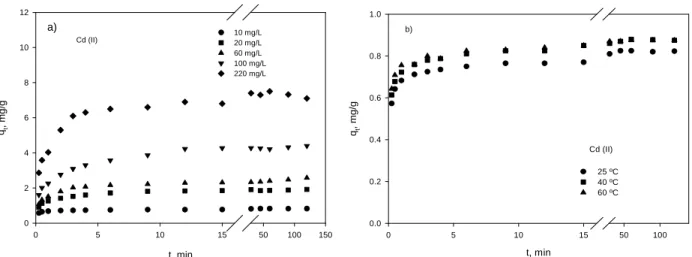
In this work, the influence of initial metal concentration and temperature on the kinetics of cadmium, chromium and lead biosorption using olive stone as sorbent was studied. For this, experimental tests were carried out varying the initial metal concentration from 10 to 220 mg/ℓ (keeping the temperature constant at 25ºC) and changing the
temperature from 25 to 60ºC (at an initial metal concentration of 10 mg/ℓ). In Figures 1, 2 and 3 the biosorption capacity values, qt, versus time, t, are
shown for cadmium, chromium and lead, respectively.
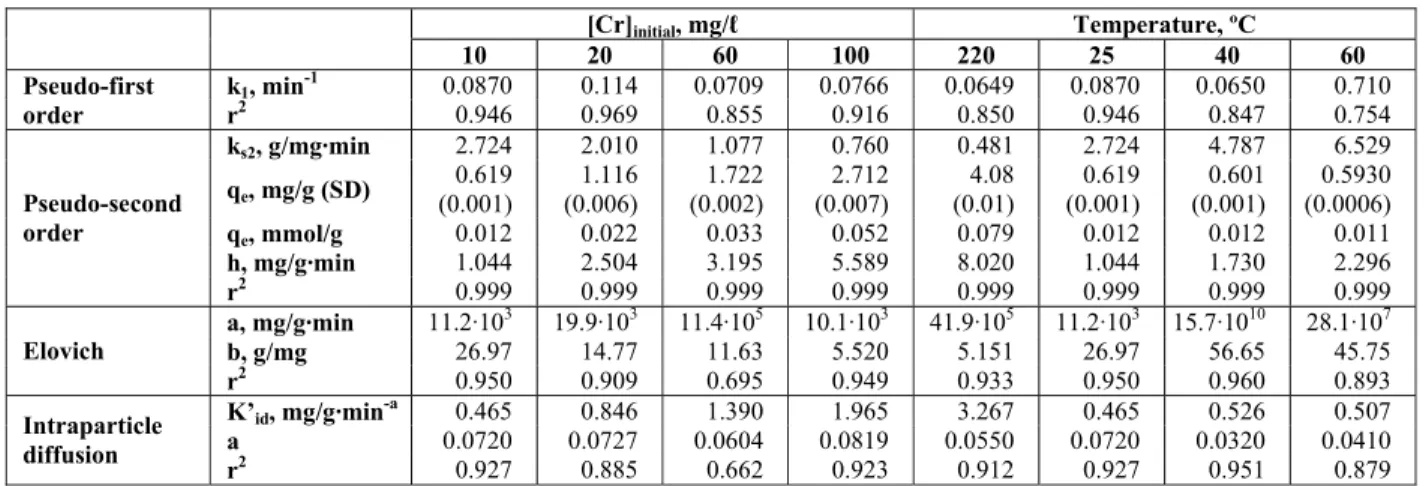
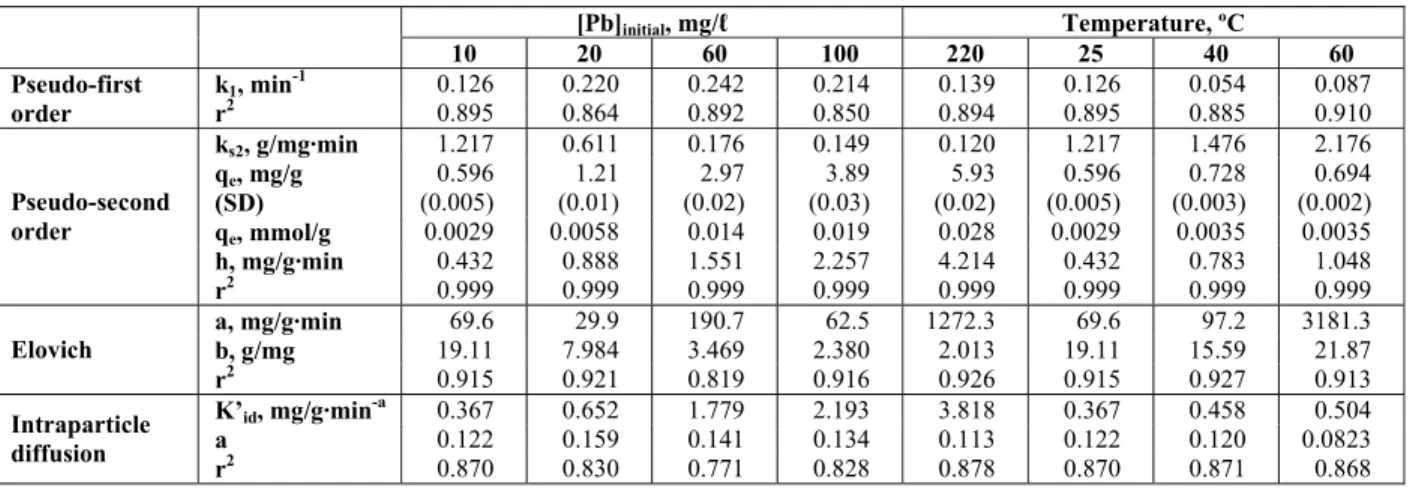
The results were fitted by linear regression to the four kinetic models chosen: pseudo-first order, pseudo-second order, Elovich and intraparticle diffusion. Tables 1, 2 and 3 report the parameter values obtained from the application of the kinetic models for cadmium, chromium and lead ions, respectively.
Cd (II)
t, min
0 5 10 15 50 100 150
q, mt
g
/g
0 2 4 6 8 10 12
10 mg/L 20 mg/L 60 mg/L 100 mg/L 220 mg/L Cd (II)
a)
t, min
0 5 10 15 50 100
qt
, m
g
/g
0.0 0.2 0.4 0.6 0.8 1.0
25 ºC 40 ºC 60 ºC b)
Cd (II)
Figure 1: Biosorption capacity of olive stone for Cd (II) versus operation time: a) different initial metal concentrations; b) different temperatures.
t, min
0 5 10 15 50 100 150
q, mg/gt
0 2 4 6 8 10
10 mg/L 20 mg/L 60 mg/L 100 mg/L 220 mg/L
Cr (III)
a)
Brazilian Journal of Chemical Engineering Vol. 26, No. 02, pp. 265 - 273, April - June, 2009 t, min
0 5 10 15 50 100 150
q, mgt
/g
0 2 4 6 8 10
10 mg/L 20 mg/L 60 mg/L 100 mg/L 220 mg/L
Pb (II) a)
Figure 3: Biosorption capacity of olive stone for Pb (II) versus operation time: a) different initial metal concentrations; b) different temperatures.
Table 1: Parameters values of the kinetic models for the biosorption of Cd (II) by olive stone
[Cd]initial, mg/ℓ Temperature, ºC
10 20 60 100 220 25 40 60
k1, min-1 0.0797 0.158 0.109 0.117 0.116 0.0797 0.0656 0.0853
Pseudo-first
order r2 0.901 0.954 0.836 0.831 0.908 0.901 0.872 0.894
ks2, g/mg·min 2.604 0.833 0.474 0.219 0.130 2.604 2.854 3.549
qe, mg/g
(SD)
0.826 (0.002)
1.910 (0.007)
2.52 (0.03)
4.40 (0.02)
7.33 (0.06)
0.826 (0.002)
0.880 (0.002)
0.878 (0.001)
qe, mmol/g 0.0074 0.017 0.022 0.039 0.065 0.0074 0.0078 0.0078
h, mg/g·min 1.778 3.041 3.020 4.240 6.991 1.778 2.208 2.734
Pseudo-second order
r2 0.999 0.999 0.998 0.999 0.999 0.999 0.999 0.999
a, mg/g·min 19.8·105 564.7 284.2 93.19 403.3 19.8·105 20.4·105 52.5·106
b, g/mg 26.51 6.277 4.467 2.097 1.371 26.51 24.71 28.59
Elovich
r2 0.941 0.878 0.910 0.906 0.860 0.941 0.929 0.911
K’id, mg/g·min-a 0.668 1.270 1.555 2.416 4.403 0.668 0.715 0.737
a 0.0526 0.110 0.124 0.159 0.141 0.0526 0.0529 0.0449
Intraparticle diffusion
r2 0.914 0.835 0.853 0.870 0.807 0.914 0.903 0.888
Table 2: Parameters values of the kinetic models for the biosorption of Cr (III) by olive stone
[Cr]initial, mg/ℓ Temperature, ºC
10 20 60 100 220 25 40 60
k1, min-1 0.0870 0.114 0.0709 0.0766 0.0649 0.0870 0.0650 0.710
Pseudo-first
order r2 0.946 0.969 0.855 0.916 0.850 0.946 0.847 0.754
ks2, g/mg·min 2.724 2.010 1.077 0.760 0.481 2.724 4.787 6.529
qe, mg/g (SD)
0.619 (0.001)
1.116 (0.006)
1.722 (0.002)
2.712 (0.007)
4.08 (0.01)
0.619 (0.001)
0.601 (0.001)
0.5930 (0.0006)
qe, mmol/g 0.012 0.022 0.033 0.052 0.079 0.012 0.012 0.011
h, mg/g·min 1.044 2.504 3.195 5.589 8.020 1.044 1.730 2.296
Pseudo-second order
r2 0.999 0.999 0.999 0.999 0.999 0.999 0.999 0.999
a, mg/g·min 11.2·103 19.9·103 11.4·105 10.1·103 41.9·105 11.2·103 15.7·1010 28.1·107
b, g/mg 26.97 14.77 11.63 5.520 5.151 26.97 56.65 45.75
Elovich
r2 0.950 0.909 0.695 0.949 0.933 0.950 0.960 0.893
K’id, mg/g·min-a 0.465 0.846 1.390 1.965 3.267 0.465 0.526 0.507
a 0.0720 0.0727 0.0604 0.0819 0.0550 0.0720 0.0320 0.0410
Intraparticle diffusion
Table 3: Parameters values of the kinetic models for the biosorption of Pb (II) by olive stone
[Pb]initial, mg/ℓ Temperature, ºC
10 20 60 100 220 25 40 60
k1, min-1 0.126 0.220 0.242 0.214 0.139 0.126 0.054 0.087
Pseudo-first
order r2 0.895 0.864 0.892 0.850 0.894 0.895 0.885 0.910
ks2, g/mg·min 1.217 0.611 0.176 0.149 0.120 1.217 1.476 2.176
qe, mg/g
(SD)
0.596 (0.005)
1.21 (0.01)
2.97 (0.02)
3.89 (0.03)
5.93 (0.02)
0.596 (0.005)
0.728 (0.003)
0.694 (0.002)
qe, mmol/g 0.0029 0.0058 0.014 0.019 0.028 0.0029 0.0035 0.0035
h, mg/g·min 0.432 0.888 1.551 2.257 4.214 0.432 0.783 1.048
Pseudo-second order
r2 0.999 0.999 0.999 0.999 0.999 0.999 0.999 0.999
a, mg/g·min 69.6 29.9 190.7 62.5 1272.3 69.6 97.2 3181.3
b, g/mg 19.11 7.984 3.469 2.380 2.013 19.11 15.59 21.87
Elovich
r2 0.915 0.921 0.819 0.916 0.926 0.915 0.927 0.913
K’id, mg/g·min-a 0.367 0.652 1.779 2.193 3.818 0.367 0.458 0.504
a 0.122 0.159 0.141 0.134 0.113 0.122 0.120 0.0823
Intraparticle diffusion
r2 0.870 0.830 0.771 0.828 0.878 0.870 0.871 0.868
As can be observed, the pseudo-second order model is the one that best describes the biosorption of the three metal ions for all the range of experimental conditions investigated. For Cd (II) (Table 1), as the initial metal concentration rises, the maximum biosorption capacity, qe, and the initial
biosorption rate, h, increase, changing from 0.826 to 7.33 mg/g and from 1.778 to 6.991 mg/g·min, respectively. However, the kinetic constant decreases when the initial cadmium concentration is increased. This indicates that, although biosorption increases rapidly with an increase in the initial concentration, the process subsequently proceeds more slowly until equilibrium is reached, as observed in Figure 1. The temperature effect on biosorption capacity is less significant, as can seen in Figure 1 and in the parameter values of the pseudo-second order model (Table 1), although an increase in the initial sorption rate is produced as temperature rises.
For Cr (III) (Table 2), the results are similar to those obtained for Cd (II), that is, the maximum sorption capacity and the initial sorption rate increase with the initial metal concentration, although the kinetic constant decreases; this indicates a similar behaviour of olive stone in the biosorption of these two metal ions. Likewise, the temperature effect on the biosorption kinetics of chromium is not very important, but an increase of the kinetic constant and the initial sorption rate is produced, especially when the temperature is increased from 25 to 40ºC.
For Pb (II) (Table 3), the effect of the initial metal concentration on biosorption kinetics is similar to that obtained for the other two metal ions, that is, an increase is produced in the maximum sorption capacity and the initial sorption rate and a decrease
in the kinetic constant for the range of process variables investigated. However, the effect of temperature is more important, especially when temperature increases from 25 to 40ºC, where an increase of the maximum biosorption capacity from 0.596 to 0.728 mg/g is produced. The initial sorption rate and kinetic constant are also increased when temperature is increased.
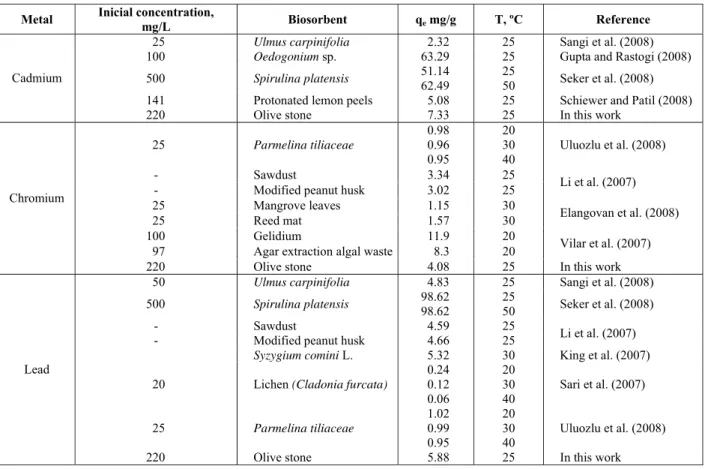
Table 4 shows the biosorption capacities obtained by other authors using the pseudo-second order kinetic model for the experimental conditions specified in the table, in order to compare the results obtained with olive stone to those of other biosorbents for the three metals studied.
Brazilian Journal of Chemical Engineering Vol. 26, No. 02, pp. 265 - 273, April - June, 2009
Table 4: Comparison of biosorption capacity of olive stone with that of different biomasses (pseudo-second order kinetic model)
Metal Inicial concentration,
mg/L Biosorbent qe mg/g T, ºC Reference
25 Ulmus carpinifolia 2.32 25 Sangi et al. (2008)
100 Oedogonium sp. 63.29 25 Gupta and Rastogi (2008)
500 Spirulina platensis 51.14
62.49
25
50 Seker et al. (2008)
141 Protonated lemon peels 5.08 25 Schiewer and Patil (2008)
Cadmium
220 Olive stone 7.33 25 In this work
25 Parmelina tiliaceae
0.98 0.96 0.95
20 30 40
Uluozlu et al. (2008)
- Sawdust 3.34 25
- Modified peanut husk 3.02 25 Li et al. (2007)
25 Mangrove leaves 1.15 30
25 Reed mat 1.57 30 Elangovan et al. (2008)
100 Gelidium 11.9 20
97 Agar extraction algal waste 8.3 20 Vilar et al. (2007)
Chromium
220 Olive stone 4.08 25 In this work
50 Ulmus carpinifolia 4.83 25 Sangi et al. (2008)
500 Spirulina platensis 98.62
98.62
25
50 Seker et al. (2008)
- Sawdust 4.59 25
- Modified peanut husk 4.66 25 Li et al. (2007)
Syzygium comini L. 5.32 30 King et al. (2007)
20 Lichen (Cladonia furcata)
0.24 0.12 0.06
20 30 40
Sari et al. (2007)
25 Parmelina tiliaceae
1.02 0.99 0.95
20 30 40
Uluozlu et al. (2008) Lead
220 Olive stone 5.88 25 In this work
The activation energy for metal ion biosorption was calculated from the pseudo-second order constants by the Arrhenius equation. Its linear form is:
a 0
E 1n k 1n A
R T
= − (12)
where A0 is the temperature independent Arrhenius
constant, Ea is the activation energy, in kJ/mol, R is
the gas constant, 8.314·10-3 kJ/mol·K and T is the temperature, in K. The activation energy values calculated for Cd (II), Cr (III) and Pb (II) were 7.37, 20.38 and 13.80 kJ/mol, respectively, and the correlation coefficients were good, higher than 0.95. The low activation energy values suggest that the strength involved in the metal ion and solid surface interaction is physical. These results are similar to those found by other researchers; thus, Han et al. (2006) reported an Ea = 2.10 kJ/mol for the
biosorption of Pb (II) by manganese oxide coated sand; Vilar et al. (2005) studied the biosorption of Pb (II) by Gelidium and found an Ea = 41.6 kJ/mol; Lee
et al. (1995), studying Cr (III) sorption using moss,
obtained an Ea value of 27.28 kJ/mol; Krishnan and
Anirudhan (2003), by studying the removal of Cd (II) from aqueous solutions by steam-activated sulfurised carbon prepared from sugar-cane bagasse pith, obtained an Ea = 18.28 kJ/mol.
CONCLUSIONS
The biosorption kinetics of Cd (II), Cr (III) and Pb (II) using olive stone as sorbent is well represented by the pseudo-second order model under all operating conditions tested. For the three metals, the maximum sorption capacity and the initial sorption rate rise as the initial metal concentration increases, while the kinetic constant of the process decreases, indicating that the biosorption occurs faster in its initial phase if the initial metal concentration is increased and then, in a second phase, the biosorption takes place slower until equilibrium is reached.
significant, while for lead an increase in the sorption capacity from 0.596 to 0.728 mg/g is produced when the temperature rises from 25 to 40ºC. The kinetic constant and the initial sorption rate increase as the temperature rises for the three metal ions.
The biosorption capacity of olive stone changes in the following order: Cr>Cd>Pb. Thus, for an initial concentration of 220 mg/ℓ, a maximum sorption capacity of 0.079 mmol/g for Cr (III), 0.065 mmol/g for Cd (II) and 0.028 mmol/g for Pb (II) has been obtained.
ACKNOWLEDGEMENTS
The authors are grateful to the Ministerio de Educación y Ciencia for the financial support received (Projet CTM2005-03957/TECNO) for the realization of this work.
REFERENCES
Ansari, M. I. and Malik, A., Biosorption of nickel and cadmium by metal resistant bacterial isolates from agricultural soil irrigated with industrial wastewater, Bioresource Technology, 98, No. 16, 3149-3153 (2007).
Basiric, D., Lulic, S. and Miletic, P., Radium and uranium in phosphate fertilisers and their impact on the radioactivity of waters, Water Research, 26, No. 5, 607-611 (1982).
Beiger, K. and Jernelöv, A., General aspect of specific data on ecological effects of metals, In: Handbook on the Toxicology of Metals, Elsevier Science Publishers, New York (1986).
Blázquez, G., Hernáinz, F., Calero, M. and Ruiz-Núñez, L. F., Removal of cadmium ions with olive stones: the effect of some parameters, Process Biochemistry, 40, No. 8, 2649-2654 (2005).
Brady, J. M., Tobin, J. M. and Roux, J. C., Continuous fixed bed biosorption of Cu2+ ions: application of a simple two parameters mathematical model, Journal of Chemical Technology and Biotechnology, 74, No. 1, 71-77 (1999).
Chien, S. H. and Clayton, W. R., Application of Elovich equation to the kinetics of phosphate release and sorption on soils, Soil Science Society of America Journal, 44, No. 2, 265-268 (1980). Chong, K. H. and Volesky, B., Metal biosoption
equilibria in a ternaty system, Biotechnology and Bioengineering, 49, No. 6, 629-638 (1996).
Costa, A. C. A. and Leite, S. G. F., Cadmium and zinc bioadsorption by Chorella homosphera, Biotechnology Letters, 12, No. 12, 941-944 (1990).
Elangovan, R., Philip, L. and Chandraraj, K., Biosorption of chromium species by aquatic weeds: kinetics and mechanism studies, Journal of Hazardous Materials, 152, No. 1, 100-112 (2008).
Erlinch, H. L., Microbes and Metals, Applied Microbiology and Biotechnology, 48, No. 6, 687-692 (1997).
Groenendijk, D., Zeinstra, L. W. M. and Postma, J. F., Fluctuanting asymmetry and mentus gaps in populations of the midge Chironomus riparus (diptera: Chironomidade) from a metal contaminated river, Environmental Toxicology and Chemistry, 17, No. 10, 1999-2005 (1998). Günay, A., Arslankaya, E. and Tosun, I., Lead
removal from aqueous solution by natural and pretreated clinoptilolite: adsorption equilibrium and kinetics, Journal of Hazardous Materials,
146, No. 1-2, 362-371 (2007).
Gupta, V. K. and Rastogi, A., Equilibrium and kinetic modelling of cadmium (II) biosorption by nonliving algal biomass Oedogonium sp. from aqueous phase, Journal of Hazardous Materials, 153, No. 1-2, 759-766 (2008).
Han, R., Zou, W., Zhang, Z., Shi, J. and Yang, J., Removal of copper (II) and lead (II) from aqueous solution by manganese oxide coated sand I. Characterization and kinetic study,Journal of Hazardous Materials, 137, No. 1, 384–395 (2006).
Ho Y. S. and Mckay, G.,The kinetics of sorption of divalent metal ions onto sphagnum moss peat, Water Research, 34, No. 3, 735-742 (2000). Iñarra, I. A. L., Cancio, D. and Del Potro, R.,
Residuos radiactivos. Ministerio de Obras Públicas, Unidades Temáticas Ambientales, Dirección General de Medio Ambiente, Madrid (1989).
Kasan, H. C. and Stegmann, P., Intracellular bioaccumulation of zinc by an Entorobacter species, Microbios, 51, No. 207, 89-96 (1987). King, P., Rakesh, N., Beenalahari, S., Kumar, Y. P.
and Prasad, V. S. R. K., Removal of lead from aqueous solution using Syzygium cumini L.: equilibrium and kinetic studies, Journal of Hazardous Materials, 142, No. 1-2, 340-347 (2007).
Brazilian Journal of Chemical Engineering Vol. 26, No. 02, pp. 265 - 273, April - June, 2009
sugar-cane bagasse pith: kinetics and equilibrium studies, Water SA, 29, No. 2, 147-156 (2003). Lagergren, S.,Zur theorie der sogenannten
adsorption geloster stoffe, Kungliga Svenska Vetenskapsakademiens Handlingar,24, No. 4, 1-39 (1898).
Lee, C. K., Low, K. S. and Kek, K. L., Removal of chromium from aqueous solution, Bioresouce Technology, 54, No. 2, 183-189 (1995).
Li, Q., Zhai, J., Zhang, W., Wang, M. and Zhou, J., Kinetic studies of adsorption of Pb(II), Cr(III) and Cu(II) from aqueous solution by sawdust and modified peanut husk, Journal of Hazardous Materials, 141, No. 1, 163-167 (2007).
Pagnanelli, F., Papini, M.P., Toro, L., Trifoni, M. and Vegliò, F., Biosorption of metal ions on Arthrobacter sp.: biomass characterization and biosorption modelling, Environmental Science & Technology, 34, No. 13, 2773-2778 (2000). Pradhan, S. and Rai, L. C., Biotechnological
potential of Microcystis sp. in Cu, Zn and Cd biosorption from single and multimetallic systems, Biometals, 14, No. 1, 67-74 (2001). Sangi, M. R., Shahmoradi, A., Zolgharnein, J.,
Azimi, G. H. and Chorbandoost, M., Removal and recovery of heavy metals from aqueous solution using Ulmus carpinifolia and Fraxinus excelsior tree leaves, Journal of Hazardous Materials, 155, No. 3, 513-522 (2008).
Sari, A., Tuzen, M., Uluozlu, O. D. and Soylak, M., Biosorption of Pb(II) and Ni(II) from aqueous solution by lichen (Cladonia furcata) biomass, Biochemical Engineering Journal, 37, No. 2, 151-158 (2007).
Schiewer, S. and Patil, S. B., Pectin-rich fruit wastes as biosorbents for heavy metal removal: equilibrium and kinetics, Bioresource Technology, 99, No. 6, 1896-1903 (2008).
Seker, A., Shahwan, T., Eroglu, A. E., Yilmaz, S.,
Demirel, Z. and Dalay, M. C., Equilibrium, thermodynamic and kinetic studies for the biosorption of aqueous lead(II), cadmium(II) and nickel(II) ions on Spirulina platensis, Journal of Hazardous Materials, 154, No. 1-3, 973-980 (2008).
Tobin, J. M., Cooper, D. G. and Neufeld, R. J., Uptake of metal ions by Rhizopus arrhizus biomass, Applied and Environmental Microbiology, 47, No. 4, 821-824 (1984).
Uluozlu, O. D., Sari, A., Tuzen, M. and Soylak, M., Biosorption of Pb(II) and Cr(III) from aqueous solution by lichen (Parmelina tiliaceae) biomass, Bioresource Technology, 99, No. 8, 2972-2980 (2008).
Vilar, V. J. P., Botelho, C. M. S. and Boaventura, R. A. R., Influence of pH, ionic strength and temperature on lead biosorption by Gelidium and agar extraction algal waste, Process Biochemistry, 40, No. 10, 3267-3275 (2005).
Vilar, V. J. P., Botelho, C. M. S. and Boaventura, R. A. R., Chromium and zinc uptake by algae Gelidium and agar extraction algal waste: kinetics and equilibrium, Journal of Hazardous Materials, 149, No. 3, 643-649 (2007).
Vílchez, R., Eliminación de metales pesados en aguas mediante sistemas de lechos sumergidos: estudio microbiológico en las biopelículas. Ph.D. Thesis, University of Granada (2005).
Weber, W. J. and Morris, J. C., Kinetic of adsorption on carbon from solution, Journal of Sanitary Engineering Division, Proceedings of the American Society of Civil Engineers, 89, 31-60 (1963).
WHO/FAO/IAEA, Trace elements in human nutrition and health, Geneva: World Health Organization (1996).