Cyclic Polarization Study of Thick Welded Joints of Lean Duplex Stainless Steel for
Application in Biodiesel Industry
Dalila Chaves Sicupiraa,c*, Ronaldo Cardoso Juniorb, Alexandre Queiroz Bracarenseb, Gerald S.
Frankelc, Vanessa de Freitas Cunha Linsa
Received: May 13, 2016; Revised: September 26, 2016; Accepted: November 21, 2016
Thick welded joints of UNS S32304 lean duplex stainless steel (LDSS) has been studied in acidiied
glycerin, a byproduct of biodiesel plants, using cyclic polarization technique. LDSS S32304 thick
plates were welded by diferent processes commonly employed in the fabrication process: shielded metal arc welding, gas metal arc welding and lux cored arc welding. The electrochemical behavior of diferent weldment zones was characterized. Transmission electron microscopy and scanning electron microscopy (SEM) were used for sample characterization. SEM images showed that the heat afected
zone was the most critical zone for pitting corrosion for all samples. The results were associated to the microstructural features of the materials. Generally, the breakdown potential of the top regions of
welds was higher in acidiied glycerin than the weld root for welds fabricated with two diferent iller
metals. Basically, all the welded samples exhibited similar or higher corrosion resistance, compared with the corresponding base metal.
Keywords: corrosion, duplex stainless steel, welding process, acidiied glycerin
* e-mail: [email protected]
1. Introduction
Duplex stainless steels (DSSs) are materials that exhibit a combination of high yield strength, toughness and localized corrosion resistance, and they are being widely used in chemical, petrochemical, marine, nuclear and paper industry1.
The best properties are obtained with approximately equal
amount of austenite (γ) and ferrite (α) phases2.
Volatility of the Ni price has led to development of low alloy duplex steels3. The nickel content is partly replaced by
manganese and nitrogen and also the molybdenum content is reduced in the so-called lean DSS (LDSS)4.
Exposure to high temperatures, for example during welding, can result in deterioration of DSS2-14. During welding,
DSS undergoes microstructural changes that impact on their mechanical and corrosion properties, especially corrosion resistance and toughness2-14. The degradation comes from
the unbalanced duplex phase fraction with excess of ferrite phase and the precipitation of deleterious secondary phases
such as chromium nitrides, secondary austenite (γ2), sigma (σ), chi (χ), etc.2-9. A great number of investigations have
been carried out on welded DSS joint1-12. Although multipass
welding is more common during fabrication, reports about multipass welding are scarce, especially for pipes of medium thickness or more.
The localized corrosion of stainless steels is related to alloying elements as Cr, Mo and N, whereas Ni mainly acts to stabilize the austenite phase13-15. A great number of investigations have studied the efect of alloying elements
on corrosion resistance of stainless steels, especially N,
which is most efective 6,8,13,16,17. According to Hsieh et al.18, a
higher content of nitrogen and nickel favors the reformation
of austenite. However, the efect of the nitrogen on the
reformation of austenite is much greater than that of nickel. Hsieh et al.18 also showed that the efect of manganese on the
formation of austenite can be negligible. Bhatt et al.19 found
that the presence of 5 and 10% nitrogen in the shielding gas, decreases the ferrite contents to 35 and 29%, respectively, resulting in an improved pitting corrosion resistance of the weldments obtained by gas tungsten arc. According to Mesquita
et al.15 the general corrosion resistance of Mo-containing DSS grades is increased. Mo has a stronger beneicial efect
on the corrosion resistance of ferrite compared to austenite. The pitting corrosion resistance of 2304 DSS welded by autogenous plasma-arc was evaluated by Tan et al.20. In this
study, the as-welded samples showed impaired corrosion resistance and pitting preferentially occurred at ferrite
grains in the heat afected zone (HAZ) near the fusion line.
In another study in welded joints of 2304 DSS, Chen et al.8
found pits occurring in the ferrite phase for all simulated
a Chemical Engineering Department, Universidade Federal de Minas Gerais, Belo Horizonte, MG,
Brazil
b Mechanical Engineering Department, Universidade Federal de Minas Gerais, Belo Horizonte, MG,
Brazil
HAZ specimens and the corrosion resistance of welded joints is inluenced by Cr2N and inclusions. According to their results, the corrosion resistance of the HAZ in 2304
DSS decreased with the cooling rate.
Based on that, this study aims to evaluate the corrosion resistance of UNS S32304 LDSS thick plates welded by
three diferent welding processes in acidiied glycerin, a
byproduct of biodiesel industry.
2. Experimental Procedures
2.1. Materials
Three diferent welding processes were used: shielded
metal arc welding (SMAW), gas metal arc welding
(GMAW) and lux cored arc welding (FCAW). For each welding process, two iller metals with diferent chemical
compositions, (23%Cr 7%Ni) and (22%Cr 9%Ni 3%Mo) were evaluated. The shielding gas for GMAW process was a ternary gas of 95%Ar, 3%CO2 and 2%N2, while for FCAW process a shielding gas with 75% Ar and 25%CO2 was used.
The same shielding gas low rate of 18 L.min-1 was utilized
for all welding processes.
The electrochemical behavior of diferent weldment zones (fusion zone (FZ), base metal (BM) and heat afected zone (HAZ)) was characterized in the top and root of the specimens.
The chemical composition of the LDSS is shown in Table 1. This work is a part of a global project to study the weldability of the UNS S32304 alloys21. The iller metals
compositions, the welding parameters and the sample preparation for electrochemical tests were described by the authors in a previous work22.
2.2. Microstructural characterization
Microstructural examination of specimens was conducted using an optical microscope (Olympus PME 3, LECO). After polishing, the specimens were then electrolytically etched in 10% oxalic acid electrolyte at 6 V for 60 s. A Tecnai G2-20
- SuperTwin FEI - 200kV transmission electron microscope (TEM) was used for identiication of the precipitates in LDSS.
After the polarization tests, microstructural observations were carried out using scanning electron microscopy (SEM,
Quanta 200F, FEI).
2.3. Electrochemical measurements
The tests were performed at a temperature of 65±1°C and under constant stirring to simulate the operational
conditions in the pipes of biodiesel plants. A conventional three-electrode cell was used, the working electrodes being prepared from the LDSS welded samples with an exposed surface of approximately 1 cm2. The reference was a saturated
calomel electrode (SCE) and a Pt mesh was used as the counter electrode.
Cyclic potentiodynamic polarization tests were performed
in an industrial acidiied glycerin provided by a biodiesel plant
with 49.5 wt.% glycerin, 29 wt.% methanol, 17 wt.% water, 3 wt.% NaCl, and 1.5 wt.% organic materials, pH=6.2 and conductivity of 4.9 mS/cm. An Ivium compactstat potentiostat was used to measure the open circuit potential (OCP) for 1 h and the cyclic potentiodynamic polarization curves were then measured at a scan rate 0.167 mV/s from the open circuit potential (OCP) until the current density reached 5 mA.cm-2 at
which point the scanning direction was then reversed. Three replicate tests of each measurement were performed.
3. Results and discussion
3.1. Microstructure
Similarly to previous investigations22, the fusion zone (FZ) structure consists of austenite grains in the form of Widmanstätten plate precipitates and secondary austenite (γ2) within a matrix of ferrite, and also, FZ region showed higher proportions of austenite than HAZ. The presence of secondary austenite (γ2) can be veriied in FZ, as detailed in Figure 1.
It is noteworthy that this type of austenite formed in the temperature range 800-1000°C and it is derived by dissolving Cr2N precipitates, which provides nitrogen to the formation of γ2
23, and its nucleation originates in inclusions and dislocations23. The HAZ exhibited chromium nitrides mainly in the interior
of the ferrite grains. Nitride precipitation is more likely to occur in the ferrite phase because the solubility of nitrogen in ferrite drops rapidly with the decrease in temperature.
Figure 2 shows the weld proile of the sample (BM, HAZ and FZ) and the nitride colonies within the ferrite grains in the HAZ of UNS S32304.
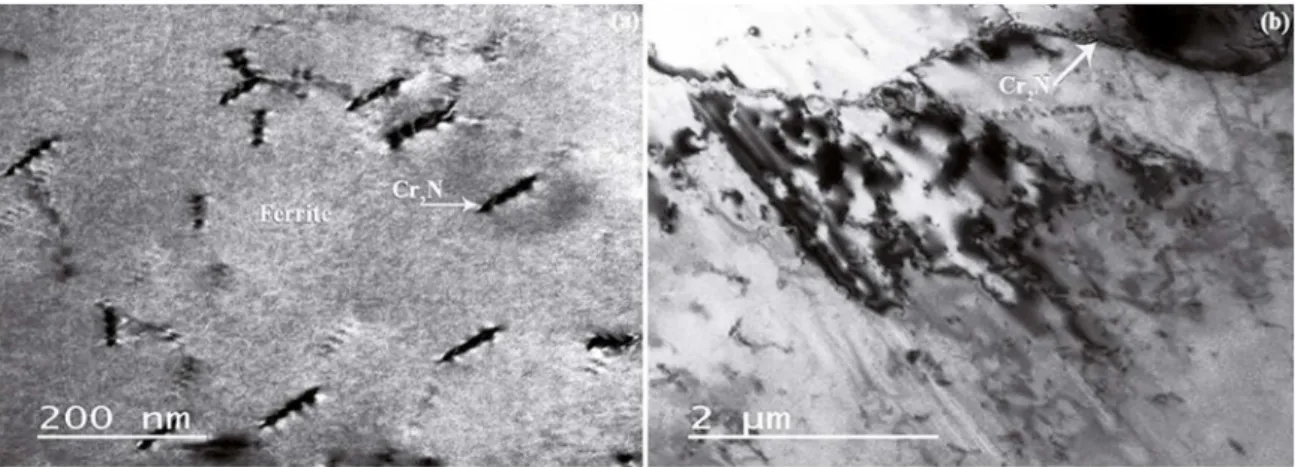
Transmission electron microscopy indicated the presence
of precipitates in the welded specimens as shown in Figure
3. Comparison with the results of other studies indicates that the precipitates are Cr2N24.
Figure 3a and 3b shows the results of the TEM analysis
of the Cr2N formed in the HAZ of as-welded sample. Figure
3a indicates that all precipitates observed in the HAZ are
rod-like Cr2N precipitated intragranularly. In addition to the intragranular rod-like nitrides, some Cr2N particles are also
observed along the ferrite/austenite interfaces (Figure 3b).
Table 1: Chemical composition of the base metal
Element C Mn Si P S Cr Ni Mo Cu N O
Content
Figure 1: OM micrograph of secondary austenite in the FZ (FCAW root of weld joint with 2209 as iller metal)
Figure 2: OM micrograph of nitride colonies in the interior of a
ferrite grain in the HAZ of UNS S32304 (FCAW top of weld joint with 2209 as iller metal)
Figure 3: Transmission electron micrograph of Cr2N of the HAZ of welded joints. (a) Transmission electron micrograph of the intragranular nitrides and (b) transmission electron micrograph of the nitrides precipitated at the ferrite/austenite interfaces (FCAW top region and 2307 as iller metal)
3.2. Electrochemical behavior
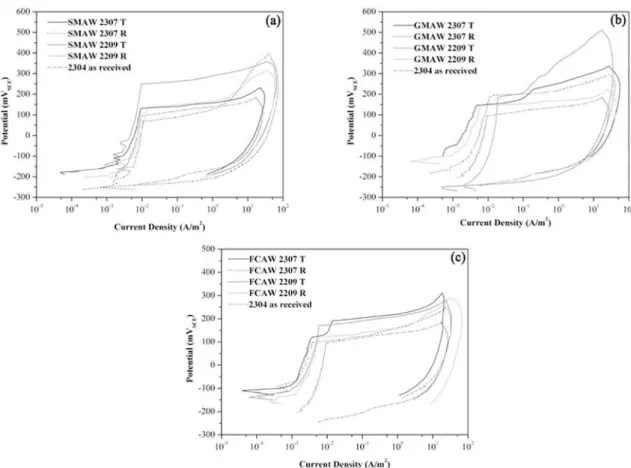
Figure 4(a-c) shows typical cyclic potentiodynamic
polarization curves obtained for samples welded using
SMAW, GMAW and FCAW processes, respectively. The
OCP values and breakdown potentials (Eb) from polarization
tests are summarized in Figure 5.
The welded joints exhibited higher values of corrosion potential than the lean duplex steel in the as received condition, except for the root region of joint welded using SMAW process and 2307 consumable, which showed the lowest corrosion and breakdown potentials among the studied samples, which can be related with the lowest heat input used in the welding process in the case of SMAW 2307 root region, as showed in a previous work22. The highest breakdown potential was identiied for the top region of the lean duplex joint welded
using SMAW process and 2209 consumable, which can be related with the highest heat input used for this sample.
This diference in the heat input was described by Cardoso
Junior et al.21 as being an experimental deviation occurred
during the manual SMAW welding process. In general, top regions showed higher values of Eb than root samples, due
to higher iller metal dilution for root regions. The iller
metals used (2307 and 2209) have higher Ni content than the base metal and presence of Mo in the case of 2209. Nickel stabilizes austenite, while molybdenum stabilizes ferrite and contributes to increase PREN of ferrite. Tan et al.25 reported
that the pitting corrosion resistance of a super duplex stainless steel was determined by the pitting resistance equivalent number of weaker phase. If the PREN of the weaker phase increases, the global corrosion resistance of steel increases. The content of Ni and Mo extends the passive region and strengthens the passive layers of the samples26. Considering the standard deviation, no remarkable diference between the welding processes was observed (Figure 5).
Figure 4: Cyclic potentiodynamic polarization curves for (a) SMAW (b) GMAW and (c) FCAW process. T – top of weld, R – root of weld
Figure 5: Experimental data for cyclic polarization tests. T – top of weld, R – root of weld
no remarkable decrease in pitting potential was found after the welding. The repassivation potentials during the reverse
scans were also similar. The backward polarization (Figure 4)
showed a positive hysteresis, a large hysteresis loop and low repassivation potential, similar in value to the OCPs, which indicate that pitting corrosion might occur over long periods
of open circuit exposure to the acidiied glycerin solution,
which contained 3% NaCl. According to Marcus et al.27, after
depassivation, the repassivation can be hindered by chloride adsorbed on the metal surface resulting in formation of nanopits.
For a more detailed understanding of the pitting corrosion
of the joints, the samples were observed using SEM analysis after the cyclic potentiodynamic testing. An example is
shown in Figure 6.
As shown by the authors in a previous work22, the FZ was more resistant than the HAZ and the pits, in all of welded joints, occurred mostly in the HAZ (Figure 6). The sites for
nucleation of pits were probably chromium nitride particles, as suggested by Tan et al.20. All of the HAZ regions exhibited more pits than the other regions and the HAZ was always
the most susceptible zone. Some pits were found to initiate
in the vicinity of inclusions in either the δ or γ phase. Others were formed at the δ/γ interface or within the δ phase.
The higher susceptibility of the HAZ to pitting corrosion was
found for all welded joints, and it resulted from two aspects of the microstructure evolution during welding. The Cr and Mo contents
are diluted by an increase in the δ volume fraction, so Cr and Mo content of ferrite phase in the HAZ is lower than in the parent
metal and, also, Cr2N precipitated in the ferrite phase due to the lower solubility of nitrogen in ferrite6,8,9,14,20,23, 28-32. According to
Figure 6: Pit morphologies after polarization measurements (SMAW 2307 top region): (a) BM (b) FZ and (c) HAZ
nitrogen and nickel contents lower than 0.15 and 5.5% (as the studied UNS S32304), respectively, even in the cases of increased cooling time18. According to Hsieh et al.18 the austenite content in the HAZ cannot fall below 25% in order to avoid precipitation
of Cr2N and guarantee superior pitting corrosion resistance at the
HAZ. The pits showed in Figure 6 were believed to be related
to the Cr2N precipitates. These precipitates resulted in depletion in Cr in the adjacent matrix region. The chromium-depleted zones provide a favorable site for pitting corrosion nucleation, as reported by several authors6,8,9,14,20,23,28-32.
According to Marcus et al.27, the presence of microstructural
defects on the samples such as metal grain boundaries or interfaces between the matrix and inclusions or second phase particles can promote local breakdown. In this work the breakdown has, preferentially, occurred at surface defect sites such as non-metallic inclusions or precipitates.
4. Conclusions
The corrosion behavior of joints of lean duplex stainless
steel, UNS S32304, welded by three diferent processes, was
studied. The following was observed:
• All welded samples exhibited similar or higher corrosion resistance, compared with the corresponding base metal.
• The pitting corrosion resistance of the whole joint has improved compared to as received samples, as a consequence of alloying elements enhanced in ferrite and austenite.
• Considerable precipitation of chromium nitrides was observed at grain boundaries or ferrite grains on the as-welded specimens.
• Some pits were found to initiate in the vicinity of inclusions and others were formed at the interface
δ/γ or within δ phase.
• The pits in HAZ are believed to be related to the Cr2N precipitates.
5. Acknowledgements
This work was inancially supported by CAPES, CNPq and FAPEMIG.
6. References
2. Garzón CM, Ramirez AJ. Growth kinetics of secondary austenite in the welding microstructure of a UNS S32304 duplex stainless steel. Acta Materialia. 2006;54(12):3321-3331.
3. Alvarez SM, Bautista A, Velasco F. Corrosion behaviour of
corrugated lean duplex stainless steels in simulated concrete pore solutions. Corrosion Science. 2011;53(3):1748-1755.
4. Westin EM, Olsson COA, Hertzman S. Weld oxide formation on lean duplex stainless steel. Corrosion Science. 2008;50(9):2620-2634.
5. Westin E. Microstructure and properties of welds in the lean duplex stainless steel LDX 2101®. [Doctoral Thesis]. Stockholm:
School of Industrial Engineering and Management, Royal Institute of Technology; 2010.
6. Tan H, Wang Z, Jiang Y, Yang Y, Deng B, Song H, et al. Inluence
of welding thermal cycles on microstructure and pitting corrosion resistance of 2304 duplex stainless steels. Corrosion Science. 2012;55:368-377.
7. Pilhagen J, Sandström R. Inluence of nickel on the toughness
of lean duplex stainless steel welds. MaterialsScienceand Engineering: A. 2014;602:49-57.
8. Chen L, Tan H, Wang Z, Li J, Jiang Y. Inluence of cooling rate
on microstructure evolution and pitting corrosion resistance
in the simulated heat-afected zone of 2304 duplex stainless
steels. Corrosion Science. 2012;58:168-174.
9. Jiang Y, Tan H, Wang Z, Hong J, Jiang L, Li J. Inluence of Creq/
Nieq on pitting corrosion resistance and mechanical properties of UNS S32304 duplex stainless steel welded joints. Corrosion Science. 2013;70:252-259.
10. Nowacki J, Łukojć A. Structure and properties of the heat-afected zone of duplex steels welded joints. Journal of Materials ProcessingTechnology. 2005;164-165:1074-1081.
11. Kang DH, Lee HW. Study of the correlation between pitting corrosion and the component ratio of the dual phase in duplex stainless steel welds. Corrosion Science. 2013;74:396-407.
12. Souza CS, Lins VFC, Silveira DM, Costa CGF, Cardoso Junior R, Campos FR, et al. Avaliação da soldagem multipasse de chapas espessas de aços inoxidáveis lean duplex UNS S32304 soldadas pelos processos SMAW, GMAW e FCAW – Parte II: resistência à corrosão. Soldagem e Inspeção. 2012;18(3):257-267.
13. Weber L, Uggowitzer PJ. Partitioning of chromium and molybdenum in super duplex stainless steels with respect to nitrogen and nickel content. MaterialsScienceand Engineering: A. 1998;242(1-2):222-229.
14. Ha HY, Jang MH, Lee TH, Moon J. Interpretation of the relation
between ferrite fraction and pitting corrosion resistance of commercial 2205 duplex stainless steel. Corrosion Science. 2014;89:154-162.
15. Mesquita TJ, Chauveau E, Mantel M, Kinsman N, Roche V, Nogueira RP. Lean duplex stainless steels—The role of molybdenum in pitting corrosion of concrete reinforcement studied with industrial and laboratory castings. Materials ChemistryandPhysics. 2012;132(2-3):967-972.
16. Ramirez AJ, Brandi SD, Lippold JC. Secondary austenite and
chromium nitride precipitation in simulated heat afected zones
of duplex stainless steels. ScienceandTechnologyofWelding andJoining. 2004;9(4):301-313.
17. Garzón CM, Serna CA, Brandi SD, Ramirez AJ. The relationship between atomic partitioning and corrosion resistance in the
weld-heat afected zone microstructures of UNS S32304 duplex stainless
steel. Journal of Materials Science. 2007;42(21):9021-9029.
18. Hsieh RI, Liou HY, Pan YT. Efects of cooling time and alloying
elements on the microstructure of the gleeble-simulated
heat-afected zone of 22% Cr duplex stainless steels. Journal of Materials Engineering and Performance. 2001;10(5):526-536.
19. Bhatt RB, Kamat HS, Ghosal SK, De PK. Inluence of nitrogen
in the shielding gas on corrosion resistance of duplex stainless steel welds. Journal of Materials Engineering and Performance. 1999;8(5):591-597.
20. Tan H, Wang Z, Jiang Y, Han D, Hong J, Chen L, et al. Annealing temperature efect on the pitting corrosion resistance of plasma
arc welded joints of duplex stainless steel UNS S32304 in 1.0M NaCl. Corrosion Science. 2011;53(6):2191-2200.
21. Cardoso Junior R, Bracarense AQ, Campos FR, Souza CS, Silveira DM, Lins VFC. Avaliação da soldagem multipasse de chapas espessas de aços inoxidáveis lean duplex UNS S32304 soldadas pelos processos SMAW, GMAW e FCAW – Parte 1: propriedades mecânicas. Soldagem e Inspeção. 2012;17(4):306-316.
22. Sicupira DC, Frankel GS, Lins VFC. Pitting corrosion of welds
in UNS S32304 lean duplex stainless steel. Materials and Corrosion. 2016;67(5):440-448.
23. Ramirez AJ, Lippold JC, Brandi SD. The relationship between chromium nitride and secondary austenite precipitation in duplex stainless steels. MetallurgicalandMaterialsTransactionsA. 2003;34(8):1575-1597.
24. Yang Y, Yan B, Li J, Wang J. The efect of large heat input on
the microstructure and corrosion behaviour of simulated heat
afected zone in 2205 duplex stainless steel. Corrosion Science. 2011;53(11):3756-3763.
25. Tan H, Jiang Y, Deng B, Sun T, Xu J, Li J. Efect of annealing
temperature on the pitting corrosion resistance of super duplex stainless steel UNS S32750. Materials Characterization. 2009;60(9):1049-1054.
26. Blasco-Tamarit E, Igual-Munõz A, Anton JG, García-García D.
Efect of aqueous LiBr solutions on the corrosion resistance and
galvanic corrosion of an austenitic stainless steel in its welded and non-welded condition. Corrosion Science.2006;48(4):863-886.
27. Marcus P, Maurice V, Strehblow HH. Localized corrosion (pitting): A model of passivity breakdown including the role of the oxide layer nanostructure. Corrosion Science. 2008;50(9):2698-2704.
28. Liou HY, Hsieh RI, Tsai WT. Microstructure and pitting corrosion in simulated heat-afected zones of duplex stainless steels.
MaterialsChemistryandPhysics. 2002;74(1):33-42.
29. Chehuan T, Dreilich V, Assis KS, Sousa FVV, Mattos OR. Inluence of multipass pulsed gas metal arc welding on
corrosion behaviour of a duplex stainless steel. Corrosion Science. 2014;86:268-274.
30. Bettini E, Kivisäkk U, Leygraf C, Pan J. Study of corrosion
behavior of a 22% Cr duplex stainless steel: Inluence of
nano-sized chromium nitrides and exposure temperature.
31. Zhang Z, Wang Z, Jiang Y, Tan H, Han D, Guo Y, et al. Efect
of post-weld heat treatment on microstructure evolution and pitting corrosion behavior of UNS S31803 duplex stainless steel welds. Corrosion Science. 2012;62:42-50.
32. Zhang Z, Zhao H, Zhang H, Yu Z, Hu J, He L, et al. Efect of
isothermal aging on the pitting corrosion resistance of UNS S82441 duplex stainless steel based on electrochemical detection.