ISSN 0104-6632 Printed in Brazil
www.abeq.org.br/bjche
Vol. 22, No. 02, pp. 277 - 284, April - June, 2005
Brazilian Journal
of Chemical
Engineering
A SOLAR COLLECTOR DESIGN PROCEDURE
FOR CROP DRYING
B. M. Santos
1, M. R. Queiroz
2and T. P. F. Borges
31
School of Agricultural Engineering, State University of Campinas, Phone: (19) 3788-1073, P.O. Box 6011 13083-970 Campinas - SP, Brazil.
E-mail: [email protected]
2School of Agricultural Engineering, State University of Campinas, Phone: (19) 3788-1073,
P.O. Box 6011 13083-970 Campinas, SP, Brazil. E-mail: [email protected]
3
Department of Mechanical Engineering, Solar Energy Laboratory, Federal University of Santa Catarina, Phone: (48) 234-2161 ext 226, 88040-900 Florianópolis - SC, Brazil.
E-mail: [email protected]
(Received: October 10, 2004 ; Accepted: February 18, 2005)
Abstract - A design procedure was proposed for sizing solar-assisted crop-drying systems and assessing the combination of solar collector area and auxiliary energy needs that meets the requirements of the load. Two empirical correlations were compared for use with high thermal inertia solar collectors that are cheap and appropriate for rural areas. A case study as performed in the city of Campinas in southeastern Brazil. Grain drying with partial air heating by solar energy can provide an annual savings of 30% in fuel consumption for 1.80m2 collector area during the drying of 1.2t of corn at 50ºC at a daily air rate of 1526.8 m3/day.
Keywords: Solar crop drying; Solar collectors; Solar air heating; Design procedure; Appropriate technologies.
INTRODUCTION
The use of solar energy in grain drying can great reduce the use of fossil fuels, consequently reducing pollutant emission. However, there is no simple design tool for sizing solar-assisted crop dryers based on drying load, climate and economic data. This lack affects rural producers, who prefer to continue using traditional sources of energy. It also affects the small producer, who is deprived of technologies appropriate to the socioeconomic realities of rural areas in developing countries.
In the 1970's, Klein, Beckmann and Duffie (1975, 1976) developed the f-Chart methodology based on TRNSYS software simulations. They established correlations between dimensionless design parameters and the solar fraction (ratio of the energy supplied by the solar system to the energy demand of the process). This methodology was developed for
water and air heating systems; however the focus was not on the drying of agricultural products. The main characteristic of the f-Chart is its simple operation and accessibility to people not skilled in solar energy engineering.
The first Brazilian studies on application of solar energy in drying processes were done at UNICAMP by a drying research group in association with the Solar Energy Group at the end of the 1970’s and beginning of the 1980's. Santos (1980) studied the use of collectors with beds made of pebbles in in-bin soy drying. The advantages over flat-plate collectors were the lower cost per unit of area, the smaller collector area and the capacity to store energy and to avoid temperature peaks.
LITERATURE REVIEW
Flat-Plate Solar Collector
A grain-drying solar-assisted system is composed of a solar collector, a fan, an additional energy source for air heating, a plenum (for air distribution) and a bin batch drying system. Flat-plate collectors are used in air and water heating systems. The incident solar energy is partially absorbed by a dark and opaque surface, part of this energy is transferred to the fluid and the remainder is lost to the enviroment. The collector plate is covered
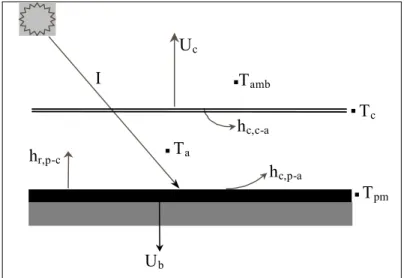
with a glass in order to minimize convective losses and create a “green house” effect. Figure 1 shows the outline of a flat-plate collector for air heating and the main parameters involved in heat transfers: incident solar radiation (I), cover heat loss coefficient (Uc), coefficient of convective heat transfer between cover and air (hc,c-a), coefficient of convective heat transfer between plate and air (hc,p-a), coefficient of radiation heat transfer between plate and cover (hr,p-c), bottom heat loss coefficient (Ub), ambient temperature (Tamb), cover temperature (Tc), air temperature (Ta) and mean plate temperature (Tpm).
hr,p-c I
hc,c-a Uc
hc,p-a
.
TpmUb
.
Tc.
Tamb.
TaFigure 1: Flat-plate solar collector heat transfer parameters.
Bliss (1959) presented an expression (equation (1)) to describe the performance of a solar collector by an energy balance involving energy gain and thermal and optic losses. Since this equation assumes the mean plate temperature to be equal to the collector inlet air temperature (Ti), a heat removal factor (FR) is introduced:
[
]
R L i a
q=AF I(τα −) U (T −Tmb) (1)
(UL is the collector heat loss coefficient)
The instantaneous efficiency of the flat-plate solar collector (η) is defined as the ratio of the rate of useful energy supplied by the collector (q) to the rate of incident solar energy in its area A:
i amb
R R L
(T T ) q
F ( ) F U
IA I
−
η = = τα − (2)
(τα is the absorptance-transmittance product).
The products FR(τα) and FRUL are assumed to be constant terms. They can be experimentally determined by plotting η versus (Ti-Tamb)/I as a independent variable and applying a linear regression to the set of experimental points. Two characteristic
parameters of solar collectors are obtained: one is related to thermal losses and gains (FR (τα)) and the other is related to thermal losses (FRUL). The ASHRAE 93-77 standard gives the procedures to characterize a flat-plate collector and to calculate its characteristic parameters.
Energy Storage Collectors
q dt
A I dt η =
∫
∫
(3)Nayak et al. (1989) and Boppshetty et al. (1992) observed that despite their high thermal inertia, concrete collectors have linear behavior similar to that in the instantaneous efficiency model:
i amb
T
T T
a b H
⎡ − ⎤
η = − ⎢
⎣ ⎦⎥ (4)
whereT is the mean inlet air temperature, i Tamb is the mean ambient temperature, HT is the daily incident radiation on a tilted surface and a and b are the daily characteristic parameters.
Empirical Correlations
Klein et al. (1976) determined a correlation between the solar fraction f (ratio of the heat supplied by a solar system Qs to the energy demand of the process Qp) and two dimensionless design parameters (X and Y) for an air heating solar system:
p s
Q
Q
f
=
(5)amb R L
AF U (100 T ) X
Q −
= (6)
R m
AF ( ) H Y
Q τα
= T (7)
2 2
f 1.040 Y 0.065 X
0.159 Y 0.00187 X 0.0095 Y3
= − −
+ − (8)
The above correlation assumes a system with an air flow rate between 5 and 20 l/s.m2, a slope equal to the local latitude plus or minus 15° and thermal storage pebble diameters between 1 and 3 cm.
The correlation of Pratoto et al. (1997) (Equations 9 and 10) uses only one design parameter (Y) because when Ti=Tamb the heat losses term in Equation (1) becomes negligible.
f =Y; 0< <Y 0.2 (9)
2 3
f 0.009 2.0251 Y 3.0482
Y 1.5263 Y ; 0.2 Y 0.554
= − + −
+ < < (10)
CASE STUDY
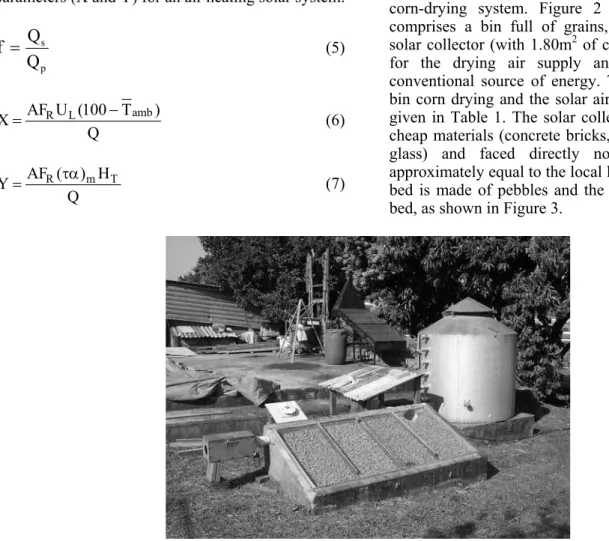
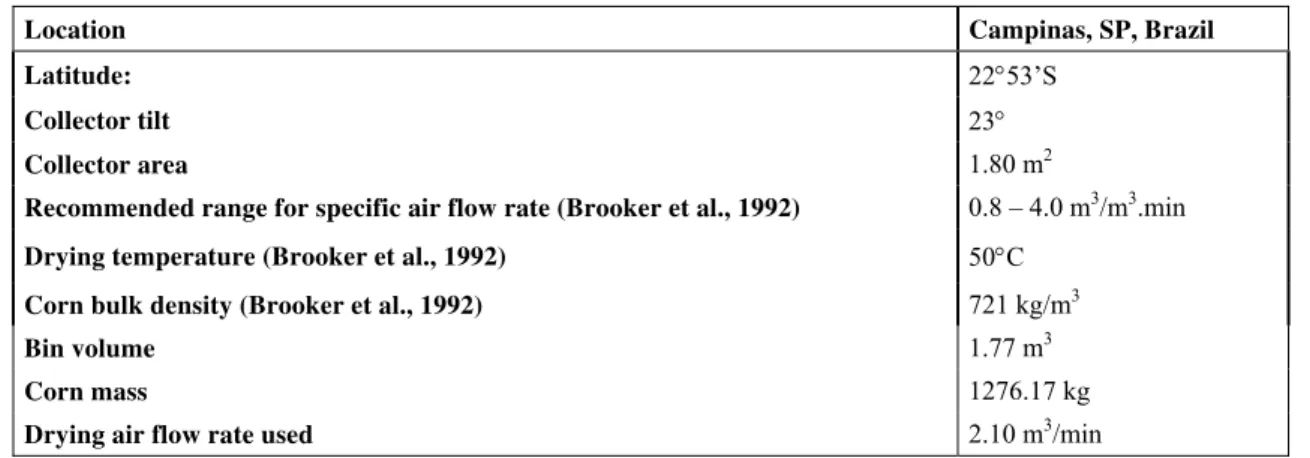
A case study was conducted in the city of Campinas in Brazil (latitude 22º53’S) on an in-bin corn-drying system. Figure 2 shows the system comprises a bin full of grains, an energy storage solar collector (with 1.80m2 of collector area), a fan for the drying air supply and a complemental conventional source of energy. The data on the in-bin corn drying and the solar air heating system are given in Table 1. The solar collector was built with cheap materials (concrete bricks, pebbles, wood and glass) and faced directly north with a slope approximately equal to the local latitude. The storage bed is made of pebbles and the air flows above the bed, as shown in Figure 3.
Glass cover (5mm)
Pebble bed (20cm)
Soil Plastic
protection 5cm
Figure 3: Pebble bed energy storage cross section.
Table 1: In-bin corn drying and solar air heating system characteristics.
Location Campinas, SP, Brazil
Latitude: 22°53’S
Collector tilt 23°
Collector area 1.80 m2
Recommended range for specific air flow rate (Brooker et al., 1992) 0.8 – 4.0 m3/m3.min
Drying temperature (Brooker et al., 1992) 50°C
Corn bulk density (Brooker et al., 1992) 721 kg/m3
Bin volume 1.77 m3
Corn mass 1276.17 kg
Drying air flow rate used 2.10 m3/min
MATERIALS AND METHODS
Solar Collector Characterization
The solar collector was characterized according to the concrete plates methodology described by Nayak et al. (1989). The collector had been exposed to ambient conditions during the previous night. The next morning, the glass cover was cleaned and the Eppley pyranometer was set up on the collector plate. A digital data logger was used for measurements and storage of temperatures and incident solar radiation values. After the pyranometer started receiving direct solar radiation, the data on incident solar radiation, inlet and outlet collector air temperatures (dry and wet bulb) and ambient air temperature were stored at five-minute intervals. Type T thermocouples were used. Due to its high thermal inertia, in the early morning hours the air loses heat from the storage collector (negative instantaneous efficiency). Therefore, to construct the daily efficiency curve,
Equation (4) was used with the data after the time at which the instantaneous efficiency became positive. On this curve each point represents a day of tests.
Collector Incident Radiation and Energy Demand of the Corn-Drying Process
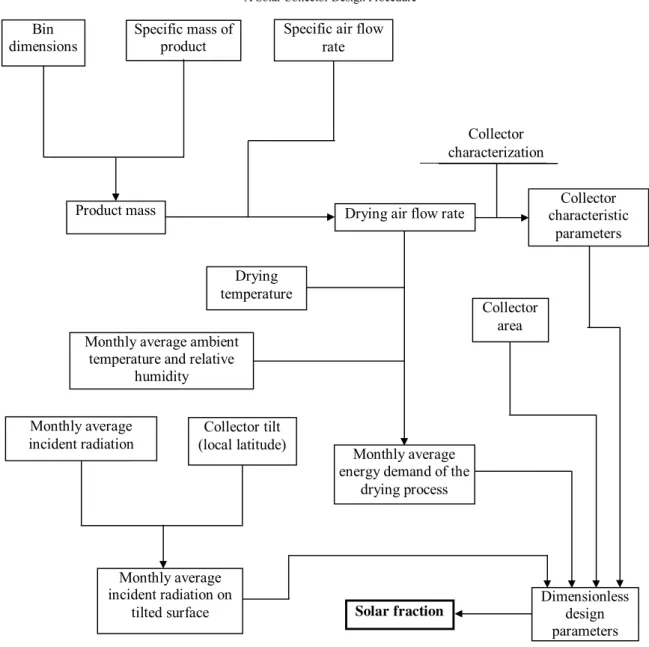
The monthly average of incident solar radiation on the tilted collector was calculated according to the methodology described by Beckmann et al. (1977) and Klein (1977), based on the Liu and Jordan (1961) model. Monthly average energy demand of the process was determined assuming the continuous drying of grains during all months of the year, twelve hours a day and using an air flow rate of 2.10m3/min at 50°C. The solar and meteorological data used were supplied by IAC (1989) and CEPAGRI-UNICAMP (2004) and the psychrometric relations were obtained from Brooker et al. (1992).
Specific mass of product
Collector characterization
Solar fraction Bin
dimensions
Specific air flow rate
Monthly average ambient temperature and relative
humidity
Collector area Product mass
Drying temperature
Monthly average incident radiation
Collector tilt (local latitude)
Monthly average energy demand of the
drying process Drying air flow rate
Monthly average incident radiation on
tilted surface
Dimensionless design parameters
Collector characteristic
parameters
Figure 4: Parameters involved in the design of solar crop-drying systems.
RESULTS
Figure 5 shows the characteristic curve of the energy storage solar collector. As for the flat-plate collectors, a linear relationship was observed. Equation (11) and the daily average characteristic parameters (a and b) were obtained by linear regression:
i amb
T
2
T T
0.4332 0.1223 H
r 0.9398
⎡ − ⎤
η = − ⎢ ⎥
⎣ ⎦
=
(11)
Figure 6 presents the changes in the annual solar
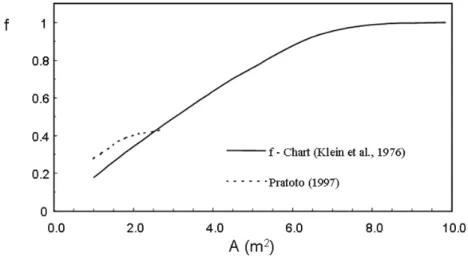
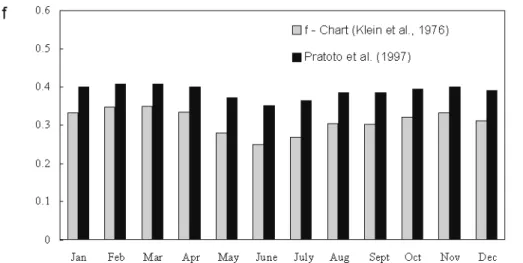
fraction as a function of solar collector area for the case studied. It was observed that the correlation of Pratoto et al. (1997) is limited to a small range of dimensionless Y parameter values. The monthly averages of energy demand, incident radiation in the collector and heat supplied by the system in the solar-assisted crop drying are shown in Figure 7. The monthly solar fractions are shown in Figure 8.
Figure 5: Characteristic curve for the energy storage solar collector.
Figure 6: Annual solar fractions as a function of the collector area for an in-bin solar-assisted corn-drying system.
Figure 8: Monthly solar fractions for the solar air heating system (A = 1.80m2).
CONCLUSIONS
The air heating solar collector with storage bed can be characterized by means of its daily efficiency, determining its daily average characteristic parameters. Empirical correlations developed for other collector plate types can be used to estimate solar fractions for solar-assisted grain drying. The f-Chart correlation gives a conservative result and should be used rather than the Pratoto et al. (1997) correlation, wich was shown to be limited to a small range of dimensionless design parameters (Y). A solar-assisted grain-drying system with a 1.80 m2 collector area can provide an annual savings of 30% in fuel consumption, which was enough to dry 1.28t of corn at 50ºC, using a daily air flow rate of 1526.80 m3 per day.
NOMENCLATURE
a Collector characteristic parameter (daily)
Dimensionless
b Collector characteristic parameter (daily)
MJ/m2°C hc Convective heat transfer
coefficient
W/m2°C hr Radiation heat transfer
coefficient
W/m2 °C q Useful solar heat delivered
by the collector
W
A Collector area m2
FR Collector heat removal factor
Dimensionless
H Daily incident radiation MJ/m2 I Incident solar radiation
flux
W/m2 Q Drying heat requirement MJ Qs Energy supplied by the
solar system
MJ
Qp Process energy demand MJ
T Temperature °C
T Daily mean temperature °C U Heat loss coefficient W/m2 K UL Collector loss heat
coefficient
X Collector characteristic parameter (instantaneous)
Dimensionless
Y Collector characteristic parameter (instantaneous)
Dimensionless
Greek Symbols
τ Transmittance Dimensionless
α Absorptance Dimensionless
Collector daily efficiency Dimensionless
Subscripts
a Air (-)
amb Ambient (-)
b Bottom (-)
c Cover (-)
i Inlet (-)
m Mean (-)
p Plate (-)
T Tilted surface (-)
REFERENCES
Beckman, W.A., Klein, S.A. and Duffie, J.A. (1977), Solar Heating Design by the f-Chart Method, 1st ed., New York, John Wiley.
Bliss, R.W. Jr. (1959), The Derivations of Several “Plate-Efficiency Factors” Useful in the Design of Flat-Plate Solar Heat Collectors, Solar Energy, Vol. 3, no. 4, pp. 55-64.
Boppshetty, S.V., Nayak, K. and Sukhatme, S.P. (1992), Performance Analysis of a Solar Concrete Collector, Energy Convers. Mgmt, Vol. 33, no. 11, pp. 1007-1016.
Brooker, D.B., Bakker-Arkema, F.W. and Hall, C.W. (1992), Drying and Storage of Grain and Oilseeds, New York, Van Nostrand Reinhold. Duffie, J.A. and Beckman, W.A. (1991), Solar
Engineering of Thermal Process, 2nd ed., New York, John Wiley.
Klein, S.A. (1977), Calculation of Monthly Average Insolation on Tilted Surfaces, Solar Energy, Vol. 19, pp. 325-329.
Klein, S.A., Beckman, W.A. and Duffie, J.A. (1975), A Design Procedure for Solar Heating Systems,
Solar Energy, Vol. 18, pp. 113-127.
Klein, S.A., Beckman, W.A. and Duffie, J.A. (1976), A Design Procedure for Solar Air Heating Systems, Solar Energy, Vol. 19, pp. 509-512. Liu, B.Y.H. and Jordan, R.C. (1961), Daily
Insolation on Surfaces Tilted Toward the Equator, ASHRAE Journal, Vol. 10, pp. 53-59.
Nayak, J.K., Sukhatme, S.P., Limaye, R.G. and Bopshetty, S.V. (1989), Performance Studies on Solar Concrete Collectors, Solar Energy, Vol. 42, no. 01, pp. 45-56.
Pratoto, A., Daguenet, M. and Zeghmati, B. (1997), Sizing Solar-Assisted Natural Rubber Dryers, Solar Energy, Vol. 61, pp. 287-291.
Pratoto, A., Daguenet, M. and Zeghmati, B. (1998), A Simplified Technique for Sizing Solar-Assisted Fixed-Bed Batch Dryers: Application to Granulated Natural Rubber, Energy Convers. Mgmt, Vol. 39, no. 9, pp. 963-971.