*e-mail: [email protected]
DLC-Si Protective Coatings for Polycarbonates
J.C. Damascenoa, S.S. Camargo Jr.a*, M. Cremonab
aEngenharia Metalúrgica e de Materiais, Universidade Federal do Rio de Janeiro
C.P. 68505, 21945-970 Rio de Janeiro - RJ, Brazil
bDepartamento de Física, Pontifícia Universidade Católica do Rio de Janeiro
C.P. 38071, 22454-970 Rio de Janeiro - RJ, Brazil
Received: January 02, 2002; Revised: September 30, 2002
In this work, a-C:H:Si (DLC-Si) films were produced onto crystalline silicon and polycarbonate substrates by the rf-PACVD technique from gaseous mixtures of CH4 + SiH4 and C2H2 + SiH4. The effects of self-bias and gas composition upon mechanical and optical properties of the films were investigated. Micro-hardness, residual stress, surface roughness and refractive index measure-ments were employed for characterization. By incorporating low concentrations of silicon and by exploring the more favorable conditions for the rf-PACVD deposition technique, highly adherent DLC-Si thin films were produced with reduced internal stresses (lower than 1 GPa), high hardness (around 20 GPa) and high deposition rates (up to 10 µm/h). Results that show the technological viability of this material for application as protective coatings for polycarbonates are also dis-cussed.
Keywords: thin films, DLC, chemical vapor deposition, silicon carbide, polycarbonate
1. Introduction
Plastics have become important materials because they can be produced in large scale and are cheaper and lighter than many other materials. Amongst those, polycarbonates are well-known, commercially available materials. Because of their excellent breakage resistance, polycarbonates have replaced glasses in many applications, such as automobile headlamps, safety shields of windows, ophthalmic lenses and sunglasses, and the like. However, their use is still lim-ited to non-abrasive and chemical-free environments, be-cause of their low hardness, low scratch resistance and their high susceptibility to harsh chemical conditions. To over-come this limitation, methods for producing a hard trans-parent protective coating on polycarbonate materials have been studied1-5, including the deposition of diamond-like
amorphous carbon (DLC) films6-9.
DLC films have been successfully deposited on differ-ent kinds of substrates by several differdiffer-ent techniques10,11.
Their high hardness, low friction coefficient and high chemi-cal inertness have made of them great candidates for wear-resistant, hard coatings for many applications. Unfortunately, the high intrinsic stress of these films limits their adhesion and thickness. Silicon-incorporated diamond-like carbon films (DLC-Si) have a great potential for solving some of
the major drawbacks of pure DLC films. Indeed, DLC-Si films present reduced residual internal stress12,13, high
depo-sition rates14, good adhesion to most substrates, including
various metal alloys, steels and glasses15-17 and very high
hardness16,18,19.
In this work, DLC-Si films were produced onto crystal-line silicon and polycarbonate substrates by the rf-PACVD technique from gaseous mixtures of CH4 + SiH4 and C2H2 + SiH4. The effects of self-bias and gas composition upon mechanical and optical properties of the films were in-vestigated.
2. Experimental
stresses. Indentation of the samples was done with a Vickers diamond micro-indenter with a 0.25 N load during approxi-mately 20 s keeping the indentation depth smaller than 20% of the sample thickness. Hardness was obtained from the measurement of the indentation diagonals on an optical microscope using the DIC (differential interference contrast) technique. In all cases hardness was calculated from the average of a series of 20 different indentations. All stress and hardness measurements were taken from samples de-posited on silicon substrates, while roughness was deter-mined for the films deposited on polycarbonate.
Refractive index was measured by the Abelés-Hacskaylo20 method using a 633 nm He-Ne laser beam. All
optical measurements were made using the samples depos-ited on polycarbonate substrates.
3. Results and Discussion
Deposition rate of DLC-Si films is strongly increased when one increases the rf power density dissipated in the plasma in a similar manner to what is observed for pure a-C:H films. As can be seen in Fig. 1, the deposition rate as a function of the resulting cathode self-bias potential presents an increase of almost one order of magnitude when the self-bias voltage is varied from -100 V to -1000 V. In addition, the deposition rate obtained when using C2H2 as carbon-source gas is much higher than in case of CH4. For instance, films deposited with CH4 present a maximum deposition rate of about 2.7 µm/h whereas with C2H2 a deposition rate of 10 µm/h was achieved keeping the other deposition con-ditions unchanged. Similar behavior was also observed for pure a-C:H films21 and can be explained considering the
following: (a) the low ionization energies of C2H2 in com-parison to CH4 which allows the first to react in higher quan-tities with the growing film surface; and (b) the increased C/H-ratio for C2H2 (1:1) compared with CH4 (1:4).
Figures 2a and 2b show the behavior of surface rough-ness of polycarbonate samples, before and after deposition of the films, as a function of cathode self-bias and gas pre-cursor. As one can see in these figures, the surface rough-ness of the polycarbonate samples is slightly raised by the plasma deposition process for |VB| up to 600 V, maintaining acceptable low surface roughness regardless of the source
gases used. On the other hand, samples deposited with val-ues of |VB| of 800 V are greatly damaged by the plasma having their surface roughness raised by almost two orders of magnitude for both gas mixtures. The surface damage of the samples can be attributed to high-energy particle bom-bardment when using high power densities, which can lead to substantial surface heating and fusion. For this reason, polycarbonate substrates were not used for deposition at VB = -1000 V.
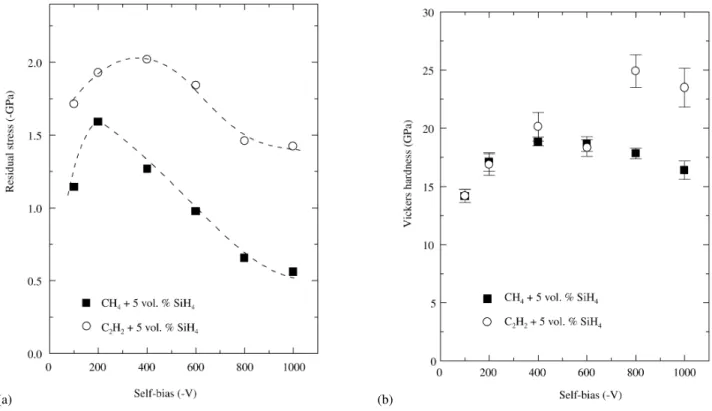
Residual internal stress of DLC-Si films strongly de-pends on the employed cathode self-bias potential, as al-ready reported elsewhere22. In the low self-bias range the
internal stress is increased when one increases the self-bias voltage, attains a maximum and then decreases monotonically for high values of self-bias, as shown in Fig. 3a. It is interesting to observe that this maximum value occurs around VB = -200 V for CH4-based films and around VB = -400 V for C2H2-based films. Similar behavior was also observed for pure a-C:H films21. This can be explained by
considering that on impact at the surface, ions from a CnHm gas plasma fragment into n separate C+ ions, evenly
distrib-uting among then the incident energy. Since the material
Figure 2. Surface roughness of polycarbonate samples before and after the deposition of Si-DLC films prepared from mixtures of C2H2 + 5 vol.% SiH4 (a) and CH4+ 5 vol.% SiH4; (b) as a function of negative self-bias voltage.
(a)
Figure 3. Residual internal stress (a) and Vickers micro hardness; (b) as a function of negative self-bias voltage of Si-DLC films prepared from mixtures of CH4 + 5 vol.% SiH4 (squares) and C2H2 + 5 vol.% SiH4 (circles) as a function of negative self-bias voltage.
(a) (b)
densification and, consequently, the residual stress gener-ated in the films depends directly on this energy, the point of maximum stress is shifted to higher negative self-bias values when the gas precursor is changed from CH4 to C2H2 because the number of carbon atoms per molecule is also increased23. In addition, residual stress values for C
2H2-based
films were found to be higher than CH4-based ones. Figure 3b shows the obtained behavior of hardness for the two series of films as a function of the cathode self-bias. As one can notice in both cases a monotonic increase of hardness is observed when the self-bias is varied from -100 V up to -400 V. For |VB| > 400 V, the hardness of CH4-based films is decresead very slightly, while in case of C2H2-based films, higher values of hardness were obtained. Indeed, in contrast to what is generally observed for DLC films21, 24 a significant reduction of hardness for high
values of negative self-bias was not observed in agreement with our previous results22.
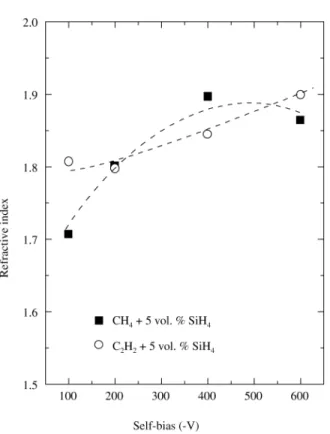
Measurements of refractive index of the films were car-ried out as a function of cathode self-bias and gas precursor. As can be observed in fig. 4, in case of CH4-based films there is an increase of the refractive index from 1.71 to 1.90 when
polycarbonate, they cannot be used as anti-reflective coat-ings. This issue will be further investigated by varying the source gas mixture composition.
4. Conclusions
The viability of producing DLC-Si films deposited by PECVD as protective coatings for polycarbonate substrates has been demonstrated. A study of the influence of deposi-tion parameters, namely self-bias and gas composideposi-tion, on the properties of the films was carried out. Films deposited at high self-bias showed very high deposition rates, low stress and high hardness. However, high self-bias values leaded to surface damage of the samples. Smooth films could be obtained keeping self-bias voltages below |VB| = 600 V so that to avoid surface heating and damage. Acetylene seems to be more attractive as carbon source gas since much higher deposition rates can be obtained while other proper-ties like surface roughness, refractive index and hardness are equivalent to films deposited from methane mixtures.
Acknowledgements
This work was supported by Finep and CNPq Brazilian agencies, CNPq/DLR International Cooperation Program and DLR/BMBF (Germany).
References
1. Suchentrunk, R.; Fuesser, H.J.; Staudigl, G.; Jonke, D.; Meyer, M. Surface and Coatings Technology, v. 112, p. 351-357, 1999.
2. Lee, C.-C.; Hsu, J.-C.; Jaing, C.-C. Thin Solid Films, v. 295, p. 122-124, 1997.
3. Zajíèková, L., Buršíková, V., Janèa, J., Vacuum, v. 50, n. 1-2, p. 19-21, 1998.
4. Katsamberis, D.; Browall, K.; Iacovangelo, C.; Neumann, M.; Morgner, H. Progress in Organic Coatings, v. 34, p. 130-134, 1998.
5. Rats, D.; Hajek, V.; Martinu, L. Thin solid Films, v. 340, p. 33-39, 1999.
6. Laidani, N.; Speranza, G.; Nefedov, A.; Calliari, L.; Anderle, M. Diamond and Related Materials, v. 7, p. 1394-1402, 1998.
7. Kimock, F.M.; Knapp, B.J. Surface and Coatings Tech-nology, v. 56, p. 273-279, 1993.
8. Ong, H.C.; Chang, R.P.H.; Baker, N.; Oliver, W.C. Sur-face and Coatings Technology, v. 89, p. 38-46, 1997. 9. Park, K.J.; Chin, E.Y. Polymer Degradation and
Stabil-ity, v. 68, p. 93-96, 2000.
10. Lifshitz, Y. Diamond and Related Materials, v. 8, p. 1659-1676, 1999.
11. Grill, A. Diamond and Related Materials, v. 8, p. 428-434, 1999.
12. Baia Neto, A.L.; Santos, R.A; Freire Jr., F.L.; Camargo Jr., S.S.; Carius, R.; Finger, F.; Beyer, W. Thin Solid Films, v. 293, p. 206, 1997.
13. Gangopadhyay, A.K.; Willermet, P.A.; Tamor, M.A.; Vassell, W.C. Tribology International, v. 30, p. 9, 1997. 14. Jiang, L.; Chen, X.; Wang, X.; Xu, L.; Stubhan, F.; Merkel, K.-H. Thin Solid Films, v. 352, p. 97, 1999. 15. Wu, W.-J.; Hon, M.-H. Thin Solid Films, v. 345, p. 200,
1999.
16. Michler, J.; Tobler, M.; Blank, E. Diamond and Related
Materials, v. 8, p. 510, 1999.
17. Gangopadhyay, A.K.; Willermet, P.A.; Vassell, W.C.; Tamor, M.A. Tribology International, v. 30, p. 19, 1997.
18. De Martino, C.; Demichelis, F.; Tagliaferro, A. Diamond and Related Materials, v. 3, p. 547, 1994.
19. De Martino, C.; Fusco, G.; Mina, G.; Tagliaferro, A.; Vanzetti, L.; Calliari, L.; Andrele, M. Diamond and Releted Materials, v. 6, p. 559, 1997.
20. Hacskaylo, M. Journal of the Optical Society of America, v. 54, n. 2, p. 198, 1964.
21. Zou, J.W.; Schmidt, K.; Reichelt, K.; Dischler, B. Jour-nal of Applied Physics, v. 67, n. 1, p. 487-494, 1990. 22. Damasceno, J.C.; Camargo Jr., S.S.; Freire Jr., F.L.;
Carius, R. Surface and Coatings Technology, v. 133-134, p. 247-252, 2000.
23. Robertson, J. Diamond and Related Materials, v. 3, p. 361-368, 1994.