JSCS–4253 551.463/.464:597(497.16)
Original scientific paper
Accumulation of trace metals in marine organisms
of the
southeastern Adriatic coast, Montenegro
DANIJELA JOKSIMOVIĆ1* and SLAVKA STANKOVIĆ2
1Institute of Marine Biology, University of Montenegro, Dobrota bb, 85330 Kotor, Montenegro and 2Faculty of Technology and Metallurgy, University of Belgrade, Karnegijeva 4,
11000 Belgrade, Serbia
(Received 23 March, revised 13 April 2011)
Abstract:The concentration and accumulation of trace metals (Co, Ni, As, Cd, Pb and Hg) were measured in seawater, sediments and marine organisms on the coastline of Montenegro. The obtained results of trace metals in sea grass and mussels were compared with those found in the water column and sediment. Sampling was performed in the fall of 2005 at five locations on the Monte-negrin coastline, Sveta Stasija, Herceg Novi, Zanjice, Budva and Bar, which present different levels and sources of human impact. The heavy metals ana-lyses of seawater, sediment, Posidonia oceanica and Mytilus galloprovincialis identified the harbor of Bar as the most Hg-contaminated site, Zanjice as the most As-contaminated and Sveta Stasija as the most Pb-contaminated areas of the Montenegrin coastal area. This study showed that P. oceanica may have a greater bioaccumulation capacity than M. galloprovincialis for the considered metals, except for As and Hg, and both organisms may reflect contamination in the water column and in the sediment. For the first time, the sea grass P. ocea-nica and M. galloprovincialis were employed as metal bioindicators for the southeastern Adriatic. The results of this study could serve as a baseline for future assessments of anthropogenic effects in this marine ecosystem.
Keywords: heavy metals; seawater; sediment; marine organisms; biomoni-toring; Montenegro.
INTRODUCTION
The Adriatic Sea is situated between the northeastern Italian coast and the southwestern coasts of Slovenia, Croatia, Montenegro and Albania. It is espe-cially subject to pollution due to its enclosed character. The coastal parts of this Adriatic area receive large amounts of contaminants introduced by domestic, in-dustrial and agricultural activities, directly, via rivers, or through atmospheric
deposition. The pollution of the Adriatic Sea is more marked along the Italian
coast, especially of the northern basin, than along the eastern coast.1 Most of the previous studies considered trace metal concentrations in sediments and mussels from selected coastal areas of the Adriatic, mainly of northern part of the Italian Adriatic coast.2 Along the eastern Adriatic coast, the effects of coastal pollution were investigated mainly in the Slovenian3 and Croatian coastal areas4–7 and some initial investigations in the Montenegrin coastal area.8,9 Investigation of sediments also included a number of sites in the Albanian coastal area.10,11
The chemical analysis of waters does not provide sufficient information on the bioavailability of the metals present in a marine environment.12 Currently, there is great interest in the use of living organisms as pollution bioindicators in aquatic ecosystems in order to evaluate the quality of a marine environment. A comparison of metal contamination in different aquatic environments is possible by analysis of water,13 sediment14 and biota,15–17 but in most cases, the impact and synergistic effects of trace metals in marine ecosystem are poorly understood. Sea grasses and mussels are increasingly used as indicators of chemical contamination of coastal regions. The endemic sea grass Posidonia oceanica (L.)
Delile has been used as a metal bioindicator17 for the last two decades in the Mediterranean Sea, but in the area of the southeastern Adriatic coast, there is no published data concerning P. oceanica as a metal bioindicator. The mussel My-tilus galloprovincialis has the ability to accumulate metals from the environment
in which lives18 and their usefulness as sentinel organisms in metal biomoni-toring studies is widely recognized. Bivalves are filter feeders and thus obtain elements not only from food and water but also from particulate materials.19,20 In both organisms, the concentration of heavy metals is largely governed by the bio-logical, chemical, and physical characteristics of the surrounding environment. For example, light and nitrogen availability positively affected the rate of Cd up-take in sea grass, which increased with increasing concentration of nitrate in the growth medium.21 However, in environments with high nutrient levels, Ni uptake by plants can be inhibited due to complex formation between the nutrients and metal ions.22
For the first time, the concentrations of Co, Ni, As, Cd, Pb and Hg have been determined and compared in different marine environmental compartments in the area of the southeastern Adriatic Sea, Montenegro: seawater, sediment, the mussel M. galloprovincialis (L) Lamarck, 1819 and the sea grass P. oceanica
EXPERIMENTAL Chemicals and instrumentation
Ultra pure water (18.2 MΩ cm) from a Milli-Q system (Millipore, Bedford, MA, USA) was used to prepare all the aqueous solutions. All the employed mineral acids and oxidants (HNO3, H2O2 and HCl) were of the highest quality (Suprapure, Merck, Germany). The
mine-ralized samples were analyzed using a cold vapor atomic absorption spectrometer (CV–AAS and and F–AAS Perkin–Elmer, AAnalyst 200) and graphite furnace atomic absorption spectrometer (GF–AAS, Perkin–Elmer, 4100ZL, with Zeeman background correction). Sampling locations
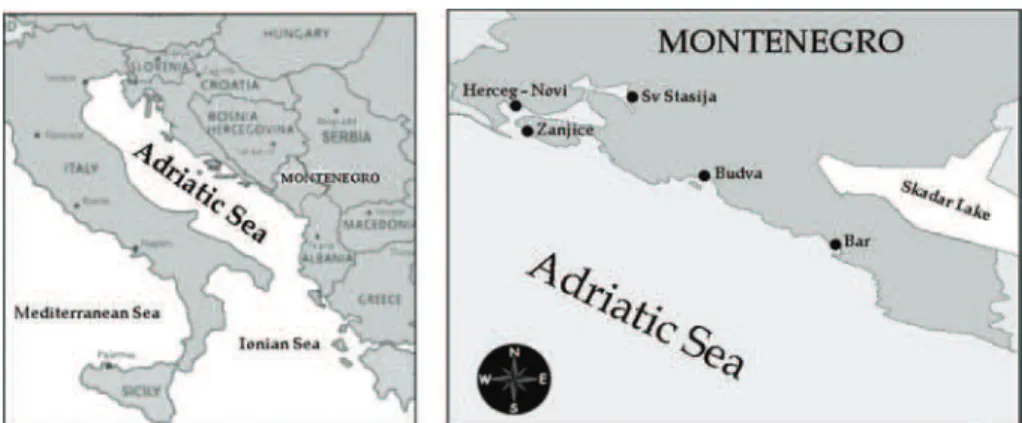
Samples were collected at five selected locations from this Adriatic coastal area: Sveta Stasija and Herceg Novi in the semi-enclosed Boka Kotorska Bay, which is on the UNESCO’s World Heritage List, and on the open coastline at Zanjice, Budva and Bar, Fig. 1, situated in the proximity of different geochemical, hydrological and human impacts.
Fig. 1. Sampling locations in the southeastern Adriatic Sea, Montenegro: 1. Sveta Stasija, 2. Herceg Novi, 3. Zanjice, 4. Budva and 5. Bar.
Sampling method, sample preparation and trace metal analyses
All the seawater samples, from the surface and the bottom, were collected at the same time as the sediment and the biota samples at all the studied locations. The water samples were analyzed after filtration and acidification with nitric acid (pH ≤ 2) for the determination of metals, immediately in the days following sampling. The pre-concentration technique was applied for the analysis of the sea water samples following a solvent extraction technique23
prior to analysis by GF–AAS (Ni, Co, Cd and Pb), while Hg and As were measured following a CV–AAS procedure17 using a Perkin–Elmer Hydride System coupled to an atomic
absorp-tion spectrometry (AAS). The accuracy of the methods was checked with three calibraabsorp-tion standards laboratory prepared from standard solutions of 1000 mg L-1 (Merck) and a seawater
matrix was used for the preparation of the Ni, Co, Cd and Pb standards. These standards were analyzed directly after solvent extraction as mentioned above.
Surface sediments (500 g) were collected in the vicinity of P. oceanica meadows. Only the top 5 cm was used for the purpose of this study. The fraction of the sediment smaller than 2 mm was frozen, lyophilized and analyzed by AAS. At the same time and place, about 350 g of fresh P. oceanica samples and two liters of seawater from the bottom were collected at a depth of 7±1 m. The P. oceanica samples were washed very thoroughly, rinsed with ultra pure water, frozen, lyophilized and reduced to powder, dissolved and analyzed.
The mussels and the seawater samples from the surface were collected in the vicinity of the P. oceanica meadows. 25–30 mussels of similar shell length were collected, placed in plastic bags and transported to the laboratory. The mussels were washed and cleaned out, opened raw and the flesh scraped out of the shells, which was then frozen, lyophilized, re-duced to powder, dissolved and analyzed.
Preparation of dissolved biota samples (approximately 0.5 g) for trace metal analysis was performed as follows: the powder was digested with a mixture of 7 mL concentrated HNO3
(65 % Merck, Suprapur) and 2 mL H2O2 (30 % Merck, Suprapur). The sediment samples (0.5
g), were digested with 2 mL of HNO3 (65 %) and 6 mL HC1 (37 %) in a high microwave
digestion system (CEM. Corporation, MDS-2100) for 30 min at 200 °C. The digested samples were diluted with ultra pure water in 25 mL volumetric flasks and then transferred to 100 mL polypropylene bottles until analysis.
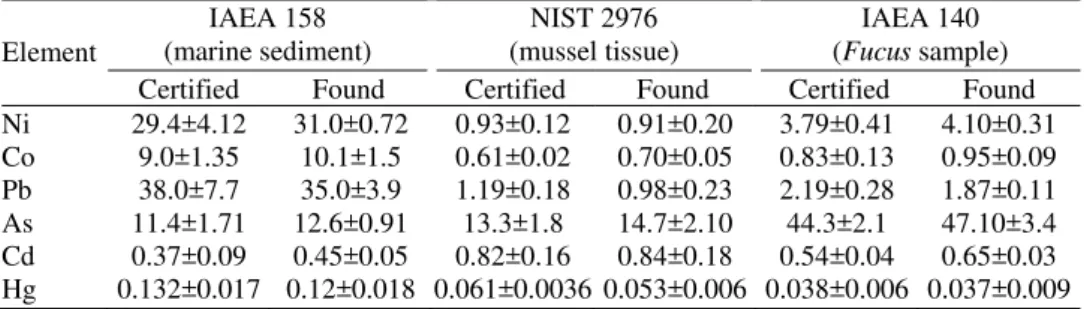
To ensure the quality control and accuracy of the applied analytical procedure for the determination of heavy metals in the sediments, mussels and sea grass, certified reference ma-terials, IAEA 158 (Marine sediment), NIST 2976 (Mussel homogenate) and IAEA 140 (Fucus sample), were also digested and analyzed.
All the results of the investigated elements in sediment, sea grass and mussel are expres-sed in dry weight (dw). To check for contamination, procedural blanks were analyzed after every five samples. The recovery of metals in the standard reference materials was in the range of 82–115 % of the certified total concentrations. This was indicated by results of tri-plicate measurements for the all samples. No correction was applied to the obtained data.
To evaluate the efficiency of metal bioaccumulation by M. galloprovincialis and P. oceanica, the bioconcentration factor (BCF) and the biosediment factor (BSAF), defined as the ratio between the metal concentration in the organism and that in the seawater24 and
sedi-ment,16 respectively, were calculated.
Statistical analysis
analytical standard errors observed with the reported certified materials were below 10 % for all investigated elements, except for Ni and As in the sediment samples, and Cd and As in the mussel tissue and Fucus samples.
TABLE I. Analysis of certified reference materials: certified values and found values (mean ± ± S.D., mg kg-1 dw.)
Element
IAEA 158 (marine sediment)
NIST 2976 (mussel tissue)
IAEA 140 (Fucus sample) Certified Found Certified Found Certified Found Ni 29.4±4.12 31.0±0.72 0.93±0.12 0.91±0.20 3.79±0.41 4.10±0.31 Co 9.0±1.35 10.1±1.5 0.61±0.02 0.70±0.05 0.83±0.13 0.95±0.09 Pb 38.0±7.7 35.0±3.9 1.19±0.18 0.98±0.23 2.19±0.28 1.87±0.11 As 11.4±1.71 12.6±0.91 13.3±1.8 14.7±2.10 44.3±2.1 47.10±3.4 Cd 0.37±0.09 0.45±0.05 0.82±0.16 0.84±0.18 0.54±0.04 0.65±0.03 Hg 0.132±0.017 0.12±0.018 0.061±0.0036 0.053±0.006 0.038±0.006 0.037±0.009
For the metal concentrations in the sediment, differences between the sampling locations were evaluated by the Kruskal–Wallis test. For the metal concentrations in M. galloprovin-cialis and P. oceanica, the differences between the organisms and between locations were de-termined by a two-way analysis of the variance (ANOVA). Correlations between the metal concentrations in P. oceanica and M. galloprovincialis and in the sediment and water samples were performed by analysis of the Pearson’s correlations.
RESULTS AND DISCUSSION
Marine water
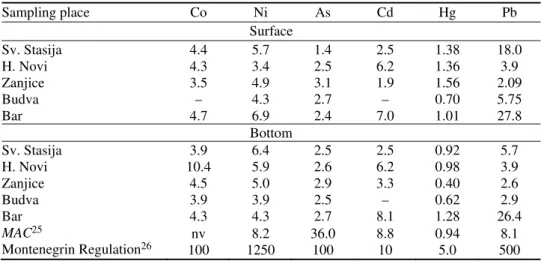
The measured trace element concentrations are listed in Table II. The Co, Ni, As, Cd, Hg and Pb mean levels are relatively high (up to 10.4. µg L–1 Co, 7.8 µg L–1 Ni, 3.1 µg L–1 As, 8.1 µg L–1 Cd, 1.56 µg L–1 Hg and 27.8 µg L–1 Pb). In the Venice lagoon and southern Adriatic of Italy such a high levels of elements in sea water were also found.2,3 The concentration of Cd was below the detection limit at the location Budva. The relative standard deviation of replicate analyses of each sample was within 10–30 %.
Following recommended marine water quality criteria for the protection of aquatic life and human health, i.e., the MAC values25 of the investigated metals in
surface waters, the Hg concentrations were below the MAC value for Hg and the
Pb concentrations were above the MAC value for Pb in seawater at three
loca-tions (Table II). Considering the Montenegrin regulations for the maximum per-missible concentrations of hazardous and harmful substances in waste water that may be discharged into surface waters,26 the concentrations of the investigated elements that may be discharged into the seawater of Montenegro are much higher than the MAC values and the values measured in this study. The EU Directive
cooperation with other Member States and third countries, to achieve a good ecological status in the marine waters for which they are responsible.27
TABLE II. Total metal concentrations in seawater in µg L-1 (MAC – maximum allowable
concentration; nv – no value)
Sampling place Co Ni As Cd Hg Pb
Surface
Sv. Stasija 4.4 5.7 1.4 2.5 1.38 18.0
H. Novi 4.3 3.4 2.5 6.2 1.36 3.9
Zanjice 3.5 4.9 3.1 1.9 1.56 2.09
Budva – 4.3 2.7 – 0.70 5.75
Bar 4.7 6.9 2.4 7.0 1.01 27.8
Bottom
Sv. Stasija 3.9 6.4 2.5 2.5 0.92 5.7
H. Novi 10.4 5.9 2.6 6.2 0.98 3.9
Zanjice 4.5 5.0 2.9 3.3 0.40 2.6
Budva 3.9 3.9 2.5 – 0.62 2.9
Bar 4.3 4.3 2.7 8.1 1.28 26.4
MAC25
Montenegrin Regulation26 100 nv 1250 8.2 36.0 100 8.8 10 0.94 5.0 500 8.1
Sediment
The highest As and Cd concentrations were recorded in Zanjice, the highest Hg and Co levels in the Harbor Bar, whereas the concentrations of Ni and Pb were the highest in H. Novi and Sveta Stasija (p < 0.05; Table III). In Table III,
the Interim Marine Sediment Quality Guidelines (ISQG) and Probable Effect
Level (PEL) values are given in dry weight. The ISQG and PEL values for
ma-rine organisms have been adopted by Environment Canada for a range of toxic substances.28 These guidelines may not be validated for use everywhere; there may be fundamental differences in sediment geochemistry.28However, in the ab-sence of any standards, these guidelines can be used as a first approximation in assessing whether organisms are at risk from sediment concentrations of toxic substances. The concentrations of the investigated elements measured in this stu-dy were below the PEL values in the all sediment samples.
TABLE III. Trace metal concentrations in surface sediment (mean ± S.D. in mg kg-1 dw, for
Hg μg kg-1 dw; nv – no value)
Sampling place Co Ni As Cd Hg Pb
Sv. Stasija 3.9±0.35 18.2±1.7 4.9±0.55 0.75±0.10 24.2±2.2 7.0±1.2 H. Novi 9.0±0.80 32.3±3.3 3.7±0.4 0.77±0.11 28.4±2.3 3.7±0.4 Zanjice 6.6±0.72 16.3±1.5 19.7±2.6 0.87±0.13 9.20±1.0 3.9±0.5 Budva 5.2±0.5 2.7±0.2 2.6±0.37 0.063±0.01 14.0±1.1 2.6±0.3 Bar 11.4±1.1 15.8±1.2 3.1±0.4 0.068±0.01 154.7±9 5.2±0.7 ISQG28
PEL28
nv
Biota
The metal concentrations found in the marine organisms M. galloprovin-cialis and P. oceanica from the different locations are presented in Table IV. The
maximum allowable concentrations or MACs8 for Ni, As, Hg and Pb in mussels
are shown in Table IV. In the all investigated mussel samples, the Cd concen-trations were lower than the MAC value for Cd and the Hg concentrations were
higher than the MAC value for Hg. Recommended MLC values for the sea grass
do not exist in the literature.
TABLE IV. Trace metal concentrations in M. galloprovincialis (Mg) and P. oceanica (Po); mean ± SD in mg kg-1 dw; MAC – maximum allowable concentration; nv – no value
Sampling place Co Ni As Cd Hg Pb
Mg
Sv. Stasija 3.92±0.4 3.35±0.3 7.35±1.0 2.15±0.3 0.95±0.12 9.10±1.1 H. Novi 1.10±0.10 4.7±0.46 17.8±2.3 1.50±0.19 0.35±0.031 3.50±0.4 Zanjice 8.98±0.76 18.9±1.8 40.8±5.6 1.70±0.24 0.59±0.062 1.77±0.23 Bar 6.07±0.6 12.3±1.2 7.54±1.1 3.53±0.47 1.06±0.130 8.50±0.9
MAC8 nv 3.40 16.0 3.70 0.23 3.20
Po
Sv. Stasija 4.15±0.4 24.8±2.3 3.82±0.53 2.20±0.25 0.26±0.03 10.1±1.5 H. Novi 3.75±0.38 22.8±2.1 2.71±0.41 2.90±0.39 0.35±0.04 8.2±0.9 Zanjice 4.30±0.41 31.0±3.2 7.96±1.34 2.80±0.46 0.57±0.06 3.4±0.28 Bar 6.50±0.60 36.7±3.6 2.50±0.29 3.50±0.52 1.37±0.12 5.1±0.60 Budva 3.80±0.39 24.7±2.5 2.68±0.38 2.70±0.44 0.46±0.04 4.5±0.5
The M. galloprovincialis and P. oceanica samples from Zanjice presented
the highest As concentrations (p < 0.05), whereas from the Harbor Bar, they had
the highest Cd and Hg concentrations (p < 0.05) and from Sveta Stasija, the
highest Pb concentrations (p < 0.05; Table IV). The Cd and Hg concentrations in
the biota samples from Bar and the Pb concentrations in the Sveta Stasija samles were very similar. The concentrations of Ni were significantly higher in P. ocea-nica than in M. galloprovincialis, whereas the As concentrations were
signifi-cantly higher in M. galloprovincialis (p < 0.05; Table IV).
Bioconcentration and sediment accumulation factors
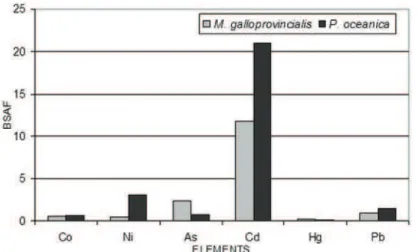
The bioconcentration and sediment accumulation factors (BCF and BSAF)
are shown for both species from the same sampling points, Figs. 2 and 3, res-pectively. The mean values the BCF should be multiplied by 103 in Fig. 2. The
metal which presents the highest mean BCF is As and Hg is the metal with the
lowest one (Fig. 2), while Cd is the metal which presents the highest mean BSAF
and Hg is the metal with the lowest one (Fig. 3). P. oceanica exhibited higher
mean BCF and BSAF values compared to M. galloprovincialis, except for As and
Fig. 2. Mean bioconcentration factor (BCF) values in M. galloprovincialis and P. oceanica (multiplied by 103).
Fig. 3. Mean biosediment accumulation factor (BSAF) values in M. galloprovincialis and P. oceanica.
Relation between the metal concentrations in P. oceanica and M.
galloprovincialis with the metal concentrations in seawater
There were significant positive correlations for the Cd and Pb concentrations in M. galloprovincialis and P. oceanica, relative to their concentrations in
sea-water (rCd = 0.95; rPb = 0.92; p < 0.05, and rCd = 0.95; rPb = 0.95; p < 0.05,
respectively) and positive relations for the As and Co concentrations (rAs = 0.62; rCo = 0.73; p < 0.05 and rAs = 0.78; rCo = 0.66; p < 0.05, respectively).
Relation between the metals concentrations in P. oceanica and M.
galloprovincialis with the metal concentrations in the sediments
There were positive correlations for the As in P.oceanica and the Hg
con-centrations in M. galloprovincialis relative to their concentrations in the
sedi-ments (rAs = 0.52; rHg = 0.65; p < 0.05) and positive relations for the Pb
concentrations in P. oceanica and M. galloprovincialis relative to their
concen-trations in sediments (rPb = 0.65; rPb = 0.52; p < 0.05), but non-significant
rela-tions were found in the case of the Cd concentrarela-tions for both organisms (rCd = –
0.70; rCd = – 0.64; p < 0.05), respectively.
The Harbor Bar was previously identified as the most Hg- and Cd-conta-minated location based on previous mussels studies29 and by the investigated compartments, except for Cd in the sediment analysis, for which a maximum value was revealed for Zanjice. The fact that no correlations were found between the Cd concentrations in M. galloprovincialis and P. oceanica and in the
sedi-ment, but very high correlations were found between the Cd concentrations in the investigated biota and seawater indicate that the Cd in P. oceanica5,15,30 and M.
galloprovincialis6,31 tissues reflect the Cd in the water column. Cd accumulation in M. galloprovincialis and P.oceanica seems to be a function of the Cd
concen-tration in seawater, which was also found in the present study.
The Harbor Bar was identified as the most Hg-contaminated location accord-ing to the results obtained for all the investigated compartments, especially the surface sediment. This result is probably related to the effluents from the storage of crude oil and oil products, transoceanic ships and tankers traffic, as well as untreated urban and industrial effluents. In this study, a positive correlation was found between the Hg concentrations (rHg = 0.65) inM. galloprovincialisand in
the sediment but a non-significant relation with the concentration in seawater (rHg = 0.01). This result could be related to the presence of a high level of Hg from sediment in the suspended particulate matter and of high levels of the parti-culate matter in the water column.19 Metals in mussels can correlate with metal levels in sediments, although mussels are not in direct contact with the sediment, which is resuspended and wafted to them by wave action.32
Sveta Stasija was identified as the most Pb-contaminated location according to the results obtained for all the investigated compartments, except the bottom seawater. Seawater had maximum Pb values in the Harbor Bar. The extreme Pb contamination in the vicinity of Sveta Stasija could be associated with an anthro-pogenic impact due to the proximity of Kotor, a city with a harbor, chemical in-dustry, food industry and the geographical location of Sveta Stasija, i.e., there is a
low hydrological influx to the small Kotor Bay.
which form more or less soluble organic matter particles, indicating that the evi-denced Pb originated primarily from human activities.7 Significant correlations between the concentrations Pb in the organisms and Pb in the surrounding water were obtained. The positive correlations found between the Pb concentrations in
P. oceanica and M. galloprovincialis and in the water would suggest that Pb in
the tissues of the organisms primarily reflects the Pb in the water.16,17 Therefore, in the case of P. oceanica, this leads to the hypothesis of preferential Pb uptake
from the water column.16 However, the positive correlation found for Pb related to the sediment, and previously in this study for Hg related to the water in this sea grass suggests that there could be some other uptakes and distributions routes for these two elements, not only by leaves and for Pb also by the root system,5 and vice versa, leaves for Hg.35 The maximum Pb level in sediment found in Sv.
Stasija is related to the highest Pb level in M. galloprovincialis at this location.
Pb in M. galloprovincialis is absorbed bound to particulate material and in a
water-soluble form.36
Zanjice was identified as the most As-contaminated location by the results of all the investigated compartments. Arsenic was homogeneously distributed along the Montenegrin coast in the sediment except at the location Zanjice. This could be due to natural leaching of terrestrial soils and sediments or increases in the As concentration when the sediment content changed,37 which in Zanjice could be attributable to the transport of metals by waves from the open sea and by the branch of the Mediterranean current coming from the southeastern side of the Adriatic38 entering into the Bay, or on leaving, carrying wastes from the Bay. For the other locations, the low As concentrations in the sediment may be explained by the lack of low contaminant inputs and the low leaching of natural arsenic. In this study, the concentrations of As in M. galloprovincialis were higher than
those in the sediment were, but slightly less in P. oceanica than in the sediment
(Tables III and IV). Positive correlations were found between the As levels in these organisms and the As levels in the sediment and water. Generally, the arse-nic levels in these organisms generally reflect the total arsearse-nic in the sediment.39 Langston39 supports the view that particulate arsenic is the most important source of the metal accumulated in bivalves, although some absorption from solution cannot be disregarded, which is in agreement with the results obtained in the pre-sent study. The lower relationship between As in P. oceanica and in
water/se-diment, compared to mussels, may be explained by other factors such as phos-phate competition related to As39 or that As is mostly immobilized as a form not available to plants.40
The M. galloprovincialis from Zanjice, located at the entrance of the Bay,
had greater contents of As, Ni and Co than M. galloprovincialis from the Bay.
The Ni concentrations in the biomonitored organisms in this study were similar to those reported in the literature.2,15,17 Positive correlations between the Ni concentrations in the organisms and those in seawater/sediment were not evi-denced. This is possibly due to the background Ni levels15 in the organisms. In the case of the Co concentrations, the positive correlations found between the Co concentrations in P. oceanica and M. galloprovincialis with those in seawater
indicate that Co in these organisms mainly came from the water, which is con-trary to the assertions of Lafabrie.16,17
CONCLUSIONS
The data obtained in the present investigation showed that the sea grass P. oceanica and the mussel M. galloprovincialis could be used as organisms for the
biomonitoring of heavy metals pollution in the marine environment of the south-eastern Adriatic Sea. These data showed that the accumulation ratios of the six studied metals in the sea grass and in the mussel differed. From the determined
BCF and BSAF values calculated for the two different marine species
investi-gated in this study, P. oceanica was found to be a stronger accumulator for Cd,
Pb, Ni and Co, and M. galloprovincialis for As and Hg. P. oceanica was a
stronger Cd accumulator from the surrounding water and M. galloprovincialis
had a higher capacity to accumulate As, mostly from particles. The Hg accumu-lation by both the investigated organisms was the lowest of the investigated metals.
However, it must be born in mind that the actual uptake mechanisms of heavy metals by the studied organisms are probably rather complex because their exposure to trace elements is not limited to soluble metals in the aquatic medium. Metal uptake from sediment particles and food, in the case of the mussels, and from sediments (through the roots), in the case of the sea grass, cannot be ignored.
The results of this first study provide a valuable baseline for further moni-toring of the marine ecosystem of the southeastern Adriatic Sea.
Acknowledgments. This research was financed by the Ministry of Education and Science of the Republic of Serbia, Contract No. III43009 and EAR, Contract No. 04SER02/05/007.
Ј
Ј Ј
Ј Ј Ћ1
Ћ2
1Institut za biologiju mora, Univerzitet Crne Gore, Dobrota bb, 85330 Kotor, Crna Gorai
2Tehnolo{ko
–metalur{ki fakultet, Univerzitet u Beogradu, Karnegijeva 4, 11000 Beograd
(Co, Ni, As, Cd, Pb Hg) ђ
, .
Posidonia oceanica Mytilus galloprovincialis
2005. , , ,
, , ђ
. ,
ђ
-ђ , , . ђ ђ
P. oceanica M.
gallo-provincialis Co, Ni, Cd Pb, As Hg. P.
oceanica M. galloprovincialis
. ђ
.
( 23. , 13. 2011)
REFERENCES 1. UNEP, MAP technical report Series 86 (1994) 91
2. L. Giusti, H. Zhang, Environ. Geochem. Health 24 (2002) 47
3. L. Manfra, A. Accornero, Mar. Pollut. Bull. 50 (2005) 686
4. J. Scancar, T. Zuliani, T. Turk, R. Milačić, Environ. Monit. Assess. 127 (2007) 271
5. Z. Kljaković-Gašpić, B. Antolić, T. Zvonarić, A. Barić, Fresenius Environ. Bull. 13
(2004) 1210
6. Z. Kljaković-Gašpić, N. Ozak, I. Ujević, T. Zvonarić, A. Barić, Fresenius Environ. Bull.
15 (2006) 1041
7. Z. Kljaković-Gašpić, D. Bogner, I. Ujević, Environ. Geol. 58 (2009) 751
8. M. Jović, R. A. Stanković, L. Slavković Beskoski, I. Tomić, S. Degetto, S. Stanković, J. Serb. Chem. Soc. 76 (2011) 933
9. D. Joksimović, I. Tomić, R. A. Stanković, M. Jović, S. Stanković, Food Chem. 127
(2011) 637
10. D. Babi, V. Çelo, A. Çullaj, N. Pano, Fresenius Environ. Bull. 7 (1998) 577
11. V. Çelo, D. Babi, B. Baraj, A. Çullaj, Water Air Soil Pollut. 111 (1999) 235
12. J. Morillo, J. Usero, I. Gracia, Chemosphere 58 (2005) 1421
13. L. Manfra, A. Accornero, Mar. Pollut. Bull. 50 (2005) 686
14. D. Acevedo-Figueroa, B. D. Jimenez, C. J. Rodriguez-Sierra, Environ. Pollut. 141 (2005)
336
15. L. Campanella, M. E. Conti, F. Cubadda, C. Sucapane, Environ. Pollut. 111 (2001) 117
16. C. Lafabrie, G. Pergent, R. Kantin, C. Pergent-Martini, J. L. Gonzalez, Chemosphere 68
(2007) 2033
17. C. Lafabrie, C. Pergent-Martini, G. Pergent, Environ. Poll. 151 (2008) 262
18. M. Romeo, C. Frasila, M. Gnassia-Barelli, G. Damiens, D. Micu, G. Mustata, Water Res.
39 (2005) 596
19. D. Cossa, J. M. Martin, K. Takayanagi, J. Sanjuan, Deep-Sea Res. 44 (1997) 721
20. K. M. El-Moselhy, M. N. Gabal, J. Mar. Syst. 46 (2004) 39
21. Y. W. Lee, W. X. Wang, Sci. Total Environ. 213 (2001) 273
22. B. M. Žarković, S. D. Blagojević, J. Serb. Chem. Soc. 74 (2009) 1009
23. M. Murakami, T. Takada, Talanta 39 (1992) 1293
24. R. Serrano, F. J. López, F. Hernández, J. B. Peña, Bull. Environ. Contam. Toxicol. 59
25. US EPA (United States Environmental Protection Agency), 2009, National Recom-mended Water Quality Criteria, United States Environmental Protection Agency. http://water.epa.gov/scitech/swguidance/standards/current/upload/nrwqc-2009.pdf (last accessed: April, 2011)
26. Montenegrin regulation, 2008, The quality of wastewater discharged into the recipient, No. 45/08 of 31.07.2008, 09/10 of 19.02.2010, Ministry of Agriculture, Forestry and Water Management, with the prior opinion of the Ministry of Tourism and Environment and the Ministry of Health, Labour and Social Welfare
27. EU (2008), Strategy for the marine environment, http://europa.eu/legislation_summaries/ maritime_affairs_and_fisheries/fisheries_resources_and_environment/l28164_en.htm (last accessed: April, 2011)
28. CCME (Canadian Council of Ministers of the Environment), 2002, Canadian Sediment Quality Guidelines for the Protection of Aquatic Life, Canadian Council of Ministers of the Environment. http://www.ccme.ca/assets/pdf/sedqg_summary_table.pdf (last acces-sed: April, 2011)
29. S. Stankovic, M. Jovic, R. Milanov, D. Joksimovic, J. Serb. Chem. Soc. 76 (2011) 1725
30. M. E. Conti, B. Bocca, M. Iacobucci, G. Finoia, M. Mecozzi, A. Pino, A. Alimonti, Arch. Environ. Contam. Toxicol. 58 (2010) 79
31. G. Adami, P. Barbieri, M. Fabiani, S. Piselli, S. Predonzani, E. Reisenhofer, Chemo-sphere 48 (2002) 671
32. J. Burger, M. Gochfeld, Sci. Total Environ. 368 (2006) 937
33. S. Degetto, C. Cantaluppi, D. Desideri, M. Schinitu, S. Stanković, Z. Kljajić, in Pro-ceeding of 7th Int. Conf. Methods and Applications of Radioanalytical Chemistry-MARC VII, (2006), Kailua-Kona, Hawaii, USA, 2006, p. 83
34. P. G. Glasby, P. Szefer, J. Geldon, J. Warzocha, Sci. Total Environ. 330 (2004) 249
35. M. A. Schlacher-Hoenlinger, T. A. Schlacher, Mar. Biol. 131 (1998) 401
36. P. Irato, G. Santovito, A. Cassini, E. Piccinni, V. Albergoni, Arch. Environ. Contam. To-xicol. 44 (2003) 476
37. F. Galgani, J. F. Chiffoleau, V. Orsoni, L. Costantini, P. Boissery, S. Calendin, B. Andral, Chem. Ecol. 22 (2006) 299
38. B. Cushman-Roisin, E. C. Naimie, J. Mar. Syst. 37 (2002) 279
39. W. J. Langston, J. Mar. Biol. Ass. U.K. 60 (1980) 869