DIRECT ASSESSMENT OF GRADUATE COMPETENCIES
THROUGH COLLABORATION
OF CLASSROOM ASSESSMENT TECHNIQUE
AS THE BASIC EVIDENCES
Agnes Herawati
English Department, Language and Culture Faculty, BINUS University Jl. Kemanggisan Ilir III No 45, Kemanggisan, Jakarta Barat 11480
ABSTRACT
Graduate competencies are the combination of knowledge, skills or abilities that play important roles in the successful completion of a task at work. However, that does not mean graduate competencies are proven most in the job occupation. The assessment during four years of undergraduate program will be effective ways to assess the achievement of graduate competencies. In the curriculum process, the graduate competencies are broken down into some related learning outcomes. As the main aims, the learning outcomes should pass some assessment to see the achievement of them and get the feedback. The types of the assessment are based on the needs. The decision of this achievement is based on some analysis through various ways, including analytical rubric and checklist. The achievement of learning outcomes will be analyzed more to see how the graduate competencies have been achieved. The result of this analysis will be the basis of direct assessment of the graduate competencies that will result in the collection of evidences as the feedback of the improvement of the whole curriculum.
Keywords: competencies, classroom assessment, feedback
ABSTRAK
Kompetensi lulusan adalah kombinasi dari pengetahuan, keterampilan atau kemampuan yang memainkan peran penting dalam berhasil menyelesaikan tugas di pekerjaan. Namun, tidak berarti bahwa kompetensi lulusan yang terbukti paling dalam pekerjaan pendudukan. Penilaian selama empat tahun program sarjana akan menjadi cara yang efektif untuk menilai pencapaian kompetensi lulusan. Dalam proses kurikulum, kompetensi dipecah menjadi beberapa hasil belajar yang berkaitan. Sebagai tujuan utama, hasil belajar harus melewati beberapa penilaian untuk melihat prestasi mereka dan mendapatkan umpan balik. Jenis penilaian ini didasarkan pada kebutuhan. Keputusan itu didasarkan pada analisis beberapa kinerja melalui berbagai cara, termasuk rubrik analisis dan daftar uji. Pencapaian hasil pembelajaran akan dianalisis lebih lanjut untuk melihat bagaimana kompetensi telah dicapai. Hasil analisis ini akan menjadi dasar penilaian langsung dari kompetensi yang akan menghasilkan pengumpulan bukti sebagai umpan balik dari perbaikan kurikulum secara keseluruhan.
INTRODUCTION
The world nowadays is changing in which “the focus is shifting to the continual production of knowledge as a commodity, positioning workers as human capital, virtually immune to obsolescence” (Butler, 1999). In this kind of world, identifying and developing the important competencies required of graduates is a challenging task for the curriculum developer. Not only that, the prime function of education program must be fulfilled, that is to prepare students for the workplace by developing generic and specific competencies that educators believe will be useful to employers (Rainsbury, Hodges, Burchell & Lay, 2001). But, do we have to wait until the employers inform us that our graduates have enough capabilities? It might be too late. The educators need to conduct assessment regularly to ensure that the students have fulfilled competencies required as well as to have some review on the updated graduate competencies. The suitable ways that we can do is by having the direct assessment, especially the one relating to formative assessment in the classroom.
This study tries to investigate that the collaboration of some formative assessments, in this case, classroom assessment techniques, play an important role in assessing the students towards the graduate competencies designed and also gathering the information about the level of achievement.
Review of the Literature
Graduate Competencies
What do we understand by the term competency? Spencer & Spencer view competency as a characteristics of an individual that is causally related to job performance (1993). Competencies can be accumulated within an individual and represent a capacity to perform at some future point (Boam & Sparrow, 1992). Essentially, these definitions relate to enduring characteristics possessed by individual that should result in an acceptable job performance. This notion is based on the premise that competencies are causally linked to individual performance outcomes (Spencer & Spencer, 1993).
In a workplace context, competency is a combination of cognitive skills (technical knowledge, expertise and abilities) and personal or behavioral characteristics (principles, attitude, values and motivation), which are a function of an individual’s personality. Spencer and Spencer (1993) suggest that, if people with the right personal characteristics are recruited initially, then they should have the capacity to quickly acquire the relevant technical knowledge and skills in order to attain the employers’ performance objectives.
Assessment
Assessment is a familiar term for educators. They use assessment at least to gather input regarding our students’ achievement or the achievement of the learning outcomes planned. Palomba & Banta (1999) define assessment as the systematic collection, review, and use of information about educational programs undertaken for the purpose of improving student learning and development. However, assessment is more than the collection of data. To make assessment work, educators must be purposeful about the information they collect. As a basis for data gathering, they must clarify their goals and objectives for learning and be aware of where these goals and objectives are addressed in the curriculum. After data are gathered, educators must examine and use assessment results to improve educational programs (Hutchings, Marchese & Wright, 1991).
about its purpose, it helps to return to these key questions. Assessment is often referred to as student outcomes assessment. However, Terenzini (1989) suggests focusing on progress rather than outcomes. The graduate competencies are the final outcomes of the students, however assessing progress through the application of classroom assessment techniques can indicate to how far those competencies are achieved.
Classroom Assessment Techniques
Classroom assessment is made up of small-scale assessment techniques that provide information to teachers and students about what is going on in the classroom. Generally, classroom assessment techniques (CATs) can be administered in a few minutes at the beginning of, end of, or during the class period. CATs, which are usually ungraded and anonymous exercise, help teachers get a sense of how much and how well students are learning and provide information about the processes students use to learn. Unlike large-scale assessment activity in which classroom teachers often must cooperate in assessment activity that was designed by others, classroom assessment techniques are selected, designed and used by individual teachers in specific classes for the benefit of the class. Teachers make all choices, including how to handle the result.
Classroom assessment techniques itself falls into three broad categories (Palomba & Banta, 1999). The first group is dealing with the assessment of course-related skills and knowledge, while the second and the third groups are dealing with the most important thing in the lesson and assessment of students’ reaction to specific aspect of instruction. Without the tendency to hesitate the second and the third group, just to specify the analysis, this study deals with the first group that is the assessment of course-related skills and knowledge. In some times during the semester, teachers may have time to analyze the result of the classroom assessment techniques. This activity will provide them with enough information regarding students’ progress, teaching learning activity and moreover about the achievement of graduate competencies.
Graduate Competencies to Classroom Assessment
As has been stated before, graduate competencies are the core competencies of the graduates and will be proven exactly through the input from the stakeholders. However, the step by step proofs should be gathered in order to get some relevant input regarding the achievement of graduate competencies. The assessment during four years of undergraduate program will be an effective ways to assess the achievement of graduate competencies. In the curriculum process, the graduate competencies are broken down into some related learning outcomes. The learning outcomes here become the main aims of a course. As the main aims, the learning outcomes should pass some assessment to see the achievement of them and get the feedback. It is better if the assessment conducted is in the form of continuous assessment, so I suggest the classroom assessment techniques, the ones that are proven as the effective ways of continuous assessment.
DISCUSSION
the same graduate competency that is graduates will be able to analyze how language works and employ this understanding to practical context.
Related to procedure, firstly, teachers analyze the learning outcomes of the courses, trying to know the relationship between the courses and the graduate competency and how strong the relationship is. Secondly, the classroom assessment techniques are conducted four times in each class. The results then are analyzed to see the achievement of the learning outcomes. The rubric is used to decide the level of each achievement. The learning outcomes of one course support only some or a few part of a graduate competency, that is why the collaboration of some classroom assessment techniques are needed here to see the achievement of graduate competency holistically.
Table 1 Table of graduate competency and the supporting courses
Course Credit Semester Graduate Competency GC-1 GC-2 GC-3
Listening 2 1 x
Speaking 2 1 x
Reading 2 1 x
Grammar 4 1 x
Writing 2 1 x
Intro to
linguistics 2 3 x
English
Syntax 2 5 x
Intro to
literature 2 4 x
Prose 2 6 x
Poetry 4 6 x
Drama 2 6 x
Table 2 Learning outcomes
Graduate Competency Course Learning outcomes Level of relationship
Graduates will be able to analyze how language works and employ this
understanding to practical context.
Introduction to Linguistics
LO -1 : Pronounce the words correctly
V
LO -2: Apply syntactical and morphological rules in analyzing the words
VV
LO -3: Analyze the meaning of sentences according to the context
VV
English syntax
LO -1: Explain the syntactical rules
VV
LO -2: Apply the syntactical rules in analyzing sentences
VV
Notes: V = low relationship VV = high relationship
Table 2 shows us that one of five learning outcomes has low relationship towards the graduate competency, however that learning outcome is directly related to the course (Introduction to Linguistics), so there is no revision regarding that outcome.
Table 3 Criteria and related LO
Graduate Competency Criteria Course Related LO
Graduates will be able to analyze how language works and employ this understanding to practical context. Key Principles of Linguistics Intro to Linguistics LO-2
English Syntax LO-1
Application of Key Principles of Linguistics Intro to Linguistics LO-1, LO-2, LO -3
English Syntax LO -2
Table 3 shows us that one graduate competency is broken down into two criteria, and then the learning outcomes of supporting course is grouped into the criterion related
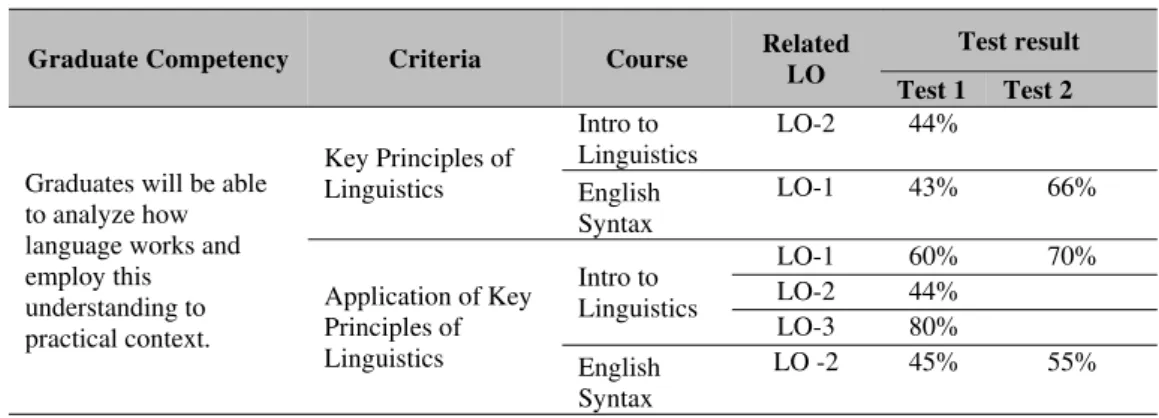
Table 4 Result of the test
Graduate Competency Criteria Course Related LO
Test result
Test 1 Test 2
Graduates will be able to analyze how language works and employ this understanding to practical context.
Key Principles of Linguistics Intro to Linguistics LO-2 44% English Syntax
LO-1 43% 66%
Application of Key Principles of Linguistics
Intro to Linguistics
LO-1 60% 70% LO-2 44%
LO-3 80%
English Syntax
The percentage stated in Table 4 shows us the average percentage of the students who fulfill the learning outcomes. The teacher conducts 4 times classroom assessment for each course and the counting of the result above is based on the test results compared with the rubric and the checklist prepared for each learning outcome.
Meanwhile, all the percentages in table 5 should be counted more to get the average of the achievement of each criterion.
Table 5 Achievement of the criteria
Graduate Competency Criteria % Achievement
Graduates will be able to analyze how language works and employ this understanding to practical context.
Key Principles of
Linguistics 51%
Application of Key
Principles of Linguistics 59%
Tables 1 to 5 show us the steps how the graduate competency is aligned to the classroom assessment. The results of the classroom assessments, as the direct assessment, provide us with the basic evidences of the achievement of the graduate competency. After analyzing the results of all classroom assessment, we can conclude that the achievement of the criteria is quite low, as shown in table 5. Regarding the achievement of the graduate competency, the percentage is only 55%; it is quite low.
CONCLUSION
The result taken from the analysis of the classroom assessment leads us to the conclusion that the graduate competency is not achieved well. The additional effect of this may lead us to the perception the students are not capable enough, however this needs further investigation.
Although we can use the result of the classroom assessment as the basis of assessing the achievement of graduate competency, actually it is not the only way. As stated above, the continuous assessment is good, however we need to analyze the result of the summative assessment, since students usually are more ready in taking the summative assessment and this will lead to the better result.
REFERENCES
Birkett, W. P. (1993). Competency based standards for professional accountants in Australia and New Zealand. Melbourne, Australia: Australian Society of Certified Practicing Accountants.
Boam, R., & Sparrow, P. (1992). Designing and achieving competency. London: McGraw-Hill.
Brookhart, S. (2002). Development measurement theory for classroom assessment purposes and uses.
Educational Measurement: Issues and Practice, 22 (4), 5-12.
Hafner, J., & Hafner, P. (2003). Quantitative analysis of the rubric as an assessment tool: An empirical study of the student peer-group rating. International Journal of Science Education, 25(12).
Hutchings, P., & Marches, T. (1990). Watching assessment: Questions, stories, prospects. Change: The Magazine of Higher Learning, 22(5), 12-34.
Hutchings, P., Marches, T., & Wright, B. (1991). Using assessment to strengthen general education.
Washington DC: American Association for Higher Education Assessment Forum.
Palomba, C. A., & Banta, T. W. (1999). Assessment essential: Planning, implementing and improving assessment in higher education. San Fransisco, California: Josey-Bass Publisher.