Orientação empreendedora e inovação aberta em startups brasileiras: um estudo
multicaso
Orientation entrepreneuriale et innovation ouverte dans des startups
brésiliennes: une étude cas multiples
Orientación emprendedora e innovación abierta en startups brasileñas: un estudio
multicaso
Eduardo Gomes Carvalho*
([email protected])Joel Yutaka Sugano**
([email protected]fl a.br)Recebido em 02/12/2015; revisado e aprovado 15/04/2016; aceito em 27/04/2016 DOI: http://dx.doi.org/10.20435/1984-042X-2016-v.17-n.3(08)
Abstract: Entrepreneurship and innovation are the basis to regional and national development. Therefore, entrepreneurs and startups are protagonists in this scenario. However, a new paradigm emerges in innovation studies: Open Innovation. But the relationship between Open Innovation and entrepreneurship is few explored. Thus, our work aims to fi ll this gap. Using case studies we
check the hypotheses presented by Carvalho and Sugano (2016). At end, a framework and new hypotheses were presented to future studies.
Key words: entrepreneurship; entrepreneurial orientation; open innovation.
Resumo: Empreendedorismo e inovação são bases para o desenvolvimento regional e nacional. Portanto, empreendedores e startups passam a ser protagonistas neste cenário. No entanto, um novo paradigma surge em estudos de inovação: Open Innovation. Mas a relação entre inovação aberta e empreendedorismo é pouco explorada. Assim, nosso trabalho visa preencher esta lacuna. Usando estudos de caso vamos verifi car as hipóteses apresentadas por Carvalho e Sugano (2016).
Ao fi nal, um framework e novas hipóteses foram apresentados para estudos futuros. Palavras-chave: empreendedorismo; orientação empreendedora; inovação aberta.
Résumé: Entrepreneuriat et innovation sont la base du développement régional et national. Par conséquent, les entrepreneurs et les startups sont les protagonistes de ce scénario. Toutefois, un nouveau paradigme émerge dans les études d’innovation: l’innovation ouverte. Mais la relation entre l’innovation ouverte et de l’entrepreneuriat est peu exploré. Ainsi, notre travail vise à combler cette lacune. En utilisant des études de cas, nous vérifi ons les hypothèses présentées par Carvalho
et Sugano (2016). Enfi n, un framework et de nouvelles hypothèses pour de futures études ont été
présentés.
Mots-clés: entrepreneuriat; orientation entrepreneuriale; innovation ouverte.
Resumen: El espíritu emprendedor y la innovación son la base para el desarrollo regional y na-cional. Por eso, los emprendedores y startups convierten en protagonistas en este escenario. No obstante, un nuevo paradigma emerge en los estudios de innovación: la innovación abierta. Pero la relación entre la innovación abierta y el espíritu emprendedor es poco explorada. Así, nuestro trabajo tiene como objetivo llenar este vacío. Utilizando estudios de caso, comprobamos las hi-pótesis presentadas por Carvalho y Sugano (2016). Al fi nal, fueron presentados un framework y
nuevas hipótesis para futuros estudios.
Palabras clave: espíritu emprendedor; orientación emprendedora; innovación abierta.
1 INTRODUCTION
Open innovation is between the
hot-test topics in innovation studies. However
the relationship between open innovation
and the broader disciplines of management
is unexplored, as pointed by West et al.
(2014). An important discipline of
manage-ment (and highly linked with innovation)
is entrepreneurship. Even before West et
al. (2014), Hossain (2013) identi
fi
ed the
gap of studies about open innovation and
entrepreneurship.
As af
fi
rmed, the relationship
betwe-en innovation and betwe-entreprbetwe-eneurship is
relevant in the literature. A pioneer in the
studies about entrepreneurship and
inno-vation is Schumpeter (1934). Schumpeter
(1934) viewed the entrepreneur as
inno-vator. Schumpeter (1934) maintained that
innovation contributes to the growth of the
economy because entrepreneurs produce
innovations. After Schumpeter (1934),
other important author that touched on
the conceptual relationship between
in-novation and entrepreneurship is Drucker
(1994). Other several works (NDUBISI;
IFTIKHAR, 2012; SWAMI; PORWAL,
2005; Zhao, 2005; Galindo; Mendez-Picazo,
2013) explored the relationship between
innovation and entrepreneurship. But,
why the relationship between open
in-novation and entrepreneurship is still
unexplored?
First, open innovation is still under
scrutiny, and it is rooted in technology.
Therefore, the relationship between open
innovation and the disciplines of
econo-mics and management is the next step
to understand the phenomenon of open
innovation. Second, this relationship
is not entire unexplored. For example,
Chaston and Scott (2012), through a
survey, presented evidences about the
impact of entrepreneurial orientation and
open innovation in firm performance,
but they did not link the dimensions of
entrepreneurial orientation and open
in-novation. After, the issue of April 2013 of
the Technology Innovation Management
Review, entitled Open Innovation and
Entrepreneurship, works of authors from
Belgium and Norway that explore this
relationship were presented (DE CLEYN
et al., 2013
;
IAKOVLEVA, 2013; SEGERS,
2013; SOLESVIK; GULBRANDSEN, 2013;
VANHAVERBEKE, 2013). Recently,
Eftekhari and Bogers (2015), using case
study, explored how an open approach
to new venture creation can be bene
fi
cial
for start-up entrepreneurs. Cheng and
Huizingh (2014) addressed how three
types of strategic orientations, between
them Entrepreneurial Orientation,
mo-derate the relationship between Open
Innovation and innovation performance.
But, no one explored Entrepreneurial
Orientation as driver for Open Innovation.
Notwithstanding, Carvalho and
Sugano (2016), using systematic review,
presented some hypotheses that explore
the relationship between open innovation
and entrepreneurial orientation,
defen-ding the hypothesis of Entrepreneurial
Orientation as driver for Open Innovation.
Thus, our work aims to check the
hypo-theses presented by Carvalho and Sugano
(2016). At check those hypothesis we are
trying to answering the following
ques-tion: What is the relationship between
Open Innovation and Entrepreneurial
Orientation? Our proposition is that
Entrepreneurial Orientation dimensions
are correlated with Open Innovation, and
both impact the
fi
rm performance. The
research method adopted is case study.
In contrast to Cheng and Huizingh (2014),
we aim to focus on
fi
rm performance, not
in innovation performance.
2 THEORETICAL BACKGROUND
2.1 Open Innovation
Chesbrough is the pioneer in the
studies of Open Innovation. The book
of Chesbrough (2003) not just compiled
re
fl
ections from a former Silicon Valley
manager’s, but presented a first
defi-nition of Open Innovation. According
to Chesbrough (2003) open innovation
means that valuable ideas can come from
inside or outside the company and can
go to market from inside or outside the
company as well. However, posteriorly,
Chesbrough (2006) emphasize the
inten-tionality of the knowledge
fl
ows into and
out of the
fi
rm. Thus, Chesbrough (2006)
af
fi
rms that open innovation is the use of
purposive in
fl
ows and out
fl
ows of
kno-wledge to accelerate internal innovation,
and expand the markets for external use
of innovation, respectively. But, in a new
effort to define open innovation West
et al. (2014) presented the most actual
de
fi
nition of open innovation provided
by Chesbrough and Bogers (2014), that
considerate the increasing interest in
non-pecuniary knowledge
fl
ows, being
open innovation de
fi
ned as a distributed
innovation process based on purposively
managed knowledge
fl
ows across
organi-zational boundaries, using pecuniary and
non-pecuniary mechanisms in line with
the organization’s business model.
Saebi and Foss (2015) analyzed the
de
fi
nitions provided by Chesbrough and
others and pointed three points. First,
open innovation studies are congruent
with regard to their understanding of
open innovation as a set of practices that
facilitate both purposive in
fl
ows and
ou-t
fl
ows of knowledge; thus open
innova-tion generally encompasses both inbound
and outbound dimensions of innovation
processes. Second, studies seem to agree
that pursuing open innovation requires a
certain degree of permeability of
organiza-tional and innovation process boundaries
to guarantee successful innovation. Third,
extant definitions of open innovation
are kept broad, arguably to re
fl
ect what
Huizingh (2011) calls the “appeal” of
open innovation, namely that it provides
the “umbrella that encompasses, connects
and integrates a range of already existing
activities”.
The
fi
rst observation of Saebi and
Foss (2015) reflects what is known as
macroprocess or archetypes of Open
Innovation. Gassmann and Enkel (2004)
present three macroprocess of Open
Innovation: outside-in, inside-out and
coupled. The outside-in process is related
to enriching the company’s own
kno-wledge base through the integration of
suppliers, customers and external
know-ledge sourcing can increase a company’s
innovativeness. The inside-out process
refers to pro
fi
ts by bringing ideas to
ma-rket, selling intellectual property and
mul-tiplying technology by transferring ideas
to the outside environment. The coupled
process involves coupling the outside-in
and inside-out processes by working in
alliances with complementary partners in
which give and take is crucial for success.
In order to accomplish both, these
compa-nies collaborate and cooperate with other
stakeholders such as partner companies
(e.g. strategic alliances, joint ventures),
suppliers and customers, as well as
uni-versities and research institutes.
Usually, most works refers only to
outside-in and inside-out dimensions.
Furthermore, Conboy and Morgan (2011)
use the terms inbound and outbound to
de
fi
ne respectively outside-in and
inside--out. The other case is van de Vrande et al.
(2009), which adopt the terms technology
exploration and technology exploitation
to de
fi
ne respectively inbound and
out-bound open innovation.
• Open Innovators: corresponds to compa-nies that are really able to manage a wide set of technological relationships, that im-pact on the whole innovation funnel and involve a broad set of different partners; • Closed Innovators: corresponds to
com-panies that access external sources of knowledge only for a specifi c, single phase of the innovation funnel and typically in dyadic collaborations;
• Integrated Collaborators: corresponds to companies that open their whole inno-vation funnel but only to contributions coming from a few types of partners and; • Specialized Collaborators: corresponds
to companies that are able to work with many different partners but concentrate their collaborations at a single stage of the innovation funnel.
Carvalho et al. (2016) point studies
about open innovation in startups are a
gap in literature. Startups are a kind of
company which is expected a more
promi-nent entrepreneurial behavior. But, what
makes a
fi
rm entrepreneurial, and how do
we distinguish entrepreneurial
fi
rms from
those more conservatively managed?
2.2 Entrepreneurial Orientation
The previous section closes with a
question. According to Anderson et al.
(2015) the foundational paper of Miller
(1983) provided much needed clarity
regarding this fundamental issue to
ma-nagement scholars. The objective of the
research of Miller (1983) was to discover
the chief determinants of
entrepreneur-ship, the process by which organizations
renew themselves and their markets by
pioneering, innovation, and risk taking.
The first constructs of entrepreneurial
orientation rely on three dimensions
identi
fi
ed by Miller (1983):
innovative-ness, proactiveness and risk taking. Later,
Lumpkin and Dess (1996) identified
more two dimensions of entrepreneurial
orientation: autonomy and competitive
aggressiveness. Autonomy is de
fi
ned by
Lumpkin and Dess (2001) as independent
action by an individual or team aimed at
bringing forth a business concept or vision
and carrying it through to completion.
Competitive aggressiveness is said to
re
fl
ect the intensity of a
fi
rm’s effort to
outperform industry rivals,
characteri-zed by a strong offensive posture and a
forceful response to competitor’s actions
(LUMPKIN; DESS, 2001). Innovativeness
re
fl
ects, according to Lumpkin and Dess
(1996), a
fi
rm’s Schumpeterian tendency to
engage in and support new ideas, novelty,
experimentation, and creative processes
that may result in new products, services,
or technological processes. Proactiveness
is de
fi
ned as acting opportunistically to
shape the environment by in
fl
uencing
trends, creating demand, and becoming
a first mover in a competitive market
(LUMPKIN; DESS, 1996). Risk taking is
de
fi
ned by Lumpkin and Dess (2001) to
a tendency to take bold actions such as
venturing into unknown new markets,
committing a large portion of resources
to ventures with uncertain outcomes.
adopts
fi
ve dimensions: autonomy,
in-novativeness, proactiveness, risk taking
and networks.
We must stress that entrepreneurial
orientation is among the main concepts
in entrepreneurship studies in the last
decades. According to Rauch et al.
(
2009)
and Anderson et al. (2015)
entrepreneu-rial orientation has emerged as a major
construct in the strategic management
and entrepreneurship literature over the
years. Entrepreneurial orientation has
been used around the world to measure
the level of entrepreneurial behavior of
the firms. According to Campos et al.
(2012) entrepreneurial orientation has
received substantial conceptual and
em-pirical attention, representing one of the
few areas in entrepreneurship research in
which a cumulative body of knowledge
is developing.
3 METHODOLOGY
Given the objective of the study and
the hypotheses presented by Carvalho
and Sugano (2016), we conducted a case
study (EISENHARDT, 1989; YIN, 1994).
According to Eisenhardt (1989) the case
study is a research strategy which focuses
on understanding the dynamics present
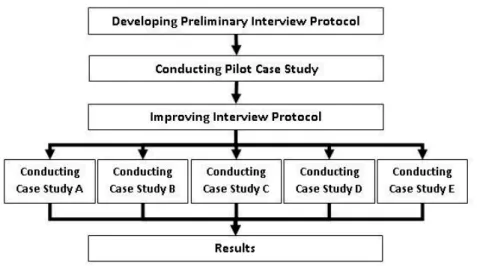
within single settings. Figure 1 provides a
summary of the research steps discussed
below.
Figure 1
– Research Steps
First, a preliminary interview
proto-col was developed. The interview protoproto-col
and the pilot case study are presented
next. Afterward, the interview protocol
was improved and the case studies were
conducted. At end, the data were analyzed
and the results are presented in discussion
section.
3.1 Pilot Case Study
The interview protocol to pilot
case study was based on the framework
proposed by Ndubisi and Iftikhar (2012).
Ndubisi and Iftikhar (2012) developed a
and outbound open innovation construct
are the adopted by Huang et al. (2013). In
questionnaire, both the constructs have
fi
ve items. Firm performance construct
used by Huang et al. (2013) was adopted
instead of quality performance construct
adopted by Ndubisi and Iftikhar (2012).
In questionnaire, the
fi
rm performance
construct has four items and analyzes
pro-fi
t, return on sales, quality of products/
services and reliability of products. A
single pilot test was performed with an
academic that was an entrepreneur too.
The enterprise chosen is a high
tech startup that develops solutions in
information technology to agribusiness.
The
fi
rm was chosen, because it was
con-sidered in 2012 top 10 between Brazilian
startups, according Info (a Brazilian
ma-gazine). The
fi
rm has two mainly products
based in image analysis technology, is
situated in Minas Gerais state, in Brazil,
and was established in 2008. The
fi
rm has
14 employees.
The owner was interviewed and he
has knowledge about open innovation
and the
fi
rm strategy. The interview was
conducted in the firm. There were no
problems to understand the questions,
however other problems are evidenced.
First, a structured questionnaire is not
adequate to a deep understanding. It is
important opened questions to a better
understanding. Second, the questions
were not adequate to small and medium
enterprises. Third, there were problems
with translation. The fourth problem is
the absence of network dimension. Thus,
a new interview protocol must be
de-veloped, based in three premises: using
preferentially constructs in Portuguese,
and/or focused in small and medium
enterprises and with opened questions.
As precondition the constructs should
preferably be derived from studies that
applied structural equation modeling,
aiming future quantitative studies.
Thus, a new interview protocol was
developed. To collect data about Open
Innovation we did not find an
inter-view protocol in Portuguese language.
However, we de
fi
ned van de Vrande et
al. (2009) as construct because it is the
fi
rst
and the most cited work to analyze Open
Innovation in small and medium
enter-prises. The Entrepreneurial Orientation
construct was Li et al
.
(2009). The construct
of Li et al
.
(2009) was chosen because we
did not
fi
nd a construct in Portuguese
lan-guage. Two questions were inserted in this
construct to analyze hypotheses presented
by Carvalho and Sugano (2016). The
ne-twork dimension was evaluated using the
construct provided by Bonner et al. (2005).
Again, we did not find a construct in
Portuguese language. Yet, to collect
infor-mation about
fi
rm performance was used
the construct provided by Fernandes and
Santos (2008), because it is in Portuguese
Language. However, the
fi
rm performance
construct is very similar to that used in
the pilot case. The degree of agreement
toward each item can be categorized into
seven levels from “extremely disagree” to
“extremely agree”. Also, the questionnaire
has questions of identi
fi
cation and opened
questions about each construct. Because
of the need of translations and to verify
the understanding of questions 7 pilot
test were applied in entrepreneurs and
academicians. After each application the
questionnaire was changed. There were no
problems in the last two applications, and
then we considered that the instrument
was ready.
3.2 The Case Studies
The enterprises were selected to case
study not because the easy access reason,
but because they are in evidence
newspa-per clippings. We take care to interview
the owner, because reliability issues. All
companies are located in Minas Gerais.
The companies A, B and E are distant
about 129 miles at south from the pilot
case. The company C is distant about 115
miles at south from pilot case, while the
company D is distant about 149 miles at
north from pilot case.
Company A is located at town of
Santa Rita do Sapucaí, south of state
of Minas Gerais. Before describing the
company, it is important to note that the
town of Santa Rita do Sapucaí is known
as Electronic Valley and it is an important
cluster. Because of this, several works
(BOTELHO et al., 2013; GARCIA et al.,
2015, SOUSA et al., 2015) study the cluster
of Santa Rita do Sapucaí and its
enterpri-ses. Company A begins its activities in
2010 in Business Incubator Inatel (
Instituto
Nacional de Telecomunicações
– National
Institute of Telecommunications) and it
has 7 employees. Since 2013 the company
is working out of business incubator.
Company A develops products and
pro-vides services in information and
com-munications technologies. The company
has a subsidiary in the city of São Paulo
(an important Brazilian economic center
located 144 miles from the Company
A). Company A is winner of MPE Brazil
award in 2012, in the category information
technology. The MPE Brazil award – a
competitiveness award for micro – and
small – sized companies – is intended to
spread the concepts of the Management
Excellence Model (from the Portuguese
language acronym MEG –
Modelo de
Excelência da Gestão
). Company A may be
considered an open innovator, following
the criteria provide by Lazzarotti et al.
(2011).
Anprotec (National Association of Entities
Promoting Innovative Enterprises –
Associação Nacional de Entidades Promotoras
de Empreendimentos Inovadores
). Company
B may be considered an open innovator.
Company C is located at city of Pouso
Alegre, south of state of Minas Gerais. The
company begins its activities in 2014 and it
has only 2 employees: the owner and the
partner. Company C works with mobile
software development. The main product
is an application to supermarkets. In 2015,
the company was chosen to uMov.me Labs
project. The uMov.me Labs project is a
startup acceleration project created by an
enterprise focused in mobile solutions to
corporative market. Company C may be
considered an open innovator.
Company D is located at town of
Santa Rita do Sapucaí, south of state of
Minas Gerais. It begins the activities in 2012
in Business Incubator Inatel and it has 4
employees. Company D works with
ener-gy solutions. Its main product is a digital
electrical switchboard that allows tracking
power consumption. The company is in
evidence in national media, mainly after
national energy crisis. Company D is in
internationalization process. Company D
may be considered an open innovator.
At end, Company E is located at
City of Belo Horizonte, the state capital
of Minas Gerais. The company begins its
activities in 2015. It has 6 employees and
works with smart vehicle systems. The
main product is a device to collect
infor-mation about the vehicle and generates
reports to maintenance. The company was
conceived inside the Federal University
of Minas Gerais and it works in BHTec
(Technological Park of Belo Horizonte).
Company E has won several awards,
such as Startup Farm (largest program
of startup acceleration of Latin America),
UFMG Challenge and Plano Beta, the last
two about business plan. Company E may
be considered a specialized collaborator.
4 DISCUSSION
The sources of evidence were three:
interviews, direct observations and
docu-mentation. The documentation is mainly
based in newspaper clippings and other
articles appearing in the mass media.
By making a
fi
eld visit to the case study
“site”, we created the opportunity for
direct observations. The interviews have
two kinds of questions: opened and
clo-sed. The opened questions were applied
fi
rst. According to Carvalho and Sugano
(2016) empirical works should replace
the competitive aggressiveness
dimen-sion by network dimendimen-sion or, in case of
qualitative studies, consider both
dimen-sions and evaluate that possibility. So,
we
fi
rst analyzed the divergence between
network and competitive aggressiveness
dimensions. As Mello and Leão (2005),
we did not
fi
nd evidences of competitive
aggressiveness. The owner of Company A
af
fi
rmed they prefer work in network. He
even did not know how to compare the
situation of the company and the
compe-titors. Company B has proposals to work
with competitors. Company C focuses
in partnership with other companies,
including a big software developer. The
owner of Company E af
fi
rmed they did
not need to use strategies of competitive
aggressiveness. In really, he emphasized
the mutual help between startups in Belo
Horizonte. The main explanation is
provi-ded in the speech of owners of Company
C and D: theirs products is new, they
have no competitors. These enterprises
can succeed not by battling competitors,
but rather by creating uncontested market
space. Other explanation is the
impor-tance of partnership, as emphasized by
owner of Company C. Startups have few
resources and because of this alliances
are very important. Thus, we employed
network dimension rather competitive
aggressiveness dimension.
Company A and Company D knew the
term, but they did not know the de
fi
nition.
Others have never heard. After we explain
the concept, they af
fi
rmed that they have
using open innovation activities.
Even not present in framework the
innovation dimension was analyzed.
Figure 3 shows a graphic that analyzed the
entrepreneurial orientation of
fi
rms. The
standard deviation of innovativeness, risk
taking, proactiveness, autonomy and
ne-twork dimensions were respectively 0.55,
1.95, 2.10, 0.71 and 0.71. Thus, the values
of innovativeness, autonomy and network
may be considered homogeneous, while
the values of risk taking and
proactive-ness may be considered heterogeneous.
Homogeneous values dif
fi
cult check
rela-tionships. Despite of the homogeneity and
the broad use of open innovation
activi-ties, the values of Innovativeness were the
lowest. However, evidences from direct
observation and documentation, such as
awards and newspaper clippings, show
innovativeness enterprises. We cannot
discard problems with the interview
protocol. Can be open innovation or
in-novativeness an uneventful something? It
is possible. Autonomy, network and risk
taking dimensions have the highest
va-lues. Thus, the use of network dimension
is adequate. The high level of risk taking
is coherent, con
fi
rming the postulate of
the owners of Company C and Company
E. According to the owner of Company C
“undertake without risk is not
entrepre-neurship”. The owner of Company E said
a similar phrase: “startup is risk”.
Figure 3
– Entrepreneurial orientation of
fi
rms.
Figure 4 shows the Open Innovation
activities values. The highest value is
from Customer Involvement. This result
is compatible with the literature (VAN
DE VRANDE et al., 2009; WYNARCZYK,
2013). As van de Vrande et al. (2009) the
second mode more used is also External
The hypotheses were checked.
Carvalho and Sugano (2016) presented
two hypotheses about the relationship
between autonomy dimension and Open
Innovation. However the
fi
rst hypothesis
has 5 under hypotheses. The
fi
rst
hypo-thesis is:
H1. Autonomy has a positive effect
on open innovation.
About the
fi
rst hypothesis we can
af
fi
rm that there is a positive relationship
between autonomy dimension and Open
Innovation, but it is no signi
fi
cant. The 5
under hypotheses are:
H1a. The independent action of an
individual or a team in bringing forth an
idea or a vision and carrying it through
to completion has a positive effect on
customer involvement.
H1b. Actions free of sti
fl
ing
organiza-tional constraints has a positive effect on
customer involvement.
H1c. The independent action of an
individual or a team in bringing forth an
idea or a vision and carrying it through to
completion has a positive effect on open
innovation.
H1d. Actions free of sti
fl
ing
organiza-tional constraints has a positive effect on
open innovation.
H1e. Autonomy is positively related
to outbound open innovation.
The hypothesis H1a can be
con-firmed. The independent action of an
individual or a team in bringing forth an
idea or a vision and carrying it through to
completion has a positive effect and
sig-ni
fi
cant effect on customer involvement.
However the hypothesis H1c cannot be
con
fi
rmed, because the relationship is
al-most nonexistent. About other hypotheses
we can af
fi
rm that there is a positive, but
not signi
fi
cant, relationship. The second
and last hypothesis related to autonomy
dimension is:
H2. Open innovation activities
be-ne
fi
t from incentives and performance
measures that capture open innovation
activities at the collective level, and not
only individual behavior.
About the second hypothesis we
can af
fi
rm that there is a positive, but not
signi
fi
cant, relationship.
About network dimension Carvalho
and Sugano (2016) present only one
hy-pothesis:
H3. Network dimension has a
posi-tive effect on open innovation.
study is very important and necessary.
About the relationship between
proacti veness dimension and Open
Innovation, Carvalho and Sugano (2016)
presented only one hypothesis:
H4. Alertness regarding new
busi-ness opportunities has a positive effect
on open innovation.
The evidences suggest that alertness
regarding new business opportunities
has a positive and strong, but no
signi-fi
cant, effect on open innovation. Thus,
the systematic search for new markets
and business opportunities can make
the organization become careful to Open
Innovation opportunities. For example,
despite of the focus of
fi
rm, most owners
af
fi
rm to be alert to develop new products.
It is the case of Company A, which
chan-ged the focus in the beginning.
Carvalho and Sugano (2016)
presen-ted four hypotheses about the relationship
between Risk taking dimension and Open
Innovation, to know:
H5. Risk taking has a positive effect
on open innovation.
H6. There is a signi
fi
cant relationship
between risk taking and outbound open
innovation.
H7. Organizations with high-level
of risk taking level adopt license, as
ou-tbound open innovation, more than
or-ganizations with low-level of risk taking.
H8. There is a negative relationship
between risk taking and selling as
out-bound open innovation.
The fifth hypothesis points to a
positive effect of risk taking on Open
Innovation. We found a positive and
mo-derate relationship between risk taking
and Open Innovation. On the other hand,
we did not
fi
nd evidences that support
the sixth hypothesis. On the contrary,
we found a negative, but not signi
fi
cant
relationship between risk taking and
outbound open innovation. Carvalho
and Sugano (2016) rely on Schroll and
Mild (2011), which af
fi
rmed that while
inbound activities do not include a great
risk, outbound activities could be more
risk because the
fi
rm may lose possibility
to capture the created value. The
fi
rms
may be aware of this problem and not use
outbound Open Innovation. The seventh
and eighth hypotheses are contradictory.
Thus, we expected evidences to support
only one. The evidences support the
ei-ghth hypothesis.
Our initial proposition is
con-firmed in part. Some dimensions of
Entrepreneurial Orientation are
correla-ted with Open Innovation, but we
can-not check the impact of both in the
fi
rm
performance.
However, some relationships
beca-me apparent. Because the values of risk
taking and proactiveness dimensions are
heterogeneous we can af
fi
rm that some
relationships are relevant. We found a
strong and positive relationship between
risk taking and external networking as
Open Innovation mode. Other relevant
relationship is between proactiveness and
outsourcing R&D. So, we present two new
hypotheses to future works:
H9. There is a significant
rela-tionship between risk taking and external
networking.
H10. There is a significant
rela-tionship between proactiveness and
out-sourcing R&D.
We cannot offer a satisfactory
ex-planation to those relationships. We can
speculate that working in alliance is a risk
and only
fi
rms which high levels of risk
taking are ready to assume. About the
tenth hypothesis is more dif
fi
cult to
spe-culate, so if this hypothesis is con
fi
rmed
then we need more exploratory studies.
ever more complex and exponentially
more competitive. Fernandes et al. (2013)
stressed that this scenario has driven
companies to adopt proactive strategies
designed to seek out sustainable
com-petitive advantage and innovation has
thereby now emerged as one of the core
strategic priorities for companies seeking
success in their business dealings. Thus,
open innovation emerge as strategy to
develop innovation. So, we present more
hypotheses to future works:
H11. Proactiveness has a positive
effect on open innovation.
H11a. Proactiveness has a positive
effect on inbound open innovation.
5 FINAL CONSIDERATIONS
Our work aimed to check the
hypo-theses presented by Carvalho and Sugano
(2016). Most hypotheses were con
fi
rmed,
but only one hypothesis has a signi
fi
cant
result. Thus, quantitative works with a
wide sample is important. It is import
check if Entrepreneurial Orientation is a
driver for Open Innovation.
Cheng and Huizingh (2014)
con-cluded that when comparing the three
strategic orientations (Entrepreneurial
Orientation, market orientation and
re-source orientation), their
fi
ndings show
that entrepreneurial orientation has the
strongest moderation effect on the relation
between open innovation and innovation
performance. Thus, it makes sense expect
Entrepreneurial Orientation as driver of
Open Innovation.
Our work does not contribute only
with Open Innovation literature, but also it
contributes to Entrepreneurial Orientation
literature. According to Anderson et al.
(2015) a number of ontological questions
persist in the Entrepreneurial Orientation
literature, between them there are ongoing
conversations regarding the
dimensiona-lity of Entrepreneurial Orientation. First
we con
fi
rmed the importance of network
dimension presented by Mello and Leão
(2005), which justify the absence of the
competitive aggressiveness dimension.
Second, based in the evidences presented
here, we advocate that innovativeness
dimension should be replaced by a new
dimension: Open Innovation dimension.
According to Chaston and Scott (2012)
the impact of Open Innovation on
fi
rm
performance is bigger than the impact
of Entrepreneurial Orientation on
fi
rma
performance. Furthermore, Gündo
ğ
du
(2012) coined the term Innopreneurship.
According to Gündo
ğ
du (2012) existing
traditional entrepreneurs also should turn
out as innopreneurs not to face the danger
of being isolated outside the system. The
innopreneur is an entrepreneur turned for
innovation and partnerships. Thus, we
suggest the constructs of our framework
can be merged into a single tool: Open
Innopreneurial Orientation.
Moreover, we contribute with new
hypotheses to future works. However, we
must advert that our work has limitations.
These limitations are the method and the
units of analysis. Therefore we cannot
generalize the results.
REFERENCES
ANDERSON, Brian S.; KREISER; Patrick M.; KURATKO, Donald F.; HORNSBY, Jeffrey S.; ESHIMA, Yoshihiro. Reconceptualizing entrepreneurial orientation. Strategic Management Journal v. 36, n. 10, p. 1579-1596, 2015.
BONNER, Joseph M.; KIM, Daekwan; CAVUSGIL, S. Tamer. Self-perceived strategic network identity and its effects on market performance in alliance relationships. Journal of Business Research, v. 58, n. 10, p. 1371-1380, 2005.
CAMPOS, Héctor Montiel; DE LA PARRA, José Pablo Nuño; PARELLADA, Francesc Solé. The entrepreneurial orientation-dominant logic-performance relationship in new ventures: an exploratory quantitative study. Brazilian Administration Review, Rio de Janeiro, v. 9, Special Issue, p. 60-77, may 2012. CARVALHO, Eduardo Gomes; GANDIA, Rodrigo Marçal; FERREIRA, Cassiano de Andrade; GARCIA, Marcelo de Oliveira; SUGANO, Joel Yutaka. Small businesses and large gaps: a meta-analysis of quantitative studies about open innovation. Espacíos, Caracas, v. 37, n. 3, 2016.
CARVALHO, Eduardo Gomes; SUGANO, Joel Yutaka. entrepreneurial orientation as driver for open innovation. Espacíos, Caracas, v. 37, n. 5, 2016.
CHASTON, Ian; SCOTT, Gregory J. Entrepreneurship and open innovation in an emerging economy. Management Decision, v. 50, n. 7, p. 1161-1177, 2012.
CHESBROUGH, Henry W. Open innovation: the new imperative for creating and profi ting from technology. Boston, MA: Harvard Business School Press, 2003.
______. Open Innovation: Researching a New Paradigm. Oxford: Oxford University Press, 2006.
CHESBROUGH, Henry; BOGERS, Marcel. Explicating open innovation: clarifying an emerging paradigm for understanding innovation. In: CHESBROUGH, Henry; VANHAVERBEKE, Wim; WEST, Joel. New frontiers in open innovation. Oxford: Oxford University Press, 2014. p. 3-28
CONBOY, Kieran; MORGAN, Lorraine. Beyond the customer: opening the agile systems development process. Information and Software Technology, v. 53, n. 5, p. 535-542, abr. 2011.
COVIN, Jeffrey G.; COVIN, Teresa Joyce. Competitive aggressiveness, environmental context, and small firm performance.
Entrepreneurship: Theory & Practice, v. 14, n. 4, p. 35-50, 1990.
COVIN, Jeffrey G.; SLEVIN, Dennis P. Strategic management of small firms in hostile and benign environments. Strategic Management Journal, v. 10, n. 1, p. 75-87, 1989.
______. A conceptual model of entrepre-neurship as fi rm behavior. Entrepreneurship: Theory & Practice, v. 16, n. 1, p. 7-25, 1991. DE CLEYN, Sven H.; GIELEN, Frank; COPPENS, Jan. Incubation programs from public research organizations as catalysts for open business ecosystems. Technology Innovation Management Review, Ottawa, p. 29-34, apr. 2013.
D R U C K E R , P e t e r F . I n n o v a t i o n a n d entrepreneurship: practice and principles. London: Heinemann, 1994.
EFTEKHARI, Nazanin; BOGERS, Marcel. Open for entrepreneurship: how open innovation can foster new venture creation.
Creativity and Innovation Management, v. 24, n. 4, p. 574-584, dez. 2015.
EISENHARDT, Kathleen M. Building theories from case study research. The Academy of Management Review, v. 14, n. 4, p. 532-550, oct. 1989.
FERNANDES, Daniel Von Der Heyde; SANTOS, Cristiane Pizzuti. Orientação empreendedora: um estudo sobre as conseqüências do empreendedorismo nas organizações. RAE electrônica, São Paulo, v. 7, n. 1, jan./june 2008.
GALINDO, Miguel-Ángel; MENDEZ- PICAZO, María-Teresa. Innovation, entrepre-neurship and economic growth. Management Decision, v. 51, n. 3, p. 501-514, 2013.
GARCIA, Renato; DIEGUES, Antônio Carlos; ROSELINO, José Eduardo; COSTA, Ariana Ribeiro. Desenvolvimento local e desconcentração industrial: uma análise da dinâmica do sistema local de empresas de eletrônica de Santa Rita do Sapucaí e suas implicações de políticas. Nova Economia, Belo Horizonte, v. 25, n. 1, p. 105-122, jan./abr. 2015.
GASSMANN, Oliver; ENKEL, Ellen. Towards a theory of open innovation: three core process archetypes. In: R&D MANAGEMENT CONFERENCE, 6 july 2004, Lisabon. Anais…, Portugal: RADMA, 2004. p. 1-18.
GÜNDOĞDU, Mehmet Çağrı. Re-thinking entrepreneurship, intrapreneurship, and innovation: a multi-concept perspective.
HOSSAIN, Mokter. Open innovation: so far and a way forward. World Journal of Science, Technology and Sustainable Development, v. 10, n. 1, p. 30-41, 2013.
HUANG, Hao-Chen; LAI, Mei-Chi; LIN, Lee-Hsuan; CHEN, Chien-Tsai. Overcoming organizational inertia to strengthen business model innovation: an open innovation perspective. Journal of Organizational Change Management, v. 26, n. 6, p. 977-1002, 2013. HUIZINGH, Eelko K. R. E. Open innovation: state of the art and future perspectives.
Technovation, v. 31, p. 2-9, 2011.
IAKOVLEVA, Tatiana. Open innovation at the root of entrepreneurial strategy: a case from the norwegian oil industry, Technology Innovation Management Review, p. 17-22, april 2013.
LAZZAROTTI, Valentina; MANZINI, Raffaella, PELLEGRINI, Luisa. Firm-specifi c factors and the openness degree: a survey of Italian fi rms. European Journal of Innovation Management, v. 14, n. 4, p. 412-434, 2011. LI, Yong-Hui; HUANG, Jing-Wen; TSAI, Ming-Tien. Entrepreneurial orientation and firm performance: the role of knowledge creation process. Industrial Marketing Management, v. 38, n. 4, p. 440-449, 2009. LUMPKIN, G. T.; DESS, Gregory G. Clarifying the entrepreneurial orientation construct and linking it to performance. Academy of Management Review, v. 21, n. 1, p. 135-172, 1996.
LUMPKIN, G. T.; DESS, Gregory. Linking two dimensions of entrepreneurial orientation to firm performance: the moderating role environment and industry life cycle. Journal of Business Venturing, v. 16, n. 5, p. 429-451, 2001. MELLO, Sérgio Carvalho Benício de; LEÃO, André Luiz Maranhão de Souza. Compreendendo a orientação empreendedora de empresas de alta tecnologia. In: SOUZA, Eda Castro Lucas; GUIMARÃES, Tomás de Aquino. Empreendedorismo além do plano de negócios. São Paulo: Editora Atlas, 2005. p. 162-178.
M I L L E R , D a n n y . T h e c o r r e l a t e s o f entrepreneurship in three types of firms.
Management Science, v. 29, n. 7, p. 770-791, 1983.
NDUBISI, Nelson Oly; IFTIKHAR, Khurram. Relationship between entrepreneurship, innovation and performance: comparing small and medium-size enterprises. Journal of Research in Marketing and Entrepreneurship, v. 14, n. 2, p. 214-236, 2012.
RAUCH, Andreas; WIKLUND, Johan; L U M P K I N , G . T . ; F R E S E , M i c h a e l . Entrepreneurial orientation and business performance: an assessment of past research and suggestions for the future. Entrepreneurship Theory and Practice, United States, v. 33, n. 3, p. 761-787, may 2009.
SAEBI, Tina; FOSS, Nicolai J. Business models for open innovation: matching heterogeneous open innovation strategies with business model dimensions. European Management Journal, v. 33, n. 3, p. 201-213, june 2015. SCHROLL, Alexander; MILD, Andreas. Open innovation modes and the role of internal R&D: an empirical study on open innovation adoption in Europe. European Journal of Innovation Management, v. 14, n. 4, p. 475-495, 2011.
SCHUMPETER, Joseph. The theory of economic development. Boston, MA: Harvard University Press, 1934.
SEGERS, Jean-Pierre. Strategic Partnerships and open innovation in the biotechnology industry in Belgium. Technology Innovation Management Review, p. 23-28, april 2013. SOLESVIK, Marina Z.; GULBRANDSEN, Magnus. Partner selection for open innovation.
Technology Innovation Management Review, p. 11-16, april 2013.
SOUSA, Ana Rosa de.; BRITO, Mozar José, SILVA, Paulo José; ARAÚJO, Uajará Pessoa. Cooperação no APL de Santa Rita do Sapucaí.
Revista de Administração Mackenzie, São Paulo, v. 16, n. 1, p. 157-187, 2015.
SWAMI, Sanjeev; PORWAL, Rajesh. Entrepreneurship, innovation and marketing: conceptualization of critical linkages. Journal of advances in management research, v. 2, n. 2, p. 54-69, 2005.
VAN DE VRANDE, Vareska; JONG, Jeroen P. J.; VANHAVERBEKE, Wim; ROCHEMONT, Maurice. Open innovation in SMEs: trends, motives and management challenges.
VANHAVERBEKE, Wim. Rethinking open innovation beyond the innovation funnel.
Technology Innovation Management Review, p. 6-10, april 2013.
W E S T , J o e l ; S A L T E R , A m m o n ; VANHAVERBEKE, Wim; CHESBROUGH, Henry. Open innovation: the next decade.
Research Policy, v. 43, n. 5, p. 805-811, 2014.
WYNARCZYK, Pooran. Open innovation in SMEs: a dynamic approach to modern
entrepreneurship in the twenty-fi rst century. Journal of Small Business and Enterprise Development, v. 20, n. 2, p. 258-278, 2013. YIN, Robert K. Case study research: design and methods. Thousand Oaks: Sage Publications, 1994.
ZHAO, Fang. Exploring the synergy between entrepreneurship and innovation. International Journal of Entrepreneurial Behaviour & Research, v. 11, n. 1, p. 25-41, 2005.