Gestão de Recursos Humanos nos BRICS: estudo compara
Ɵ
vo
Ges
Ɵ
on des Ressources Humaines dans les BRICS: une étude compara
Ɵ
ve
Ges
Ɵ
ón de recursos humanos de los países BRICS: un estudio compara
Ɵ
vo
Luciana Campos Lima1
TaƟ ani dos Santos Zuppani2
Maria Laura Ferranty Maclennan3
Received 02/03/2017; Revised and approved in 30/04/2017; Accept in 30/04/2017 DOI: h p://dx.doi.org/10.20435/inter.v18i3.1514
Abstract: The objec ve of the study is to inves gate the contextual characteris cs of BRICS countries on Human Resource Management (HRM) policies and prac ces. For that we used secondary data analysis, such as reports, journals, and newspapers. Data is organized in order to provide logical support for the arguments presented. The main fi ndings relate ins tu onal environment characteris cs from the educa on system
and labour market with: (i) recruitment and selec on prac ces; (ii) remunera on systems; (iii) training and development prac ces.
Key words: BRICS; remunera on systems; recruitment and selec on; training and development.
Resumo: O obje vo do estudo é comparar as caracterís cas contextuais dos países dos BRICS sobre as polí cas e prá cas de Gestão de Recursos Humanos (HRM). Para tal, a análise de dados secundários, como relatórios, revistas e informes acadêmicos foi organizada para dar suporte lógico aos argumentos. As conclusões relacionam caracterís cas do ambiente ins tucional do sistema de ensino e mercado de trabalho com: (i) prá cas de recrutamento e seleção; (ii) sistemas de remuneração; (iii) ações de treinamento e desenvolvimento.
Palavras-chave: BRICS; sistemas de remuneração; recrutamento e seleção; treinamento e desenvolvimento. Résumé: L’objec f de l’étude est de rechercher les caractéris ques contextuelles des pays du BRICS sur la Ges on des Ressources Humaines (HRM) poli ques et pra ques. Ce que nous avons u lisé pour l’analyse des données secondaires, tels que les rapports, revues et journaux. Les données sont organisées dans le but de fournir un sou en logique pour les arguments présentés. Les principales conclusions concernent caracterís cas de l’environnement ins tu onnel du système éduca f et du marché du travail avec: (i) pra ques de recrutement et de sélec on; (ii) systèmes de rémunéra on; (iii) pra ques de forma on et de développement.
Mots clés: BRICS; systèmes de rémunéra on; recrutement et sélec on; la forma on et le développement. Resumen: El obje vo del estudio es inves gar las caracterís cas contextuales de los países BRICS en polí cas y prác cas de Ges ón de Recursos Humanos (HRM). Para eso se u lizó el análisis de datos secundarios, como informes, revistas y periódicos. Los datos se organizan para provenir apoyo lógico a los argumentos presentados. Las principales conclusiones relacionan caracterís cas del sistema educa vo y mercado de trabajo con: (i) prác cas de reclutamiento y selección; (ii) sistemas de remuneración; (iii) prác cas de formación y desarrollo.
Palabras clave: BRICS; sistemas de remuneración; reclutamiento y selección; formación y desarrollo.
1 INTRODUCTION
It is generally agreed that Human Resource Management (HRM) policy and prac ces are infl uenced by contextual factors, such as poli cal, legal, technological, ins tu onal and social
frameworks (KHAVUL; BENSON; DATTA, 2010; LENGNICK-HALL et al., 2009). The contextual
1 Fundação Escola de Comércio Álvares Penteado (Fecap), São Paulo, São Paulo, Brasil. 2 Centro Universitário Senac São Paulo, São Paulo, Brasil.
approach takes a fresh look at the rela onship between HRM, by considering the importance of environmental factors as the infl uence of public administra on, trade unions, and the incidence
of social and ins tu onal infl uences in people management (BREWSTER; MAYRHOFER, 2012).
Resource availability and the dynamic nature of the environment and its level of complexity are recognised as having an infl uence on management prac ces and, consequently, on company
performance (MORISHIMA, 1995). So the way organiza ons manage their human resources is ins tu onally rooted in na onal contexts and socially incorporated (MATTEN; GEPPERT, 2004). According to Brewster, Wood, and Brookes (2008), it seems there is no global consensus of best prac cesin the human resources area, although there is some similarity between such prac ces.
Conversely, the working policies and prac ces organiza ons adopt may boost their compe ve advantage and this consequently has an impact on na ons themselves, because this may, or may not contribute to more compe ve companies. This becomes especially relevant for emerging countries (BUDHWAR; DEBRAH, 2003; LAWLER et al., 1995; STOREY; WRIGHT; ULRICH, 2009; TESSEMA; SOETERS, 2006) in order to face up to their development challenges.
An understanding of these rela onships in emerging countries is also mo vated by the lack of support provided by the HRM constructs coming from tradi onal Anglo-Saxon models, which seem not to deal with the impact of globaliza on on the reality of each of these countries (PRAHALAD; BHATTACHARYYA, 2011). Budhwar and Debrah (2001) also stress that management in these countries is ineff ec ve and outdated and this denotes a barrier to good organiza onal results. These analyses can be applied to the BRICS group of emerging countries (Brazil, Russia, India, China and South Africa) (WILSON; PURUSHOTHAMAN, 2003), but there are very few academic publica ons comparing these regions (MOSTAFA; MAHMOOD, 2015). This is especially no ceable when dealing with studies that focus on Human Resource Management (HRM) in the BRICS (GARAVAN et al., 2012). We intent to contribute to this gap with the comparison of contextual characteris cs on BRICS as dissimilari es impact HRM prac ces.
Considering that compara ve knowledge of HRM prac ces in these countries is s ll in its early stages, the objec ve of this study is to inves gate the contextual characteris cs of countries belonging to the BRICS group, by iden fying their rela onships with each Human Resource Management policies and prac ces.Star ng with a contextual approach, the aim is to develop a compara ve study that highlights the consistent ins tu onal and cultural structures and how they interfere in their own environment (IGNJATOVIĆ; SVETLIK, 2003). As known, there is a synerge c eff ect of HRM elements and its context that may create compe ve advantages for both companies and na ons (MORISHIMA, 1995). Lawler et al. (1995) draw a en on to the lack of cross-sec onal studies comparing HRM within emerging country contexts. So we aim in this study to expand the discussion about labour markets and labour force training in BRICS countries and compe veness. We consider that the la er depends on each country’s produc on system and innova on capacity and also on the challenge of crea ng and developing human capital capable of mee ng the demands generated by globalized processes.
2 LITERATURE REVIEW
Compara ve studies on HRM are tradi onal on the fi eld, and have been studied from several
perspec ves, considering contextual infl uences on people management. Maurice (1986) provided
Fra e a d Ger a ”. Based on a compara ve ins tu onal study, the author inves gates the rela onship between environment and companies. He shows that organiza onal forms and prac ces, qualifi ca on, structure and the organiza on of society are interdependent.
Whitley (1999) explains this interdependence from ins tu onal perspec ve. Countries with an environment characterized by lack of confi dence in their formal ins tu ons, a State indiff erent
to private companies and distant from them and a scarcity of fi nancial resources available for
long-term commitments rarely foster the construc on of organiza onal capabili es as a compe ve strategy. As a consequence, those companies’ human resources, tools and technologies might be easily acquired and disposed of by organiza onal and people management rou nes that are sta c and very complex.
On the other hand, in a context in which there is access to fi nancing and technical
interchange, developments are achieved in society by state agencies limi ng the predatory price compe on of large companies and by trade unions being strong enough to prevent companies from introducing strategies that allow for fl exibility in staff numbers; both have a direct impact
on the type of recruitment and the subsequent organiza onal investment in employees. There is also encouragement to improve quality and incremental innova on Training systems are high quality with a lot of incen ves for both individuals and employers since they are able to improve their technical skills (WHITLEY, 1999), thus making it possible to orchestrate career plans and retain talent in organiza ons.
HRM, therefore, is found at the interface between the labour market environment and people management within organiza ons. It deals with employment policies, prac ces and employee recruitment, selec on, development and reten on ac vi es (BOXALL; PURCELL, 2011). So the theore cal review focuses on HRM based on the contextual paradigm, because we choose to carry out an exploratory study. There is no interest in tes ng hypotheses, but in searching for direct discoveries and future proposals.
Applying a contextual paradigm of HRM in the BRICS countries
The contextual HRM approach makes an important modifi ca on from the managerial point
of view, because it seeks for a global understanding of what is unique and diff erent in various environments (BREWSTER; MAYRHOFER, 2012; BREWSTER; WOOD; BROOKES, 2008; MARTÍN-ALCÁZAR; ROMERO-FERNÁNDEZ; SÁNCHEZ-GARDEY, 2005). Prior studies involving BRICS countries are concentrated on (i) the impact of globaliza on process and company compe veness; (ii) interdependence between the na onal business context and HRM; and (iii) diff erences and similari es between the human resource prac ces among developed and developing countries. However, a compara ve approach on HRM is lacking.
According to Mar n-Alcázar, Romero-Fernández e Sánchez-Gardey (2005), the external environment infl uences and is infl uenced by the HRM system. In other words, labour market
condi ons infl uence the choice made by the HRM department with regard to recrui ng either
internally or externally (AYCAN, 2005). Likewise, a context that comprises a large popula on is not synonymous with high indices of qualifi ed candidates available for selec on processes. For
In research about the educa onal background in the BRICS, Chaudhary et al. (2012) point out that for economists the diff erence between developed countries and developing countries in the 19th century was reinforced by, if not caused by sustained investment growth in human capital. Therefore educa onal quality, especially at the higher level, and training are crucial for cons tu ng the produc on value chain, since they impact produc on processes. Only a qualifi ed
labour force is capable of undertaking complex tasks and adap ng quickly to the changing environment (BECKER; TOMES, 1994; SCHULTZ, 1961).
Competences developed by educa on and training systems external to organiza ons will only be valued once they are allocated and used to fulfi l the needs of an effi cient and fl exible labour
market. This means that professionals may quickly migrate from one economic ac vity to another at li le cost and reduced impact on wage fl uctua ons (CARNEIRO; ALMEIDA, 2008; KAPLAN, 2009).
Both the educa on system and labour market are infl uenced by the innova on level
that is developed within the ins tu onal context. This arises from new knowledge, especially technological knowledge, which is why it is related to know-how, skills and organiza ons’ working condi ons. In their turn these organiza ons may provide an innova ve environment, especially with investment in research and development (WIR, 2014). Freeman (1995) argues that low innova on levels can be explained by factors such as ineff ec ve educa onal systems for training engineers and professionals, low investment in research and development, low levels of scien fi c
produc on and technology transfer, and weak rela onships with industry.
We can see how educa on systems, training, labour market and innova on systems are complementary aspects, in view of the fact they are able to infl uence organiza onal results,
since they are the cons tuent elements of the ins tu onal environment to which they belong. In this sense, and based on produc vity comparisons in Europe, Brewster, Wood and Brookes (2008) state that factors that aff ect produc vity include exposure, the stock of human capital and private investment in training and innova on. Nelson (2006) concludes that quality educa on and pro-innova on policies can s mulate environments with high innova ve performance.
Another important contextual aspect to be considered by HRM is employee compensa on. Menezes-Filho, Fernandes, and Picche (2006) believe that salary variances in popula on are propor onal to diff erences in educa on, since they recognise a posi ve link between both. Despite this, we might consider the existence of legal pronouncements that have a bearing on remunera on in the BRICS countries, since they provide evidence of the peculiari es established by the ins tu onal environment in HRM prac ces.
3 RESEARCH METHODOLOGY
poten al of diff erent par cipant countries. BRICS (2014) is the fi h edi on of a joint ini a ve
from BRICS to consolidate data about these economies.
These indicators will be dealt with interdependently in the process of data analysis, since they mutually reinforce each other (KOVAČIČ, 2011; MARTIN, 2012). Previous compara ve studies about the BRICS also used this same data as a way of interpre ng and presen ng results (AGGARWAL, 2013; HEINZ; TOMENENDAL, 2012; MOSTAFA; MAHMOOD, 2015).
4 BRICS BUSINESS CONTEXT
Between 2000 and 2012, the BRICS were responsible for 30% of global gross domes c product (GDP) growth. By 2050 the GDP of this group, plus Mexico, Indonesia and Turkey will probably be 50% bigger than the current G7’s GDP (HEINZ; TOMENENDAL, 2012). BRICS are considered to be markets in expansion, since they have been gradually opening up to more liberal economic regimes and deregula on of their economic ac vity (WRIGHT; VAN DE VOORDE, 2009). These characteris cs, allied with a large consumer market and labour force, favour a rise in mergers and acquisi ons’ ac vity and the se ng up of subsidiaries by mul na onal companies, even though these countries suff er from a higher level of environmental uncertainty and weaker legal systems (FARASHAHI; MOLZ, 2004; SCOTT-KENNEL; SALMI, 2008) compared to developed countries, which makes an understanding of context even more important when analysing their human resource prac ces.
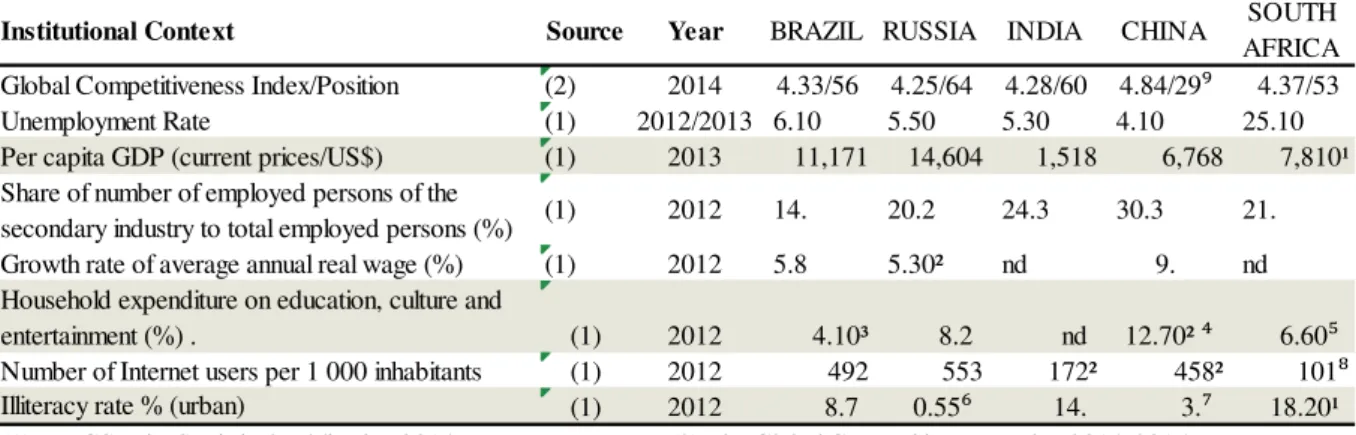
Since HRM is strongly aff ected by na onal context, companies in diff erent market economies adopt diff erent approaches when managing people (FARNDALE; BREWSTER; POUTSMA, 2008). These macro environmental eff ects on human resource prac ces have already been shown empirically. Zhu, Cooper, Thomson, De Cieri, and Zhao (2013) found there to be a posi ve rela onship between changes in the business environment, the func oning of the labour market and the use of people selec on and reten on prac ces. The environmental indicators of the BRICS countries are shown in Table 1 and are the basis for our context analysis.
Table 1 – BRICS contextual indicators Index
Institutional Context Source Year BRAZIL RUSSIA INDIA CHINA SOUTH
AFRICA Global Competitiveness Index/Position (2) 2014 4.33/56 4.25/64 4.28/60 4.84/29΅ 4.37/53 Unemployment Rate (1) 2012/2013 6.10 5.50 5.30 4.10 25.10 Per capita GDP (current prices/US$) (1) 2013 11,171 14,604 1,518 6,768 7,810¹ Share of number of employed persons of the
secondary industry to total employed persons (%) (1) 2012 14. 20.2 24.3 30.3 21. Growth rate of average annual real wage (%) (1) 2012 5.8 5.30² nd 9. nd Household expenditure on education, culture and
entertainment (%) . (1) 2012 4.10³ 8.2 nd 12.70² 6.60 Number of Internet users per 1 000 inhabitants (1) 2012 492 553 172² 458² 101΄ Illiteracy rate % (urban) (1) 2012 8.7 0.55 14. 3. 18.20¹ (1) BRICS Joint Statistical Publication 2014 (2) The Global Competitiveness Index 2014-2015
Cap ons in Figure 1: ¹2011, ²2013, ³2009, 2006, 2000, 2010, refer to urban popula on, World Development Indicators/Educa on comple on and outcomes, excl. Hong Kong.
Based on a compe veness defi ni on that considers the income increase of the popula on
surpasses countries like Brazil and Russia in its real growth rate in salaries and occupies the 29th
posi on in the global compe veness index ranking. This is a considerable feat, since the next BRICS economy, which is South Africa, lies 53rd in the ranking.
Unemployment rates are around 4 - 6%, with the excep on of South Africa with its 25% rate. But when we consider employment in industry, once again China dis nguishes itself with 30%, prac cally double the fi gure for the last placed country in the ranking, which is Brazil with
14%. Despite this, Brazil has the second biggest GDP per capita ($11,171), only exceeded by Russia ($14,604).
Generally speaking, a substan al investment in training and development ac vi es is indica ve of a low level of professional qualifi ca on resul ng from the formal educa on system
(WRIGHT; VAN DE VOORDE, 2009). Moreover, in countries in which there is a scarcity of competent labour, organiza ons direct higher investments to training and development programmes in order to a ract the best candidates (AYCAN, 2005; GROSSMAN; HELPMAN, 1991).
We observe a great varia on in illiteracy indicators among the BRICS countries. While Russia has the most favourable score (0.55), South Africa and India have the highest levels of illiteracy (18% and 14% respec vely), revealing not only the heterogeneity between the BRICS, but also poin ng to the challenges faced by companies located in those environments in their search for qualifi ed people and ways of retaining them (table 1).
Considering HRM to be a product of the business environment (BJÖRKMAN; FEY; PARK, 2007; BREWSTER; WOOD; BROOKES, 2008), the next topic examines how HRM prac ces are opera onalized given the cultural and ins tu onal peculiari es of each component of the BRICS group.
4.1 HRM context in the BRICS countries
The indicators in Table 2 are related to HRM in the BRICS countries. They show the ‘share of public spend on educa on’, ‘higher educa on and training’, ‘labour market effi ciency’ and the ‘innova on’ indicators.
Table 2 – Human resource indicators of the BRICS countries
Local HR indicators Source Year BRAZIL RUSSIA INDIA CHINA SOUTH
AFRICA
Share of public spend on education as % of GDP (1) 2012/2013 5.3 4.3 3.3 4.3 6.8 Higher Education and Training (2) 2013/2014 4.22/72 4.66/47 3.88/91 4.23/70 3.94/89 Labor Market efficiency (2) 2013/2014 4.13/92 4.31/72 4.08/99 4.63/34 3.93/116 Innovation (2) 2013/2014 3.42/55 3.13/78 3.62/41 3.89/32 3.64/39 (1) BRICS Joint Statistical Publication 2014
(2) The Global Competitiveness Index 2014-2015
These data support the analysis of the cons tuent elements of HRM in the BRICS countries analysed in this study and presented in the following topics.
4.1.1 Labour Market and HRM in the BRICS countries
Ferreira (2013), who classify specialist labour in the labour market in the country as being scarce. Furthermore, those professionals who have special competences are being head-hunted by other countries, especially the Europeans. Finally, the unemployment rate has remained low over recent years, which sharpens the dispute for good professionals.
Employment and labour practices in Russia are fairly homogenous, even after the transi on of the economic regime, which weakened state regula on over company policies. Public investment in educa on (4.30) is similar to the higher educa on and training indicator (4.66), since all of the indicators seem to point to a par ally good quality level. Since people selec on processes are carried out by line managers who are seeking to fi ll gaps as quickly as
possible regardless of HRM guidelines (BIZYUKOV, 2005; SHULZHENKO, 2012), it is possible that they choose insuffi cient professionals with adequate qualifi ca ons to fi l the posi ons. In this
environment the ones who stand out from a mass of mediocre candidates who come from an average educa onal system may profi t from higher remunera on.
Cultural values in India weigh heavily on human resource prac ces (WRIGHT; VAN DE VOORDE, 2009), including the placing of people in the labour market. The caste people are born into determines their social strata, which has both an explicit and implicit impact on the recruitment and selec on of people. This possibly explains the fact that among the BRICS countries, India makes the smallest public investment percentage-wise in educa on (3.30), in higher educa on (3.88) and in training (4.08).
On the other hand, the labour market effi ciency indicator for China is the highest among the BRICS countries (4.63), but the quality of the workforce available is not as great as its volume. This explains part of the scarcity of competences, which drives the use of prac ces for retaining professionals (CAI; MORRIS; CHEN, 2011). This characteris c may also be a remnant of the past, since during the Marxist regime period job genera on was theore cally the responsibility of the Chinese government, which had to allocate all graduates into the labour market. Therefore, the Chinese concept of career was defi ned and directed by the State (ZHOU; ZHANG; LIU, 2012).
For Bernstein (2011), one of the main challenges to the economic growth of South Africa depends on reconciling high labour standards with the development of qualifi ca ons, good
remunera on and a protec on system for workers. Turok (2010) es mates that there is a shortage of around 100,000 competent people, which is fairly insignifi cant when compared with
an unemployment rate of more than 4 million people. Even given the evidence of the increase in employment rela ons ins tu ons with trade unions that are not linked to the State, we fi nd
an increase in the numerical and temporal ‘fl exibiliza on’ process governing workers by way of
sub-contrac ng and outsourcing. This is leading to a deteriora on in employment standards, social protec on and growing precariousness in the labour market (HORWITZ, 2012; STOREY; WRIGHT; ULRICH, 2009). These factors perhaps explain the fact that the effi ciency of the labour market in South Africa (3.93) is the lowest in the BRICS countries.
4.1.2 EducaƟ on System, Training and HRM remuneraƟ on in the BRICS countries
their opera onaliza on. It is less capable, however, of evalua ng the investment needed for training and developing professionals. So, in order to maintain high levels of produc vity and high volumes of investment in the private sector, HRM’s capacity to evaluate the return on the amount spent on development programmes needs to be improved. We have already discussed the fact that Brazilian investment in the professionaliza on process via the educa on system is considered to be par ally good (4.22), but lower than Russia’s (4.66) and China’s (4.23). Negri and Cavalcante (2014) argue that produc vity in Brazil is severely impaired by a lack of qualifi ed
professionals, which points to the importance of this dimension.
Remunera on prac ce is related to legal determina ons that provide support for the func oning of this system in companies. Some types of remunera on do not have specifi c
legisla on and others have incomplete or out-of-date legisla on. Under these circumstances there is no legisla on with regard to bonuses, shareholdings and skills and competence-based pay making it possible to adapt remunera on tools to fi t the interests of each organiza on.
There is also no detailed legisla on about the incidence, or otherwise, of taxes on some of the remunera on prac ces; it is up to trade unions to decide on their applica on by way of the collec ve union agreement (THEOTÔNIO; REIS NETO; LOPES, 2013).
In Russia, there are two types of training; training for the newly hired and technical training for blue-collar workers (non-managers) and white-collar workers (managers)in various training prac ces (BIZYUKOV, 2005), which are increasingly characterized by Western HRM techniques (GURKOV; SETTLES, 2013). Russian HR development strategy allows us to infer that they are aiming to compensate the investment made by the current educa on system (4.66) and reduced public investment (4.30) for professional qualifi ca on. This is because they allocate their resources in
a way that is spread across the three professional profi les: the recently hired, specialists and
generalists.
The prac ces that compose their remunera on system are characterized by an offi cial guarantee of just a small part of the payment. But companies can reduce or increase salaries without nego a ng beforehand with employees (SHULZHENKO, 2012). A er the transi on from a planned economy in the 2000s, Russia went into economic recession, with a drop of 23%, on average, in industrial produc on. As a survival strategy, companies adopted a 30% reduc on in salaries and while they avoided dismissing people, they encouraged their employees to ask for voluntary leave of absence without pay. In the 2009-2010 period, the total number of people on voluntary leave without pay reached 3% of the labour force, thus masking the real unemployment rate. The economic situa on improved in the 2010-2011 period (GURKOV; SETTLES, 2013). Despite the fact that the labour market effi ciency index (4.31) only loses out to China (4.63), it is diffi cult to understand it as being something that is favourable, given the signs of strong government interven on, as described.
The new market economy and regula ons allow companies to fi nance growth and reward
produc ve employees (LI; ZHAO; LIU, 2006). Managers can choose special monetary rewards to mo vate workers in accordance with their performance. Rewards are not based on individual performance and the distribu on of bonuses to all workers, regardless, does not lead to increases in produc vity (SHEN; D’NETTO, 2012; ZHU et al., 2013).
Racial segmenta on in the labour market in South Africa s ll subsists as a legacy of apartheid and has an impact on access to technological knowledge at the higher level (ERASMUS; SCHENK; SWANEPOEL, 2008). This may explain why the country’s public investment indicator in educa on is the highest of all the BRICS countries (6.80), but the higher educa on level cannot even be classifi ed as average, because it tends towards being of a poor quality (higher educa on and
training at 3.94), despite a empts to improve the compulsory educa on system.
Results from such investments may take a long me to appear (HORWITZ, 2012). Just 15 out of every 500 children in South Africa enter university post-graduate schools. This is probably the reason why most of the companies invest an amount of their wage-roll on training for all posi ons in an egalitarian way (ERASMUS; SCHENK; SWANEPOEL, 2008). Turok (2010) agrees that the lack of technical and professional training is one of the main obstacles to infrastructure projects being carried out.
In rela on to other BRICS countries, India has the lowest level of formal educa on (3.88), which is in line with the professionaliza on process that started at the end of the 1990s. We saw an eff ort on the part of HRM at the me, to ensure the development of employee competences and training and there were signs of a movement towards performance-related salaries and promo ons (AZMI, 2011).
Trade union organiza on and government had a very strong infl uence on the determina on
of salary levels in that country. However, as from the 1980s the globaliza on of markets and the access of Indian students to foreign universi es generated new forms of thinking and increased the fl exibility of salary rela ons, thus strengthening the rela onship between pay and
performance. However, we can s ll observe signifi cant diff erences between HR performance
in major corpora ons that assess performance and recommend salary increases based on the same and the reality we see in small companies and with workers in rural areas (SPARROW; BUDHWAR, 1997).
5 FINAL CONSIDERATIONS
Analysis of the rela onships between the contextual characteris cs and the various HRM prac ce formats of BRICS country companies allows for a resignifi ca on of HRM studies.
Inves ga ons of people management policies and prac ces limited to organiza ons are incapable of off ering academics and prac oners the full dimension of their social importance. This is because the main fi nding of this study was the presenta on of an ini al analysis and inference
path that relates aspects of the macro-environment with the micro-environment. As a result, it came up with an interpreta on of how much the interna onal HRM and HRM fi elds that have
developed na onally seem to share a short-sighted view of the subject.
system; (iii) people training and development prac ces, which are strongly infl uenced by the
legal context.
Convergent points were iden fi ed between the cons tuents of the BRICS members. Those
countries in which there has been a great change in their context, especially as far as concerns economic and poli cal aspects, such as China and Russia, show that their HRM prac ces are considerably infl uenced and modifi ed as a result of contextual transforma ons. Divergent points
occur in the global-local dilemma; despite the fact that na ons are infl uenced by the
Anglo-American management standards introduced by mul na onals, they s ll preserve HRM prac ces whose structures are strongly based on cultural aspects, such as Brazil, India and South Africa.
These fi ndings are in line with the discussions about the convergent and divergent forces
opera ng in the globaliza on process. On the one hand, management is infl uenced by the
characteris cs of the ins tu onal environment (size, ownership status, industry, compe veness of the market and resource availability) and, on the other, it is also infl uenced by the assump ons
of the compe ve interna onal market (AYCAN, 2005).
We suggest that a longitudinal study be carried out, which should be developed with researchers represen ng each of the BRICS countries; joint quan ta ve produc on should be used to validate qualita ve inferences. As far as concerns the study’s limita ons, it was carried out on the basis of a snapshot in me, which did not allow for a more in-depth analysis based on a longitudinal study. This is because, in addi on to there being a dearth of informa on about HRM development over the years in BRICS countries, scien fi c produc on combining both a
macro and micro perspec ve is limited. Because this is an exploratory study, non-longitudinal analysis is recognized as being a limita on but not a restric on.
Another limita on of the method was the use of data from the WEF report (SHWAB, SALA-I-MARTIN, 2013; SCHWAB, 2015). There is cri cism of the methodology used for cons tu ng the report and about the way it is used, both in academic and commercial fi elds (CARVALHO; DI
SERIO; VASCONCELLOS, 2012). The non-existence of another, more reliable data source ends up suppor ng the choice of this par cular source.
The fi nal considera on regarding limita ons was that it was not possible to discuss issues
related to innova on, since the HRM bibliography has very li le informa on about the subject, except in reference to India.
ImplicaƟ ons
We believe we have expanded the discussion about preparing the labour force within the context of the BRICS labour market. Considering that the compe veness of a na on depends on its produc on and innova on capacity, the challenge is to develop and create its human capital in such a way as to serve the requirements of interna onal markets. So it is possible that the developers of public policies that deal with the ins tu onal aspects discussed can make use of the analy cal path we travelled down.
Company managers now have access to analyses and interpreta ons that can help them when taking decisions that involve the way in which people are managed in diff erent regions in the world. Academics, especially those working in the IHRM and HRM fi elds, are off ered an
REFERENCES
AGGARWAL, R. Adjus ng to BRIC s in glass houses: replacing obsolete ins tu ons and business models.
Thu der ird I ter a o al Busi ess Re ie , v. , n. 1, p. 37-54, 2013.
AYCAN, Z. The interplay betwee n cultural and ins tu onal/structural con ngencies in human resource management prac ces. The I ter a o al Jour al of Hu a Resour e Ma age e t, v. 16, n. 7, p. 1083-1119, 2005.
AZMI, F. T. Strategic human re source management and its linkage with HRM eff ec veness and organiza onal performance: evidence from India. The I ter a o al Jour al of Hu a Resour e Ma age e t, v. 22, n. 18, p. 3888-3912, 2011.
BECKER, G. S.; TOMES, N. Human capital and the rise and fall of families Hu a Capital: a theore cal and empirical analysis with special reference to educa on. 3. ed. Illinois: The University of Chicago Press, 1994. p. 257-298.
BERNSTEIN, H. A dinâmica de cl asse do desenvolvimento agrário na era da globalização (Agricultural development class dynamics in the age of globaliza on). So iologias, v. 13, n. 27, p. 52-81, 2011. BIZYUKOV, P. Sluzhby personala - upravlencheskaya periferiya. In: KABALINA, V. I. (Ed.). Prak ki upra le i a perso alo a so re e kh rossi skikh predpri a akh. Moscow: ISITO, 2005.
BJÖRKMAN, I.; FEY, C. F.; PARK , H. J. Ins tu onal theory and MNC subsidiary HRM prac ces: evidence from a three-country study. Jour al of I ter a o al Busi ess Studies, v. 38, n. 3, p. 430-446, 2007.
BOXALL, P.; PURCELL, J. Strate g a d hu a resour e a age e t. 3. ed. Basingstoke: Palgrave Macmillan, 2011.
BREWSTER, C.; MAYRHOFER, W. Ha d ook of resear h o o para e hu a resour e a age e t. Lisboa: Edward Elgar Publishing, 2012.
BREWSTER, C.; WOOD, G.; BROOKE S, M. Similarity, isomorphism or duality? Recent survey evidence on the human resource management policies of mul na onal corpora ons. Bri sh Jour al of Ma age e t, v. 19, n. 4, p. 320-342, 2008.
BRICS: Brazil, Russia, India, China, South Africa. Joi t Sta s al Pu li a o : 2014. Rio de Janeiro: IBGE, 2014. 212 p.
BUDHWAR, P. S.; DEBRAH, Y. Ret hinking compara ve and cross-na onal human resource management research. The I ter a o al Jour al of Hu a Resour e Ma age e t, v. 12, n. 3, p. 497-515, 2001. doi: 10.1080/713769629
CAI, Z.; MORRIS, J. L.; CHEN, J. Explaining the human resource management preferences of employees: a study of Chinese workers. The I ter a o al Jour al of Hu a Resour e Ma age e t, v. 22, n. 16, p. 3245-3269, 2011.
CARNEIRO, L. P.; ALMEIDA, M. H . T. D. Defi nindo a arena polí ca local: sistemas par dários municipais na
federação brasileira. Dados, Rio de Janeiro,v. 51, n. 2, p. 403-432, 2008.
CARVALHO, L. C. D.; DI SERIO, L. C.; VASCONCELLOS, M. A. D. Compe veness of na ons: review of the metric used by the World Economic Forum. Re ista de Ad i istração de E presas, v. 52, p. 421-434, 2012. CHAUDHARY, L.; MUSACCHIO, A.; NAFZIGER, S.; YAN, S. Big BRICs, weak founda ons: The beginning of public elementary educa on in Brazil, Russia, India, and China. E plora o s i E o o i Histor , v. 49, n. 2, p. 221-240, 2012.
COSTA, R. M. Os progra as de t rei a e to, dese ol i e to e edu ação orpora a e o í el de aturidade e gestão de pessoas: [recurso eletrônico]: um estudo baseado no People Capability Maturity Model (P-CMM). 262f. 2012. Dissertação (Mestrado em Administração de Empresas) - Pon cia Universidade Católica do Rio de Janeiro (PUC-Rio), RJ, 2012.
FARASHAHI, M.; MOLZ, R. A Fram ework for mul level organiza on analysis in developing countries.
I ter a o al Jour al of Co er e a d Ma age e t, v. 14, n. 1, p. 59-78, 2004.
FARNDALE, E.; BREWSTER, C.; P OUTSMA, E. Coordinated vs. liberal market HRM: the impact of ins tu onaliza on on mul na onal fi rms. The I ter a o al Jour al of Hu a Resour e Ma age e t,
v. 19, n. 11, p. 2004-2023, nov. 2008.
FREEMAN, C. The Na onal Syste m of Innova on’ in historical perspec ve. Ca ridge Jour al of E o o i s,
v. 19, n. 1, p. 5-24, 1995.
GARAVAN, T. N.; CARBERY, R.; AR DICHVILI, A.; ZAVYALOVA, E.; MININA, V. Human capital development: compara ve analysis of BRICs. Europea Jour al of Trai i g a d De elop e t, v. 36, n. 2/3, p. 213-233, 2012.
GROSSMAN, G. E.; HELPMAN, E. I o a o a d Gro th i the Glo al E o o . Cambridge: MIT Press, 1991.
GURKOV, I.; SETTLES, A. A domin ant archetype of the HRM system in Russian industrial companies in post-recession mes. The I ter a o al Jour al of Hu a Resour e Ma age e t, v. 24, n. 19, p. 3630-3643, 2013.
HEINZ, D. B.; TOMENENDAL, M. Th e Emerging market hype-pu ng market size and growth in BRIC countries into perspec ve. Cri al perspe es o i ter a o al usi ess, v. 8, n. 3, p. 241-258, 2012. HORWITZ, F. M. Evolving human r esource management in Southern African mul na onal fi rms: towards
an Afro-Asian nexus. The I ter a o al Jour al of Hu a Resour e Ma age e t, v. 23, n. 14, p. 2938-2958, 2012.
IGNJATOVIĆ, M.; SVETLIK, I. Eur opean HRM clusters. EBS re ie , Autumn, n. 17, p. 25-39, 2003.
KAPLAN, D. S. Job crea on and labor reform in La n America. Jour al of Co para e E o o i s, v. 37, n. 1, p. 91-105, 2009.
KHAVUL, S.; BENSON, G. S.; DATT A, D. K. Is interna onaliza on associated with investments in HRM? A study of entrepreneurial fi rms in emerging markets. Hu a Resour e Ma age e t, v. 49, n. 4, p.
693-713, 2010.
KOVAČIČ, A. Industrial enlargem ent and compe veness index. Zagre I ter a o al Re ie of E o o i s a d Busi ess, v. 14, n. 2, p. 15-50, 2011.
LAWLER, J. J.; JAIN, H. C.; VEN KATA RATNAM, C. S.; ATMIYANANDANA, V. Human resource management in developing economies: a comparison of India and Thailand. The I ter a o al Jour al of Hu a Resour e Ma age e t, v. 6, n. 2, p. 319-346, 1995. DOI: 10.1080/09585199500000022
LENGNICK-HALL, M. L.; LENGNICK- HALL, C. A.; ANDRADE, L. S.; DRAKE, B. Strategic human resource management: the evolu on of the fi eld. Hu a Resour e Ma age e t Re ie , v. 19, n. 2, p. 64-85, 2009.
LI, Y.; SHELDON, P. HRM lives inside and outside the fi rm: employers, skill shortages and the local labour
market in China. The I ter a o al Jour al of Hu a Resour e Ma age e t, v. 21, n. 12, p. 2173-2193, 2010.
LI, Y.; ZHAO, Y.; LIU, Y. The r ela onship between HRM, technology innova on and performance in China.
I ter a o al jour al of a po er, v. 27, n. 7, p. 679-697, 2006.
LUNDVALL, B.-Å.; JOHNSON, B.; A NDERSEN, E. S.; DALUM, B. Na onal systems of produc on, innova on and competence building. Resear h Poli , v. 31, n. 2, p. 213-231, 2002. DOI: h p://dx.doi.org/10.1016/ S0048-7333(01)00137-8
MARTIN, B. R. The evolu on of science policy and innova on studies. Resear h Poli , v. 41, n. 7, p. 1219-1239, 2012. DOI: h p://dx.doi.org/10.1016/j.respol.2012.03.012
MATTEN, D.; GEPPERT, M. Work sy stems in heavy engineering: the role of na onal culture and na onal ins tu ons in mul na onal corpora ons. Jour al of I ter a o al Ma age e t, v. 10, n. 2, p. 177-198, 2004.
MAURICE, M. La qualifi ca on co mme rapport social: à propos de la qualifi ca on comme mise en forme du
travail. In: SALAIS, R.; THÉVENOT, L. (Eds.). Le tra ail, ar he’. Aix-en-Provence: Laboratoire d’economie et de sociologie du travail, 1986. p. 179-192.
MENEZES-FILHO, N. A.; FERNANDES , R.; PICCHETTI, P. Rising human capital but constant inequality: the educa on composi on eff ect in Brazil. Re ista Brasileira de E o o ia, v. 60, p. 407-424, 2006.
MORISHIMA, M. Embedding HRM in a social context. Bri sh Jour al of I dustrial Rela o s, v. 33, n. 4, p. 617-640, 1995.
MOSTAFA, G.; MAHMOOD, M. The ri se of the BRICS and their challenge to the G7. I ter a o al Jour al of E ergi g Markets, v. 10, n. 1, 2015.
NEGRI, F. D.; CAVALCANTE, L. R. Produ idade o Brasil: desempenho e determinantes. Brasilia: ABDI, 2014. NELSON, R. Sistemas Nacionais d e Inovação: retrospecto de um estudo. In: NELSON, R. (Ed.). As fo tes do res i e to e o ô i o. Campinas: Unicamp, 2006. p. 427-467 (Clássicos da Inovação).
PRAHALAD, C.; BHATTACHARYYA, H. How to be a truly global company. Strateg + Busi ess Magazi e, n. 64, aug. 2011.
RICARDO, R. G.; COSTA, D. V. F. ; FERREIRA, V. C. P. Recruitment and selec on in organiza ons in the percep on of the manager as internal customer: a case study. Re ista de Ad i istração da UEG, v. 4,n. 2, p. 10, 2013.
SCHULTZ, T. Investment in human capital. The A eri a e o o i re ie , v. 51, n. 1, p. 1-17, mar. 1961.
SCOTT-KENNEL, J.; SALMI, A. The rise of the big emerging markets of Brazil, Russia, India, and China: implica ons for interna onal business teaching in the next decade. Jour al of Tea hi g i I ter a o al Busi ess, v. 19, n. 2, p. 142-166, 2008.
SHEN, J.; D’NETTO, B. Impact of the 2007–09 global economic crisis on human resource management among Chinese export-oriented enterprises. Asia Pa ifi Busi ess Re ie , v. 18, n. 1, p. 45-64, 2012.
SHULZHENKO, E. Hu a resour e a age e t a d la our rela o s i post-tra si o al Russia. Discussion Paper. Berlin: WZB Berlin Social Science Center, 2012.
SPARROW, P. R.; BUDHWAR, P. S. C ompe on and change: mapping the indian HRM recipe against world-wide pa erns. Jour alof orld usi ess, v. 32, n. 3, p. 224-242, 1997. doi: h p://dx.doi.org/10.1016/ S1090-9516(97)90009-2
STOREY, J.; WRIGHT, P. M.; ULRIC H, D. The Routledge o pa io to strategi hu a resour e a age e t. London: Routledge, 2009. 530p.
TESSEMA, M. T.; SOETERS, J. L. C hallenges and prospects of HRM in developing countries: tes ng the HRM – performance link in the Eritrean civil service. The I ter a o al Jour al of Hu a Resour e Ma age e t,
v. 17, n. 1, p. 86-105, 2006. doi: 10.1080/09585190500366532
THEOTÔNIO, K. S.; REIS NETO, M. T .; LOPES, S. A. A. Remuneração no Brasil: uma análise segundo os aspectos legais. In: ENCONTRO DA ANPAD - EnANPAD, 37., 7-11 set. 2013, Rio de Janeiro. A als… Rio de Janeiro: ANPAD, 2013.
TUROK, I. Towards a developmental state? Provincial economic policy in South Africa. De elop e t Souther Afri a, v. 27, n. 4, p. 497-515, 2010.
WAHEEDUZZAMAN, A. N. M. Competiti veness and convergence in G7 and emerging markets.
Co pe e ess Re ie , v. 21, n. 2, p. 110-128, 2011.
WILSON, D.; PURUSHOTHAMAN, R. Dre a i g With BRICs: the path to 2050. New York: GSGE, 2003. 23p. WIR. World I est e t Report : inves ng in the SDGs, an ac on plan. New York and Geneva: United Na ons, 2014.
WORLD ECONOMIC FORUM (WEF). The G lo al Co pe e ess Report - . Geneve: WEF, 2014. p. 3-48.
WRIGHT, P.; VAN DE VOORDE, K. Mul level issues in IHRM: mean diff erences, explained variance, and moderated rela onships. In: SPARROW, Paul (Ed.). Ha d ook of i ter a o al hu a resour e a age e t: integra ng people, process, and context. Chichester: Wiley, 2009. p. 29-40.
ZHOU, Y.; ZHANG, Y.; LIU, J. A hy bridism model of diff eren ated human resource management eff ec veness in Chinese context. Hu a Resour e Ma age e t Re ie , v. , n. 3, p. 208-219, 2012.
ZHU, C. J.; COOPER, B. K.; THOMSO N, S. B.; DE CIERI, H.; ZHAO, S. Strategic integra on of HRM and fi rm
performance in a changing environment in China: the impact of organisa onal eff ec veness as a mediator.
The I ter a o al Jour al of Hu a Resour e Ma age e t, v. 24, n. 15, p. 2985-3001, 2013.
About the authors:
Luciana Campos Lima: Holds a PHD in Business Administra on by University of São Paulo,
and is a professora at Fundação Escola de Comércio Álvares Penteado (Fecap). E-mail:
TaƟ ani dos Santos Zuppani: Holds a PHD in Business Administra on by FEA USP. Professora at
Centro Universitário Senac São Paulo. E-mail: [email protected]
Maria Laura Ferranty Maclennan: Holds a PhD in Business Administra on by FEA USP, a Master’s
degree in Administra on by ESPM and graduated in Business Administra on from FEA USP.