Design & Performances of Coconut De-Shelling Machine
Mr. Ketan K.Tonpe
1, Mr. Vinod P. Sakhare
2, Dr. C. N. Sakhale
3 1Research Scholar, Department of Mechanical Engg., Priyadarshini College of Engineering, Nagpur:19
2
Assistant Professor, Department of Mechanical Engg. Datta Meghe Institute of Engineering, Technology & Research ,Wardha
3
Associate Professor, Department of Mechanical Engg. Priyadarshini College of Engineering, Nagpur:19
ABSTRACT
The traditional method used in India, for the separation of copra and shell from partially-dried split coconuts, is labour intensive. To overcome this problem, a power operated coconut de-shelling machine was designed and developed. A coconut de-shelling machine comprising of cutter with belt drive. Performances test analysis conducted show that the machine de-shelled the fruits without nut breakage and also that its average de-shelling efficiency and capacity are 90% and 195 coconut per hour. All materials used in the fabrication of this machine are of standard specification and locally sourced. The estimated cost of producing one unit of the machine is twenty five thousand six hundred (Rs.25, 600). The machine also eliminated dependency on the epileptic public electric power supply in our rural areas which constitutes the major obstacle in the use of other mechanized coconut de-shelling equipment in the rural area.
Keywords
-
Coconut De-shelling machine, de-shelling efficiency, capacity, small scale farmersI.
INTRODUCTION
Coconut (cocos nucifera) is one of the world most useful and important perennial plants [1].Coconut plays an important role in the economic, social and cultural activities of millions of people in our country. India is a major producer of coconut in the world. Coconut provides food, edible oil, industrial oil and health drink to humanity. All parts of coconut tree is useful in one way or other and the crop profoundly influences the socio-economic security of millions of farm families. Coconut oil, which comes under edible-industrial group, is used as a cooking oil, hair oil, massage oil and industrial oil. Coconut oil can be blended with diesel, straight in an adapted engine or turned into biodiesel
Fig. 1. Coconut Palm (Cocos nucifera)
The fruit of the coconut (Cocos nucifera) is technically a large, dry drupe (D) composed of a thin outer layer (exocarp), a thick, fibrous middle layer
called a mesocarp (F), and a hard inner layer called an endocarp (E) that surrounds a large seed. The endocarp (A) contains three germination pores at one end, one of which the sprouting coconut palm grows through. The "meat" of the seed is endosperm tissue (B) and a small, cylindrical embryo is embedded in this nutritive tissue just opposite the functional germination pore. The seed is surrounded by an outer brown layer called the seed coat or testa. This is the brown material that adheres to the white "meat" or endosperm when it is removed from the endocarp shell. "Coconut water" (C) is multinucleate liquid endosperm that has not developed into solid tissue composed of cells. Copra comes from the meat of dried coconuts, while coir fibers are derived from the fibrousmesocarp.
Fig. 2. Structure of a coconut fruit
Sprouting fruit of a coconut Cocos nucifera. The hard inner layer (endocarp) contains the actual seed composed of a minute embryo and food storage tissue (endosperm). The base of the embryo (cotyledon) swells into an absorbing organ that fills the entire cavity of the seed as it digests the
endosperm. The endocarp has three germination pores, one functional pore and two plugged pores. [In "blind coconuts" all three pores are plugged.] The three pores represent three carpels, typical of the palm family (Arecaceae). Just inside the functional germination pore is a minute embryo embedded in the endosperm tissue. During germination, a spongy mass develops from the base of the embryo and fills the seed cavity. This mass of tissue is called the "coconut apple" and is essentially the functional cotyledon of the seed.
The nut varies from 147 to196mm in diameter and 245to 294mm long. Three sunken holes of softer tissue called “eyes” are at one end of the nut. Inside the shell is a thin, white, fleshy layer, about 12.25mm thick at maturity, known as the “coconut meat”. The interior of the nut is hollow and partially filled with a watery liquid called “coconut milk”. The meat is soft and jelly-like when immature and becomes firm at maturity. The coconut milk is abundant in unripe fruits but it is gradually absorbed as ripening proceeds [3]. According to [4], the meat of immature coconut fruit can be made in to ice cream while that of a mature coconut fruit can be eaten fresh or used for making shredded coconut and livestock feed. Coconut milk is a refreshing and nutritious drink while its oil is use for cooking and making margarine.
Coconut is commercially cultivated in 93 countries especially on the small and marginal holdings over an area of 11.8 million hectares and about 10.26 million tons of copra equivalent were produced in the year, India contributes to 15.28% of the global area and 19.44% of global production, and is the largest single market for coconut, consuming almost its entire production of 12.6 billon nuts. Indonesia is the next largest market for coconut, consuming nearly 11.2 billion nuts accounting for about 74% of its production. As much as 50.8% of the total coconut area in India is concentrated in Kerala and the state account for 43.6% of the total production of the country. Kerala is a small state along the west coast of India, which accounts for only 1.18% of the total land area of the country.
Rey (1955) reported a knife-shaped shallow spoon, which moved back and forth upon the rotation of a cam, and in the process, the coconut meat was scooped in fragments. Mix (1957) designed a shelling machine for removing the shell from the fresh coconut meat, while Blandis and Glaser (1973) used water under pressure to separate the coconut meat from the shell. Even in large processing units, about 15-20 labours are used for de-shelling 20,000 to 30,000 nuts (Singh,2004). This is a labour-intensive operation and takes several hours to separate shell and copra. However, no attempt has been made so far to develop a mechanical de-shelling machine, With
this objective, an attempt has been made in the present study to develop a de-shelling machine.
II.
MATERIAL
AND
METHOD
A. Machine Description:
The major components of the developed coconut de-shelling machine shown in Figure 3 are frame, Cross cutter, conveying unit, driven and driver pulleys, rubber belt and motor and bearing housing.
Fig.3. Diagram of the developed coconut de-shelling machine
III.
DESIGN
ANALYSIS
OF
THE
MACHINE
A. Design consideration:
The coconut de-shelling machine was developed based on the following consideration:
1. The availability of materials locally to reduce cost of production and maintenance of the machine.
2. The de-shelling rod was introduced in between and near to disc cutter without touching the disc cutter and smoothly conducts the operation. 3. It is desired that the coconut fruits should be
well de-shelled without nut breakage and also that cobra extracted should not be distorted, thus pulleys were carefully designed/selected to meet the required synchronized speeds of the de-shelling units.
B. Selection of pulley and determination of their speeds and belt tensions:
The machine requires four pulleys and a belt for its drives. Standard pulley were selected due to simplicity in design, availability/economy of maintenance, absence of end thrust on bearing and suitability for heavy loads. Due to its availability, durability, cost and performance, mild steel pulleys with grooves angle of 380 each were selected. The driving pulley was mounted on the motor shaft and the driven on the intermediate shaft. In motor shaft the pulley diameter 88.9 mm and intermediate shaft 279 mm diameter, thus the of motor shaft has transmitted power to intermediate shaft with belt drive run at the less speed and this speed was determined as 458 rpm using the relation;
N1D1 = N2D2 (1)
Where:
N1 is the speed of the driving pulley = 1440 N2is the speed of the driven pulley = 45 D1is diameter of smaller pulley (P1) D2 is diameter of lager pulley (P2)
The centre distance, C between the adjacent pulleys was computed as 680mm.
Thus, length of the belt, l was computed as 1501.62 mm from expression given by ;
(2) Where, D1 is the diameter of the pulley on the driven
motor shaft. Type “A” V-belt is suitable for this drive since the drive transmitted less than 0.81 kW. Based on a v-belt with standard nominal width, nominal thickness, minimum diameter, no. of strands and bending stress factor, centrifugal tension factor of 13 mm, 8 mm, 75 mm, 6, 17.6 x 10³, 2.52 was selected for drive. Consequently, determine as , 2.74 rad and 6.70 m/s using Equation (2), (3) and (4) respectively in accordance [11].
(3)
(4) Where: = Angle of lap of the drive, rad.
Vp= Perperial velocity (Belt speed),m/s N1 = Speed of the driven pulley, rpm
In addition, Maximum, centrifugal tension, working load and life of belt were sequentially computed as 4.52 N, 169 N, 34.10 N respectively from the following relation by [11];
(5) (6)
(7) Where: Fc = Centrifugal tension of the belt, N
Fw= working load of the belt,N
F= Fatigue of the belt,N Fb= Bending load of the belt, N
= Cone angle
= Coefficient of friction between pulley and belt Now, design of pulley for cutter shaft .The driving pulley was mounted on the intermediate shaft and the driven on the cutter shaft. In motor shaft the pulley diameter 63.5 mm and cutter shaft 152 mm diameter, thus the of intermediate shaft has transmitted power to cutter shaft with belt drive run at the less speed and this speed was determined as 190 rpm . In addition, Maximum, centrifugal tension, working load and life of belt were sequentially computed as 8.41 N, 169 N, 127 N respectively from the following relation by [11];
C. Determination shaft diameter:
The diameter, d for each of the two shaft of this machine was determine using maximum stress relation given by [11] as;
(8) Where :
= Allowable shear stress for steel shaft with provision for
key ways = 88.8 N/mm2
T = Torque transmitted by the shaft , N-mm
M = Maximum bending moment on the shaft, N-mm
Kt = Combined shock and fatigue factor for twisting. Kb = Combined shock and fatigue for bending.
Shaft material consider as SAE 1030 steel Sut = Ultimate tensile strength=527 MPa and Syt = Yield strength in compression =296 MPa Therefore ,
Syt or < 0.18 Sut. < 0.30 x 296 = 88.8
MPa or <0.18 x 527 =94.86 MPa. Selecting
minimum value i.e. = 88.8 MPa.
Now, because there is a keyway at critical section
should be reduced by 25 precent. Therefore
=0.75 x 88.8 = 66.6 MPa.
D. Electric motor Specifications:
A three phase 1hp electric motor with a rated speed of 1440 rpm was chosen for the de-shelling machine. It is because it is the range of electric motor available in the market with a specification close to the estimated minimum power requirement of 0.745 kW and by virtue of the coconut mass and density the high shelling speed like 190 rpm is needed to give the coconut adequate momentum to let the coconut be shelled by impaction.
E. Determination of shaft Load and Reactions:
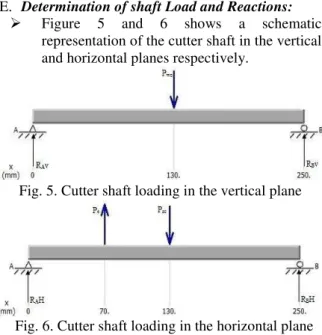
Figure 5 and 6 shows a schematic representation of the cutter shaft in the vertical and horizontal planes respectively.
Fig. 5. Cutter shaft loading in the vertical plane
Fig. 6. Cutter shaft loading in the horizontal plane
With reference to figure 5, the summation of forces in the vertical direction is given as
(9) With reference to figure 6, the summation of forces on the horizontal direction is given as
(10) Using the Shelled strength of coconut to be 230N/m,the valves obtained using equations (14) and (15) are RAV = 22.32 N, RBV = 24.19 N, RBH =
142.5 N and RAH = -104.5 N.
Therefore, the maximum bending moment on this shaft is 101668 N-mm. The de-shelling of the coconut fruit by the driven shaft is partially sudden with minor shock at the start of each operation and gradual as the process progresses, hence, Kb =1.5 and
Kt =1.5 [11]. Hence, the minimum diameter of this shaft was determined as 22.14 mm using Equation (8). Thus, a standard solid mild steel shaft of 25mm in diameter was selected for this machine’s driven cutter shaft.
Figure 7 and 8 shows a schematic representation of the intermediate shaft in the vertical and horizontal planes respectively.
Fig. 7. Intermediated shaft loading in the vertical plane
Fig. 8. Intermediated shaft loading in the horizontal plane
With reference to figure 7,the summation of forces in the vertical direction is given as
(11) With reference to figure 8, the summation of forces on the horizontal direction is given as
(12) Using the Shelled strength of coconut to be 230N/m,the valves obtained using equations (11) and (22) are RAV = 360.41 N, RBV = -224 N and
RcV=232 N , RBH = 1256 N and RAH = --1066 N
and RcH= 1012N.
Thus, the maximum bending moment on the conveyor shaft is 251877.89Nmm. The twisting and conveying of coconut fruit by the auger during as the fruit is been de-shelled is sudden with minor shocks, hence, Kb = 2 and Kt =1.5 [11]. The minimum diameter of this intermediated shaft was determined from Equation (8) as 23.13mm. Therefore, a standard 25mm diameter solid mild steel shaft was selected for the intermediated shaft.
IV.
ENGINEERING
ECONOMICS
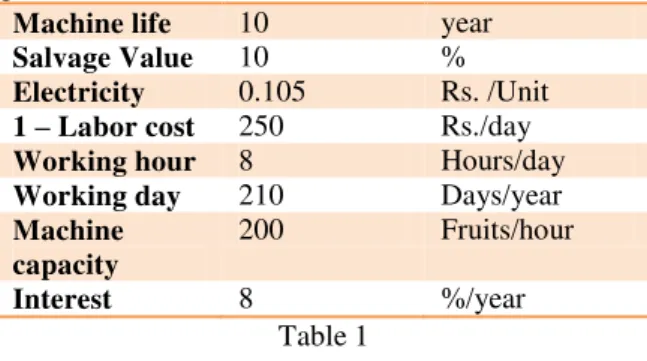
( about 30%, 15%,and 10% respectively). The cost of cutting per fruit could be evaluated from the fixed cost (depreciation and interest) and variable cost (electricity, labour and maintenance). Sink fund method was used to calculate the fixed cost. Details of assumption for calculating the variable cost are given in Table 1
Machine life 10 year
Salvage Value 10 %
Electricity 0.105 Rs. /Unit 1 – Labor cost 250 Rs./day
Working hour 8 Hours/day
Working day 210 Days/year
Machine capacity
200 Fruits/hour
Interest 8 %/year
Table 1
V.
PERFORMANCE EVALUATION
PROCEDURE:
In order to actualize the aims of this project, the deshelling capacity and efficiency of the coconut deshelling machine were evaluated using ten experimental runs after its fabrication. Each test involved operating the machine by a different operator and recording of the total number of fruits, NT each of the twenty operators deshelled in a given
time. The deshelling process as per each operator was timed with a stop-watch. Also determined in each test are number of well deshelled nuts without distortion on the length of the Shell extract, Ndf and number of well deshelled nuts with distorted husk extract, Ndw. Thereafter, the efficiency, η and capacity, C of the machine were computed in each case using the following relations:
(14)
(15)
VI.
R
ESULT ANDDISCUSSION
The results of the performance test (Table 2) show that the machine performed above 86% efficiency in all the tests cases as expected. It is also obvious from this table that the capacity of the developed machine ranges between 191 and 206 nuts per hour depending on the operator, however, on average an operator deshelled 195 nuts per hour with this machine. This machine was fabricated with standard and locally sourced materials and its estimated cost Twenty five thousand six hundred (Rs.25,600.00) thus, the machine is affordable to small scale farmers and maintainable.S/No.
Number of fruits Deshelled
Number of well deshelled
fruits
Number of fruits not deshelled
well
Time (Second)
Efficiency (%)
Capacity (Coconut/h)
1 16 14 2 292.58 87.50 196
2 15 13 2 282.68 86.66 191
3 17 16 1 308.78 94.11 198
4 16 15 1 297.56 93.75 193
5 15 13 2 272.78 86.66 197
6 17 15 2 321.89 88.23 190
7 17 15 2 319.85 88.23 191
8 15 14 1 275.90 93.33 195
9 16 14 2 289.91 87.50 199
10 17 16 1 295.71 94.11 206
Average 90 195
Table 2: Result of Performance Evaluation of Coconut Deshelling Machine
VII.
C
ONCLUSIONSA power operated coconut deshelling machine was designed and developed. Coconut deshelling machine which deshelled coconuts without nut breakage and machine is easy to operate and perform with an average deshelling efficiency and capacity of 90% and 195 nuts per hour. Introduction of this machine eliminates the problem of extracted shell length distortion associated with the use of some risks involved in the use of cut and hold the coconut de-shelling.
R
EFERENCES[1] Foale, M.A. The Coconut Palm. In: Chopra, V.L. and Peter K.V. edited Handbook of Industrial Crops. Haworth Press, New York, 2005.
[2] APCC. Coconut Food Process – Coconut Processing Technology. Information Document. Arancon, Jr, R.N., ed. Asian and Pacific Coconut Community. Jakarta, Indonesia,1996.
[3] Brandis, C. and Glaser, F. (1973).
[4] Madhavan, K. (1985). Design and development of copra moisture meter. J. Planta. Crops. 16: 113-116.
[5] Tilledaratne, H.A. Processing of Coconut Products inSri Lanka. Asian and Pacific Coconut Informantion Document. Arancon, Jr., R.N., ed. Asian and Pacific Coconut Community. Jakarta, Indonesia.
[6] Thampan, P.K. Handbook on Coconut Palm. Oxford & IBH Publishing Co., New Delhi. 1996.
[7] Ohler, J.G.. Coconut, Tree of Life. FAO
Plant Production and Protection Paper 57. FAO, Rome, Italy, 1984.
[8] Rethinam, P. (2003). Prospects for the coconut industry. J. Planta. Crops. 31(1): 1-7.
[9] Rey, H.O. (1955). Device for removing meat from coconut. Philippine Patent No. 793. [10] Thampan, P.K. (1981). Hand Book of
Coconut Palm, Oxford and IBH Co. Pvt. Ltd., New Delhi. Pp. 311.
[11] Shiwalkar B.D., Design Data for Machine Elements, Dattatraya Publications, Nagpur (India).
[12] Sharma, P.C. and Aggarwal, D.K. Machine Design. S.K. Kataria and Sons, Nai Sarak Dechi. Katra books @yahoo.com, 2006. [13] Khurmi, R.S. and Gupta, J.K.. A Textbook of
Machine Design (S.I. Units), Eurasia publishing House (PVT) Ltd., Ram Nagar, New Delhi-11005s, 2005
[14] IS 2494-1974. Indian Standards. Indian StandardsI institute, New Delhi, 1974. [15] Rajput, R.K. Strength of Materials, S. Chand