Improvement in collapsibility of ZrO
2
ceramic mould for investment casting
of TiAl alloys
Male, born in 1976. He obtained his B.S. and M.S./Ph.D. at Harbin Institute of Technology. His research and teaching interests mainly focus on titanium alloys/TiAl alloys and investment casting processing. He has published more than 20 papers by now.
E-mail: [email protected]
Received: 2010-06-12; Accepted: 2010-10-08 *Xiao Shulong
Chen Yanfei, *Xiao Shulong, Tian Jing, Xu Lijuan, Kong Fantao and Chen Yuyong
(School of Materials Science and Engineering, Harbin Institute of Technology, Harbin 150001, China)
T
iAl alloys (γ-titanium aluminide) are emerging as a novellight weight material in the application ield of aerospace and automobile industry because of their low density, high melting temperature, good elevated-temperature strength and modulus retention, good resistance to oxidation and hydrogen
absorption as well as acceptable creep properties[1-6]. However,
like other intermetallics, TiAl alloys have low ductility and fracture toughness at room temperature, which introduces manufacturing dificulties and potentially limits their structural
applications. It is worth mentioning that investment casting
offers the opportunity of producing complex net or near-net-shape components in a variety of TiAl alloys[7-12]
.
It is well known that TiAl alloys show remarkable cracking
sensitivity, particularly in areas where geometrical shrinkage
hindrance occurs when carrying out the investment casting process. TiAl alloys usually cannot withstand the thermal
stresses which may cause not only cracking of casting during solidiication, but also distortions and affect dimensional stability and even cause a complete destruction of the cast parts[13-15].
This paper presents the work on the improvement in
collapsibility of ZrO2 ceramic mould by adding high polymer
Abstract: Investment casting has been widely recognized as the best option in producing TiAl components with key beneits of accuracy, versatility and integrity. The collapsibility of ceramic moulds for investment casting is critical in the manufacturing process of TiAl components due to TiAl’s intrinsic brittleness at room temperature. The aim of the present research is to provide a method for production of TiAl components by investment casting in ZrO2 ceramic
moulds with improved collapsibility. Slurries prepared with high polymer additions were utilized during the preparation of ceramic moulds. The stress/strain curves obtained from green and baked ceramic moulds demonstrate that the green strength was increased with the application of high polymer, while baked strength decreased, thus the collapsibility of ceramic moulds was improved. It is suggested that this result is related to the burn-out of high polymer which left a lot of cavities. The experimental indings were also veriied by the investment casting of “I”- shaped TiAl components.
Key words: collapsibility; improvement; ZrO2 ceramic mould; TiAl alloys; investment casting
CLC numbers: TG222/146.2+3 Document code: A Article ID: 1672-6421(2011)01-009-05
to ZrO2 slurry system. In this research, the effects of high
polymer addition on ZrO2 ceramic mould were studied.
1 Experimental details
The alloy used in this study had a nominal composition of Ti-47Al-2Cr-2Nb (at.%). The ZrO2 ceramic moulds were
produced by process of dipping, stuccoing and drying for several times to get desired thickness of the mould. “I”-shaped ceramic moulds with ZrO2 facecoats were produced. The
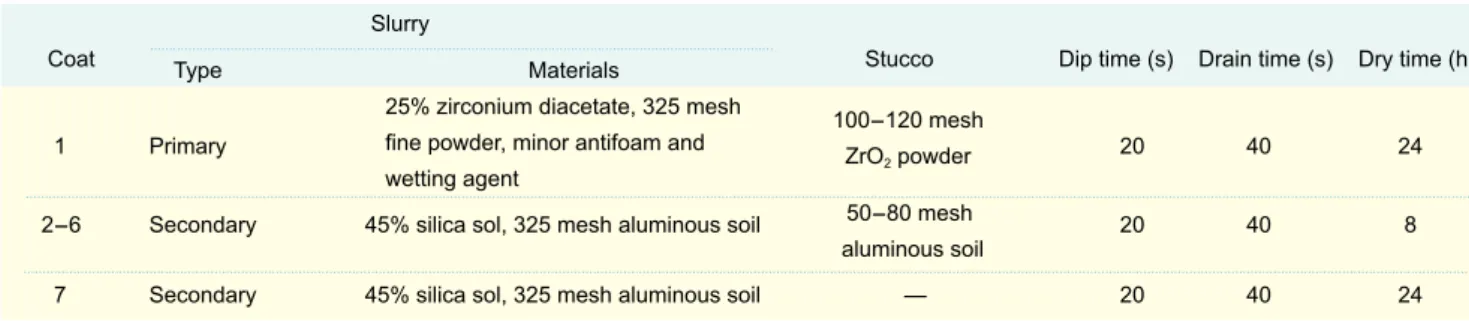
details of slurry compositions and mould building parameters are listed in Table 1. Secondary slurry was modified with minor (0.01wt.%, 0.02wt.%, 0.03wt.% and 0.04wt.%, respectively) high polymer (i.e. polyacrylamid water-soluble polymer with molecular weight = 6 × 10⁴ and particle size<
200 μm, Dalian Guanghui Chemical Co., Ltd.).
To evaluate the mechanical properties of the moulds at room temperature, three-point bend tests were conducted on the green and ired bars. The samples were prepared upon a wax pattern. After dewaxing, the moulds were cut into rectangular test bars with the dimension of 40 mm × 20 mm × 4 mm
according to the bending strength standard. The test samples
were fired at 950℃ for 2 h. The bending strength, σw, was
calculated using Eq. (1).
where P is the fracture load, L is span length, a and h are the
width and thickness of sample fracture area.
twice as high as that for sample A without high-polymer. The green samples B, C and D also exhibited similar stress/ strain behavior. This is beneicial to meet the requirement of suficient green strength to withstand dewaxing. A low green strength may lead to the failure during the dewaxing process or subsequent handling. The increased strength of the moulds was mainly attributed to the high polymer modiication which acts as strengthening agent for the green moulds.
The load/delection curve was converted into a stress/strain using Eqs. (1) and (2).
where,
ε
is the strain, and δ is the delection.Samples were loaded in an Instron 5569 tensile testing machine at a constant load rate of 0.5 mm/min until failure. All tests were conducted on five samples in order to verify the reproductivity of the test results. Finally, the collapsibility improvement of ZrO2 ceramic moulds was veriied by testing
the “I” shaped moulds on a centrifugal casting machine (V-3, 3-TITAN, Linn High Therm GmbH, Germany) as shown in Fig. 1. The melting and pouring process was protected under
argon atmosphere in order to avoid gas reactions with the melt.
Fig. 1: Schematic representation of the titanium centrifugal casting machine with middle frequency generator
Fig. 2: Stress/strain curve of green ceramic moulds
Fig. 3: Stress/strain curve of baked ceramic moulds Table 1: Slurry compositions and fabrication technology of ZrO2 ceramic moulds
Coat Stucco Dip time (s) Drain time (s) Dry time (h)
1 Primary 20 40 24
2-6 Secondary 45% silica sol, 325 mesh aluminous soil 20 40 8
7 Secondary 45% silica sol, 325 mesh aluminous soil — 20 40 24 Slurry
Type Materials
25% zirconium diacetate, 325 mesh
ine powder, minor antifoam and
wetting agent
100-120 mesh ZrO2 powder
50-80 mesh aluminous soil
The surface and fracture of ceramic moulds were examined by means of scanning electron microscopy (SEM).
2 Results and discussion
2.1 The effects of high polymer on the
mechanical properties of ceramic moulds
The 3-point bend stress/strain curves of green ceramic moulds at room temperature are shown in Fig. 2. The green strength
increased obviously when high polymer was introduced into
the ceramic moulds. Except for sample E, the high-polymer added samples B, C and D showed a bend strength value almost
The stress/strain curves of moulds baked at 950℃ for 2 h are illustrated in Fig. 3. It is apparent that substantially higher
strength was obtained on the mould without high polymer.
Furthermore, the baked strength of samples B, C and D was lower not only than that of baked sample A, but also than that of green samples B, C and D. This can be attributed to the burn-out of the high polymer at high temperature. The sintering and crystallization of the colloidal binder system
were obviously changed to a large extent. It is worth noting that samples C and D still have similar stress/strain curves in terms of the green strength while sample B has a higher curve
(or green strength). Sample E possesses the lowest strength and largest strain among them.
2.2 The morphology of facture surface of the
moulds
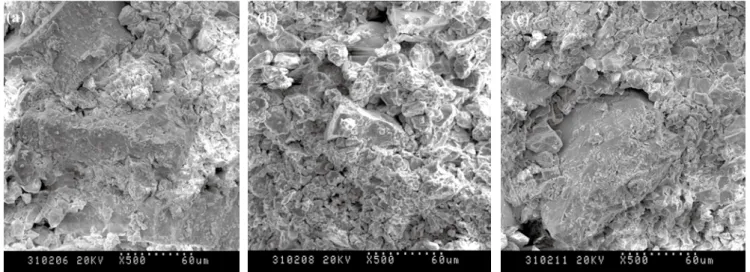
From the analysis in section 2.1, samples A, C and E were chosen as examples for observation of the facture moulds under SEM. The fracture surfaces of the ceramic moulds are shown in Fig. 4. In Fig. 4(a), there existed large stucco particles surrounded by slurry layers. In Fig. 4(b) the proportion of large stucco particles was reduced whereas half of the surface was almost occupied by smaller iller particles. The binder and high
polymer coalesce as a whole mould system. As compared to
the fracture surfaces shown in Figs. 4(a) and 4(b), the one in
Fig. 4(c) appears to be smoother. It is reasonable to believe
that this is attributable to the increased slurry viscosity and the
ability for stucco materials to adhere to the surface of moulds. The difference of particle size distribution indicated on fracture surface is likely to be related to the increased viscosity of slurry which consists of fine powders. The high polymer imparted high deposition force on coarse stucco materials. However, in Fig. 4(c) the fracture occurred through the high polymer phase, while in Fig. 4(b) the fracture developed along the interface between high polymer and ceramic particles. The morphology of ceramic mould in Fig. 4(a) was characterized by inter-particle fracture, leading to cleavage fracture and partial fracture at the junction of binder and fine ceramic powders. Therefore, the high polymer content in the slurry is a critical factor that determines the green strength of the ceramic
moulds.
Fig. 4: The green fracture surfaces of ceramic moulds with high polymer: 0 (a); 0.02wt.% (b); 0.04wt.% (c)
Figure 5 shows the fracture surface of ceramic moulds baked at 950℃ for 2 h. In Fig. 5(a), cracks propagated through the junction of the slurry and stucco. Figure 5(b) shows many cavities left after the burn-out of high polymer during baking
process. The connected porosities enhanced the permeability
of the ceramic moulds during investment casting. The removal of high polymer in Fig. 5(c) led to the propagation of cracks around the large stucco particles. Thus the baked strength of
this condition was too low to prevent cracking during metal pouring which brings high thermal shock. As can be seen
from Fig. 5, some cavities were left by the volatilization of
high polymer during the baking process while others can be
ascribed to the difference of size distribution of ine powders
and coarse particles stucco materials. The increased baked
strength of ceramic mould could be related to the sintering and crystallization of the colloidal zirconium binder. As indicated in Fig. 3, the addition of high polymer played an important part in adjusting the strength of ceramic mould. It is worthy
mentioning that the common ceramic mould usually becomes
very hard after baking and casting. Thus the removal of the
ceramic mould material to recover the metal castings becomes
time consuming, very dificult and expensive. The introduction of high polymer to the improvement of collapsibility of ceramic moulds is not only beneficial for the prevention of cracks in TiAl castings but also helpful in reducing workloads of sand cleaning. Thus, it has great significance for the reduction of manufacturing cost.
2.3 Investment casting of “I” shaped TiAl
components
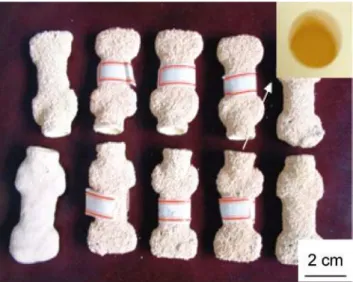
Figure 6 shows the “I” shaped ceramic moulds after baking. Details showing the inner surface quality of the moulds which determines the cast surface roughness are presented in the top right corner of Fig. 6.
3-point bend strength results shown in Fig.3. It is well known
that TiAl castings are sensitive to cracks due to their intrinsic
brittleness at room temperature. Once initiated, the cracks often propagate to the entire section of TiAl casting when it cannot withstand the strength of ceramic moulds. The conclusion can be drawn that the existence of cracks observed
with an unaided eye in TiAl casting can be regarded as the
implication of collapsibility of ceramic moulds to a certain degree. However, X-ray nondestructive testing is a scientiic method in the detection of casting laws. Further study will be conducted using the recommended experimental methods that
have not been tested in this study.
Figure 8 illustrates the stress analysis of “I” shaped TiAl cast. During the investment casting process of TiAl alloys, cracks may come from the following reasons: poor collapsibility and strong residual strength of the moulds, and large shrinkage factor of TiAl alloys during the solidiication process. As shown in Fig. 8, solidiication shrinkage and the resistance of the moulds can result in the rupture of “I” shaped casting at the root position. However, more sophisticated calculation approaches, based on the genetic algorithms and evolution strategy, are needed to assist in optimizing the TiAl
investment casting technology.
Fig. 6: “I” shaped ceramic moulds with high polymer
Figure 7 shows the result of investment casting of TiAl alloys using the “I” shaped ceramic moulds. A clear improvement can be noticed from the pouring experiment. It is obvious that larger cracks led to the failure of the cast (Fig. 7a). There were still little cracks at the root position when the amount of high polymer was 0.01wt.% (Fig. 7b). No cracks were found in the cast samples when the addition reaches 0.02wt.% (Fig. 7c) and 0.03wt.% (Fig. 7d). It should be mentioned that the moulds will crush in the effect of centrifugal force when the addition is more than 0.04% in practical pouring experiment. This was consistent with the
Fig. 7: “I” shaped TiAl alloys with high polymer: 0 (a), 0.01% (b), 0.02% (c), 0.03% (d)
This work was inancially supported by the National Natural Science Foundation of China under grant No. 51001040, the Specialized Research Fund for the Doctoral Program of Higher Education within project No. 200802130014, the Fundamental Research Funds for the Central Universities (grant No. HIT NSRIF.2010116) and the Development program for Outstanding Young Teachers in Harbin Institute of Technology (HITQNJS 2009022).
3 Conclusions
A method for fabricating ceramic moulds with improved collapsibility was suggested. Property testing and fracture surface examination were carried out during the present study. This method is to introduce high polymer into the manufacturing of ceramic moulds for investment casting of TiAl alloys to increase the green strength to prevent cracking, improve the
collapsibility and enhance the permeability during the investment
casting. The new approach is also helpful in reducing workloads of sand cleaning in the investment casting of TiAl alloys. The research makes it an alternative method for manufacturing the moulds and has great significance for the reduction of manufacturing cost in investment casting of TiAl alloys.
References
[1] Kim Y W. Intermetallic alloys based on gamma titanium aluminide. JOM, 1989, 41 (7): 24-30.
[2] Appel F, Wagner R. Microstructure and deformation of
two-phase γ-titanium aluminides. Materials Science and Engineering R, 1998, 22 (5): 187-268.
[3] Lu M, Barrett J R, Kelly T J. Investment casting of gamma
titanium-aluminides for aircraft engine applications. In: Proceedings of the Third International Symposium on Structural Intermetallics (ISSI-3), TMS, 2001: 225-232.
[4] Bartolotta P A, Krause D L. Titanium Aluminide Applications in the High Speed Civil Transport. In: Proceedings of the International Symposium on Gamma Titanium Aluminides, The Minerals, Metals and Materials Society, San Diego, California,
February 28-March 4, 1999: 12-27.
[5] Wu X. Review of alloy and process development of TiAl alloys.
Intermetallics, 2006, 14 (10-11): 1114-1122.
[6] Loria E A. Quo vadis gamma titanium aluminide. Intermetallics, 2001, 9 (12): 997-1001.
[7] Kuang J P, Harding R A, Campbell J. Microstructures and properties of investment castings of γ-titanium aluminide.
Materials Science and Engineering A, 2002, 329: 31-37.
[8] Larsen J D E. Status of investment cast gamma titanium
aluminides in the USA. Materials Science and Engineering A, 1996, 213 (1-2), 128-133.
[9] Jia Q, Cui Y, Yang R. A study of two refractories as mould materials for investment casting TiAl based alloys. Journal of
Materials Science, 2006, 41 (10): 3045-3049.
[10] Nan H, Huang D, Li Z X, J.Q. Z. Research on investment
casting of TiAl alloy agitator treated by HIP and HT. China
Foundry, 2007, 4 (2): 112-115.
[11] Liu K, Ma Y C, Gao M, et al. Single step centrifugal casting
TiAl automotive valves. Intermetallics, 2005, 13 (9): 925-928.
[12] Yang R, Cui Y Y, Dong L M, Jia Q. Alloy development and shell mould casting of gamma TiAl. Journal of Materials Processing
Technology, 2003, 135 (2-3): 179-188.
[13] Wang S R, Guo P Q, Yang L Y. Centrifugal precision cast TiAl turbocharger wheel using ceramic mold. Journal of Materials
Processing Technology, 2008, 204 (1-3): 492-497.
[14] Guan J, Dieckhues G W, Sahm P R. Analysis of
residual-stresses and cracking of gamma-TiAl castings. Intermetallics, 1994, 2 (2): 89-94.
[15] Chen Y Y, Xiao S L, Kong F T, Wang X. Microstructure
and interface reaction of investment casting TiAl alloys.
Transactions of Nonferrous Metals Society of China, 2006, 16: