This study evaluated the casting accuracy of crown margins and metal-ceramic shear bond strength (SBS) of pure titanium injected into casting molds made using 2 investment types at 3 mold temperatures. Sixty crown (30-degree beveled finish line) and 60 cylinder (5 mm diameter x 8 mm high) patterns were divided into 6 groups (n=10), and cast using a phosphate-bonded investment (P) and a magnesium oxide-bonded investment (U), at 400°C (groups P400 and U400), 550°C (groups P550 and U550) and 700°C (groups P700 and U700) mold temperatures. Crown margins were recorded in impression material, the degree of marginal rounding was measured and margin length deficiencies (µm) were calculated. Titanium-ceramic specimens were prepared using Triceram ceramic (2 mm high) and SBS was tested. Failure modes were assessed by optical microscopy. Data were subjected to two-way ANOVA and Tukey’s HSD test (α=0.05). For casting accuracy, expressed by marginal deficiency (µm), investment U provided more accurate results (64 ± 11) than P (81 ± 23) (p<0.001). The increase in temperature resulted in different effects for the tested investments (p<0.001), as it provided better casting accuracy for U700 (55 ± 7) and worse for P700 (109 ± 18). Casting accuracy at 700°C (82 ± 31) was significantly different from 400°C (69 ± 9) and 550°C (68 ± 9) (p<0.05). For SBS, there was no significant differences among the groups for factors investment (p=0.062) and temperature (p=0.224), or for their interaction (p=0.149). Investment U provided better casting accuracy than investment P. The SBS was similar for all combinations of investments and temperatures.
Effect of Investment Type and Mold
Temperature on Casting Accuracy
a n d T i t a n i u m - C e r a m i c B o n d
Mônica Barbosa Leal1, Valéria Oliveira Pagnano2, Osvaldo Luiz Bezzon2
1Department of Dentistry,
UFS - Federal University of Sergipe, Aracaju, SE, Brazil
2Department of Dental Materials
and Prosthodontics, Ribeirão Preto Dental School, USP - University of São Paulo, Ribeirão Preto, SP, Brazil
Correspondence: Profa. Dra. Valéria Oliveira Pagnano de Souza, Avenida do Café s/n, 14040-904 Ribeirão Preto, SP, Brasil. Tel: +55-16-3602-4795. e-mail: [email protected]
Key Words: titanium, casting accuracy, bond strength, investments, temperature.
Introduction
Alloys with a high percentage of gold have been successfully used in the fabrication of dental prostheses for many years, but their high cost had led to the development of less expensive alternatives using both noble and base metals (1,2). Although nickel-chromium (Ni-Cr) alloys have been widely used in the fabrication of metal ceramic crowns, there are concerns about their biological safety following reports of nickel sensitivity in patients (3).Nickel is considered one of the most common causes of allergic dermatitis and is responsible for more allergic reactions than all other metals combined (3). Beryllium, present in many alternative alloys, is considered a potential carcinogenic agent, presenting a problem for dental laboratory technicians because beryllium is released during casting and finishing procedures (3). In recent years, titanium has become a material of great interest in prosthodontics. Commercially pure titanium (CPTi) and its alloys are alternatives to gold and base metal alloys. CPTi offers excellent biocompatibility, good corrosion resistance at room temperature and characteristics such as low density and high mechanical resistance (4,5). The light weight and high strength-to-weight ratio of titanium allow the design of more functional and comfortable prostheses (6).
CPTi is available in grades, I through IV, the purest being grade I. The 4 grades differ in trace amounts of oxygen,
nitrogen, hydrogen, iron and carbon retained after the refining process (6). The search for esthetic restorations has led to the development of ceramics that can be combined with titanium (7,8). Exposure of titanium to temperatures exceeding 800°C leads to absorption of oxygen and nitrogen, thus forming a thick oxide layer that does not bond strongly to the metal surface (7). Moreover, CPTi has two crystal modifications: the close-packed hexagonal alpha (α) structure up to 882°C, and above this temperature the body-centered cubic beta (β) structure (8). This phase change is associated with volume and surface changes (8). In addition to the high-temperature firing of conventional ceramics (>900ºC), another problem for titanium-ceramic systems is the lower linear coefficient of thermal expansion (CTE) of titanium (around 9.4×10⁻⁶/°C) compared with conventional ceramics (around 14×10-6/°C) (7). Therefore, low-fusing ceramics, with firing temperatures lower than 800ºC and adequate CTE have been developed and are commercially available (7,8).
41
Casting accuracy and titanium-ceramic bond
extensively used in casting noble and base metal alloys are not suitable for titanium (11-13) because silica (SiO2) and phosphate (P2O5) are easily reduced by molten titanium (13). Consequently, the release of oxygen contaminates the surface layer of titanium casting with titanium oxide scales (TiO2) and TiO, a compound that incorporates oxygen in solid solution (13). This surface layer, called alpha-case (α-case), is responsible for the high hardness values and brittleness that may be detrimental to prosthetic restorations (13). The α-case layer also affects titanium-ceramic bond (8) and its thickness is influenced by the composition of the investment (14-16). Therefore, suitable investments for titanium require more thermally stable oxides, such as magnesia, alumina, zirconia and yttria (14-16).
Typically, molten titanium at 1668°C is injected in a mold at a much lower temperature (<800°C) to protect the metal from reacting with the investment (9). The extreme temperature difference between mold and molten titanium causes the cast metal to cool rapidly, reducing the time for gas to escape from the mold, disturbing adequate mold filling, and causing defective castings (12). Although higher mold temperatures may improve the casting accuracy of titanium crowns by increasing the flow molten metal during injection in the mold (17,18), it may increase α-case layer thickness (15,16), weakening titanium-ceramic bond (8,19).
Metal ceramic crowns have been widely used in dental practice because they combine the resistance of the metal substructure and the esthetic properties of ceramics (8). Several tests have been designed and selected by researchers to evaluate the metal-ceramic bond strength (20,21). ISO standard 9693:1999/Amd.1:2005 employs a 3-point bending test and the minimum acceptable bond strength with this test is 25 MPa (22). Most studies have used 3-point bending (23,24) and shear strength tests (7,19). A critical factor in cast crown fabrication is dimensional precision. Crowns must fit the prepared teeth and this is directly influenced by the castability of the alloy (1,2). In general, methods for determining castability are based on the ability of an alloy to faithfully reproduce the sharp detail and fine margins of the mold space after burnout procedures (1). Tests that employ specimenssimulating a clinical crown design are more sensitive because they represent a dental restoration (1,2,4,5). Although there are conflicting opinions in the literature regarding how much marginal gap is considered clinically acceptable (1), more recently a marginal gap of 120 µm has been considered (4,5). Despite some casting difficulties of titanium, its excellent biocompatibility justifies the investigations for its use in prosthodontics (5). Considering the development of reliable bonding between veneering ceramic and metal as the primary requirement for clinical success of the metal-ceramic restorations (8), as well as the sharpness of cast
crown margins (1,2,4,5), the purpose of this study was to evaluate the accuracy of crown castings and metal-ceramic shear bond strength (SBS) of CPTi injected into casting molds using two investment types at three temperatures. The null hypothesis was that casting accuracy and metal-ceramic SBS of CPTi is not different for the two investments at three different mold temperatures.
Material and Methods
The casting accuracy was evaluated indirectly by determining the marginal deficiency (µm) of stylized cast crown specimens. Crown margins were measured, the degree of marginal rounding was recorded and marginal deficiencies (µm) were calculated. A stainless steel die with a height of 7.0 mm, diameter of 7.0 mm and a 30-degree beveled finish line relative to the long-axis of the preparation was used to create test specimens (Fig. 1A). A hollow brass cylinder with a height of 12.1 mm, external diameter of 20.5 mm and internal diameter of 7.75 mm was fabricated to fit accurately around the steel die base. This was used to form the external surfaces of the stylized crown specimens, and to standardize their size and form by providing a 0.6-mm axial wall thickness and 1.2-mm occlusal surface thickness. To form the crown specimens, the cylinder and die were first isolated with an acrylic resin separator. Self-curing acrylic resin (Duralay; Reliance Dental Mfg Co, Worth, IL, USA) was prepared and flowed into the space between the lubricated and assembled cylinder and the die. After acrylic resin polymerization and brass cylinder removal, inlay casting wax (GEO Classic transparent blau; Renfert, Hilzingen, Germany) was used to refine the acrylic resin crown margins. The final step was carefully carving the 30-degree beveled margin for each crown pattern with a #11 surgical blade and examine its sharpness under a stereomicroscope at 10× magnification (Model SMZ-2; Nikon, Tokyo, Japan). The acrylic resin portion of pattern and cylindrical base of the steel die were used as references to obtain a cylindrical external form as uniform as possible in thickness and ensure a 30-degree beveled margin.
Self-M
.B
. Leal et al.
curing acrylic resin (Duralay; Reliance Dental Mfg Co.) was flowed into the space between the lubricated and assembled Parts a and b with the 8-mm-high spacer in position (Part c). After acrylic resin polymerization, inlay casting wax was used to refine the acrylic resin cylinder surfaces.
Wax/acrylic resin patterns were attached to sprues (3 mm long and 3 mm diameter) at a 45o angle to the crown and cylinder pattern’s long axes and invested using two commercially-available titanium investments, a phosphate-bonded SiO2/Al2O3/MgO-based investment (RematitanPlus; Dentaurum, Pforzheim, Germany) (P) and a magnesium oxide-bonded MgO/Al2O3/ZrO2-based investment (Rematitan Ultra; Dentaurum)(U). The patterns were invested according to the manufacturers’ recommendations using silicone rings (Rema Form; Dentaurum) for investment P and metal rings for investment U. A surface tension reduction agent (Lubrofilm; Dentaurum) was applied on the wax/acrylic resin patterns and then they were immediately invested to minimize distortion of the wax. The investments were mixed at 425 rpm under vacuum for 60 s in a vacuum investor (Model A 300; Polidental, São Paulo, Brazil). Liquid and powder ratios were those recommended by the manufacturers, 40 mL/250 g for investment P and 35
mL/250 g for investment U. Rings for investment P were allowed to bench set 60 min and those for investment U set 120 min. Investment U rings were stored in sealed plastic bags until burnout procedures, since this investment material is sensitive to desiccation. Each investment mold contained two wax/acrylic resin patterns: a crown-shaped pattern and a cylinder-shaped pattern.
The casting rings were placed in a furnace (Model Edgcon 5P; EDG, São Carlos, SP, Brazil) to burn out patterns and thermally expand the molds. Heating cycles were specific for each investment (Table 1). After reaching the maximum temperatures of 1,000ºC and 900ºC for investments P and U, respectively, the casting rings were cooled to 400ºC to obtain the castings of the first group. The same procedure was followed for the other two groups of specimens cast at mold temperatures of 550ºC and 700ºC. After removal from the furnace, the rings were positioned in the casting machine (Rematitan; Dentaurum), where the titanium was melted with a voltaic arc. Air was automatically evacuated from the casting machine functional chamber and an inert argon atmosphere was provided for melting and casting. The molten titanium was forced into the casting mold with a combination of vacuum and pressure. To cast each ring, a 22-g ingot of CPTi (Titanium Grade I) (Tritan; Dentaurum) was used. After the rings cooled, the castings were divested manually and airborne-particle abraded (Model Microjet III; EDG) with 50 µm aluminum oxide abrasive under 2-bar pressure for 5 s to remove residual investment. After the castings separated from their sprues, crown specimens were evaluated for casting accuracy test, while metal cylinders were prepared for applying the ceramic veneering disks.
A total of 120 castings were made: 60 crown-shaped for casting accuracy test, and 60 cylinder-shaped castings for titanium-ceramic SBS test. Six groups (n=10) were formed: specimens cast with investment P at 400ºC, 550ºC and 700ºC (groups P400, P550 and P700) and with investment U at 400ºC, 550ºC and 700ºC (groups U400, U550 and U700).
Casting Accuracy Test
C ro w n s p e c i m e n s w e re evaluated for marginal rounding as proposed by Brokhurst et al. (1). This method has been widely used to assess the casting accuracy of metal alloys using a dental impression material to record crown margins (2,4,5). Specimens were fixed with wax to the shaft of a dental surveyor (Bio-Art, São Carlos, SP, Brazil) in line with the vertical axis. Casting margins were then lowered into a polyvinyl chloride resin ring Figure 1. A: Dimensions (mm) of stainless steel die. B: Plastic custom mold with the Parts a, b, c,
and d separated. C: Mold with Parts a, b, c, and d positioned for making the specimens: side view. D: Mold with Parts a, b, c, and d positioned for making the specimens: top view.
Table 1. Heating cycles for casting mold preparation
Investment Step HT/CT (°C) HT/CT rate
(°C/min)
Time hold temp (min)
P
1 RT-150 5 90
2 150-250 5 90
3 250-1000 5 60
4 1000-TT 5 ≤ 90
U
1 RT-250 5 90
2 250-900 5 20
3 900-TT 5 ≤ 30
HT: Heating temperature. CT: Cooling temperature RT: Room
43
Casting accuracy and titanium-ceramic bond
(20 mm height, 26 mm outer diameter and 20.5 inner diameter), filled with a light-body condensation silicone impression material (Xantopren VL Plus; Heraeus Kulzer, Hanau, Germany). After material setting, specimens were removed from the impressions within the rings. Each of 10 silicone impressions was then sectioned into eight equal-size wedge shaped sections using a razor blade and cutting guides located in the ring, and measured for each of the 6 groups, resulting in a total of 480 marginal location measurements. For this, the silicone sections were positioned on a glass slab and the superior face of each section was marked with a permanent marker. Each impression section had two faces, but only the marked face was photographed. The images were obtained within a maximum period of 30 min, considering the dimensional stability of the condensationsiliconeimpression material.
The silicone sections were positioned under an inverted incident light microscope (Model Metaval-H 30-G684a; Carl Zeiss, Oberkochen, Germany) and photographed at 40× magnification using black and white film (Tri-X Pan ASA 400; Kodak, Rochester, NY, USA). The exact magnification of the image was determined using a microscope scale photographed with the impression material sections on the same film. The obtained film negatives revealed marginal rounding that was measured (1) and used it to calculate the distance (D) between an actual casting margin and a potentially perfect margin by the expression: D=2.7×R, where R is the radius of the marginal rounding.
The radii of rounded margins were measured in millimeters directly from the film negatives with a double coordinate microscope (Model ZKM 0.2-250; Carl Zeiss), using an accessory device (E2-8140; Carl Zeiss). The accessory device was a lens that contained tracings of semicircles and their radius values in millimeters. The device was placed on the double-coordinate microscope and the image of the semicircle tracings were seen over the film negative. With the coincident tracings, the radii (in mm)of rounded margins were directly determined. In relation to the silicone section, the negative image was magnified 40×. Thus, to determine radius R, the observed value was divided by 40 and converted from millimeters to micrometers. Then the above-mentioned formula was applied to calculate the distance. For each specimen, eight marginal sections were measured and the mean value of the eight measurements was obtained. Data were analyzed statistically by two-way ANOVA and Tukey’s HSD test (α=0.05).
Metal-Ceramic Shear Bond Strength Test
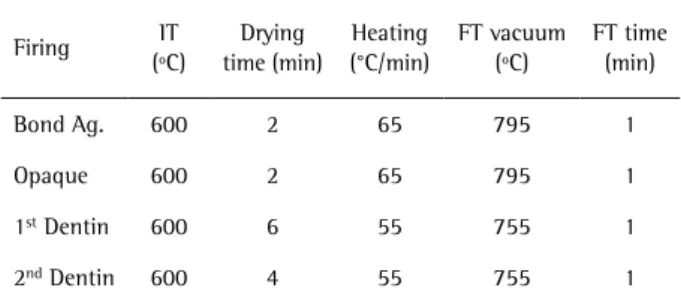
Specific ceramic for titanium (Triceram/Triline ti; Esprident GmbH, Ispringen, Germany) with ultra-low firing temperature was used (Table 2). The titanium cylinder surfaces were prepared for applying ceramic according to
the manufacturers’ recommendations. The metal specimen surfaces were ground with tungsten grinding stones for titanium at 10,000 rpm, until a glossy surface was obtained. After grinding, the titanium cylinder surfaces were airborne-particle abraded (Model Microjet III; EDG) with 150 µm aluminum oxide abrasive (Asfer Chemical Industry) under 3 bar pressure for ten seconds, using a 2-cm distance and an approximately 45o angle. Subsequent cleaning was performed with water steam spray and the specimens were allowed to dry for ten minutes for passive oxidation. The powder/liquid ratio of the bonding agent was mixed until a creamy consistency was obtained, and the bonding agent was applied on the 5-mm-diameter surface of the metal cylinder within 30 min after airborne-particle abrasion and cleaning, considering that a longer time period provides excess oxidation of the titanium surface according to manufacturer’s specifications. The bonding agent was spread with a glass spatula in a thin layer. The opaque ceramic material was also mixed as powder and liquid until obtaining a creamy consistency and it was applied onto the previously sintered bonding agent. After the opaque ceramic firing cycle, each metal specimen was placed into the custom mold with both 8 mm and 2 mm spacers positioned. The same custom mold used to obtain the casting patterns was used for condensing of the ceramic (Fig. 1B-D). Before dentin ceramic sintering, Partsc and d were removed from the custom mold and the piston (Part a) was used to remove metal specimen with the compacted ceramic powder from Part b. The opaque and dentin ceramic were each applied in 2 layers. Ceramic sintering cycles were done according to manufacturer’s specifications (Table 2) in an oven (Sinterpress Alumini; EDG). Specimens were cooled to room temperature between the sintering cycles.
A modified apparatus to test SBS, based on ISO 11405:1994 standard for shear bond testing of adhesion of dental materials to tooth structure (25), was used to measure bond strength of ceramic to metal. This metal device consisted of 3 independent parts (Fig. 2). Parts a and c were built according to ISO 11405:1994 (25). Part b, a metal ring with a central hole, was built to allow the
Table 2. Triceram ceramic sintering cycles
Firing IT
(ºC)
Drying time (min)
Heating (°C/min)
FT vacuum (ºC)
FT time (min)
Bond Ag. 600 2 65 795 1
Opaque 600 2 65 795 1
1st Dentin 600 6 55 755 1
2nd Dentin 600 4 55 755 1
M.B
. Leal et al.
placement of the metal-ceramic specimen, which was fixed with a side screw. After placement, the specimen ceramic portion was outside from Part b, while the specimen metallic portion was inside Part b (Fig. 2B). Part c was a loading plate with a 5 mm diameter hole that acted on the metal/ ceramic interface during the mechanical test (Fig. 2C). This design enabled that the force applied during the shear bond test fell exactly on the metal/ceramic interface. The device containing the metal-ceramic specimen was placed in a mechanical testing machine (Model DL 2 000; EMIC, São José dos Pinhais, PR, Brazil) and subjected to SBS testing with a 500-kgf load cell and a crosshead speed of 0.5 mm/ min. Using the metal-ceramic interface area (5 mm), the load at fracture was then converted to SBS value (MPa). Data distribution was not normal and two-way ANOVA was used after logarithmic transformation (normal distribution) of original data (α=0.05). Fractured surfaces were examined under an optical microscope at 25× magnification (Neophot 30; Carl Zeiss) to classify the failure mode after SBS testing. Bond failures were classified as: adhesive (between metal and ceramic), cohesive (entirely within ceramic), and mixed (combination of adhesive and cohesive failures).
Results
The results of marginal deficiency are presented in Table 3. The mean values, standard deviations and range of mean values for each group are presented, along with the minimum and maximum marginal deficiency values that were observed for a total of 80 marginal locations evaluated within each of the 6 groups. ANOVA indicated significant differences for the main factors, investment material (p<0.001) and mold temperature (p<0.001) and also for the interaction between them (p<0.001). The mean marginal deficiency for investment U was significantly smaller than the mean for investment P (Table 3). The Tukey’s HSD test revealed that the mean marginal deficiency for mold temperatures of 400ºC and 550ºC were significantly
smaller than for mold temperature of 700ºC. There was no statistically significant difference between the mean values of marginal deficiency for mold temperatures of 400ºC and 550ºC (Table 3).
The results of SBS values and failure modes are presented in Table 4. There was statistically significant differences among groups for the main factors, investment (p=0.062) and temperature (p=0.224), or for their interaction (p=0.149). The stereomicroscope images in Figure 3 illustrate the fractured surfaces of representative metal-ceramic specimens for groups P400, U550, and P700.
Discussion
The results of the study suggest that the null hypothesis was partially accepted since there were no significant differences for titanium-ceramic SBS for any of the combinations of investments and mold temperatures. Nevertheless, marginal accuracy of crowns cast with
Figure 2. A: Metal device for the SBS test with Parts a, b, and c separated. B: Part b with metal-ceramic specimen placed. C: Metal device with Parts a, b, and c positioned, and placed in mechanical testing machine with the Part c ready to act on the metal/ceramic interface (arrow).
Figure 3. Representative stereomicroscope images of the fractured specimen surfaces (×25). A: Group P400-adhesive failure. B: Group U550-mixed failure. C: Group P700-mixed failure.
Table 3. Marginal deficiency mean values (µm) and standard deviations
(µm) for the groups, investment and mold temperatures
Groups and factors
Mean (SD)
Range of mean values
Minimum value
Maximum value
P400 66 (7) 56-76 20 122
P550 69 (10) 53-86 40 122
P700 109 (18) 89-149 61 162
U400 71 (11) 48-89 20 122
U550 67 (8) 51-76 20 122
U700 55 (7) 41-66 20 101
Investment
P 81 (23) - -
U 64 (11) - -
-Temperature (°C)
400 69 (9) - -
550 68 (9) - -
-45
Casting accuracy and titanium-ceramic bond
CPTitanium was significantly affected by investment type and mold temperature. Marginal accuracy is the characteristic of dental castings most dependent on the castability of the alloy used and it may be assessed by measuring the marginal deficiency in a test crown. On the basis of theoretical calculations for clinically tolerable marginal openings, recent studies have proposed a value of 120 µm (4,5), which allows 25 µm for a cement layer (1) and 95 µm for deficiency of a cast margin (5). Based on this consideration, results obtained for groups P400, P550, U400, U550, and U700 (Table 3) indicate that titanium may be cast to produce crowns with clinically acceptable margins. However, maximum marginal deficiency values (Table 3) of more than 95 µm were recorded from the cast specimens for all the groups. The maximum marginal deficiency measurement, derived from a test casting, should be the basis for predicting clinical results to be expected when using a particular metal or alloy (2). Therefore, the results of the study indicate that improvements in titanium casting techniques are required, if the expectation is to cast clinical crowns with acceptable margins in all locations.
The results of this study showed significantly lower marginal deficiencies when investment U was used (Table 3). These findings are consistent with those of Leal et al. (5), who also observed lower marginal deficiencies for CPTi crowns cast using the MgO/Al2O3/ZrO2-based investment compared to SiO2/Al2O3/MgO-based investment. The investment composition explains this result. A MgO/Al2O3/ ZrO2-based investment having thermally-stable oxides reduces the surface layer contamination of the solidified titanium (13-16). Despite the presence of stable oxides, such as MgO and Al2O3, investment P still contains SiO2 in its formulation, a compound easily reduced by titanium (11). Consequently, the thickness of the surface layer resulting from the molten metal reaction with mold components is greater for castings obtained with a SiO2-containing investment (13-16).
In this experiment, specimens cast at mold temperatures of 400ºC and 550ºC had significantly less marginal
deficiencies compared to those cast at mold temperatures of 700ºC (Table 3). There was no significant difference between the mold temperatures of 400ºC and 550ºC (Table 3). These findings concur with the increase of chemical reactivity of the titanium at temperatures above 600ºC (9).
The evaluation of the two investments in terms of the mold temperatures showed that CPTi injection into casting mold at 700ºC provided opposite results for the two investment types. The mold temperature of 700ºC reduced significantly the marginal deficiencies for investment U. As this investment is less prone to react with titanium (5,13,15,16), a higher mold temperature reduced the extreme temperature difference between the mold and molten titanium, promoting proper mold filling (12). Thus, the lowest marginal deficiencies were observed for group U700 (Table 3). Notwithstanding, the mold temperature of 700ºC increased significantly the marginal deficiencies for investment P because it contains SiO2, which is reduced by molten titanium between 1,800ºC and 500ºC (13).
The present study demonstrated that injection of CPTi into casting molds made with investments P and U, at temperatures of 400ºC, 550ºC and 700ºC did not have a significant effect on the titanium-ceramic SBS. These findings are consistent with those of Bondioli and Bottino (19), who observed similar results between the mold temperatures of 430ºC and 700ºC for SBS of ceramic Triceram (Esprident GmbH) to CPTi. Several investigations have found that the α-case layer thickness is affected by the investment type (14-16). Eliopoulous et al. (15) observed that the thickness of the α-case layer was of 15-20 µm on titanium castings made with a magnesium oxide-bonded MgO/Al2O3-based investment and 80 µm for a phosphate-bonded SiO2-based investment. It is possible that the use of a investment more prone to react with molten titanium, such as investment P, may have resulted in a thicker α-case layer (15,16). However, this layer might be removed prior to the application of the ceramic by grinding procedures (19) and airborne-particle abrasion (7), producing results similar to those obtained for investment U.
Although various types of tests have been described in the literature to evaluate metal-ceramic bond strength (20), there is no methodology capable of directly measuring the shear forces along the metal/ceramic interface (21), since the specimens have residual thermal stresses at the interface due to a mismatch of the CTE of ceramic and metal (23). Considering the methodology of the present study, there was a predominance of mixed failures in the groups P700 and U700, while adhesive failures were more noted in groups P400 and U400 (Table 4). These findings are close to those observed in a previous study that showed a similar behavior of the failure types with increased mold temperature (19). The adhesive failures suggest that the Table 4. Shear bond strength mean values (MPa), standard deviations
and failure modes for each group
Group Mean (S.D.) Adhesive Cohesive Mixed
P400 85.14 (27.03) 6 0 4
P550 76.87 (29.97) 3 0 7
P700 94.45 (28.02) 1 0 9
U400 78.03 (25.91) 4 0 6
U550 76.83 (26.93) 2 0 8
M.B
. Leal et al.
oxide layer was weaker than the ceramic. A previous study considered that the failures in the titanium-ceramic systems occurred at the oxide layer/titanium surface interface (9). Within the limitations of this study, it was difficult to compare results of this experiment with those obtained in other studies since different methodologies were used to measure metal-ceramic bond strength (7,19,24). In fact, few studies evaluated the effect of higher mold temperature (19) and investment type (24) on the titanium-ceramic bond strength. Although the α-case layer weakens the titanium-ceramic bond (8), this could be overcome by its removal prior to applying the ceramic (7,19). Currently, research to improve the titanium-ceramic bond strength continues and this includes methods to prevent the formation of excessive and non-adherent oxide layer during ceramic firing (10). With respect to casting accuracy of CPTi, it was also difficult to compare results of this experiment with those of previous investigations because of differences in the methodologies used to evaluate marginal accuracy (17,18). In the present study, marginal accuracy measurements depended on a stylized metal die simulating the configuration of a tooth prepared to receive a cast metal complete crown. However, the obtained results cannot be directly extrapolated to clinical practice because factors such as the fit of the crowns and thickness of cement layer were not evaluated. Further investigations are needed to improve the accuracy of titanium casting techniques. The SBS was similar for all combinations of investments and mold temperatures.
Resumo
O objetivo neste estudo foi avaliar a precisão da fundição de margens de coroas e a resistência de união metalocerâmica do titânio puro injetado em moldes de fundição feitos com 2 tipos de revestimentos em 3 diferentes temperaturas. Sessenta copings (com linha de término em bisel de 30°) e 60 padrões em forma de cilindros (diâmetro de 5 mm e altura de 8 mm) foram separados em 6 grupos (n=10) e fundidos usando revestimento aglutinado por fosfato (P) ou revestimento aglutinado por óxido de magnésio, nas temperaturas finais do molde: 400° (grupos P400 e U400), 550° (grupos P550 e U550) e 700° (grupos P700 e U700). As margens dos copings foram registradas em material de moldagem, o grau de arredondamento marginal foi medido e as deficiências marginais (µm) foram calculadas. Os espécimes metalocerâmicos foram confeccionados com cerâmica Triceram (altura de 2 mm) e submetidos aos ensaios de resistência de união por cisalhamento. Os tipos de fratura foram avaliados em microscópio óptico. Os dados foram submetidos à ANOVA e teste de Tukey (α=0,05). Para precisão de fundição (µm), o revestimento U promoveu melhores resultados (64 ± 11) que o P (81 ± 23) (p<0,001); o aumento da temperatura do molde resultou em efeitos diferentes para os revestimentos avaliados (p<0,001), considerando que promoveu melhor precisão de fundição para U700 (55 ± 7) e pior para P700 (109 ± 18). Os valores promovidos por 700°C (82 ± 31) foram significantemente diferentes de 400°C (69 ± 9) e 550°C (68 ± 9) (p<0,05). Para resistência de união ao cisalhamento, a ANOVA não demonstrou diferença significante para os fatores revestimento (p=0,062) e temperatura (p=0,224), nem para a interação deles (p=0,149). O revestimento U promoveu melhor precisão de fundição que o revestimento P. A resistência de união ao cisalhamento foi similar para todas as combinações de revestimentos e temperaturas do molde.
References
1. Brockhurst PJ, McLaverty VG, Kasloff Z. A castability standard for alloys used in restorative dentistry. Oper Dent 1983;8:130-139.
2. Bessing, C. Evaluation of the castability of four different alternative alloys by measuring the marginal sharpness. Acta Odontol Scand 1986;44:165-172.
3. Bezzon OL. Allergic sensitivity to several base metals: a clinical report. J Prosthet Dent 1993;69:243-244.
4. Paulino SM, Leal MB, Pagnano VO, Bezzon OL. The castability of pure titanium compared with Ni-Cr and Ni-Cr-Be alloys. J Prosthet Dent 2007;98:445-454.
5. Leal MB, Paulino SM, Pagnano VO, Bezzon OL. Influence of investment type and sprue number on the casting accuracy of titanium crown margins. J Prosthet Dent 2006;95:42-49.
6. Wang RR, Fenton A. Titanium for prosthodontic applications: a review of the literature. Quintessence Int 1996;27:401-408.
7. Taira Y, Matsumura H, Yoshida K, Tanaka T, Atsuta M. Influence of surface oxidation of titanium on adhesion. J Dent 1998;26:69-73. 8. Könönen M, Kivilahti J. Fusing of dental ceramics to titanium. J Dent
Res 2001;80:845-854.
9. Taira M, Moser JB, Greener EH. Studies of Ti alloys for dental castings. Dent Mater 1989;5:45-50.
10. Elsaka SE, Swain MV. Effect of surface treatments on adhesion of low-fusing porcelain to titanium as determined by strain energy release rate. Dent Mater 2011;27:1213-1220.
11. Takahashi J, Kimura H, Lautenschlager EP, Chern Lin JH, Moser JB, Greener EH. Casting pure titanium into commercial phosphate-bonded SiO2 investment molds. J Dent Res 1990;69:1800-1805.
12. Herø H, Syverud M, Waarli M. Mold filling and porosity in castings of titanium. Dent Mater 1993;9:15-18.
13. Wang RR, Welsch GE, Castro-Cedeno M. Interfacial reactions of cast titanium with mold materials. Int J Prosthodont 1998;11:33-43. 14. Yan M, Takahashi H. Effects of magnesia and potassium sulfate on
gypsum-bonded alumina dental investment for high-fusing casting. Dent Mater J 1998;17:301-313.
15. Eliopoulos D, Zinelis S, Papadopoulos T. The effect of investment material type on the contamination zone and mechanical properties of commercially pure titanium castings. J Prosthet Dent 2005;94:539-548. 16. Guilin Y, Nan L, Yousheng L, Yining W. The effects of different types of
investments on the alpha-case layer of titanium castings. J Prosthet Dent 2007;97:157-164.
17. Oliveira PCG, Adabo GL, Ribeiro RF, Rocha SS. The effect of mold temperature on castability of CPTi and Ti-6Al-4V castings into phosphate bonded investment materials. Dent Mater 2006;22:1098-1102.
18. Vidovic Y, Chung H-G P, Mori T. Enhancement of titanium denture frame model: mold temperature and spruing factors. Dent Mater J 1995;14:256-262.
19. Bondioli IM, Bottino MA. Evaluation of shear bond strength at the interface of two porcelains and pure titanium injected into the casting mold at three different temperatures. J Prosthet Dent 2004;91:541-547. 20. Hammad IA, Talic YF. Designs of bond strength tests for metal-ceramic
complexes: review of the literature. J Prosthet Dent 1996;75:602-608. 21. Anusavice KJ, Dehoff PH, Fairhurst CW. Comparative evaluation of
ceramic-metal bond tests using finite element stress analysis. J Dent Res 1980;59:608-613.
22. International Organization for Standardization. ISO 9693:1999/ Amd.1:2005. Metal-ceramic dental restorative systems.
23. Lenz J, Kessel S. Thermal stresses in metal-ceramic specimens for the ISO crack initiation test (three-point flexure bond test). Dent Mater 1998;14:277-280.
24. Papadopoulos TD, Spyropulos KD. The effect of a ceramic coating on the cpTi-porcelain bond strength. Dent Mater 2009;25:247-253. 25. International Organization for Standardization. ISO 11405:1994. Dental
materials – Guidance on testing of adhesion to tooth structure.