Karyotypic conservatism in samples of
Characidium
cf.
zebra
(Teleostei,
Characiformes, Crenuchidae): Physical mapping of ribosomal genes and
natural triploidy
José Carlos Pansonato-Alves, Claudio Oliveira and Fausto Foresti
Departamento de Morfologia, Instituto de Biociências, Universidade Estadual Paulista
“Júlio de Mesquita Filho”, Botucatu, SP, Brazil.
Abstract
Basic and molecular cytogenetic analyses were performed in specimens ofCharacidium cf. zebra from five collection sites located throughout the Tietê, Paranapanema and Paraguay river basins. The diploid number in specimens from all samples was 2n = 50 with a karyotype composed of 32 metacentric and 18 submetacentric chromosomes in both males and females. Constitutive heterochromatin was present at the centromeric regions of all chromosomes and pair 23, had additional interstitial heterochromatic blocks on its long arms. The nucleolar organizer regions (NORs) were located on the long arms of pair 23, while the 5S rDNA sites were detected in different chromosomes among the studied samples. One specimen from the Alambari river was a natural triploid and had two extra chromosomes, re-sulting in 2n = 77. The remarkable karyotypic similarity among the specimens ofC. cf. zebra suggests a close evolu-tionary relationship. On the other hand, the distinct patterns of 5S rDNA distribution may be the result of gene flow constraints during their evolutionary history.
Key words: Characidium, heterochromatin, 18S rDNA, 5S rDNA, natural triploidy.
Received: July 8, 2010; Accepted: October 29, 2010.
Introduction
Characidiumis the richest genus in number of spe-cies within the subfamily Characidiinae (Crenuchidae). It comprises about 50 valid species widespread throughout the Neotropical region, from Panama to Argentina (Buckup, 2003). The phylogenetic status of this assem-blage has been controversial since the first description of Characidiinae, which has already been regarded as a mem-ber of Hemiodontidae, a subfamily of Characidae or an in-dependent family (Buckup, 1998). Studies based on morphological data using cladistic methods indicated that Characidiinae along with Crenuchinae formed the family Crenuchidae (Buckup, 1998).
Characidium zebrarepresents a dispersed and poly-morphic species, often misidentified as C. fasciatum
(Buckup and Reis, 1997). This species is characterized by the presence of a completely scaled isthmus. The presence of several plesiomorphic morphological traits led to the conclusion that this species was primitive in relation to its congeners, occupying a basal position in the phylogeny of
Characidium(Buckup, 1993). The type locality ofC. zebra
is in the Amazon drainage, but there are no studies defining its actual range (Buckup and Reis, 1997). Due to its phylo-genetic position, the cytophylo-genetic analysis of species related toC. zebramay represent an interesting starting point for understanding events related to the karyotypic evolution within the genus.
The objective of this work was to study the karyo-types of five samples ofC. cf. zebracollected in three major Brazilian river basins (Tietê, Paranapanema and Paraguay) in order to contribute to the understanding of the processes involved in the karyotypic differentiation ofCharacidium
species.
Material and Methods
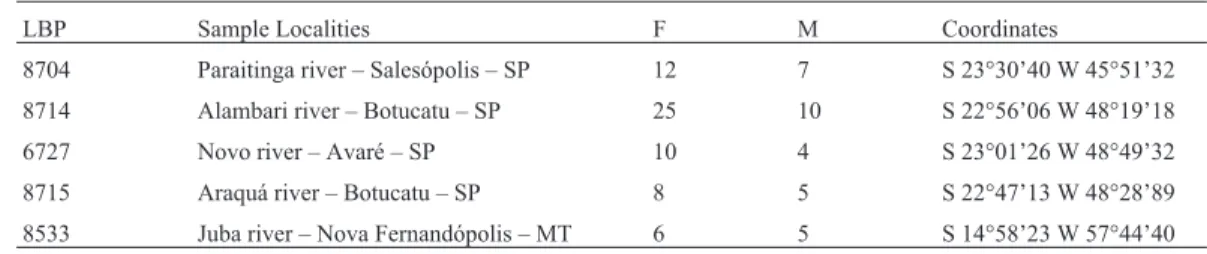
Specimens ofCharacidium cf. zebrafrom five collec-tion sites along distinct hydrographic basins in Brazil were analyzed. The specimens were fixed in 10% formaldehyde, stored in 70% ethanol for identification, and deposited in the fish collection of the Laboratório de Biologia e Gené-tica de Peixes (LBP) at UNESP, Botucatu, São Paulo, Brazil (Table 1).
Chromosome preparations were obtained from kid-ney and gill tissue following the technique described by Forestiet al.(1981). Nucleolar organizer regions (NORs) were evidenced by silver nitrate staining according to
www.sbg.org.br
Send correspondence to José Carlos Pansonato Alves. De-partamento de Morfologia, Instituto de Biociências, Universidade Estadual Paulista, “Júlio de Mesquita Filho”, Distrito de Rubião Junior s/n, 18618-970 Botucatu, SP, Brazil. E-mail: [email protected].
Howell and Black (1980) and C-banding was performed based on Sumner (1972).
Molecular cytogenetic analyses comprised the identi-fication of GC- and AT-rich regions by fluorochrome stain-ing with chromomycin A3 (Schweizer, 1976) and DAPI
(Schweizeret al., 1978), respectively. Mapping of both 18S and 5S rDNA sites on metaphase chromosomes was per-formed by fluorescentin situhybridization (FISH) accord-ing to Pinkelet al.(1986), with slight modifications. The probes used were a 18S rDNA sequence obtained after PCR from the nuclear DNA ofProchilodus argenteus(Hatanaka and Galetti Jr, 2004) using the primers NS1 5’-GTAGTCATATGCTTGTCTC-3’ and NS8 5’-TCCGCAGGTTCACCTACGGA-3’ (White et al., 1990) and a 5S rDNA sequence amplified using the primers A (5’- TACGCCCGATCTCGTCCGATC-3’) and B (5’-GCTGGTATGGCCGTAGC-3’) of Leporinus elongatus(Martins and Galetti Jr, 1999). The 18S rDNA probe was labeled with 14-dATP biotin by nick translation, according to the manufacturer’s instructions (Bionick La-beling System – Invitrogen). Signal detection and amplifi-cation were performed with fluorescein-conjugated avidin (FITC) and biotinylated anti-avidin antibodies. The 5S rDNA probe was labeled with digoxigenin-11-dUTP (Roche Applied Science) by PCR and the hybridization sig-nal was detected with anti-digoxigenin conjugated with rhodamine.
Chromosomes were counterstained with DAPI or propidium iodide (in the case of the triploid specimen) and analyzed under an epifluorescence photomicroscope (Olympus BX61). Images were captured using Image Pro Plus, 6.0 software (MediaCybernetics). The chromosomes were morphologically classified according to their arms ra-tio, as established by Levanet al.(1964), and were arranged in decreasing size.
Results
The five samples ofCharacidium cf. zebrapresented a constant diploid number of 2n = 50 and a karyotype com-posed of 32 metacentric and 18 submetacentric chromo-somes. Constitutive heterochromatin was identified only at the centromeric regions of most chromosomes in individu-als of both sexes. Pair 23, presented additional interstitial
heterochromatic blocks on its long arms in some meta-phases, which colocalized with the NORs (Figure 1). No sex chromosome heteromorphism was identified. The Ag-NORs, evidenced after silver nitrate staining (Figure 1, in-set), CMA3staining (Figure 2a) and FISH with a 18S rDNA
probe (Figure 3d), were located at an interstitial position in the long arm of pair 23. Chromomycin A3staining allowed
the demonstration that the NORs were located in GC-rich segments in all the populations studied.
FISH with the 5S rDNA probe showed that the speci-mens from the Paraitinguinha river presented 5S rRNA genes at interstitial positions of five chromosomes (pairs 1 and 6 and one homologue of pair 17) (Figure 3b). In the in-dividuals from the Novo, Alambari and Araquá rivers (Fig-ure 3a), this ribosomal sequences were located at an
Figure 1- Karyotype present in the five populations ofCharacidium cf. zebraanalyzed after Giemsa staining (a) and C-banding (b). In the inset, the NOR-bearing chromosomes. Bar = 10mm.
Figure 2- Metaphases ofCharacidium cf. zebraafter chromomycin A3
(a) and DAPI (b) staining. The arrows indicate GC-rich (a) and AT-poor (b) sites. Bar = 10mm.
Table 1- Specimens ofCharacidium cf. zebraanalyzed.
LBP Sample Localities F M Coordinates
8704 Paraitinga river – Salesópolis – SP 12 7 S 23°30’40 W 45°51’32
8714 Alambari river – Botucatu – SP 25 10 S 22°56’06 W 48°19’18 6727 Novo river – Avaré – SP 10 4 S 23°01’26 W 48°49’32
8715 Araquá river – Botucatu – SP 8 5 S 22°47’13 W 48°28’89 8533 Juba river – Nova Fernandópolis – MT 6 5 S 14°58’23 W 57°44’40
interstitial position on pair 17. The 5S rDNA sites were lo-calized at interstitial regions of five chromosome pairs (1, 6, 9, 17 and 18) in the samples from the Juba river (Fig-ure 3c).
All the cells of one specimen collected in the Alam-bari river presented 77 chromosomes, characterizing a case of natural triploidy (Figure 4). This individual also carried two extra chromosomes (Figure 4a, inset). C-banding vealed heterochromatic blocks only in the centromeric re-gions of all chromosomes of the normal set (Figure 4b) in both diploid and triploid specimens. The extra
chromo-somes were almost completely euchromatic (Figure 4b, in-set), except for their centromeric regions. Although the specimen was a triploid, its NORs, identified by silver ni-trate staining, CMA3,and FISH with the 18S rDNA probe,
were restricted to two chromosomes (Figure 5).
Discussion
Cytogenetic studies in five samples ofCharacidium cf. zebrashowed a constant 2n = 50 with similar karyotypes comprising metacentric and submetacentric chromosomes. The largest chromosome pair (pair 1) in this karyotype is remarkably larger than the second pair (pair 2) in all the in-dividuals, thus representing an important marker for the species. The largest chromosomes in species such as
Characidium cf. gomesi(Centofanteet al., 2001; Maistroet al., 1998, Pansonato-Alveset al., 2010b),C. lanei(Noleto
et al., 2009, Pansonato-Alves et al., 2010a) and C. schubarti(Pansonato-Alveset al., 2010a) are those from the 17thsubmetacentric pair. The presence of the marker chromosome pair 1, the similar distribution pattern of heterochromatin and of the NORs suggest that the studied samples ofC. cf. zebraare closely related.
Based on the phylogenetic position ofC. zebra pro-posed by Buckup (1993), the absence of differentiated sex chromosomes in this species would represent a plesio-morphic trait within the genus, whereas the presence of heteromorphic sex chromosomes in some representatives of the genus should be regarded as an apomorphy (Cen-tofanteet al., 2003). According to Centofanteet al.(2003), the occurrence of a ZW sex chromosome system with a heterochromatic W chromosome is restricted to a few spe-cies closely related toC. gomesi. However, among the ten
Characidium species cytogenetically studied (Miyazawa and Galetti Jr, 1994; Maistroet al., 1998; Centofanteet al., 2001, 2003 and Pansonato-Alveset al., 2010a,b), onlyC. cf. zebraandC. lagosantensislack heteromorphic sex chro-mosomes. This suggests that the presence of differentiated sex chromosomes is the most common condition of the character among the species of the genus.
The NOR-bearing chromosome pair 23 was identical in the five studied samples ofCharacidium cf. zebra. The region corresponding to the NOR was faintly stained by DAPI, reinforcing its AT-poor nature (Figure 2b). NORs Figure 3- Karyotype ofCharacidium cf. zebrashowing the 5S rDNA on
pair 17, typical of the populations from the Alambari, Novo and Araquá rivers (a); in pairs 1, 6 and one homologue of pair 17, from the Parai-tinguinha river (b) and in pairs 1, 6, 9, 17 and 18 from the Juba river (c). In (d), the karyotype present in the five populations ofCharacidium cf. zebra
with the 18S rDNA on pair 23. Bar = 10mm.
Figure 4- Karyotype of a triploid specimen ofCharacidium cf. zebra
from the Alambari river after Giemsa staining (a) and C-banding (b). In the inset, the supernumerary chromosomes. Bar = 10mm.
Figure 5- Metaphases of a triploid specimen ofCharacidium cf. zebra
showing NORs after: silver nitrate staining (a), FISH with a 18S rDNA probe (b) and CMA3staining (c). Note that there are only two
have been shown to be usually stained by GC-specific fluorochromes, such as chromomycin A3and mithramycin
in fish (Pendáset al., 1993; Vicariet al., 2005) and amphib-ians (Schmid, 1982). However, some heterochromatic seg-ments unrelated to NORs may also brightly fluoresce after GC-specific fluorochrome staining (Artoniet al., 1999).
FISH with 5S rDNA probes in metaphase chromo-somes ofCharacidiumrevealed a peculiar distribution of these sequences. Vicariet al.(2008) mapped the 5S rRNA genes to an interstitial position in a single metacentric pair of aC. cf. gomesipopulation from the Tibagi river. Panso-nato-Alveset al.(2010b) located the same genes at an inter-stitial position in the 25th submetacentric pair in specimens from two populations ofC. cf. gomesi from the Parana-panema river basin and at an interstitial position in pairs 20 and 25 in individuals from the Tietê river basin. In the pres-ent study, the populations ofC. cf. zebrafrom the Alam-bari, Araquá and Novo rivers had 5S rDNA sites at an interstitial position on pair 17. The 5S rDNA clusters were located in several chromosomes in populations from the Paraitinguinha (in pairs 1, 6 and one homologue of pair 17) and Juba rivers (in pairs 1, 23, 6, 9, 17 and 18). These find-ings indicate that, in spite of a close relationship among the studied samples, specific modifications have occurred on the basic genome and restrictions to gene flow during their evolutionary history may have determined the currently ob-served patterns. Furthermore, the 5S rDNA probes pro-duced signals at centromeric heterochromatic regions in the populations from the Juba and Paraitinguinha rivers. This suggests that, some of them may correspond to pseudo-genes representing inactive 5S rDNA-like sequences, as proposed forCentropyge aurantonotus(Affonso and Ga-letti Jr, 2005).The 5S rDNA and 18S rDNA sequences were located in distinct chromosome positions. This is in agree-ment with the most frequent pattern found in vertebrates, in which the two ribosomal gene families follow independent evolutionary pathways (Lucchiniet al., 1993; Suzukiet al., 1996).
The presence of multiple 5S rDNA sites at interstitial regions of several chromosomes, a derived situation as compared to the plesiomorphic condition of a single inter-stitial site, may be due to structural rearrangements in the interphase nucleus (Schweizer and Loidl, 1987). This hy-pothesis contradicts the suggestion that an interstitial posi-tion would protect 5S rDNA sites (Martins and Galetti Jr, 2001), as chromosomal domains and heterochromatin dis-persion could play a major role in the distribution of these genes.
The occurrence of natural triploidy in a single speci-men ofC. cf. zebrafrom the Alambari river may be related to the geography and climate of the Botucatu region, where other natural triploids have already been reported (Maistro
et al., 1994). In fish, external fecundation and completion of the second mitotic division only take place after spawn-ing. Environmental temperature changes may facilitate the
retention of the second polar body and lead to the formation of natural triploids (Cuellar and Uyeno, 1972). Triploid fish are artificially produced by several techniques, such as thermal or pressure shocks and chemical treatment after fertilization, resulting in a large number of phenotypically normal polyploids (Purdom, 1983). In these procedures, the second meiotic division is disrupted, inhibiting anaphase II (Thorgaard et al., 1981). The outcome is a triploid fish bearing three chromosome sets: two maternal and one pa-ternal, as an unreduced diploid oocyte is fertilized by a nor-mal haploid spermatozoon. The same features were observed in natural triploids of the genusCyprinus(Vasilev
et al., 1975) andSalmo(Thorgaard and Allen Jr, 1987).
The occurrence of natural triploidy inCharacidium cf. zebraseems to result from a process similar to that re-ported forC.gomesi(Centofanteet al., 2001), although the former species lacks heteromorphic sex chromosomes. However, in addition to the 75 chromosomes of the triploid specimen, two supranumerary chromosomes were ob-served, resulting in a 2n = 77 (Figure 4). Cases of triploidy associated with B chromosomes have already been reported inAstyanax scabripinnis(Fauazet al., 1994; Maistroet al., 1994) andCurimata modesta(Venere and Galetti Jr, 1985). In these studies, the extra chromosomes were easily identi-fied by C-banding due to their heterochromatic nature. All the chromosomes of the triploidC. cf. zebraspecimen pre-sented centromeric heterochromatin, hindering the precise identification of the extra elements by C-banding (Fig-ure 4). Nevertheless, two acro/subtelocentric chromosomes could be detected, contrasting to the meta- and submeta-centric chromosomes commonly reported inCharacidium
karyotypes.
An extra element was also found in a single diploidC. cf. zebrafrom the Passa Cinco river, Ipeúna, SP by Miya-zawa and Galetti Jr (1994). That chromosome was identi-fied as an euchromatic acrocentric B chromosome, similar to those observed in our triploid specimen. There were no B chromosomes in the other 35 diploid specimens ofC. cf. ze-brafrom the Alambari river. This may indicate that the oc-currence of extra chromosomes constitute a unique condi-tion present in the triploid specimen and that they are a consequence of the same event that led to the formation of the triploid fish.
Conspicuous nucleolar organizer regions were lo-cated in only two chromosomes of the triploid specimen af-ter silver nitrate and CMA3staining and FISH with a 18S
rDNA probe. This may indicate a complete functional inac-tivation of the NOR in the third NOR-bearing homologue, as already reported in a Cyprinidae (Mayr et al., 1986). However, the lack of CMA3and 18S rDNA signals in the
The remarkable karyotypic similarities in the five populations ofC. cf. zebrastudied reinforces the possibility of a close relationship among them. Nevertheless, the dis-tinct pattern of 5S rDNA distribution in the samples from the Paraitinguinha and Juba rivers most likely derive from constraints in gene flow during their evolutionary history. This, in turn, may indicate a tendency of fixation of allo-patric differentiation mechanisms among populations iso-lated in headwaters of different hydrographic systems, which is related to the lifestyle of the species.
References
Affonso PRAM and Galetti Jr PM (2005) Chromosomal diversifi-cation of reef fishes from genusCentropyge(Perciformes, Pomacanthidae). Genetica 123:227-233.
Artoni RF, Molina WF, Bertollo LAC and Galetti Jr PM (1999) Heterochromatin analysis in the fish species Liposarcus anisitsi(Siluriformes) andLeporinus elongatus (Characifor-mes). Genet Mol Biol 22:39-44.
Buckup PA (1993) The monophyly of the Characidiinae, a Neo-tropical group of characiform fishes (Teleostei, Ostario-physi). Zool J Linn Soc 108:224-245.
Buckup PA (1998) Relationships of the Characidiinae and phy-logeny of characiform fishes (Teleostei, Ostariophysi). In: Malabarba LR, Reis RE, Vari RP, Lucena CAS and Lucena ZMS (eds) Phylogeny and Classification of Neotropical Fishes. Edipucrs, Porto Alegre, pp 123-144.
Buckup PA (2003) Family Crenuchidae (South American Dar-ters). In: Reis RE, Kullander ESO and Ferraris Jr CJ (eds) Check List of the Freshwater Fishes of South and Central America. 2nd edition. Edipucrs, Porto Alegre, pp 87-95. Buckup PA and Reis RE (1997) Characidiin genusCharacidium
(Teleostei, Characiformes) in southern Brazil, with descrip-tion of three new species. Copeia 3:531-548.
Centofante L, Bertollo LAC and Moreira-Filho O (2001) Compar-ative cytogenetics among sympatric species ofCharacidium (Pisces, Characiformes). Diversity analysis with the descrip-tion of a ZW sex chromosome system and natural triploidy. Caryologia 54:253-260.
Centofante L, Bertollo LAC, Buckup PA and Moreira-Filho O (2003) Chromosomal divergence and maintenance of sym-patricCharacidiumfish species (Crenuchidae, Characidii-nae). Hereditas 138:213-218.
Cuellar O and Uyeno T (1972) Triploidy in rainbow trout. Cyto-genetics 11:508-515.
Fauaz G, Vicente VE and Moreira-Filho O (1994) Natural tri-ploidy and B chromosomes in the Neotropical fish genus Astyanax(Characidae). Braz J Genet 17:157-163.
Foresti F, Almeida-Toledo LF and Toledo-Filho AS (1981) Poly-morphic nature of nucleolus organizer regions in fishes. Cytogenet Cell Genet 31:137-144.
Howell WM and Black DA (1980) Controlled silver staining of nucleolus organizer regions with a protective colloidal de-veloper: A 1-step method. Experientia 36:1014-1015. Hatanaka T and Galetti Jr PM (2004) Mapping of the 18S and 5S
ribosomal RNA genes in the fish Prochilodus argenteus Agassiz, 1829 (Characiformes, Prochilodontidae). Genetica 122:239-244.
Levan A, Fredga K and Sandberg AA (1964) Nomenclature for centromeric position on chromosomes. Hereditas 52:201-220.
Lucchini S, Nardi I, Barsacchi G, Batistoni R and Andronico F (1993) Molecular cytogenetics of the ribosomal (18S + 28S and 5S) DNA loci in primitive and advanced urodele am-phibians. Genome 36:762-773.
Martins C and Galetti Jr PM (1999) Chromosomal localization of 5s rDNA genes in Leporinusfish (Anostomidae, Chara-ciformes). Chromosome Res 7:363-367.
Martins C and Galetti Jr PM (2001) Two rDNA arrays in Neo-tropical fish species: Is it a general rule for fishes? Genetica 111:439-446.
Maistro EL, Dias AL, Foresti F, Oliveira C and Moreira O (1994). Natural triploidy inAstyanax scabripinnis(Pisces, Chara-cidae) and simultaneous occurrence of macro B-chromo-somes. Caryologia 47:233-239.
Maistro EL, Mata EP, Oliveira C and Foresti F (1998) Unusual oc-currence of a ZZ/ZW sex-chromosome system and supernu-merary chromosomes inCharacidium cf. fasciatum(Pisces, Characiformes, Characidiinae). Genetica 104:1-7.
Mayr B, Rab P and Kalat M (1986) NORs and counterstain-enhanced fluorescence studies in Cyprinidae of different ploidy level. Genetica 69:111-118.
Miyazawa CS and Galetti Jr PM (1994) First cytogenetical studies inCharacidiumspecies (Pisces, Characiformes, Characidii-nae). Cytologia 59:73-79.
Noleto RB, Amorin AP, Vicari MR, Artoni RF and Cestari MM (2009) An unusual ZZ/ZW sex chromosome system in Characidiumfishes (Crenuchidae, Characiformes) with the presence of rDNA sites. J Fish Biol 75:448-453.
Pansonato-Alves JC, Paiva LRS, Oliveira C and Foresti F (2010a) Interspecific chromosomal divergences in the genus Characidium (Teleostei, Characiformes, Crenuchidae). Neotrop Ichthyol 8:77-86.
Pansonato-Alves JC, Vicari MR, Oliveira C and Foresti F (2010b) Chromosomal diversification in samples ofCharacidium cf. gomesi(Teleostei, Crenuchidae). J Fish Biol, epub. Pendás AM, Morán P and Garcia-Vásquez G (1993) Ribosomal
RNA genes are interspersed throughout a heterochromatic chromosome arm in Atlantic salmon. Cytogenet Cell Genet 63:128-130.
Pinkel D, Straume T and Gray JW (1986) Cytogenetic analysis us-ing quantitative, high-sensitivity, fluorescence hybridiza-tion. Proc Natl Acad Sci USA 83:2934-2938.
Purdom CE (1983) Genetic engineering by the manipulation of chromosomes. Aquaculture 33:287-300.
Schmid M (1982) Chromosome banding in Amphibia. VII. Anal-ysis of the structure and variability of NORs in Anura. Chromosoma 87:327-344.
Schweizer D (1976) Reverse fluorescent chromosome banding with chromomycin and DAPI. Chromosoma 58:307-324. Schweizer D and Loidl J (1987) A model for heterochromatin
dis-persion and the evolution of C band patterns. Chromosome Today 9:61-74.
Schweizer D, Ambros P and Andrle M (1978) Modification of DAPI banding on human chromosomes by prestaining with a DNA-binding oligopeptide antibiotic, Distamycin A. Exp Cell Res 111:327-332.
Suzuki H, Sakurai S and Matsuda Y (1996) Rat rDNA spacer se-quences and chromosomal assignment of the genes to the extreme terminal region of chromosome 19. Cytogenet Cell Genet 72:1-4.
Thorgaard GH and Allen Jr SK (1987) Chromosome manipula-tion and markers in fishery management. In: Ryman N and Utter F (eds) Population Genetic and Fishery Management. University of Washington Press, Seattle, pp 319-331.
Thorgaard GH, Jazmin ME and Stier AR (1981) Polyploidy in-duced by heat shock in rainbow trout. Trans Am Fish Soc 110:546-550.
Vasilev VP, Makeeva AP and Ryabov IN (1975) On the triploidy of remote hybrids of carp (Cyprinus carpio) with other rep-resentative Cyprinidae. Genetika 11:49-56.
Venere PC and Galetti Jr PM (1985) Natural triploidy and
chro-mosome B in the fish Curimata modesta (Curimatidae,
Characiformes). Rev Bras Genet 7:681-687.
Vicari MR, Artoni RF and Bertollo LAC (2005) Comparative cytogenetics ofHoplias malabaricus(Pisces, Erythrinidae): A population analysis in adjacent hydrographic basins. Genet Mol Biol 28:103-110.
Vicari MR, Artoni RF, Moreira-Filho O and Bertollo LAC (2008) Diversification of a ZZ/ZW sex chromosome system in Characidiumfish (Crenuchidae, Characiformes). Genetica 134:311-317.
White TJ, Bruns T, Lee S and Taylor L (1990) Amplification and direct sequencing of fungal ribosomal RNA genes for phylo-genetics. In: PCR Protocols: A Guide to Methods and
Appli-cations. Academic Press Inc, London/New York,
pp 312-315.
Associate Editor: Yatiyo Yonenaga-Yassuda