This investigation received support from the Instituto Fundación Hipólito Unánue. (1) Universidad Peruana Cayetano Heredia, Alberto Hurtado School of Medicine, Peru
(2) Alexander von Humboldt Tropical Medicine Institute, Universidad Peruana Cayetano Heredia, Peru. (3) Pathology Department, Hospital Nacional Cayetano Heredia, Peru
(4) Department of Veterinary Pathology, University of Liverpool, United Kingdom. (5) Emílio Ribas Institute of Infectology, São Paulo, Brazil
A PROSPECTIVE STUDY OF CAT-SCRATCH DISEASE IN LIMA-PERU
Erick HUARCAYA(1), Ciro MAGUIÑA(1,2), Jenny MERELLO(2), Jaime COK(3), Richard BIRTLES(4), Berónica INFANTE(2), José VIDAL(5), Afilio TELLO(2) & Palmira VENTOSILLA(2)
SUMMARY
Cat-Scratch Disease (CSD) is a benign lymphadenitis that may progress to severe or recurrent forms, and it is occasionally associated with morbidity. Between January of 1998 and March of 1999, forty-three suspected CSD patients were assessed in the Hospital Cayetano Heredia and the Instituto de Salud del Niño, in Lima, Peru. Twelve patients had a confirmed diagnosis, 8 of whom were women, and the mean age was 10 years old. The majority (53%) of the cases were encountered in the summer. All patients reported having had contact with cats. Fever, malaise, lymphadenopathy and skin lesions were the most frequent clinical features. Twelve patients had indirect immunofluorescence antibody test titers of between 1/50 and 1/800 for Bartonella henselae and Bartonella clarridgeiae. Two lymph node biopsies were histologically compatible with CSD. No positive blood cultures could be obtained. This is the first Peruvian prospective study able to identify B. henselae and B. clarridgeiae in pediatric patients.
KEYWORDS: Cat-scratch disease; Bartonella; Emerging diseases.
INTRODUCTION
Cat-Scratch disease (CSD) was first described as a clinical entity in 1931 and since 1950 many case reports have been published with reference to, but without characterization of an etiological agent8,36. The
association between B. henselae and CSD was first made by REGNERY
et al. in 1992 in a study demonstrating that sera from CSD patients reacted with antigen prepared from the bacterium28,29. Subsequently B. henselae was recovered from lymph nodes of CSD patients and patients
with Bacillary Angiomatosis34,36. In 1997, B. clarridgeiae was also
implicated in the syndrome18. Both species, together with a third, B.
koehlerae (which has yet to be implicated in human disease) have been consistently isolated from the blood of a significant proportion of domestic, feral, stray and wild cats worldwide6,7,14.
CSD usually manifests as a benign lymphadenitis but may progress to a severe, systemic or recurrent form producing Parinaud’s Oculoglandular Syndrome, encephalopathy, convulsions, osteomyelitis, retinitis, arthritis, hepatitis, splenitis, mediastinal masses, erythema nodosum, and
pleurisy2,9,18,30. CSD is considered as a common infection, and it is
occasionally associated to morbidity11,20,23,32,33. This condition usually occurs
in children and young adults. 80% of patients are younger than 21 years9,16,20,32. Clinical manifestations in an immunocompetent host appear
approximately two weeks after inoculation (range, 3 to 50 days), and lymphadenopathy is present in more than 90% of the cases. Axillary, cervical, or submaxilar lymph nodes groups are the most commonly involved9. Approximately one third of the patients will present a history
of fever and tiredness that can persist for a long period of time20,32.
Lymphadenopathy gradually resolves, but sometimes it may take some months, and in few cases it can be prolonged for as long as 12 to 24 months2,9. Epidemiological investigations have revealed that a history of
contact with cats is found in 90% of CSD patients and the antecedent of a cat scratch or bite is found in 60% of the patients9,26,32. In cats the prevalence
ofBartonellabacteremia ranges between 15% to 44% in different states of U.S.A9,10,17,33, where B. henselae17and B. clarridgeiae10,18were found;
however both species can coexist10. Infected cats usually show no signs of
illness and, as laboratory studies have shown that infection can be transmitted from one animal to another via fleas, cats are considered as reservoirs for the bacteria12,17. TSUKAHARA et al.35 have also suggested
that domestic dogs constitute a reservoir of B. henselae after this bacterium was detected in peripheral blood, oral swabs and nail clippings using a polymerase chain reaction (PCR)-based method.
Attempts to isolate Bartonella species from CSD patients are
frequently unsuccessful2,4,8,13,19. Usually, samples are inoculated onto
rabbit or sheep blood agar and maintained at 35 ºC to 37 ºC during three
or more weeks in an atmosphere with 5% CO219,25. Recovered bacteria
are small and coco-bacilliform19,20. Due to the frequent failure of
culture-based methods, diagnosis often relies of histopathological examination of biopsy material in which organisms may be visualized using Hematoxyline-Eosine (H-E) and Warthin-Starry (W-S) staining methods3,25,30. A variety of serological assays have also been described,
326
96% specificity20,21,25. However, cross-reactions with Chlamydia psittaci
and other Bartonella sp. have been reported24. Nonetheless, detection of
IgM using IFAT is considered as the first step for the serology diagnosis,
with sensitivity comparable with PCR-based tests5, although in some
patients, antibody titers may never reach the detection threshold5,20.
Detection of Bartonella DNA in infected material also serves as a
cornerstone of CSD diagnosis, with a number of different assays being described. All appear to perform well, with sensitivity between 86 and 100% depending on the diagnostic criteria chosen5.
In 1996, the first probable case of non-bacilliformis Bartonella
infection was described in Peru following a histopathological diagnosis of Bacillary Angiomatosis3. In 1999, a retrospective pathological study
reported 13 cases of CSD31. However, CSD has not yet been described
in a prospective study considering epidemiological and clinical characteristics of patients, as well as using serological and microbiological diagnosis methods. The objective of the study was to know the clinical and epidemic manifestations and possible methods for diagnosing CSD in Lima, Peru.
MATERIALS AND METHODS
Patients: Patients were recruited to the study between January of 1998 and March of 1999, in Hospital Nacional Cayetano Heredia (Pediatrics Ward and Transmissible and Dermatology Diseases Department), and Instituto de Salud del Niño (Infectious Diseases Service) in Lima-Peru, with the previous informed consent by parents or attorneys. Patients were suspected of having CSD when fulfilling the following criteria: a history of being scratched or bitten by cats and lymphadenopathy, without another attributable cause, associated with fever, malaise, or other general symptoms, with or without clinical evolution to either encephalitis, retinitis, neuropathy, Parinaud’s oculoglandular syndrome, erythema nodosum, osteomyelitis, arthritis, hepatitis, splenitis, mediastinal mass or pleurisy. Patients completed a standard questionnaire and a whole blood, serum and/or a lymph node biopsy was or were collected from each of them when they have been incorporated to the study. Diagnosis was confirmed on the basis of either (i) isolation of Bartonella species, (ii) histopathology or (iii) a positive serology to B. henselae and/or B. clarridgeiae.
Culture of Bartonella species: Whole blood samples were collected into Vacutainer® tubes with ethylendyamintetraacetic acid (EDTA). These
were refrigerated at –70 ºC for three days, then an aliquot was inoculated
onto Potato Agar and Columbia agar (Difco®) containing 5% fresh sheep
or rabbit blood. Plates were incubated at 37 ºC in 5% of C02 (BBL® Gas
Pack CO2 Pouch System bags) for up to four weeks. If no colonies were
observed after this period, plates were discarded and samples considered negative.
Antibody estimations: Serum samples were processed using an in-house IFAT developed and evaluated in the Unité des Rickettsies, Faculté de Médecine, Université de la Mediterranée, France. Agar-grown control bacteria were inoculated into Vero cells, which were harvested and used as antigen. Serum specimen have been fixed on slides with acetone, and diluted in phosphate-buffered saline (pH 6.8). Starting at a 1/25 dilution, a titer of 1/50 is considered the cut-off point; among patients with
antibody titers ≥ 1/50, 62.5% definitely or possibly had CSD; among
patients with titers ≥ 1/100, 68.2% definitely or possibly had CSD27.
Histological assessments: Cervical lymph node biopsies were stained with H-E coloration in the Pathology Laboratory of Cayetano Heredia National Hospital (HNCH) and the Instituto de Salud del Niño. W-S coloration was developed only in the HNCH.
Skin tests for CSD: Skin tests for CSD are not available in Peru.
RESULTS
Forty-seven patients with clinical suspicion of CSD were initially included in the study. Of these, two had an eventual histopathological diagnosis of lymph node tuberculosis, one had a microbiological diagnosis of atypical mycobacterial infection and one was diagnosed with lymphoma; all four of these patients were therefore excluded from the study, and their data were neither analyzed nor presented in any of the tables. In the remaining patients, no other diseases could be confirmed during the study or thereafter.
Serum were obtained from 21 suspected CSD patients (Table 1); only one blood sample could be obtained at the moment of the first evaluation. Nine patients had negative titers, four possessed an IgG and IgM titer of 1/50 for B. henselae, four patients possessed an IgG titer of
1/100 and IgM titers of between 1/25 and 1/50 for B. henselae, three
patients possessed an IgG titer of 1/200 to B. henselae and an IgG of 1/ 100 for B. clarridgeae, one patient possessed an IgG titer of 1/800 for B. henselae and 1/800 for B. clarridgeiae. All patients had negative IFAT titers for B. quintana and B. bacilliformis.
Nine lymph node biopsies were obtained from nine suspected CSD
patients, but one case of tuberculosis, one case of M. kansasii, and a
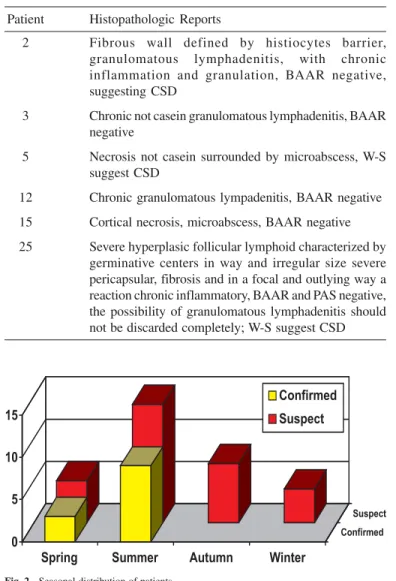
case of lymphoma were excluded from the study. One sample obtained in the Instituto de Salud del Niño and two others at the HNCH (with W-S coloration) were reported as CW-SD (Fig. 1), while other three samples obtained in the HNCH were reported as lymphadenitis with caseating granulomata negative for acid-fast bacilli without definitive diagnostic (Table 2).
Using by serology and/or pathology confirmation, a definitive diagnostic of CSD was made in 12 patients. The range of patients ages was between 3 and 30 years old (mean age, 10 years old), 4 were men (33.3%) and 8 were women (Table 1).
Ten of the 12 patients had contact with kittens, and all of them reported having been bitten or clawed by the animals. Summer was the season where most patients were recruited (Fig. 2), 53.5% (23/43) of the patients were included in the study during summer (between December and February in Peru), and nine of them had a confirmed diagnosis. 83.3% of suspected patients had previously visited a physician and were receiving antibiotics at the time samples were collected for this study.
Table 1
Results of diagnosis assays in patients with suspicion of CSD
Serology
Patient Age Time of Pathology B.henselae 1 B.henselae 2 B.quintana B.clarridgeiae
illness IgG IgM IgG IgM IgG IgM IgG IgM
1 35 7
2* 28 120 CSD 1/100 1/50 1/100 1/50 1/0 1/0 1/100 1/50
3 22 95
4 19 7 1/0 1/0 1/0 1/0 1/0 1/0 1/0 1/0
5* 6 26 CSD 1/50 1/0 1/50 1/0 1/0 1/0 1/50 1/0
6* 13 20 1/50 1/0 1/50 1/0 1/0 1/0 1/50 1/0
7 20 20
8 19 90 1/0 1/0 1/0 1/0 1/0 1/0 1/0 1/0
9 16 90
10 6 7
11 11 10 1/0 1/0 1/0 1/0 1/0 1/0 1/0 1/0
12 18 365
13 15 21
14 9 30
15 4 27 1/0 1/0 1/0 1/0 1/0 1/0 1/0 1/0
16 7 20
17* 6 25 1/50 1/0 1/50 1/0 1/0 1/0 1/0 1/0
18* 12 30 1/100 1/25 1/0 1/0 1/100 1/25 1/100 1/25
19 9 30
20* 3 60 1/800 1/50 1/800 1/50 1/400 1/0 1/800 1/50
21 7 30 1/0 1/0 1/0 1/0 1/0 1/0 1/0 1/0
22 9 365 1/0 1/0 1/0 1/0 1/0 1/0 1/0 1/0
23 10 14
24* 10 90 1/100 1/50 1/100 1/50 1/0 1/0 1/50 1/50
25* 12 60 CSD 1/100 1/25 1/0 1/0 1/100 1/25 1/100 1/25
26 5 20
27 21 30
28* 11 20 1/200 1/0 1/200 1/0 1/0 1/0 1/100 1/0
29 6 60
30 4 45
31* 30 60 1/200 1/0 1/200 1/0 1/0 1/0 1/100 1/0
32 20 14
33 25 10
34* 8 14 1/200 1/0 1/200 1/0 1/0 1/0 1/100 1/0
35 19 90 1/0 1/0 1/0 1/0 1/0 1/0 1/0 1/0
36 21 45 1/0 1/0 1/0 1/0 1/0 1/0 1/0 1/0
37* 6 7 1/50 1/0 1/50 1/0 1/0 1/0 1/50 1/0
38 5 90 1/0 1/0 1/0 1/0 1/0 1/0 1/0 1/0
39 18 7
40 23 60
41 20 30
42 14 14
43 12 14
328
Table 2
Histopathology reports of lymph nodes biopsy
Patient Histopathologic Reports
2 Fibrous wall defined by histiocytes barrier,
granulomatous lymphadenitis, with chronic inflammation and granulation, BAAR negative, suggesting CSD
3 Chronic not casein granulomatous lymphadenitis, BAAR
negative
5 Necrosis not casein surrounded by microabscess, W-S
suggest CSD
12 Chronic granulomatous lympadenitis, BAAR negative
15 Cortical necrosis, microabscess, BAAR negative
25 Severe hyperplasic follicular lymphoid characterized by
germinative centers in way and irregular size severe pericapsular, fibrosis and in a focal and outlying way a reaction chronic inflammatory, BAAR and PAS negative, the possibility of granulomatous lymphadenitis should not be discarded completely; W-S suggest CSD
Table 3
Clinical characteristics of 12 patients with CSD
Symptoms Nº % Signs Nº %
Fever 11 91.6 Lymphadenopathy
Malaise 07 58.3 Right cervical 05 41.6
Headache 04 33.3 Right axillar 04 33.3
Chills 02 16.6 Left cervical 02 16.6
Hiporexia 02 16.6 Left inguinal 02 16.6
Right inguinal 02 16.6
Right epitroclear 01 08.3
Submaxillary 01 08.3
Scratch or bite 09 75.0
Hepatomegaly 01 08.3
Splenomegaly 01 08.3
Fig. 1 - Silver-impregnation technique (Warthin-Starry) in a lymph node biopsy showing a conglomerate of black colored Barthonellabacillus (40X)
Fig. 2 - Seasonal distribution of patients
Whole blood was collected from all 12 confirmed CSD cases and used for attempted cultivation of Bartonellaspecies. No cultures yielded isolates.
In 14 suspected CSD patients a cell blood count was performed and leukocytosis was found with a mean leukocyte count in 12678 cells/µl (range, 7500 to 26000). In 11 patients the hematocrit was in the range between 22% and 43% (mean, 35%). The Erythrocyte Sediment Rate (ESR) of 7 patients was in the range between 12 mm/h and 53 mm/h (mean, 38 mm/h). Toxoplasma and CMV serology studies were performed in all the patients with a confirmed diagnosis.
DISCUSSION
More than 40,000 cases of CSD are annually reported in the USA, resulting in more than 2,000 annual hospitalizations, with a rate of 0.77-0.86/100,000 hospitalizations12,20,32,37. It is reported that CSD affects
mainly children and young adults with a peak incidence between 2 to 14 years2,9. In the present study the average age was 10 years old. Similar
results were found by RIVERA31 in Peru, who found that 69% were
younger than 20 years in a retrospective series of 13 patients, and by
ABARCA et al.1 in Chile, who found an age range between 6 and 13
years old in a series of 10 patients. In Peru, we do not have information about incidence or morbidity.
Epidemiology studies have determined that CSD is a seasonal illness, affecting the population mainly during autumn and winter, and preferably in regions with warm and humid weather9,12,37. In contrast, we found that
the majority of patients with suspected (23/43) and confirmed diagnosis (9/12) of CSD were found during summer (Fig. 1), and mainly between December and January (37.77%). This coincides with observations made in our hemisphere proposing as a possible explanation the fact that cats and dogs in our geographical area reproduce mainly between September and November, giving birth to their kittens during Summer1. Also, another
possible reason is that in our geographical area the season for school vacation is in summer and children spend more time in contact with their pets.
75.6% of cats were younger than one year, as it was published in the
article by CARITHERS8 who implied kitten in the transmission of the
illness. Two of the patients with a definitive diagnosis denied contact with cats but referred contact with dogs, and these animals have been implied as reservoir for B. henselae35.
The clinical features of the disease in patients studied showed that 91.6% had fever. Other frequently reported symptoms were malaise, chills, hyporexia, and headache (Table 3). This clinical presentation is similar with series of cases that described a 59% frequency for fever, 30% with malaise and tiredness, 15% hyporexia, and 14% with headache8,9,30. Lymphadenopathy was found in all patients, 58.3% in the
cervical region, and 41.6% in the axillary region; an important sign was the lesion due to the cat scratch or bite (Table 2). The range of the duration of illness among patients (mean duration of illness, 44.6 days) was similar
to the description by RIVERA31 in a retrospective study in Peru and by
JALIL et al.15 in Argentina.
It is known that 10 to 15% of typical cases feature negative serology studies24,25,32. In our series of patients with suspected CSD 9/21 (42.8%)
presented negative serology using IFIT. At least in part they may represent false-negative results. This high percentage can be due to the period of illness that had the patients at the time that they were recruited, and there was a delay in obtaining the sample for performing the IFIT, mainly because the diagnosis of CSD is not considered by most physicians. Another possible reason is the limitations of IFIT in comparison to PCR or ELISA5, the fact that diagnoses titers have not yet been determined in
Peru. Additionally, as it is in the case for serotypes Houston and Marseilles ofB. henselae, perhaps a native serotype could already exist and a specific serotype assay is needed22. In addition to possible disadvantages of the
IFIT, only a histopathologic confirmation was available during the study.
Because cross-reaction has not been demonstrated between B. henselae
andB. clarridgeiae14,24, the discovery of equal titers for these species
may represent coinfection, as has been demonstrated in animals14.
Unfortunately, we were not able to obtain serum from all 43 patients with clinical suspicion of CSD due to either lack of parental consent for blood sample and difficulties in serum transport; therefore, only 21 serum were processed in a foreign laboratory, allowing 12 serologic confirmations. Additional studies using ELISA or PCR are needed to evaluate the IFIT results.
The histopathologic descriptions during the illness depend on the stage of it. At the beginning a lymphoid hyperplasia with arteriolar proliferation is expected, finally the characteristic description of CSD is a star-shaped conformation with multiple microabscesses will appears, with the particularity of being able to find as much granulomas as
microabscesses in a combined fashion; Bartonella may be silver stained
during the early stages of lymphadenopathy, but not during the later granulomatous stage of inflammation3,4,25,30,31. We found histopathological
features of CSD in two patients, but most of the findings were described as granulomas negative for acid-fast bacilli. On Fig. 1, a conglomerate of black colored Bartonellabacillus are able to be observed with the W-S staining method.
Bartonellaare considered organisms with difficult and slow growth in cultures13,20,23,28. A sensitivity of 13% for lymph node aspiration and
culture compared to 9% in peripheral blood culture has been described19,
as well as that a successful isolation is possible if the sample is collected
in an early phase of the illness, since when lymph nodes form abscesses, the likelihood of growth is almost null2,5,8,23. Microbiology cultures and
subcultures were carried out using EDTA and blood agar under the conditions required for these microorganisms; however, no isolations could be obtained in our blood cultures. In the literature, other diagnostic methods have been demonstrated to be equally or more effective, such as the lysis-centrifugation technique for blood samples, cellular culture media or liquid agar2,8,25,30. However, these procedures are more expensive than those used
for the present study, and they were not available in our country.
A mean leukocyte count in 12678 cells/µl was found, leukocytosis
has already been described by RIVERA31 and JALIL et al.15 in South
America. Additionally, patients possessed mild anemia (mean hematocrit,
33%) and an increase in ESR (mean, 38 mm/h). JALIL et al.15 described
the increase in ESR in 57% of the patients in his series. In this respect, it is known that ESR may remain elevated during the first two weeks of illness16.
RESUMO
Estudo prospectivo da doença da arranhadura do gato em Lima, Peru
A doença da arranhadura do gato é descrita como uma linfadenite benigna que pode progredir para formas recorrentes ou severas, sendo isto ocassionalmente associado com morbidade. Entre janeiro de 1998 e março de 1999, 43 pacientes foram admitidos no Hospital Cayetano Heredia e no Instituto de Salud del Niño, em Lima -Peru. Doze pacientes tiveram o diagnóstico confirmado, sendo 8 mulheres, com uma média de idade de 10 anos. A maioria (53,3%) dos casos foram recrutados no verão. Todos os pacientes relataram ter contato com gatos. Febre, mal-estar, linfadenopatia e lesões cutâneas foram as características mais freqüentes. Doze pacientes tiveram títulos de imunofluorescência indireta (IFI) entre 1/50 e 1/800 para Bartonella henselae e Bartonella clarridgeiae.
Duas biópsias de linfonodos foram descritas como típicas para doença da arranhadura do gato. Nenhuma hemocultura se mostrou positiva. Este é o primeiro estudo peruano prospectivo que foi capaz de identificar
Bartonella henselae e Bartonella clarridgeiae em pacientes pediátricos.
ACKNOWLEDGMENT
We are indebted to Dr. Didier Raoult and the staff of the Unité des Rickettsies (Faculté de Médecine, Université de la Mediterranée, Marseille-France). We thank workers of Alexander von Humboldt Tropical Medicine Institute Laboratories and the Pathology Laboratory in the Hospital Nacional Cayetano Heredia. We also acknowledge residents and interns that help us to incorporate patients to the study.
REFERENCES
1. ABARCA, K.; VIAL, P.A.; RIVERA, M. et al. - Infección por Bartonella henselae en pacientes inmunocompetentes: enfermedad por arañazo de gato. Rev. méd. Chile, 124: 1341-1349, 1996.
2. ANDERSON, B.E. & NEUMAN, M.A. - Bartonella spp. as emerging human pathogens. Clin. Microbiol. Rev., 10: 203-219, 1997.
330
4. BASS, J.W.; VINCENT, J.M. & PERSON, D.A. - The expanding spectrum of Bartonella
infections. II. Cat-scratch disease. Pediat. infect. Dis. J., 16: 163-179, 1997.
5. BERGMANS, A.M.; PEETERS, J.F.; SCHELLENKENS, J.F. et al. - Pitfalls and fallacies of cat scratch disease serology: evaluation of Bartonella henselae-based indirect fluorescence assay and enzyme-linked immunoassay. J. clin. Microbiol., 35: 1931-1937, 1997.
6. BIRTLES, R.J.; HARRISON, T.G.; SAUNDERS, N.A. & MOLYNEUX, D.H. -Proposals to unify the genera Grahamella andBartonella, with descriptions of
Bartonella talpae comb. nov.,Bartonella peromysci comb. nov., and three new species,
Bartonella grahamii sp. nov., Bartonella taylorii sp. nov., and Bartonella doshiae sp. nov.Int. J. system. Bact., 45: 1-8, 1995.
7. BRENNER, D.J.; O‘CONNOR, S.P.; WINKLER, H.H. & STEIGERWALT, A.G. -Proposals to unify the genera Bartonella and Rochalimaea, with descriptions of
Bartonella quintana comb. nov., Bartonella vinsonii comb. nov., Bartonella henselae comb. nov., and Bartonella elizabethae comb. nov., and to remove the family Bartonellaceae from the order Rickettsiales. Int. J. system. Bact., 43: 777-786, 1993. 8. CARITHERS, H.A. - Cat scratch disease: notes on its history. Amer. J. Dis. Child., 119:
200-203, 1970.
9. CARITHERS, H.A. - Cat-scratch disease, an overview based on a study of 1,200 patients. Amer. J. Dis. Child., 139: 1124-1133, 1985.
10. CHOMEL, B.B.; CARLOS, E.T.; KASTEN, R.W. et al. - Bartonella henselae and
Bartonella clarridgeiae infection in domestic cats from the Philippines. Amer. J. trop. Med. Hyg., 60: 593-597, 1999.
11. DALY, J.S.; WORTHINGTON, M.G.; BRENNER, D.J. et al. - Rochalimaea elizabethae
sp. nov. isolated from a patient with endocarditis. J. clin. Microbiol., 31: 872-881, 1993.
12. DEMERS, D.M.; BASS, J.W.; VINCENT, J.M. et al. - Cat-scratch disease in Hawaii: etiology and seroepidemiology. J. Pediat., 127: 23-26, 1995.
13. ENGLISH, C.K.; WEAR, D.J.; MARGILETH, A.M.; LISSNER, C.R. & WALSH, G.P. – Cat-scratch disease. Isolation and culture of the bacterial agent. J. Amer. med. Ass., 259: 1347-1352, 1988.
14. GURFIELD, A.N.; BOULOUIS, H.J.; CHOMEL, B.B. et al. - Coinfection with Bartonella clarridgeiae and Bartonella henselae and with different Bartonella henselae strains in domestic cats. J. clin. Microbiol., 35: 2120-2123, 1997.
15. JALIL, M.; CULLEN, I.; ALLEMAND, W. & MORENO, P. - Enfermedad por arañazo de gato: presentación de 14 casos, actualización bibliográfica. Salud Infantil (Arg.), 7: 142-146, 1998.
16. KLEIN, J.D. - Cat-scratch disease. Pediat. Rev., 15: 348-353, 1994.
17. KOEHLER, J.E.; GLASER, C.A. & TAPPERO, J.W. - Rochalimaea henselae infection: a new zoonosis with the domestic cat as reservoir. J. Amer. med. Ass., 271: 531-535, 1994.
18. KORDICK, D.L.; HILYARD, E.J.; HADFIELD, T.L. et al. - Bartonella clarridgeiae, a newly recognized zoonotic pathogen causing inoculation papules, fever, and lymphadenopathy (cat scratch disease). J. clin. Microbiol., 35: 1813-1818, 1997.
19. LA SCOLA, B. & RAOULT, D. - Culture of Bartonella quintana and Bartonella henselae
from human samples, a 5-year experience (1993 to 1998). J. clin. Microbiol., 37: 1899-1905, 1999.
20. MAGUIÑA, C. & GOTUZZO, E. - Bartonellosis. New and old. Infect. Dis. Clin. N. Amer., 14: 1-22, 2000.
21. MAGUIÑA, C.; GARCIA, P.J; GOTUZZO, E.; CORDERO, L. & SPACH, D. -Bartonellosis (Carrion’s disease) in the modern era. Clin. infect. Dis., 33: 772-779; 2001.
22. MAINARDI, J.L.; FIGLIOLINI, C.; GOLDSTEIN, F.W. et al. - Cat scratch disease due toBartonella henselae serotype Marseille (Swiss cat) in seronegative patient. J. clin. Microbiol., 36: 2800, 1998.
23. MARGILETH, A.M.; WEAR, D.J. & ENGLISH, C.K. - Systemic cat scratch disease: report of 23 patients with prolonged or recurrent severe bacterial infection. J. infect. Dis., 155: 390-402, 1987.
24. MAURIN, M.; EB, F.; ETIENNE, J. & RAOULT, D. - Serological cross-reactions between
BartonellaandChlamydiaspecies: implications for diagnosis. J. clin. Microbiol., 35: 2283-2287, 1997.
25. MAURIN, M. & RAOULT, D. - Bartonella infections: diagnostic and management issues. Curr. Opin. infect. Dis., 11: 189-193, 1998.
26. NOSAL, J.M. - Bacillary angiomatosis, cat-scratch disease, and bartonellosis: what’s the connection? Int. J. Derm., 36: 405-411, 1997.
27. RAOULT, D.; TISSOT-DUPONT, H. & ENEA-MUTILLOD, M. - Positive predictive value of Rochalimaea henselae antibodies in the diagnosis of Cat-Scratch Disease. Clin. infect. Dis., 19: 355, 1994.
28. REGNERY, R.L.; ANDERSON, B.E.; CLARRIDGE III, J.E. et al. - Characterization of a novel Rochalimaea species, R. henselae, sp. nov. isolated from blood of a febrile human immunodeficiency virus-positive patient. J. clin. Microbiol., 30: 265-274, 1992.
29. REGNERY, R.L.; OLSON, J.G.; PERKINS, B.A. & BIBB, W. - Serology response to
Rochalimaea henselae antigen in suspected cat-scratch disease. Lancet, 339: 1443-1445, 1992.
30. REGNERY, R. & TAPPERO, J. - Unraveling mysteries associated with cat-scratch disease, bacillary angiomatosis and related syndromes. Emerg. infect. Dis., 1: 16-21, 1995. 31. RIVERA, A. - Enfermedad por arañazo de gato en el hospital naval, Lima-Perú.
Lima, 1999. (Tesis de Bachiller - Universidad Peruana Cayetano Heredia). 32. SPACH, D. & KOEHLER, J. - Bartonella-associated infections. Infect. Dis. Clin. N.
Amer., 12: 137-155, 1998.
33. TOMPKINS, L.S. - Of cats, humans, and Bartonella.New Engl. J. Med., 337: 1916-1917, 1997.
34. TOMPKINS, D.C. & STEIGBIGEL, R.T. - Rochalimaea’s role in cat scratch disease and bacillary angiomatosis. Ann. intern. Med., 118: 388-390, 1993.
35. TSUKAHARA, M.; TSUNEOKA, H.; IINO, H.; OHNO, K. & MURANO, I.. - Bartonella henselae infection from a dog. Lancet, 352: 1682, 1998.
36. WEAR, D.J.; MARGILETH, A.M.; HADFIELD, T.L. et al. - Cat scratch disease: a bacterial infection. Science, 221: 1403-1405, 1983.
37. ZANGWILL, K.M.; HAMILTON, D.H.; PERKINS, B.A. et al. - Cat scratch disease in Connecticut: epidemiology, risk factors, and evaluation of a new diagnostic test. New Engl. J. Med., 329: 8-13, 1993.