Temporal variability of benthic macrofauna on Cassino beach,
southernmost Brazil
Luciano P. das Neves, Pedro de S. R. da Silva & Carlos E. Bemvenuti
Fundação Universidade Federal do Rio Grande (FURG), Av. Itália Km 8, Caixa Postal 474, 96201-900 Rio Grande, RS, Brasil. ([email protected]; [email protected]; [email protected]).
ABSTRACT. The temporal variability of benthic macrofauna on Cassino beach, southernmost Brazil, was studied for a period of one year (June 2004 to May 2005) based on monthly sampling. Three sites were selected distant 50m from each other. At each site, 3 transects were established, 2m equidistant from one another. Each transect extended from the base of the primary dunes to the inner surf zone at approximately 1m in depth, with 7 or 8 sampling levels. Within transects, the distance between the levels was 20m until the upper swash zone, from which distance was 10m until the 1-meter isobath. The temporal variation in the abundance of benthic macrofauna observed in the present study can be attributed to (1) the positive effects of the recruitment peaks and migration of particular species to the swash zone and (2) negative effects of the migration of some species to deeper waters, as well (3) as mortality through natural causes (stranding and action of predators) and (4) human causes (harvesting and vehicle transit). We attribute the expressive abundance increase of benthic macrofauna to recruitment. The stranding, that is, the trapping of the organisms on the upper parts of the beach, is likely the main cause of abrupt drops in benthic macrofauna abundance.
KEYWORDS. Sandy beaches, benthic macrofauna, temporal variation, Cassino beach.
RESUMO. Variabilidade temporal da macrofauna bentônica na praia do Cassino, extremo sul do Brasil. A variabilidade temporal da macrofauna bentônica na praia do Cassino, Rio Grande do Sul, Brasil, foi estudada durante o período de um ano (junho 2004 a maio de 2005) com base em coletas mensais. Escolheram-se três locais, distantes 50m um do outro, sendo que em cada local foram fundadas três transversais 2m eqüidistantes. Cada transversal se estendeu desde a base das dunas primárias até aproximadamente 1m de profundidade no infralitoral. A distância dos níveis de coleta em cada transversal foi de 20m até o limite superior da zona de varrido, a partir do qual a distância foi de 10m. A variação temporal da abundância da macrofauna bentônica, constatada no presente trabalho pode ser atribuída a (1) efeitos positivos decorrentes dos picos de recrutamento e migração de determinadas espécies para a zona de varrido e a (2) efeitos negativos como a migração de algumas espécies para águas mais profundas, a (3) mortalidade por causas naturais (embancamento e ação dos predadores) e (4) antrópicas (extrativismo e o trânsito de veículos). Ao recrutamento é atribuída a responsabilidade pela expressiva elevação da abundância da macrofauna bentônica. Já o embancamento, isto é, o aprisionamento dos organismos nas partes superiores da praia, provavelmente seja a principal causa das abruptas quedas nas abundâncias do macrozoobentos.
PALAVRAS-CHAVE. Praias arenosas, macrofauna bentônica, variabilidade temporal, praia do Cassino.
The distribution, abundance and diversity of beach macrofauna have been related to different physical factors, from which the most important are wave action, the size of sand grains and the slope of the beach (MCLACHLAN,
1983). The availability and search for food, dispersion and settling, modes of locomotion and aggregation patterns, intra- and interspecific competition and the effects of predation may also influence the structure of benthic macrofauna communities (KNOX, 2000).
Several studies that characterize benthic assemblages on sandy beaches are restricted to a short sampling period from which it is not possible to assess the temporal variation of benthic macrofauna (JARAMILLO,
1978; MCLACHLAN, 1990; DEFEOet al., 1992a; JARAMILLO
& MCLACHLAN, 1993; BORZONE et al., 1996; JAMES &
FAIRWEATHER, 1996; HERNANDEZet al., 1998).
The temporal variability of benthic macrofauna around the world has been related to seasonality as well as periods of upwelling (DEXTER, 1979), reproductive
activities of the more abundant species (DEXTER, 1984)
and changes in temperature (LEBER, 1982). However,
JARAMILLO et al. (1996b) observed that abundance
patterns were generally not linked to physical factors, except for one species, whose temporal variation was related to beach morphodynamics.
In Brazil, VELOSOet al. (1997) reported in the state
of Rio de Janeiro, that the temporal variation of benthic macrofauna was subject to reproductive activities and recruitment, and that these variations were not related to non-biological factors. VELOSO & CARDOSO (2001)
compared three beaches, and observed that one of them exhibited more temporal variation than the others. VELOSO
et al. (2003) did not verify significant differences in
macrofauna density and biomass on fifteen beaches studied between winter and summer. In the state of Paraná, Brazil, a year-long follow-up by SOUZA & GIANUCA (1995)
indicated that the variation in benthic macrofauna abundance was mainly due to recruitment, whereas changes in the richness of the species were caused by the organisms that recruit but did not remain on the beach. In another year-long study on a sandy beach in Paraná, BORZONE & SOUZA (1997) verified a striking seasonality in
macrofauna abundance due to the recruitment of dominant species and variability in the occurrence of the organisms.
GIANUCA (1983, 1987) and BORZONE & GIANUCA
studies have been carried out with quantitative sampling replicated between the supralittoral zone and the inner surf zone with a focus on the temporal variation of benthic macrofauna on sandy beaches in the southernmost region of Brazil.
Considering the lack of information of this nature for the region, this study aimed to analyze the temporal variation of the benthic macrofauna assemblage during one year on Cassino Beach, southernmost Brazil.
MATERIAL AND METHODS
The sandy beaches of southernmost Brazil are exposed, slightly declined, with fine sand, moderate to strong wave action and well-developed surf zone, presenting dissipative to intermediate morphodynamic states (GIANUCA, 1983; BORZONE & GIANUCA, 1990; GARCIA
& GIANUCA, 1998). The astronomical tides have a
microtidal regime, and meteorological factors are the main cause of variations in water level (CALLIARI & KLEIN, 1993).
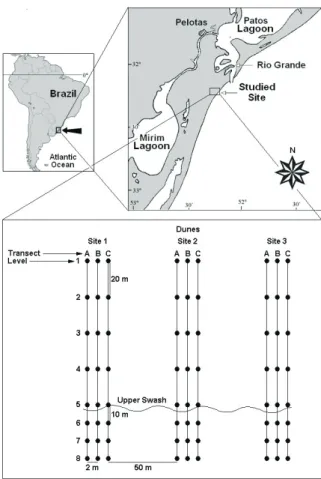
The site of present study is located on Cassino beach, Rio Grande, state of Rio Grande do Sul, 17.2 Km to the south of the western jetty (052º14’04”W, 32º15’55”S) (Fig. 1).
The sampling of benthic macrofauna was performed monthly for a period of 12 months (June 2004 to May 2005). Three sites were selected at a distance of 50m from one another. At each site, three transects were
established, 2m equidistant from one another. Each transect extended from the base of the primary dunes to the inner surf zone at approximately 1m in depth, with between 7 and 8 sampling levels. Within transects, the distance between the levels was 20m until the upper swash zone, from which distance was 10m until the 1-meter isobath (Fig. 1). The smaller distance between levels on the lower parts of the beach was due to the greater number of species and organisms that tend to concentrate in this area (GIANUCA, 1983; DEGRAERet al., 2003).
Biological samples were obtained using a core of 20cm in diameter (0.03 m2), sunk into the sediment to a depth of 20cm, as most of the macrofauna abundance is found in the first 15-20cm of depth in the sediment (BALLY,
1983). Samples were sieved with a nylon mesh with a 0.5mm pore opening, and the material collected was fixed in a 10% formaldehyde solution. In the laboratory, the organisms were quantified and identified to the smallest possible taxonomic level under a stereomicroscope.
A monthly quantification was also performed on the number of burrows of the ghost crab, Ocypode quadrata (Fabricius, 1787), which were mainly located in
the supralittoral zone. Starting from the bases of the primary dunes, 100m lines parallel to the beach were established. These lines were anchored in the area of occurrence of the O. quadrata burrows at a distance of
5m from one another. Through the continuous arrangement of 1x1m grid, the density of burrows along each line was recorded.
Samples belonging to each transect were totaled on a monthly basis for the analysis of the temporal variation of the benthic macrofauna and with the aim of avoiding disturbances to the spatial variation.
Regarding the bivalve Mesodesma mactroides
Deshayes, 1854, individuals with a shell length between
1 and 10mm were defined as recruits; those with a shell length between 10.1 - 42.9mm were defined as juveniles; the ones with a shell length greater than 43mm were defined as adults, according to MASELLO & DEFEO (1986)
and DEFEOet al. (1992b). Recruits, juveniles and adults
of the bivalve Donax hanleyanus Philippi, 1847 were
defined respectively as individuals of 1-5mm, 5.5-15mm and >15mm in length, following DEFEO & DE ALAVA (1995).
Seasonal sediment samples were taken at each of the levels of the three sites. The proportions of sand, silt and clay in the sediment were determined through sieving (> 0.062mm in diameter) and pipetting (< 0.062mm in diameter), following procedures described by SUGUIO
(1973). During the monthly sampling, wave height (visual observations), average wave period (digital chronometer) and salinity (optical refractometer) were recorded, along with air and water temperatures (mercury thermometer). Hourly data on wind speed and direction were provided by the Barra de Rio Grande Pilotage Authority.
To characterize the seasonal morphodynamics state of the beach, the dimensionless Dean’s parameter
11=Hb/WsT was employed, where Hb is the wave height of the surf, Ws is the rate of sediment decantation and T is the wave period. The values < 1 represent reflective
Ω
Fig. 1. Location of study area and sampling design from which the benthic macrofauna was collected, Cassino beach, southernmost
beaches; intermediate beaches are classified within the 1 to 6 interval; and dissipative beaches present values > 6 (SHORT & WRIGHT, 1983).
In order to analyze the temporal variation of the benthic macrofauna throughout the year, statistical analyses were performed on the PRIMER v5 program (Plymouth Routines In Multi Ecological Research) using quantitative data (CLARKE & WARWICK, 1994). From the
sum of the samples of each transect, a similarity spreadsheet was drawn up (Q mode) using the Bray-Curtis dissimilarity index. Multi-Dimensional Scaling (MDS) analysis was then performed and the groups determined by grouping of the samples and analysis of the graphics that showed the temporal variability of the populations abundance. The difference between groups was tested through the analysis of similarity (ANOSIM), at a significance level of p<5% and R statistic >0.5.
Similarity percentage analysis (SIMPER) was used to determine the contribution of the principal species in the formation of the groups.
The monthly variability of the abundance of the eleven most important taxa was compared. The Shannon-Weaver diversity index (H’) and the Pielou evenness index (J’) were also determined for each month.
RESULTS
Minimum salinity was recorded during July (29) and maximums were recorded in January (36) and March
(36). Water temperature of the inner surf zone following the same tendency as air temperature, with minimums recorded in July (water=14º C; air=15º C) and May (water=13.5º C; air=15º C), and the maximum recorded in January (water=26º C; air=30º C). Wave height presented higher values in November (1.5m) and July (1m), whereas the average wave period ranged from 8 to 11.9 seconds. Average declivity of the beach was 1.7º throughout the sampling period.
From the values, it was determined that the beach studied presented an intermediate stage throughout the four seasons of the year (Tab. I). The sediment type for most of the area was classified as fine sand, but in some occasions medium sand predominated on the lower part of the beach (Tab. I).
The NE wind was the most frequent among the sampling periods. The S wind was not very frequent, but reached high velocities, especially among the sampling periods of October – November and February – March (Tab. II).
A total of 28 taxa were collected. January had the highest number of taxa and July had the lowest, but the latter presented a higher diversity index (H’). The class Crustacea presented the highest number of taxa, followed by the class Polychaeta (Tab. III).
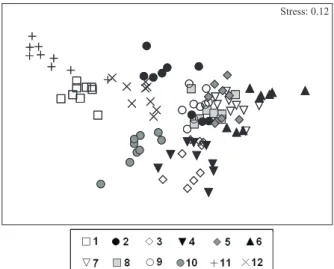
The MDS analysis indicated the tendency to formation of three sample groups: the first formed by samples obtained in June, July, August, September and May (6, 7, 8, 9 and 5); the second by samples of March
Ω
Table I. Average grain size (phi), sediment classification and seasonal value of , Cassino beach, southernmost Brazil, June 2004 to May 2005.
Winter Spring Summer Fall
Site Level Average Classification Average Classification Average Classification Average Classification
(phi) (phi) (phi) (phi)
1 1 2.564 Fine sand 2.568 Fine sand 2.764 Fine sand 2.747 Fine sand
2 2.753 Fine sand 2.562 Fine sand 2.723 Fine sand 2.521 Fine sand
3 2.499 Fine sand 2.358 Fine sand 2.508 Fine sand 2.770 Fine sand
4 2.270 Fine sand 2.541 Fine sand 2.546 Fine sand 2.766 Fine sand
5 2.154 Fine sand 2.332 Fine sand 2.383 Fine sand 2.753 Fine sand
6 1.889 Medium sand 2.188 Fine sand 2.502 Fine sand 2.465 Fine sand 7 1.774 Medium sand 2.214 Fine sand 2.394 Fine sand 2.501 Fine sand
8 *** *** *** *** 2.403 Fine sand 2.375 Fine sand
2 1 2.609 Fine sand 2.499 Fine sand 2.565 Fine sand 2.747 Fine sand
2 2.621 Fine sand 2.691 Fine sand 2.574 Fine sand 2.533 Fine sand
3 2.342 Fine sand 2.765 Fine sand 2.429 Fine sand 2.723 Fine sand
4 2.282 Fine sand 2.530 Fine sand 2.423 Fine sand 2.638 Fine sand
5 2.373 Fine sand 2.363 Fine sand 2.597 Fine sand 2.415 Fine sand
6 1.733 Medium sand 2.467 Fine sand 2.198 Fine sand 2.483 Fine sand 7 1.987 Medium sand 2.513 Fine sand 2.163 Fine sand 2.098 Fine sand
8 *** *** *** *** 1.991 Medium sand 2.441 Fine sand
3 1 2.523 Fine sand 2.755 Fine sand 2.585 Fine sand 2.576 Fine sand
2 2.479 Fine sand 2.748 Fine sand 2.719 Fine sand 2.571 Fine sand
3 2.406 Fine sand 2.787 Fine sand 2.385 Fine sand 2.776 Fine sand
4 2.293 Fine sand 2.774 Fine sand 2.409 Fine sand 2.750 Fine sand
5 2.264 Fine sand 2.766 Fine sand 2.508 Fine sand 2.242 Fine sand
6 1.895 Medium sand 2.511 Fine sand 2.370 Fine sand 2.394 Fine sand 7 1.491 Medium sand 2.518 Fine sand 2.346 Fine sand 2.442 Fine sand
8 *** *** *** *** 1.877 Medium sand 2.466 Fine sand
4.956 4.097 3.269 3.131
Ω
Ω
and April (3 and 4); and the third by samples of December and February (12 and 2). The remaining sampling periods were not grouped (Fig. 2).
ANOSIM analysis revealed significant differences between all the groups and remaining periods (Tab. IV). The polychaeta Scolelepis gaucha (Orensanz &
Gianuca, 1974) characterized the December/February group, as well as the November and January periods. The difference in abundance of this species was the main reason for the separation of this group from the other months. The May-September and March/April groups were respectively formed mostly by the amphipod Platyischnopidae indet. and the bivalve D. hanleyanus.
The amphipod Bathyporeiapus sp. strongly influenced
the samples grouping of the October period (Tab. V).
Scolelepis gaucha was the most abundant taxon
throughout the study period, followed by M. mactroides, Bathyporeiapus sp., and D. hanleyanus (Tab. III).
Temporal variability of the abundance of populations indicated that S. gaucha, M. mactroides, Bathyporeiapus
Table II. Frequency, average and maximum speed of winds in the periods between the sampling of benthic macrofauna, Cassino beach, southernmost Brazil, June 2004 to May 2005.
N NE E SE S SW W N W
Jun - Jul Frequency (%) 7.1 34.6 0.5 4.4 3.7 29.0 8.6 12.0
Average Speed (m.s-¹) 4.3 6.1 2.1 3.3 4.1 5.4 4.5 3.7
Maximum Speed (m.s-¹) 12.5 16.1 4.5 6.7 12.5 19.7 19.7 18.4
Jul - Aug Frequency (%) 2.2 60.5 3.9 3.9 2.2 20.3 3.9 3.1
Average Speed (m.s-¹) 4.9 8.4 6.0 7.2 3.6 6.1 4.0 2.6
Maximum Speed (m.s-¹) 13.0 22.4 13.9 3.8 13.0 15.6 10.3 11.6
Aug - Sep Frequency (%) 3.8 36.5 3.3 14.8 10.5 14.2 6.5 10.4
Average Speed (m.s-¹) 4.4 8.6 7.6 6.9 6.6 5.2 5.6 4.6
Maximum Speed (m.s-¹) 17.0 21.9 17.4 17.4 17.4 16.1 20.1 19.2
Sep - Oct Frequency (%) 2.3 34.7 6.6 13.6 7.4 27.2 5.6 2.7
Average Speed (m.s-¹) 3.7 8.6 7.3 5.9 6.2 5.9 4.3 3.0
Maximum Speed (m.s-¹) 14.8 26.4 17.0 13.9 15.2 19.2 10.3 8.5
Oct - Nov Frequency (%) 3.5 45.6 5.7 11.4 7.4 3.8 4.4 18.2
Average Speed (m.s-¹) 4.6 9.1 6.8 4.6 6.8 3.2 5.1 6.7
Maximum Speed (m.s-¹) 16.6 21.5 15.2 15.6 23.7 18.4 15.6 24.6
Nov - Dec Frequency (%) 0.3 35.0 18.4 24.3 6.0 11.4 3.2 1.3
Average Speed (m.s-¹) 4.5 9.7 8.3 7.4 6.9 6.8 6.0 4.6
Maximum Speed (m.s-¹) 9.0 21.9 15.6 15.2 13.9 16.6 15.6 11.6
Dec - Jan Frequency (%) 1.7 50.6 11.2 17.2 3.8 8.9 1.5 5.0
Average Speed (m.s-¹) 4.8 8.7 6.6 5.8 7.2 6.3 5.2 5.0
Maximum Speed (m.s-¹) 16.1 21.5 14.3 15.6 15.2 19.7 17.0 17.0
Jan - Feb Frequency (%) 2.2 46.1 10.0 15.6 5.8 15.5 2.4 2.4
Average Speed (m.s-¹) 4.6 10.2 9.2 6.6 7.9 7.8 4.1 3.0
Maximum Speed (m.s-¹) 13.4 21.5 17.0 13.9 17.0 18.4 10.8 12.5
Feb - Mar Frequency (%) 1.4 35.7 13.1 30.1 7.2 6.4 3.6 2.5
Average Speed (m.s-¹) 4.6 8.2 7.6 6.4 7.7 6.2 3.0 3.2
Maximum Speed (m.s-¹) 11.6 22.8 21.9 18.8 25.5 25.1 10.3 8.5
Mar - April Frequency (%) 5.3 35.4 7.7 16.8 9.8 13.5 4.6 6.9
Average Speed (m.s-¹) 3.9 7.9 7.1 5.8 7.1 6.2 4.0 5.0
Maximum Speed (m.s-¹) 15.6 20.6 17.9 17.0 17.6 22.4 13.4 17.0
April - May Frequency (%) 6.7 31.6 4.0 10.1 9.6 17.8 10.5 9.7
Average Speed (m.s-¹) 3.7 6.7 4.7 4.9 6.6 5.8 4.2 3.0
Maximum Speed (m.s-¹) 19.7 19.2 12.1 14.8 19.2 21.9 18.8 15.6
Table III. Total abundance of organisms caught monthly on the beach, and monthly diversity index (H’) and evenness index (J’), Cassino beach, southernmost Brazil, June 2004 to May 2005. (P, Polychaeta; B, Bivalvia; C, Crustacea; G, Gastropoda).
Code Jun Jul Aug Sep Oct Nov Dec Jan Feb Mar April May Total
Abundance
P Scolelepis gaucha 2 6 7 243 418 590 65145 4461 22217 2278 5 3 7 6 2 95543 (Orensanz & Gianuca, 1974)
P Euzonus furciferus 5 2 143 162 9 9 8 1 348 3 2 3 8 5 7 3 5 109 681 1837 (Ehlers, 1897)
P Hemipodus olivieri 3 1 2 8 2 1 2 7 132 3 1 5 1 1 1 5 1 1 249
Orensanz & Gianuca, 1974
P Sigalion cirriferum 5 3 6 5 5 5 4 6 2 4 3 2 5 0
Orensanz & Gianuca, 1974
P Capitellidae indet. 0 0 0 0 0 0 2 0 0 0 0 0 2
P Capitellasp. 0 0 0 1 0 0 0 0 0 0 0 0 1
P Hyalinoeciasp. 0 0 0 0 0 0 0 0 0 1 0 0 1
P Hesionidae indet. 0 0 0 0 0 1 0 0 0 0 0 0 1
P Grubeulepis bracteata 0 0 0 0 1 0 0 0 0 0 0 0 1
Nonato,1981
B Mesodesma mactroides 3 3 239 247 764 1970 748 2097 9573 596 660 923 103 17953
Deshayes, 1854
B Donax hanleyanus 223 134 479 305 637 492 458 1339 135 2472 2592 433 9699
Philippi, 1847
B Donax gemmula 0 0 0 0 1 0 2 8 2 7 4 895 109 4 1068
Morrison, 1971
C Bathyporeiapus sp. 3 3 104 260 321 8100 724 6 3 106 133 7 2 129 6 0 10105 C Phoxocephalopsis sp. 9 6 179 268 139 586 426 986 452 159 9 1 131 425 3938 C Platyischnopidae indet. 250 272 350 325 788 314 281 392 112 272 290 224 3870
C Emerita brasiliensis 4 1 4 2 8 9 9 2 4 8 736 225 242 2 1 8 1337
Schmitt, 1935
C Excirolana armata 3 3 4 8 5 5 6 8 3 0 1 8 8 1 9 3 118 3 7 4 7 9 2 720
(Dana, 1852)
C Macrochiridothea sp. 5 1 8 1 1 1 3 6 1 6 9 7 6 1 5 7 6 2 0 2 6 291
C Puelche orensanzi 0 0 1 0 5 3 0 4 5 3 3 4 3 5 8
Barnard & Clark, 1982
C Excirolana braziliensis 1 0 1 1 1 0 0 0 0 0 0 1 5
Richardson, 1912
C Pinnixa patagoniensis 0 2 0 0 0 0 2 3 0 0 0 0 7
Rathbun, 1918
C Balloniscus sellowii 0 0 1 0 0 0 0 0 0 0 0 0 1
(Brandt, 1833)
C Arenaeus cribarius 0 0 0 0 0 0 0 1 0 0 1 0 2
(Lamarck, 1818)
C Megalopa of Ocypode 0 0 0 0 0 0 0 0 0 0 1 0 1
quadrata (Fabricius, 1787)
G Buccinanops duartei 0 0 0 0 0 0 0 7 1 1 0 0 9
Klappenbach, 1965
G Olivancillaria auricularia 1 0 0 1 0 0 0 1 1 1 0 0 5
(Lamarck, 1810)
Nemertea indet. 6 1 5 2 5 2 9 4 0 4 4 3 6 1 8 1 3 1 3 1 0 231
Oligochaeta indet. 0 0 0 0 0 2 1 4 8 2 2 1 1 1 1 9 5
Total monthly abundance 747 1250 2122 2495 12866 68435 8647 35130 3865 4970 4397 2156
Number of taxa 1 5 1 4 1 6 1 6 1 7 1 6 1 7 2 0 1 8 1 9 1 8 1 7 2 8
H’(loge) 1.78 2.14 2.08 1.96 1.27 0.29 1.42 1.03 1.48 1.62 1.35 1.90 1.30
J’ 0.66 0.81 0.75 0.71 0.45 0.10 0.50 0.35 0.51 0.55 0.47 0.67 0.39
sp., Phoxocephalpsis sp., Platyischnopidae indet., and Emerita brasiliensis Schmitt, 1935 presented higher
values between spring and summer (Fig. 3). Euzonus furciferus (Ehlers, 1897), Donax gemmula Morrison, 1971,
and D. hanleyanus presented higher abundances in fall.
The occurrence of Excirolana armata (Dana, 1852) was
more erratic, presenting several peaks throughout the study period (Fig. 3).
During the study, populations of M. mactroides
and D. hanleyanus were characterized mostly by
recruits and, to a lesser degree,juveniles (Tabs. VI, VII).
The crab O. quadrata presented the highest
DISCUSSION
Fluctuations in the total abundance of organisms throughout the twelve months of sampling were strongly influenced by periods of recruitment. The two main occurrence peaks, however, were due to the high number of adults and juveniles of the polychaeta S. gaucha in
the mesolittoral zone.
Scolelepis gaucha was the most abundant species,
being numerically dominant between November and February and with abundance peaks in November and January. SANTOS (1991) verified that S. gaucha was the
most abundant polychaeta in the mesolittoral zone of Cassino Beach, reaching a density of up to 100,000m-2 in spring and early summer. BARROS et al. (2001) also
observed the dominance of this genus in Paraná, where
Scolelepis squamata (Müller,1806) reached around 70%
of macrofauna abundance on two sandy beaches in winter and summer. BORZONE et al. (1996), in summer, and
DEGRAERet al. (2003), at the end of summer and early fall,
observed that S. squamata was the most dominant species
on several beaches.
Fig. 3. Total abundance of main organisms collected on the beach in the different months, Cassino beach, southernmost Brazil, June 2004 to May 2005.
Table IV. Analysis of similarity (ANOSIM) between the groups and the other periods (p<5% and R statistic >0.5). The numbers from
1 to 12 refer respectively to the months of January, February, March, April, May, June, July, August, September, October, November and December (Cassino Beach, southernmost Brazil, June 2004 to May 2005).
R p
5 - 9 vs 10 0,89 0,1%
5 - 9 vs 11 0,998 0,1%
5 - 9 vs 12 and 2 0,729 0,1%
5 - 9 vs 1 0,998 0,1%
5 - 9 vs 3 - 4 0,668 0,1%
10 vs 11 1 0,1%
10 vs 12 and 2 0,765 0,1%
10 vs 1 1 0,1%
10 vs 3 - 4 0,973 0,1%
11 vs 12 and 2 0,91 0,1%
11 vs 1 0,752 0,1%
11 vs 3 - 4 1 0,1%
12 and 2 vs 1 0,721 0,1%
12 and 2 vs 3 - 4 0,854 0,1%
Mesodesma mactroides had its abundance peak in
January, and also had a high number of organisms in October, December and April due to recruitment of this bivalve. DEFEOet al. (1992b) identified two recruitment
periods for the species: one between November and January; and the other between February and April.
For the high abundance of M. mactroides in
October, there was a contribution from juveniles, which up until then were practically absent from the beach. CASCARÓN (1959) stated that most M. mactroides juveniles
and adults are concentrated in the infralittoral zone during winter, and in spring there is a migration to the mesolittoral zone, where they remain through summer and early fall. During research carried out with M. mactroides on the coast
of Mar del Plata, Argentina, in the 1970s, it was also observed migratory movement of the species in this period (R. Capítoli, pers. comm.). Information obtained from fishermen who extract yellow clam from Cassino beach confirms an increase in the amount of juvenile and adult yellow clam between spring and summer in the swash zone (pers. comm.).
The expressive occurrence of Bathyporeiapus sp.
strongly influenced the macrofauna abundance in October. In the state of Paraná, BORZONE & SOUZA (1997)
observed that Bathyporeiapus ruffoi Escofet, 1971
presented high abundance in September and November, but October was not sampled in the study. This species was well represented in stations of the lower mesolittoral zone, extending its distribution to the infralittoral zone with high abundance (BORZONE & SOUZA, 1997). In the
USA at 34º40’N of latitude, LEBER(1982) observed that
two species of amphipods predominated in early winter at milder temperatures. In Florida, USA, CHARVATet al.
(1990) observed that amphipods were more important in the infralittoral than the mesolittoral zone, suggesting that higher temperatures exclude amphipods from the upper parts of the beach.
Donax haleyanus recruits were largely responsible
for the formation of the March/April group. On Uruguayan beaches, DEFEO & DE ALAVA (1995) verified
recruitment peaks between February and May, coinciding with the finding of the present study, whereas CARDOSO
& VELOSO (2003), on a tropical beach, found greater
abundances of this species in fall and winter. It is noteworthy that the recruitment peak for D. hanleyanus
came after the recruitment peak for M. mactroides. In a
study carried out in Uruguay, an inverse relationship was found between the recruitments of D. hanleyanus and
the presence of M. mactroides juveniles and adults (de
Alava, 1993 apud DEFEO, 1996b). Indications of
competition between these species are reinforced by the fact that the distinct class sizes of D. hanleyanus and M. mactoides recruits and juveniles occur at similar depths
in the sediment (DEFEOet al., 1986), thereby increasing
the chances of competition for space.
The formation of the group that encompassed the months of May, June, July, August and September was due to the frequency of Platyischnopidae and, especially, the low abundance of other taxa. There was an absence of recruitments in this period, as well as the migration of some species to deeper waters, contributing to the scarcity of benthic macrofauna. LEBER (1982) observed that Donax parvula Philippi, 1849 migrated to the infralittoral zone
during winter and CASCARÓN (1959) verified the same
tendency for M. mactroides.
Euzonus furciferus was the only species that
recruited during the period in which the lowest abundance of benthic macrofauna occurred, with its peak abundance concentrated in May. On Matadeiro beach, in the state of Santa Catarina, Brazil, the population of E. furciferus showed the main recruitment period between
May and August (pers. comm.), in agreement with the findings of the present study. In Oregon, USA, KEMP
Table V. Result of SIMPER analysis. The main organisms that contributed to the formation of the groups and other periods are presented. The numbers from 1 to 12 refer respectively to the months of January, February, March, April, May, June, July, August, September, October, November and December (Cassino beach, southernmost Brazil, June 2004 to May 2005).
5 - 9 1 0 1 1 12 and 2 1 3 - 4
Platyischnopidae indet. 25,19%
Donax hanleyanus 19,20% 67,96%
Mesodesma mactroides 16,51% 22,60% 21,67% 12,19%
Bathyporeiapus sp. 57,18%
Scolelepis gaucha 95,56% 51,48% 69,20%
Phoxocephalopsis sp. 13,58%
Table VI. Total abundance of recruits, juveniles and adults of Mesodesma mactroides Deshayes, 1854 in the different months, Cassino
beach, southernmost Brazil, June 2004 to May 2005.
Jun Jul Aug Sep Oct Nov Dec Jan Feb Mar April May
Recruits 1 8 236 221 706 1146 210 1742 9026 393 627 907 9 3
Juveniles 1 1 1 4 4 3 854 510 325 340 155 1 4 1 7
Adults 1 0 1 2 4 2 3 6 8 2 1 3 0
Table VII. Total abundance of recruits, juveniles and adults of Donax hanleyanus Philippi, 1857 in the different months, Cassino beach,
southernmost Brazil, June 2004 to May 2005.
Jun Jul Aug Sep Oct Nov Dec Jan Feb Mar April May
Recruits 175 129 344 187 312 3 4 9 8 1220 127 2449 2534 420
Juveniles 2 6 130 105 322 435 317 2 7 0 0 0 1 1
(1988) verified that Euzonus mucronata (Treadwell, 1914)
recruitment occurred in early summer. The difference of approximately 13º more in latitude of the site in Oregon in comparison to the studies carried out in southern Brazil allows us to infer that the recruitment period of both species occurs at times with quite similar temperatures.
One of the typical organisms from the supralittoral zone, the crab O. quadrata, presented oscillations in the
density of burrows throughout the year, with no high densities verified during the 12-months study period. Furthermore, there were months in which no burrows were encountered. During the study it was observed that wind action could easily cover the burrows with sand, and the low density could be a reflection of such a process. NEVES
& BEMVENUTI (2006) recorded this phenomenon studying
the distribution and abundance of O. quadrata burrows on
three beaches on the northern coast of state of Rio Grande do Sul. ALBERTO & FONTOURA (1999), in the same state,
observed that variations in temperature, wind directions and intensity, and the reach of the waves directly interfered in the activities of O. quadrata, and in adverse conditions no
sign of the species is observed on the beach.
It was generally verified that most of the recruitments of the several taxa mainly occurred in the periods of spring and fall, thereby altering the abundance of benthic macrofauna.
From a study carried out in the temperate region of Cape Paterson, Victoria, Australia, HAYNES & QUINN (1995)
found a significant temporal variation in densities and number of species, relating this occurrence with changes in the densities of species common to the mesolittoral zone. On a subtropical sand beach in Paraná, SOUZA & GIANUCA
(1995) observed that the overall abundance of macrofauna was significantly higher in summer than in winter. VELOSOet al. (2003), however, did not verify a significant difference in
benthic macrofauna density and biomass between the periods of summer and winter on a tropical beach (state of Rio de Janeiro). It is likely that the difference in latitude of the beaches, with the subsequent variations in temperature, is the main non-biological determinant in the seasonal variation of benthic macrofauna.
The temporal variation revealed that there were abrupt reductions in the abundance of diverse species of benthic macrofauna generally 30 days after the occurrence of abundance peaks. Donax hanleyanus was the only species
that maintained two consecutive abundance peaks (March and April), but one month later, a striking reduction in the number of individuals was verified.
There is a number of factors that may be responsible for the abrupt drop in the abundance of taxa. One of these factors is the predation pressure on the benthic macrofauna. In a study carried out in the USA, the most obvious predators on the beach were crabs, fish and birds. These predators fed on the tidal migrants and were more abundant during the summer months (LEBER, 1982). On Cassino Beach, many
species of fish fed on the benthic macrofauna in the surf zone during the high tide, accompanied by crabs and gastropods. At low tide, birds were the main predators, some of which were residents and others were migrants (GIANUCA,
1983). The migration of some birds determines that the arrival of flocks coincides with peak benthic macrofauna abundance in southernmost Brazil (VOOREN, 1998).
The larger number of beach-goers and, consequently greater transit of vehicles on the beach, especially during the hotter months of the year, may also affect benthic
macrofauna recruits and juveniles abundance. On the Chilean coast, JARAMILLOet al. (1996a) verified no significant effect
of the presence of humans on benthic macrofauna. However, GIANUCA (1983) observed that a threat that affects the
populations of the mesolittoral zone, especially juveniles and surface diggers, is the use of damp, compact sands by all types of vehicles, including the trucks of fishermen.
The decrease in M. mactroides density soon after the
peak recorded in October may have been influenced by the imprisonment of individuals on the upper parts of the beach. Winds from the south, which occurred between the sampling of October and November, with velocities of up to 23.7m/s-1, elevated the sea level, causing the imprisonment of a high number of M. mactroides specimens in the supralittoral zone.
In the study area, the incidence of southern winds can raise the sea level by as much as 2m (BARLETTA & CALLIARI, 2003).
In Argentina, strong southern winds carry and deposit a large number of organisms, without the possibility of their returning to the lower parts of the beach. This phenomenon commonly occurs with M. mactroides, making the return of
the species to the water impossible (RAMÍREZet al., 2004).
DEFEO (1989) observed that M. mactroides is collected
by fishermen with shovels on the Uruguayan coast. The collection of M. mactroides with the use of shovels causes
collateral damage to non-exploited classes, breaking their shells and affecting the survival of juveniles due to disturbances in the sediment (DEFEO, 1996a; BRAZEIRO &
DEFEO, 1999). This collection procedure is also used by
fishermen in southernmost Brazil, and the mortality of individuals from all classes may be a consequence of this type of activity.
Temporal variations in the benthic macrofauna abundance on Cassino beach can be attributed to the positive effect of recruitment peaks and the migration of species to the swash zone, as well as the negative effects of the migration of some species to deeper waters, mortality by natural causes (stranding and action of predators) and human activity (extracting and traffic of vehicles). Among the positive effects, recruitment can be considered the main determinant in the expressive increases of benthic macrofauna abundance for most organisms. Stranding, that is, the trapping of organisms on the upper parts of the beach, is likely the main cause for the abrupt drops in benthic macrofauna abundance on sandy beaches in southernmost Brazil.
It was possible verify the monthly temporal variability in the present study. Perhaps other patterns could be observed depending on the samplings frequency.
REFERENCES
ALBERTO, R. M. F. & FONTOURA, N. F. 1999. Distribuição e estrutura
etária de Ocypode quadrata (Fabricius, 1787) (Crustacea,
Decapoda, Ocypodidae) em uma praia arenosa do litoral sul do Brasil. Revista Brasileira de Biologia 59(1):95-108. BALLY, R. 1983. Intertidal zonation on sandy beaches of the west
coast of South Africa. Cahiers de Biologie Marine 24(1):85-103.
BARLETTA, R. C. & CALLIARI, L. J. 2003. An assesment of the
atmospheric and wave aspects determining beach morphodynamic characteristics along central coast of RS state, southern Brazil. Journal of Coastal Research 35(special issue):300-308.
BARROS, F.; BORZONE, C. A. & ROSSO, S. 2001. Macroinfauna of six
beaches near Guaratuba bay, southern Brazil. Brazilian Archives of Biology and Technology 44(4):351-364. BORZONE, C. A. & GIANUCA, N. M. 1990. A zonação infralitoral em
da Costa Sul e Sudeste Brasileira, Publ. ACIESP, São Paulo 3:280-287.
BORZONE, C. A. & SOUZA, J. R. B. 1997. Estrutura da macrofauna
bentônica no supra, meso e infralitoral de uma praia arenosa do sul do Brasil. Oecologia Brasiliensis v. III:197-212 BORZONE, C. A.; SOUZA, J. R. B. & SOARES, A. G. 1996.
Morphodynamic influence on the structure of inter and subtidal macrofaunal communities of subtropical sandy beaches.
Revista Chilena de Historia Natural 69:565-577. BRAZEIRO, A. & DEFEO, O. 1999. Effects of harvesting and density
dependence on the demography of sandy beach populations: the yellow clam Mesodesma mactroides. Marine Ecology Progress Series 182(1):127-135.
CALLIARI, L. J. & KLEIN, A. H. F. 1993. Características
morfodinâmicas e sedimentológicas das praias oceânicas entre Rio Grande e Chuí, RS. Pesquisas 20(1):48-56.
CARDOSO, R. S. & VELOSO, V. G. 2003. Population dynamics and
secondary production of the wedge clam Donax haleyanus
(Bivalvia: Donacidae) on a high-energy subtropical beach of Brazil. Marine Biology 142(1):153-162
CASCARÓN, S. 1959. La almeja amarilla (Mesodesma (T.) mactroides
Deshayes) de la costa de la provincia de Buenos Aires. AGRO Publicación Técnica 1(3):1-66.
CHARVAT, D. L.; NELSON, W. G. & ALLENBAUGH, T. A. 1990.
Composition and seasonality of sand-beach amphipod assemblages of the east coast of Florida. Journal of Crustacean Biology 10(3):446-454.
CLARKE, K. R. & WARWICK, R. M. 1994. Changes in marine communities: an approach to statistical analysis and interpretation. Plymouth, NERC. 187p.
DEFEO, O. 1989. Development and management of artisanal
fishery for yellow clam Mesodesma mactroides in Uruguay.
Fishbyte 7:21-25.
___. 1996a. Experimental management of an exploited sandy beach bivalve population. Revista Chilena de Historia Natural 69:605-614.
___. 1996b. Recruitment variability in sandy beach macroinfauna: much to learn yet. Revista Chilena de Historia Natural 69:615-630.
DEFEO, O. & DE ALAVA, A. 1995. Effects of human activities on
long-term trends in sandy beach populations: the wedge clam
Donax hanleyanus in Uruguay. Marine Ecology Progress Series 123:73-82.
DEFEO, O.; JARAMILLO, E. & LYONNET, A. 1992a. Community structure
and intertidal zonation of the macroinfauna on the Atlantic coasts of Uruguay. Journal of Coastal Research 8(4):830-839.
DEFEO, O.; LAYERLE, C. & MASELLO, A. 1986. Spatial and temporal
structure of the yellow clam Mesodesma mactroides
(Deshayes, 1854) in Uruguay. Medio Ambiente 8(1):48-57.
DEFEO, O.; ORTIZ, E. & CASTILLA, J. C. 1992b. Growth, mortality
and recruitment of the yellow clam Mesodesma mactroides
on uruguayan beaches. Marine Biology 114(3):429-437.
DEGRAER, S.; VOLCKAERT, A. & VINCX, M. 2003. Macrobenthic
zonation patterns along a morphodynamical continuum of macrotidal, low tide bar/rip and ultra-dissipative sandy beaches.
Estuarine, Coastal and Shelf Science 56(3):459-468. DEXTER, D. M. 1979. Community structure and seasonal variation
in intertidal panamanian sandy beaches. Estuarine and Coastal Marine Science 9:543-558.
___. 1984. Temporal and spatial variability in the community structure of the fauna of four sandy beaches in south-eastern New South Wales. Australian Journal of Marine and Freshwater Research 35(6):663-672.
GARCIA, V. M. T. & GIANUCA, N. M. 1998. A praia e a zona de
arrebentação. In: SEELIGER, U.; ODEBRECHT, C. & CASTELLO J. P.
eds. Os ecossistemas costeiro e marinho do extremo sul do Brasil. Rio Grande, Ecoscientia. p.184-189.
GIANUCA, N. M. 1983. A preliminary account of the ecology of
sandy beaches in southern Brazil. In: MCLACHLAN, A. & ERASMUS,
T. eds. Sandy beaches as ecosystems. The Hague, W.
Junk. p.413-420.
___. 1987. Zonação e produção nas praias arenosas do litoral sul e sudeste do Brasil: síntese dos conhecimentos. In: Simpósio sobre ecossistemas da costa sul e sudeste Brasileira, 1º, Cananéia, 1987. Anais.... São Paulo, ACIESP. v.1, p.313-332. HAYNES, D. & QUINN, G. P. 1995. Temporal and spatial variability
in community structure of a sandy intertidal beach, Cape Paterson, Victoria, Australia. Marine and Freshwater
Research 46(6):931-942.
HERNANDEZ, C.; CONTRERAS, S. H.; GALLARDO, J. A. & CANCINO, J. M.
1998. Community structure of the macroinfauna along a sandy beach of central Chile: Lenga, Bahia San Vicente.
Revista Chilena de Historia Natural 71(3):303-311.
JAMES, R. J. & FAIRWEATHER, P. G. 1996. Spatial variation of
intertidal macrofauna on a sandy ocean beach in Australia.
Estuarine, Coastal and Shelf Science 43(1):81-107.
JARAMILLO, E. 1978. Zonación y estrutura de la comunidad
macrofaunística en playas de arena del sur de Chile (Mehuín, Valdivia). In: ANKEL, W. E.; BRUNDIN, L.; BÜCHERL, W.; MARCUS,
E. B.; GERY, J.; IILIES, J.; KILIAN, E. F.; KOEPCKE, H. W. &
WYGODZINSKY, P. W. eds. Studies on Neotropical Fauna and Environment. Lisse, Swers & Zeitlinger. p. 71-92.
JARAMILLO, E. & MCLACHLAN, A. 1993. Community and population
responses of the macroinfauna to physical factors over a range of exposed sandy beaches in south-central Chile. Estuarine, Coastal and Shelf Science 37(6):615-624. JARAMILLO, E.; CONTRERAS, H. & QUIJON, P. 1996a. Macroinfauna
and human disturbance in a sandy beach of south-central Chile. Revista Chilena de Historia Natural 69:655-663. JARAMILLO, E.; STEAD, R.; QUIJON, P.; CINTRERAS, H. & GONZALEZ, M.
1996b. Temporal variability of the sand beach macroinfauna in south-central Chile. Revista Chilena de Historia Natural 69:641-653.
KEMP, P. F. 1988. Production an life history of a deposit-feeding
polychaete in an atypical enviroment. Estuarine, Coastal and Shelf Science 26(4):437-446.
KNOX, G. A. 2000. The Ecology of Sea Shores. New York,
CRC. 555p.
LEBER, K. M. 1982. Seasonality of macroinvertebrates on a
temperate, high wave energy sandy beach. Bulletin of Marine Science 32(1):86-98.
MASELLO, A. & DEFEO, O. 1986. Determinación de la longitud de
primera madurez sexual en Mesodesma mactroides (Deshayes
1854). Comunicaciones de la Sociedad Malacologica del Uruguay 6:387-392.
MCLACHLAN, A. 1983. Sandy beaches ecology – a review. In:
MCLACHLAN, A. & ERASMUS, T. eds. Sandy beaches as ecosystems. The Hague, W. Junk. p.321-380.
___. 1990. Dissipative beaches and macrofauna communities on exposed intertidal sands. Journal of Coastal Research 6(1):57-71.
NEVES, F. M. & BEMVENUTI, C. E. 2006. The ghost crab Ocypode quadrata (Fabricius, 1787) as a potential indicator of
anthropic impact along the Rio Grande do Sul coast, Brazil.
Biological Conservation 133(4):431-435.
RAMÍREZ, C. F.; MIANZAN, H. & CHIAVERANO, L. 2004. Varamientos e
arribazones. In: BOSCHI, E. E. & COUSSEAU, M. B. eds. La vida entre mareas: vegetales y animales de las costas de Mar Del Plata, Argentina. Mar del Plata, INIDEP. p.59-64. SANTOS, P. J. P. 1991. Morphodynamical influence of temporary
freshwater stream on the population dynamics of Scolelepis gaucha (Polychaeta: Spionidae) on a sandy beach in southern
Brazil. Bulletin of Marine Science 48(3):657-664.
SHORT, A. D. & WRIGHT, L. D. 1983. Physical variability of sandy
beaches. In: MCLACHLAN, A. & ERASMUS, T. eds. Sandy beaches as ecosystems. The Hague, W. Junk. p.133-144.
SOUZA, J. B. R. & GIANUCA, N. M. 1995. Zonation and seasonal
variation of the intertidal macrofauna on a sandy beach of Paraná State, Brazil. Scientia Marina 59(2):103-111.
SUGUIO, K. 1973. Introdução à Sedimentologia. São Paulo,
EDUSP. 317p.
VELOSO, V. G. & CARDOSO, R. S. 2001. Effect of morphodynamics
on the spatial an temporal variation of macrofauna on three sandy beaches, Rio de Janeiro state, Brazil. Journal of the Marine Biological Association of the UK 81(3):369-375.
VELOSO, V. G.; CAETANO, C. H. S. & CARDOSO, R. S. 2003.
Composition, structure and zonation of intertidal macroinfauna in relation to physical factors in microtidal sandy beaches in Rio de Janeiro state, Brazil. Scientia Marina 67(4):393-402.
VELOSO, V. G.; CARDOSO, R. S. & FONSECA, D. B. 1997.
Spatio-temporal characterization of intertidal macrofauna at Prainha beach (Rio de Janeiro State). Oecologia Brasiliensis v. III: 213-225.
VOOREN, C. M. 1998. Aves marinhas e costeiras. In: SEELIGER, U.;
ODEBRECHT, C. & CASTELLO, J. P. eds. Os ecossistemas costeiro e marinho do extremo sul do Brasil. Rio Grande,
Ecoscientia. p.170-176.