DOI: 10.4025/jphyseduc.v28i1.2814
Artigo Original
RELATIVE AGE EFFECT AND CONSTITUENT YEAR EFFECT: AN ANALYSIS OF THE INTERNATIONAL TENNIS FEDERATION RANKING
EFEITO DA IDADE RELATIVA E EFEITO DO ANO CONSTITUINTE: UMA ANÁLISE DO RANKING DA FEDERAÇÃO INTERNACIONAL DE TÊNIS
João Paulo Abreu Moreira1, Mariana Calábria Lopes1, Larissa Oliveira Faria1 e Maicon Rodrigues Albuquerque2
1
Universidade Federal de Viçosa, Viçosa-MG, Brasil.
2
Universidade Federal de Minas Gerais, Belo Horizonte-MG, Brasil.
RESUMO
O Efeito da Idade Relativa (EIR) e o Efeito do Ano Constituinte (EAC) parecem influenciar o processo de formação de jovens tenistas. O objetivo do presente estudo foi investigar a presença desses efeitos no ranking de tenistas juniores da International Tennis Federation (ITF) e sua influência na pontuação obtida pelos tenistas. Os resultados encontrados demonstram a presença do EIR e do EAC (p ≤0,05). O modelo de regressão identificou que as variáveis “ano” e “mês” de nascimento predizem a pontuação dos atletas no ranking da ITF com uma variância explicada de 19%. Em conclusão, o ranking formado por várias faixas etárias não tem se mostrado uma estratégia de classificação sensível o bastante para prevenir o EIR e o EAC entre os tenistas juniores.
Palavras-chave: Efeito da Idade Relativa. Efeito do Ano Constituinte. Tênis.
ABSTRACT
Relative Age Effect (RAE) and Constituent Year Effect (CYE) seem to influence the process of training young tennis players. The aim of this study was to investigate the presence of these effects in the ranking of junior tennis players of the International Tennis Federation (ITF) and its influence on the score obtained by such tennis players. The results show the presence of the RAE and the CYE (p ≤ 0.05). The regression model identified that the variables "year" and "month" of birth predict the scores of athletes in the ITF ranking with an explained variance of 19%. In conclusion, the ranking composed of various age groups does not seem to be a classification strategy sensitive enough to prevent the RAE and the CYE among junior tennis players.
Keywords: Relative Age Effect. Constituent Year Effect. Tennis.
Introduction
In tennis, as in other sports, the process involving the selection and training of athletes is quite complex. Achieving excellence and becoming a professional tennis player is a difficult task that few can handle. To be successful in such a selective sport, children are chosen to participate in training programs and competition1 in order to achieve high performance soon in early adulthood. The development of young athletes requires multivariate procedures2, since, in addition to concern with physical and socio-affective characteristics, cognitive and motor-sensory aspects need to be worked on as well3. However, other variables may interfere throughout development stages, including genetic characteristics4, the environment where development takes place and social aspects involved6 in this process.
tennis12-15. The term Relative Age refers to the biological age difference between individuals with the same chronological age, within the same category or age group16,17. The effects caused by these differences in the selection and throughout sports development are known in the literature as Relative Age Effect, which can be understood as the effect caused by the age difference between individuals within the same age group18. During sports training, young people are divided into categories by chronological age. Cut-off dates are chosen to delimit these categories in order to form more homogeneous groups, reducing potential physical and cognitive differences, allowing fair competition19 and equal opportunities for all participants18. However, organization by categories according to age group has been inefficient in the sense of preventing some from being benefited, and harming others during this process7, since physical18,20 and psychological advantages1,21,22 due to advanced maturational stages could favor the older ones. For Votteler and Höner19, maturational advantages are often confused with sports talent, reducing the efficiency of athlete development programs. Young talents, because they are not mature yet, end up not receiving the same support as others, which leads them to quit the sport, with this being one of the most serious problems caused by the RAE. Specifically in tennis, investigations have pointed out the existence of the effect between amateur tennis players12,13 and professional tennis players13. It also seems that the Relative Age Effect can influence the position of tennis players in the ranking, since Ribeiro Júnior et al.15 verified the presence of the RAE in the South American and world rankings composed of infanto-juvenile athletes.
In Tennis, the position of players in the ranking is very important. Being well placed guarantees the player’s presence in the best events of the world circuit (eg. Grand Slams, Masters Tournaments). These competitions offer players the highest cash prizes, guarantee exposure in the media (which can generate a high financial return on advertising), in addition to being the ones that distribute more points to the ranking. Young players are introduced to this classification system through the ITF junior ranking, where classification is based on the player’s score over the seasons (last 52 weeks). This same ranking includes tennis players aged from 13 to 18 years old, that is, tennis players born in six different years.
In this sense, besides the RAE, another phenomenon that may influence the position of tennis players in the ranking is the Constituent Year Effect (CYE). Wattie, Cobley and Baker23 use this term to refer to the effects of the year of birth observed in groups with more than one age group (eg. sub-13, sub-15 and sub-17 football categories). During the training process, young athletes belonging to older groups tend to be in advantage compared to younger ones, especially due to physical differences arising from maturational processes. On the other hand, among athletes in the “masters” category, who are usually grouped into categories composed of five age groups (eg. 40-44, 45-49, 50-54), the tendency is for younger athletes to stand out24 . Some indicators, such as the work by Schorer, Wattie and Baker25, have addressed the influence of various age groups within the same group on athlete training process. It is believed that these two phenomena (RAE and CYE) can be observed within the same context26 due to groupings done during the training process, such as in tennis.
Thus, the purpose of the present study is to investigate the Relative Age Effect (RAE) and the Constituent Year Effect (CYE) on the ranking of junior tennis players, verifying how the “year” and “month” of birth variables can influence the score of the athletes for the composition of the ITF ranking.
Methods
Data collection
Relative age effect and constituent year effect: an analysis of the international tennis federation ranking
(http://www.itftennis.com/media/163622/163622.pdf). A total of 2,481 male athletes born in the following years: 1995 (n = 588); 1996 (n = 784); 1997 (n = 653); 1998 (n = 334); 199 (n = 72) and 2000 (n = 10) were verified.
Procedures
To assess the RAE, just as in other studies that were composed of an international sample10,27,28, all tennis players were categorized according to month of birth and denominated: Q1- January-March; Q2 - April-June; Q3 - July-September; Q4 - October-December.
Finally, to assess the CYE, the athletes were divided by year of birth.
Statistical analysis
For data analysis, the Chi-square test (χ2) was used to verify the RAE (eg. Barnsley, Thompson and Barnsley16, Delorme and Raspaud29, Edgar and O’Donoghue13) and the CYE (eg. Medic, Starkes and Young24).
The present study adopted the expected frequency of birth proportional to the number of days that make up each quartile, in the expectation of further reducing the margin of error in the distribution of births11. Thus, the frequencies expected for each quartile are: Q1 - 24.7% (90 days); Q2 - 24.9% (91 days); Q3 and Q4 - 25.2% (92 days each). For RAE analysis, a uniform distribution of births was adopted for the years that make up the ranking, with the expected frequency of 406.83 athletes per year (16.67%), defined by the ratio between the total number of the sample and the number of years that make up the ITF ranking24.
The odds ratio (OD) analysis, with a 95% confidence interval, was performed to calculate the Effect Size between the frequency of tennis players born in Q1, Q2 and Q3 in relation to Q4. The same procedure was used to analyze the frequency of births between the years that make up the ranking. The reference values for the effect size (small, medium or large) are: 1.22; 1.86; 3.00, respectively 11,27, 28,30.
A Stepwise regression model was used to determine the specific contribution of the “year of birth” and “month of birth” independent variables to the explanation of the “score in the ranking” dependent variable. The level of significance adopted in all procedures was p ≤
0.05. All the statistical treatment was performed using the IBM SPSS Statistics program for Mac, version 20.0.
Results
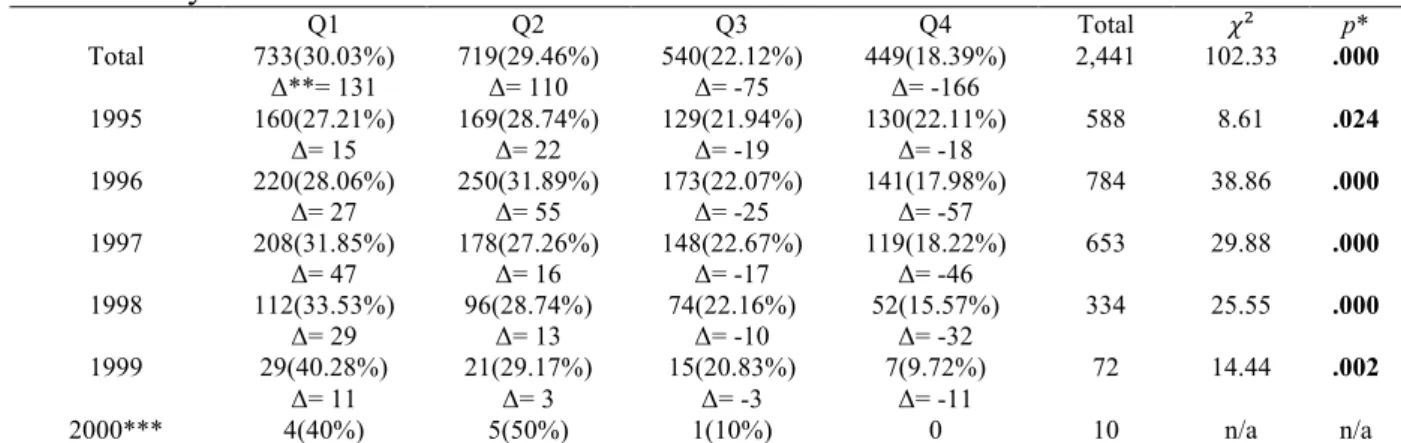
Table 1 shows the total distribution of the birth frequencies of the 2,471 subjects researched and of each of the subgroups formed by years of birth. In relation to the total sample, the χ² test identified significant difference between birth quartiles [χ² (3) = 102.33;
Table 1. Frequencies, Chi-square values and p value for the total sample and subgroups by year of birth
Q1 Q2 Q3 Q4 Total �² p*
Total 733(30.03%) Δ**= 131
719(29.46%) Δ= 110
540(22.12%) Δ= -75
449(18.39%) Δ= -166
2,441 102.33 .000
1995 160(27.21%)
Δ= 15
169(28.74%) Δ= 22
129(21.94%) Δ= -19
130(22.11%) Δ= -18
588 8.61 .024
1996 220(28.06%)
Δ= 27
250(31.89%) Δ= 55
173(22.07%) Δ= -25
141(17.98%) Δ= -57
784 38.86 .000
1997 208(31.85%)
Δ= 47
178(27.26%) Δ= 16
148(22.67%) Δ= -17
119(18.22%) Δ= -46
653 29.88 .000
1998 112(33.53%)
Δ= 29
96(28.74%) Δ= 13
74(22.16%) Δ= -10
52(15.57%) Δ= -32
334 25.55 .000
1999 29(40.28%)
Δ= 11
21(29.17%) Δ= 3
15(20.83%) Δ= -3
7(9.72%) Δ= -11
72 14.44 .002
2000*** 4(40%) 5(50%) 1(10%) 0 10 n/a n/a
Note: *p ≤0.05; ** Δ: difference between observed and expected values; ***For the subgroup of athletes born in 2000, 3 cells (100.0%) have expected frequencies lower than 5.
Source: The authors.
Table 2 shows results referring to the odds ratio, used to assess effect sizes between quartiles. A greater probability of athletes born in the initial quartiles was found in relation to the final quartile (Q4), and in most comparisons the effect size found was medium, with the exception of Q3 x Q4 comparisons for the total sample and for those born in 1995, which presented a small effect size, and of Q1 x Q4 and Q2 x Q4 comparisons for tennis players born in 1999, who presented a large effect size.
Table 2. Odds Ratio of Q1, Q2 and Q3 in relation to Q4 for the total sample and subgroups by year of birth
Total Q1 x Q4 Q2 x Q4 Q3 x Q4
Total 2441 1.67** (1.42-1.96) 1.62** (1.37-1.90) 1.20* (1.02-1.42) 1995 588 1.26** (0.91-1.74) 1.31** (0.95-1.81) 0.99* (0.71-1.39) 1996 784 1.60** (1.20-2.14) 1.80** (1.35-2.40) 1.23** (0.91-1.65) 1997 653 1.79** (1.31-2.45) 1.52** (1.11-2.10) 1.24** (0.90-1.72) 1998 334 2.18** (1.39-2.41) 1.87** (1.19-2.94) 1.42** (0.89-2.27) 1999 72 4.14*** (1.45-11.87) 3.00*** (1.02-8.80) 2.14** (0.71-6.50)
2000**** 4 5 1 0
Note: Effect Size (es) *es ≤ 1.22 (small), **es ≤ 1.86 (medium) and ***es ≤ 3.00 (large). **** For the subgroup of athletes born in 2000, 100.0% have expected frequencies lower than 5.
Source: The authors.
Table 3 displays results for the CYE. The χ² test showed significant difference [χ²(5)=1254.98; p<0.001] in the distribution of the year of birth of the athletes present in the ranking.
Table 3. Frequencies, Chi-square values and p value for the distribution of years of birth in the ITF junior ranking
Year of Birth total �² p*
1995 1996 1997 1998 1999 2000
588 Δ=181.17 784 Δ=377.17 653 Δ=246.17 334 Δ=-72.83 72 Δ=-334.83 10 Δ=-396.83
2.441 1254.98 .000
Note: Expected frequency (ef) = 406.83 Source: The authors.
Relative age effect and constituent year effect: an analysis of the international tennis federation ranking
between the years 1995 x 1996, 1995 x 1997 and 1996 and 1997. Comparing 1995, 1996 and 1997 with 1998, medium effects were found. Comparing 1995, 1996, 1997 and 1998 with 1999 and 2000, large effect sizes were found. These results point to differences in the distribution of tennis players in the ranking, with high representativeness of older players (1995, 1996 and 1997) and small representation of younger players (1998, 1999 and 2000).
Table 4. Odds Ratio between years of birth, based on observed frequencies (of) and expected frequencies (ef)
Year of Birth 1995 (of=588)
1996 (of=784)
1997 (of=653)
1998 (of=334)
1999 (of=72) 1995
1996 0.75*
(0.63-0.89)
1997 0.90*
(0.75- 1.07)
1.20* (1.01-1.43)
1998 1.76**
(1.45-2.13)
2.35** (1.95-2.83
1.96** (1.62-2.37)
1999 8.16***
(6.17-1.,81)
10.89*** (8.25-14.37)
9.07*** (6.86-11.99)
4.64*** (3.48-6.20)
2000 58.80***
(31.01-111.51)
78.40*** (41.40-148.50)
65.30*** (34.46-123.78)
33.40*** (17.54-63.59)
7.20*** (3.66-14.15) Note: Effect Size (es) *es ≤ 1.22 (small), **es ≤ 1.86 (medium) and ***es ≤ 3.00 (large). Expected frequency (ef) = 406.83 Source: The authors.
In relation to the insertion of the “year of birth” and “month of birth” variables as independent variables into the regression model, in which the score in the ranking was the dependent variable, it was verified that the stepwise regression analysis indicated a significant model (F= 24.180, p<0.001, R² = 0.019), showing that 19% of the score obtained by the tennis player is directly influenced by the year and month of his birth. Both variables, “year of birth” (β= -13.931, t = -6.433, p <0.001) and “month of birth” (β= -6.877, t = -3.111, p = 0.002), were significant, and in this case, were inserted into the model.
Discussion
The objective of the present study was to investigate the Relative Age Effect (RAE) and the Constituent Year Effect (CYE) on the ITF junior tennis players ranking. In short, the results found showed the presence of RAE (Table 1), revealing a trend of greater representativeness of players born in the first months of the year in relation to those born in the final ones, in addition to the CYE (Table 3), with a statistically greater representation of tennis players born in the years 1995, 1996 and 1997 than in 1998, 1999 and 2000. In addition, it was possible to identify that the year of birth and the month of birth predict the score in the ranking with an explained variance of 19% and that, as expected, the year of birth contributes more to the score in the ranking than the athletes’ month of birth does.
positions in the ranking seem to translate not only technical differences between players, but mainly their maturational differences.
Specifically about the RAE, several factors may have influenced its presence among the ranked players. According to the model proposed by Wattie et al.5, the RAE may be related to numerous variables, but all linked to three interrelated spheres, being: 1) individual characteristics; 2) environmental aspects; and 3) specific characteristics of the modality.
Concerning individual characteristics, the RAE appears to be an aspect to be constantly investigated. According to Cobley et al.20, an explanation to the smaller representativeness of athletes born far from the cut-off date would be associated with their late maturation compared to those relatively older, which would result in physical13,32, cognitive12 and psychological13 disadvantages, as well as a relatively smaller life experience13 for the youngest, since the selection stages and throughout the training process. Although differences in growth, biological maturity and cognition decline over the years33, in an environment where competition is high, any initial advantage in these aspects can trigger a series of events that may place more mature younger athletes in situations of advantage compared to less mature ones. As an example, older and more developed athletes have greater opportunities to participate in sports with a high level of competitiveness, in which case they can improve their psychological skills (eg. motivation, self-efficacy, etc.), techniques (enhanced motor control due to richer and more frequent practice opportunities), as well as tactical aspects18,22,34-37. In this sense, any initial advantage that a certain “older” athlete has over “younger” ones can increase this disadvantage throughout the selection process and, consequently, make the process unequal. For Baxter-Jones31, motivation can influence sports training process, interfering with an individual’s desire to continue practicing the modality in question. Thus, face the barriers that stand during training, such as competition for space with other more mature athletes, potential tennis players, relatively younger, may consider the competition level unfair, losing motivation towards the sport and, as a consequence, quitting it.
Relative age effect and constituent year effect: an analysis of the international tennis federation ranking
instance, if in a big tennis club there are 15 vacancies and 15 athletes are interested in filling them, the level of competitiveness will be low. However, if this same club offers 15 vacancies and 15,000 athletes want them, the level of competitiveness will be high18. Thus, the higher the competitiveness, the higher the influence of the birth period on the selection process of high-performance athletes18, that is, competitiveness may make the training process of athletes increasingly susceptible to the influence of the subject’s month of birth. In this sense, Goldschmied38 believes that athletes that play competitive sports born in the final months of the year and who manage to reach a high level of performance in adulthood (eg. being among the 10 best tennis players in the world ranking) should be considered resilient due to the great disadvantage they had in relation to the other ones (born in the beginning of the year) throughout the training process.
On specific characteristics of the modality, it can be inferred that the presence of the RAE and the CYE relate to the high physical demands of tennis, which are important for good performance on court (eg. strength, power and speed). Having such abilities at more advanced stages due to maturation can contribute to older athletes being in advantage over younger ones during childhood and adolescence22,25. That is, these relatively older athletes tend to be taller and have a higher body mass22, which might lead them to perform better and, consequently, have greater chances of success in the sport. Due to this momentary advantage, young athletes end up being chosen and subjected to training, experiencing situations that will contribute to the enhancement of their performance9, achieving high scores and the first places in the ranking of players.
The results of the regression analysis indicated that both the year and the month of birth influence the points accumulated by the player throughout the season. Among the many variables that could influence an aspiring tennis player’s score, approximately one-fifth is related to these two factors (explained variance of 19%). In this specific case, although both influence the obtained score, the CYE has greater impact than the RAE. This reality suggests that the organization of the ranking, in the way it is done, ends up benefiting more mature players, serving as a purely quantitative parameter of the performance of each of them.
It is important to note that the present study presents some limitations, such as the selected sample, which was obtained from different countries. Therefore, it is not possible to carry out a more in-depth analysis of the particularities in the organization of the sport (selection process, number of athletes, categories, form of level/group ascension, among others) in each country. There is also the fact that births are not uniformly distributed throughout the year and are affected by environmental zones and cultural factors39. Thus, other expected distributions can not be used40.
Conclusions
Although previous studies on tennis have demonstrated the RAE12,13, the present study seems to confirm that this effect continues to influence the training process of young tennis players, along with the CYE. The presence of the RAE and the CYE in the ITF junior athletes ranking can provide evidence of flaws during the selection and training processes of young tennis players, which could contribute decisively to the loss of potential talents of the modality for withdrawal or abandonment40. The ranking made up by several age groups has not been proving a classification strategy sensitive enough to prevent the RAE and the CYE among the junior players, especially in relation to the (dis)advantages during the selection and development of the athletes18, and which will interfere considerably with their careers in the modality.
researchers have presented proposals in this sense. For instance, Musch and Grondin18 suggested the cut-off date rotation system or the adoption of a classification system based on biological age, similar to weight categories. However, there is already evidence that this system is flawed27. Del Campo et al.41 proposed the grouping of categories by quartiles; however, in a system driven by competition, this solution has not been accepted by the professionals involved. Finally, there is still a lot to investigate on this theme, but everything indicates that the solution to the problem will revolve around a proposal that will eliminate formal competition during the training process of young athletes42 and/or drop from 12 to 6 months the age groups of competition18.
References
1. Williams AM, Reilly T. Talent identification and development in soccer. J Sports Sci 2000;18(9):657-667. 2. Reilly T, Williams AM, Nevill A, Franks A. A multidisciplinary approach to talent identification in soccer. J
Sports Sci 2000;18(9):695-702.
3. Vaeyens R, Lenoir M, Williams AM, Philippaerts RM. Talent identification and development programmes in sport: current models and future directions. Sports med 2008;38(9):703-714.
4. Ostrander EA, Huson HJ, Ostrander GK. Genetics of athletic performance. Annual rev genomics hum genet 2009;10:407-429.
5. Wattie N, Schorer J, Baker J. The Relative Age Effect in Sport: A Developmental Systems Model. Sports Med 2015;45(1):83-94.
6. Hancock DJ, Adler AL, Cote J. A proposed theoretical model to explain relative age effects in sport. Eur J sport Sci 2013;13(6):630-637.
7. Costa IT, Albuquerque MR, Garganta J. Relative age effect in Brazilian soccer players: a historical analysis. Int J Perf Anal Spor 2012;12(3):563-570.
8. Helsen WF, Van Winckel J, Williams AM. The relative age effect in youth soccer across Europe. J Sports Sci 2005;23(6):629-636.
9. Schorer J, Cobley S, Busch D, Brautigam H, Baker J. Influences of competition level, gender, player nationality, career stage and playing position on relative age effects. Scand J Med & Sci Sports 2009;19(5):720-730.
10. Albuquerque MR, Lage GM, da Costa VT, Ferreira RM, Penna EM, Moraes LC, et al. Relative age effect in Olympic Taekwondo athletes. Percept Mot Skills 2012;114(2):461-468.
11. Fukuda DH. Analysis of the Relative Age Effect in Elite Youth Judo Athletes. Int J Sports Physiol Perform 2015;10(8):1048-1051.
12. Dudink A. Birth Date and Sporting Success. Nature 1994;(6472):368-592.
13. Edgar S, O'Donoghue P. Season of birth distribution of elite tennis players. J Sports Sci 2005;23(10):1013-1020.
14. Loffing F, Schorer J, Cobley SP. Relative Age Effects are a developmental problem in tennis: but not necessarily when you're left-handed! High Abil Stud 2010;21(1):19-25.
15. Ribeiro Júnior EJF, Keller B, Pereira JL, Coelho RW, Boas MSV, Grunevald E. O fenômeno da idade relativa em atletas de tênis infanto-juvenil e profissional: nível de associação com o ranking da Federação Sul-Americana e mundial. Rev Educ Fís/UEM 2013;24(3):371-379.
16. Barnsley RH, Thompson AH, Barnsley PE. Hockey success and birthdate: The RAE. CAHPERD 1985;51(8):23-28.
17. Barnsley RH, Thompson AH. Birthdate and Success in Minor Hockey - the Key to the Nhl. Can J Behav Sci1988;20(2):167-176.
18. Musch J, Grondin S. Unequal competition as an impediment to personal development: A review of the relative age effect in sport. Dev Rev 2001;21(2):147-167.
19. Votteler A, Honer O. The relative age effect in the German Football TID Programme: Biases in motor performance diagnostics and effects on single motor abilities and skills in groups of selected players. Eur J Sport Sci 2013;14(5):433-442.
20. Cobley S, Baker J, Wattie N, McKenna J. Annual age-grouping and athlete development: a meta-analytical review of relative age effects in sport. Sports Med 2009;39(3):235-256.
Relative age effect and constituent year effect: an analysis of the international tennis federation ranking
22. Malina RM, Eisenmann JC, Cumming SP, Ribeiro B, Aroso J. Maturity-associated variation in the growth and functional capacities of youth football (soccer) players 13–15 years. Euro J Appl Physiol 2004;91(5-6):555-562.
23. Wattie N, Cobley S, Baker J. Towards a unified understanding of relative age effects. J Sports Sci 2008;26(13):1403-1409.
24. Medic N, Starkes JL, Young BW. Examining relative age effects on performance achievement and participation rates in Masters athletes. J Sports Sci 2007;25(12):1377-1384.
25. Schorer J, Wattie N, Baker JR. A new dimension to relative age effects: constant year effects in German youth handball. PLoS One 2013;8(4):e60336.
26. Wattie N, Cobley SP, Macpherson A, Montelpare WJ, McKenna J, Howard A, et al. Constituent Year: A New Consideration for Injury Risk in Canadian Youth Ice Hockey. Clin J Sport Med. 2010;20(2):113-116. 27. Albuquerque MR, Costa VT, Faria LO, Lopes MC, Lage GM, Sledziewski D, et al. Weight categories do not
prevent athletes from Relative Age Effect: an analysis of Olympic Games wrestlers. Arch Budo 2014;10:127-132.
28. Albuquerque MR, Franchini E, Lage GM, Costa VT, Costa IT, Malloy-Diniz LF. The Relative Age Effect in Combat Sports: An Analysis of Olympic Judo Athletes, 1964-2012. Percept Motor skills 2015;121(1):300-308.
29. Delorme N, Raspaud M. Is there an influence of relative age on participation in non-physical sports activities? The example of shooting sports. J Sports Sci 2009;27(10):1035-1042.
30. Olivier J, Bell ML. Effect sizes for 2x2 contingency tables. PLoS One 2013;8(3):e58777.
31. Baxter-Jones AD. Growth and development of young athletes. Should competition levels be age related? Sports Med 1995;20(2):59-64.
32. Edwards S. Born too late to win? Nature. 1994;370(6486):186.
33. Papalia DE, Olds SW, Feldman RD. Human Development. New York: McGraw Hill Companie Incs; 2007. 34. Baker J, Logan AJ. Developmental contexts and sporting success: birth date and birthplace effects in national
hockey league draftees 2000–2005. Br J Sports Med 2007;41(8):515-517.
35. Delorme N, Chalabaev A, Raspaud M. Relative age is associated with sport dropout: evidence from youth categories of French basketball. Scand J Med Sci Sports 2011;21(1):120-128.
36. Okazaki FHA, Keller B, Fontana FE, Gallagher JD. The relative age effect among female Brazilian youth volleyball players. Res Q Exerc Sport. 2011;82(1):135-139.
37. Williams AM, Reilly T. Talent identification and development in soccer. J Sports Sci 2000;18(9):657-667. 38. Goldschmied N. No Evidence for the Relative Age Effect in Professional Women's Sports. Sports Med
2011;41(1):87-88.
39. Condon RG, Scaglion R. The ecology of human birth seasonality. Hum Ecol 1982;10(4):495-511. 40. Delorme N, Boiche J, Raspaud M. Relative age effect in elite sports: Methodological bias or real
discrimination? Euro J Sport Sci 2010;10(2):91-96.
41. Del Campo DGD, Vicedo JCP, Villora SG, Jordan ORC. The relative age effect in youth soccer players from Spain. J Sports Sci Med 2010;9(2):190-198.
42. Andronikos G, Elumaro AI, Westbury T, Martindale RJ. Relative age effect: implications for effective practice. J Sports Sci 2016;34(12):1124-1131.
Received on Dec, 23, 2015. Reviewed on, Nov, 17, 2016. Accepted on, Nov, 21, 2016.