1368 ISSN 0102-695X
http://dx.doi.org/10.1590/S0102-695X2012005000103 Received 10 May 2012 Accepted 8 Aug 2012 Available online 6 Sep 2012 Revista Brasileira de Farmacognosia Brazilian Journal of Pharmacognosy
22(6): 1368-1371, Nov./Dec. 2012
Leishmanicidal activity of fractions rich
in aporphine alkaloids from Amazonian
Unonopsis species
Felipe M. A. da Silva,
*,1Hector H. F. Koolen,
2Janaína P. S. de
Lima,
3Delvânia M. F. Santos,
4Izaltina Silva Jardim,
5Afonso D.
L. de Souza,
1Maria Lúcia Belém Pinheiro
11Departamento de Química, Universidade Federal do Amazonas, Brazil,
2Instituto de Química, Universidade Estadual de Campinas, Brazil,
3Instituto de Educação, Agricultura e Ambiente, Universidade Federal do Amazonas,
Campus Vale do Rio Madeira, Brazil,
4Instituto de Pesquisas em Patologias Tropicais de Rondônia, Fundação Oswaldo
Cruz, Fiocruz Noroeste, Brazil,
5Departamento de Física e Informática, Instituto de Física São Carlos, Universidade
de São Paulo, Brazil.
Abstract: In vitro evaluation of alkaloidal fractions of twigs, barks and leaves from two Unonopsis species, Unonopsis guatterioides R.E. Fr. and Unonopsis duckei R.E. Fr., Annonaceae, against promastigote forms of Leishmania amazonensis revealed these species as sources of substances with promising leishmanicidal potential. All alkaloidal fractions from twigs, barks and leaves of U. guatterioides were classified as highly active, with IC50 1.07, 1.90, and 2.79 mg/mL, respectively. Only the alkaloidal fraction from the twigs of U. duckei was classified as inactive.
Keywords: aporphine alkaloids leishmanicidal activity
Unonopsis duckei Unonopsis guatterioides
Introduction
Leishmaniasis is a tropical disease, considered by the World Health Organization (WHO) as the second most important protozoal public disease, even to infect two million people annually worldwide. In Brazil, leishmaniasis affects nineteen states, with approximately 90% of human cases related to the Northeast and there are major outbreaks in the Midwest, Southeast and North (Rath et al., 2003; Rocha et al., 2005; Gil et al., 2008). The treatment of leishmaniasis is based on complexes of trivalent or pentavalent antimony and the patients treated with this drug present some cardiotoxicity and gastrointestinal intolerances. Other problems associated with these types of medications are the pain at the injection site and in some cases kidney and liver failure (Bacab & Rodriguéz, 2001; Gil et al., 2008). Considering the
difi culties of the treatment and the absence of vaccines,
there is urgency in the search for new therapeutic drugs, including those of herbal medicines. According to the WHO, the plants are the best and largest source of drugs for mankind. Besides alkaloids, the literature describes other classes of natural substances with proven leishmanicidal activity in vitro assays on promastigote and/or amastigotes forms of Leishmania, such as: quinones, terpenes, phenolic derivatives, acetogenins, among others (Bacab
& Rodriguéz, 2001). It is estimated that in the Amazon region more than 1200 species are marketed as medicinal plants (Maciel et al., 2002). The use of extracts from plants or potions for developing countries is a reality (Montanari & Bolzani, 2001) and ethnobotanical studies have shown the popular use of plants in the treatment of leishmaniasis (Bacab & Rodriguéz, 2001).
The Neotropical genus Unonopsis (Annonaceae)
comprises about i fty species and presents a wide
distribution through the Amazon region where there are species with restricted distribution as is the case of U. duckei (Maas et al., 2007). This genus is rich in aporphine alkaloids and its derivatives, being oxaporphine,
azafl uorenone, phenanthrene and bisaporphine the most
Leishmanicidal activity of fractions rich in aporphine alkaloids from
Amazonian Unonopsis species
Felipe M. A. da Silva et al.
Rev. Bras. Farmacogn. Braz. J. Pharmacogn. 22(6): Nov./Dec. 2012 1369 al., 1988) and Unonopsis glaucopetala (Jayasuriya et
al., 2005), and data of the composition of the essential oils of some species, such as Unonopsis guatterioides (Fournier et al., 1997) and Unonopsis costaricencis (Palazzo et al., 2009). In this short communication we report the evaluation of the in vitro leishmanicidal activity from the alkaloid fractions from the twigs, barks and leaves of Unonopsis guatterioides and Unonopsis duckei.
Materials and Methods
Plant material
The botanical material (twigs, barks and leaves) of Unonopsis guatterioides R.E. Fr., Annonaceae, was collected in the Campus of Federal University of Amazonas (UFAM) in January 2010. The specimen was
identiied by Prof. Dr. Antonio Carlos Webber from the
Biology Department from UFAM, a voucher specimen was deposited in the herbarium of UFAM under registration number 8249. The botanical material (twigs, barks and leaves) of Unonopsis duckei R.E. Fr. was collected from Adolpho Ducke Forest Reserve (km 26 of AM-010 highway) from individual specimen previously marked
(number 3289) and identiied during the execution of the
Ducke Reserve Flora Project. A voucher specimen under registration number 191265 is deposited in the herbarium of the Instituto Nacional de Pesquisas da Amazônia. After drying in an oven with air circulation at 50 °C for a period of two days, the material was powdered.
Preparation of the alkaloid fractions
The powdered material was extracted successively with n-hexane and methanol, during six days for each solvent which were renewed every three days. After evaporation of the solvent at reduced pressure, a part of methanol extracts of the barks of the trunk (4.1 g), twigs (4.4 g), and leaves (4.2 g) of U. guatterioides and barks of the trunk (4.2 g), twigs (4.3 g), and leaves (4.7 g) of U. duckei were subjected to acid-base treatment, according to the methodology to obtain the conventionally alkaloid fractions (Costa et al., 2006), where the methanol extracts were solubilized in CH2Cl2 (50 mL) and partitioned with a solution of 3% aqueous HCl (3 x 250 mL). In sequence the aqueous solutions were combined and adjusted with NH4OH to pH 10, followed by the extraction with CH2Cl2 (3 x 200 mL). The CH2Cl2 fractions were combined, and the solvent evaporated under vacuum, providing, respectively, 53.6, 30.9, and 71.9 mg of alkaloid fractions of U. guatterioides and 25.6, 13.3, and 47.4 mg of alkaloid fractions of U. duckei.
In vitro evaluation of the leishmanicidal activity
Promastigote forms of Leishmania amazonensis (IFLA/BR/67/PH8) were maintained at 24 ºC in RPMI 1640 culture medium containing 50
μg/mL of gentamicin sulfate and supplemented with
10% of fetal bovine serum. To the evaluation of the leishmanicidal activity of the alkaloid fractions, 5x10⁵
promastigotes/mL were treated with 100, 50, 25, 12,
and 6 μg/mL of the fractions, by six days at 24 °C.
Every 24 h was performed the differential counting of the promastigotes using the erythrosin B vital exclusion dye at 0.04% in a Neubauer hemocytometer chamber under an optical microscope with a magnification of 400x. The drug pentamidine (50 mg/mL) was used as reference. Cultures containing dimethyl sulfoxide (DMSO) at a concentration of 0.7% were made to control the solvent fractions. Assays were performed in duplicate and repeated twice. The results were expressed as parasite growth inhibitory concentration (IC50) (Schmeda-Hirschmann et al., 1996; Camacho et al., 2003). The IC50 calculations were performed using the regression model by nonlinear dose-response curve of inhibition (log [inhibitor] x response), describing the relationship between various concentrations of the samples and the number of Leishmania in the growth curves obtained. The leishmanicidal activity of each
sample was classified as highly active (IC50 <10μg/ mL), active (10 mg/mL <IC50 <50 μg/mL), moderately active (50 μg/mL <IC50 <100μg/mL) and non-active (IC50> 100 μg/mL) (Osório et al., 2007).
Results and Discussion
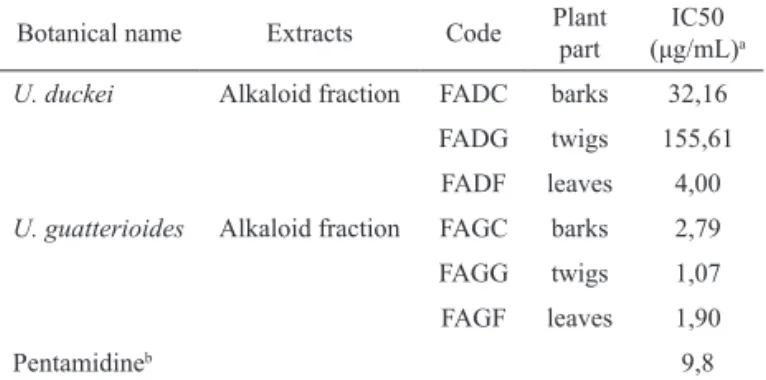
Table 1 presents the results of the leishmanicidal activity of six alkaloid fractions. The fractions from U. guatterioides were classiied as highly active, with the IC50 of alkaloid fractions of the twigs, leaves and
barks, respectively, 1.07, 1.90, and 2.79 μg/mL. On the
other hand, from the evaluated alkaloid fractions of U. duckei, only the portion derived from the leaves showed
high activity, with IC50 of 4.00 μg/mL, with the fraction derived from the barks classiied as active (IC50 32.16 μg/ mL) and the fraction from the twigs classiied as inactive.
The pronounced activity of alkaloid fraction of the twigs
(IC50 1.07 μg/mL) may be a consequence of the presence
of the majority aporphine alkaloid anonaine (1) (Silva et al., 2012a). Previous studies revealed that this alkaloid has
signiicant leishmanicidal activity against promastigotes of L. braziliensis and L. amazonensis (Queiroz et al., 1996). The observation of the high activity of the alkaloid fraction
of the leaves (IC50 1.90 μg/mL) may also be related to
Leishmanicidal activity of fractions rich in aporphine alkaloids from
Amazonian Unonopsis species
Felipe M. A. da Silva et al.
Rev. Bras. Farmacogn. Braz. J. Pharmacogn. 22(6): Nov./Dec. 2012 1370
The alkaloid fraction from the barks of the trunk of U. guatterioides, (IC50 2.79 μg/mL) also showed signiicant activity, that can be attributed to the oxaporphine alkaloids liriodenina (3) and lisycamine (4) (Silva et al., 2012a), which showed good leishmanicidal activity (Waechter et al., 1999) when evaluated against promastigotes form of L. major and L. donovani. Liriodenine also
presented signiicant activity against L. guyanensis and L. braziliensis (Costa et al., 2006). Another alkaloid in the genus Unonopsis described with leishmanicidal potential against promastigote forms of Leishmania in vitro assays is the bisaporphine alkaloid unonopsine (5) isolated from U. buchtienii (Waechter et al., 1999) and from the species synonymy of U. guatterioides, U. lindmanii (Siqueira et al., 1998).
Table 1. Leishmanicidal activity in vitro of alkaloidal fractions of Amazonian Unonopsis species.
Botanical name Extracts Code Plant part
IC50
(μg/mL)a
U. duckei Alkaloid fraction FADC barks 32,16 FADG twigs 155,61
FADF leaves 4,00
U. guatterioides Alkaloid fraction FAGC barks 2,79 FAGG twigs 1,07
FAGF leaves 1,90
Pentamidineb 9,8
aLeishmania (Leishmania) amazonensis strain PH8 (IFLA/BR/67/
PH8); IC50, 50% inhibitory concentration; bReference drug.
The present results demonstrate that both U. duckei and the U. guatterioides have a signiicant leishmanicidal activity. Prior knowledge of the chemistry of the species U. guatterioides reinforces the idea of
potentiality of aporphine alkaloids in the ight against
leishmaniasis. U. guatterioides can be considered a strong candidate to source of metabolites with leishmanicidal character, since in addition to all the fractions were highly actives, is a species that is widely distributed in the Amazon Region.
References
Arango GJ, Cortes D, Cavé A, D’Ocon PM 1988. 7-7'-bisdeshidroaporfns de Unonopsis pacifica. Anales de Quimica, Serie C: Quimica Organica y Bioquimica 84: 124-127.
Bacab MJC, Rodriguez LMP 2001. Plant natural products with leishmanicidal activity. Nat Prod Rep 18: 674-688. Camacho MR, Phillipson SL, Croft PN, Marshall SJ, Ghazanfar
SA 2003. Screening of plants extracts for antiprotozoal and cytotoxic activities. J Ethnopharmacol 89: 185-191.
Costa EV, Pinheiro MLB, Xavier CM, Silva JRA, Amaral AC, Souza ADL, Barison A, Campos FR, Ferreira AG,
Machado GMC, Leon LLPJ 2006. A
pyrimidine-β-carboline and other alkaloids from Annona foetida with antileishmanial activity. J Nat Prod 69: 292-294. Fournier G, Hadjiakhoondi A, Leboeuf M, Cavé A, Charles B
1997. Essential oils of Annonaceae. Part VII. Essential oils of Monanthotaxis diclina (Sprague) Verdcourt and
Unonopsis guatterioides R. E. Fries. Flavour Frag J 12: 95-98.
Gil ES, Paula JR, Nascimento FRF, Bezerra JCB 2008. Produtos naturais com potencial leishmanicida. Rev Cienc Farm Basica Apl 29: 223-230.
Guinaudeau H, Leboeuf M, Cave A 1988. Aporphinoid alkaloids, IV. J Nat Prod 51: 389-474.
Jayasuriya H, Herath KB, Ondeyka JG, Guan Z, Borris RP, Tiwari S, Jong W, Chavez F, Moss J, Stevenson DW, Beck HT, Slattery M, Zamora N, Schulman M, Ali A, Sharma N, Macnaul K, Hayes N, Menke JG, Singh SB 2005. Diterpenoid, steroid, and triterpenoid agonists of liver X receptors from diversified terrestrial plants and marine sources. J Nat Prod 68: 1247-1252. Laprévote O, Roblot F, Hocquemiller R, Cavé A 1988.
Alcaloides des Annonacées, 87. Azafluorénones de L’Unonopsis spectabilis. J Nat Prod 51: 555-561. Maas PJM, Westra LYT, Vermeer M 2007. Revision of the
Neotropical Genera Bocageopsis, Onychopetalum, and Unonopsis (Annonaceae). BLUMEA 52: 413-554.
N
O NH
R2
R1
R2
R1
3R1/R2=OCH2O
4R1=R2=OCH3
1 R1/R2=OCH2O
2 R1=OCH3; R2=OH
NH
HN O
O
O O
Leishmanicidal activity of fractions rich in aporphine alkaloids from
Amazonian Unonopsis species
Felipe M. A. da Silva et al.
Rev. Bras. Farmacogn. Braz. J. Pharmacogn. 22(6): Nov./Dec. 2012 1371 Maciel MAM, Pinto AC, Veiga Jr, VF, Grynberg NF,
Enchevarria A 2002. Plantas medicinais: a necessidade de estudos multidisciplinares. Quim Nova 25: 429-438.
Mishra BB, Kale RR, Singh RK, Tiwari VK 2009. Alkaloids: future prospective to combat leishmaniasis. Fitoterapia 80: 81-90.
Mollataghi A, Coudiere E, Hadi AHA, Mukhtar MR, Awang K, Litaudon M, Ata A 2012. Anti-acetylcholinesterase,
anti-α-glucosidase, anti-leishmanial and anti-fungal
activities of chemical constituents of Beilschmiedia
species. Fitoterapia 83: 298-312.
Montanari CA, Bolzani VS 2001. Planejamento racional de fármacos baseados em produtos naturais. Quim Nova 24: 105-111.
Osório E, Arangoa GJ, Jiménez N, Alzate F, Ruiz G,
Gutiérrez D, Paco MA, Giménez A, Robledo S 2007. Antiprotozoal and cytotoxic activities in vitro of Colombian Annonaceae. J Ethnopharmacol 111: 630-635.
Palazzo MC, Wright HL, Agius BR, Wright BS, Moriarity DM, Haber WA, Setzer WN 2009. Chemical compositions and biological activities of leaf essential oils of six species of Annonaceae from Monteverde, Costa Rica.
Rec Nat Prod 3: 153-160.
Queiroz EF, Roblot F, Cavé A 1996. Pessoine and spinosine, two catecholic berbines from Annona spinescens. J Nat Prod 59: 438-440.
Rath S, Trivelin LA, Imbrunito TR, Tomazela DM, Jesus MN, Marzal PC 2003. Antimoniais empregados no tratamento da leishmaniose: estado da arte. Quim Nova 26: 550-555.
Rocha LG, Almeida JRGS, Macêdo RO, Barbosa-Filho JM 2005. A review of natural product with antileishmanial activity. Phytomedicine 12: 514-535.
Schmeda-Hirschmann G, Razmilic I, Sauvain M, Moretti C, Munoz V 1996. Antiprotozoal activity of jatrogrossidione from Jatropha grossidentada and jatrophone from Jatropha isabelli. Phytother Res 10: 375-378.
Silva DB, Matos MFC, Nakashita ST, Misu CK, Yoshida NC, Carollo CA, Fabri JR, Miglio HS, Siqueira JM
2007. Isolamento e avaliação da atividade citotóxica de alguns alcalóides oxaporfínicos obtidos de
Annonaceae. Quim Nova 30: 1809-1812.
Silva FMA, Koolen HHF, Almeida RA, Souza ADL, Pinheiro MLB, Costa, EV 2012a. Desreplicação de
alcalóides aporfínicos e oxoaporfínicos de Unonopsis guatterioides por ESI-IT-MS. Quim Nova 35: 944-947.
Silva FMA, Koolen HHF, Barisson A, Souza ADL, Pinheiro MLB 2012b. Steroids and triterpene from the bark of
Unonopsis guatterioides R. E. FR. (Anonnaceae). Int
J Pharm Pharmac Sci 4: 522-523.
Siqueira JM, Bomm MD, Pereira FG, Garcez WS, Boaventura
MAD 1998. Estudo fitoquímico de Unonopsis lindmanii - Annonaceae, biomonitorado pelo ensaio de toxicidade sobre a Artemia salina leach. Quim Nova 21: 557-559.
Touche A, Desconclois JF, Jacquemin H, Lelievre Y, Forgacs P 1981. Some constituents of Annonaceae from Guiana qualitative and quantitative analysis of basic free amino acids. Presence of a triterpene, polycarpol.
Plantes Medicinales et Phytotherapie 15: 4-9. Waechter AI, Cave A, Hocquemiller R, Bories C, Munõz V,
Fournet A 1999. Antiprotozoal activity of aporphine alkaloids isolated from Unonopsis buchtienii
(Annonaceae). Phytother Res 13: 175-177.
Zanin SMW, Lordello ALL 2007. Alcalóides aporfinóides do
gênero Ocotea (Lauraceae). Quim Nova 30: 92-98.
*Correspondence
Felipe Moura Araújo da Silva
Departamento de Química, Universidade Federal do
Amazonas
Av. Gal. Rodrigo Otávio, 3000, Japiim, 69077-000 Manaus-AM, Brazil