HESSD
9, 7415–7440, 2012Changes in K ¨oppen-Geiger climate types under a
future climate
R. S. Crosbie et al.
Title Page
Abstract Introduction
Conclusions References
Tables Figures
◭ ◮
◭ ◮
Back Close
Full Screen / Esc
Printer-friendly Version Interactive Discussion
Discussion
P
a
per
|
Dis
cussion
P
a
per
|
Discussion
P
a
per
|
Discussio
n
P
a
per
|
Hydrol. Earth Syst. Sci. Discuss., 9, 7415–7440, 2012 www.hydrol-earth-syst-sci-discuss.net/9/7415/2012/ doi:10.5194/hessd-9-7415-2012
© Author(s) 2012. CC Attribution 3.0 License.
Hydrology and Earth System Sciences Discussions
This discussion paper is/has been under review for the journal Hydrology and Earth System Sciences (HESS). Please refer to the corresponding final paper in HESS if available.
Changes in K ¨oppen-Geiger climate types
under a future climate for Australia:
hydrological implications
R. S. Crosbie1, D. W. Pollock2,*, F. S. Mpelasoka3, O. V. Barron2, S. P. Charles2, and M. J. Donn2
1
CSIRO Water for a Healthy Country National Research Flagship, CSIRO Land and Water, PMB 2, Glen Osmond, SA 5064, Australia
2
CSIRO Water for a Healthy Country National Research Flagship, CSIRO Land and Water, Private Bag 5, Wembley, WA 6913, Australia
3
CSIRO Water for a Healthy Country National Research Flagship, CSIRO Land and Water, G.P.O. Box 1666, Canberra, ACT 2601, Australia
*
now at: Rio Tinto Iron Ore, 152–158 St George’s Terrace Perth, Western Australia, 6000, Australia
Received: 17 May 2012 – Accepted: 1 June 2012 – Published: 12 June 2012 Correspondence to: R. S. Crosbie ([email protected])
HESSD
9, 7415–7440, 2012Changes in K ¨oppen-Geiger climate types under a
future climate
R. S. Crosbie et al.
Title Page
Abstract Introduction
Conclusions References
Tables Figures
◭ ◮
◭ ◮
Back Close
Full Screen / Esc
Printer-friendly Version Interactive Discussion
Discussion
P
a
per
|
Dis
cussion
P
a
per
|
Discussion
P
a
per
|
Discussio
n
P
a
per
Abstract
The K ¨oppen-Geiger climate classification has been used for over a century to delineate climate types across the globe. As it was developed to mimic the distribution of veg-etation it may provide a useful surrogate for making projections of the future distribu-tion of vegetadistribu-tion, and hence resultant hydrological implicadistribu-tions, under climate change 5
scenarios. This paper developed projections of the K ¨oppen-Geiger climate types cov-ering the Australian continent for a 2030 and 2050 climate relative to a 1990 historical baseline climate using 17 Global Climate Models (GCMs) and five global warming sce-narios. At the highest level of classification for a+2.4◦C future climate (the upper limit projected for 2050) relative to the historical baseline, it was projected that the area of 10
the continent covered by:
– Tropical climate types would increase from 8.8 % to 9.1 %
– Arid climate types would increase from 76.5 % to 81.7 %
– Temperate climate types would decrease from 14.7 % to 9.2 %
– Cold climate types would decrease from 0.016 % to 0.001 %. 15
Previous climate change impact studies on water resources in Australia have assumed a static vegetation distribution. If the change in projected climate types is used as a surrogate for a change in vegetation, then the major transition in climate from Temper-ate to Arid in parts of Australia under a drier future climTemper-ate could cause indirect effects on water resources. For a transition from annual cropping to perennial grassland this 20
HESSD
9, 7415–7440, 2012Changes in K ¨oppen-Geiger climate types under a
future climate
R. S. Crosbie et al.
Title Page
Abstract Introduction
Conclusions References
Tables Figures
◭ ◮
◭ ◮
Back Close
Full Screen / Esc
Printer-friendly Version Interactive Discussion
Discussion
P
a
per
|
Dis
cussion
P
a
per
|
Discussion
P
a
per
|
Discussio
n
P
a
per
|
1 Introduction
The K ¨oppen-Geiger climate classification (K ¨oppen, 1936) is the most widely applied method for determining climate zones, it has been used recently in such diverse fields as Environmental Science, Veterinary Science and Mathematics (Rubel and Kottek, 2011). Its origins can be traced to observations of the distribution of vegetation through-5
out Russia (K ¨oppen, 1884) and is still under active development (Kottek et al., 2006; Peel et al., 2007; Rubel and Kottek, 2010).
The central theme of the K ¨oppen-Geiger climate classification is that climate controls the distribution of vegetation (K ¨oppen, 1884), as reflected in some of the names given to the particular climate types e.g. Savannah, Steppe and Tundra (K ¨oppen, 1936). This 10
idea has been used repeatedly over the years such as for Budyko’s (1974) geobotanic zones and the global biome model of Prentice et al. (1992). This link between climate and vegetation is very useful because climate is more readily mapped than vegetation. Vegetation also exerts a strong control over hydrology. Using data from over 250 catchments around the world, Zhang et al. (2001) demonstrated that for any given an-15
nual average rainfall a forested catchment will have a higher evapotranspiration than a grassed catchment. Similarly, from a review of Australian field studies of ground-water recharge, Crosbie et al. (2010a) showed that for a given annual average rainfall groundwater recharge was highest under annual vegetation and lowest under tree type vegetation. Any change in vegetation will have a corresponding impact upon the hydrol-20
ogy of a catchment.
Projections of water resources availability under a future climate have generally as-sumed a static vegetation coverage, either implicitly through calibration of a rainfall-runoffmodel (Chiew et al., 2009b) or explicitly through having a pre-defined vegetation layer as an input to the modelling process (Crosbie et al., 2010b). The limitations of 25
HESSD
9, 7415–7440, 2012Changes in K ¨oppen-Geiger climate types under a
future climate
R. S. Crosbie et al.
Title Page
Abstract Introduction
Conclusions References
Tables Figures
◭ ◮
◭ ◮
Back Close
Full Screen / Esc
Printer-friendly Version Interactive Discussion
Discussion
P
a
per
|
Dis
cussion
P
a
per
|
Discussion
P
a
per
|
Discussio
n
P
a
per
changes in vegetation can be modelled in managed systems using coupled crop growth and economic models (Holman, 2006) or in natural systems using dynamic vegetation growth models (Cramer et al., 2001), however this adds complexity and computational demands upon studies investigating the climate change impacts on water resources.
Given that the K ¨oppen-Geiger climate classification was developed to mimic the dis-5
tribution of vegetation types (K ¨oppen, 1884), it may provide a relatively simple surro-gate for providing projections of future vegetation types under climate change scenar-ios (Kleidon et al., 2000). This paper aims to investigate the changes in climate types for Australia under a future climate based upon projections from an ensemble of Global Climate Models (GCMs) and a range of global warming scenarios and then to discuss 10
the hydrological implications of the projected change in climate types.
2 Methods
The K ¨oppen-Geiger classification is calculated from long term averages of temperature and precipitation at an annual, seasonal and monthly time scale. For the definitions described by Peel et al. (2007) there are 30 discrete climate types, 15 of which are 15
present in Australia (Table 1). At the highest level there are five climate types: Tropical (A), Arid (B), Temperate (C), Cold (D) and Polar (E). Within these five top level climate types there are a number of further classes with the second level delineated by rainfall and the third level delineated by temperature. For a full description of the classification criteria the reader is referred to Peel et al. (2007).
20
For this study the historical climate data used as inputs for calculating the distribution of the K ¨oppen-Geiger climate types across Australia came from the monthly gridded (0.05◦) climate surfaces of the Bureau of Meteorology (Jones et al., 2009). These are created by interpolation of rainfall and temperature anomalies from observation data, for the year 1990 this included over 6000 rainfall stations and 600 temperature stations 25
HESSD
9, 7415–7440, 2012Changes in K ¨oppen-Geiger climate types under a
future climate
R. S. Crosbie et al.
Title Page
Abstract Introduction
Conclusions References
Tables Figures
◭ ◮
◭ ◮
Back Close
Full Screen / Esc
Printer-friendly Version Interactive Discussion
Discussion
P
a
per
|
Dis
cussion
P
a
per
|
Discussion
P
a
per
|
Discussio
n
P
a
per
|
The historical time period considered by this study is 1970 to 2010, this is 20 yr either side of a 1990 centred baseline climate. The future climate scenarios are defined by global warming above a 1990 climate. We have considered a low, medium and high global warming scenario for 2030 (+0.7◦C,
+1.0◦C, and
+1.3◦C) and 2050 (
+1.0◦C, +1.7◦C, and
+2.4◦C) based upon previous work (Crosbie et al., 2012; Post et al., 5
2012) that inferred the degree of global warming from the IPCC Fourth Assessment Report (IPCC, 2007; Nakicenovic and Swart, 2000). These levels of global warming can be considered a surrogate for time, in that the+2.4◦C used here as the high global warming scenario for 2050 could equally be considered a very low global warming scenario for 2100.
10
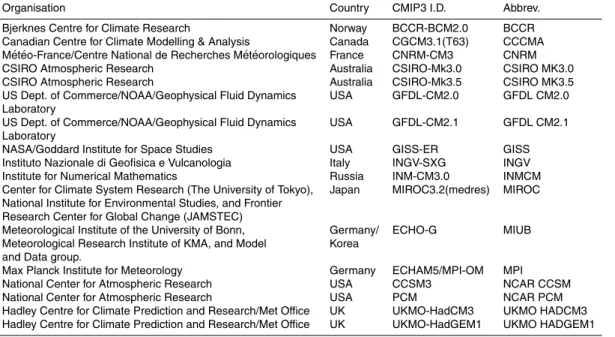
The future climate output from 17 GCMs (Table 2) that are archived by the World Cli-mate Research Programme’s (WCRP’s) Coupled Model Intercomparison Project phase 3 (CMIP3) multi-model dataset (Meehl et al., 2007) were used to derive monthly scaling factors as a percentage change in rainfall per degree of global warming and a change in temperature per degree of global warming at the grid resultion of each GCM (Mitchell, 15
2003; Mpelasoka and Chiew, 2009; Suppiah et al., 2007). These scaling factors were applied to the observed time series of historical monthly gridded rainfall and tempera-ture to create projections for the five global warming scenarios for each of the 17 GCMs. These 85 future climate variants were then assessed on a gridded basis to determine the projected future distribution of K ¨oppen-Geiger climate types across Australia using 20
the definitions of Peel et al. (2007). To simplify the results, the mode of the K ¨oppen-Geiger climate types derived from the 17 GCMs has been reported for each of the five global warming scenarios.
The method used here is different to Rubel and Kottek (2010) who calculated climate types for four emission scenarios after taking the average rainfall and temperature from 25
HESSD
9, 7415–7440, 2012Changes in K ¨oppen-Geiger climate types under a
future climate
R. S. Crosbie et al.
Title Page
Abstract Introduction
Conclusions References
Tables Figures
◭ ◮
◭ ◮
Back Close
Full Screen / Esc
Printer-friendly Version Interactive Discussion
Discussion
P
a
per
|
Dis
cussion
P
a
per
|
Discussion
P
a
per
|
Discussio
n
P
a
per
3 Results
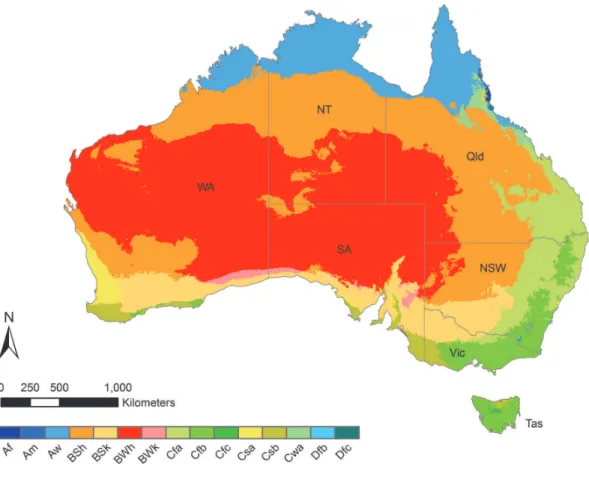
The historical baseline climate types derived from this study are different from those produced by Peel et al. (2007) and Kottek et al. (2006) due to differences in the input data. Jones et al. (2009) had access to more than three times as many rainfall stations and more than twice as many temperature stations compared to Peel et al. (2007) to 5
create the gridded climate surfaces used here, and the resolution of the interpolation is also higher from Jones et al. (2009) compared to that used by Peel et al. (2007) or Kot-tek et al. (2006). Jones et al. (2009) also used an interpolation algorithm that included elevation and so the major differences in climate types are in the higher elevation ar-eas of Victoria (Vic), Tasmania (Tas) and New South Wales (NSW) where the climate 10
types Cfc, Dfb and Dfc are present in this analysis but not that of Peel et al. (2007) or Kottek et al. (2006) (Fig. 1). Overall the difference is quite minor with the Arid types (B) being dominant (76.5 % here compared to 77.8 % in Peel et al., 2007), followed by the Temperate (C) (14.7 % cf 13.9 %), Tropical (A) (8.8 % cf 8.3 %) and Cold (D) (0.016 % here, not present in Peel et al., 2007, or Kottek et al., 2006).
15
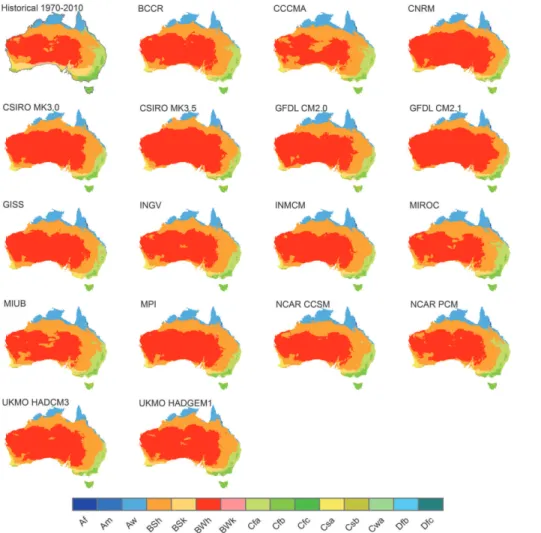
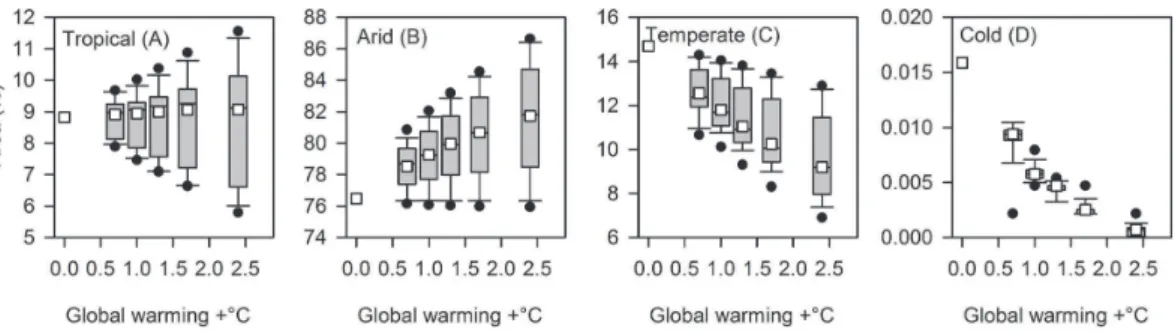
The 17 GCMs used here all give different distributions of future climate types (Fig. 2). The variability in projections of climate types is consistent with the variability previously reported in rainfall (Chiew et al., 2009a), runoff (Chiew et al., 2009b) and recharge (Crosbie et al., 2010b). The most variability is seen in the Tropical (A) climate types where the proportion of the continent with these climate types is projected to decrease 20
by 8 GCMs and increase by 9 GCMs (Fig. 3), this inconsistency between GCMs across Northern Australia has been reported previously (CSIRO, 2009c). There is more con-sensus amongst the projected Arid (B) climate types where 15 out of 17 GCMs project an increase in their proportion of the continent. The projections derived from all GCMs agree that the proportion of the continent covered by the Temperate (C) and Cold 25
HESSD
9, 7415–7440, 2012Changes in K ¨oppen-Geiger climate types under a
future climate
R. S. Crosbie et al.
Title Page
Abstract Introduction
Conclusions References
Tables Figures
◭ ◮
◭ ◮
Back Close
Full Screen / Esc
Printer-friendly Version Interactive Discussion
Discussion
P
a
per
|
Dis
cussion
P
a
per
|
Discussion
P
a
per
|
Discussio
n
P
a
per
|
types, the exception is for the Cold (D) climate types where the proportion of the conti-nent is approaching zero with increasing global warming.
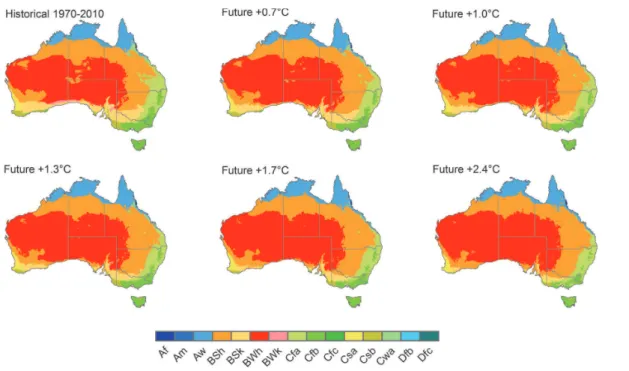
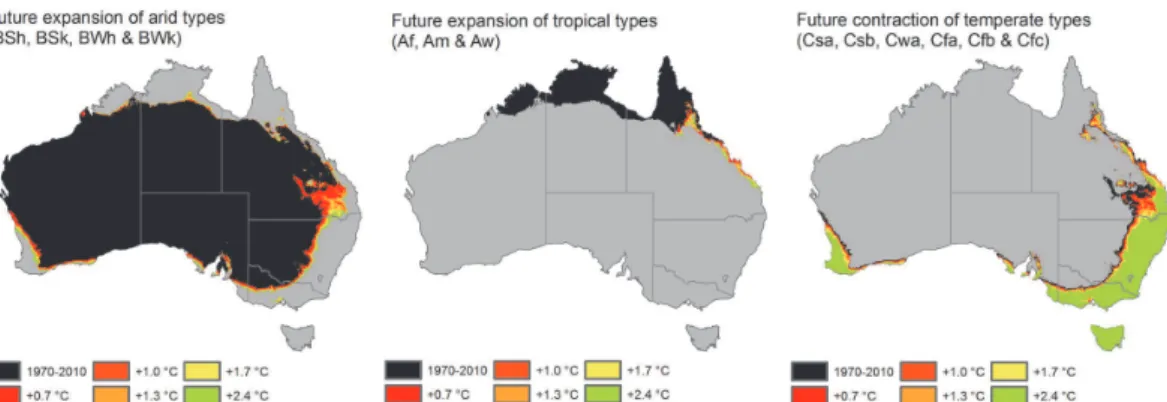
The mode of the climate types from the ensemble of GCMs was determined for each global warming scenario at the historical grid cell scale (Fig. 4) and was further sim-plified to just the changes in top level classifications (Fig. 5). The Tropical (A) climate 5
types are expanding overall with increasing global warming, this is due to an expan-sion along the Queensland (Qld) coast (displacing Temperate) that is progressing faster than the contraction inland (being replaced by Arid). Overall the Tropical (A) area is pro-jected to expand from 8.8 % of the continent under the historical baseline up to 9.1 % for+2.4◦C. The Arid (B) climate types are expanding in every direction with increasing 10
global warming, the area is projected to increase from 76.5 % to 81.7 % of the conti-nent for+2.4◦C. The greatest area of expansion is in the south-east of Queensland, but the more surprising result is that by+1.0◦C the Arid climate types have spread into Southern Victoria. The Temperate (C) climate types are contracting to the south-west, south and south-east after being replaced by Arid (B) climate types and also along the 15
Queensland coast after being replaced by Tropical (A) climate types. Overall the Tem-perate climate types are projected to contract from 14.7 % to 9.2 % of the continent for +2.4◦C. The Cold (D) climate types only occupy a very small proportion of the conti-nent (0.016 %) under the historical baseline climate and this proportion is projected to rapidly disappear with increasing global warming to the point where there are only 2 20
grid cells (∼50 km2) remaining for+2.4◦C.
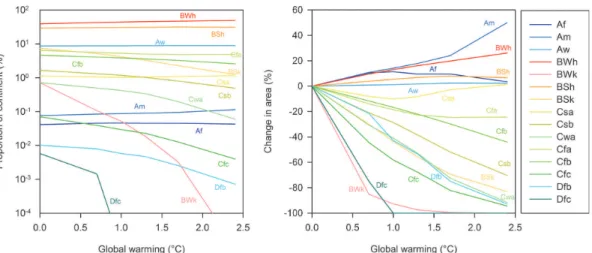
A summary of the changes in the proportion of the continent of each climate type, at the third level of the classification, are shown in Fig. 6. For Af (Tropical, Rainfor-est), the area increases to a peak at +1.0◦C before declining with further increases in global warming to be 3 % above the historical baseline by+2.4◦C. The area of Am 25
(Tropical, Monsoon) increases with increasing global warming to be 50 % above the historical baseline by+2.4◦
HESSD
9, 7415–7440, 2012Changes in K ¨oppen-Geiger climate types under a
future climate
R. S. Crosbie et al.
Title Page
Abstract Introduction
Conclusions References
Tables Figures
◭ ◮
◭ ◮
Back Close
Full Screen / Esc
Printer-friendly Version Interactive Discussion
Discussion
P
a
per
|
Dis
cussion
P
a
per
|
Discussion
P
a
per
|
Discussio
n
P
a
per
This climate type is projected to have a small increase in area with increasing global warming (8.9 % of the continent for+2.4◦C); this is caused by a contraction in inland areas and an expansion southward along the Queensland coast.
The Arid climate types cover most of the continent, of them BWh (Arid, Desert, Hot) covers the most area of 39.2 % under the historical baseline (Fig. 6). This climate type 5
is projected to expand to the south-west, south and south-east and by+2.4◦
C covers 49.4 % of the continent. Under the historical baseline climate BSh (Arid, Steppe, Hot) covers the second greatest area (29.2 %) and this is projected to increase to the north, east, south-east, south and south-west to a total of 31.1 % of the continent by+2.4◦
C. Under the historical baseline climate BSk (Arid, Steppe, Hot) had the fourth greatest 10
area (7.4 %) but is projected to see the majority (83 %) of this area replaced by BSh by +2.4◦
C. The BWk (Arid, Steppe, Cold) climate type only occupies a small proportion of the continent under the historical baseline climate (0.7 %) and this is completely replaced by BWh by+2.4◦C.
The Temperate (C) climate types are projected to have the greatest reduction in area 15
under a future climate (Fig. 6). Climate type Csa (Temperate, Dry Summer, Hot Sum-mer) initially decreases in area with increasing global warming to reach a minimum at+1.0◦
C where it is being replaced by BSh, with further global warming Csa is dis-placing Csb (Temperate, Dry Summer, Warm Summer) and by+2.4◦C occupies 1 % more area than it did under the historical baseline climate (1.1 % of the continent). Cli-20
mate type Csb occupied 1.6 % of the continent under the historical baseline climate and this decreases rapidly with increasing global warming for a 70 % reduction in area by+2.4◦C. The Cwa (Temperate, Dry Winter, Hot Summer) climate type only occupies a small area (0.7 % of the continent) of North Queensland under the historical baseline climate. Under the future climate scenarios this area is projected to be displaced by 25
HESSD
9, 7415–7440, 2012Changes in K ¨oppen-Geiger climate types under a
future climate
R. S. Crosbie et al.
Title Page
Abstract Introduction
Conclusions References
Tables Figures
◭ ◮
◭ ◮
Back Close
Full Screen / Esc
Printer-friendly Version Interactive Discussion
Discussion
P
a
per
|
Dis
cussion
P
a
per
|
Discussion
P
a
per
|
Discussio
n
P
a
per
|
BSh from the north-west and is replacing Cfb (Temperate, Without Dry Season, Warm Summer) to the south-east, overall the area it occupies is projected to decrease by 24 % by+2.4◦C. Under the future climate scenarios the Cfb climate type is decreasing in area with increasing global warming, by+2.4◦C it is projected to have lost 44 % of the 4.6 % of the continent that it occupied under the historical baseline climate. The 5
Cfc (Temperate, Without Dry Season, Cold Summer) climate type only occurs in small areas (0.07 % of the continent) of Tasmania (Tas) under this historical baseline climate, under the future climate scenarios it is projected to be increasingly replaced by Cfb with increased global warming (94 % reduction by+2.4◦C).
The Cold (D) climate types Dfb (Cold, Without Dry Season, Warm Summer) and 10
Dfc (Cold, Without Dry Season, Cold Summer) only occupy a small area (0.01 % and 0.006 %, respectively) of New South Wales and Victoria at high altitude under the his-torical baseline climate. After +1.0◦C Dfc is projected to be completely replaced (by Cfb) and by+2.4◦C the projected area of Dfb is reduced by 93 %.
4 Discussion
15
The modelled direct effects of projected climate change on water resources have been extensively studied in Australia in recent years (CSIRO, 2008, 2009a–c). The results of these studies can be placed into the context of the K ¨oppen-Geiger climate classi-fication. In the historical baseline climate the Cold (D) climate types form a subset of the Extremely High Yield Zone of Donohue et al. (2011) which are defined as energy 20
limited and are responsible for a disproportionately large amount of the runoff in the Murray-Darling Basin (MDB). The change in climate type from Cold (D) to Temperate (C) is the result of a projected increase in temperature and therefore potential evapo-transpiration, combined with a projected decrease in rainfall (Chiew et al., 2009a) and the area that is water limited is reduced which results in less runoff. The area classified 25
HESSD
9, 7415–7440, 2012Changes in K ¨oppen-Geiger climate types under a
future climate
R. S. Crosbie et al.
Title Page
Abstract Introduction
Conclusions References
Tables Figures
◭ ◮
◭ ◮
Back Close
Full Screen / Esc
Printer-friendly Version Interactive Discussion
Discussion
P
a
per
|
Dis
cussion
P
a
per
|
Discussion
P
a
per
|
Discussio
n
P
a
per
The transition of areas from Temperate (C) to Arid (B) climate types could cause either an increase or decrease in recharge. Barron et al. (2012) showed that ground-water recharge under BSh is higher for a given annual rainfall than Cfa but BSh by definition experiences a lower rainfall than Cfa (Peel et al., 2007). The majority of the areas projected to transition from Temperate (C) to Arid (B) under a future climate are 5
also projected to have a reduction in recharge (Crosbie et al., 2012), the analysis of Barron et al. (2012) suggests that the reduction in recharge would have been greater without the change in climate type.
For a future climate of+2.4◦C, 24 % of the country is projected to change climate type. This includes the disappearance of two climate types completely (BWk & Dfc) and 10
five others that are projected to occupy less than one third of the area that they occu-pied under the historical baseline climate (BSk, Csb, Cwa, Cfc & Dfb). These changes in climate type will cause changes in vegetation types that are not actively managed and potentially also a loss of biodiversity (Markham, 1996). Dynamic vegetation growth models have been used to assess the temporal (as well as spatial) scale of potential 15
vegetation changes and in some cases it has been reported that vegetation change could take over 100 yr to come to equilibrium after the climate has reached a new equi-librium (Cramer et al., 2001; Loehle, 2011). There are also observations that suggest that vegetation change could occur much more rapidly, this could occur due to a catas-trophic event such as forest mortality (Mitchell et al., 2012) or gradually over a couple of 20
decades as has been observed through an increase in persistent vegetation (Donohue et al., 2009).
In actively managed agricultural landscapes, any change in vegetation type will result from socio-economic factors rather than climate change alone (Holman, 2006). This will occur when it is no longer profitable to grow crops. Under the historical baseline climate 25
HESSD
9, 7415–7440, 2012Changes in K ¨oppen-Geiger climate types under a
future climate
R. S. Crosbie et al.
Title Page
Abstract Introduction
Conclusions References
Tables Figures
◭ ◮
◭ ◮
Back Close
Full Screen / Esc
Printer-friendly Version Interactive Discussion
Discussion
P
a
per
|
Dis
cussion
P
a
per
|
Discussion
P
a
per
|
Discussio
n
P
a
per
|
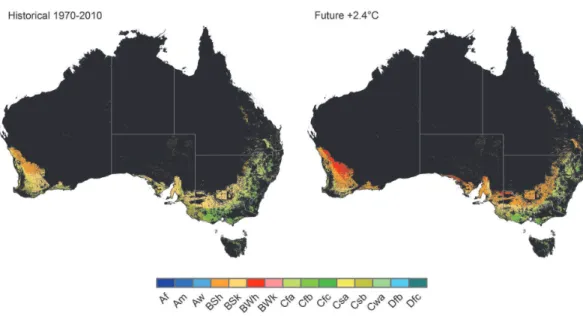
annual vegetation under the BWh climate type. Under a +2.4◦C future climate BWh has moved into the northern wheatbelt (WA), far west, mid north, riverland (SA) and the sunraysia (Vic) areas of annual vegetation. The BSh climate type is projected to be dominant in the southern wheatbelt (WA), Eyre Peninsula, Yorke Peninsula, Mallee (SA), northern plains (Vic), the northern, central and southern slopes (NSW), and the 5
Darling Downs (Qld). Large reductions in wheat yield have been projected under a fu-ture climate in the areas that are projected to become BWh climate types (Farre and Foster, 2010; Wang et al., 2009; Luo et al., 2005).
If areas that are currently under annual crops and pastures change to another land use due to climate change, then there will be a corresponding hydrological impact. 10
For example, the northern wheatbelt (WA) is projected to have a 10–20 % reduction in recharge for a median 2050 climate assuming that the vegetation type remains static (Crosbie et al., 2012). However, if the vegetation were to revert to a more naturalised state of perennial vegetation then the recharge could be reduced by at least double the amount projected for climate change directly (Fig. 8). In this example the direct and 15
indirect effects of climate change upon groundwater recharge are compounded (i.e. a positive feedback).
The largest transition in climate types projected for +2.4◦C is from Temperate (C) to Arid (B); this could cause a transition in vegetation type in some areas from forest to grassland. Many of the forested areas of south-east Australia are projected to have 20
a decrease in runoffdue to reduced rainfall under a future climate (Chiew et al., 2009b). Some of these areas are also projected to have a change in climate type from Temper-ate (C) to Arid (B). Zhang et al. (2001) showed that for a given annual rainfall, forests have greater evapotranspiration than grassland and consequently less runoff(Fig. 8). If reduced rainfall under a future climate results in a transition from forest to grassland, 25
HESSD
9, 7415–7440, 2012Changes in K ¨oppen-Geiger climate types under a
future climate
R. S. Crosbie et al.
Title Page
Abstract Introduction
Conclusions References
Tables Figures
◭ ◮
◭ ◮
Back Close
Full Screen / Esc
Printer-friendly Version Interactive Discussion
Discussion
P
a
per
|
Dis
cussion
P
a
per
|
Discussion
P
a
per
|
Discussio
n
P
a
per
5 Conclusions
This paper has presented projections of K ¨oppen-Geiger climate types across Australia for future climates based upon 17 GCMs and five global warming scenarios. There is no consensus amongst the GCMs in the projections for the Tropics (A), where nine GCMs project an increase in area and eight project a decrease. The mode of the GCMs 5
shows an increase of 0.3 % in area for a global warming scenario of+2.4◦C to 9.1 % from 8.8 % under the historical baseline climate. For the Arid (B) climate types 15 out of 17 GCMs project an increase in area with a mode of 81.7 % of the continent for +2.4◦C compared to 76.5 % under the historical baseline climate. All 17 GCMs project reductions in the Temperate (C) and Cold (D) climate types. The increase in the area 10
covered by the Arid (B) climate types is balanced by a reduction in the Temperate (C) climate types with the historical baseline climate being 14.7 % of the continent and this is projected to reduce to 9.2 % for a+2.4◦C future climate. The Cold (D) climate types only occupy a very small part of the continent under the historical baseline climate (0.016 %) and this is reduced by 95 % under a+2.4◦C future climate.
15
Under a warmer drier climate, previous studies have made projections for reduc-tions in runoff and recharge over large parts of Australia assuming static vegetation coverage. As the K ¨oppen-Geiger climate classification was developed based upon the distribution of vegetation it may provide a useful surrogate for vegetation change pro-jections under a future climate. If vegetation change were to be incorporated into future 20
projections of water resources availability it could provide different results. A transition in vegetation type from annual cropping to perennial grassland would have a com-pounding effect on a reduction in recharge whereas a transition from forest vegetation to grassland would have a mitigating effect upon a reduction in runoff. Therefore it is recommended that detailed research is necessary to incorporate the indirect effects of 25
HESSD
9, 7415–7440, 2012Changes in K ¨oppen-Geiger climate types under a
future climate
R. S. Crosbie et al.
Title Page
Abstract Introduction
Conclusions References
Tables Figures
◭ ◮
◭ ◮
Back Close
Full Screen / Esc
Printer-friendly Version Interactive Discussion
Discussion
P
a
per
|
Dis
cussion
P
a
per
|
Discussion
P
a
per
|
Discussio
n
P
a
per
|
Acknowledgements. The authors would like to acknowledge the National Water Commission
for providing funding to support the Climate Change Impacts on Groundwater Resources
project under the National Groundwater Action Plan and CMIP3 for providing GCM outputs.
References
Barron, O. V., Crosbie, R. S., Pollock, D., Dawes, W. R., Charles, S. P., Pickett, T., and Donn, M.:
5
Climatic controls on diffuse groundwater recharge across Australia, Hydrol. Earth Syst. Sci. Discuss., 9, 6023–6062, doi:10.5194/hessd-9-6023-2012, 2012.
BRS: Integrated Vegetation Cover 2008, Bureau of Rural Sciences, Canberra, 2008. Budyko, M. I.: Climate and Life, International Geophysics, Academic Press, 508 pp., 1974. Chiew, F. H. S., Teng, J., Vaze, J., and Kirono, D. G. C.: Influence of global climate model
10
selection on runoffimpact assessment, J. Hydrol., 379, 172–180, 2009a.
Chiew, F. H. S., Teng, J., Vaze, J., Post, D. A., Perraud, J. M., Kirono, D. G. C., and Viney, N. R.: Estimating climate change impact on runoff across Southeast Australia: method, results, and implications of the modeling method, Water Resour. Res., 45, W10414, doi:10.1029/2008WR007338, 2009b.
15
Cramer, W., Bondeau, A., Woodward, F. I., Prentice, I. C., Betts, R. A., Brovkin, V., Cox, P. M., Fisher, V., Foley, J. A., Friend, A. D., Kucharik, C., Lomas, M. R., Ramankutty, N., Sitch, S., Smith, B., White, A., and Young-Molling, C.: Global response of terrestrial ecosystem struc-ture and function to CO2 and climate change: results from six dynamic global vegetation models, Global Change Biol., 7, 357–373, doi:10.1046/j.1365-2486.2001.00383.x, 2001.
20
Crosbie, R. S., Jolly, I. D., Leaney, F. W., and Petheram, C.: Can the dataset of field based recharge estimates in Australia be used to predict recharge in data-poor areas?, Hydrol. Earth Syst. Sci., 14, 2023–2038, doi:10.5194/hess-14-2023-2010, 2010a.
Crosbie, R. S., McCallum, J. L., Walker, G. R., and Chiew, F. H. S.: Modelling the climate change impact on groundwater recharge in the Murray-Darling Basin, Hydrogeol. J., 18, 1639–1656,
25
2010b.
HESSD
9, 7415–7440, 2012Changes in K ¨oppen-Geiger climate types under a
future climate
R. S. Crosbie et al.
Title Page
Abstract Introduction
Conclusions References
Tables Figures
◭ ◮
◭ ◮
Back Close
Full Screen / Esc
Printer-friendly Version Interactive Discussion
Discussion
P
a
per
|
Dis
cussion
P
a
per
|
Discussion
P
a
per
|
Discussio
n
P
a
per
CSIRO: Water availability in the Murray-Darling Basin. A report to the Australian Govern-ment from the CSIRO Murray-Darling Basin Sustainable Yields Project, CSIRO: Water for a Healthy Country National Research Flagship, Canberra, Australia, 67, 2008.
CSIRO: Water yields and demands in South-West Western Australia: Summary of a report to the Australian Government from the CSIRO SWSY Project, CSIRO: Water for a Healthy
5
Country National Research Flagship, Canberra, 2009a.
CSIRO: Water availability for Tasmania: CSIRO Tasmania Sustainable Yields Project, CSIRO: Water for a Healthy Country National Research Flagship, Canberra, 2009b.
CSIRO: Water in Northern Australia: Summary of Reports to the Australian Government from the CSIRO Northern Australia Sustainable Yields Project, CSIRO: Water for a Healthy
Coun-10
try National Research Flagship, Canberra, 2009c.
Donohue, R. J., McVicar, T. R., and Roderick, M. L.: Climate-related trends in Australian veg-etation cover as inferred from satellite observations, 1981–2006, Global Change Biol., 15, 1025–1039, 2009.
Donohue, R. J., Roderick, M. L., and McVicar, T. R.: Assessing the differences in sensitivities
15
of runoffto changes in climatic conditions across a large basin, J. Hydrol., 406, 234–244, doi:10.1016/j.jhydrol.2011.07.003, 2011.
Farre, I. and Foster, I.: Impact of climate change on wheat yields in Western Australia. Will wheat production be more risky in the future?, Food Security from Sustainable Agriculture, in: Proceedings of 15th Agronomy Conference, Lincoln, New Zealand, 2010.
20
Holman, I., Allen, D., Cuthbert, M., and Goderniaux, P.: Towards best practice for assessing the impacts of climate change on groundwater, Hydrogeol. J., 20, 1–4, doi:10.1007/s10040-011-0805-3, 2012.
Holman, I. P.: Climate change impacts on groundwater recharge: uncertainty, shortcomings and the way forward?, Hydrogeol. J., 14, 637–647, 2006.
25
IPCC: Climate Change 2007: The Physical Science Basis. Contribution of Working Group 1 to the Fourth Assessment Report of the Intergovernmental Panel on Climate Change, edited by: Solomon, S., Qin, D., Manning, M., Chen, Z., Marquis, M., Averyt, K. B., Tignor, M., and Miller, H. L., Cambridge University Press, Cambridge, UK, 996 pp., 2007.
Jones, D. A., Wang, W., and Fawcett, R.: High-quality spatial climate data-sets for Australia,
30
HESSD
9, 7415–7440, 2012Changes in K ¨oppen-Geiger climate types under a
future climate
R. S. Crosbie et al.
Title Page
Abstract Introduction
Conclusions References
Tables Figures
◭ ◮
◭ ◮
Back Close
Full Screen / Esc
Printer-friendly Version Interactive Discussion
Discussion
P
a
per
|
Dis
cussion
P
a
per
|
Discussion
P
a
per
|
Discussio
n
P
a
per
|
Kleidon, A., Fraedrich, K., and Heimann, M.: A green planet versus a desert world: estimating the maximum effect of vegetation on the land surface climate, Climatic Change, 44, 471–493, doi:10.1023/a:1005559518889, 2000.
K ¨oppen, W.: Das geographisca System der Klimate, in: Handbuch der Klimatologie, edited by: K ¨oppen, W. and Geiger, G., Borntraeger, Berlin, 1–44, 1936.
5
K ¨oppen, W.: Die W ¨armezonen der Erde, nach der Dauer der heissen, gem ¨assigten und kalten Zeit und nach der Wirkung der W ¨arme auf die organische Welt betrachtet (The thermal zones of the earth according to the duration of hot, moderate and cold periods and to the impact of heat on the organic world), Meteorol. Z., 1, 215–226, 1884, translated and edited by: Volken, E. and Br ¨onnimann, S., Meteorol. Z., 220, 2351–2360, 2011.
10
Kokic, P., Heaney, A., Pechey, L., Crimp, S., and Fisher, B. S.: Climate change, predicting the impacts on agriculture: a case study, Aust. Commod., 12, 161–170, 2005.
Kottek, M., Grieser, J., Beck, C., Rudolf, B., and Rubel, F.: World map of the K ¨oppen-Geiger climate classification updated, Meteorol. Z., 15, 259–263, 2006.
Loehle, C.: Criteria for assessing climate change impacts on ecosystems, Ecol. Evol., 1, 63–72,
15
2011.
Luo, Q., Bellotti, W., Williams, M., and Bryan, B.: Potential impact of climate change on wheat yield in South Australia, Agr. Forest Meteorol., 132, 273–285, 2005.
Markham, A.: Potential impacts of climate change on ecosystems: a review of implications for policymakers and conservation biologists, Clim. Res., 6, 179–191, doi:10.3354/cr006179,
20
1996.
Meehl, G. A., Covey, C., Delworth, T., Latif, M., McAvaney, B., Mitchell, J. F. B., Stouffer, R. J., and Taylor, K. E.: The WCRP CMIP3 multimodel dataset – a new era in climate change research, B. Am. Meteorol. Soc., 88, 1383–1394, 2007.
Mitchell, P. J. M., O’Grady, A. P., and Pinkard, E. A.: Defining past and future climate drivers
25
of drought induced tree mortality: a case study from Southern Australia, Nature Climate Change, in review, 2012.
Mitchell, T. D.: Pattern scaling – an examination of the accuracy of the technique for describing future climates, Climatic Change, 60, 217–242, doi:10.1023/a:1026035305597, 2003. Mpelasoka, F. S. and Chiew, F. H. S.: Influence of rainfall scenario construction methods on
30
runoffprojections, J. Hydrometeorol., 10, 1168–1183, 2009.
HESSD
9, 7415–7440, 2012Changes in K ¨oppen-Geiger climate types under a
future climate
R. S. Crosbie et al.
Title Page
Abstract Introduction
Conclusions References
Tables Figures
◭ ◮
◭ ◮
Back Close
Full Screen / Esc
Printer-friendly Version Interactive Discussion
Discussion
P
a
per
|
Dis
cussion
P
a
per
|
Discussion
P
a
per
|
Discussio
n
P
a
per
Peel, M. C., Finlayson, B. L., and McMahon, T. A.: Updated world map of the K ¨oppen-Geiger climate classification, Hydrol. Earth Syst. Sci., 11, 1633–1644, doi:10.5194/hess-11-1633-2007, 2007.
Post, D. A., Chiew, F. H. S., Teng, J., Viney, N. R., Ling, F. L. N., Harrington, G., Crosbie, R. S., Graham, B., Marvanek, S., and McLoughlin, R.: A robust methodology for conducting
large-5
scale assessments of current and future water availability and use: a case study in Tasmania, Australia, J. Hydrol., 412–413, 233–245, doi:10.1016/j.jhydrol.2011.02.011, 2012.
Prentice, I. C., Cramer, W., Harrison, S. P., Leemans, R., Monserud, R. A., and Solomon, A. M.: A global biome model based on plant physiology and dominance, soil properties and climate, J. Biogeogr., 19, 117–134, 1992.
10
Rubel, F. and Kottek, M.: Observed and projected climate shifts 1901–2100 depicted by world maps of the Koppen-Geiger climate classification, Meteorol. Z., 19, 135–141, doi:10.1127/0941-2948/2010/0430, 2010.
Rubel, F. and Kottek, M.: Comments on: The thermal zones of the Earth by Wladimir Koppen (1884), Meteorol. Z., 20, 361–365, 2011.
15
Suppiah, R., Hennessy, K., Whetton, P. H., McInnes, K., Macadam, I., Bathols, J., Ricketts, J., and Page, C. M.: Australian climate change projections derived from simulations performed for the IPCC 4th Assessment Report, Aust. Meteorol. Mag., 56, 131–152, 2007.
Wang, E., Cresswell, H., Bryan, B., Glover, M., and King, D.: Modelling farming systems perfor-mance at catchment and regional scales to support natural resource management,
NJAS-20
Wagen. J. Life Sc., 57, 101–108, 2009.
HESSD
9, 7415–7440, 2012Changes in K ¨oppen-Geiger climate types under a
future climate
R. S. Crosbie et al.
Title Page
Abstract Introduction
Conclusions References
Tables Figures
◭ ◮
◭ ◮
Back Close
Full Screen / Esc
Printer-friendly Version Interactive Discussion
Discussion
P
a
per
|
Dis
cussion
P
a
per
|
Discussion
P
a
per
|
Discussio
n
P
a
per
|
Table 1.Description of the K ¨oppen-Geiger climate types in Australia, see Peel et al. (2007) for classification criteria.
Code Description
Af Tropical, Rainforest Am Tropical, Monsoon Aw Tropical, Savannah BWh Arid, Desert, Hot BWk Arid, Desert, Cold BSh Arid, Steppe, Hot BSk Arid, Steppe, Cold
Csa Temperate, Dry Summer, Hot Summer Csb Temperate, Dry Summer, Warm Summer Cwa Temperate, Dry Winter, Hot Summer
HESSD
9, 7415–7440, 2012Changes in K ¨oppen-Geiger climate types under a
future climate
R. S. Crosbie et al.
Title Page
Abstract Introduction
Conclusions References
Tables Figures
◭ ◮
◭ ◮
Back Close
Full Screen / Esc
Printer-friendly Version Interactive Discussion
Discussion
P
a
per
|
Dis
cussion
P
a
per
|
Discussion
P
a
per
|
Discussio
n
P
a
per
Table 2.List of GCMs used in this study also showing the abbreviations used in Fig. 2.
Organisation Country CMIP3 I.D. Abbrev. Bjerknes Centre for Climate Research Norway BCCR-BCM2.0 BCCR Canadian Centre for Climate Modelling & Analysis Canada CGCM3.1(T63) CCCMA M ´et ´eo-France/Centre National de Recherches M ´et ´eorologiques France CNRM-CM3 CNRM CSIRO Atmospheric Research Australia CSIRO-Mk3.0 CSIRO MK3.0 CSIRO Atmospheric Research Australia CSIRO-Mk3.5 CSIRO MK3.5 US Dept. of Commerce/NOAA/Geophysical Fluid Dynamics USA GFDL-CM2.0 GFDL CM2.0 Laboratory
US Dept. of Commerce/NOAA/Geophysical Fluid Dynamics USA GFDL-CM2.1 GFDL CM2.1 Laboratory
NASA/Goddard Institute for Space Studies USA GISS-ER GISS Instituto Nazionale di Geofisica e Vulcanologia Italy INGV-SXG INGV Institute for Numerical Mathematics Russia INM-CM3.0 INMCM Center for Climate System Research (The University of Tokyo), Japan MIROC3.2(medres) MIROC National Institute for Environmental Studies, and Frontier
Research Center for Global Change (JAMSTEC)
Meteorological Institute of the University of Bonn, Germany/ ECHO-G MIUB Meteorological Research Institute of KMA, and Model Korea
and Data group.
HESSD
9, 7415–7440, 2012Changes in K ¨oppen-Geiger climate types under a
future climate
R. S. Crosbie et al.
Title Page
Abstract Introduction
Conclusions References
Tables Figures
◭ ◮
◭ ◮
Back Close
Full Screen / Esc
Printer-friendly Version Interactive Discussion
Discussion
P
a
per
|
Dis
cussion
P
a
per
|
Discussion
P
a
per
|
Discussio
n
P
a
per
|
HESSD
9, 7415–7440, 2012Changes in K ¨oppen-Geiger climate types under a
future climate
R. S. Crosbie et al.
Title Page
Abstract Introduction
Conclusions References
Tables Figures
◭ ◮
◭ ◮
Back Close
Full Screen / Esc
Printer-friendly Version Interactive Discussion
Discussion
P
a
per
|
Dis
cussion
P
a
per
|
Discussion
P
a
per
|
Discussio
n
P
a
per
Fig. 2.K ¨oppen-Geiger climate types under a future climate of+2.4◦C derived from 17 GCMs
HESSD
9, 7415–7440, 2012Changes in K ¨oppen-Geiger climate types under a
future climate
R. S. Crosbie et al.
Title Page
Abstract Introduction
Conclusions References
Tables Figures
◭ ◮
◭ ◮
Back Close
Full Screen / Esc
Printer-friendly Version Interactive Discussion
Discussion
P
a
per
|
Dis
cussion
P
a
per
|
Discussion
P
a
per
|
Discussio
n
P
a
per
|
HESSD
9, 7415–7440, 2012Changes in K ¨oppen-Geiger climate types under a
future climate
R. S. Crosbie et al.
Title Page
Abstract Introduction
Conclusions References
Tables Figures
◭ ◮
◭ ◮
Back Close
Full Screen / Esc
Printer-friendly Version Interactive Discussion
Discussion
P
a
per
|
Dis
cussion
P
a
per
|
Discussion
P
a
per
|
Discussio
n
P
a
per
HESSD
9, 7415–7440, 2012Changes in K ¨oppen-Geiger climate types under a
future climate
R. S. Crosbie et al.
Title Page
Abstract Introduction
Conclusions References
Tables Figures
◭ ◮
◭ ◮
Back Close
Full Screen / Esc
Printer-friendly Version Interactive Discussion
Discussion
P
a
per
|
Dis
cussion
P
a
per
|
Discussion
P
a
per
|
Discussio
n
P
a
per
|
HESSD
9, 7415–7440, 2012Changes in K ¨oppen-Geiger climate types under a
future climate
R. S. Crosbie et al.
Title Page
Abstract Introduction
Conclusions References
Tables Figures
◭ ◮
◭ ◮
Back Close
Full Screen / Esc
Printer-friendly Version Interactive Discussion
Discussion
P
a
per
|
Dis
cussion
P
a
per
|
Discussion
P
a
per
|
Discussio
n
P
a
per
HESSD
9, 7415–7440, 2012Changes in K ¨oppen-Geiger climate types under a
future climate
R. S. Crosbie et al.
Title Page
Abstract Introduction
Conclusions References
Tables Figures
◭ ◮
◭ ◮
Back Close
Full Screen / Esc
Printer-friendly Version Interactive Discussion
Discussion
P
a
per
|
Dis
cussion
P
a
per
|
Discussion
P
a
per
|
Discussio
n
P
a
per
|
HESSD
9, 7415–7440, 2012Changes in K ¨oppen-Geiger climate types under a
future climate
R. S. Crosbie et al.
Title Page
Abstract Introduction
Conclusions References
Tables Figures
◭ ◮
◭ ◮
Back Close
Full Screen / Esc
Printer-friendly Version Interactive Discussion
Discussion
P
a
per
|
Dis
cussion
P
a
per
|
Discussion
P
a
per
|
Discussio
n
P
a
per