T
HE EFFECTS OF THE EXPANSION OF INNOVATIVE
CLUSTERS ON THE REGIONAL TERRITORIAL
DEVELOPMENT
Ilinca-Adela MĂRGINEANU Candidate to a Master Degree in Urban Planning, „Ion Mincu” University of Architecture and Urban Planning in Bucharest Research Assistant - National Institute for Research and Development in Construction, Urban Planning and Sustainable Spatial Development „URBAN-INCERC”, URBANPROIECT Branch [email protected]
Abstract. This article is a short synthesis of a project which aims to
determinate, on a scientific basis, the potential ways and efficient methods for the national territorial planning, in order to formulate and apply public policies to regional development and for the achievement of territorial, economic and social cohesion. The goal was to raise the competitiveness of the companies in order to be able to face new economic challenges, to enhance productivity and the employment rate in the regions and increase the income of the local communities, in order to improve the living conditions.
Key words: cohesion, technology, transformation, research, economy,
education, competitiveness, know-how, awareness
1. Introduction – evolution and clusters
This article prese nts the notion of “innovative clusters and te chnology poles” looking at different examples in the European Union, in order to analyse long-term techno-industrial change in Romania.
The prospect of being able to identify
long-term regularities in the
development of regions has been highly
debated. Patterns and cycles are
attractive because if they are veracious
representations of repe titive
regularities, they could provide clue s as
to what we need the policy to promote or to avoid in the near future. Many characteristics of the proce ss of industry or sectoral development are subject to path-dependent evolutionary dynamics (Storper, 1997).
activity throughout the world consists in a mechanism.
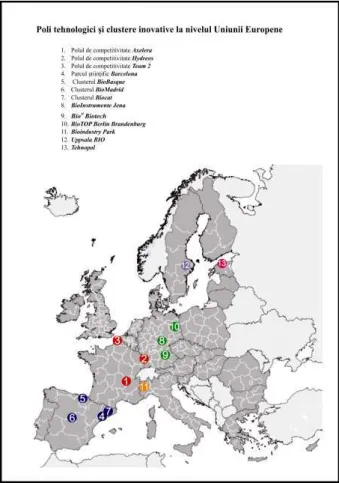
The first part of the project shows a few examples of technological poles and innovative clusters in member countries of the European Union (Fig. 1), such as
Sweden (Uppsala Bio), Estonia (Technopol),
Germany (BioInstrument Jena, Bio Biotech,
BioTOP Berlin Brandenburg), Italy (Bioindustry Park), France (Axelera,
Hydreos, Team 2) and Spain (Barcelona,
BioBasque, BioMadrid, Biocat) (Datar.gouv.fr, 2011; European Cluster Excellence Initiative, 2012).
The second part of the proje ct studies the situation in Romania; until the year 1990, the industrial enterprises were grouped together into generally named „Industrial Groups” and at present we
are witnessing the restr ucturing of this system as clusters. This „clustering” process has appeared in Romania, as well as in other former communist countries and underwent an e xtensive and difficult process of implementation.
The cl usters and other industrial fields have appeared on a clearly established base, followed shortly by research and technology, in other more developed European states (Stor per and Harrison, 1991).
We can see how the learning capacity of local firms is very much improved by
the presence of other related
enterprises, the resear ch and
development facilities, and also by a developmental state in a market-oriented spatial cluster.
1.1. The situation in Romania
As it was mentioned above, this kind of
development was based on
industrialization, a particular situation for the entire continent and not only, after the Second World War. In time they settled as industrial groups in the countries of the communist bloc.
The most well-known of them in Romania
are still in place, like the 23 August Industrial
Group (the former ‘Malaxa’ Company), the
IMGB Industrial Platform, the SIDEX Galaţi Platform, etc.
As it was mentioned in the introduction, in the ’90s these great companies have known a slow process, gradually reducing their production capacity and employment, so the competitiveness at an international level
was significantly reduced, even as
compared to the grey early years of the ’80s. In this way, it made it into a key-point where the optimal decision to re-launch these activities was a positive sign through a total or partial transformation of cluster
technology and equipment (Tehnopolis, 2012; Research Institute for Knowledge Systems, 2012).
1.2. Aspects
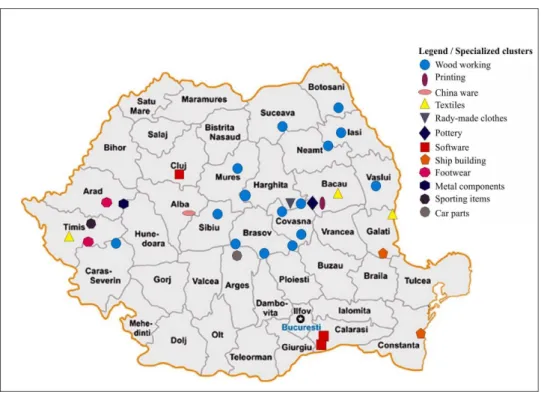
We must consider and evaluate the dimension of the gap between the theories of research clusters, the qualifications and skills of entrepreneurs, and the policies created for the eight developing regions of Romania. By reducing this gap, we can identify the limits in the developing process of the clusters and there might be an opportunity for a strong and complete set of measures, which can allow an optimal balance of the resources, and of course, the expected effort (Fig. 2).
Practices of regional and urban planning are concentrated on projects for the resuscitation of degraded parts of regions and cities and also land regulations. All these efforts involve new institutional structures in the government, in order to protect the resources, the investments and
the infrastructure (Albrechts et al., 2003).
2. Innovative clusters and technology poles
2.1. Definition and know-how
The purpose of this study is to promote
technological poles and innovative
clusters through identifying competitive advantages, developing this concept as a national priority, supporting the increase of competitiveness, and then identifying and evaluating the national potential, in order to process the country’s natural resources at a local level.
Clusters are based on two important key processes: the first is that the growth, emergence, decline and renewal of the cluster always de pend on the technological heterogeneity of firms; the second proce ss is that firms have a larger relative retentive capacity, when they are in the same location, and that is
why espe cially localized learning
changes heterogeneity: it leads to a
technological convergence when
learning takes place in the cluster and technological divergence, when learning is found in the region, but outside the cluster (Menzel and Fornahl, 2009).
Clusters can be defined as geographic
concentrations of interconnected
companies, specialized suppliers, service providers, firms in the related industries and associated institutions from a particular field, which are in a close
collaboration, but remaining in
competition. They are groups of
independent companies, operating in a specific and complex field, to stimulate
innovative activity by promoting
intensive interactions, sharing facilities, exchanging experience and knowledge, but also contributing to technology
transfer, networking and the
dissemination of information among
businesses in the cluster (Beckeman and Skjöldebrand, 2007).
Cluster policy is still emerging in most
countries. In those which have
implemented it, there is a wide variation regarding the know-how. In most of the cases there is a ministry responsible for this, sometimes even two, or more. The importance of the cluster-policy is growing evermore. In this way, the countries that developed at a rapid pace, such as Spain, France, Germany or
Sweden, have already published
documents related to cluster policy at a national level, and these studies are very close to the innovation policies.
2.2. Actions involved – Good practices in EU
Cluster policies are present in most of the EU countries; the main source of their funding is the national budget, the target-groups of the programs being private companies, especially SMEs, and is tending to reach the research and sustainable development sectors.
In addition to the national budget, funding is provided from the European Union’s budget, regional budgets, or other sources.
Cluster-policy can be formulated and implemented at regional level, keeping a tight bond with the national policy. Most of the agencies which are responsible for the implementation of a cluster-policy at a regional level are generally based on business and regional development (De Propris and Driffield, 2004).
Depending on the country in whi ch they develop, cl uster s have differe nt names, but they still keep the same meaning. In Austria, for exam ple, they
networks, in France – competitiveness poles, in Italy – in dustr ial distr icts, in
Spain – inn ovation syste ms, and in
Romania – entities of in fras tructure of
transfer and inn ovation. (Tehno polis, 2012).
Romania’s accession to the Europe an Union in 2007, as well as the e conomic recession, have create d a whole new situation in the evolution of firms, by
changi ng taxes, brands, common
standar ds, ne w te chnologies, markets, human re sour ces, management, IT, and relationships with their institutions.
SMEs are a major component in the study issue s of te chnological poles and
innovative clusters, because their
agglutination contributes to the
formation of the cluster, whi ch defi nes
cooperation, information, solving
common issues in an organize d matter. In thi s situation, the relationship between the public authorities (name d above) is transforme d into a successful partner ship. For this re ason, a priority for the Europe an Commission is to support the SMEs, in favour of
economic growth, cre ating job
opportunities and, last b ut not least,
encour aging social and e conomic
cohesion (Pitelis et al., 2006).
2.3. Implications
At a global level, competitivene ss is compul sory driven by innovation, being a necessary path; only in this way it can fully re sist and corre spond to the international competition and can anticipate the physical, social and economic mutations. It de pends on a large scale on the establishment of strategi c partner ships at a state level, in the territory and so cio-economi c actor s, as well as passing thro ugh sustainable policies of the clusters (Scott, 1996).
A new approach would be considering the territory as a source of innovation and creativity. It is no longer a test platform that serve s for some attem pts more or less successful, innovative policies and devices defined at a national or regional level; it represents a fundament and a so urce to implement a
coherent relationship between its
potential and the needs or demands of society’s evolution, which prece des choice or creating the organizational devices of innovation, that will be able to enable the objectives (Reid, 1993).
Even if needs are diverse and in a continuous change, they can be stated as “alienated basic needs” and these projects concentrate on needs for access to resources and also political participation. Clusters can initiate and support community enterprises that can improve individual living conditions and at one point, they can strengthen the local economy and the social, cultural and physical infrastructure (Moulaert and Sekia, 2003).
This abundant diversity of research into such initiatives permits the exploration of the connection between path dependence,
the present and the future of
neighbourhoods, as well as the one between the analysis of the strategies for territorial and community development
(MacAllum et al., 2009).
identification and exploitation of the
resources (social, economic,
geographical, educational etc.) into an efficient government, and also a sustaine d resear ch in the territory by the development of innovation, and finally, a support for the potential growth of innovation in the territory by voluntarily improving the previous resources and the structural elements conditioned by so cial networks, urban
planning conceived by creativity,
number of employees etc. (Tanţău, 2011).
Therefore, we must overcome in an
efficient way the “classical” the
economic territorial development plans (setting the activity zone s, subventions etc.), to create at all scales (territorial clusters, cities and regions) and in all types of territory (more dense or diffuse) complementary models and partnerships that can respond to different features, spe cificities and economic and social environment.
Innovation may change the nature; it
has become more and more
participatory, faster and it proposes hybrid offers, separating itself from the past. Based on technological aspects, it is also cultur al, organizational, social, bound on citizens and their needs (Coe
et al., 2004).
The advantages can be divide d into strong and minor benefits; the strong ones are obtained from a more efficient
number of transactions, wise
investments and reduce d spending, that generates profit and create s new jobs. Minor benefits come from learning, evaluating the company ’s performance comparing it with another company and from knowledge-sharing, whi ch can increase awarene ss and conducts to
innovation, imitation and improvement (Giuliani, 2005).
2.4. Advantages and results
The advantages that can be recognized faster and easily measurable for firms are those resulting from the concentrations of resources required to run the business. Companies built in clusters can choose from a larger number of well-adapted services. These services include bankers
and accountants that understand
technology and markets, appointed consultants who can solve specific problems, marketing companies and PR who know the clients, and a small business centre that can evaluate the procedures and can offer advice. In addition, local companies can buy these products faster and at a lower price than the competitors at greater distance (Niosi, 1991).
The presence of potential local suppliers is an advantage, especially in industries that include a significant amount of
knowledge. In today’s economy,
overnight delivery and Internet
communication reduce the importance of being close to standardized components and supplying with accessories. The
companies are increasingly using
electronic auctions for components, and being near matters, mainly for critical components or accessories, which include a vast amount of knowledge, depending on the research, interactive design or special support for assembly or use. Supply chains are advantageous, but currently less than in the twentieth century.
priorities and to formulate their best interests, rarely placing equity very high on the agenda. European clusters were organized to establish priorities and formulate their interests and they rarely placed equity very high on the agenda. In order for the development efforts dictated by the demands to include social objectives, there must be a damping of
the profits (for example, high
productivity), the reputation which has as a result some supplementary sales or a reduced fluctuation of the labour force). In the labour markets in crisis this damping could represent the capacity to maintain a complete labour force. This creates advantages for under-developed regions that can receive new employees, so that the companies will invest more in preparing less educated population to satisfy labour force occupation. In weaker labour markets companies could work in areas where the educational level and salaries are at a minimum level, or they can find employees with a good salary that are usually associated with a lower socio-economic status (Oxford Research in partnership with Europe Innova, 2008).
3. Conclusions
In our days, all developed industrial economies may stand or fall with their industries’ abilities to commercialize emerging technologies. Success in innovation could bring growth and development; failure brings stagnation and economic decay. Leading industries and industrial economies that can’t innovate will not survive. It can be indicated that innovation is one of the
most important and the largest
contributor to economic growth in
many leading e conomies today
(Nordfors, 2004).
Research on industrial clusters in developing countries like Romania is
increasingly concerned with how the competitiveness is evolving and how it changes over time. In most of the cases, in large-scale firms, building upon an understanding of technological learning, we show the need to focus on systems of knowledge accumulation, instead of production systems. So, having this in mind, one of the options is that the future research should investigate clusters' active abilities for generating and diffusing knowledge, and their will to external sources of knowledge (Bell and Albu, 1999).
Romania can be integrated in the European territorial structures through the affirmation power of a
regional-continental identity, competitiveness
development, increased territorial
cohesion and sustainable development. The national territory must be connected to the European and intercontinental network of corridors and poles, and this requires a solid structure of a coherent network of urban settlements. The solidarity of the urban-rural relationship needs to be stimulated, and the rural areas must be connected in an efficient way to the different categories of territories, developing themselves and strengthening the inter-regional network. In the same way, the national natural and cultural heritage must be capitalized, protected and supported in order to encourage tourism, a very important factor from an economic and social point of view (Quantum Leap, 2008).
maintained under strict observation through an activity report. Also, there is an imperative need to include them on a website kept under the observation of the European Union.
REFERENCES
Albrechts L., Healey P., Kunzmann K. R. (2003), Strategic Spatial Planning and Regional Governance in Europe, Journal of the American Planning Association 69(2 ) :113-129
Beckeman M., Skjöldebrand C. (2007), Clusters/networks promote food innovati ons, Journal of Food Engineering 79(4) :1418-1422
Bell M., Albu M. (1999), Knowledge Systems and Technological Dynamism in Industrial Clusters in Developing Countries, World Development 27(9):1715-1736
Boschma R. A. (1999), The rise of clusters of innovative industries in Belgium during the industrial epoch, Research Policy 28(8) :853-861
Coe N. M., Hess M., Yeung H. W., Dicken P., Henderson J. (2004), ‘Gl obali zing’ regional devel opmen t: a gl obal producti on networks persp ecti ve, Transacti on s 29(4 ):468-473
Datar.gouv.fr (2011), Territoires et innovation, http://territoires.gouv.fr/territoires-et-innovation
De Propris L., Driffield N. (2004), The importance of clusters for spillovers from foreign direct investment and technology sourcing, Cambridge Journal of Economics 30(2):278-285
European Cluster Excellence Initiative (2012), http://www.cluster-excellence.eu/ France Clusters (2012), http://www.franceclusters.fr/
Giuliani E. (2005), The Structure of Cluster Knowledge Networks: Uneven and Selective, not Pervasive and Collective, DRUID Working Paper Nr. 05-11.
MacAllum D., Moulaert F., Hillier J., Haddock S. (2009), Social Innovation and Territorial
Development, Ashgate Publishing Limited, ISBN 978-0-7546-7233-3
Menzel M. P., Fornahl D. (2009), Cluster life cycles—dimensions and rationales of cluster evolution, Industrial and Corporate Change 19(1):205-210
Moulaert F., Sekia F. (2003), Territorial Innovation Models: A Critical Survey, Regional Studies, 37(3):289-302
Niosi J. (1991), Technology and N ational Competitiveness, McGill-Queens University Press, ISBN 0-7735-0859-7 Nordfors D. (2004), The R ole of Journalism,
Innovation Systems, Innovation Journalism 1(7):1-18.
Oxford Research in partnership with Europe Innova (2008), Cluster policy in Europe – a Brief summary of cluster policies in 31 European countries – comparative study, www.pbkik.hu/
Pitelis C., Sugden R., Wilson J. R. (2006), Clusters and Globalisation, Edward Elgar Publishing Limited, ISBN 1-84376-675-2 Quantum Leap (2008), Activity 4 – Correlation with
other local and trans-boundary strategies, Identification and development of clustersin Euroregion Bihor-Hajdu Bihar [in Romanian], Phare project CBC 2005/017-535.01.01.01.21.
Reid G. C. (1993), Small Business Enterprise: An Economic Analysis, Routledge, ISBN 0-415-05681-0, 978-0-415-05681-6.
Research Institute for Knowledge Systems (2012), Project page, http://www.riks.nl
Scott A. J. (1996), Regional motors of the global economy, Futures 28(5):391–411
Storper M. (1997), The Regional World, The Guilford Press, ISBN 1-57230-315-8
Storper M., Harrison B. (1991), Flexibility, hierarchy and regional development: The changing structure of industrial production systems and their forms of governance in the 1990s, Research Policy 20(5):407–422
Tanţău A. D. (2011), Guide of good practices for clusters and company networks [in Romanian], Print Group, Bucharest. Tehnopolis (2012), Iaşi Scientific and Technological
Park [in Romanian], ttp://www.tehnopol-is.ro/despre.html