
Pyvolve: A Flexible Python Module for
Simulating Sequences along Phylogenies
Stephanie J. Spielman*, Claus O. Wilke
Department of Integrative Biology, Center for Computational Biology and Bioinformatics, and Institute of Cellular and Molecular Biology, The University of Texas at Austin, Austin, TX 78712, United States of America
Abstract
We introduce Pyvolve, a flexible Python module for simulating genetic data along a phylog-eny using continuous-time Markov models of sequence evolution. Easily incorporated into Python bioinformatics pipelines, Pyvolve can simulate sequences according to most stan-dard models of nucleotide, amino-acid, and codon sequence evolution. All model parame-ters are fully customizable. Users can additionally specify custom evolutionary models, with custom rate matrices and/or states to evolve. This flexibility makes Pyvolve a convenient framework not only for simulating sequences under a wide variety of conditions, but also for developing and testing new evolutionary models. Pyvolve is an open-source project under a FreeBSD license, and it is available for download, along with a detailed user-manual and example scripts, fromhttp://github.com/sjspielman/pyvolve.
Introduction
The Python programming language has become a staple in biological computing. In particular, the molecular evolution community has widely embraced Python as standard tool, in part due to the development of powerful bioinformatics modules such as Biopython [1] and DendroPy [2]. However, Python lacks a robust platform for evolutionary sequence simulation.
In computational molecular evolution and phylogenetics, sequence simulation represents a fundamental aspect of model development and testing. Through simulating genetic data according to a particular evolutionary model, one can rigorously test hypotheses about the model, examine the utility of analytical methods or tools in a controlled setting, and assess the interactions of different biological processes [3].
To this end, we introduce Pyvolve, a sequence simulation Python module (with dependen-cies Biopython [1], SciPy, and NumPy [4]). Pyvolve simulates sequences along a phylogeny using continuous-time Markov models of sequence evolution for nucleotides, amino acids, and codons, according to standard approaches [5]. The primary purpose of Pyvolve is to provide a user-friendly and flexible sequence simulation platform that can easily be integrated into Python bioinformatics pipelines without necessitating the use of third-party software.
a11111
OPEN ACCESS
Citation:Spielman SJ, Wilke CO (2015) Pyvolve: A Flexible Python Module for Simulating Sequences along Phylogenies. PLoS ONE 10(9): e0139047. doi:10.1371/journal.pone.0139047
Editor:Marc Robinson-Rechavi, University of Lausanne, SWITZERLAND
Received:June 15, 2015
Accepted:September 7, 2015
Published:September 23, 2015
Copyright:© 2015 Spielman, Wilke. This is an open access article distributed under the terms of the Creative Commons Attribution License, which permits unrestricted use, distribution, and reproduction in any medium, provided the original author and source are credited.
Data Availability Statement:All relevant data are within the paper and its Supporting Information files. Source code for the software described in the paper is available fromhttp://github.com/sjspielman/pyvolve.
Furthermore, Pyvolve allows users to specify and evolve custom evolutionary models and/or states, making Pyvolve an ideal engine for novel model development and testing.
Substitution models and frameworks in Pyvolve
Pyvolve is specifically intended to simulate gene sequences along phylogenies according to Markov models of sequence evolution. Therefore, Pyvolve requires users to provide a fixed phylogeny along which sequences will evolve. Modeling frameworks which are included in Pyvolve are detailed inTable 1.
Pyvolve supports both site-wise and branch (temporal) heterogeneity. Site-wise heterogeneity can be modeled withΓorΓ+I rates, or users can specify a custom rate-distribution. Further, users can specify a custom rate matrix for a given simulation, and thus they can evolve sequences according to substitution models other than those shown inTable 1. Similarly, users have the option to specify a custom set of states to evolve, rather than being limited to nucleotide, amino-acid, or codon data. Therefore, it is possible to specify arbitrary models with corresponding cus-tom states, e.g. states 0, 1, and 2. This general framework will enable users to evolve, for instance, states according to models of character evolution, such as the Mk model [6].
Similar to other simulation platforms (e.g. Seq-Gen [7], indel-Seq-Gen [8], and INDELible [9]), Pyvolve simulates sequences in groups ofpartitions, such that different partitions can have unique evolutionary models and/or parameters. Although Pyvolve enforces that all parti-tions within a single simulation evolve according to the same model family (e.g. nucleotide, amino-acid, or codon), Python’s flexible scripting environment allows for straight-forward alignment concatenation. Therefore, it is readily possible to embed a series of Pyvolve simula-tions within a Python script to produce highly-heterogeneous alignments, for instance where coding sequences are interspersed with non-coding DNA sequences. Moreover, Pyvolve allows users to specify, for a given partition, the ancestral sequence (MRCA) to evolve.
In addition, we highlight that Pyvolve is among the first open-source simulation tools to include the mutation-selection modeling framework introduced by Halpern and Bruno in ref. [10] (we note that the simulation software SGWE [11] also includes this model). Importantly, although these models were originally developed for codon evolution [10,12], Pyvolve ments mutation-selection models for both codons and nucleotides. We expect that this imple-mentation will foster the continued development and use of this modeling framework, which has seen a surge of popularity in recent years [13–19].
Basic Usage of Pyvolve
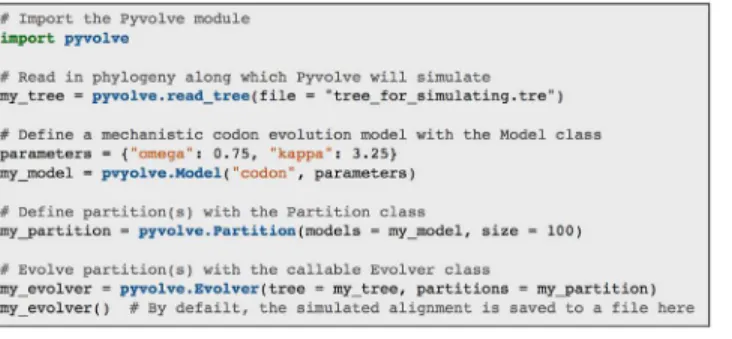
The basic framework for a simple simulation with the Pyvolve module is shown inFig 1. To simulate sequences, users should input the phylogeny along which sequences will evolve, define evolutionary model(s), and assign model(s) to partition(s). Pyvolve implements all evolutionary models in their most general forms, such that any parameter in the model may be customized. This behavior stands in contrast to several other simulation platforms of comparable scope to
Table 1. Substitution models included in Pyvolve.
Modeling Framework Available Models
Nucleotide GTR [20] and all nested variants (e.g. HKY85 [21] and TN93 [22])
Amino acid JTT [23], WAG [24], LG [25], mtMAM [26], mtREV24 [27], DAYHOFF [28], AB [29] Mechanistic codon GY-style [30,31] and MG-style [32]
Empirical codon ECM (restricted and unrestricted) [33]
Mutation-selection Halpern-Bruno model [10], for both nucleotides and codons doi:10.1371/journal.pone.0139047.t001
design, data collection and analysis, decision to publish, or preparation of the manuscript.
Pyvolve. For example, some of the most commonly used simulation tools that implement codon models, including INDELible [9], EVOLVER [34], and PhyloSim [35], do not allow users to specifydSrate variation in codon models. Pyvolve provides this option, among many others.
In the example shown inFig 1, stationary frequencies are not explicitly specified. Under this circumstance, Pyvolve will assume equal frequencies, although they would normally be pro-vided using the key“state_freqs”in the dictionary of parameters. Furthermore, Pyvolve contains a convenient module to help specify state frequencies. This module can read in fre-quencies from an existing sequence and/or alignment file (either globally or from specified alignment columns), generate random frequencies, or constrain frequencies to a given list of allowed states. In addition, this module will convert frequencies between alphabets, which is useful, for example, if one wishes to simulate amino-acid data using the state frequencies as read from a file of codon sequence data.
Validating Pyvolve
We carefully assessed that Pyvolve accurately simulates sequences. To this end, we simulated several data sets under a variety of evolutionary models and conditions and compared the observed substitution rates with the simulated parameters.
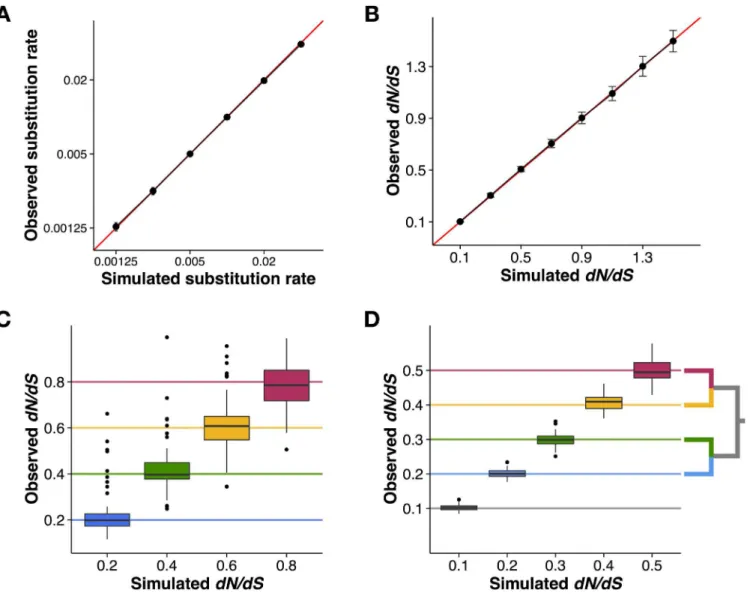
To evaluate Pyvolve under the most basic of conditions, site-homogeneity, we simulated both nucleotide and codon data sets. We evolved nucleotide sequences under the JC69 model [36] across several phylogenies with varying branch lengths (representing the substitution rate), and we evolved codon sequences under a MG94-style model [32] with varying values ofdN/dS. All alignments were simulated along a two-taxon tree and contained 100,000 positions. We sim-ulated 50 replicates for each branch length and/ordN/dSparameterization. As shown inFig 2A and 2B, the observed number of changes agreed precisely with the specified parameters.
We additionally validated Pyvolve’s implementation of site-wise rate heterogeneity. We sim-ulated an alignment of 400 codon positions, again under an MG94-style model [32], along a bal-anced tree of 214taxa with all branch lengths set to 0.01. This large number of taxa was
necessary to achieve accurate estimates for site-specific measurements. To incorporate site-spe-cific rate heterogeneity, we specified fourdN/dSvalues of 0.2, 0.4, 0.6, and 0.8, to be assigned in equal proportions to sites across this alignment. We counted the observeddN/dSvalues for each resulting alignment column using a version of the Suzuki-Gojobori algorithm [37] adapted for phylogenetic data [38].Fig 2Cdemonstrates that Pyvolve accurately implements site-specific rate heterogeneity. The high variance seen inFig 2Cis an expected result of enumerating substi-tutions on a site-specific basis, which, as a relatively small data set, produces substantial noise.
Fig 1. Example code for a simple codon simulation in Pyvolve.This example will simulate an alignment of 100 codons with adN/dSof 0.75 and aκ(transition-tranversion mutational bias) of 3.25. By default, sequences will be output to a file called“simulated_alignment.fasta”, although this file name can be changed, as described in Pyvolve’s user manual.
Finally, we confirmed that Pyvolve accurately simulates branch heterogeneity. Using a four-taxon tree, we evolved codon sequences under an MG94-style model [32] and specified a dis-tinctdN/dSratio for each branch. We simulated 50 replicate alignments of 100,000 positions, and we computed the observeddN/dSvalue along each branch.Fig 2Dshows that observed branchdN/dSvalues agreed with the simulated values.
Conclusions
Because Pyvolve focuses on simulating the substitution processes using continuous-time Mar-kov models along a fixed phylogeny, it is most suitable for simulating gene sequences,
Fig 2. Pyvolve accurately evolves sequences under homogenous, site-wise rate heterogeneity, and branch-specific rate heterogeneity.A) Nucleotide alignments simulated under the JC69 [36] model along two-taxon trees with varying branch lengths, which represent the substitution rate. Points represent the mean observed substitution rate for the 50 alignment replicates simulated under the given value, and error bars represent standard deviations. The red line indicates thex=yline. B) Codon alignments simulated under an MG94-style [32] model with varying values for thedN/dSparameter. Points represent the meandN/dSinferred from the 50 alignment replicates simulated under the givendN/dSvalue, and error bars represent standard deviations. The red line indicates thex=yline. C) Site-wise heterogeneity simulated with an MG94-style [32] model with varyingdN/dSvalues across sites. Horizontal lines indicate the simulateddN/dSvalue for eachdN/dScategory. D) Branch-wise heterogeneity simulated with an MG94-style [32] model with each branch evolving according to a distinctdN/dSvalue. Horizontal lines indicate the simulateddN/dSvalue for each branch, as shown in the inset phylogeny. The lowestdN/dScategory (dN/dS= 0.1) was applied to the internal branch (shown in gray). All code and data used to validate Pyvolve’s performance and generate this figure are available inS1 File.
benchmarking inference frameworks, and for developing and testing novel Markov models of sequence evolution. For example, we see a primary application of Pyvolve as a convenient sim-ulation platform to benchmarkdN/dSand mutation-selection model inference frameworks such as the ones provided by PAML [34], HyPhy [39], Phylobayes [17], or swMutSel [16]. Indeed, the Pyvolve engine has already successfully been applied to investigate the relationship between mutation-selection anddN/dSmodeling frameworks and to identify estimation biases in certaindN/dSmodels [18]. Moreover, we believe that Pyvolve provides a convenient tool for easy incorporation of complex simulations, for instance those used in approximate Bayesian computation (ABC) or MCMC methods [40], into Python pipelines.
Importantly, Pyvolve is meant primarily as a convenient Python library for simulating sim-ple Markov models of sequence evolution. For more comsim-plex evolutionary scenarios, including the simulation of entire genomes, population processes, or protein folding and energetics, we refer the reader to several more suitable platforms. For example, genomic process such as recombination, coalescent-based models, gene duplication, and migration, may be best simu-lated with softwares such as ALF [41], CoalEvol and SGWE [11], or EvolSimulator [42]. Simu-lators which consider the influence of structural and/or biophysical constraints in protein sequence evolution include CASS [43] or ProteinEvolver [44]. Similarly, the software REvolver [45] simulates protein sequences with structural domain constraints by recruiting profile hid-den Markov models (pHMMs) to model site-specific substitution processes.
We additionally note that Pyvolve does not currently include the simulation of insertions and deletions (indels), although this functionality is planned for a future release. We refer read-ers to the softwares indel-Seq-Gen [8] and Dawg [46] for simulating nucleotide sequences, and we suggest platforms such as INDELible [9], phyloSim [35], orπBuss [47] for simulating
cod-ing sequences with indels.
In sum, we believe that Pyvolve’s flexible platform and user-friendly interface will provide a helpful and convenient tool for the biocomputing Python community. Pyvolve is freely avail-able fromhttp://github.com/sjspielman/pyvolve, conveniently packaged with a comprehensive user manual and several example scripts demonstrating various simulation conditions. In addi-tion, Pyvolve is distributed with two helpful Python scripts that complement Pyvolve simula-tions: one which implements the Suzuki-Gojobori [37]dN/dScounting algorithm adapted for phylogenetic data [38], and one which calculatesdN/dSfrom a given set of mutation-selection model parameters as described in ref. [18]. Pyvolve is additionally available for download from the Python Package Index (e.g. viapip).
Supporting Information
S1 File. This file contains all scripts and data used to validate Pyvolve.
(ZIP)
Acknowledgments
We thank Suyang Wan and Dariya Sydykova for helpful feedback during Pyvolve development and Rebecca Tarvin for her help designing the Pyvolve logo.
Author Contributions
References
1. Cock PJ, Antao T, Chang JT, Chapman BA, Cox CJ, Dalke A, et al. Biopython: freely available Python tools for computational molecular biology and bioinformatics. Bioinformatics. 2009; 25:1422–1423. doi:
10.1093/bioinformatics/btp163PMID:19304878
2. Sukumaran J, Holder MT. DendroPy: A Python library for phylogenetic computing. Bioinformatics. 2010; 26:1569–1571. PMID:20421198
3. Arenas M. Simulation of Molecular Data under Diverse Evolutionary Scenarios. PLoS Comp Biol. 2012; 8:e1002495. doi:10.1371/journal.pcbi.1002495
4. Oliphant T. Python for Scientific Computing. IEEE Comput Sci Eng. 2007; 9:10–20. doi:10.1109/ MCSE.2007.58
5. Yang Z. Computational Molecular Evolution. Oxford University Press; 2006.
6. Lewis PO. A Likelihood Approach to Estimating Phylogeny from Discrete Morphological Character Data. Syst Biol. 2001; 50:913–925. doi:10.1080/106351501753462876PMID:12116640
7. Rambaut A, Grassly N. Seq-Gen: an application for the Monte Carlo simulation of DNA sequence evo-lution along phylogenetic trees. Comput Appl Biosci. 1997; 13:235–238. PMID:9183526
8. Strope C, Scott S, Moriyama E. indel-Seq-Gen: a new protein family simulator incorporating domains, motifs, and indels. Mol Biol Evol. 2007; 24(3):640–649. doi:10.1093/molbev/msl195PMID:17158778
9. Fletcher W, Yang Z. INDELible: A Flexible Simulator of Biological Sequence Evolution. Mol Biol Evol. 2009; 26(8):1879–1888. doi:10.1093/molbev/msp098PMID:19423664
10. Halpern A, Bruno W. Evolutionary distances for protein-coding sequences: modeling site-specific resi-due frequencies. Mol Biol Evol. 1998; 15:910–917. doi:10.1093/oxfordjournals.molbev.a025995PMID:
9656490
11. Arenas M, Posada D. Simulation of Genome-Wide Evolution under Heterogeneous Substitution Mod-els and Complex Multispecies Coalescent Histories. Mol Biol Evol. 2014; 31:1295–1301. doi:10.1093/ molbev/msu078PMID:24557445
12. Yang Z, Nielsen R. Mutation-Selection Models of Codon Substitution and Their Use to Estimate Selec-tive Strengths on Codon Usage. Mol Biol Evol. 2008 Jan; 25(3):568–579. doi:10.1093/molbev/ msm284PMID:18178545
13. Holder M, Zwickl D, Dessimoz C. Evaluating the robustness of phylogenetic methods to among-site variability in substitution processes. Phil Trans R Soc B. 2008; 363:4013–4021. doi:10.1098/rstb.2008. 0162PMID:18852108
14. Rodrigue N, Philippe H, Lartillot N. Mutation-selection models of coding sequence evolution with site-heterogeneous amino acid fitness profiles. Proc Natl Acad Sci USA. 2010; 107(10):4629–4634. doi:10. 1073/pnas.0910915107PMID:20176949
15. Tamuri AU, dos Reis M, Goldstein RA. Estimating the distribution of selection coefficients from phyloge-netic data using sitewise mutation-selection models. Gephyloge-netics. 2012; 190:1101–1115. doi:10.1534/ genetics.111.136432PMID:22209901
16. Tamuri AU, Goldman N, dos Reis M. A penalized-likelihood method to estimate the distribution of selec-tion coefficients from phylogenetic data. Genetics. 2014; 197:257–271. doi:10.1534/genetics.114. 162263PMID:24532780
17. Rodrigue N, Lartillot N. Site-heterogeneous mutation-selection models within the PhyloBayes-MPI Package. Bioinformatics. 2014; 30:1020–1021. doi:10.1093/bioinformatics/btt729PMID:24351710
18. Spielman S, Wilke C. The relationship betweendN/dSand scaled selection coefficients. Mol Biol Evol. 2015; 32:1097–1108. doi:10.1093/molbev/msv003PMID:25576365
19. dos Reis M. How to calculate the non-synonymous to synonymous rate ratio of protein-coding genes under the Fisher–Wright mutation–selection framework. Biol Lett. 2015; 11:20141031. doi:10.1098/ rsbl.2014.1031PMID:25854546
20. Tavare S. Lines of descent and genealogical processes, and their applications in population genetics models. Theor Popul Biol. 1984; 26:119–164. doi:10.1016/0040-5809(84)90027-3PMID:6505980
21. Hasegawa M, Kishino H, Yano T. Dating of human-ape splitting by a molecular clock of mitochondrial DNA. J Mol Evol. 1985; 22(2):160–174. doi:10.1007/BF02101694PMID:3934395
22. Tamura K, Nei M. Estimation of the number of nucleotide substitutions in the control region of mitochon-drial DNA in humans and chimpanzees. Mol Biol Evol. 1993; 10:512–526. PMID:8336541
24. Whelan S, Goldman N. A general empirical model of protein evolution derived from multiple protein families using a maximum likelihood approach. Mol Biol Evol. 2001; 18:691–699. doi:10.1093/ oxfordjournals.molbev.a003851PMID:11319253
25. Le S, Gascuel O. An improved general amino acid replacement matrix. Mol Biol Evol. 2008; 25:1307–
1320. doi:10.1093/molbev/msn067PMID:18367465
26. Yang N, Nielsen R, Hasegawa M. Models of Amino Acid Substitution and Applications to Mitochondrial Protein Evolution. Mol Biol Evol. 1998; 15:1600–1611. doi:10.1093/oxfordjournals.molbev.a025888
PMID:9866196
27. Adachi J, Hasegawa M. MOLPHY version 2.3: programs for molecular phylogenetics based on maxi-mum likelihood. Comput Sci Monogr. 19896; 28:1–150.
28. Dayhoff M, Schwartz R, Orcutt B. A model of evolutionary change in proteins. Atlas of Protein Sequence and Structure. 1978; 5(3):345–352.
29. Mirsky A, Kazandjian L, Anisimova M. Antibody-Specific Model of Amino Acid Substitution for Immuno-logical Inferences from Alignments of Antibody Sequences. Mol Biol Evol. 2015; 32:806–819. doi:10. 1093/molbev/msu340PMID:25534034
30. Goldman N, Yang Z. A codon-based model of nucleotide substitution for protein-coding DNA sequences. Mol Biol Evol. 1994; 11:725–736. PMID:7968486
31. Nielsen R, Yang Z. Likelihood models for detecting positive selected amino acid sites and applications to the HIV-1 envelope gene. Genetics. 1998; 148:929–936. PMID:9539414
32. Muse S, Gaut B. A likelihood approach for comparing synonymous and nonsynonymous nucleotide substitution rates, with application to the chloroplast genome. Mol Biol Evol. 1994; 11:715–724. PMID:
7968485
33. Kosiol C, Holmes I, Goldman N. An empirical codon model for protein sequence evolution. Mol Biol Evol. 2007; 24:1464–1479. doi:10.1093/molbev/msm064PMID:17400572
34. Yang Z. PAML 4: Phylogenetic Analysis by Maximum Likelihood. Molecular Biology and Evolution. 2007; 24:1586–1591. doi:10.1093/molbev/msm088PMID:17483113
35. Sipos B, Massingham T, Jordan GE, Goldman N. PhyloSim—Monte Carlo simulation of sequence evo-lution in the R statistical computing environment. BMC Bioinform. 2011; 12(104).
36. Jukes T, Cantor C. Evolution of protein molecules. In: Munro H, editor. Mammalian protein metabolism. New York: Academic Press; 1969.
37. Suzuki Y, Gojobori T. A method for detecting positive selection at single amino acid sites. Mol Biol Evol. 1999; 16:1315–1328. doi:10.1093/oxfordjournals.molbev.a026042PMID:10563013
38. Kosakovsky Pond S, Frost S. Not So Different After All: A Comparison of Methods for Detecting Amino Acid Sites Under Selection. Mol Biol Evol. 2005; 22:1208–1222. doi:10.1093/molbev/msi105PMID:
15703242
39. Kosakovsky Pond S, Frost S, Muse S. HyPhy: hypothesis testing using phylogenies. Bioinformatics. 2005; 12:676–679. doi:10.1093/bioinformatics/bti079
40. Arenas M. Advances in Computer Simulation of Genome Evolution: Toward More Realistic Evolution-ary Genomics Analysis by Approximate Bayesian Computation. J Mol Evol. 2015; 8:189–192. doi:10. 1007/s00239-015-9673-0
41. Dalquen D, Anisimova M, Gonnet G, Dessimoz C. ALF–a simulation framework for genome evolution. Mol Biol Evol. 2012; 29:1115–1123. doi:10.1093/molbev/msr268PMID:22160766
42. Beiko R, Charlebois R. A simulation test bed for hypotheses of genome evolution. Bioinformatics. 2007; 23:825–831. doi:10.1093/bioinformatics/btm024PMID:17267425
43. Grahnen J, Liberles D. CASS: Protein sequence simulation with explicit genotype-phenotype mapping. Trends in Evolutionary Biology; 4:e9. doi:10.4081/eb.2012.e9
44. Arenas M, Dos Santos H, Posada D, Bastolla U. Protein evolution along phylogenetic histories under structurally constrained substitution models. Bioinformatics. 2013; 29:3020–3028. doi:10.1093/ bioinformatics/btt530PMID:24037213
45. Koestler T, von Haeseler A, Ebersberger I. REvolver: modeling sequence evolution under domain con-straints. Mol Biol Evol. 2012; 29:2133–2145. doi:10.1093/molbev/mss078PMID:22383532
46. Cartwright R. DNA assembly with gaps (Dawg): simulating sequence evolution. Bioinformatics. 2005; 21:iii31–iii38. doi:10.1093/bioinformatics/bti1200PMID:16306390

![Protein clustering and RNA phylogenetic reconstruction of the influenza A [corrected] virus NS1 protein allow an update in classification and identification of motif conservation.](data:image/gif;base64,R0lGODlhAQABAIAAAP///wAAACH5BAEAAAAALAAAAAABAAEAAAICRAEAOw==)