ISSN 0104-6632 Printed in Brazil
www.abeq.org.br/bjche
Vol. 23, No. 02, pp. 213 - 218, April - June, 2006
Brazilian Journal
of Chemical
Engineering
DESORPTION OF HEAVY METALS FROM ION
EXCHANGE RESIN WITH WATER
AND CARBON DIOXIDE
D. L. Silva
1*and G. Brunner
21
Universidade Federal do Pará. Depto. de Engenharia Química e de Alimentos, Phone: +(55) (91) 3201-7297, Fax: +(55) (91) 3201-7293, Rua Augusto Corrêa 01, CEP 66075-900, Belém - PA, Brazil.
E-mail: [email protected]
2
Technische Universitaet Hamburg-Harburg, Thermische Verfahrenstechnik Eissendorfer Strasse 38, 21073, Hamburg – Germany.
(Received: October 20, 2004 ; Accepted: February 1, 2006)
Abstract - Adsorption and regeneration of ion exchange resins were studied using a subcritical solution of a
CO2-H2O mixture and a fixed bed column. The commercial Amberlite IRC-50/IRC-86 cation exchange resins
and Amberlite IRA-67 anion exchange resin were tested for heavy metals (Pb, Cu, Cd) adsorption from a solution with different initial metal concentrations at different temperatures. After adsorption, the loaded resins were regenerated with water and carbon dioxide at different temperatures and a pressure of 25 MPa. The efficiency of the IRC-50 resin was lower than that of the IRC-86 resin for the adsorption of metals like Cd, Cu and Pb. Results obtained for desorption of these metals indicated that the process could be used for Cd and in principle for Cu. Sorption of metal ions depended strongly on feed concentration. Mathematical modeling of the metal desorption process was carried out successfully as an extraction process. For this purpose, the VTII Model, which is applied to extraction from solids using supercritical solvents, was used in this work.
Keywords: Adsorption and regeneration; Ion exchange; Carbon dioxide.
INTRODUCTION
Ion exchange resins are usually regenerated with highly concentrated electrolyte solutions so disposal of concentrated saline solutions is necessary. In order to increase the concentration of salt in aquifers as little as possible, the amount of disposed salt has to be small. This can be achieved either by a suitable regeneration process or by the use of especial regeneration chemicals (Höll, 1981). One of the more promising possibilities is to use carbonic acid as a regeneration agent by dissolving supercritical CO2 in water at a high pressure. The applications of
this technology in different areas have been reviewed in detail by a number of researchers (Jessop, 1999; Marr & Gamse, 2000). One of these applications is
to regenerate adsorbents (Picht et al., 1982; Tan & Liou, 1988). A study of the regeneration of the sodium form of some carboxylic cation exchange resins using pressurized CO2 aqueous solutions was
carried out and demonstrates that the regeneration efficiency of carbonic acid depends upon the acidity of the resin. When a saturated CO2 solution is used
as the regeneration agent, a solution of NaHCO3 is
resins are regenerated simultaneously by CO2 and
water (Höll & Flemming, 1991). In this work, subcritical water and carbon dioxide were applied as an alternative method to study the possibility of recovering heavy metals, particularly Pb2+, Cd2+ and Cu2+, from ion exchange resins. Desorption experiments were carried out in a supercritical extraction pilot plant at 25 MPa and temperatures of 22, 38 and 35 °C.
MATERIAL AND METHODS
The Amberlite IRA-67 anion exchange resin and the Amberlite IRC-86/IRC-50 cation exchange resins, supplied by Aldrich, were tested in this study. The column experiments were performed on ion exchange resin with a particle size of 16-50 mesh. Analytical grade reagents Pb(NO3)2 , CuSO4.5H2O
and Cd(NO3)2 [Merck], were used. Solutions of
approximately 10 to 300 mg/L were prepared using demineralized water as the solvent. In order to improve the adsorption process, the Amberlite IRA-67 anion exchange resin was converted to its bicarbonate form by activation with the CO2-H2O
mixture at 25 MPA and 22, 28 or 35 °C. After activation, the Amberlite IRA-67 anion exchange resin in the HCO3- form was used in the same
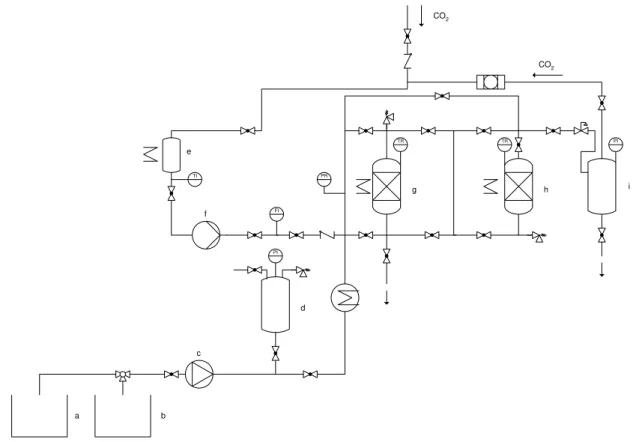
stainless steel (SS) column (Autoclave Engineers, Pennsylvania, USA) with a 17.2 mm inner diameter and a length of 486 mm. The Amberlite IRC-86 or IRC-50 cation exchange resin was packed in an other SS column with an inner diameter of 14 mm and a length of 490 mm (Fig. 1).
Columns were operated in the down-flow mode at room pressure in the adsorption experiments. Metal concentration was measured using an atomic absorption spectrophotometer (Perkin-Elmer Optima 2000 DV OES/ICP, Boston, USA). After the adsorption experiment, the direction of the flux (H2O-CO2) through the columns containing cation
and anion resins was inverted in order to do the desorption experiment in the same apparatus. In the columns, the heavy metal was extracted from the adsorbent particles with the mixture of H2O-CO2
under a given state condition (P and T). The H2
O-CO2 + heavy metal solution was separated by
reduction in pressure, and samples were collected to analyze the Pb2+, Cu2+ and Cd2+ concentrations.
TR
P-20
TR PI
FI
TI PR
PI
f e
a b
c
d
g h i
CO2
CO2
Figure 1: The experimental setup (a,b: water and metal solution vessel; c: high-pressure membrane pump; d:
RESULTS AND DISCUSSION
Kinetic Study on Amberlite IRC-50 Resin
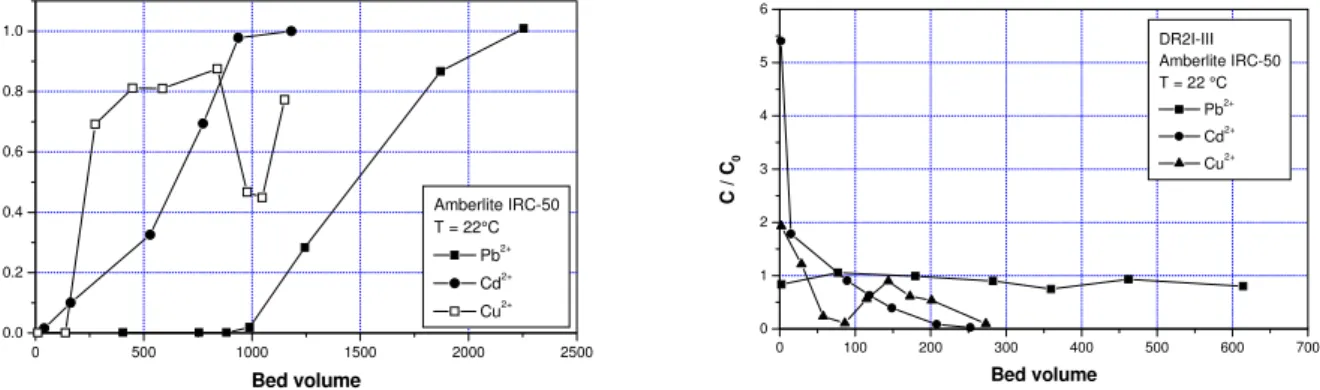
The selectivity of the resin can be analyzed using the breakthrough results. Figure 2 shows the adsorption breakthrough curve for Pb2+, Cd2+ and Cu2+ at 22 °C using the IRC-50 cation exchange resin. In these breakthrough curves the normalized concentration, defined as the measured concentration divided by the inlet concentration, is plotted against bed volume, where one bed volume is defined as the empty volume of the column that is occupied by the packed-bed ion exchange resin. The order of adsorption capacity for the three metal ions tested was Pb2+>Cu2+>Cd2+, i.e., of the metals ions studied the efficiency of removal was highest for the lead ions. The spreading observed in actual breakthrough
curves could be due to the existence of flow nonidealities (channeling), mixing (axial dispersion and dead spaces) and finite mass transfer and sorption rates, as observed in the work of Sridhar (1996).
The elution of Pb, Cd and Cu separately from the IRC-50 resin after the breakthrough experiment was studied at the same temperature as that used in the adsorption experiment. As shown in Fig. 2, the concentration of Cd in the eluate decreased more rapidly for the resin than the concentration of Cu. This can be attributed to the lower capacity of the resin to bind with the Cd2+ ions,as shown previously in the breakthrough curve. It can also be observed that the elution profile for the Pb ions has a broad peak with a long tail. These observations support previous results, indicating that Pb binds strongly to the ion exchange resin.
0 500 1000 1500 2000 2500
0.0 0.2 0.4 0.6 0.8 1.0
Amberlite IRC-50 T = 22°C
Pb2+
Cd2+
Cu2+
C /
C
0
Bed volume
0 100 200 300 400 500 600 700
0 1 2 3 4 5 6
DR2I-III Amberlite IRC-50 T = 22 °C
Pb2+
Cd2+
Cu2+
C /
C
0
Bed volume
Figure 2: Breakthrough and elution curves for Pb2+, Cd2+ and Cu2+ ions at 22 °C.
Kinetic and Equilibrium Study on Amberlite IRC-86 Resin
The Effect of Feed
Figure 3 displays the effect of solute concentration (Cd ) on the breakthrough curve. The change in inlet metal concentration markedly affects the shape and position of the breakthrough curve. The higher the metal concentration, the faster the breakthrough is. Lean feed is found to be better for metal recovery. However, the quantity of solutions to be supplied is large when the metal concentration is low and an optimum value has to be obtained. The results of the breakthrough behavior experiment for a metal concentration of 21.8 mg/L show that about 1400 bed volumes of feed solution could be passed through the resin with less than 0.2 mg/L of Cd ion in the effluent.
The elution of Cd ions from the sample after using the breakthrough curve experiment was then studied. The H2O-CO2 mixture was passed through
the bed at 250 bar and 35 °C. Figure 3 also depicts the effect of metal concentration on the elution curve. The higher metal concentration in the adsorption experiment, the slower Cd elution is. The elution of Cd ions is slow and requires a large number of bed volumes when the metal concentration is high; however given that the lean feed is found to be better for metal recovery, as illustrated by the breakthrough curve, the elution process will be also better, for the lean metal concentration.
The Effect of Temperature
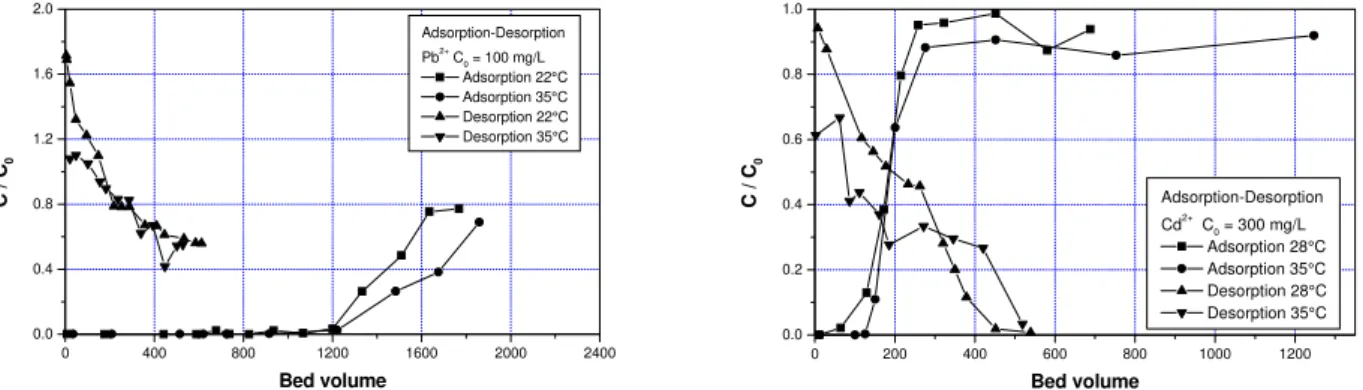
Figure 4 shows these effects for the adsorption of Pb2+ at 22 °C, with a Pb2+ feed concentration about 100 mg/L. It is evident from the breakthrough curve that temperature has little effect on the efficiency of the adsorption process, corresponding to an efficiency of Pb removal of over approximately 96% after 1200 bed volumes. At 250 bar, the greatest desorption was obtained at the lowest temperature. The efficiency of regeneration decreased with increasing temperature.
The effect of temperature on the adsorption of
Cd, with a feed concentration of 300 mg/L is shown in Fig. 4. The highest temperature of 35°C results in slightly more efficiency. It is evident that the effluent Cd concentration is below 1mg/L during the first 50 min (approximately 125 bed volumes) of adsorption operation, corresponding to an efficiency of removal nearly 100 %. However, in the desorption process efficiency was inverted. Here again, at a temperature of 28°C the desorption process is more efficient due to the higher acidity (lower pH value) of the carbonic acid at lower temperatures.
0 500 1000 1500 2000 2500 3000 3500
0.0 0.2 0.4 0.6 0.8 1.0
ISOaI-V: Cd2+ Adsorption T = 35 °C
C0 = 21.8 mg/L C0 = 44.5 mg/L C0 = 147 mg/L C
0 = 204 mg/L C0 = 297 mg/L
C /
C0
Bed volume
0 100 200 300 400 500 600
0.0 0.5 1.0 1.5 2.0 2.5 3.0 3.5
4.0 ISOdI-V: Cd2+
Desorption T = 35 °C
C0 = 44.5 mg/L
C0 = 147 mg/L
C0 = 204 mg/L
C0 = 297 mg/L
C / C
0
Bed volume
Figure 3: Effect of metal concentration on breakthrough and elution curves.
0 400 800 1200 1600 2000 2400
0.0 0.4 0.8 1.2 1.6 2.0
Adsorption-Desorption
Pb2+
C0 = 100 mg/L
Adsorption 22°C Adsorption 35°C Desorption 22°C Desorption 35°C
C /
C0
Bed volume
0 200 400 600 800 1000 1200
0.0 0.2 0.4 0.6 0.8 1.0
Adsorption-Desorption Cd2+
C0 = 300 mg/L
Adsorption 28°C Adsorption 35°C Desorption 28°C Desorption 35°C
C /
C0
Bed volume
Figure 4: Effect of temperature on the adsorption-desorption of Pb2+ and Cd2+.
Selectivity
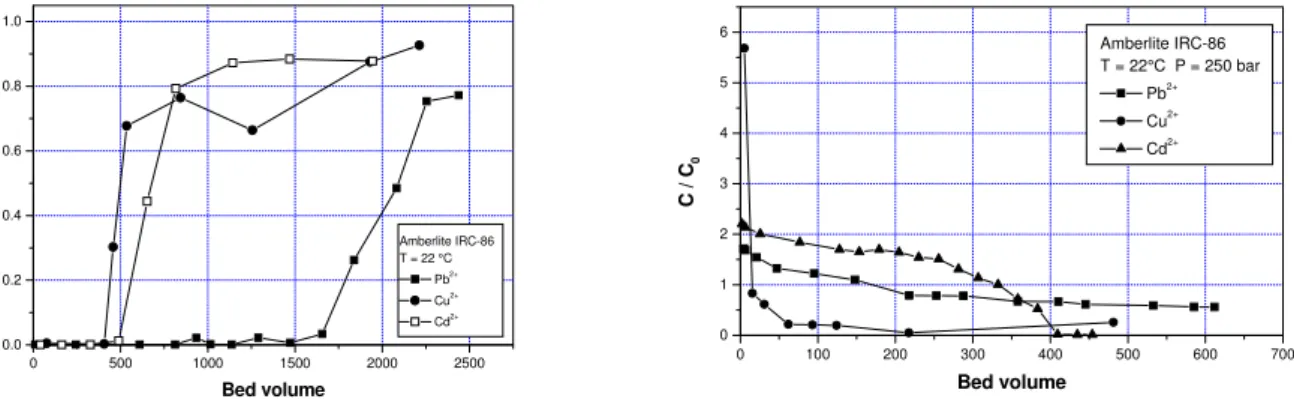
A series of column experiments was conducted for three different metals (Pb, Cd and Cu) in the adsorption-desorption processes using the Amberlite IRC-86 cation exchange resin in a single-metal system, where the affinity of the resin for the metals was examined. Figure 5 shows the breakthrough curves for Pb2+, Cd2+ and Cu2+ in a
The elution of metal ions from the resin after the breakthrough experiment was also studied. The regeneration of the resin supports the selectivity sequence discussed above. Comparing the curves, it can be observed that the sequence of metal desorption is inverted. The rapid elution of Cu from the resin was expected and attributed to the lower capacity of the resin to bind with the Cu ions. In the sequence of the desorption process, Cd is seen first and then Pb.
Modeling of Heavy Metal Desorption - VTII Model
Metal desorption was modeled successfully as an extraction process. For this purpose, the VTII Model (Brunner, 1994) that is applied to extraction from solids using supercritical solvents, was chosen for this work. The experimental and calculated desorption curves are compared in Figures 6 and 7 for Amberlite IRC-86 cation exchange resin; the coincidence is sufficient.
0 500 1000 1500 2000 2500
0.0 0.2 0.4 0.6 0.8 1.0 Amberlite IRC-86 T = 22 °C
Pb2+ Cu2+ Cd2+ C / C 0 Bed volume
0 100 200 300 400 500 600 700
0 1 2 3 4 5 6 Amberlite IRC-86 T = 22°C P = 250 bar
Pb2+ Cu2+ Cd2+ C / C 0 Bed volume
Figure 5: Breakthrough and elution curves for Pb2+, Cd2+ and Cu2+ ions at 22 °C.
0 200 400 600 800 1000 1200 1400 1600 0.00 0.02 0.04 0.06 0.08 0.10 0.12 0.14 0.16 Desorption simulation Pb2+
T = 22 °C P = 250 bar QH2O = 2.73 L/h
QCO2 = 14.51 g/min
Experimental results C oncen tr ati o n [m g /g]
Time [ min ]
0 200 400 600 800 1000
0.00 0.01 0.02 0.03 0.04 0.05 0.06 0.07 0.08 0.09 Desorption simulation Pb2+
T = 35 °C P = 250 bar QH2O = 2.70 L/h
QCO2 = 17.07 g/min
Experimental results Con centrat io n [mg /g] Time [min]
Figure 6: Calculated and experimental desorption curves for Pb2+ at 22 and 35 °C.
0 200 400 600 800 1000
0.00 0.02 0.04 0.06 0.08 0.10 0.12
0.14 Desorption simulation
Cd2+
T = 35 °C P = 250 bar
QH2O = 2.95 L/h
QCO2
= 18.82 g/min Experimental results Conc e n tr a ti o n [ m g /g] Time [min]
0 200 400 600 800 1000
0.0 0.1 0.2 0.3 0.4 0.5 0.6
0.7 Desorption simulation
Cu2+
T = 22 °C P = 250 bar
QH2O = 3.23 L/h
QCO2 = 17.5 g/min
Experimental results Conc e n tr a ti o n [ m g /g] Time [min]
CONCLUSIONS
Although the IRC-50 resin isn’t as efficient as the IRC-86 resin in the adsorption of metals like Cd, Cu and Pb, the results obtained for desorption of these metals indicated that the process can be suitable for Cu and principally for Cd. Temperature does not have much effect on the efficiency of the adsorption process for the heavy metal, but exerts a strong effect on the efficiency of metal desorption, with the best results at the lowest temperature. The sorption of metal ions was strongly dependent on feed concentration and lean feed was found to be better for metal desorption from the resin. Metal desorption as an extraction process was successfully modeled. The fitting obtained for the experimental points with the kinetic VTII extraction model were shown to be appropriate for ion exchange.
REFERENCES
Brunner, G., Gas Extraction. Topics in Physical Chemistry; Steinkopff/Springer: Darmstadt/New York, pp. 179-250 (1994).
Höll, W., Umweltfreundliche Regeneration von Ionenaustascherharzen. KfK 3112 B, Kernforchungszentrum Karlshuhe, Karlshuhe, Germany, pp. 1-32 (1981).
Höll, W. and Flemming, H.C., Treatment of Drinking Water with Ion Exchange Resins. In Ion Exchangers; Dorfner, K. Editor; Walter de Gruyter: Berlin, pp. 835-844 (1991).
Jessop, P.G., Chemical Synthesis using Supercritical Fluids. VCH/Wiley Verlag, Weinheim, Germany (1999).
Kunin, R. and Vassiliou, B., Regeneration of Carboxylic Cation Exchange Resins with Carbon Dioxide, Industrial & Engineering Chemistry, 2(1), pp. 1-3 (1963).
Marr, R. and Gamse, T. Use of Supercritical Fluids for Different Processes Including New Developments - A Review, Chemical Engineering and Processing, (39), pp. 19-28 (2000).
Picht, R.D. Dillman, T.R. Burke, D.J. and deFilippi, R.P., Regeneration of Adsorbents by a Supercritical Fluid, AIChE – Symposium Series, American Institute of Chemical Engineers, 78 (219), pp. 136-149 (1982).
Sridhar, P., Modelling of Affinity Separation by Batch and Fixed Bed Adsorption- A Comparative Study, Chem. Eng. Technol., 19, pp. 357-363 (1996).