51
ABSTRACT
BACKGROUND AND OBJECTIVES:Notwithstanding sev-eral studies pointing to a relationship between psychological as-pects and pain, the scientiic literature still lacks articles specii-cally addressing the psychological assessment process. his study aimed at answering to three questions: Why, when and how to refer painful patients to a psychological assessment? With this, we intend to cooperate with professionals of diferent areas by of-fering them guidelines about major indications for psychological assessment, what should be expected from this process and how to efectively refer patients.
CONTENTS:he following databases were searched: Medline, LILACS, Pubmed and Scielo, by crossing the terms “psychology”, “pain”, “psychology interview” and “psychological tests”. In addi-tion, we looked for articles having in the title or abstract the words “psychological assessment” or “psychological evaluation” and “pain” – since the two former terms are not descriptors identiied in Health Sciences Descriptors. Studies between 2002 and 2013 were considered, being included only those speciically mention-ing psychological assessment, resultmention-ing in 11 articles in total.
CONCLUSION: From selected studies, all have pointed to jus-tiications about the importance of psychological assessment of painful patients. As to indications to psychological assessment, seven articles have addressed the subject. he major gap was re-lated to how to refer patients. Only one out of 11 articles has addressed this subject. Further studies may, in the future, better explore this aspect.
Keywords: Pain, Psychological interview, Psychology.
Psychological assessment of chronic pain patients: when, how and why
refer?*
Avaliação psicológica de pacientes com dor crônica: quando, como e por que encaminhar?
José Luiz Dias Siqueira1, Marcia Carla Morete2
*Receved from Israelite Hospital Albert Einstein, São Paulo, SP, Brazil.
1. Israelite Hospital Albert Einstein, Psychology Area, São Paulo, SP, Brazil. 2. Israelite Hospital Albert Einstein, Nursing Area, São Paulo, SP, Brazil.
Submitted in September 17, 2013.
Accepted for publication in February 13, 2014. Conlict of interests: None.
Correspondence to:
José Luiz Dias Siqueira
Av. Albert Einstein, 627 – Morumbi
Instituto de Ensino e Pesquisa do Hospital Israelita Albert Einstein Especialização em Dor
05652-900 São Paulo, SP, Brasil. E-mail: [email protected]
© Sociedade Brasileira para o Estudo da Dor
RESUMO
JUSTIFICATIVA E OBJETIVOS: Apesar de inúmeros estudos apontarem a relação entre aspectos psicológicos e a experiência dolorosa, a literatura cientíica ainda carece de artigos a respeito, especiicamente, do processo de avaliação psicológica. O obje-tivo deste estudo foi obter respostas para três perguntas: Por que, quando e como encaminhar pacientes com dor para uma avalia-ção psicológica? Com isso pretende-se colaborar com proission-ais de diversas áreas no sentido de oferecer-lhes apontamentos sobre as principais indicações para uma avaliação psicológica, o que esperar desse processo e como fazer o encaminhamento de uma maneira eicaz.
CONTEÚDO:Foi realizada uma pesquisa nas bases de dados Medline, LILACS, Pubmed e Scielo, cruzando-se os termos: “psychology”, “pain”, “psychology interview” e “psychological tests”. Além disso, foram buscados artigos que contivessem no título ou no resumo as palavras “psychological assessment” ou “psychological evaluation” e “pain” – já que estes dois primeiros não são descritores identiicados nos Descritores em Ciências da Saúde. Foram considerados trabalhos entre 2002 e 2013, sendo incluídos apenas os que se referiam especiicamente à avaliação psicológica, resultando em 11 artigos no total.
CONCLUSÃO: Dos estudos selecionados, todos apontavam justiicativas sobre a importância da avaliação psicológica do pa-ciente com dor. Quanto a indicações para a avaliação psicológica, sete artigos abordaram o assunto. A grande lacuna se referiu ao modo de se encaminhar o paciente. Apenas um dos 11 artigos abordou esse assunto. Novos estudos podem no futuro explorar melhor esse aspecto.
Descritores:Dor,Entrevista psicológica,Psicologia.
INTRODUCTION
Traditional biomedical approach started to be further challenged in the second half of last century. Speciically with regard to pain, studies pointed to the need for a model encompassing the com-plexity of the pain phenomenon. he biopsychosocial perspec-tive closes this gap by conirming the existence of a dynamic relationship among biological changes, psychological status and social context1.
he diiculty to accept the multidimensional nature of pain is largely linked to the widespread acceptance of Cartesian prin-ciples separating mind from body2. Conversely, the
biopsycho-Rev Dor. São Paulo, 2014 jan-mar;15(1):51-4 REVIEW ARTICLE
52
Siqueira JL and Morete MC
Rev Dor. São Paulo, 2014 jan-mar;15(1):51-4
social approach tries to consider physical, psychological, social and spiritual aspects not separately, but as an integrated whole. As a consequence of biopsychosocial understanding, pain man-agement starts to require interdisciplinary work, counting on the integrated action of professionals of diferent specialties3.
In this sense, pain persisting for a long time has major impact on all domains of life. Several complex conditions associated to chronic pain afect individuals’ physical and psychosocial func-tioning. Among them, there are sleep disorders, loss of appetite, drug dependence, mood disorders, crises of anxiety, fatigue and frustration, which generate numerous consequences for those people, their families, jobs and to the health system4.
In addition, several studies show the major role of biopsycho-social factors in triggering chronic pain, in the process of acute pain chronicity and in patients’ incapacity. Associated to those issues, one may add cognitive elements, such as patients’ be-liefs; afective elements, such as anxiety, depression and stress; and behavioral elements such as learning and reinforcement processes1,5-8.
he intertwining of body processes and emotion, cognition and interpersonal dynamics explains addressing psychological vari-ables to manage chronic pain9.
Psychological assessment is a practice based on scientiic method and counts on diferent resources to promote thorough under-standing of the individual. Among major practices of this process there are information collection, psychological tools and difer-ent measuremdifer-ents methods to iddifer-entify speciic dimensions of subjects, their environment and the relationship between them10.
Notwithstanding the increasing importance of Psychology in pain management, professionals of other areas still lack knowl-edge about the criteria to refer patients to psychological assess-ment and what can be expected from this process.
With this study we intend to cooperate with professionals of diferent areas by ofering them guidelines about major indi-cations for psychological assessment, what should be expected from this process and how to efectively refer patients. For such, scientiic articles published in the last 11 years about the subject were reviewed.
CONTENTS
We looked for studies published from 2002 to 2013, in Eng-lish, Portuguese and Spanish in LILACS, Medline, SciElo and PubMed databases, crossing the following descriptors: “psychol-ogy”, “pain”, “psychological interview” and “psychological tests”. In addition, we looked for articles having in the title or abstract the expressions “psychological assessment”, “psychological evalu-ation” and “pain”, since the two former terms are not identiied among Health Sciences Descriptors. Major inclusion criteria were direct reference to psychological assessment processes. In total, 11 articles were selected addressing psychological assess-ment in diferent contexts. Articles analysis tried to understand how each of these articles answered to one or more of the follow-ing questions:
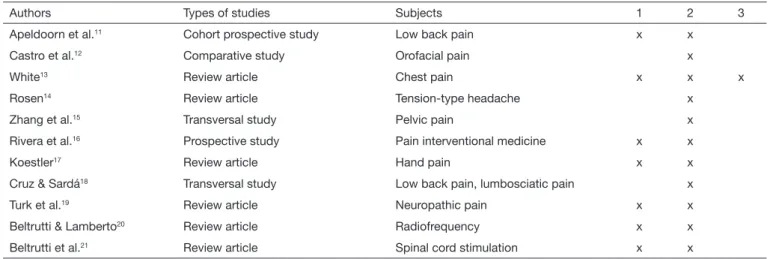
1. When to refer patients to psychological assessment? 2. Why refer patients to psychological assessment? 3. How to refer patients to psychological assessment?
Table 1 shows analyzed articles, their authors, major subjects addressed and which questions, from the three above, could be answered as from the reading of each text.
When to refer patients to psychological assessment?
he prospective cohort study on low back pain tried to identify signs and symptoms which would prompt clinicians to the need for psychological assessment of patients with chronic low back pain. A rehabilitation team and a group of psychologists have evaluated 229 patients. By crossing data evaluated by the physio-therapists of the team and those evaluated by psychologists, the study arrived at four variables which could prompt generalists to the importance of additional psychological assessment: daily use of analgesics, presence of Waddell signs, high pain drawing test scores and absence of directional preference11.
According to authors, Waddell signs are a set of 8 physical signs which may indicate non-organic or psychological components of chronic low back pain. he pain drawing test used divides a human body diagram into 45 anatomic areas which, if marked
Table 1. Description of selected texts
Authors Types of studies Subjects 1 2 3
Apeldoorn et al.11 Cohort prospective study Low back pain x x
Castro et al.12 Comparative study Orofacial pain x
White13 Review article Chest pain x x x
Rosen14 Review article Tension-type headache x
Zhang et al.15 Transversal study Pelvic pain x
Rivera et al.16 Prospective study Pain interventional medicine x x
Koestler17 Review article Hand pain x x
Cruz & Sardá18 Transversal study Low back pain, lumbosciatic pain x
Turk et al.19 Review article Neuropathic pain x x
Beltrutti & Lamberto20 Review article Radiofrequency x x
53
Psychological assessment of chronic painpatients: when, how and why refer?
Rev Dor. São Paulo, 2014 jan-mar;15(1):51-4
by patients as painful, receive scores11.
he article on hand pain has shown several points to which cli-nicians should be attentive to identify the need for psychologi-cal assessment: low adhesion to treatment, resistance in taking the responsibility for their own health care, avoidance behaviors, catastrophizing, emotional reactions, exaggerated painful behav-iors and expressions of guilt, anger and hopelessness. In addition, in the presence of suicide ideation, psychotic symptoms or drug abuse, psychological assessment becomes mandatory17.
he study on chest pain has shown that, in practice, major rea-son for referring patients to psychological assessment is, in gen-eral, not poor adhesion to treatment. Other aspects often leading clinicians to make such referral are: behavioral (smoking, inac-tivity) and emotional (depression, anxiety, anger) risk factors, in addition to coping diiculties13.
he article on neuropathic pain has determined six situations in which psychological assessment is indicated: 1) when inca-pacity goes well beyond what is expected from patients as from clinical indings; 2) when patients exaggeratedly demand health services; 3) when patients insist in looking for treatments and exams which are not indicated; 4) when patients have signiicant distress; 5) when patients show behaviors of drug dependence or poor adhesion to proposed treatment; 6) before interventional procedures, such as spinal cord stimulation19.
With regard to this latter item, two articles show the critical role of psychological assessment just before interventional pro-cedures. he article on spinal cord stimulation has concluded that the process of determining whether patients are it for the procedure should necessarily include the evaluation of patients’ psychosocial characteristics20. In the article on radiofrequency,
authors have reached similar conclusions21.
In this context, two major objectives are shown with regard to psychological assessment: 1) determining the presence of psy-chological and social characteristics which may increase the like-lihood of the beneit of the procedure, and 2) helping physicians identifying patients for whom such treatment could result in uncertainty, failure or medical-legal consequences. Very often, in spite of the success of the treatment, patients are unable to per-ceive a signiicant change in their status. his “failure” is closely related to the way each patient experiences pain. his aspect should be taken into consideration through a careful psychologi-cal assessment before any interventional procedure21.
Why refer patients to psychological assessment?
From 11 evaluated articles, all have addressed justiications for psychological assessment: 10 tried to justify why to refer chronic pain patients to evaluation by a psychologist and one tried to justify why not to refer them.
A prospective cohort study tried to analyze whether interven-tional physicians were able to identify anxiety and depression us-ing a brief interview and a questionnaire based on the Diagnostic and Statistical Manual of Mental Disorders, 4th edition
(DSM-IV). he study has concluded that such professionals were suc-cessful in identifying these two conditions in 100 patients of an interventional pain center12. Authors have justiied that, when
not referring patients to psychologists or psychiatrics, there are
time and money savings.
One Brazilian study has identiied in 55 patients with low back pain and lumbosciatic pain a strong presence of emotional changes which could interfere or cooperate with the manifesta-tion or perpetuamanifesta-tion of such diseases, which would justify the need for psychological assessments18. A Chinese study on
pel-vic pain has concluded that the management of such patients is much more adequate when it is performed as from a multidisci-plinary approach including routine psychological assessment15.
A diferent Brazilian study has compared several aspects among 30 patients of a hospital: 15 with trigeminal neuralgia and 15 with temporomandibular disorders. Notwithstanding the irst group having more severe and limiting pain, there have been no signiicant diferences with regard to complaints and levels of de-pression and anxiety, which suggests that pain intensity may not be directly related to afective aspects. For the authors, this fact justiies the need for careful psychological assessment of facial pain patients12.
Article on hand pain explains that, when psychological assess-ment early identiies complicating psychological and behavioral factors in patients with such condition, this helps more adequate interventions and improves management results17.
How to refer patients to psychological assessment?
he article on chest pain shows that many clinicians have dif-iculties in referring patients to a psychologist so it is critical to explain patients about the reasons why psychological assessment is important. According to the article, patients are more receptive to referral when this is introduced as part of an essential routine for treatment results. Explanations are essential since anxious pa-tients may think that the physician suspects that their pain is not real, or that they have a mental disease causing the symptoms13.
CONCLUSION
Several articles address psychological pain aspects, however few mention psychological assessment. he lack of the term “psycho-logical assessment” among Health Sciences Descriptors makes diicult a search by the subject.
From 11 evaluated articles, 10 intended to give justiications for the psychological assessment of patients with pain, among them: understanding the inluence of emotions on pain; identifying stressors and coping styles; evaluating patients’ expectations; identifying diiculties and pointing targets for interventions. One article has stated that interventional physicians are able to detect anxiety and depression in pain patients without the help of a mental health professional. However, other articles have shown how broad might be a psychological assessment of pain patients, going well beyond the identiication of anxiety and depression. Seven articles have shown referral criteria for psychological as-sessment, among them: poor adhesion to treatment, avoidance, catastrophizing, guilt, anger, distress, hopelessness, suicide ide-ation and before interventional procedures.
From all articles, only one has mentioned the way to refer pa-tients to psychological assessment13. Further studies should
pa-54
Siqueira JL and Morete MC
Rev Dor. São Paulo, 2014 jan-mar;15(1):51-4
tients, because the way in which patients are referred very often determines the acceptance of the work of the psychologist and also patients’ adhesion to the treatment as a whole.
REFERENCES
1. Sardá JJ, Nicholas MK, Pimenta CA, Asghari A. Preditores biopsicossociais de dor, incapacidade e depressão em pacientes brasileiros com dor crônica. Rev Dor. 2012;13(2):111-8.
2. Loeser JD. Part II: Evaluation of the pain patient, Introduction. In: Loeser JD, Butler SH, Chapman RC, Turk DC, (editors). Bonica’s Management of Pain. 3rd ed.
Phila-delphia (PA): Lippincott Williams & Wilkins Publishers; 2001. 43-6p.
3. Almeida FF, Costa AL, Doca FN, Turra V. Experiência de dor e variáveis psicossociais: o estado da arte no Brasil. Temas em Psicologia. 2010;18(2):367-76.
4. Garven A, Brady S, Wood S, Hattield M, Bestard J, Korngut L, et al. he impact of enrollment in a specialized interdisciplinary neuropathic pain clinic. Pain Res Manag. 2011;16(3):159-68.
5. Turk DC, Okifuji A. Psychological factors in chronic pain: evolution and revolution. J Consult Clin Psychol. 2002;70(3):678-90.
6. Andrasik F, Flor H, Turk DC. An expanded view of psychological aspects in head pain: the biopsychosocial model. Neurol Sci. 2005;26(Suppl2):S87-91.
7. Eccleston C, Palermo TM, de Williams AC, Lewandowski A, Morley S, Fisher E, et al. Psychological therapies for the management of chronic and recurrent pain in children and adolescents. Cochrane Database Syst Rev. 2012;12:CD003968.
8. Linton SJ. A review of psychological risk factors in back and neck pain. Spine (Phila Pa 1976). 2000;25(9):1148-56.
9. Silva DS, Rocha EP, Vandenberghe L. Tratamento psicológico em grupo para dor crônica. Temas em Psicologia. 2010;18(2):335-43.
10. Capitão CG, Scortegagna SA, Baptista MN. A importância da avaliação psicológica na saúde. Avaliação Psicológica. 2005;4(1):75-4.
11. Apeldoorn AT, Bosselaar H, Ostelo RW, Blom-Luberti T, van der Ploeg T, et al. Iden-tiication of patients with chronic low back pain who might beneit from additional psychological assessment. Clin J Pain. 2012;28(1):23-31.
12. Castro AR, Siqueira SR, Perissinotti DM, Siqueira JT. Psychological evaluation and cope with trigeminal neuralgia and temporomandibular disorder. Arq Neuropsiquiatr 2008;66(3B):716-9.
13. White KS. Assessment and treatment of psychological causes of chest pain. Med Clin North Am. 2010;94(2):291-318.
14. Rosen NL. Psychological issues in the evaluation and treatment of tension-type heada-che. Curr Pain Headache Rep. 2012;16(6):545-53.
15. Zhang G, Bai W, Xu T, Wang X. A preliminary evaluation of the psychometric proiles in Chinese men with chronic prostatitis/chronic pelvic pain syndrome. Chin Med J. 2011;124(4):514-8.
16. Rivera JJ, Singh V, Fellows B, Pampati V, Damron KS, McManus CD. Reliability of psychological evaluation in chronic pain in an interventional pain management setting. Pain Physician. 2005;8(4):375-83.
17. Koestler AJ. Psychological perspective on hand injury and pain. J Hand her. 2010;23(2):199-211.
18. Cruz RM, Sardá JJ. Diagnóstico de aspectos emocionais associados à lombalgia e à lombociática. Avaliação Psicológica, 2003;1:29-33.
19. Turk DC, Audette J, Levy R, Mackey SC, Stanos S. Assessment and treatment of psychosocial comorbidities in patients with neuropathic pain. Mayo Clin Proc. 2010;85(3 Suppl):S42-50.
20. Beltrutti D, Lamberto A. Psychological assessment of candidates for radiofrequency treatment. Pain Pract. 2002;2(3):201-5