172 Rev Panam Salud Publica/Pan Am J Public Health13(2/3), 2003
Evaluation of the concomitant use
of two different EIA tests for HIV screening
in blood banks
Marcia M. Otani,
1Nanci A. Salles,
1Angela M.E. Barreto,
1Claudia C. Barreto,
1Dalton F. Chamone,
1, 2and Ester C. Sabino
1Objective. In 1998, the Brazilian Ministry of Health made it mandatory for all blood banks in the country to screen donated blood for human immunodeficiency virus (HIV) concomi-tantly using two different enzyme immunoassay (EIA) tests. Concerned with the best use of available resources, our objective with this study was to evaluate the usefulness of conducting two EIA screening tests instead of just one.
Methods. We analyzed data from 1999 through 2001 obtained by testing 698 191 units of donated blood using two EIA HIV screening tests concomitantly at the Pro-Blood Founda-tion/Blood Center of São Paulo (Fundação Pró-Sangue/Hemocentro de São Paulo),which is a major blood center in the city of São Paulo, Brazil. All samples reactive in at least one of the two EIA tests were submitted for confirmation by a Western blot (WB) test, and the per-sons who had donated those samples were also asked to return and provide a follow-up sample. Results. Out of the 698 191 blood units that were donated, 2 718 of them (0.4%) had to be discarded because they were reactive to at least one of the EIA tests. There were two WB-pos-itive donation samples that were reactive in only one HIV EIA screening test. On their follow-up samples, both donors tested WB-negative. These cases were considered false positive results at screening. Of the 2 718 donors who were asked to return and provide a follow-up sample, 1 576 of them (58%) did so. From these 1 576 persons, we found that there were two individ-uals who had been reactive to only one of the two EIA screening tests and who had also been negative on the WB at screening but who were fully seroconverted on the follow-up sample. We thus estimated that, in comparison to the use of a single EIA screening test, the use of two EIA screening tests would detect only one extra sample out of 410 700 units of blood. Conclusions. Our data do not support the use of two different, concomitant EIA screening tests for HIV. The great majority of HIV-positive donors have already seroconverted and will be detected using only a single EIA screening test. Only persons who are going through the process of seroconversion may be missed by using a single EIA test and detected using two EIAs for screening. To screen out these individuals and decrease the residual risk of HIV trans-mission from the blood donated in our center, the use of other techniques, such as nucleic acid testing (NAT) or a p24 antigen assay, would be more effective.
Blood banks, blood donors, HIV, Brazil.
ABSTRACT
The standard procedure for testing blood donation samples for human immunodeficiency virus (HIV) in-cludes an enzyme immunoassay (EIA)
Key words
1 Fundação Pró-Sangue/Hemocentro de São Paulo,
São Paulo, São Paulo, Brazil. Send correspondence to: Ester C. Sabino, Fundação Pró-Sangue/ Hemocentro de São Paulo, Av Dr Enéas de Car-valho Aguiar 155, 1 andar, São Paulo, SP
05409-010, Brazil; e-mail: [email protected]; fax: (5511) 30888317.
2 Faculdade de Medicina da Universidade de São
screening test followed by a confirma-tory test, such as the Western blot or immunofluorescence, on samples that are reactive. Successive generations of EIA tests for HIV have improved in their sensitivity and specificity and now have a sensitivity of nearly 100% (1, 2). Because of this high sensitivity, it is standard practice in blood banks worldwide to use a single EIA test for HIV screening (3–5).
Around three million blood units are collected per year in Brazil. The Brazilian Health Surveillance Agency (Agência Nacional de Vigilância Sani-tária, or ANVISA), an agency of the Government of Brazil, is responsible for setting rules for all the blood cen-ters in the country, including ones that are governmental, private, or non-profit. Screening for HIV has been a major concern in Brazil, and the Brazil-ian Ministry of Health has made ef-forts to have the public blood collec-tion system improved over the past 15 years. Today, the procedures for blood collection in Brazil are similar to what is done in European countries and in the United States of America: paid do-nation is forbidden, and voluntary donors are not allowed to donate if they acknowledge risk factors for HIV in their initial interview.
In 1998, with the objective of pre-venting the transmission of HIV by blood transfusion in Brazil, the Min-istry of Health made it mandatory for all blood centers to concomitantly use two different EIA tests to screen for HIV all blood donations made in the country. At that time no data were available on the Brazilian blood donor population as to the sensitivity and specificity of the available serological screening tests.
Concerned with the best use of avail-able resources, it was the objective of our center, the Pro-Blood Foundation/ Blood Center of São Paulo (Fundação Pró-Sangue/Hemocentro de São Paulo [PBF/BCSP]), to evaluate whether the use of two EIA screening tests rather than just one enhanced the ability to detect actual cases of HIV infection. A large blood center in the city of São Paulo, the PBF/BCSP collects around 200 000 units of blood per year, or
some 50% of the blood collected in the city. The PBF/BCSP is also the largest blood center in Latin America. The purpose of this study was to evaluate the concomitant use of the two differ-ent EIA screening tests for HIV in our center’s blood donor population. We present here the results obtained with this dual screening of 698 191 samples.
MATERIALS AND METHODS
From January 1999 to November 2001, a total of 698 191 units of blood were collected and tested at the PBF/ BCSP. In 1999 the tests used were the Vironostika HIV Uni-Form plus O (Organon Teknika, Boxtel, Holland) and the Murex ICE-HIV-1.O.2 (Murex, Datford, United Kingdom). For the fol-lowing two years the Murex kit was replaced by the ORTHO HIV-1/HIV-2 Ab-Capture ELISA Test System(Raritan New Jersey, United States of America). All those tests are considered third-generation assays and are highly sen-sitive. The cost of the tests in Brazil is around US$ 1.50 per test.
Any sample reactive in at least one of the two EIA tests was considered initially reactive and was retested in duplicate for the reactive EIA test in the next work shift. If both duplicates were nonreactive, the sample was con-sidered nonreactive for EIA, and the blood unit was used. If at least one of the duplicates was reactive, the sam-ple was considered EIA-reactive, the unit was discarded, and a Western blot (WB) test was also performed. The WB test used was the HIV BLOT 2.2
(Genelabs®Diagnostics, Singapore). A
sample was considered WB-positive if it was reactive to the p24 and gp120/ 160 bands, WB-negative if no bands were seen, and indeterminate if it pre-sented some other pattern.
A letter was sent to all EIA-reactive donors asking them to return so that a follow-up sample could be collected. The follow-up sample was subjected to both EIA tests; if it was reactive to at least one of the EIA tests, it was also subjected to WB testing. Because of the period that it normally took for a letter to be received and for a donor to re-turn, the follow-up samples were gen-erally obtained between 2 and 8 weeks after the initial, donation sample.
RESULTS
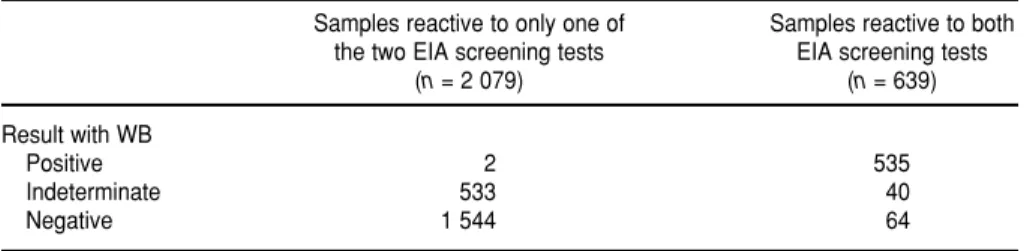
Of the 698 191 blood units initially screened with the two different EIA tests, 2 718 of them (0.4%) had to be discarded for transfusion use because they were reactive to at least one of the EIA screening tests. The WB results on these EIA-positive donation samples are presented in Table 1. Of the 2 718 EIA-reactive samples, 639 of them were reactive in both EIA screening tests, and 2 079 were reactive to only one of the EIA screening tests.
Of the 639 samples reactive in both EIA screening tests, 535 (84%) were confirmed positive by WB. Of the 2 079 samples that were reactive to only one of the two EIA screening tests, only two of them (0.1%) were positive by WB. These two samples both had only weak p24 and gp160 bands on the WB.
Rev Panam Salud Publica/Pan Am J Public Health13(2/3), 2003 173
TABLE 1. Western blot (WB) results on 2 718 blood-donation samples that were reactive to one or two different, concomitant enzyme immunoassay (EIA) screening tests for HIV, São Paulo, Brazil, 1999–2001
Samples reactive to only one of Samples reactive to both the two EIA screening tests EIA screening tests
(n= 2 079) (n= 639)
Result with WB
Positive 2 535
Indeterminate 533 40
174 Otani et al. • Evaluation of the concomitant use of two different EIA tests for HIV screening in blood banks A follow-up sample was obtained in
both of these cases. One of the donors was negative on both of the EIA tests of the follow-up sample, which was col-lected 45 days after the initial dona-tion, and the person remained nega-tive over the following 3 years when he was tested again for HIV at the blood center as part of the reentry process. The second individual had only one follow-up sample collected, 22 days after the initial donation. In comparison to the tests on the initial donation sample, this person’s follow-up sample was reactive to the same EIA test and had a weak p24 band on the WB test but no longer had a gp160 band. Based on these findings, we con-cluded that the blood donations in both of these cases had produced false-positive WB results.
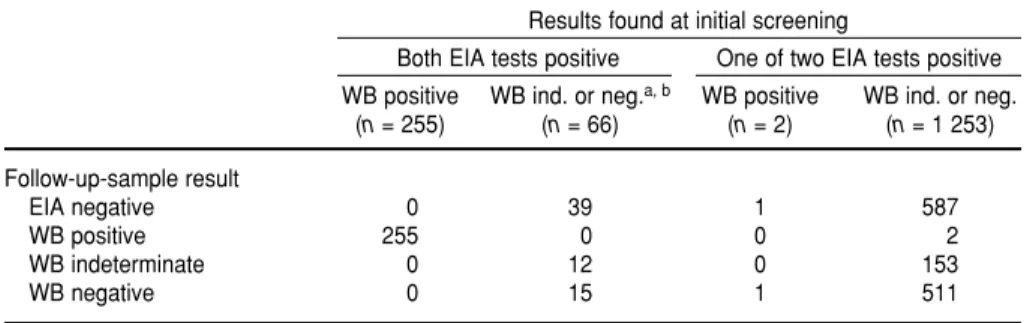
Of the initial 2 718 donors whose samples were reactive in at least one EIA screening test, 1 576 of them (58%) returned for follow-up testing. The re-sults with those follow-up samples are shown in Table 2.
There were two donors who were initially weakly reactive to a single EIA test and with a negative WB who seroconverted, being positive to both of the follow-up EIAs and to the follow-up WB. These were the only true HIV-positive samples that were
detected with only one of the two EIAs used at screening.
DISCUSSION
The majority of the latest-generation HIV EIA tests detect all samples with a positive WB (1, 2). However, differ-ences in EIA sensitivity have been de-scribed for samples obtained during the period of seroconversion, espe-cially for non-subtype B viruses (6). The data presented here support this, since all the WB-positive samples were detected by both EIAs. The only two cases that were reactive to one of two EIA screening tests and positive on the WB at screening turned out to be false-positives. As previously described (7–9), false-positive results on the WB may be caused by cross-contamination with a positive sample, labeling errors, or nonspecific reactivity to monomeric and multimeric forms of gp41.
During seroconversion, EIA reactiv-ity precedes WB positivreactiv-ity by about 3 days. The two seroconverter samples detected in this study were weakly positive by one EIA screening test and were WB-negative at screening. The follow-up samples for these two donors were positive by both EIA tests as well as the WB. One of these
follow-up samples was collected 4 weeks af-ter the initial blood donation, and the other was collected a year after the ini-tial donation.
Our study shows that the use of two different, concomitant EIA screening tests detected 2 seroconversion sam-ples from among the 1 576 donors who returned for follow-up. This set of 1 576 donors represents 58% of the original reactive donor population of 2 718 persons. Therefore, we can esti-mate that there were about 3.4 serocon-version samples from among the 698 191 blood units (that is, 2/0.58 = 3.4). If we assume that each EIA test has a 50% chance of detecting these low-reactive samples, only 1 more case for every 410 700 units of donated blood would be detected by using two different EIA screening tests as compared to using a single EIA screening test (that is, 698 191/(3.4 ⫻0.5) = 410 700).
To summarize, we have shown that the use of two screening EIAs rather than just one was of virtually no value in our São Paulo blood donor popula-tion, and that the use of a second EIA test to detect HIV-positive blood dona-tions does not contribute to blood safety in practical terms. That is be-cause the great majority of HIV-posi-tive donors have already serocon-verted and will be detected using only a single EIA screening test. Only per-sons who are going through the process of seroconversion may be missed by using a single EIA test and detected using two EIAs for screening. For screening out these individuals, other techniques, such as p24 or nu-cleic acid testing, are known to be more effective than the use of two different, concomitant EIA tests. Fur-thermore, these other tests also de-tect HIV-antibody-negative cases that would still be missed even when per-forming two different, concomitant EIA screening tests.
Acknowledgments. The authors thank Dr. Allen Mayer for critical dis-cussion and suggestions.
TABLE 2. Enzyme immunoassay (EIA) and Western blot (WB) test results on follow-up blood samples provided by 1 576 blood donors whose initial blood donation had been re-active to one or two EIA screening tests for HIV, São Paulo, Brazil, 1999–2001
Results found at initial screening
Both EIA tests positive One of two EIA tests positive WB positive WB ind. or neg.a, b WB positive WB ind. or neg.
(n= 255) (n= 66) (n= 2) (n= 1 253)
Follow-up-sample result
EIA negative 0 39 1 587
WB positive 255 0 0 2
WB indeterminate 0 12 0 153
WB negative 0 15 1 511
Rev Panam Salud Publica/Pan Am J Public Health13(2/3), 2003 175
Objetivo. En 1998, el Ministerio de Salud de Brasil decretó que todos los bancos de sangre en el país debían someter toda la sangre donada a un tamizaje para la detec-ción del virus de la inmunodeficiencia humana (VIH) usando concomitantemente dos inmunoensayos enzimáticos (IEE) diferentes. Nuestro objetivo al realizar el pre-sente estudio, resultado de un afán por sacar el máximo provecho a los recursos disponibles, ha sido evaluar la utilidad de hacer un tamizaje con dos IEE en lugar de uno solo.
Métodos. Analizamos datos de 1999–2001 obtenidos como resultado del tamizaje de 698 191 unidades de sangre donada mediante dos IEE aplicados concomitante-mente en la Fundación Pro-Sangre del Centro de Sangre de São Paulo (Fundação Pró-Sangue/ Hemocentro de São Paulo), que es un centro hematológico importante en la ciu-dad de São Paulo, Brasil. Toda muestra que fue reactiva en por lo menos uno de los dos IEE fue sometida a un inmunoblot de Western (WB) a manera de confirmación, y a las personas que habían donado la sangre positiva también se les pidió que re-gresaran para proporcionar una muestra de seguimiento.
Resultados. De las 698 191 unidades de sangre que fueron donadas, hubo que descartar 2 718 (0,4%) porque mostraron reactividad a uno de los IEE o ambos. Dos de las muestras donadas que mostraron positividad en el WB fueron reactivas en so-lamente uno de los IEE de tamizaje. En lo que respecta a las muestras de seguimiento, ambos donantes tuvieron resultados negativos en el WB. Estos resultados se consid-eraron positivos falsos para fines del tamizaje. De los 2 718 donantes a quienes se les pidió que regresaran para proporcionar una muestra de seguimiento, 1 576 (58%) cumplieron. De estas 1 576 personas, dos habían mostrado reactividad a solamente uno de los IEE de tamizaje, con resultados negativos en el WB, pero habían mostrado una seroconversión completa en la muestra de seguimiento. Por consiguiente, nues-tra conclusión es que el tamizaje con dos IEE, en comparación con uno solo, permi-tiría detectar solamente una muestra adicional de un total de 410 700 unidades de sangre.
Conclusiones. Nuestros datos no respaldan la conveniencia de usar concomitante-mente dos IEE diferentes para el tamizaje del VIH. La gran mayoría de los donantes con positividad a VIH ya habrán tenido una seroconversión y se pueden detectar con un solo IEE. Solamente aquellas personas que están aún en proceso de seroconver-sión podrían no ser detectadas mediante un solo IEE, pero sí con dos. Para identificar a estas personas y reducir cualquier riesgo residual de transmitir el VIH por medio de la sangre donada en nuestro centro, sería más eficaz el uso de otras técnicas, tales como las pruebas a base de ácidos nucleicos o un ensayo a base de Agp24.
RESUMEN
Evaluación del uso
concomitante de dos
inmunoensayos enzimáticos
distintos para el tamizaje del
VIH en bancos de sangre
1. Weber B, Moshtaghi-Boronjeni M, Brunner M, Preiser W, Breiner M, Doerr HW. Evaluation of the reliability of 6 current anti-HIV-1/HIV-2 enzyme immunoassays. J Virol Methods 1995; 55(1):97–104.2. Koch WH, Sullivan PS, Roberts C, Francis K, Downing R, Mastro TD, et al. Evaluation of United States-licensed human immunodefi-ciency virus immunoassays for detection of group M viral variants. J Clin Microbiol 2001; 39(3):1017–1020.
3. George JR, Schochetman G. Detection of HIV infection using serological techniques. In: Scho-chetman G, George JR, eds. AIDS testing: a comprehensive guide to technical, medical, so-cial, legal and management issues. New York: Springer Verlag; 1994. Pp. 62–102.
4. United States of America, Centers for Disease Control and Prevention. Current trends
up-date: serologic testing for antibody to human immunodeficiency virus. MMWR 1988;36(52): 833–840.
5. Proffitt MR, Yen-Lieberman B. Laboratory diagnosis of human immunodeficiency virus infection. Infect Dis Clin North Am 1993;7(2): 203–219.
6. Apetrei C, Loussert-Ajaka I, Descamps D, Damond F, Saragosti S, Brun-Vezinet F, et al. Lack of screening test sensitivity during HIV-1 non-subtype B seroconversions. AIDS 1996; 10(14):F57–60.
7. Ascher DP, Roberts C. Determination of the eti-ology of seroreversals in HIV testing by anti-body fingerprinting. J Acquir Immune Defic Syndr 1993;6(3):241–244.
8. Sabino EC, Delwart E, Lee TH, Mayer A, Mullins JI, Busch MP. Identification of low-level contamination of blood as basis for
detec-tion of human immunodeficiency virus (HIV) DNA in anti-HIV-negative specimens. J Acquir Immune Defic Syndr 1994;7(8):853–859. 9. Sayre KR, Dodd RY, Tegtmeier G, Layug L,
Alexander SS, Busch MP. False-positive human immunodeficiency virus type 1 western blot tests in noninfected blood donors. Transfusion 1996;36(1):45–52.
Manuscript received 11 February 2002. Revised version accepted for publication on 5 August 2002.