Audit Regulation in Banking Systems: Analysis of the International
Context and Determining Factors*
José Alves Dantas
Assistant Professor, Department of Accounting and Actuarial Sciences, University of Brasília E-mail: [email protected]
Fábio Moraes da Costa
Associate Professor, Departamnent of Acounting and Finance, FUCAPE Business School E-mail: [email protected]
Jorge Katsumi Niyama
Full Professor, Department of Accounting and Actuarial Sciences, University of Brasília E-mail: [email protected]
Otávio Ribeiro de Medeiros
Full Professor, Department of Accounting and Actuarial Sciences, University of Brasília E-mail: [email protected]
Received on 10.25.2011- Desk acceptance on 10.26.2011- 4th. version approved on 10.16.2012
ABSTRACT
This empirical-analytical study aims to provide a comparison between the levels of audit activity regulation in banking institutions and evaluate the relationship between the degree of regulation and the characteristics of national banking systems. To this end, a database con-taining data from a survey conducted with the national banking supervisory and regulatory authorities of 172 countries that is maintained by the World Bank was used. Descriptive statistics revealed that the highest levels of regulation are recorded in the most developed nations as well as Middle Eastern, North African, European and Central Asian countries. The study also confirmed that Brazil has a higher level of regulation than the international average. Tests were carried out using regressions to evaluate the relationship between the level of audi-ting regulations and the characteristics of banking sectors; it was evident that countries with higher levels of domestic credit provision by the banking sector and more profitable banks impose more requirements regarding the performance of auditors. In contrast, there is less regulation in countries where state banks participate more in the financial system and where there are more restrictions on the activities of banking institutions. A positive association between a banking sector’s degree of concentration and the level of auditing regulation was not found. Finally, it was noted that, in 2000, the first year in which the employed survey was conducted, the level of regulation was lower than in the other years, whereas in 2007, the final year of the survey, the level of regulation was higher than in previous years. These results confirm the findings in the literature that auditing standards are likely to become more stringent over time as the demand for more rigo-rous requirements accumulates, especially during credibility crises.
Keywords: Audit, Regulation, Banking system, Auditing standards, Banks.
1 INTRODUCTION
The activities performed by independent auditors are generally seen as essential for the functioning of finan-cial and capital markets in light of the role of auditors to provide opinions on accounting information, which con-tributes to the creation of business environments that are characterized by greater trust and credibility (Newman, Patterson, & Smith, 2005; Ojo, 2008). Auditors therefore act as intermediaries for financial information. In addi-tion to helping economic agents in these markets, audi-ting also contributes to the actions of oversight bodies, particularly in more regulated sectors such as banking. The premise behind this notion is that the work of au-ditors complements the actions of supervisors, thereby helping to build the perception of the financial system’s reliability and soundness.
It is therefore natural for regulators to be concerned about whether expectations regarding audit performance are being met. This concern is often reflected in the streng-thening of standards that regulate auditing activities, espe-cially when problems involving auditing work are detected and when regulators are under pressure to respond to ques-tions from economic agents and the specialized media.
Although the most significant regulatory changes most often occur in response to problems that compro-mise the credibility of auditors, changes in the regula-tory environment in terms of increasingly stringent re-quirements have been a hallmark of the auditing market. In the early 1990s, for example, Dye (1993) emphasized that this aspect characterized the strong transformations that took place in the United States (US) auditing market at that time.
The most relevant regulatory change in the US, howe-ver, occurred in the early 2000s, with the enactment of the Sarbanes-Oxley Act (SOX) in response to a series of corpo-rate scandals. The most emblematic of these was the Enron case, in which one of the largest auditing firms at the time, Arthur Andersen, was convicted of destroying evidence (Norris, 2004). The new law substantially changed the au-diting market’s regulatory environment and reduced the profession's self-regulatory powers by creating the Public Company Accounting Oversight Board (PCAOB), which has the authority to regulate the profession, establish au-diting standards and impose professional discipline (Co-ffee Jr., 2004). The global financial crisis of 2008 raised new questions about the role of auditors, particularly in finan-cial institutions, and the response of regulators has been to reinforce regulatory frameworks and invest in bringing about the global convergence of standards for professional practices (Ramos, 2010).
In Brazil, the most significant regulatory changes in the auditing market have also generally occurred in response to credibility crises. This applies, for example, to the sto-ck exchange crisis of the early 1970s, which resulted in the establishment of the first professional auditing standards issued by auditing and market regulatory bodies as well as a review of the legal model of the structure and
functio-ning of the capital market. During the 1990s, in response to frauds committed by financial institutions, legal and nor-mative changes were implemented to increase the degree of responsibility attributed to the auditors of financial institu-tions and to establish a series of requirements for professio-nal auditing activities, including the mandatory rotation of auditors and the prohibition of activities that may represent conflicts of interest, among others.
In addition to occurring as a response to credibility crises, another factor that has encouraged the adoption of regulatory changes for auditing in different countries is international trends, especially those originating in nations with greater power, i.e., those with more impor-tant financial and capital markets. For example, SOX has become a reference for regulators across different con-tinents. More recently, the movement to unify national auditing standards gained strength with the internatio-nalization of markets and the advanced accounting stan-dard convergenceharmonization process. Multinational corporations began requiring the adoption of auditing standards that were consistent across countries with the aim of increasing investor confidence (Hayes, Dassen, Schilder, & Wallage, 2005). The argument is that the opinions of non-domestic auditors, which are based on internationally recognized standards, would attribute more credibility to financial reporting.
These changes, in addition to being a way for regula-tors to respond to public opinion during times of crisis, are based on the assumption that the adoption of more com-prehensive and/or rigorous regulatory frameworks helps improve the performance of auditors by enhancing profes-sional guidelines, reducing gaps in understanding regar-ding the scope of work and more clearly defining what can and cannot be done by auditors to preserve their indepen-dence and skepticism.
The implications of auditing in relation to the functio-ning of capital markets have been widely discussed, at least in the international literature. This same coverage has not been found in relation to financial markets, as highlighted by Ojo (2008), Kanagaretnam, Lim, and Lobo (2010) and Ettredge, Xu, and Yi (2010). According to Fields, Fraser, and Wilkins (2004), given that the role of financial in-termediation played by banks is vital for the functioning of economies, it is surprising that there is such a paucity of research investigating the performance of auditors in banking markets.
periodically updated by the World Bank. This database contains the results of a survey conducted on banking supervisory and regulatory authorities from every con-tinent that covers several aspects of the financial syste-ms in each country, including specific requirements for independent auditing activities.
The present study fills a gap in the literature on the regulation of auditing activities within national banking systems, enabling a broad view of changes in the profession’s regulatory environments across the globe. This work advances the findings of Herath and Kumar (2002), who used the same database but limited their study to the base year, 2000, and more narrowly focu-sed on the relationship between auditing requirements and the development level of countries. Furthermore, the present study presents a more specific analysis of
the Brazilian case in the international context, offering support for the more effective performance of market regulators and the auditing profession itself.
In addition to this introduction, the study includes in the following sections: the theoretical framework, which emphasizes issues such as the purpose of audi-ting, the rigor of auditing regulatory environments and auditing regulations in banking systems (Section 2); a specification of the methodology used to conduct em-pirical tests, including the development of the research hypotheses and details on the econometric reference model (Section 3); the determination and analysis of the achieved empirical results (Section 4); and the con-clusions of the study (Section 5), which use the rela-tionship between the theoretical foundations and the obtained empirical data as a reference.
2 THEORETICAL FRAMEWORK
According to the Basel Committee on Banking Su-pervision (BCBS, 2002) and the International Federation of Accountants (IFAC, 2008), the goal of auditors is to express an opinion on whether financial statements were prepared, in all material aspects, in accordance with an applicable framework – in this case, the accounting stan-dards set by regulatory bodies. In the study of Woods, Humphrey, Dowd, and Liu (2009) on compliance with accounting standards, the authors stated that the role of the auditor is to certify that the disclosed financial sta-tements represent a ‘true and fair view’ of the financial position and performance of an entity.
Citing the potential conflicts of the agency theory, Wat-ts and Zimmerman (1986) address the reliability of in-formation from an argumentative approach, emphasizing that audits are monitoring mechanisms that help reduce information asymmetry and protect the interests of sha-reholders and potential investors by ensuring that financial statements are free from material misstatements. Newman, Patterson and Smith (2005) reinforce this notion, stating that auditors play a significant role in protecting investors against actions taken by the directors or controlling sha-reholders of companies.
Specifically addressing the value of audits in the opera-tion and soundness of financial system, the BCBS (2008) states that activities carried out in accordance with ethical and high-level, globally accepted auditing standards are essential for their proper adoption, which would help to ensure that financial statements are reliable, transparent and useful to markets. This attitude increases market con-fidence and improves the quality of information used by banking supervisors.
2.1 From Management Incentives to Auditor
Conflicts of Interest
There is clearly some consensus on the purpose of the work of auditors given the role of these professionals as in-termediaries in the financial disclosure process who redu-ce information asymmetry between management and the
users of financial statements. It is important to emphasize, however, that in the same way that managerial incentives can be observed in the preparation of financial statements, reinforcing the need for action on the part of auditors, the-re athe-re also potential conflicts of intethe-rest the-related to the per-formance of auditors that can compromise the quality of the performed audits.
Nelson, Elliott and Tarpley (2002), for example, note that competition in the auditing market increa-ses the pressure on auditors, particularly partners or managers, to maintain customer relations and expand business, which can compromise their objectivity and independence. This aspect of the competitive market strategy is also highlighted by Norris (2004) when dis-cussing the post-Enron environment in which auditors are increasingly challenged. According to the author, this is because auditing firms have grown in size more than they have improved in terms excellence, with partners being rewarded for getting more clients and penalized for obstructing the interests of the most im-portant customers. This type of concern is echoed by Coffee Jr. (2004), who states that in certain situations and under certain conditions, auditing firms can de-velop and follow a competitive strategy that results in their agreement with the claims of clients and even the responsibility for costs related to legal challenges or loss of reputation.
In the early 1980s, DeAngelo (1981) stated that when a large proportion of an auditor's revenue is tied to a particular client, it can make that professional less objective and compromise his or her skepticism. This was one of the arguments used by the author to argue that larger firms would provide better quality audit services: Because they are less dependent on any par-ticular client, large audit firms are better equipped to withstand management pressure to allow for aggressive interpretations.
occur-rence of situations that may compromise the objectivi-ty and independence of auditors and that define clearer responsibilities and penalties – constituting the threat of litigation – if auditors do not act appropriately. This dilemma is discussed by Dye (1993), who states that to provide adverse or qualified opinions, auditors act as economic agents. As such, they weigh the pros and cons of this decision: protection against disputes (in-cluding liability for any third party losses) and the loss of the client, respectively.
The effectiveness of the threat of litigation in limi-ting improper behavior by auditors is evaluated by Pae and Yoo (2001). Using an analytical model, they de-monstrated that the degree of responsibility attributed to the auditor influences the quality of the audit. For the authors, accountability acts as a strong ex-ante in-centive for the auditor to prevent possible errors, inclu-ding the application of more auditing resources when the internal control system established by the manage-ment is inefficient.
Also using an analytical model, Newman, Patterson and Smith (2005) demonstrated that the severity of the penalty serves as a parameter for the level of investor protection, representing an indication of the rigor of the market's le-gal and regulatory framework in the preservation of the rights of minority partners. The authors demonstrated a relationship between the threat of litigation, represented by the degree of exposure to penalties, and the quality level of the auditors' work.
2.2 Regulation of the Auditing Market
The assumption that auditing regulations play an important role in the quality of the services of indepen-dent auditors by defining responsibilities, establishing minimum coverage for each task, advising on repor-ting standards and defining references for procedu-res, among others, has historically prevailed. A more comprehensive and rigorous regulatory environment is expected to contribute to the improvement of audits, whether due to the greater clarity of regulatory guide-lines or the more appropriate delineation of the role of auditors in terms of what is expected of them and what they cannot do. This delineation is especially relevant when there is potential for the auditor’s independence to be compromised – the most common example being restrictions on the provision of consulting services by the auditor responsible for certifying the financial sta-tements.
In summary, "more stringent or comprehensive" re-gulatory requirements seek to limit the risks associated with conflicts of interest and incentives that may com-promise the quality of audits. By providing more objec-tive responsibilities and broader penalties, for example, regulators expect to reduce the likelihood that auditors will act against the interests of the users of financial information if previous incentives are changed or new ones are created in the opposite direction, such as the threat of litigation, loss of reputation and civil and
ad-ministrative accountability, among others.
Merchant and Van der Stede (2007) follow the same line of reasoning, citing SOX requirements. According to the authors, despite the high costs of meeting require-ments, positive effects on the quality of financial reports can be observed and reveal a greater degree of rigor in the assessment and examination of the disclosed state-ments. For example, cases in which financial statements were reformulated increased substantially, from 5.7% to 14%, between 2003 and 2005. Evidence indicating more conservative behavior of auditors after SOX, as measu-red by opinions on the likelihood of business continui-ty, can also be found in Cahan and Zhang (2006). Only recently has auditor conservatism returned to pre-SOX levels (Feldmann & Read, 2010).
The scandal in 2009 involving the Indian company Satyam, in which a subsidiary of Pricewaterhouse-Coopers was questioned in depth about its failure to identify a fraud of more than one billion dollars, pro-vides another example of the impact of the regulatory environment on the performance of auditors. An state-ment made by Professor Ganesh Krishnamoorthy from Northeastern University consulted at the time reveals how the rigor of the regulatory and supervisory envi-ronment can influence the behavior of auditors and the quality of their work:
“If you’re an auditor working in an emerging market like India and you believe regulatory scrutiny is going to be somehow lower than if you were doing it somewhere else in the world, then there are less incentives to give the same quality audit” (Sharma, Kratz, & Hollanda, 2009, p.D3).
Blakely (2009) notes that, as a result of this scandal, foreign investors questioned India’s regulatory system. For example, the author cites that it was possible for auditing firms that review financial statements to also provide consultancy services, a practice that had alrea-dy been banned in many Western countries (especially after the Enron scandal) because of the obvious conflict of interest involved. The example of India highlights the importance of the institutional environments of coun-tries. Although the literature generally uses US or UK market standards as a reference, the particularities of each country cannot be ignored when trying to unders-tand the impact of regulatory frameworks on the perfor-mance of auditors. This understanding, in fact, is one of the pillars of the movement towards the convergence of national auditing standards demanded by international investors (Hayes et al., 2005).
The degree to which regulation has affected the auditing market has grown in importance due to the corporate scandals of the early 2000s, in which several cases of auditor failure to identify problems with the quality of disclosed information resulted in changes in the auditing profession's rules of governance. The main consequence around the world was the replacement of self-regulation by strong regulation, including the cre-ation of agencies to monitor the work of auditors – the most relevant example being the PCAOB in the US. In Brazil, there have been studies regarding the establish-ment of an independent supervisory body to monitor and regulate the auditing market (Niero, 2009; Valor Econômico, 2010).
Finally, it must be noted that the pressure applied by re-gulators to prevent material misstatements from receiving positive opinions from auditors, which constitutes a type II error, may serve as an incentive for the occurrence of type I errors – statements receiving qualified opinions, especially regarding the likelihood of business continuity, which are subsequently not confirmed. Despite this concern, Carey, Kortum, and Moroney (2008) found that auditors became more likely to issue qualified opinions about the possibility of business continuity after the Enron scandal but the level of type I errors remained unchanged between the pre- and post-Enron periods.
2.3 Regulation of Auditing Activities in Banking
Systems
Given the peculiarities of the financial system, in which an institution's insolvency can generate a chain reaction in-volving other banks and other economic segments, as sho-wn in the 2008 global crisis, the credibility of accounting information is particularly important. To ensure an envi-ronment of trust, the roles of regulatory and supervisory bodies – which seek to safeguard financial stability and the soundness of the system – are highlighted, as are those of external auditors – who are responsible for attesting to the credibility of accounting information.
Goulart (2007) states that the importance of transpa-rency as one of the foundations of a sound financial sys-tem is why international agencies and the central banks of various nations demand that banking institutions disclose information that demonstrates their levels of equity, finan-cial positions and results, as well as information on other aspects such as organizational structure, internal controls and risk management.
In this context, Barth, Caprio Jr., and Levine (2001, updated 2008) developed a database comprising sur-veys conducted on banking supervisory and regulatory authorities in countries from every continent with re-gard to regulatory aspects of financial systems, inclu-ding requirements for entry into the system, property restrictions, capital requirements, activity restrictions, independent auditing requirements, characteristics of secure deposits, loan classification and provisioning requirements, accounting and disclosure requirements, troubled bank resolution actions and the quality of su-pervisory staff and their actions. The original database, whose reference date is 2000, was later updated by the World Bank with data from 2003 and 2007. Its purpose is to allow for the identification of existing banking re-gulations and supervision, as well as specific aspects of the structures of the local financial systems and secure deposit arrangements of a number of countries.
Using specific auditing information from the original database, with a base year of 2000, Herath and Kumar (2002) investigated the nature of audit requirements for banks around the world and found a direct relationship be-tween requirements for audit certifications and developed countries, emerging markets and offshore countries. Ho-wever, such a relationship was not found in lower-income countries. The relationship between the monitoring and control of audits and the level of development and income was also tested, but no significant relationship was found. Similarly, no statistically significant results were found regarding groups of countries when considering a com-prehensive measure of auditing requirements.
3 METHODOLOGY
Regarding methodological approaches, the present study can be classified as an empirical-analytical study, which is defined by Martins (2000) as an approach that uses techniques to collect, process and analyze marke-dly quantitative data, focusing on practical studies and having a strong concern for the causal relationship be-tween variables.
The main reference for the empirical tests was the database of Barth, Caprio Jr., and Levine (2001, updated 2008), covering data on the regulations of the banking systems of 118, 151 and 143 countries in the base years of 2000, 2003 and 2007, respectively. In total, data from 172 countries were considered, although they were not complete for all considered periods. The data from this database were obtained directly from the World Bank
website and grouped/processed in accordance with the criteria outlined in Sections 3.1 and 3.2.
3.1 Comparative Analysis of Levels of Audit
Requirements
For the purpose of proposing a comparative asses-sment of the levels of requirements related to auditing activities within the financial systems of different coun-tries – with a particular focus on Brazil – levels of com-pliance with each specific auditing requirement in the survey were initially analyzed.
Ku-mar (2002), as well as by geographic region, enabling the Brazilian case to be evaluated in relation to each grouping of nations.
3.2 Relationship Between Auditing Regulations
and Characteristics of Banking Systems
The next step was to test the relationship between the level of auditing regulations and the characteris-tics of national banking systems, based on the precepts found in the literature on the causes and effects of the auditing regulation process, particularly in financial systems, as outlined in Section 2.
Initially, the relationship between the level of audi-ting regulation (RAud) and a representative measure of the importance of the banking system in the country's economy was tested using credit operations as a para-meter. This was based on the assumption that the more important the financial system was to the local eco-nomy, the greater the concern of the regulatory body would be with regard to the performance of auditors in contributing to the provision of more reliable infor-mation about institutions, which should translate into more auditing regulations. The following research hy-pothesis is thus empirically tested:
H1- Countries whose financial systems are of greater importance to the national economy have higher levels of auditing regulations.
A test was then carried out to determine whether the ownership structure – more specifically, the control type – predominant in financial systems affects how regula-tors are positioned in relation to the establishment of normative requirements for auditors. In countries where government control of banks is prevalent, regulators are expected to have fewer reasons to establish requirements for auditing activities because the state can directly mo-nitor the situation of banks. This, in turn, should be reflected in fewer normative requirements for the per-formance of independent auditors. Thus, the following hypothesis is formulated:
H2- Countries in which governmental control of banks is predominant in the financial system have lower levels of auditing regulations.
The relationship between the level of auditing regu-lation and any regulatory restrictions on the activities of financial institutions was also evaluated. This was based on the assumption that banking systems that impose greater restrictions on the activities of banks – such as limitations with regard to activities related to insurance, securities and mortgage loans – regulators may be less concerned about the quality of accounting information given that banking operations would be simpler to monitor and verify. This is expected to be reflected in fewer requirements with regard to the ac-tivities of auditors. Thus, the following hypothesis is formulated:
H3- Countries where there are more restrictions on bank exploration of activities such as insurance, secu-rities and mortgage loans, have lower levels of auditing
regulations.
Another tested relationship was the impact of bank profitability on the level of auditing requirements in each financial system. The assumption was that in countries with more profitable banks, regulators would be more concerned with the potential manipulation of accounting information, which would translate into more auditing requirements given the auditor's role of reviewing and certifying the quality of financial state-ments. The following research hypothesis is thus empi-rically tested:
H4- Countries whose banking institutions are more profitable have higher levels of auditing regulations.
Finally, the relationship between the country's level of auditing regulations and the concentration of its fi-nancial system was evaluated. Given that concentration in the financial sector represents a measure of risk consi-dering that the stability of the banking system is heavily dependent on the soundness of its most important ins-titutions, which often become too big to fail, regulators must demonstrate greater concern for the supervision and monitoring of the situation of these banks. In parti-cular, there should be more auditing requirements that complement the work of supervisory bodies. Thus, the following hypothesis is formulated:
H5- Countries whose banking systems are more con-centrated have higher levels of auditing regulations.
In light of the formulated research hypotheses, the follo-wing model is specified to test the relationship between the level of audit regulations and the characteristics of national banking systems:
RAudit = β0 + β1CBankit + β2PGovit + β3RRFit
+ β4ROAit + β5Concit + εit
where:
RAud = level of auditing regulations in the banking sys-tem of country i at time t, determined by the level of com-pliance with the audit requirements contained in the data-base of Barth, Caprio Jr. and Levine (2001, updated 2008);
CBank = domestic credit provided by the banking sec-tor as a proportion of the gross domestic product (GDP) of country i, at time t – source: World Bank (2010);
PGov = proportion of the assets of the banking system of country i at time t in banks whose capital comes mostly from the government (50% or more) – source: Barth, Ca-prio Jr. and Levine (2001, updated 2008);
RRF = level of regulatory restrictions in country i
at time t regarding the participation of banks in securi-ty, insurance and mortgage loan activities – on a scale ranging from 1 (no restrictions) to 4 (prohibition) cal-culated in accordance with the criteria of Herath and Kumar (2002) – source: Barth, Caprio Jr. and Levine (2001, updated 2008);
ROA = profitability of the banking institutions of coun-try i at time t calculated according to average returns on assets – source: Beck, Demirgüç-Kunt and Levine (1999 - updated 2010);
Conc = concentration of the financial system of coun-try i at time t calculated according to the proportion of the banking system’s total assets represented by the top three banks – source: Beck, Demirgüç-Kunt and Levine (1999, updated 2010).
The relationship between the research hypotheses, the model independent variables and the expected signs are shown in Table 1.
Table 1 Association between research hypotheses and model independent variables
Hipothesys H
1 H2 H3 H4 H5
Variables CBank PGov RRF ROA Conc
Expected Sign + - - + +
Model (3.1) was estimated using panel data and the following procedures and tests were employed to ensure the robustness of the results: (i) use of the full sample and exclusion of extreme values to verify whether the results would be influenced by outliers, (ii) use of the Chow test, as suggested by Baltagi (2008), to determine the existence of individual effects, which justifies the use of panel data, (iii) use of the Hausman test to identify the most appro-priate panel data method – fixed or random effects, (iv) estimation of the model with the cross-section seemingly unrelated regression (SUR) method to avoid the risk of distortions caused by any non-compliance with condi-tions of homoscedasticity and the absence of autocorrela-tions in the residuals.
4 ANALYSIS OF RESULTS
The empirical test results are discussed considering three evaluation parameters: analysis by type of ment, comparative analysis of compliance with require-ments and test of the determinants of auditing regulations in banking systems.
4.1 Analysis by Type of Requirement
In the database of Barth, Caprio Jr., and Levine (2001, updated 2008), eight specific requirements
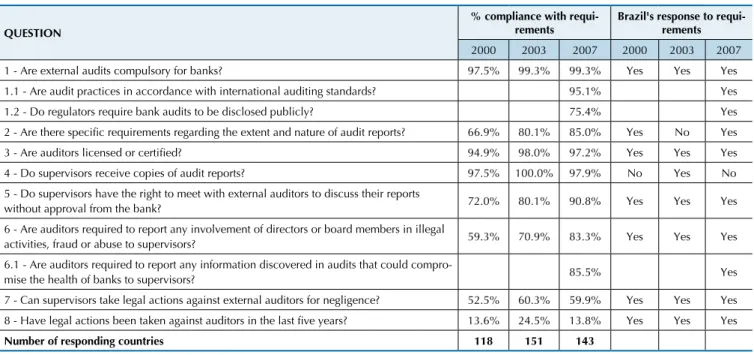
re-lating to independent auditing activities in financial systems are highlighted in the reference years of 2000 and 2003. Three other requirements were incorpora-ted in 2007. Table 2 presents a summary of the results with regard to the percentage of compliance with each requirement based on the responses of supervisory au-thorities and banking regulators, with a particular em-phasis on the case of Brazil.
Table 2 Summary of responses on auditing in the Bank Regulation and Supervision survey
QUESTION
% compliance with requi-rements
Brazil's response to requi-rements
2000 2003 2007 2000 2003 2007
1 - Are external audits compulsory for banks? 97.5% 99.3% 99.3% Yes Yes Yes
1.1 - Are audit practices in accordance with international auditing standards? 95.1% Yes
1.2 - Do regulators require bank audits to be disclosed publicly? 75.4% Yes
2 - Are there speciic requirements regarding the extent and nature of audit reports? 66.9% 80.1% 85.0% Yes No Yes
3 - Are auditors licensed or certiied? 94.9% 98.0% 97.2% Yes Yes Yes
4 - Do supervisors receive copies of audit reports? 97.5% 100.0% 97.9% No Yes No
5 - Do supervisors have the right to meet with external auditors to discuss their reports
without approval from the bank? 72.0% 80.1% 90.8% Yes Yes Yes
6 - Are auditors required to report any involvement of directors or board members in illegal
activities, fraud or abuse to supervisors? 59.3% 70.9% 83.3% Yes Yes Yes
6.1 - Are auditors required to report any information discovered in audits that could
compro-mise the health of banks to supervisors? 85.5% Yes
7 - Can supervisors take legal actions against external auditors for negligence? 52.5% 60.3% 59.9% Yes Yes Yes
8 - Have legal actions been taken against auditors in the last ive years? 13.6% 24.5% 13.8% Yes Yes Yes
Number of responding countries 118 151 143
Source: Barth, Caprio Jr., and Levine (2001, updated 2008).
The temporal analysis of the data shows that there is ge-nerally a certain amount of growth or stability in the level of compliance with requirements over the examined periods. The only exception is in relation to the question regarding the adoption of legal actions against auditors in the last five years, which returned to its initial level in early 2007 after significant growth in 2003 compared to 2000. One possible explanation for this behavior in 2003 may be related to the post-Enron environment, which was characterized by deep
distrust of auditors and may have influenced the adoption of legal actions against these professionals.
the questions that had the lowest compliance were the adoption of legal actions against auditors in the last five years (only 13.8%), the ability of supervisors to take legal actions against auditors for negligence (59.9%) and the requirement for the public disclosure of audits (75.4%).
With regard to the Brazilian case, of the eleven study questions for the 2007 base year, ten were answered affir-matively. The only negative response was regarding the obli-gation to send a copy of the audit report to the supervisor. Resolution 3,198 of the National Monetary Council (Con-selho Monetário Nacional – CMN), passed in 5/27/2004, determined that banks and auditors should preserve the documents that support auditing results so they can be
submitted to regulators if requested. This draws attention to the fact that among the 143 countries surveyed in that year, only Brazil, Jersey, and the United States – 2.1% of the total – had no such requirement.
4.2 Comparative Analysis of Average
Compliance with Requirements
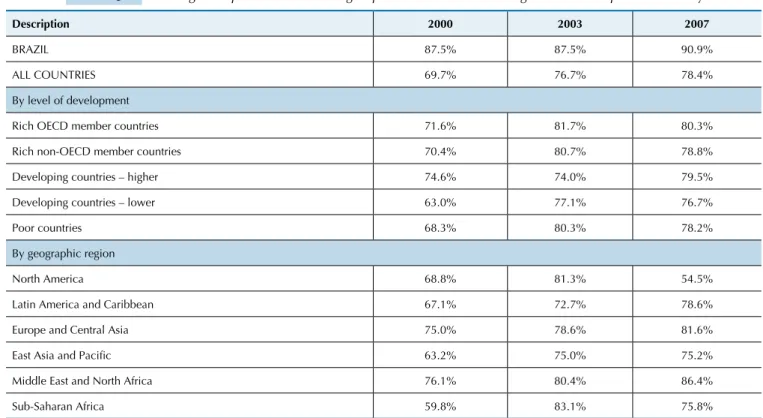
The levels of compliance with regulatory auditing requirements in banking systems, according to the le-vels of economic development (noting the World Bank classification based on GDP per capita) and the geogra-phic regions of countries, with particular emphasis on Brazil, are summarized in Table 3.
Table 3 Average compliance with auditing requirements in the Bank Regulation and Supervision survey
Description 2000 2003 2007
BRAZIL 87.5% 87.5% 90.9%
ALL COUNTRIES 69.7% 76.7% 78.4%
By level of development
Rich OECD member countries 71.6% 81.7% 80.3%
Rich non-OECD member countries 70.4% 80.7% 78.8%
Developing countries – higher 74.6% 74.0% 79.5%
Developing countries – lower 63.0% 77.1% 76.7%
Poor countries 68.3% 80.3% 78.2%
By geographic region
North America 68.8% 81.3% 54.5%
Latin America and Caribbean 67.1% 72.7% 78.6%
Europe and Central Asia 75.0% 78.6% 81.6%
East Asia and Paciic 63.2% 75.0% 75.2%
Middle East and North Africa 76.1% 80.4% 86.4%
Sub-Saharan Africa 59.8% 83.1% 75.8%
Source: Barth, Caprio Jr., and Levine (2001, updated 2008).
The results show that when considering all coun-tries collectively, the average compliance with auditing requirements exhibits a constant evolution over the three examined years, from an average of 69.7% in 2000 to 78.4% in 2007.
Regarding the data grouped by the level of country development, the results show that although differen-ces are not significant and have declined over the three examined years, the financial systems of the richest countries generally record average levels of regulation that are higher than those of poorer nations. All groups have experienced positive changes over the years, espe-cially those that are less economically developed, and this has reduced the gap between poorer and richer countries.
When considering the groupings by geographic location, it is found that the highest average levels of auditing regulations in banking systems are found in Middle Eastern and North African countries as well as in Europe and Central Asia. This draws attention to the
marked reduction in the level of regulation in North American between 2003 and 2007. The main reason for this change is that for all requirements incorporated into the latest version of the survey, the responses of two countries in this group – Canada and the United States – were negative.
Regarding the Brazilian case, the data show that the degree of compliance with external audit requirements under the National Financial System (Sistema Finan-ceiro Nacional – SFN) – of 87.5% in 2000 and 2003 and 90.9% in 2007 – is higher than the calculated averages of all countries as well as the averages of the groupings by development level or geographic region. This shows that the regulation of independent auditing in the Bra-zilian banking market is higher than the average level recorded in the international arena.
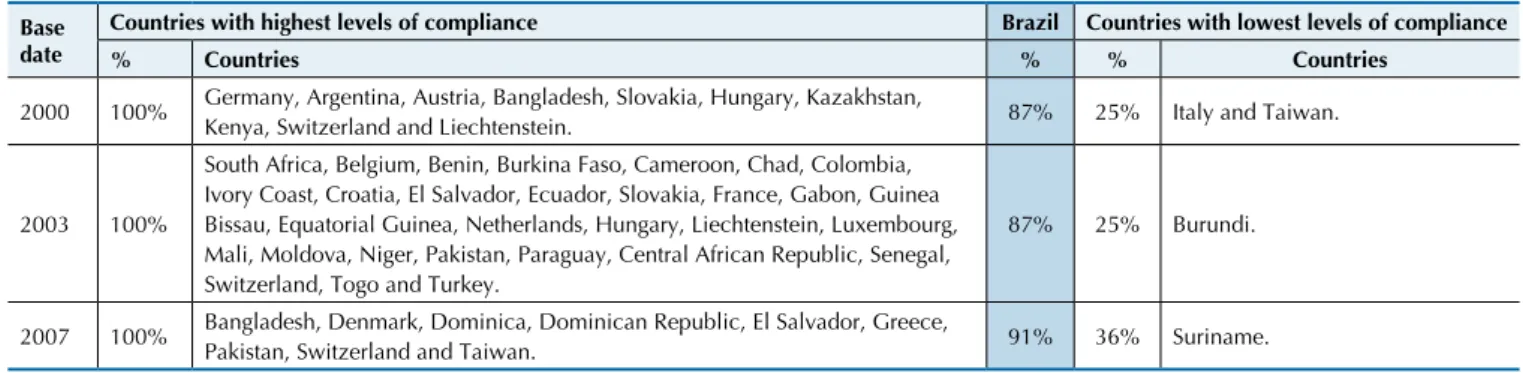
Based on this information, attention is drawn to the heterogeneity of the countries listed among those that recorded the highest or lowest levels of auditing regu-lations in their banking systems. They are a mixture of countries at different stages of economic development and in different geographic regions. Moreover, the case of Taiwan is particularly significant because in 2000, along with Italy, it recorded the lowest level of com-pliance with requirements and yet in 2007, it joined the select group of nine countries that met all the require-ments included in the study. Curiously, only Switzer-land met all the requirements in every reference year.
Table 4 Countries with highest and lowest levels of compliance with auditing requirements
Base date
Countries with highest levels of compliance Brazil Countries with lowest levels of compliance
% Countries % % Countries
2000 100% Germany, Argentina, Austria, Bangladesh, Slovakia, Hungary, Kazakhstan,
Kenya, Switzerland and Liechtenstein. 87% 25% Italy and Taiwan.
2003 100%
South Africa, Belgium, Benin, Burkina Faso, Cameroon, Chad, Colombia, Ivory Coast, Croatia, El Salvador, Ecuador, Slovakia, France, Gabon, Guinea Bissau, Equatorial Guinea, Netherlands, Hungary, Liechtenstein, Luxembourg, Mali, Moldova, Niger, Pakistan, Paraguay, Central African Republic, Senegal, Switzerland, Togo and Turkey.
87% 25% Burundi.
2007 100% Bangladesh, Denmark, Dominica, Dominican Republic, El Salvador, Greece,
Pakistan, Switzerland and Taiwan. 91% 36% Suriname.
Fonte: Source: Barth, Caprio Jr., and Levine (2001, updated 2008).
4.3 Test of the Determinants of the Level of
Auditing Regulations in Banking Systems
To evaluate the relationship between the levels of auditing regulations in national banking systems and the features of tho-se financial systems, model (3.1) was tested using panel data with cross-sectional fixed effects. As robustness elements, the tests were conducted with the full sample and with a sample that excluded outliers (considered to be data that are more than three standard deviations away from the mean in either direction) to confirm whether the results were determined by extreme va-lues. Tests were also carried out with and without controlling for time periods to verify whether the identified relationships were determined by differences in information timing. The results of this set of tests are summarized in Table 5.
Table 5 Results of regressions with cross-sectional ixed effects (p-values in parentheses)
Model tested:
RAudit = β0 + β1CBankit + β2PGovit + β3RRFit + β4ROAit + β5Concit + εit
Variable Full Sample Samples without Outliers
C 0.7700***
(0.0000)
0.8365*** (0.0000)
0.7495*** (0.0000)
0.8239*** (0.0000)
CBank 0.0015***
(0.0001)
0.0011*** (0.0025)
0.0014*** (0.0000)
0.0009*** (0.0000)
PGov - 0.2160***
(0.0004)
- 0.1635** (0.0390)
- 0.1758*** (0.0003)
- 0.1058* (0.0619)
RRF - 0.0289**
(0.0221)
- 0.0347** (0.0363)
- 0.0260** (0.0144)
- 0.0347** (0.0272)
ROA 1.5055*
(0.0954)
1.2263 (0.1127)
2.3681*** (0.0098)
1.6495* (0.0769)
Conc - 0.0185
(0.8695)
- 0.0429 (0.6908)
- 0.0071 (0.9481)
- 0.0327 (0.7664)
Year2000 - 0.0358***
(0.0000)
- 0.0348*** (0.0000)
Year2007 0.0075*
(0.0815)
0.0150** (0.0247)
Nº observations: 238 238 226 226
Nº countries 112 112 106 106
R2 0.7643 0.7721 0.7558 0.7641
Adjusted R2: 0.5383 0.5461 0.5222 0.5303
F-statistic: 3.3819 3.4162 3.2355 3.2684
Chow test: 6.2798 6.0172 5.8378 5.6683
Hausman test: 16.9718 22.3759 14.1364 18.8567
Where: Raud is the level of auditing regulation in the banking system; C is the regression constant; Cbank is the domestic credit provided by the banking sector as a proportion of GDP; Pgov is the proportion of banking system assets in banks with a majority of government capital;
RRF is the level of regulatory restrictions on bank participation in security, insurance and mortgage loan activities; ROA is the proitability of banks, calculated as a function of average returns on assets; Conc is the concentration of the inancial system, calculated according to the
contribution of the biggest three banks to the total assets of the banking system; Year2000 and Year2007 are dummy variables to control for information relative to the 2000 and 2007 base years.
Legend for signiicance parameters: 99% (***); 95% (**); and 90% (*).
As suggested by Baltagi (2008), the Chow test was performed to evaluate the existence of individual effects, confirming the importance of the use of panel data in the provision of evidence with greater informational power. To define the panel data method, i.e., fixed or random effects, the Hausman test was conducted. The results showed the use of the random effects method to be inappropriate. Moreover, the underlying assumption of the random effects model is that errors are random extractions from a much larger population. This is not the case in the present study, which considered all the countries included in database.
To prevent the risk of heteroskedasticity and autocor-relation in the residuals – especially given that preliminary tests indicated the occurrence of the latter condition – the cross-section SUR method was used. This method estima-tes robust parameters, assuming the presence of heteroske-dasticity and cross-sectional correlation of residuals.
Because the series used in the study considered only three, non-sequential years, the risk of unit roots in the series is eliminated because the minimum conditions re-quired for the test are not reached. The risk of the non-stationarity of the series is therefore excluded, eliminating the risk of spurious regressions.
4.4 Analysis of Regression Results
The results of model (3.1) shown in Table 5 demons-trate that there is a statistically significant relationship be-tween the level of auditing regulations in banking systems (RAud) and the independent variables CBank, PGov, RRF
and ROA, as well as the control variables Year2000 and Ye-ar2007. As an element of robustness of the findings, the results regarding the statistical significance and sign of the variables of interest are roughly equivalent in all four types of tests – with the full sample and the sample without ou-tliers, as well as when controlling and not controlling for the time period. The only exception is the variable ROA, which is not statistically significant in the full sample and when time periods are controlled for. The analysis of the results is based on a comparison of the parameter data with the research hypotheses.
For the first three research hypotheses, the results of the four types of tests (full sample or sample without outliers and controlling or not controlling for time periods) con-firmed the expectations regarding the statistical significan-ce and signs of the coefficients of the variables of interest. In the case of H1, the results regarding the variable CBank
confirmed the hypothesis that countries whose financial systems are of greater importance to the national economy adopt a higher level of auditing regulations. Regarding hy-pothesis H2, the statistical significance and negative sign of the variable PGov confirms the prediction that the banking systems of countries in which financial institutions under government control are predominant have a lower level of auditing regulations. Hypothesis H3 tests whether regula-tory restrictions on bank activities interfere with the level of auditing regulations. This is confirmed by the results obtained with the RRF variable – the evidence suggests
that in countries where there are more restrictions on bank involvement with insurance, security and mortgage loan activities, there is a lower level of auditing regulations. In addition to presenting comparable results across the four test types, the robustness of the findings is strengthened by the fact that the statistical significance level of the variables was almost always above 95% – only the RRF variable in the sample without outliers and controlling for the time period had a p-value of 0.0619.
In the case of hypothesis H4, in the results of three out of the four tests, a statistically significant positive relationship was found between the level of auditing regulations for the financial system and the profitability of banks, represented by the variable ROA, thus confirming the research hypo-thesis. Using the full sample and controlling for the time period, the determined coefficient was not statistically sig-nificant despite maintaining a positive sign. Nonetheless, given the prevalence of evidence corroborating the pre-diction of H4, the conclusion was to not reject the research hypothesis.
For the Conc variable, which was used to assess the relationship between the level of auditing regulation and the banking sector’s concentration, statistically significant coefficients were not found in any of the four tests. This result leads to the rejection of hypothe-sis H5, which predicted that a higher concentration in the sector would justify greater concern regarding the work of independent auditors.
Finally, it is worth noting that the incorporation of the control variables representing time periods – con-trolling the information for the base years of 2000 and 2007 – revealed the statistical significance of the two dummy incorporated variables, the first financial year having a negative sign and the last year having a positive sign. This reveals that the degree of auditing regulations in banking systems was significantly lower in the first year and higher in the last year, as indeed had already been identified in the analysis of Tables 2 and 3. These findings confirm the feature of auditing regulations most often cited in the literature, which is the continuous in-crease in the level of regulations through the periodic incorporation of new regulatory requirements – particu-larly during credibility crises. During the period covered by the survey, for example, corporate scandals erupted early in the century, resulting in the imposition of SOX, which implemented strong regulatory changes in rela-tion to auditing. It is also expected that due to the 2008 financial crisis, which particularly affected financial sys-tems, new requirements will have been introduced in relation to auditing activities. Because the data provided by the World Bank only includes information until 2007, it would be useful to monitor the next update to deter-mine whether this expectation has materialized.
Table 6 Summary of the relationships among the hypotheses, variables, expected signs and parameter results
Hiphotesys Variables Expected Sign I Test II Test III Test IV Test Summary
H1 CBank + + + + + H1 not rejected
H2 PGov - - - H2 not rejected
H3 RRF - - - H3 not rejected
H4 ROA + + N/R + + H4 not rejected
H5 Conc + N/R N/R N/R N/R H5 rejected
Note: Test I – full sample without controlling for time period; Test II – full sample controlling for time period; Test III – sample without outliers and without controlling for time period; Test IV – sample without outliers and controlling for time period. N / A = Not applicable.
5 CONCLUSION
panel data – with the full sample and the sample without outliers and controlling or not controlling for the time period – revealed that the level of auditing regulations in the banking system has the following statistically signifi-cant relationships: a positive relationship with domestic credit provided by the banking sector as a proportion of GDP; a negative relationship with the proportion of the banking system’s assets in banks with a majority of government capital; a negative relationship with the le-vel of regulatory restrictions for bank participation in security, insurance and mortgage loan activities; and a positive relationship with the profitability of banks. The-se results confirmed reThe-search hypotheThe-ses H1, H2, H3 and
H4, respectively. In the case of H5, no relationship was found between the concentration of the banking sector and the level of auditing regulations in financial systems, not confirming the original premise.
By controlling for information periods, tests showed that in the first researched reference year, 2000, the de-gree of regulation was statistically lower than the average values calculated for the three years, whereas in the final reference year, 2007, the requirement level was statistically higher. This shows that regulation has experienced conti-nuous growth over time, confirming published reports that indicate the widespread establishment of new normative prescriptions regarding the work of auditors, particularly in response to credibility crises.
In terms of study limitations, it is first necessary to em-phasize that data relating to the regulation and supervision processes of banking systems, including auditing require-ments, are primarily based on the declaratory information of national authorities, which may suggest the possibility of reporting bias in the construction of the database pu-blished by the World Bank. Despite this possibility of bias due to the manner in which information is produced, the use of the database is fully justified both because it is the only available source on this subject that includes global coverage and because of the credibility of the institution that sponsors it.
Another notable fact is that the criterion for deter-mining the dependent variable RAud – the percentage of compliance with the requirements included in the da-tabase developed by Barth, Caprio Jr., and Levine (2001, updated 2008) and maintained by the World Bank – as-signs equal weight to all normative requirements, which This study used the database developed by Barth,
Ca-prio Jr., and Levine (2001, updated 2008) and maintained by the World Bank, which contains the results of a survey on national banking supervisory and regulatory authorities from 172 countries from every continent – with reference years of 2000, 2003 and 2007 – covering various aspects of the financial systems of each country. The goals of the present study were to perform a comparative analysis of the different levels of auditing regulations in banking sys-tems, grouping countries by their levels of economic deve-lopment, income and geographic region. A particular em-phasis was placed on the case of Brazil and the relationship between the level of auditing regulations and the features of financial systems was assessed.
When analyzing the degree of auditing regulation in banking systems, as determined by the level of com-pliance with requirements, a progression was found among the three examined reference years, from an average of 69.7% in 2000 to 78.4% in 2007, represen-ting an increase of 18.7 percentage points and indica-ting a trend towards greater concern for the work of auditors. The evaluation based on data grouped by the level of development showed that the richest countries generally exhibited greater degrees of regulation than poorer nations, although the difference between these groups is declining. The analysis based on geographic regions, meanwhile, revealed that the highest levels of compliance with requirements are found in Middle Eas-tern and North African countries as well as in Europe and Central Asia. In Brazil, the degree of auditing regu-lations within the SFN's jurisdiction is higher than the average level recorded in the international arena, even when considering groupings by level of development or geographic region. In the last conducted survey, there is a lack of compliance only with the requirement that a copy of the audit report be sent to the supervisor.
Tests were then conducted to verify whether there is a relationship between the level of auditing regulation in each national banking system and the characteristics of the financial sector. Based on the precepts of the litera-ture regarding regulatory actions for audit activities, five different research hypotheses were formulated to serve as a reference for the definition of the model and the application of the empirical tests.
may be debatable. Nonetheless, whether different wei-ghts should be assigned to the requirements is equally debatable. The fact that the number of available obser-vations is naturally small given that there are only three reference years may also be considered a limitation and this makes testing with a larger number of explanatory variables more difficult, given the loss of degrees of fre-edom in applying the tests.
Finally, it is noteworthy that the available information predates the 2008 global financial crisis. It is natural to expect that this event will influence future data on requirements for independent auditors working in banking systems.
Based on the cited limitations, it is suggested that
future research be directed toward evaluating alterna-tives for measuring the level of auditing regulations in banking systems and identifying other indicators that may be associated with the dependent variable. The monitoring of future updates of the database is also re-commended to observe possible changes in the beha-vioral patterns highlighted in the present study, par-ticularly changes influenced by the effects of the 2008 global financial crisis. Finally, with regard to the beha-vior of regulators, by the time the present article is pu-blished, it may be presented in an altered form, making it important to identify those changes that may lead to new and different research findings.
Baltagi, B. H. (2008). Econometric analysis of panel data. (4. ed.). West Sussex, UK: John Wiley.
Barth, J. R., Caprio Jr., G., & Levine, R. (2001, April updated 2008). he regulation and supervision of banks around the world: a new database. Policy Research Working Paper, he World Bank, 2588. Recuperado em 6 março, 2011, de http://econ.worldbank.org/WBSITE/EXTERNAL/ EXTDEC/EXTRESEARCH/0,,contentMDK:20345037~pagePK:642148 25~piPK:64214943~theSitePK:469382,00.html>.
Basel Committee on Banking Supervision. BCBS. (2002, January). he relationship between banking supervisors and banks’ external auditors. BIS. Recuperado em 13 novembro, 2010, de http://www.bis.org/publ/ bcbs87.pdf.
Basel Committee on Banking Supervision. BCBS. (2008, December). External audit quality and banking supervision. BIS. Recuperado em 13 novembro, 2010, de http://www.bis.org/publ/ bcbs146.pdf. Beck, T., Demirgüç-Kunt, A., & Levine, R. (1999, June updated 2010,
November). A new database on inancial development and structure. Recuperado em 30 junho, 2010, de http://econ.worldbank.org. Blakely, R. (2009, January 8). Investors raise questions over PwC Satyam
audit. Times On Line. Recuperado em 16 outubro, 2009, de http:// business.timesonline.co.uk/tol/business/industry_sectors/technology/ article5476010.ece.
Cahan, S. F., & Zhang, W. (2006). Ater Enron: auditor conservatism and ex-Andersen clients. he Accounting Review, 81 (1), 49-82. Carey, P. J., Kortum, S., & Moroney, R. A. (2008, December). Auditors'
going concern modiied opinions post 2001: increased conservatism or improved accuracy. SSRN Working Papers. Recuperado em 31 março, 2011, de http://papers.ssrn.com/sol3/papers.cfm? abstract_ id=1309943.
Cofee Jr, J. C. (2004). What caused Enron?: A capsule social and economic history of the 1990’s. Cornell Law Review, 89 (2), 269-309.
Conselho Monetário Nacional. CMN. Resolução 3.198, de 27.5.2004. Altera e consolida a regulamentação relativa à prestação de serviços de auditoria independente para as instituições inanceiras. Recuperado em 30 novembro, 2011, de http://www.bcb.gov.br/pre/normativos/ res/2004/pdf/res_3198_v7_P.pdf.
Deangelo, L. E. (1981). Auditor size and audit quality. Journal of Accounting and Economics, 3, 183-199.
Dye, R. A. (1993, October). Auditing standards, legal liability, and auditor wealth. he Journal of Political Economy, 101 (5), 887-914.
Ettredge, M. L., Xu, Y., & Yi, H. (2010, October). Fair value measurements, auditor industry expertise, and audit fees: evidence from the banking industry. SSRN Working Papers. Recuperado em 12 dezembro, 2010, de http://papers.ssrn.com/sol3/papers.cfm? abstract_id=1473569. Feldmann, D. A., & Read, W. J. (2010). Auditor conservatism ater Enron.
Auditing: A Journal of Practice and heory, 29 (1), 267-278. Fields, L. P., Fraser, D. R., & Wilkins, M. S. (2004). An investigation of
the pricing of audit services for inancial institutions. Journal of Accounting and Public Policy, 23, 53-77.
Goulart, A. M. C. (2007). Gerenciamento de resultados contábeis em instituições inanceiras no Brasil. Tese de doutorado, Programa de Pós-Graduação em Contabilidade, Universidade de São Paulo, FEA/USP, São Paulo, SP, Brasil.
Hayes, R., Dassen, R., Schilder, A., & Wallage, P. (2005). Principles of auditing: an introduction to international standards on auditing. (2. ed.). Harlow, England: Prentice Hall.
Herath, H., & Kumar, P. (2002). External audit requirements of banking systems around the world. University of Northern Columbia (UNBC). Working Paper. Recuperado em 9 dezembro, 2010, de http://web.unbc. ca/~kumarp/c1.pdf.
International Federation of Accountants. IFAC. (2008). Handbook of international auditing, assurance, and ethics pronouncements. New York: IFAC.
Kanagaretnam, K., Lim, C. Y., & Lobo, G. J. (2010, January). Auditor reputation and earnings management: international evidence from the banking industry. SSRN Working Papers. Recuperado em 01 dezembro, 2010, de http://ssrn.com/abstract=1568866. Martins, G. A. (2000). Manual para elaboração de monograias e
dissertações. (2. ed.). São Paulo: Atlas.
Merchant, K. A., & Van Der Stede, W. A. (2007). Management control systems. (2. ed.). Harlow: Pearson.
Nelson, M. W., Elliott, J., & Tarpley, R. L. (2002). Evidence from auditors about manager’s and auditor’s earnings management decisions. he Accounting Review, 77, Suplement, 175-202.
Newman, D. P., Patterson, E. R., & Smith, J. R. (2005). he role of auditing in investor protection. he Accounting Review, 80 (1), 289-313. Niero, N. (2009, September 15). CVM aumenta pressão sobre auditor.
Jornal Valor Econômico. Recuperado em 30 novembro, 2011, de http:// www.valor.com.br/arquivo/783015/cvm-aumenta-pressao-sobre-auditor.
Norris, F. (2004, September 10).Will big four audit irms survive in a world of unlimited liability? he New York Times. Recuperado em 30 novembro, 2011, de http://query.nytimes.com/gst/fullpage.html?res=9 C0DE7DE1530F933A2575AC0A9629C8B63.
Ojo, M. (2008). he role of the external auditor in the regulation and supervision: a comparative analysis between the UK, Germany, Italy and the US. La Vergne, TN USA: Lightning Source Incorporated. Pae, S., & Yoo, S. W. (2001, July). Strategic interaction in auditing: an
analysis of auditors' legal liability, internal control system quality, and audit efort. he Accounting Review, 76 (3), 333-356.
Ramos, G. (2010, Octubre 28). Global regulatory convergence. Response to the crisis. Congreso Nacional de Auditoria, Madrid, Spain, XIX. Recuperado em 20 abril, 2011, de http://www.ipiob.org/speeches/ global-regulatory-convergence-response-crisis.
Sharma, S., Kratz, I., & Hollanda, B. (2009, Janeiro 14). Enron indiana traz auditores de volta à berlinda: Escândalo da Satyam fragiliza o setor. Jornal Valor Econômico. Recuperado em 30 novembro, 2011, de http:// www.cfc.org.br/conteudo.aspx?codMenu=67&codConteudo=3549. Valor Econômico. V. E. (2010, Junho 10). Avança projeto de órgão de
supervisão brasileiro. Jornal Valor Econômico. Recuperado em 30 novembro, 2011, de http://www.valor.com.br/arquivo/829189/avanca-projeto-de-orgao-de-supervisao-brasileiro.
Watts, R. L., & Zimmerman, J. L. (1986). Positive accounting theory. New Jersey: Prentice Hall.
Wolk, H., & Tearney, M. (1997). Accounting theory. (4. ed.). Cincinnati: South-Western.
Woods, M., Humphrey, C., Dowd, K., & Liu, Y. L. (2009). Crunch time for bank audits? Questions of practice and the scope for dialogue. Managerial Auditing Journal, 24 (2), 114-134.
World Bank. W. B. (2010). World Development Indicators. Recuperado em 6 março, 2011, de http://data.worldbank.org/data-catalog.