© FECAP
RBGN
Review of Business Management
DOI:10.7819/rbgn.v18i61.2966
416
Received on
08/02/2016
Approved on
15/06/2016
Responsible editor:
PhD. J. Ignacio Canales
Evaluation process: Double Blind Review
Valuing of knowledge in organizations
and its embedding into organizational
practices and routines
Andréa Cherman
Sandra Regina da Rocha-Pinto
Pontiical Catholic University of Rio de Janeiro (PUC-Rio), IAG Business School, Business Administration Department, Rio de Janeiro, RJ, Brazil
Abstract
Purpose – his study aims to analyze the impact of the diferent ways
in which organizational members perceive and experience valuing of knowledge within the work context on its subsequent embedding into organizational routines.
Design/methodology/approach – he phenomenographic method
was applied, using in-depth semi-structured interviews for data collection. he intentional sample comprised twenty-two human resource professionals.
Findings – he structural context, which the organization is part of,
creates the social and spatial context that shapes a structuring pattern. his pattern establishes the way people consider knowledge of value and act to embed it into organizational practices and routines.
Originality/value – he study reveals the relevance of contemporary
organizational structures and forms – cooperatives, hybrid and social business; holacratic or entrepreneurial models; collaborative or partnership networks for innovation – that promote the use and embedding of individual knowledge into organizational routines and practices.
Keywords – Valuing of knowledge; organizational knowledge;
1
Introduction
The area of organizational knowledge (OK) has been widely studied, stimulating a discussion on how individual knowledge becomes embedded in organizational knowledge (Gherardi, 2000; Orlikowski, 2002; Patriotta, 2003). he articles that explore OK point to the mechanisms used by individuals that intervene or bias the attribution of importance and valuation of certain types of knowledge to the detriment of others, and which inluence the behavior of members in the subsequent incorporation of knowledge in the organization. In turn, studies on organizational routines (OR) are divided between the ones that analyze the capabilities that structure routines and those that study the practices that enact routines (Parmigiani & Howard-Grenville, 2011), without, however, taking into account how the conception of knowledge of individuals considered relevant in that context inluences the embedding of individual knowledge in organizational practices.
his study directly addresses the question of how individually valued knowledge is embedded and used in organizational routines and practices. It thus investigates behavior that results from adopting and internalizing what individuals consider the most valued specific knowledge into an organization. Hence, the objective of the study is to analyze how the diferent modes (conceptions) by which organizational members perceive and experience valuing of knowledge in the work context impact the subsequent embedding of that knowledge into organizational routines. To this end, a phenomenographic research was conducted (Akerlind, 2005; Marton, 1981; Marton & Booth, 1997; Sandberg, 2000) with human resources (HR) professionals who, in principle, convey routines, culture, structure, strategies, organizational skills and training-development-education, and who forge the vision of shared knowledge among the diferent groups of the organization.
Organizational knowing, in this paper, is deined by the perspective of knowing-in-practice
and knowing-in-action, from the standpoint of practice-based theorizing, according to which knowledge results from work practice and is inseparable from the historical, social, spatial and temporal context experienced by individuals (Gherardi, 2000; Orlikowski, 2002; Patriotta, 2003). As an analogous theoretical vision, we adopt the stream of routines in practice, embedded through their execution, which feature both an ostensive and a performative character that results from a coordination that is ixed and undergoes continuous contextual adaptations and changes (Feldman, 2000; Feldman & Pentland, 2003; Feldman & Orlikowski, 2011; Pentland, 1995; Pentland & Hærem, 2015). Based on this theoretical perspective and supported by phenomenography, the study focuses on knowledge of value and organizational routines expressed and perceived by individuals as being relevant according to their experience in a given context. However, no detailed analysis of organizational routines established a priori is performed; the study rather focuses on the behavior of individuals and the organization regarding the embedding of knowledge deemed important into organizational routines and practices.
his paper is divided into six sections: 1) introduction; 2) theoretical framework underlying the analysis; 3) method, including the details of its application; 4) indings of the empirical research; 5) discussion about the valuing of knowledge and its embedding into organizational practice and routines; 6) conclusions.
2
heoretical framework
2.1
Organizational knowledge and value:
deinitions in the context of the study
object, independent of the knower, which can be retained and transferred from one mind to another (e.g., Nonaka, 1994; Nonaka & Takeuchi, 1997). he second line, the structural or economic line, knowledge emerges as a factor of production, a commodity, reiied into routines in the form of strategic capabilities, found in the resource-based view (Barney, 1991; 1996) and the knowledge-based view (Grant, 1996; Prahalad & Hamel, 1990). he third line understands OK contextually, inserted in and emerging from organizational practice and action, where knowing and performing work in such a context are inseparable. his is the approach of knowing-in-practice (Gherardi, 2000), knowing-in-action (Orlikowski, 2002), situated cognition and technical-scientiic cognition (Patriotta, 2003), adopted as the theoretical foundation and for data analysis in this paper.
he three lines of OK presented in the paragraph above are not mutually exclusive, but are diferent approaches to the same subject: knowledge in organizations and ways to conceive it and treat it. he vision of knowing-in-practice and knowing-in-action, however, affords a synthetic approach, thereby making the historical-socio-spatial-temporal context experienced by individuals inherent to and inseparable from the emergent knowledge (Antonacopulou, 2006; Brown & Duguid, 1991; Gherardi, 2000; Latour, 2012; Lave & Wenger, 1991; Orlikowski, 2002; Patriotta, 2003). he Sociology of Association or the Actor-Network heory by Latour (2012), inserted into that view, underlies the explanatory dimension of the discussion in this study. According to that view, knowledge is relational, made up and mediated by human and non-human actors who form a social group, a collective arrangement. As for non-human actors, Latour (2012) presents all the mediating aspects that demand and compel human actors to act, such as organizational culture, decision/power structures, organizational practices and routines per se, and
reiication of ‘leadership,’ ‘upper management,’ ‘strategy,’ and ‘hierarchy,’ among others.
he author claims that although all actors — both human and non-human ones — are on the same plane and are the same size, some exert
a greater collective weight due to the ‘panorama’ that conditions the actors’ way of thinking and their justiications, but also due to the circulating ‘structuring patterns’ and the comparative ‘scales’ produced by the collective itself. he structuring pattern, panoramas and scales strongly establish the ways of thinking, acting and being that are part of the social structure. Any contextual change of that structure may alter these elements and everything it produces. Consequently, emergent knowledge is negotiated, contested, and always provisionally permanent until new knowledge come up as a result of a contextual change of the structure (Latour, 2012).
According to this perspective of knowing-in-practice and knowing-in-action, value is deined as a collective sense of mutual appreciation. As such, it is socially constructed (Swart, 2011). hus, in a speciic context, a group assigns value to the result of a given activity (Swart, 2011). hrough work practice, through action within a given context, the value of knowledge becomes visible to the members of that organization (Nag et al., 2007).
2.2
Organizational routines
Organizational routines go back to the work by Dewey (1922) on habit and relexive action as the first guides for individual and collective behavior. Subsequently, Simon (1947), March and Simon (1958), and Cyert and March (1963) conceived OR as simple rules, a loosely agglutinated programming aimed at performance that enables the organization to react to the environment (March & Simon, 1958), where standard procedures, rules and standards of behavior are developed to save time and to pay attention to certain aspects during decision making analysis (Simon, 1947).
repositories of organizational memory, so that the organization prompts itself to trigger speciic routines for speciic individuals according to certain stimuli. Nelson and Winter (1982) reinforce the contextual character of routines, where skills, organization and technology are closely interconnected within a functional routine.
Pentland (1995) adds the perspective of practice to OR emphasizing daily actions associated with specific routines. The author introduces the notion of performative routines, which require that individuals make choices based on a large repertoire of possibilities; the resulting performance, on the other hand, is better conceived as an efort that is made as a result of the action. his perspective does not only take into account emergent routines that result from the performance of multiple actors (Feldman, 2000; Parmigiani & Howard-Grenville, 2011), but also the generative ones, as they feature their own internal dynamics for their continuity and change (Feldman & Pentland, 2003; Feldman & Orlikowski, 2011).
Thus, although the initial concept associates the idea of OR to ixed, static, and repetitive rules and procedures that control activities and behaviors, the notion of OR evolved and as per Feldman (2000), routines incorporate continuous adaptations and changes into actions, into the practice of their execution, according to the context. hese ideas resulted into two diferent constitutive lines of study as to what a comprehensive view of OR might be (Parmigiani & Howard-Grenville, 2011).
he irst line, the one of Capabilities, treats routines as a black box and analyzes them as a unique and complete entity; it focuses on the purpose and motivation of routines and on their impact on organizational performance. Individuals are considered rational to a limited extent, potentially acting in self-interest, but operating as expected and performing routines as they were designed.
A prototypical deinition of the capabilities line is that routines are building blocks of
capabilities, featuring a repetitive and context-dependent nature (Parmigiani & Howard-Grenville, 2011). According to this line, ORs are considered as (i) microfoundations of capabilities (Felin, Foss, Heimeriks, & Madsen, 2012; Teece, 2007); repositories of organizational knowledge, which enables learning and change (Argote & Ren, 2012; Grant, 1996; Nelson & Winter, 1982) and genes that may promote either stability or inertia (Szulanski, 1996). Blending the ideas about organizational learning and changes in OR led to the concept of dynamic capabilities (Eisenhardt & Martin, 2000; Teece, Pisano, & Shuen 1997; Zollo & Winter, 2002), i.e., the systematic pattern of organizational activity aimed at generating and adapting operational routines (Zollo & Winter, 2002). From this perspective, the fundamentals of changes in routines derive from mechanisms of learning from accumulated experience, articulation of knowledge and codiication of knowledge in organizations.
The second line, the one of Practice, focuses on the internal dynamics of ORs, on their diferent parts and interconnections (Parmigiani & Howard-Grenville, 2011), on the practice of routines, on how they operate and on how they are reproduced or changed according to how people enact them in the daily routine of organizations (Feldman, 2000; Feldman & Pentland, 2003; Pentland & Feldman, 2008). According to Feldman (2000), performative routines should be thought of as a low that includes the broad range of thoughts, feelings and actions that individuals experience as they engage in work. In such a case, human action is situated in a speciic set of circumstances, which may or may not lead individuals to perform the routines as they were designed.
the resources to perform the action and at the same time hampers and constrains routine changes, while the latter generates, recreates, maintains and modiies the ostensive aspect (Feldman & Pentland, 2003; Pentland & Feldman, 2008).
Friesl and Larty (2013) suggest that understanding OR according to the line of Practice allowed deining the replication of routines as a political process within organizations, since the notion of an agency encompassing individuals and their inluences on practice (Latour, 2012) – and not only on institutions –, imply the multiple interests of the various actors engaged in routine. In their latest work, Pentland and Hærem (2015) expand the concept of ORs by deining them as standards of actions embedded in the socio-material context. hey state that they can be represented as a network of actions performed by actors and artifacts (as understood by Latour, 2012). Based on this perspective, Bertels, Howard-Grenville and Pek (2016) found that organizational culture, understood as a repertoire/pattern of actions, shapes the routines and expectations that relate to them even before they are performed, which modiies them by excluding or including activities for their enactment. hus, they corroborate the notion that the structural pattern by Latour (2012), shapes the way we think and act in each context.
3
Method
The phenomenographic method was used to ind out how the subjects’ conceptions of valuing knowledge in the work context impact its embedding in organizational routines and practices. Phenomenography aims to describe and map the qualitatively different ways of experiencing and apprehending a phenomenon (Marton, 1981; Marton & Booth, 1997), seeking to understand how individuals perceive (awareness), make sense of (thought) and act (action) on specific aspects of their world. his awareness-thought-action triad is termed conception (Sandberg, 2000).
Ph e n o m e n o g r a p h y p ro p o s e s t h e arrangement of conceptions – or descriptive
categories – in a hierarchical, logic and inclusive structure of increasing complexity, which aims at relating the conceptions to each other. his structure is called an outcome space. As the individuals repeat their experience with the phenomenon under investigation, they become aware of new contours, expand their focal consciousness, shift from a narrow, limited, and incomplete conception of how to conceive the phenomenon to the next category, which is wider, more comprehensive and more complex than the previous one (Marton & Booth, 1997). he totality of all ways of perceiving-thinking-acting the phenomenon, expressed by conceptions arranged in the outcome space, forms the collective mind (Marton & Booth, 1997), i.e., the most complete consciousness possible of that phenomenon/reality.
To survey the conceptions of the subjects, the method requires applying 20 to 30 semi-structured in-depth interviews. he purposive sample is planned by seeking variety in subjects, aiming to take into account the diferent ways of experiencing the phenomenon (Akerlind, 2005). For this study, interviews were conducted with 22 HR professionals, considering (i) diversity of position (three levels — analyst, middle management, and senior management); (ii) professional experience (four ranges); (iii) type of company (national/multinational); (iv) company size (small/medium/large); and (v) training. The professionals surveyed ranged from analyst to vice president; they had from 3 to 36 years of professional experience and worked at 22 diferent companies, 12 of which were domestic and 10 of which were medium to large multinationals operating in 18 diferent sectors, i.e., perfumes and toiletries, food and drinks, pharmaceuticals, oil, gas and energy, telecommunication, information technology, insurance and pension plans, consulting and auditing, infrastructure and engineering, higher education, clothing manufacturing, retail trade of various kinds, e-commerce, and franchising. Figure 1 shows the planned and the obtained samples.
that are not related to the survey scope from being introduced at the time of interview; (ii) the central question that requires that the subjects narrate their experience that best exempliies the phenomenon, supporting questions, such as ‘what’ ‘how’ and ‘why’ to ind out what the phenomenon is and how it is conceived, as well as understanding the perception and the thinking behind the action (Sandberg, 2000). he script included two central questions: “1) Could you give me an example of a situation in which you believed your knowledge was more (less) valued in the context of work?” After exploring the support questions as well, the next question was: “2) How do you perceive that valued knowledge is embedded into work practice and routines?”
The phenomenographic method — qualitative and interpretative — doesn’t operate with deinitions of the nature of knowledge, neither with types of routines established a priori. he experiences that signify valued knowledge — just as the perceptions of how such knowledge of value was embedded in the routines and practices of the organization — emerged from the narratives of the subjects, reinforcing the individuals’ perspective on what was considered relevant and therefore valued in their work environment/context.
The interviews were conducted from November 2012 to March 2013. he total data collected amounted to a net of 21 hours and
9 minutes of recorded material (excluding the informed consent and the research scenario), which was transcribed for analysis, resulting in 352 pages. According to the method recommendations, the interviews were read entirely three times to separate the most dissimilar ones and group the most similar ones according to the meaning of the phenomenon. he goal was to isolate the aspects that would show the logical, hierarchical and inclusive interrelation between an appropriate number of conceptions. Only then was the content of each interview analyzed by means of Atlas-Ti to codify the elements found in the narratives, rearrange and conirm the conceptions and describe the descriptive category.
It is worth noting that the routines that emerged from the narratives by the HR professionals contained information on HR subsystem routines, such as recruitment and selection, attracting and retaining talents, training, granting of beneits, evaluation and performance assessment processes. he subjects further mentioned complex processes of setting up or shutting down plants and closing of departments and areas, and the ensuing employee relocation policies. his diversity and variation of complexity in organizational practices and routines is relected by the diferent gradations of conceptions through which the subjects conceive knowledge of value in organizations.
Groups Variation Proposed in the Number of Respondents Variation Obtained in the Number of Respondents
Length of Career to Date
4 subgroups containing 5 to 8 respondents: up to 5 years
6 to 15 years 16 to 25 years more than 26 years.
less than 5 years: 4 6 to 15 years: 8 16 to 25 years: 7 more than 26 years: 3
Position / Title analyst/coordinator: 6 to 8middle management: 8 to 12 senior management/leadership: 6 to 8
analyst/coordinator/specialist: 9 middle management: 8
senior management/leadership: 5
Type of Company
Private National and Multinational Industries in various economic sectors
2 subgroups:
small and midsize companies: 6 to 10 large companies: 10 to 14
18 industries National: 12 Multinational: 10 Midsize companies: 8 Large companies: 14
Education Business Administration: 6 to 8Psychology: 6 to 8 Economics, Engineering, other: 8 to 12
Business Administration: 6 Psychology: 9
3.1
Field data analysis
This study aimed to analyze how the diferent modes (conceptions) through which organizational members perceive and experience the valuation of knowledge in the context of work impact the subsequent embedding of knowledge into organizational routines. Based on their experiences and in the form of narratives, individuals relected on knowledge of value and how it was embedded in (or excluded from) work routines. Some of these concerned human resources routines and their subsystems, while others concerned the routines and practices of the organization, in which HR intervenes through training, hiring, relocation or retention. Given the diferent conceptions of the phenomenon, diferent conceptualizations as to what organizational routines in fact are were also stated.
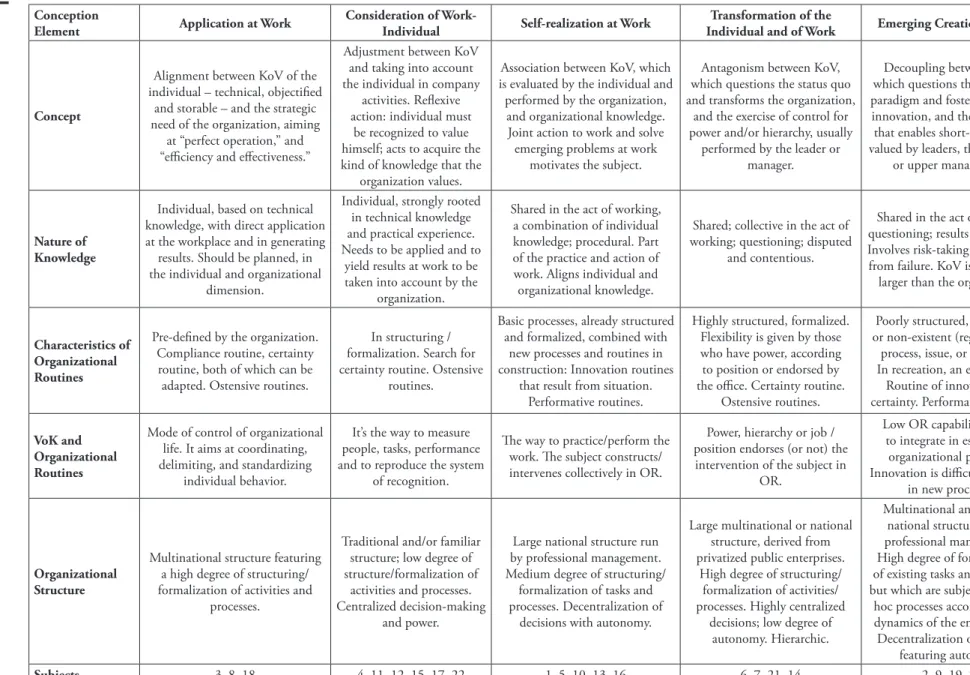
he analysis yielded ive conceptions of valuing knowledge in the work context, i.e., ive modes via which individuals perceive, attribute meaning to and behave towards valuing of knowledge at work, from the narrowest and most limited one to the widest and most complex one: Application to Work, Consideration of the Work-Individual, Self-realization at Work, Transformation of Work and the Individual, Emerging Creation for Life. hese conceptions resulted from narrative elements, such as: the nature of knowledge, the dimension of social interaction of the individual with groups in relation to the phenomenon, social, spatial and temporal context, organizational structural arrangement, the role of routines, and the embedding through OR of knowledge valued by the individual into organizational knowledge.
Four conceptualizations of organizational routine also emerged, revealing that the subjects have diferent concepts of OR as a result of their experiences: Compliance routine, Certainty routine, Translated routine (‘tropicalized’ was the term originally obtained by the in-vivo code) and Innovation routine. Its constituent elements refer to: structuring the activity or task (to what
extent it is new or routinized, to what extent it is formalized and disseminated), its lexibility (to what extent the routine may be altered and to what degree), the larger context of routines (their purpose, application and use). It should be noted that the conceptualizations regarding ORs were not grouped into descriptive categories, since they were explored as an aspect related to the use of valued knowledge in the work context. he conceptualizations belonging to organizational routines emerging from the interviews were rich, which shows to what extent perceptions may vary regarding a single phenomenon.
3.2
Conceptions of valuing of knowledge
in the context of work
3.2.1
Valuing knowledge means applying
it at work
Organizational knowledge is framed by the metaphor of the machine, which is part of the economic perspective (Gherardi, 2000) and the structural perspective (Patriotta, 2003), where knowledge of value is an object that supports the eiciency and efectiveness of organizational processes. Valued knowledge is expressed as something fundamentally individual and technical, it arises from formal education of individuals and from formal training received at work. It is useful insofar as it can be applied and yield the desired results for the organization.
values ...”) or the irst person plural [we (the organization and I) did ...].
he ORs structure the tasks (inluential factor for valuing knowledge) and organize the life of the organization. For the HR area, ‘routines establish work standards’ (Respondent 3), ‘make the rules transparent’ (Respondent 22), thereby creating a sense of justice and justification regarding the organizational demands and responses. In a wider sense, they have a coordinative, delimiting and standardizing meaning and mainly meet the classiication of the most evident routines by Feldman and Pentland (2003).
In addition, routines are given and pre-deined by the headquarters of the organization. hey are about (i) compliance (regulatory rules and standard operating procedures to comply with regulatory agencies, ISO-type, and Good Practice certiications) and (ii) certainty (work policies, rules and procedures). At most, the certainty routines may be adapted, i.e., adjusted and made to it to comply with legal, operational and local business demands and requirements.
Given the fact that valued knowledge is individual, technical and formal, embedding it into routines either reinforces the existing process or supports the adaptation of routines. As a matter of fact, in this category, the question is inverted, i.e., the established routines deine work and therefore establish the knowledge of value that needs to be recruited, trained and aligned with each part of the process. In Latour’s (2012) view, the routine deines how the subjects are supposed to perform their activities (Pentland & Hærem, 2015) by outlining how they should behave and what they should value.
It may be inferred that embedding individual knowledge into organizational knowledge, into its practices and routines, is quite limited and utilitarian: its goal is rather adaptive than innovative. Individuals continually reproduce the organization in a mimetic fashion, rarely question it, nor do they take any personal or professional risks, which reiterates the political
domination that routine may exert, preventing diversions and replicating and disseminating the values and beliefs of the dominant groups (Friels & Larty, 2013).
3.2.2
Valuing of knowledge is giving
the work-individual due consideration
(recognition)
Valued knowledge is mainly individual, strongly based on formal and technical knowledge and practical experience; its main purpose is to be applied and to yield results at work. What difers from the previous conception is the respondents’ need to get recognized by other organizational members. Consideration/recognition comes in different types of rewards, such as being mentioned in relation to a successful activity, being recommended/remembered to participate in or lead a speciic job, or even getting a raise or a promotion.
Valuing of knowledge occurs in the form of individuals being recognized by the leader of the organization, by the leadership, peers and team members, i.e., valued knowledge is signiied as given due consideration to individuals and/or their work and/or their knowledge — elements that are almost inseparable. A circular action seems to take place: the individual needs to be acknowledged by other members, his work/knowledge needs to be recognized so that he may value himself and he relexively acts to have/be the knowledge that the organization values, in a process of adaptation and itting into the organization. Within that circle, as the organization recognizes the individual’s knowledge, as applied to work, he is understood as being of value for the company. he subject needs approval to feel that he belongs to the organization.
rigid) and/or familiar structures that feature a high degree of centralized decision-making and power and few formal processes seem to favor this type of conception.
Organizational routines structure and shape work and aim to control tasks, people and performance (Pentland & Hærem, 2015). hey make up certain routines, which are more expressive in nature (Pentland and Feldman, 2003). Given the adjustment and relective act between subject and organization, the individual’s knowledge is at the service of creating ORs (subject to approval by the leader or upper management), which set up control mechanisms that aim to evaluate performance and reward other employees. In other words, a new relective cycle/ circle characterized by subjects relying on their conception that is applied to other employees. At the same time, ORs create and preserve the social status and recognition of subjects. It somehow seems that embedding individual knowledge into organizational knowledge (into practices and routines) is mediated by the leadership or upper management.
3 . 2 . 3
Valuing of knowledge is
self-realization at work
his conception is based on the view that knowledge emerges from social practices in the context of work, i.e., the perspective of practice (Gherardi, 2000) and knowing-in-action (Orlikowski, 2002), within the domain of located cognition (Patriotta, 2003). Valued knowledge is the result of sharing, of building by working collectively; it emerges from the situation that requires it. It is a blend of individual knowledge of diverse order and nature that are considered equally relevant: technical knowledge (from diferent operational and managerial areas), practical and relational experience.
Social exchange synthesizes individual knowledge into a solution that is wider than the initial individual proposals and therefore of greater value. For individuals, knowledge only acquires meaning when it is shared: “it doesn’t
make the slightest sense for me to know for myself ” (Respondent 10). his concept refers to the vision of a community of practice, as described by Brown & Duguid (1991) and Lave & Wenger (1991). At the moment of sharing, knowledge becomes meaningful and hence valued, which reminds us of Swart’s (2011) deinition according to which value emerges from action and inds support and common collective meaning in that group (although the common meaning arising from actions takes place in all categories).
Knowledge of value emerging from shared construction should yield results that add to both collective, participatory work and to autonomous work, resulting in the individual’s self-realization. he ORs are the consequence, the product of work, they result from practice and are then formalized and institutionalized inside the organization; they also undergo changes as new needs are identiied during the performance of activities. hus, the routines are created the way things are done, taking into account the implicit cultural rules (Bertels, Howard-Grenville & Pek, 2016). hey blend in with the concepts of routine innovation, since they are lexible, situationally adapted and strongly performative (Feldman & Pentland, 2003).
Routines rather strive to be records for the conservation and dissemination of a proven practice (i.e., the result of something known and valued by individuals collectively) than to merely coordinate work. However, some processes established that way also serve to evaluate individual performance and may therefore be construed as goals. It is suggested that the embedding of individual knowledge in organizational knowledge through practices and routines is a luid feedback process.
3.2.4
Valuing knowledge is transformation
of work and the individual
— and the exercise of control based on formal, structural, organizational power and/or hierarchy and usually performed by the leader, manager or “hierarchical box” that holds such power. Just as in the previous category, the nature of valued knowledge is a collective construction shared between members and teams in the act of working. However, this is not processed in that collective and shared form inside the organization.
The question concerns the structures of power and hierarchy that present barriers to individuals, leading them to eventually question the organization itself: management and leadership, the mechanisms of power, the hierarchical structure, the very culture itself (cf. the ‘non-human mediators’ by Latour 2012; Pentland & Hærem, 2015). As a result, the mode of making knowledge emerge is contested and conflictual among groups or members, as it questions the status quo and the existing structures. Valued knowledge needs to be transformed by the organization in order to be established. Established knowledge is contested, which relects in a momentum that strengthens the relations of power.
As they work in such a conlicting context, individuals express the articulated political strategies to perform activities and/or to make sure their knowledge is taken into account. hus, among other strategies, they cultivate relationships with people from other areas (Respondent 21), align with the immediate management in terms of conduct and the respective discourse of a given activity (Respondent 21), they make sure they are getting heard by the leader in power (interviewed 14). As a result of forging strategies, creating characters and performing roles (which the subjects deem necessary to avoid going unnoticed in such an environment), they transform themselves.
ORs are highly structured, either by formalization of the processes, or by internalization of the practices of the organizational culture. In some way or another, the working manner already exists, it is a given (Pentland & Hærem,
2015). Thus, they are routines of certainty. Flexibility in practices and routines only occurs via determination of those in power or who hold a position backed by their oice — not necessarily to change routines, but rather to meet someone’s speciic need or because the leader “said so.” Such lexibility refers to the dispute discussed by Friel and Larty (2013).
he contribution of individual knowledge to organizational knowledge through practices and routines is low, unless contributing is a requirement of the job/position or arises from a request made by a leader, which results in much frustration and questioning from the subjects. Innovative projects are devalued and new ways of doing something established are not accepted, much less embedded in work practices or routines.
3.2.5
Valuing knowledge is emerging
creation for life
his concept shows how disconnected valued knowledge is from the knowledge valued by the organization; these are separate and independent spheres. Valued knowledge provides a new paradigm, questions work itself and its objectives, deconstructs order and — as a long-term construction — provides innovation. On the other hand, knowledge valued by leaders, supervisors or upper management provides short-term results in compliance with the organizational goal and reproduces the organization.
Knowledge emerges from practice and action (Gherardi, 2000; Orlikowski, 2002): it is generative, shared, and collective in the action of working, thereby composing the social context. It is located in people, in daily activities — both small and large — of work. Individuals seem to realize that there are new and diferent models for performing the conventional. However, to develop them, individuals must break paradigms and expose themselves to personal risk. Moreover, they act independently in the decision as to whether to expose themselves to such a risk.
diferent from the organization, i.e., they feel some kind of ‘otherness’ towards the organization, but which doesn’t result in any clashes. Although they may question the organization, they don’t seek to transform neither the company, nor themselves. Work is just part of life, not life itself. Valued knowledge is something that the subject carries throughout and for life, it is greater than the knowledge used at the organization. All these aspects are present in the focal consciousness of individuals (Marton & Booth, 1997) and represent the broadest conception of the phenomenon.
ORs appear to be non-existent, inadequate or insuiciently structured for a given process, issue or situation. hus, little experience in the situation and dynamics of the environment call for an experiment, approved by upper management, that allows the individual to create something diferent from the conventional with a high degree of autonomy. he solution sought is an emergent generative creation of work that intrinsically challenges the conventional order of how things are done. here is, therefore, room for trial and error and the results are not measured in the same way as traditional processes. Such routines are performative in nature (Pentland and Feldman, 2003) and generate innovation.
However, the experiments — even when they are successful — are not repeated or applied in similar situations, which shows that the embedding of individual knowledge into organizational knowledge — arising from these new experiences and based on these innovative practices and routines — is very small. Indeed, it seems that organizations feature low capability, through individuals and managers, to integrate them within the established organizational processes. Respondents point to the upper management’s expedient vision: the incompatibility of adopting innovations subject to risk, trial-and-error learning, and uncertain time of adoption against the pressure for short-term results and objective goals, in addition to the lack of long-term entrepreneurial vision and fear of risk-taking. It was noted that emergent innovative
processes address subjective aspects of the tasks, which are subsidiary, intangible and diicult to measure in terms of conventional HR practices, such as quality, image, values, and involvement. Whenever possible, leadership chooses to adopt the routine and comfort of measurable results, thereby reproducing the status quo.
3.3
he emerging conceptualizations of
organizational routines
3.3.1
Compliance routine
The strictest OR concept describes routines as descriptive guides in the processes of compliance for the organization’s operations, especially regarding compliance with legal and regulatory requirements. They include standard operating procedures (SOP) related to certifications such as ISO, Best Practices, and policies for compliance, quality (TQM) or safety. he context is inevitably associated with manufacturing environments or organizations in highly regulated industries.
The routine is “handed down from headquarters” and/or originates from “the department in charge of establishing these processes.” It is strongly structured, disseminated, and may not be questioned; it permeates the reality of the organization and even its non-manufacturing activities. It translates into the logic of thinking about its operations. Routines thus include practices, mindset, behaviors and control of the organization’s results for the organization. Their nature is purely ostensive (Feldman & Pentland, 2003). At most, the compliance routine may unfold as a translated routine (see below) to comply with local regulations.
many things that you could execute better, you end up not being able to. (Respondent 11)
herefore, this view of ORs is related to the traditional approach (Cyert & March, 1963; March & Simon, 1958; Nelson and Winter, 1982; Simon, 1947) and may be deined as a capabilities stream (Parmigiani & Howard-Grenvolle, 2011). Such a view comprises all activities within a single entity, encased in a black box; it focuses on organizational performance and considers the subjects as the operative part, as designed by the routine.
According to the view of the sociology of association (Latour, 2012), routine itself is an actor that mediates how subjects should perform their activities, it interprets how they should behave, what they should value. Routine also plays the role of the dominant controller. Due to its operational nature, it becomes the means to replicate activities and to measure results and performance (Friels & Larty, 2013).
The compliance routine was found in multinational organizations, in organizations with a centralized management, and in those that disseminate their culture and values. Innovative and generative knowledge are hardly embedded in the compliance routine and dominant thinking actually doesn’t even take that aspect in account. his routine is present in the descriptive categories of Application at Work and Consideration of Work/Individual.
3.3.2
Certainty routine
The concept of the certainty routine dismisses the idea that routines, practices or administrative processes need to be formalized to establish how the organization should perform its activities, especially in environments that hardly structure and formalize policies and rules, but which feature a high degree of centralized decision-making. According to that concept, routine (which is supposed to be an organizing element of corporate life) is presented as a coordinating element that controls and structures
organizational reality. However, it doesn’t depend on legal and regulatory aspects.
It deals with the daily aspects of a company, establishes not only the processes of all activities, but also creates and ensures the position of individuals (and their power and status), how to assess results and performance, thereby controlling the recognition system of the other members. hat routine may be established by the headquarters or arise from the need to coordinate/control a given activity. In the latter case, the area that owns the routine proposes it — usually based on benchmarking by other companies — as a way of being endorsed. herefore, rarely does the routine emerge from work in the way work is performed, i.e., in a performative manner; the routine is almost always implemented. he routine may even occasionally originate in a performative way, but once established, it becomes ostensive (Feldman & Pentland, 2003), since it is hosted by the interested area and ensures certain positions within the organization.
“My contribution is currently to turn the processes more cohesive, to actually make routines, because when you design processes, things low better, faster and more accurately. [The organization] enters an industrial, manufacturing stage... it therefore follows a sequence, it goes with the low. [...] in my area, HR, we have been spending time creating great things ... now, we are putting these things into control. Currently, I need to get control of training. I must have control of training and remuneration, because to promote someone, I need these two systems to talk to each other. I need to know the matrix of information that this individual made at the [organization] so that I can handle his succession, either laterally or vertically ... Finally, systems have been created and now I need them to talk to each other. And for that to happen, I need to have processes.” (Respondent 4)
time allotted to these activities is deined by the leadership or upper management, regardless of the need or urgency of individuals. The aspects related to the political process of the organization, expressed through routine, its implementation and maintenance are visible (Friesl & Larty, 2013). his may be one of the routine’s motivations to ensure the status and position of certain organizational members. he routine as a political process, which even acts as an artifact, emerges very strongly in the conception of Transformation of Work and the Individual.
his concept contains a traditional view (Cyert & March, 1963; March & Simon, 1958; Nelson & Winter, 1982; Simon, 1947) and reveals the presence of the stream of capabilities (Parmigiani & Howard-Grenvolle, 2011), similarly to the concept of the compliance routine. It is just as diicult for new knowledge to emerge from action, as it’s not valued knowledge, let alone to establish itself within routines.
The certainty routine was found in national organizations featuring nonprofessional management, in medium-sized multinationals with little structure or formalization of activities and in very hierarchical companies run by centralized management. he certainty routine is present in the descriptive categories of Consideration of Work/Individual and Transformation of Work/ Individual, and to a lesser extent in Application at Work.
3.3.3
Translated routine
The concept of the translated routine introduces precisely the concept of lexibility and adaptation of the routine to contextual circumstances of the organization. Such lexibility may occur formally, in a process of adapting the routine to the local situation, or informally, in a process adapting to action, which ends up by incorporating the way of doing things into the routine.
In the irst case, the formal adaptation of the routine seeks to comply with the rules, regulations and local laws. It is, in a way, an
extension of the compliance routine. In such a case, headquarters is still the center of practices, but there is an understanding that the local contexts require diferent processes or modes of executing processes. However, there is still a strong coordinative bias and as soon as the routine is translated, it becomes ostensible (Feldman & Pentland, 2003) in the normative sense of constraining diferent ways of working in the organization. he routine is assigned to the descriptive category of Application at Work, as a result of the compliance routine.
In the second case, it may result from work in routine activities, where certain tasks don’t apply or no longer make sense. After a lexible, performative period that allows working around these points that don’t it the context, the routine is revisited and revised. It is assigned to the descriptive category Consideration of Work/Individual.
“Here, too, I’ve gained experience in many other human resources processes and procedures. I implemented several of them, here: we take what the company has that’s global, but which needs to be adapted to the location ... because they are regionalities, different realities, hence, we implement ... I’ve already made progress, too, in implementing procedures, reviewing processes and in implementing improvements.” (Respondent 11)
“From a standpoint of HR, the company has its own policies which we call corporate policies and we have the legislation [...] which doesn’t always meet the one headquarters has. Thus, some things that existed as a standard were adopted with the required adaptation. This is always necessary. (Respondent 3).
the relevance of the contexts for their operation. However, the mere adaptation of the routine does not characterize it from a purely performative perspective.
3.3.4
Innovation routine
Refers to a more flexible concept of routine, according to which it emerges from action and features a performative nature (Feldman & Pentland, 2003). Innovation routine arises from organizational members’ perception that the current process is not the most appropriate one for the situational context of the organization or area involved and that it therefore must be revised based on a new point of view or entirely recreated. A perceived gap may also occur due to the absence of a certain process. Professionals understand that no ready solution or model exists, or that there may be better answers regarding the activity in question.
In any case, routine results from the action of working collectively and somehow encompasses collective knowledge for that situation. he very creation of the activity that involves the innovation routine is a learning process, a consequence of the organization’s way of thinking. It’s no coincidence, then, that the innovation routine is present in the descriptive categories Self-realization at Work and Emerging Creation for Life.
“We had a discussion yesterday ... we stayed here until two a.m. to go over the targets, when the year ends ... I told [the manager] “his process isn’t viable ... It’s one thing to do performance reviews when the company has two hundred people. Now there are two thousand! You can’t sit down with each one and ask them ‘tell me what you did’, because the guy puts the target into the system and then, how does he prove he has the evidence of the project? I said, “It won’t do any longer ... [...] We really have to rethink what we’re doing, how we’re doing it. he company has been expanding a lot in a short time.” (Respondent 5)
Unlike previous concepts, the innovation routine is not intended to coordinate organizational life rigidly or to monitor individual performance.
Its intention is to establish the very practices and ways of working, which can therefore measure the practices and performances (in some cases, according to the conception of Self-realization at Work), but not necessarily (according to the conception of Emerging Creation for Life). As routine results from action, as a part of its situational nature, it is subject to questioning, change, and recreation.
Paradoxically, it is not necessarily knowledge created by new ways of conducting activities that will be embedded in routines. As discussed in the conception of Emerging Creation for Life, several innovative processes were incorporated into organizational practice, which is due to pressure for short-term results, the diiculty of organizations to learn from the new and the fear of taking risks that may result from changing the way activities are performed. It is appropriate here to take up once again the model of performative routines by Feldman (2000) according to which the cycle of updating the routine involves a series of actions that require addressing noncompliance, expanding operations, and hard work.
The innovation routine is part of the routine-as-practice stream (Parmigiani & Howard-Grenville, 2011), according to which human action, located in a given speciic context, produces the subjects’ actions on routines, if not on the routine itself. It was found in multinational companies and large domestic companies run by professional management that feature a decentralized management model, a high degree of autonomy and a low degree of hierarchy.
Review of Business Management., São Paulo, V
ol. 18, No. 61, p. 416-435, Jul./Sept. 2016
Andréa Cherman / Sandra Regina da Rocha-Pinto
Conception
Element Application at Work
Consideration of
Work-Individual Self-realization at Work
Transformation of the
Individual and of Work Emerging Creation for Life
Concept
Alignment between KoV of the individual – technical, objectiied
and storable – and the strategic need of the organization, aiming
at “perfect operation,” and “eiciency and efectiveness.”
Adjustment between KoV and taking into account the individual in company
activities. Relexive action: individual must
be recognized to value himself; acts to acquire the kind of knowledge that the
organization values.
Association between KoV, which is evaluated by the individual and performed by the organization,
and organizational knowledge. Joint action to work and solve emerging problems at work
motivates the subject.
Antagonism between KoV, which questions the status quo and transforms the organization,
and the exercise of control for power and/or hierarchy, usually
performed by the leader or manager.
Decoupling between KoV, which questions the prevailing paradigm and fosters long-term innovation, and the knowledge that enables short-term results valued by leaders, the leadership
or upper management.
Nature of Knowledge
Individual, based on technical knowledge, with direct application at the workplace and in generating
results. Should be planned, in the individual and organizational
dimension.
Individual, strongly rooted in technical knowledge and practical experience. Needs to be applied and to
yield results at work to be taken into account by the
organization.
Shared in the act of working, a combination of individual knowledge; procedural. Part of the practice and action of work. Aligns individual and organizational knowledge.
Shared; collective in the act of working; questioning; disputed
and contentious.
Shared in the act of working; questioning; results from action. Involves risk-taking and learning from failure. KoV is for life, it is
larger than the organization.
Characteristics of Organizational Routines
Pre-deined by the organization. Compliance routine, certainty routine, both of which can be adapted. Ostensive routines.
In structuring / formalization. Search for certainty routine. Ostensive
routines.
Basic processes, already structured and formalized, combined with
new processes and routines in construction: Innovation routines
that result from situation. Performative routines.
Highly structured, formalized. Flexibility is given by those who have power, according to position or endorsed by the oice. Certainty routine.
Ostensive routines.
Poorly structured, inadequate or non-existent (regarding that
process, issue, or situation). In recreation, an experiment. Routine of innovation vs. certainty. Performative routines
VoK and Organizational Routines
Mode of control of organizational life. It aims at coordinating, delimiting, and standardizing
individual behavior.
It’s the way to measure people, tasks, performance and to reproduce the system
of recognition.
he way to practice/perform the work. he subject constructs/ intervenes collectively in OR.
Power, hierarchy or job / position endorses (or not) the
intervention of the subject in OR.
Low OR capability created to integrate in established
organizational processes. Innovation is diicult to embed
in new processes.
Organizational Structure
Multinational structure featuring a high degree of structuring/ formalization of activities and
processes.
Traditional and/or familiar structure; low degree of structure/formalization of
activities and processes. Centralized decision-making
and power.
Large national structure run by professional management. Medium degree of structuring/ formalization of tasks and processes. Decentralization of
decisions with autonomy.
Large multinational or national structure, derived from privatized public enterprises.
High degree of structuring/ formalization of activities/ processes. Highly centralized
decisions; low degree of autonomy. Hierarchic.
Multinational and/or large national structure run by professional management. High degree of formalization of existing tasks and processes, but which are subject to new ad
hoc processes according to the dynamics of the environment. Decentralization of decisions
featuring autonomy.
Subjects 3, 8, 18 4, 11, 12, 15, 17, 22 1, 5, 10, 13, 16 6, 7, 21, 14 2, 9, 19, 20
4
Discussion about valuing of
knowledge and its embedding
into organizational practice and
routines
Taking up once again the application of valued knowledge into the practices and ORs in each category, it was found that the application and embedding of valued knowledge in work routines and practices assumes diferent gradations for each conception — from almost zero or very low (in the Application at Work), to very luid and continuous (in Self-realization at Work), including control explicitly mediated by leadership and upper management in other conceptions.
Self-realization at Work was the only category to which the individual and collective contribution of emerging knowledge of practice and action resulted in the organization’s own processes and activities, which were consistently embedded in the ORs in a more performative way (Feldman, 2000; Feldman & Pentland, 2003). In turn, the conception Emerging Creation for Life is characterized by the contribution of individual knowledge resulting from actions to organizational activities, where innovative content encourages breaking paradigms. However, these were isolated experiences; little of what was experienced and learned by the individual and the collective was embedded into organizational routines, which shows the low capacity of the current model and of the organizational practices to absorb, learn, and internalize the experience. It should be noted that regarding the categories Application at work, Consideration Work/Individual and Transformation of Work/Individual, there are indeed contributions to organizational practices; they restrict themselves to adapting or introducing practices and routines that (i) are more ostensive (Feldman, 2000; Feldman & Pentland, 2003); and (ii) preserve the way the organization works, i.e., generating new or additional performance controls and addressing the demands deined and authorized by the leadership. Routines meet
the needs of the organization, but not those of individuals and the use of their knowledge at work.
However, it is suggested that all conceptions found are intrinsically determined by the ‘structural patterns’ of that arrangement (Latour, 2012). The study suggests that the structural context of which the organization is part — centralized decisions or not, hierarchical or not, dependent on national / multinational / privatized / family origin — end up creating the social / spatial context that shapes the structural pattern, deining the way how individuals think the value of knowledge and how to embed it into organizational practices and routines (Friesl & Larty, 2013; Pentland & Hærem, 2015). Social construction produces the (i) collective in which the individual is immersed, (ii) valued knowledge, and (iii) the rules of living of that collective (Latour, 2012; Pentland & Hærem, 2015), thereby shaping the relations of exchange and embedding of valued knowledge in the individual/organizational interaction, according to certain structural patterns that are inherent to the arrangement.
signiicant contributions (from the point of view of the perception of value by individuals that generate impacts on organizational practice and help to rethink the organization and its way of working) are unlikely to occur.
hus, the study suggests that signiicant changes in organizational practices and routines seem to continually come from the upper management and the leadership, i.e., the key mediators of the organization (Latour, 2012) who authorize, sponsor, require or allow changes to and/or inclusions of practices and routines into organizational life. It turns out that ORs reflect and, at the same time, compose the structural pattern of the organization, along with the organizational context, hierarchy, decision-making, organizational culture, leadership and upper management, and other aspects that make up that collective (Pentland & Hærem, 2015). In addition to the existing ostensible or performative character of routines (Feldman 2000, Feldman & Pentland, 2003), the indings corroborate the vision by Friesl & Larty (2013) who deine ORs as a process of politics and power that results in implications for the interests of the various actors involved in the routine and its approval.
5
Conclusion
he purpose of this study was to analyze the impact of different modes (conceptions) by which organizational members perceive and experience valuing of knowledge in the context of work on the subsequent embedding of knowledge into organizational routines. Its contribution to business studies develops from the discussion on the limited use of individual knowledge in collective knowledge of the organization, due to the diiculty to harness the full use of human capabilities for the beneit of the organization, notably in the models of management and structure found in the organizations surveyed. herefore, this study analyzes how the existing, conventional organizational models are perceived by individuals, generating real consequences in terms of hampering the embedding of knowledge
of value into organizational routines.
he organizations in which the individuals are inserted and that composed the sample are traditional, active in conventional markets, feature organizational structures that are still based on more or less hierarchical and centralized models, and that are inserted in partnership networks. In those models, the survey showed a dominant, structural pattern of logic built by the major actors and rebuilt by everyone in the arrangement, which shapes the way of thinking, being, and acting in that context. he study inquires the real possibility of adopting open, transparent, decentralized management models that are participatory and shared among organizational members and that facilitate the inclusion of individuals in the recursive construction of the organization and of their knowledge embedded in practices. It questions the knowledge already established in that context and deined prior to the situation experienced. Hence, this paper reveals that the structure shapes the individual and his practices at the organization. It thus suggests that other forms of contemporary conigurations — cooperative, hybrid and social co-management (Jay, 2013; Tracey, Phillips, & Jarvis, 2011), holacratic in structure (Robertson, 2007; 2015), entrepreneurial, collaborative in nature, or partnership networks (Camarinha-Matos & Afsarmanesh, 2006; Kreiner & Schultz, 1993; Powell, 2003) and innovative (Baldwin & von Hippel, 2011; Kreiner & Schultz, 1993) — are necessary and would greatly beneit human capital in the use of its potential, fostering the emergence of what is referred to, in this study, as innovation routines.
routines could proceed differently, given the urgency of the application of knowledge to the organization’s core products.
Another important limitation relates to the organizations in which the individuals participate. he sample did not include organizations from other industries, such as the creative sector, the cooperative economy, or those that strongly focus on innovation and technology, such as the electronics and computing industry. In these types of organization, the importance of innovation and creativity seem to require new contemporary configurations that suggest different ways of conceiving organizational practices and routines.
It is therefore appropriate to suggest that additional phenomenographic comparative research be conducted with professionals from other corporate areas, especially those that are related to the core business, to include new conceptions of ways of understanding valuing of knowledge and its embedding in ORs. An additional phenomenographic study with individuals from organizations featuring contemporary structures and configurations is also suggested to analyze whether diferent conceptions emerge from a new structural pattern. Above all, researchers should continue to study the embedding of ORs into diferent contexts and structural patterns, which is reinforced by the indings by Bertels, Howard-Grenville & Pek (2016) and Pentland & Hærem (2015). Finally, researchers should expand the line of research of organizational knowledge by including a greater dimension of wisdom in organizational studies that illuminate and transform the forms, models and paradigms of how actors think: individuals and organizations.
References
Akerlind, G. S. (2005). Learning about phenomenography: Interviewing, data analysis and the qualitative research paradigm. In J. Bowden., & P. Green (Orgs.), Doing Developmental Phenomenography (Qualitative
Research Methods Series), (pp. 63-73). Melbourne: RMIT University Press.
Antonacopoulou, E. P. (2006). he relationship between individual and organizational learning: New evidence from managerial learning practices.
Management learning, 37(4), 455-473.
Argote, L., & Ren, Y. (2012). Transactive memory systems: A microfoundation of dynamic capabilities. Journal of Management Studies, 49(8),
1375-1382.
Baldwin, C., & von Hippel, E. (2011). Modeling a paradigm shift: From producer innovation to user and open collaborative innovation.
Organization Science, 22(6), 1399-1417.
Barney, J. B. (1991). Firm resources and sustained competitive advantage. Journal of Management, 17(1), 99-120.
Barney, J. B. (1996). Gaining and sustaining competitive advantage. Massachusetts:
Addison-Wesley Pub. Co.
Bertels, S., Howard-Grenville, J., & Pek, S. (2016). Cultural molding, shielding, and shoring at Oilco: he role of culture in the integration of routines. Organization Science, 27(3), 573 – 593.
doi.org/10.1287/orsc.2016.1052
Brown, J. S., & Duguid, P. (1991). Organizational learning and communities-of-practice: Toward a uniied view of working, learning, and innovation.
Organization science, 2(1), 40-57.
Camarinha-Matos, L. M., & Afsarmanesh, H. (2006). Collaborative networks: Value creation in a knowledge society. Knowledge enterprise, IFIP, 207, 26-40.
Cyert, R. M., & March, J. G. (1963). A behavioral theory of the irm. New Jersey: Prentice-Hall.
Dewey, J. (1922). Human nature and conduct.
Massachusetts: Courier Corporation.
Feldman, M. S. (2000). Organizational routines as a source of continuous change. Organization science, 11(6), 611-629.
Feldman, M. S., & Orlikowski, W. J. (2011). Theorizing practice and practicing theory. Organization Science, 22(5), 1240-1253.
Feldman, M. S., & Pentland, B. T. (2003). Reconceptualizing organizational routines as a source of lexibility and change. Administrative science quarterly, 48(1), 94-118.
Felin, T., Foss, N. J., Heimeriks, K. H., & Madsen, T. L. (2012). Microfoundations of routines and capabilities: Individuals, processes, and structure. Journal of Management Studies, 49(8),
1351-1374.
Friesl, M., & Larty, J. (2013). Replication of routines in organizations: Existing literature and new perspectives. International Journal of Management Reviews, 15(1), 106-122.
G h e r a r d i , S . ( 2 0 0 0 ) . Pr a c t i c e - b a s e d theorizing on learning and knowing in organizations. Organization, 7(2), 211-224.
Grant, R. M. (1996). Toward a knowledge‐ based theory of the irm. Strategic Management Journal, 17(S2), 109-122.
Jay, J. (2013). Navigating paradox as a mechanism of change and innovation in hybrid organizations.
Academy of Management Journal, 56(1), 137-159.
Kreiner, K., & Schultz, M. (1993). Informal collaboration in R & D: The formation of networks across organizations. Organization studies, 14(2), 189-209.
Latour, B. (2012) Reagregando o social: Uma introdução à teoria do ator-rede. Salvador:
EDUFBA/EDUSC.
Lave, J., & Wenger, E. (1991). Situated learning: Legitimate peripheral participation. Cambridge:
Cambridge University Press.
March, J. G., & Simon, H. A. (1958).
Organizations. Oxford, England: Wiley.
Marton, F. (1981). Phenomenography-describing conceptions of the world around us. Instructional Science, 10(2), 177-200.
Marton, F., & Booth, S. A. (1997). Learning and awareness. Mahwah: Lawrence Erlbaum Inc.
Publishers.
Nag, R., Corley, K. G., & Gioia, D. A. (2007). The intersection of organizational identity, knowledge, and practice: Attempting strategic change via knowledge grafting. Academy of Management Journal, 50(4), 821-847.
Nelson, R. R., & Winter, G. (1982). An evolutionary theory of economic change. Cambridge,
MA: Harvard University.
Nonaka, I. (1994). A dynamic theory of organizational knowledge creation. Organization Science, 5(1), 14-37.
Nonaka, I., & Takeuchi, H. (1997) Criação de conhecimento na empresa: Como as empresas japonesas geram a dinâmica da inovação. (7a ed.),
Rio de Janeiro: Campus.
Orlikowski, W. J. (2002). Knowing in practice: Enacting a collective capability in distributed organizing. Organization Science, 13(3), 249-273.
Parmigiani, A., & Howard-Grenville, J. (2011). Routines revisited: Exploring the capabilities and practice perspectives. he Academy of Management Annals, 5(1), 413-453.
Patriotta, G. (2003) Organizational knowledge in the making: How irms create, use and institutionalize knowledge. New York: Oxford University Press.
Pentland, B. T. (1995). Grammatical models of organizational processes. Organization Science, 6(5), 541-556.
Annual Review of Organizational Psychology and Organizational Behavior, 2(1), 465-487.
Powell, W. (2003). Neither market nor hierarchy.
he sociology of organizations: Classic, contemporary, and critical readings, 315, 104-117.
Prahalad, C. K., & Hamel, G. (1990) he core competence of the corporation. Harvard Business Review, 68(3), 79-91.
Robertson, B. J. (2007). Organization at the leading edge: Introducing holacracy™ Evolving Organization. Integral Leadership Review, 7(3). Source: http://www.integralesleben.
org/ ileadmin/user_upload/images/DIA/Flyer/ Organization_at_the_Leading_Edge_2007-06_01.pdf
Robertson, B. J. (2015). Holacracy: The revolutionary management system that Abolishes hierarchy. Londres: Penguin.
Sandberg, J. (2000). Understanding human competence at work: An interpretative approach. Academy of management journal, 43(1), 9-25.
Simon, H. A. (1947). Administrative behavior.
New York: Free Press.
Swart, J. (2011). That’s why it matters: How knowing creates value. Management Learning, 42(3), 319-332.
Szulanski, G. (1996). Exploring internal stickiness: Impediments to the transfer of best practice within the irm. Strategic Management Journal, 17(S2), 27-43.
Teece, D. J. (2007). Explicating dynamic capabilities: he nature and microfoundations of (sustainable) enterprise performance. Strategic Management Journal, 28(13), 1319-1350.
Teece, D. J., Pisano, G., & Shuen, A. (1997). Dynamic capabilities and strategic management. Strategic Management Journal, 18(7),
509-533.
Tracey, P., Phillips, N., & Jarvis, O. (2011) Bridging institutional entrepreneurship and the creation of new organizational forms: A multilevel model. Organization Science22(1), 60-80.
Zollo, M., & Winter, S. G. (2002). Deliberate learning and the evolution of dynamic capabilities. Organization Science, 13(3), 339-351.
About the authors:
1. Andréa Cherman, PhD in Business Administration, Pontiical Catholic University of Rio de Janeiro
(PUC-Rio), Brazil. Email: [email protected].
2.Sandra Regina da Rocha-Pinto, PhD in Education, Pontiical Catholic University of Rio de Janeiro
(PUC-Rio), Brazil. Email: [email protected].
Contribution of each author:
Contribution Andréa Cherman Sandra Regina Rocha-Pinto
1. Deinition of research problem √ √
2. Development of hypotheses or research questions (empirical studies) √ √ 3. heoretical foundation /Literature review √
4. Deinition of methodological procedures √ √
5. Data collection √
6. Analysis and interpretation of data √
7. Critical revision of the manuscript √ √