© FECAP
RBGN
Review of Business Management
DOI:10.7819/rbgn.v18i61.3020
348
Received on 02/24/2016 Approved on 06/17/2016
Responsible editor: PhD. Leire San-Jose
Evaluation process:
Double Blind Review
Stakeholders or Shareholders? Board members’
personal values and corporate identity
Edson Ricardo Barbero
Álvares Penteado Foundation School of Commerce (Fecap), Master Program in Business, São Paulo, SP, Brazil
Marcello Marchiano
Nove de Julho University (Uninove), Graduate Program in Management, São Paulo, SP, Brazil
Abstract
Purpose – his article diagnoses the relationship between the value
priorities of board members in Brazil and their companies’ identities trending towards stakeholders or shareholders. The paper tested ive hypotheses referring to the fact that board members of proit-oriented companies are more individualistic, while board members of stakeholder-oriented companies tend to be more collectivist.
Design/methodology/approach – A survey was carried out through
the Schwartz (1992) values inventory with 74 board members in Brazil. he Brazilian Corporate Sustainability Index (ISE) was considered a proxy for stakeholder orientation. he Mann-Whitney test was used in order to verify if the two independent samples were drawn from populations with equal averages.
Findings – In partial consonance with previous research, the board members of stakeholder-oriented companies – those participating in the Corporate Sustainability Index – held less individualistic values. However, for individualistic motivational types, only Stimulation and Hedonism were more frequent in companies not participating in the ISE index.
Originality/value – his result ampliies the predictive power of individual values and complements the work of Adams, Licht and Sagiv (2011), which experimentally studied the same relationship within
individual choices and in a controlled situation. his article enhances the theory by incorporating the organizational level into the debate. he results suggest that other factors also inluence pro-shareholder or pro-stakeholder corporate orientation.
1
Introduction
his paper seeks to explain the relationship between the individual values of board members and their companies’ identities – whether pro-shareholders or pro-other stakeholders. To Schwartz (1992), individual values bring together various scientific fields interested in human behavior and are “criteria people use to select and justify actions” (p. 1). In parallel, Brickson (2005) reveals that corporate identity is a set of symbols, behaviors and processes that make an organization diferent from others that are similar to it. This author reveals that organizational identities can be either individualist or collectivist and that “the relationship with stakeholders constitute the prominent feature of organizational identity” (Brickson, 2005, p. 576). In this respect, organizations that tend towards collectivism are the ones which see themselves as members of society as a whole and which guide their decisions to multiple stakeholders (Bartlett, McDonald & Pini, 2015).
Adams et al. (2011) closely analyzed the abovementioned relationship by means of a quasi-experimental research in the individual context of decision makers. hey found that there are positive correlations between collectivist values and decisions in favor of stakeholders who are not owners. However, those authors only studied the individual level of decisions, since they exposed directors to “laboratory” situations and measured the correlations between the decisions they made and their personal values. he conclusions of Adams et al. (2011) emphasize to the existence of the explanatory power of values in directors’ trends towards exclusively to shareholders or towards other stakeholders.
From the research of Adams et al. (2011), therefore, a question arises: would the results be the same if the aforementioned relationship were analyzed within the context of an organization as a whole, and in a real (not experimental) situation? hus, there is still a theoretical gap concerning the existence of relationships between the axiological
proiles of business leaders and their companies’ pro-shareholder or pro-stakeholder orientation. It is important to answer this question, because businessmen do in fact make decisions not only according to their personal convictions, but according to their context. To Jones et al. (2007), “although the focus of Stakeholder heory has been managers as anonymous decision makers, these businessmen are deeply influenced by organizational context” (p. 137).
This study fills this gap. Instead of evaluating the individual decisions of board members, it identiies the greater or lesser presence of certain types of motivation in the board members of stakeholder-oriented companies. he insertion of the domain of entire organization has theoretical and practical relevance. From a theoretical perspective, no previous studies have undertaken research on individual values and corporate identity in favor of shareholders or other stakeholders. As well as Adams et al. (2011), who did not include organizational dimensions in their analysis, as mentioned, empirical studies show that values are related to creativity (Dollinger, Burke, & Gump, 2007), to reaction to organizational change (Sverdlik & Oreg, 2009), to cooperation and to competition (Sagiv, Sverdlik, & Schwartz, 2011).
In practical terms, understanding of this relationship sheds relevant light on the selection of board members who are most appropriate for a company. Recent literature indicates that leaders who harbor greater identiication with the values of a company tend to be better stewards of the organization’s interests (Boivie, Lange, McDonald & Wespahl, 2011). his paper contributes, inally, to the empirical understanding of an important public (board members), since Brazilian studies such as Bruére, Mendes-da-Silva and Santos (2007) did not advance as to the question of personal values.
the relationship between a company and its external stakeholders (Freeman & Phillips, 2002; Bosse, Phillips & Harrison, 2009). Bridoux and Stoelhorst (2014) point out that empirical evidence on human motivational heterogeneity suggests improvements to the Stakeholder heory. Freeman and Phillips (2002) indicate that it is necessary to understand the topic beyond the default assumption that individuals only selishly strive for their own results; they also warn us that “it is necessary to question oneself as to how values are created in a world where individuals have complex motivations” (p. 334). To Jones, Felps and Bligley (2007), inally, the convergent topic in Business Ethics is precisely the opposition between values which consider the interests of others and, in the opposite direction, those which consider only individual interests.
From these indings and justiications, this article’s research problem emerges: What are the diferences, in terms of individual values, between the board members of stakeholder-oriented companies and those belonging to other publicly traded companies? To answer this question, we carried out a survey with 74 board members from publicly traded companies operating in Brazil, and used the company’s presence in BM&FBovespa’s (São Paulo Stock Exchange) Corporate Sustainability Index as a proxy for corporate identity. As we will explain later on, this index is suitable for measuring this important aspect of the identity of a company: the relationship with its external publics (Brickson, 2005).
As main results, we identiied the greater presence of individualistic board members in companies listed in the São Paulo Stock Exchange which are not part of the Corporate Sustainability Index (ISE). Moreover, 18 individual values from Schwartz’s theory (1992) presented themselves as different between companies focused on stakeholders (ISE) and other companies listed in BM&FBovespa. In addition, motivational types Stimulation and Hedonism presented lower axiological priority among board members
working in stakeholder-oriented companies. hese indings reinforce – in part – the hypotheses of this article. As will be examined in more detail later, there are diferences as to the indings of Adams et al. (2011). In this regard, specially, this article includes discussions about the Hedonism motivational type. he next item presents this debate’s theoretical framework and establishes research hypotheses. After that, we present and discuss the results.
2
Theoretical framework and
formulation of hypotheses
2.1
Origins and assumptions of the
Stakeholder heory
The theoretical debate about the relationship of a company with its external public is largely dichotomous. Fundamentally, it is divided in two opposing currents: the heory of the Firm and the Stakeholder heory. According to Boaventura, Cardoso, Silva and Silva (2009), the former’s origins are in the eighteenth century, but its main work is in Friedman (1962). his conceptual line advocates that managers should make all decisions focused on increasing the long-term value of a company (Jensen, 2001). he Stakeholder heory is more recent – Freeman (1984) is its seminal work – and considers that companies should coordinate the interests of various stakeholders. Friedman (1962) states that businessmen are the principal’s agents and that their primary responsibility is to serve its interests.
currents argue against this claim, suggesting other factors as drivers of the decision-making process.
he Stakeholder heory sees organizations as a collection of groups whose objectives must be coordinated by managers (Freeman, 1984). he classic deinition of stakeholder is “any group or individual who can afect or is afected by the achievement of the organization’s objectives” (Freeman, 1984, p. 46). In this sense, “a more comprehensive and ambitious understanding of the concept of stakeholder is a redeinition of organizations and of how they should be deined” (Friedman & Phillips, 2002, p. 1).
According to Laplume, Sonpar and Litz (2008, p. 1153), “the Stakeholder heory is timely
yet adolescent, controversial yet important.” Timely because of the prevalence of corporations and of several ethical scandals; adolescent because empirical validation is still incipient in many of its propositions; and controversial, because it touches controversial issues. Margolis and Walsh (2003) argue that, because the Stakeholder heory incites diferences concerning deeply held values, its supporters and detractors tend not to converge. It is clear, too, that the increasing prominence of the Stakeholder heory occurred because it is a proposition that moves people, also due to the emotional resonance that its assumptions generate in many individuals (Weick, 1999). he Stakeholder heory, as well as its practice, therefore, seems to relate to people and to the ways in which they see the world. Hence the relevance of empirically connecting the conceptual framework of values and that which discusses the relationship of a company with its stakeholders.
Given these elements, we are led to realize that companies with diferent characteristics also must have equally diferent orientations with respect to the relationship with their publics. To Bridoux and Stoelhorst (2014), companies can develop relationships based on bargaining power (arms-length approach) or, oppositely, relationships based on reciprocity and justice. Mitchell, Agle and Wood (1997) understand that the relationship between the company
and its publics is mediated by the power and legitimacy of these stakeholders and by the urgency of their demands. Harrison, Bosse and Phillips (2010) call this company relationship type based on harmonious relations as “managing for stakeholders”. According to these authors, a company with such an approach “allocates more resources to meet the needs and demands of its stakeholders than necessary to simply maintain their participation” (Harrison et al., 2010, p. 58). In essence, these authors explain that a better relationship with stakeholders leads them to share their utility functions and, thus, feed this good relationship by increasing company value (Harrison et al., 2010).
In the context of Organizational heories, Brickson (2005) approaches the debate about orientation towards the plurality of publics or simply shareholders to the concept of Organizational Identity. To this author, companies can harbor three different orientations (individualistic, relational or collectivist) and the relationship with stakeholders is the supreme attribute of organizational identity (Brickson, 2005). We can observe, from the above discussion, the already manifest proximity between stakeholder theories and those focused on understanding human values. Hence, this is the next topic we are going to focus on theoretically; with greater emphasis, it presents the conceptual framework of Schwartz, on which the empirical work of this article is based. his topic also includes contributions that explain the mediation between individual values and a company’s general guidelines. Harrison, Freeman and Abreu (2015, p. 866) assert that “stakeholders are basically moral”.
2.2
Values, shareholder or stakeholder
orientation and intervening variables
addressed the predictability of human behavior based on values, and said that a person’s values predict how he or she will behave. Rokeach (1973) deines value as a permanent belief in a speciic model of conduct that is personally or socially adopted.
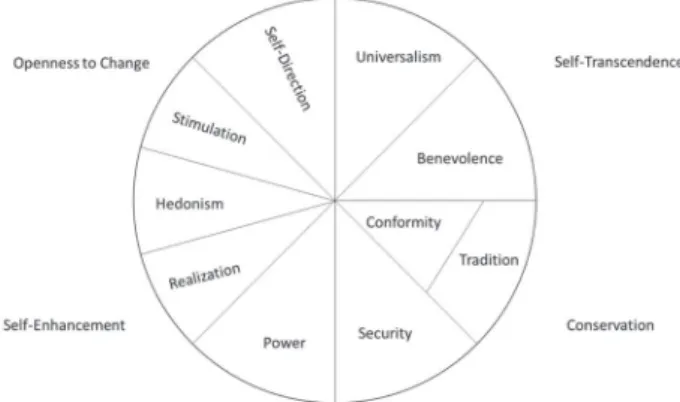
he great contribution of Schwartz (2005) was the identiication of motivations that express these values, leading to dynamic relationships between values and their corresponding motivational types (Tamayo, 2007). Schwartz’s theory proposes a model that establishes values as aspirations that aim to satisfy human needs, organized in ten motivational types. Schwartz (2005) proposes that the theory of values describes aspects that are common to all mankind. To this end, he identiied a set of universal values, wherein motivational types were comprehensive and held meaning to various diferent cultures. hese values can be organized in hierarchies, representing the preferences, choices and actions of individuals. he hierarchy of values is also known as the Axiological Priority. he ten motivational types identiied by Schwartz (1992; 1994; 2005) are as follows:
a) Security: personal integrity, stability in society and of itself;
b) Conformity: share restriction that may violate social norms;
c) Tradition: respect and acceptance of the ideals and customs of the society;
d) Benevolence: promoting the well-being of intimates;
e) Universalism: tolerance and protection of people and nature;
f ) Achievement: personal success through demonstrating competence;
g) Stimulation: excitement, novelty, change and challenge in life;
h) Hedonism: pleasure or sensual gratiication for yourself;
i) Self-direction: independent thought and action;
j) Power: social status and dominance over people and resources.
The compatibility or conflict between dimensions should be observed. On the one hand, there is self-transcendence (universalism and benevolence), which is opposed to self-enhancement (power, achievement and hedonism). At the other end, there is openness to change (stimulation and self-direction), which is opposed to conservation (tradition, conformity and security). he dimensions are shown in Figure 1. he same pictorial structure is commonly used to present the results of empirical studies.
Figure 1. heory of basic human values. Source: Adapted
from Schwartz (2005, p.143).
2005). Individualism emphasizes self-suiciency, prioritizes personal goals at the expense of group goals and gives greater importance to its own worldviews than to social norms (Triandis & Gelfand, 1998). Collectivist values, on the other hand, emphasize interdependence and prioritize joint decisions (Triandis & Gelfand, 1998).
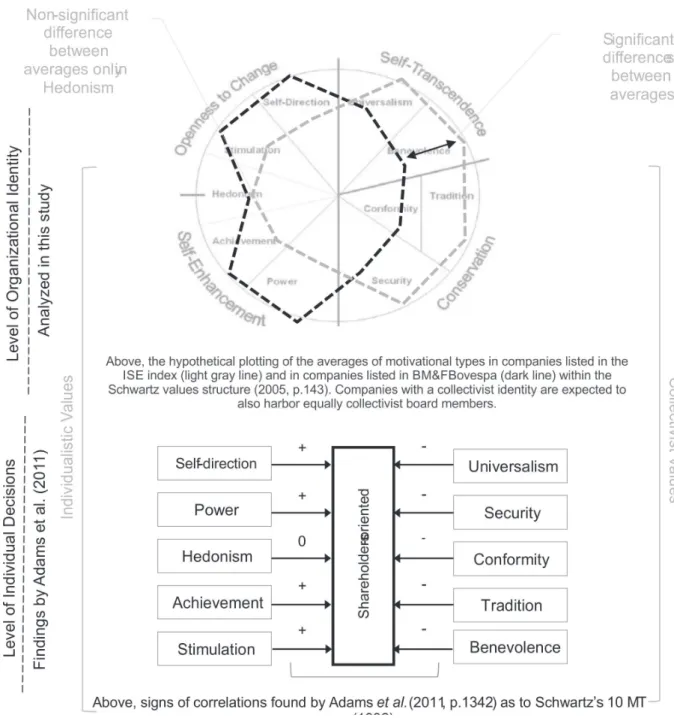
Regarding the Stakeholder heory, the value x managers´ behavior relation has encouraged the contribution of Adams et al. (2011), who undertook quasi-experimental research exposing 628 Swedish company board members to vignettes that showed dilemmas between stakeholders and shareholders. he authors proposed the construct shareholderism, which measures the preference to distribute resources to shareholders. he authors exposed respondents to four situations (each with a diferent stakeholder) in which individuals had to point out their positions on a Likert agreement scale. As well as other analyses, Adams et al. (2011) came to the conclusions presented in Table 1.
Table 1
Correlations identiied by Adams et al. (2011)
Motivational Type
Individualism (I) Collectivism (C)
Correlations with shareholderism
Conformity C -0.11**
Tradition C -0.11**
Benevolence C -0.18**
Universalism C -0.34**
Security C -0.10*
Self-direction I 0.20**
Stimulation I 0.13**
Hedonism I 0.00
Achievement I 0.34**
Power I 0.35**
Source: Modiied from Adams et al. (2011, p.1342)**
Signiicant at 0.01 and * Signiicant at 0.05
In Table 1, the significant positive correlations between individualistic values (except hedonism) – which the authors call “entrepreneurial values” – and shareholderism can be observed. We can also observe the signiicant negative correlations between this same construct and collectivist values. he authors conclude that
“these indings are generically consistent with the notion that shareholderism goes hand in hand with endorsing more entrepreneurial values” (Adams et al., 2011, p. 1343). he question of this article, however, includes the organizational domain, and not only the scope of individual decisions.
Jo Hatch and Cunlife (2005, p. 5) point out that human beings, when making decisions, do not behave as if they were in a laboratory situation, “in which day-to-day inluences are controlled.” Organizational and institutional interventions ought to modify the similarity between individual decisions and the actual trends of organizations as a whole. One of these interventions, among others, is March’s (1999) explanation for appropriateness, which indicates that, regardless of their personal inclinations, individuals tend to decide according to what their social group considers appropriate. he institutional environment also affects this relationship. Scott and Meyer (1991) point out that the regulatory environment, for example, modifies people’s references. Hence, too, the urgent need to assess the values x stakeholder management in the way this article suggests.
2.3
Conceptual model and research
hypotheses
the igure only recalls the indings of Adams et al.
(2011), and is there to show part of the arguments
that support the construction of hypotheses.
Figure 2. Conceptual research model. Top part of the igure is tested in this paper.
Several studies show that the personal attributes of corporate elites influence their behavior and, therefore, motivate their actions within the organizational context (Fiss & Zajac, 2004; Hiller & Hambrick, 2005). In parallel, as explained earlier, Schwartz’s values theory (1992) points to 10 motivational types that, in their
values considered “entrepreneurial” and decisions trending towards shareholders.
Few studies focused on relating the personal values of individuals and their business decisions. he irst among these rare studies was carried out by Agle, Mitchell and Sonnenfeld (1999), who examined whether the personal values of head American businessmen (CEOs) were linked to the prominence of the various stakeholders involved. This study, based on Rokeach’s scale value of items (1973) did not produce conclusive results.
he debate about the direction of corporate identity, whether favorable to the exclusive interests of shareholders or proposing coordination between all stakeholders, is still recent, and has not found deinitive theoretical and practical support. What is that determines whether a company’s identity tends more towards shareholders or stakeholders, after all? he role of the various types of shareholders also cannot be considered homogeneous, since institutional shareholders, governments and families have diferent cultural purposes and inluences (Fiss & Zajac, 2004). These influences entail specific purposes by the representatives of each type of shareholder, playing within organizations a favorable role to an exclusively pro-shareholder or broader model. As well as this diversity, the cultural environment in which the organization operates interferes with its social and environmental performance (Ringov & Zollo, 2007), as well, as in the opposite direction, their own reputation and organizational legitimacy inluence the attraction of the publics of a given company (Puncheva, 2008). A irm whose organizational identity favors stakeholders would tend also to attract heterogeneous publics to their relationships. his point to the hypotheses of this article, since it leads us to believe that pluralistic companies’ board members would tend to be collectivist.
In addition to this debate, it is worth consulting literature as to board members. he controversy surrounding studies that concern board members appears especially when traits
that interfere in the decision-making process are considered, such as self-esteem, desire to control, emotional stability and self-conidence (Hiller & Hambrick, 2005). In this sense, individual values – since they are considered ways that afect individuals’ perceptions of the external world (Meglino & Ravlin, 1998) – can broaden the understanding of key business decisions. Verplanken and Holland (2002) stated that values lead to actions that are consistent with them. Regarding the relationship between the axiological proile of board members and their companies’ trend towards stakeholders or shareholders, we expect signiicant diferences between the values propounded by the board members of companies listed in BM& FBovespa’s ISE and those of other companies.
Since Adams et al. (2011) have already pointed out a relationship in the context of individual decisions in quasi-experimental research using correlational techniques, this study focuses on a broader organizational context, aiming to extend the theory on the subject within the scope of company’s identity. We expect a greater presence of collectivist board members among companies with an equally collectivist identity. To reinforce the indings of Adams et al.
(2011), the reason for this hypothesis is the fact that collectivist values highlight interdependence and prioritize joint decisions between individuals and their surroundings (Triandis & Gelfand, 1998). Since we expect leaders to print their own values on their companies, and since these values signiicantly inluence decisions (Keeney, 1992), we also anticipate that there is, therefore, adhesion between personal values and organizational identity.
senior managerial bodies tends over time towards individuals adhering to the values propounded by a company. Suchman (1995) points out that the actions of an organization are considered legitimate when they correspond to the standards of the social group that surrounds them. Hence, also, the hypothetical adhesion between the values and the pro-shareholders or pluralistic organizational trend.
hus, we present our hypotheses (Hs) below. Hypotheses H1 and H2 deal with the agglutination of motivational types around the concepts of individualism and collectivism. Hypotheses H3 and H4 refer to each of the motivational types separately; H3 for individualistic types and H4 for collective types. Hypothesis H5 deals with the exception of motivational type Hedonism, which did not present any correlation to the study of Adams et al. (2011).
H1: Board members from stakeholder-oriented companies (in the ISE index) present signiicantly lower individualism than those from other companies listed in BM&FBovespa; H2: Board members from stakeholder-oriented companies (in the ISE index) present signiicantly higher collectivism than those from other companies listed in BM&FBovespa; H3: Board members from stakeholder-oriented companies (in the ISE index) present motivational types Self-Direction, Stimulation, Achievement and Power signiicantly lower than those from other companies listed in BM&FBovespa;
H4: Board members from stakeholder-oriented companies (in the ISE index) present motivational types Security, Conformity, Tradition, Benevolence and Universalism signiicantly higher than those from other companies listed in BM&FBovespa.
he hypothesis about motivational type Hedonism, which was an exception in the indings of Adams et al. (2011), is established as described below. According to Adams et al.
(2011), the fact that Hedonism does not appear as
correlated with the pro-shareholders trend comes from the Schumpeter theory, which suggests that entrepreneurial capitalists do not seek immediate pleasure from their actions. So, we do not expect any diferences between samples with respect to this motivational type.
H5: Board members from stakeholder-oriented companies (in the ISE index) present motivational type Hedonism equivalent to the board members of other companies listed on BM&FBovespa.
3
Methods
This research was characterized as descriptive, with a quantitative approach and, from the perspective of its technical procedures, as a survey. It was a collection of primary data through the Schwartz inventory of SVI values (with its 60 items), adapted and validated in Brazil by Tamayo (2007). Questions were closed-ended, seeking to obtain judgment through a scale of varying degrees of intensity. he answers attributed an increasing degree of intensity, from -1 (totally opposite) to 7 (extremely important), to each of the statements on the SVI scale. As well as the SVI questionnaire, a question was included to capture the presence in the ISE index (proxy for the pro-stakeholder trend). The resulting Cronbach’s alpha for the questionnaire containing 60 Schwartz values was 0.923, therefore considered satisfactory. Cronbach’s alphas for constructs individualism and collectivism were 0.839 and 0.841, respectively (Favero et al., 2009). Figure 2 shows the model used for the study.
because it is a criterion that is respected by the Corporate Governance community in Brazil, and selection for companies’ inclusion in the ISE follows strict criteria; its Executive Council is made up of eleven independent institutions.
With regard to data processing, we initially found that it was not normally distributed through the Kolmogorov-Smirnov and Shapiro-Wilk (α p <0.001) tests for both the 60 values and the 10 motivational types that group them. After finding that data was non-parametric, the Mann-Whitney test was applied in order to determine whether the two independent samples (ISE and non-ISE companies) were drawn from populations with the same averages (Favero et al., 2009). hus, each of the hypotheses from H1 to H5 were dealt with statistically as follows: Ho: there is no signiicant diference between the averages of groups of companies (null hypothesis) and H1: there is a diference.
The questionnaire was sent to board members participating in the Brazilian Institute of Corporate Governance (Instituto Brasileiro de Governança Corporativa, IBGC). Based on IBGC (2011) data, that there are approximately 2,000 board members working in Brazil. his institution collaborated with the response, forwarding messages and encouraging members to answer. Only board members were allowed to answer the survey, and as so certain cases were excluded. he survey was made available to the entire IBGC database; 145 questionnaires were answered, leading, ultimately, to 121 valid questionnaires. However, we chose to analyze only data from the board members of companies whose shares are traded in BM&FBovespa. his generated a sample of 74 board members. his data deletion occurred so that there would be better control of the sample – because nothing would indicate that unlisted companies would not be pro-stakeholder oriented, since they would not anyway be able to participate in the ISE index. Given the diiculty of access to board members, we considered this sample as a valid contribution to empirical studies on the subject in Brazil. he questionnaires were
self-administered via internet, and data collection was carried out between February 24, 2014 and April 14, 2014.
4
Results and DISCUSSion
4.1
Contextualization of the universe and
of the sample
This study investigates the research problem in the context of public companies in Brazil. he Brazilian capital market is a relection of the national business structure, with a strong concentration of capital in the hands of a few shareholders (Saito & Dutra, 2002), and low independence of boards as to ownership structures (Guerra, 2009). his indicates the strong presence of controlling shareholders in boards. These features generate a speciic context for analysis. Additionally, from a cultural point of view, when assessing the six dimensions proposed by Hofstede (1980) and comparing them to Sweden, the country of origin of the studies of Adams et al. (2011), we observe signiicant diferences. Among these diferences, we highlight the following: (i) acceptance of inequalities and hierarchy (69 in Brazil and 31 in Sweden), (ii) individualism (38 in Brazil and 71 in Sweden), indicating a more collectivist society in the Brazilian case, (iii) also much higher risk aversion in Brazil (76-29) and (iv) greater indulgence in Sweden (59 to 78). Both aspects, capital structure in Brazil and cultural diferences, should be considered when evaluating results.
According to the Brazilian Institute of Corporate Governance, there are 2,647 board member positions available in Brazil (IBGC, 2011); from this availability, only 7.7% are women and the rest are men. Each man occupies an average 1.24 boards, and every woman, an average 1.30 boards. hus, we can infer that there are approximately 2,000 board members working in Brazil. In all, 335 companies are listed in the various corporate governance levels of the BM&FBovespa.
operating in Brazil, and whose companies are listed in the São Paulo Stock Exchange (BM&FBovespa). We excluded from analysis companies without shares traded in the São Paulo Stock Exchange. Most respondents (98.3%) are male. his is approximately consistent with IBGC (2011), which indicates 7.7% of women in board positions in Brazil. he results also point towards a sample of individuals in the 51-60 age group, accounting for 35.1% of the sample. he second largest age group is 41-50 (32.4%). he entire sample has at least a university degree. hirty-eight companies in the sample participate in the ISE index, and 36 are not part of this index of companies.
Companies considered large (with revenues over six hundred million reais) represented 41.8% of the sample. To classify companies’ sector, we used the BM&FBovespa standard. Of the 17 possible sectors, 11 are represented in the sample, the most relevant as follows: industrial (14.8%), inancial (12.2%) and consumer and retail (10.8%). Classification as to the level of governance followed the one presented by
BM&FBovespa: Traditional market (44.6% of sample companies), Level 1 (13.5%), Level 2 (5.4%) and New Market (36.5%). The coniguration of the axiological priorities of board members studied for the whole sample indicates a greater overall trend towards values referring to Universalism and Benevolence, and a smaller trend towards Power and Tradition. We can identify a general pattern sample in this diagnosis and in other studies with national publics. he sample data shows a Pearson correlation of 0.91 with Tamayo (2007), and of 0.79 with Calvosa, Sierra and Almeida (2011). hat said, we move on to the answer to the research problem.
4.2
Diferences between ISE companies
and all the other companies listed in
BM&FBovespa
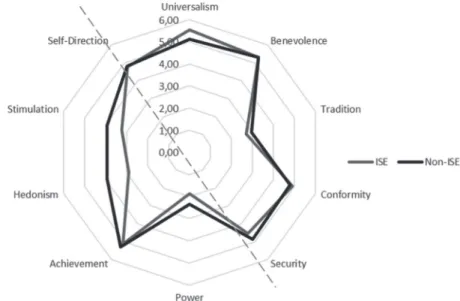
What are the differences, in terms of individual values, between the board members of companies with a pro-stakeholder corporate identity and other publicly traded companies in Brazil? Figure 3 shows the results pictorially.
Figure 3. Circular structure of ISE companies × other companies
Source: he authors, 2016
he light gray line represents motivational types and values belonging to the group of board
We can observe, on the left side of Figure 3 (where individualistic values are concentrated), that there is a visual diference between samples. Board members from companies included in ISE seem to have with less importance for this group of values, when compared to the sample of all other companies listed in BM&FBovespa. his already allows us to preliminarily infer the rejection of the null hypothesis for H1 and, thus, to assert that values can be predictors of a pro-stakeholder or shareholder trend with respect to the individualism x collectivism agglutination.
his panoramic perception, however, must be statistically tested. We present, in Table 2, average diferences between the two samples (ISE and others) with respect to two groups of values (individualistic and collectivist). Companies in the ISE index had an average individualism (considering the ive motivational types to the left of the dashed line in Figure 3) equal to 3.65. he other companies obtained this value at 4.05 (a signiicant diference at 0.01). Regarding the set of collectivist values, however, there was no signiicant diference. his last result, nonetheless, is not surprising. his is because these guidelines do not make up a bipolar scale, but that “people are a bit of each, and, often, appropriate behavior
is deined by the context and the immediate situation” (Gouveia, Andrade, Milfront, Queiroga & Santos, 2003, p. 224).
Board members from companies belonging to the ISE index are less individualistic, which suggests that this is an important predictor of pro-stakeholder identity. Individualism “expresses a trend towards success, towards appreciation of one’s own intimacy. In this type of orientation, the individual is above the groups in all aspects” (Gouveia et al., 2003, p. 225). We reject, therefore, the null hypothesis for H1, and conirm that board members from pro-stakeholder companies are less individualistic. In addition, however, we accepted the null hypothesis for H2, indicating that there is no evidence that the sample board members are diferent as to collectivism. It is worth remembering, in order to understand the above results, that the sample presented especially – in its entirety – a large presence of universalism and benevolence. This finding is consistent with other diagnoses in the Brazilian context, and highlights greater collectivism in general in national individual values, therefore preventing us from inding a greater number of collectivist particularly in ISE companies.
Table 2
Diferences between the averages of two blocs of opposite motivational types (n=74)
Individualism-Collectivism
according to Schwartz Average – Listed in Bovespa and ISE Bovespa, but not in ISEAverage - Listed in
Mann-Whitney U among motivational
types
Signiicance Sig. (2 extremes) among motivational types
Individualism 3.65 4.05 515.5 0.046**
Collectivism 4.76 4.73 668.5 0.71
** Signiicant at 0.01
The above data, moreover, partially complies with indings in literature. Adams et al.
(2011) demonstrated the correlations transcribed in Table 1, revealing signiicant relationships between individualism and shareholderism in the scope of individual decisions in an experimental situation. Mitchell, Agle and Wood (1997) also indicate that the values of managers as to
appropriate to the norms, values and beliefs of a social group (Suchman, 1995).
When comparing the two samples, not according to the individualism x collectivism agglutination, but to the 10 motivational types of Schwartz (2005), we observe that only types Stimulation and Hedonism statistically manifest themselves as diferent between the two groups of companies. These results offer answers to hypotheses H3 to H5. hus, the results of this article are only in part aligned with the indings of
Adams et al. (2011) and with the hypotheses of the research. Stimulation, motivational type observed as more prevalent among non-ISE companies, is derived from the need for challenges in “exciting”, “bold” and “varied lives” (Schwartz, 2005). Hedonism, also more manifest in companies which are not a priori pro-stakeholder oriented, refers to gratiication through sensory pleasure and by avoidance of unpleasantness (Schwartz, 2005). Table 3 presents this discussion.
Table 3
Motivational Types in ISE and other listed companies (n=74)
Motivational Type according to Schwartz
Individualism (I) Collectivism
(C) according to Schwartz
Average – Listed in
ISE
Average – Not listed in
ISE
Mann-Whitney U among motivational
types
Signiicance Sig. (2 extremes) among motivational types
Correlations found by Adams et al.(2011) as to Shareholderism
Self-direction I 4.79 4.83 645.50 0.54 Signiicant positive
Stimulation I 3.23 3.92 522.50 0.05* Signiicant positive
Hedonism I 2.89 3.92 497.00 0.028** Non-signiicant
Achievement I 4.75 5.07 571.00 0.16 Signiicant positive
Power I 1.87 2.36 592.00 0.24 Signiicant positive
Security C 4.52 4.85 565.50 0.14 Signiicant positive
Conformity C 4.91 4.79 699.50 0.97 Signiicant positive
Tradition C 2.71 2.94 600.00 0.27 Signiicant positive
Benevolence C 5.31 5.30 684.00 0.84 Signiicant positive
Universalism C 5.54 5.11 571.50 0.16 Signiicant positive
** Signiicant at 0.01 and * Signiicant at 0.05
Although the results presented in Table 3 present certain convergence with the expected, it is not full (note that there is signiicance only in the two lines with *). Furthermore, as shown in the last column of Table 3, only the motivational type Stimulation showed complete correspondence with Adams et al. (2011). While those authors identiied correlations between individual value and a pro-stakeholder or pro-shareholder trend in almost all motivational types, this article shows signiicance in only two of the motivational types of Schwartz’s theory. his generates the answer that the null hypothesis (equality between samples) for H3 and H4 is rejected only for motivational types Stimulation and Hedonism. For the eight other
motivational types, it is not possible to say that there are signiicant diferences in motivational types considered individually.
The reasons for this discrepancy are probably due, in the real organizational framework (a dimension added in this article), to interference from “non-laboratory” reality. We mention: (a) the stakeholder diversity observed in the reality of studied board members; (B) the heterogeneity of organizational cultures; (c) Diferent business sectors and their economic contexts and (d) dissimilar institutional environments. he work of Adams et al. (2011) aimed to capture only the individual level in an experimental context. hus, while in a laboratory situation a high correlation between values and decision orientation can be observed, in empirical reality this correspondence was weaker, although present. According to Jo Hatch and Cunlife (2005, p. 5), “human behavior is notoriously unpredictable, except under controlled conditions.” Adams et al. (2011, p. 1339) understand this limitation by claiming that “empirical research to study managers’ support to shareholders or stakeholders should ideally examine their actual behavior”, but they also stated that this research is virtually infeasible. Below, we discuss the above four items from literature as a way to suggest an initial debate to explain derivation between an individual decision and the actual context.
Stakeholders’ different characteristics represent one of the major influencers of stakeholder management. he study of Adams
et al. (2011) used vignettes containing dilemmas from actual legal cases. Little was informed, however, about the relative importance of these publics. In contrast, Mitchell, Agle and Wood (1997) argue that managers effectively pay attention to prominent publics – deined by these authors as the conluence of Power, Legitimacy and Urgency. he authors assert that literature is often simplistic, because in reality “managers cannot meet all real claims” (Mitchell, Agle & Wood, 1997, p. 854). here is reason to believe, then, that the experimental situation applied by Adams et al. (2011) did not seize the “dynamic relationships and complex considerations” (Mitchell, Agle & Wood, 1997, p. 854) that inluence the prominence of an organization’s stakeholders. It is worth remembering that these
authors consider prominence as derived from the perception of businessmen: it refers to factors that are perceived by managers as gifts. In this sense, the answers attributed to the demands of stakeholders “are built over time, rather than an objective reality” (Agle, Mitchelll & Sonnenfeld, 1999, p. 509).
The heterogeneity of organizational cultures also inluences the proile of stakeholder management. March (1999) points out that individuals, in their complex organizational contexts, tend to make “appropriate” decisions. The logic of appropriateness is a perspective that sees human actions as partly driven by “exemplary” behavior rules facing a social group. hus, extracting the organizational context of businessmen from decision should affect the divergence studied here. To strengthen this idea, Brickson (2005) states that the identity socially created by individuals and organizations forges relationships between companies and their stakeholders. The institutional environment similarly tends to modify the relationship of companies and their stakeholders. Scott and Meyer (1991) show that organizations are part of an environment from which they derive their regulation and their references for action. Depending on the specificities of the environment in which they operate, organizations are subject to dissimilar types and magnitudes of stakeholder influence. Abreu (2009) demonstrates, for example, that, in emerging countries, environmental regulations and stakeholder demands play a central role in raising commitment to environmental issues.
personal entrepreneurial interests are based on the quest for success, having little relationship with hedonistic incentives (Adams et al., 2011). he results of the study presented here suggest, however, a relationship between hedonism and pro-shareholder orientation. The sample companies that do not belong to the ISE index presented board members who were more inclined to seeking pleasure (see Table 3).
his inding may be discussed based on Freud, and may be reiterated by Stakeholder Theory. Indeed, in this respect, the possible relection by this article is limited, indicating the need for further theoretical development of the issue. One reason for this bias is that the Schwartz SVI scale applied here ofers only two assertions about hedonism (see Table 4 for a list of individually studied values). However, the results serve as a reminder of the importance of progress in addressing the Hedonism topic and its possible correlation with business proiles. How would the more or less hedonistic proile of main leaders inluence their companies’ trend towards shareholder or stakeholder value? Thus, how would leaders who advocate “a life full of delights” tend to lead organizations that emphasize short-term inancial gains? he questions above insert the particle “how” because, in this article, we have pointed out the presence of the relationship without, however, deepening the mechanisms through which this increased presence of hedonists in companies that are not stakeholder-oriented occurs. he following paragraphs raise some possible explanations.
Addressing Hedonism compels us to bring to the debate theories stemmed from Psychology and its relationships with Organizational heory. Freud (1930) indicates that the search for pleasure tends to impel individuals to the shortest paths in their search for pleasure and avoidance of displeasure. Freudian work called this element the “principle of pleasure.” However, the same author conceived the idea of the “principle of reality” which, contrary to other indings, asserts that, to obtain certain pleasures, it is necessary to diferentiate them because of the group culture within which one lives (Drago, 1992). According
to Freud, if human beings had full freedom to pursue their natural objectives, there would be no lasting social compatibility and preservation. hus, “immediate satisfaction becomes delayed satisfaction” (Drago, 1992, p. 60) and this changes “not only instinctive desires as well as instinctive values” (ibid, p. 60). his inding creates doubts about the extent to which reality perceived by active managers in companies with pluralist models would cause smaller stimulus to short-term gratiication.
There are indications, also in the Stakeholder heory, that orientation towards reciprocity-based relationships tend to – especially in the long-term – add value to companies (Harrison et al., 2010). Due to the correspondence between the dichotomy of looking for short or long-term results and the principles of Freud’s theory of pleasure, we conjecture, in this article, that there are relationships between hedonism and pro-shareholder decisions. he results presented here allow us only to demonstrate this possible relationship. In Adams et al. (2011), perception of pleasure was not observed by respondents.
he previous discussion aimed to compare the results between ISE and non-ISE samples at the level of motivational types. hus, answers to the research hypotheses are already available. We will now ofer a brief description of the 60 individual values proposed by Schwartz (2005), so as strengthen and detail these answers. As seen in Table 4, only in 18 distinct values did we identify signiicant inequities between ISE and non-ISE companies. In certain values, expected directions are diferent from expected.
Table 4
Statistics concerning speciic values
Motivational Type Values ISE Non-ISE M. Whitney U Sig.
Self-direction Curiosity 6.05 5.37 580.5 0.17
Creativity 5.84 5.55 603 0.27
Freedom 6.16 5.55 535.5 0.06*
Self-directed 5.62 5.24 653.5 0.59
Independent 1.51 2.68 531.5 0.07*
Self-respect 3.54 4.58 520.5 0.05*
Stimulation Bold 4.19 4.92 519 0.047**
Varied life 1.78 1.74 657 0.62
Exciting life 3.73 5.11 481 0.017**
Hedonism Pleasure 2.49 3.32 537 0.08*
Life of pleasure 3.30 4.53 501 0.03**
Achievement Successful 6.14 5.87 670.5 0.71
Capable 4.95 5.13 666.5 0.69
Ambitious 5.97 6.16 621 0.36
Inluential 2.81 3.89 501.5 0.03**
Intelligent 4.24 4.47 693 0.91
Smart 4.38 4.89 560.5 0.12
Power Social power 1.41 1.95 635 0.47
Authority 1.27 1.47 669 0.71
Riches 1.97 2.74 530.5 0.06*
Public image 1.84 2.11 690 0.89
Vanity 2.43 2.95 609.5 0.32
Social image 2.32 2.92 613 0.34
Security Clean 4.22 4.92 542.00 0.08*
National security 1.89 2.84 546.00 0.09*
Retribution of values 6.30 5.76 563.5 0.10
Social order 3.19 3.87 626 0.41
Family security 6.49 6.11 613 0.27
Sense of belonging 4.49 4.84 636.5 0.47
Healthy 5.08 5.63 622.5 0.38
Conformity Obedient 3.78 3.92 675.5 0.77
Respect for the elderly 5.57 5.58 677 0.77
Politeness 5.95 5.26 553.00 0.098*
Self-disciplined 4.32 4.39 684 0.84
Tradition Conscious of limits 5.68 5.08 595 0.24
Devoted 1.73 2.45 583.5 0.20
Humble 4.05 4.08 695.5 0.94
Respect for tradition 1.30 2.50 490.5 0.022**
Moderate 0.03 0.45 626 0.39
Privacy 3.49 3.11 632.5 0.45
Benevolence Helpful 4.86 5.16 592 0.23
Honest 4.86 5.24 587.5 0.21
Forgiving indulgence 4.76 4.71 693 0.91
Loyal 5.51 5.68 657 0.61
Responsible 6.30 6.00 592 0.19
Work 5.89 5.58 589 0.21
Spiritual life 2.73 3.50 582 0.20
True friendship 6.30 5.53 544.00 0.07*
Mature love 6.00 5.84 652.5 0.57
Meaning of life 5.89 5.74 617.5 0.32
Motivational Type Values ISE Non-ISE M. Whitney U Sig.
Unity with nature 4.92 4.21 512 0.039**
A world of beauty 4.89 3.76 429.5 0.003**
Na open mind 5.57 5.16 640.5 0.49
Social justice 5.46 5.47 685 0.84
Wisdom 6.00 5.66 644 0.51
Equality 5.11 4.82 660 0.64
World peace 5.41 4.63 532.00 0.06*
Dreamer 6.14 5.84 626 0.38
Inner harmony 5.89 6.11 591 0.20
* Signiicant at 0.1 ** Signiicant at 0.05 - Source: he authors, 2016
Note also that owning “riches” (wealth) is more intense in companies that are not stakeholder- oriented. Interestingly, in motivational type Security, the only values that showed diferences were “clean” and “national security”, and that these diferences were opposite to the expected. It is worth remembering that this motivational type is the irst collectivist one in the Schwartz
circle and, therefore, we could understand it as transitory. This “inverted” phenomenon also occurs with the value “respect for tradition.” his also appeared more intense in non- stakeholder-oriented organizations. Board members from non-ISE companies, therefore, seem to be more conservative. Table 5 summarizes the indings.
Table 5
Summary of indings
Research Hypotheses Answers Observations
Board members from stakeholder-oriented companies present signiicantly lower
individualism than those from other companies (H1)
he null hypothesis is rejected (equally among averages), conirming that board members from stakeholder-oriented companies are more individualistic
ISE board members indicated less importance to a life of pleasure and the need for social inluence
Board members from stakeholder-oriented companies present signiicantly higher collectivism than those from other companies (H2)
No opposition between the concepts of individualism and collectivism was demonstrated.
he null hypothesis is accepted
Although collectivism was shown to be equivalent, non-ISE board members demonstrated made conservative values a priority
Board members from stakeholder-oriented companies present motivational types Self-Direction, Stimulation, Achievement and Power signiicantly lower than those from other companies (H3)
he null hypothesis is rejected only for motivational types Stimulation and Hedonism
Here there is disagreement with the indings of Adams et al. (2011). hose authors found correlations in nine of the ten MTs
Board members from stakeholder-oriented companies (in the ISE index) present motivational types Security, conformity, Tradition, Benevolence and Universalism signiicantly higher than those from other companies (H4)
he null hypothesis is rejected for all collectivist motivational types
his rejection is partly explained by the higher incidence, in the whole sample, of types prone to universalism and benevolence
Board members from stakeholder-oriented companies (in the ISE index) present motivational type Hedonism equivalent to the board members of other companies (H5)
he null hypothesis is rejected, and hedonistic priorities are perceived among board members from non-ISE companies
his inding is the contradictory with respect to the work of Adams et al.
(2011)
5
Conclusions, limits, and future
directions
This article aimed to evaluate the relationship between individual values and corporate identity in favor of shareholders or other stakeholders. Previous research – Adams et al. (2011) – revealed strong correlations between the above values and individual decisions by directors. Brickson (2005) indicates that the identity of a company is strongly related to its relationships with stakeholders, and that this orientation can vary between individualistic and collectivist. As shown in Table 5, the indings of this article indicate only partial convergence with the previous study.
If, on one hand, the predictive power of individual values may indicate board members’ decision-making trends, on the other, regulation, culture and the environment tend to exert pressure on individuals. From a practical point of view, this seemingly dynamic process indicates that individuals tend to look for positions that are more closely aligned with their beliefs, but only when the options are available. he smaller propensity towards individualism by board members from companies that voluntarily declare themselves as more concerned with other stakeholders allows us to suggest that the context and the group, as pointed out by March (1999), do in fact interfere in the behavior of individuals. his inding further reinforces that the regulatory environment does have the power to inluence (Brickson, 2005), if not individual values, the behavior of those who are part of a given organization.
he motivational types that characterize individualism are less pronounced in board members who work for stakeholder-oriented companies. It is noteworthy, however, that motivational types Hedonism and Stimulation are worth mentioning, since they are related to sensory satisfaction. These motivational types, sometimes forgotten by organizational studies, have shown that, beyond the power, ambition and self-determination of businessmen,
innermost motivations are deeply linked to their decision-making processes. In contrast, we must highlight the similar importance given by both groups to collectivism. hese indings are in line with national values, leading us to realize that predominant cultural traits are not always decisive to decision-making.
Companies rely on individuals to promote their values and cultures; the results show an opposite trend to the traditional isomorphism of companies, indicating that, even though they are part of a national culture, there may be several corporate identities, raised by a variety of controlling shareholders, not necessarily converging to dominant culture – also indicating that many other factors influence business practices, beyond context and rules, and, therefore, are a matter of business options and choice. his argument goes against traditional common sense, as well as expands and brings additional responsibilities to organizations. We suggest that these boundaries between the internal and external environments of organizations – which make them unique even though they are part of a given culture – can be the individual values of their leaders.
Although the indings do not allow us to establish causal relationships, the practical implications of this material are significant. Companies that wish to enhance stakeholder-oriented organizational identities should measure board members’ and other directors’ values to thus maximize the likelihood of this identity being realized. Leaders who are more intensely in agreement with the values of an organization tend to be more committed to its interests (Boivie
et al., 2011). Although this article has not pointed out relationships that are as strong as those observed by Adams et al. (2011), the imperative of searching for adhesion between individual values and organizational identity remains.
to a small sample, and by particular methods: the Schwartz scale and the adoption of ISE criterion to infer pro-stakeholder orientation. Furthermore, we believe that the theoretical discussion presented has gaps, due to its complexity and amplitude. Speciic research concerning values and speciic topics can ofer greater depth.
hus, the results of this research point to other possible investigations, such as: (i) assessing whether individual values of board members considered independent present diferent axiological priorities from other board members’ values, (ii) studying whether board members working in different institutional environments also present diferent axiological priorities, (iii) deepening the theoretical and empirical discussion of Hedonism’s role in building organizational orientation, and (iv) developing qualitative work, such as case studies, which penetrate the meanings, contexts and nuances of the relationships between values and orientations presented in this material. he issue, in short, is complex. he debate goes on.
References
Abreu, M. C. S. (2009). How to define an environmental policy to improve corporate sustainability in developing countries. Business Strategy and the Environment.18, 542-546.
Adams, R. B., Licht, A. N., & Sagiv, L. (2011). Shareholders and stakeholders: how do board members decide? Strategic Management Journal.
32, 1331-1355.
Agle, B.R., Mitchelll, R.K., & Sonnenfeld, J.A. (1999). Who matters to CEOs? An investigation of stakeholder attributes and salience, corporate performance, and CEO Values. Academy of Management Journal. 42 (5), 507-525.
Bartlett, J, Mc Donald, P. & Pini, B. (2015). Identity orientation and stakeholder engagement—the corporatisation of elite schools.
Journal of Public Afairs, 15(2), 201-209.
Bm&fbovespa (2015). Índice de sustentabilidade empresarial-ISE. Recuperated on September 1, 2015, from: http://www.bovespa.com.br.
Boaventura, J. M. G., Cardoso, F. R., Silva, E. S., & Silva, R. S. (2009). Teoria dos stakeholders e teoria da irma: um estudo sobre a hierarquização das funções-objetivo em empresas brasileiras.
Revista Brasileira de Gestão de Negócios.11(1), 289-307.
Boivie, S., Lange, D., Mc Donald, M. L., & Westphal, J. D. (2011). Me or we: he efects of CEO organizational identiication on agency costs. Academy of Management Journal, 54, 551–576.
Bosse D. A., Phillips R.A., & Harrison J.S. (2009). Stakeholders, reciprocity, and firm performance.
Strategic Management Journal. 30(4), 447–456.
Brickson, S. L. (2005). Organizational identity orientation: forging a link between organizational identity and organizations´ relations with stakeholders. Administrative Science Quartely. 50, 576-609.
Bridoux, F., & Stoelhorst, J. W. (2014). Microfoundations for stakeholder theory: managing stakeholders with heterogeneous motives. Strategic Management Journal. 35, 107-125.
Bruére, A. J., Mendes-da-Silva, W., & Santos, J. F. dos (2007). Aspectos da governança corporativa de empresas listadas na bovespa: um estudo exploratório sobre a composição e peril dos Conselhos de Administração. Revista de Administração e Contabilidade. Unisinos. 4(2), 149-159.
Clarke, T. (1998). he shareholders corporation: a business philosophy for the information age.
Long Range Planning, 31(2), 182-194.
Davis, J. H., Schoorman, D. F., & Donaldson, L. (1997). Toward a stewardship theory of management. Academy of Management Review, 22, 20-47.
Dollinger, S .J., Burke, P.A. & Gump, N.W. (2007). Creativity and values. Creativity Research Journal, 19, 91-103.
Drago, P. A. (1992). Teoria crítica e teoria das organizações. Revista de Administração de Empresas. São Paulo, 32(2), 58-64.
Fávero, L. P., Beliore, P., Takamatsu, T. R., & Suzart, J. A. (2009). Métodos quantitativos com stata. Rio de Janeiro: Elsevier.
Fiss, P. C., & Zajac, E. J. (2004). he difusion of ideas over contested terrain: the (non)adoption of a shareholder value orientation among german firms. Administrative Science Quarterly, 49, 501–534.
Freeman, R. E. (1984). Strategic management: a stakeholder approach. Nova Iorque. Cambridge University Press.
Freeman, R. E & Phillips, R. A. (2002). Stakeholder theory: a libertarian defense. Business Ethics Quartely, 13, 331-349.
Freud, S. (1930). Civilization and its discontents. Nova Iorque. he Standard Edition.
Friedman, M. (1962). Capitalism and freedom (2a ed.). University of Chicago Press.
Gouveia, V. V., Andrade, J. M., Milfont, T. L. Queiroga, F., & Santos, W. S. (2003). Dimensões normativas do individualismo e coletivismo: é suiciente a dicotomia pessoal vs. social? Psicologia: Relexão e Crítica, 16(2), 223-234.
Guerra, S. M. (2009). Os papéis do conselho de administração em empresas listadas no Brasil.
2009. Dissertação (Mestrado em Administração) – Faculdade de Economia, Administração e Contabilidade, Universidade de São Paulo, São Paulo, Brasil.
Harrison, J. S., Bosse, D. A., & Philips, R. A. (2010). Managing for stakeholders, stakeholder utility functions and competitive advantage.
Strategic Management Journal, 31, 58-74.
Harrison, J. S., Freeman, R. E. & Abreu, M. C. S. (2015) Stakeholder heory as an ethical approach to efective management: Applying the theory to multiple contexts. Revista Brasileira de Gestão de Negócios, 17(55), Special Edition, 858-869.
Hiller, N. J., & Hambrick, D. C. (2005). Conceptualizing executive hubris: the role of (hyper-core) self-evaluations in strategic decision-making.
Strategic Management Journal, 26, 297-319.
Hofstede, G. (1980). Cultural consequences: international diferences in work related values. Beverly Hills: Sage.
IBGC - Instituto Brasileiro de Governança Corporativa (2011). Relatório de mulheres na administração das empresas brasileiras listadas – 2010 e 2011. Recuperated on May 18, 2016, from http://www.ibgc.org.br/userfiles/files/ Mulheres_no_Conselho.pdf
Jensen, M. C., (2001). Value maximization, stakeholder theory and the corporate objective function. European Financial Management, 7 (3), 297-317.
Jo Hatch, M., & Cunlife, A. (2005). Organization theory: modern, symbolic and postmodern perspectives. Oxford: Oxford University Press.
Jones, T. M., Felps, W., & Bigley, G. A. (2007). Ethical theory and stakeholder-related decisions: The role of stakeholder culture. Academy of Management Review, 32(1), 137-155.
Kilmann, R., Saxton, M., & Serpa, R. (1986).
Gaining control of the corporate culture. São Francisco: Jossey-Bass.
Laplume, A. O., Sonpar, K., & Litz, R. A. (2008). Stakeholder theory: reviewing a theory that moves us. Journal of Management, 34, 1152–1189.
Lee W.N. & Choi S. M. (2005). The role of horizontal and vertical individualism and collectivism in online consumers’ response toward persuasive communication on the web. Journal of Computer-Mediated Communication, 11(1), 280-298.
March, J. G. (1999). he pursuit of organizational intelligence. Oxford: Blackwell.
Margolis, J. D., & Walsh, J. P. (2003). Misery loves companies: rethinking social initiatives by business. Administrative Science Quarterly, 48, 268-305.
Meglino, B. M., & Ravlin, E. C. (1998). Individual values in organizations: concepts, controversies, and research. Journal of Management, 24(3), 353-389.
Mitchelll R. K., Agle B. R., & Wood D. J. (1997). Toward a theory of stakeholder identification and salience: defining the principle of who and what really counts. Academy of Management Review,
22, 853–886.
Puncheva, P. (2008). The role of corporate reputation in the Stakeholder decision-making process. Academy of Magament Review. v. 32. n.3. p. 946-967
Rokeach, M. (1973). he nature of human values. Free Press. Nova Iorque.
Ringov, D., & Zollo, M. (2007). Corporate responsibility from a socio-institutional perspective: the impact of national culture on corporate social performance. Corporate Governance, 7(4), 476-485.
Sagiv, L., Sverdlik, N., & Schwartz, S. H. (2011). To compete or to cooperate? Values´impact on perception and action in social dilemma games.
European Journal of Social Psychology, 41, 64-77.
Saito, R., & Dutra, M. G. L. (2002). Conselhos de administração: análise de sua composição em um conjunto de companhias abertas brasileiras.
Revista de Administração Contemporânea, 6(2), 9-27.
Schwartz, S. H. (1992). Universals in the content and structure of values: theory and empirical tests in 20 countries. New York: Zanna.
Schwartz, S. H. (1994). Are there universal aspects in the structure and contents of human values?
Journal of Social Issues, 50(4), 19-45.
Schwartz, S. H. (2005). Theory of cultural value orientations: explication and applications.
Comparative Sociology, 5(2), 137-182.
Scott, W. R., & Meyer, J. W. (1991). The organization of societal sectors: propositions and early evidence. In: Powell, W. W. & Dimaggio, P. J. (Eds). he new institutionalism in organizational analysis. Chicago: University of Chicago Press.
Suchman, M. C. (1995). Managing legitimacy: strategic and institucional approaches. Academy of Management Review, 20, 571-610.
Sverdlik, N., & Oreg, S. (2009). Personal values and conlicting motivational forces in the context of imposed change. Journal of Personality, 77, 1437-1466.
Tamayo, A. (2007). Contribuições ao estudo dos valores pessoais, laborais e organizacionais.
Psicologia: Teoria e Pesquisa, 23, 63-70.
Tamayo, A., & Porto, J. B. (2005). Valores e Comportamentos nas Organizações. Petrópolis: Vozes.
Triandis H. C. & Gelfand M. J. (1998). Converging measurement of horizontal and vertical individualism and collectivism. Journal of Personality and Social Psychology, 74(1), 118-128.
Verplanken, B., & Holland, R. W. (2002). Motivated decision making: efects of activation
and self-centrality of values on choices and behavior. Journal of Personality and Social Psychology, 2, 434-447.
Weick, K. (1999). hat’s moving: theories that matter. Journal of Management Inquiry, 8, 134-142.
About the authors:
1. Edson Ricardo Barbero, PhD in Business Administration by the Faculty of Economics, Business
Administration and Accounting of the University of São Paulo (FEA-USP). Master Program Professor at the Álvares Penteado Foundation School of Commerce (Fecap), Brazil. E-mail: [email protected].
2. Marcello Marchiano, Master in Business by Álvares Penteado Foundation School of Commerce (Fecap), PhD. Candidate from Nove de Julho University, Brazil. E-mail: [email protected].
Contributions by each author:
Contribution Edson Ricardo Barbero Marcello Marchiano
1. Deinition of research problem √ √
2. Development of hypotheses or research questions (empirical studies) √ √
3. Development of theoretical propositions (theoretical work) √
4. heoretical foundation/Literature review √ √
5. Deinition of methodological procedures √ √
6. Data collection √
7. Statistical analysis √
8. Analysis and interpretation of data √ √
9. Critical revision of the manuscript √ √