© FECAP
RBGN
Review of Business Management
DOI:10.7819/rbgn.v18i61.2635
392
Received on
07/28/2015
Approved on
07/07/2016
Responsible editor:
Prof. Dr. João Maurício Gama Boaventura
Evaluation process:
Double Blind Review
Exploration and firms’ innovative performance
– How does this relationship work?
Frederico G. P. Moreira
Ana Lúcia V. Torkomian
Federal University of São Carlos - UFSCar, Center of Exact Sciences and Technology, Production Engineering Department, Sao Carlos, SP, Brazil
hiago J. C. C. Soares
University of Sao Paulo - USP, School of Engineering of São Carlos, Production Engineering Department, Sao Carlos, SP, Brazil
Abstract
Purpose – he main purpose of this paper is to analyze (1) the
relationship between a irm’s exploration strategy and its innovative performance, and (2) whether its absorptive capacity (AC) moderates this relationship.
Design/methodology/approach – We adopted an econometric
approach, using secondary data. We synchronized two databases – Compustat and USPTO –, from which we extracted common data concerning 275 biopharmaceutical irms for the period between 1990 and 2003. We used negative binomial regression to analyze data.
Findings – The exploration strategy positively influences firms’
innovative performance. However, excessive emphasis on this strategy can diminish its beneits. Moreover, a irm’s AC will not positively moderate the curvilinear relationship between exploration and the irm’s innovative performance in all contexts, contradicting our theoretical predictions. his is due to the existence of trade-ofs between AC characteristics and other organizational factors.
Originality/value – his paper extends the understanding of Open
Innovation and AC theories. Our results suggest that AC cannot be understood as a one-dimensional and autonomous capacity located exclusively in R&D departments. Aspects such as inancial power, the business model and the diferent dimensions of AC and their respective locations in the irm’s value chain should be considered whenever the inluence of AC on exploration strategies is analyzed.
Keywords – Exploration; Innovative performance; Patents; Absorptive
1
Introduction
his article investigates the relationship between a irm’s strategy or activity to acquire new knowledge – exploration – and its innovative performance, while analyzing whether the irm’s absorptive capacity moderates this relationship. herefore, this study is expected to contribute to an open innovation approach, and to the irm’s perspectives as to knowledge and learning.
The innovation process requires searching for new combinations of knowledge or technologies that harbor commercial potential (Laursen & Salter, 2014; Laursen, 2012; Nelson & Winter, 1982). Literature on innovation has shown the importance of searching for these new combinations beyond the organization’s technological boundaries, a strategy that relects the open innovation model (Chesbrough, 2003; 2006; Berchicci, 2013; Leeuw, Lokshin & Duysters, 2014; Laursen & Salter, 2014).
With regard to how knowledge and organizational learning is viewed, this article emphasizes that new combinations of knowledge and technology involve synchronicity between a irm’s current knowledge and new knowledge. Both types of knowledge can be developed within or beyond the organization’s physical boundary (Rosenkopf & Nerkar, 2001; Hoang & Rothaermel, 2010). Here, the focus will be on the exploration strategy, a term coined by March (1991), which refers to the following terms: variation, risk, lexibility, discovery and innovation. his strategy expresses the activity adopted by the irm that explores new knowledge, subject to risks and taking advantage of the beneits this strategy can provide (March, 1991).
Implementing the exploration strategy, when aligned with the business model, enables the irm to gain competitive advantage (Chebrough, 2003). In other words, the exploration strategy is an important activity through which the open innovation model materializes. he accumulation of and interaction with new knowledge positively inluences the irm’s technological development
or innovative performance (Rosenkopf & Nerkar, 2001; Katila & Ahuja, 2002; Hoang & Rothaermel, 2010). Consequently, new opportunities may arise in new but uncertain markets (Kogut & Zander, 1992). High levels of search and sharing of knowledge can positively afect exploration activities, which in turn afect innovation performance (Aloini & Martini, 2013), by increasing the irm’s positive R&D efect (Ritala, Olander, Michailova & Husted, 2015; Ren, Eisingerich & Tsai, 2015).
However, literature on innovation also acknowledges complexity in the knowledge search strategy. Aspects related to a irm’s knowledge protection (Laursen & Salter, 2014; Ritala et al., 2015), to processes and organizational structures (Benner & Tushman, 2001) to integrating new knowledge (Grant, 1996; Katila & Ahuja, 2002) are associated with rising costs that may cause the irm to “sufer the costs of experimentation without gaining many of its beneits” (March, 1991, p. 71). Accordingly, excessive accessing of new knowledge from outside sources must be carefully managed. Otherwise, it may not yield the expected positive returns after a certain point (Laursen & Salter, 2006).
Our study intends to broaden knowledge on how irms can deal with this paradox. herefore, this paper suggests that the absorptive capacity (AC) of a irm can moderate the relationship between its exploration strategy and its innovative performance. This argument, based on the seminal concept of AC, was coined by Cohen & Levinthal (1990) as the irm’s capacity to recognize the value of new, external information, assimilate it and apply it to commercial ends. he review of the concept proposed by Zahra & George (2002) reinforces the argument built herein, by proposing that AC has two diferent dimensions. hus, the dimension that adds the capacity to transform and explore new knowledge would not be efective without the previous dimension, by which the irm acquires and assimilates new knowledge.
irm can exploit the new knowledge in various technology ields. It is expected that this (AC) competence positively afects its capability to appropriate – or absorb – the technological innovation value, thereby stimulating subsequent innovations (Meyer & Subramaniam, 2014). Therefore, if the firm has a high capacity of absorbing knowledge or technologies (AC), it can identify and exploit them more eiciently (Zhou & Wu, 2010; Nambisan, 2013). In other words, with increasing levels of AC, the irm can explore a greater or more diverse level of new knowledge before experiencing less rewarding returns.
Here, the innovative performance will be measured based on the annual number of patents granted to a irm over a given period. Patents identify the inventions of products, processes or designs useful for the industry and unprecedented in the technological field to which they belong (Stuart & Podolny, 1996). hey are recognized as rich data sources for the study of innovation and technological change (Hall, Jafe & Trajtenberg, 2001), and represent the irm’s history of technological knowledge (Stuart & Podolny, 1996; Lewin, Massini, & Peeters, 2011). herefore, if this article studies the relationships between the search and absorption of new knowledge with innovative performance, it seems appropriate using patents as an indicator of performance. Furthermore, literature of innovation has added several studies that use patents as proxies for the innovative capacity of a irm (Owen-Smith & Powell, 2004; Rothaermel
& Hess, 2007; Rothaermel & hursby, 2007; Rothaermel & Alexandre, 2009).
Similarly, it also seems appropriate that the American and Canadian biopharmaceutical sectors choose to empirically test the arguments presented above. his segment is “characterized as oriented to technology-intensive R&D and technological knowledge is critical for development and sustainable competitive advantage” (Laursen, Moreira & Markus, 2015:15). Strong competition for patents in this sector encourages organizations by adding
knowledge derived from various external sources. Moreover, the regime governing the protection of knowledge created in these countries is strong and therefore encouraging (Tzabbar, Aharonson & Amburgey, 2013).
2 Theory and hypotheses
According to literature on open innovation, there are several factors that have contributed for this model to become a new paradigm. Information technology, globalization, increased mobility of skills and capabilities, the extensive availability of types of inancing, among other factors, help to reduce uncertainty and costs involved with activities to explore ields that are beyond the irm’s knowledge base (Chesbrough, 2003, 2006).
he assumptions used in this text are that the original closed model is no longer entirely satisfactory, given current market characteristics and demands (Chesbrough, 2003): the open model is more efective, particularly in sectors in which technological change comes about quickly (Katila & Ahuja, 2002; Hoang & Rothaermel, 2010). To produce successful innovations that result in competitive advantages, access to an array of knowledge is vital, even if the irm’s current knowledge is fundamental in this process (Cohen & Levinthal, 1990; Laursen, 2012).
A part of innovation literature attributes great importance to the number of new products launched as innovative performance indicators. he same applies to inancial indicators, when they are associated to selling these products. However, in intensive research/knowledge sectors, without market exclusivity ofered by a patent, the development of these products and their commercial viability may be substantially afected (Bawa, 2007; Funk, 2014). herefore, although less visible to the market, the patenting stage can be a reliable way to measure innovative performance, specially in environments in which open innovation is a reality – for example, a patent not used by a irm can be exploited by another irm (Chesbrough, 2003; 2006). his practice is called “outbound open innovation” by Huizingh (2011), when internal knowledge is externally exploited.
Particularly in this article, three factors indicate that patents can efectively measure a firm’s innovative performance. Firstly, to the extent that they represent an efective knowledge recombination (Laursen et al., 2015), a central element of the main theoretical line addressed here. Secondly, the internalization of external knowledge through patents is a source of competitive advantage, especially in dynamic industries (Laursen et al., 2015; Tzabbar et al., 2013), a strong characteristic of the industry studied here. hird, the scope of this study is limited by the phase in which new knowledge is generated internally or accessed through partnerships (recombination). In this phase, the irm identiies the potential and registers the new knowledge to protect it. herefore, the product launch phase and the intermediate phases that precede it are excluded from analysis in this paper.
Innovation is in essence an uncertain process that involves learning, providing new combinations of knowledge and technology (Pavitt, 2005). he exploration of new knowledge plays a key role in this context by enabling the irm to acquire a wide array of experiences (Mom, Van Den Bosch & Volberda, 2007). his array
of experiences leads to “discoveries and new opportunities, while enabling a greater potential for developing the irm’s current knowledge” (exploitation) (Rothaermel & Deeds, 2004, p. 203).
Previous studies have made advances in terms of relating exploration to a firm’s innovative performance, admitting its disposition to experimentation. Intrinsic to the exploration strategy, failures are important in R&D results, for although they can lower the performance of this ield in terms of volume, they increase it in terms of quality (Khanna, Guler & Nerkar, 2016). When compared to the activity that explores the irm’s current knowledge – exploitation – the exploration activity is more likely to generate disruptive inventions (Ahuja & Lampert, 2001; Henderson & Clark, 1990). his occurs by increasing inventive performance variance (Jung & Lee, 2014). he exploration of unfamiliar knowledge generates recombination with knowledge, experience and previous technologies, and it is this recombination that enable the irm to develop radical innovations (Li, Maggitti, Smith, Tesluk & Katila, 2013; Jung & Lee, 2014).
The literature that supports the configuration and the importance of the exploration strategy does so by highlighting the exchange of formal and informal knowledge by means of interorganizational networks and strategic alliances (Powell & Grodal, 2005; Lavie & Rosenkopf, 2006; Phelps, 2010), through the firm’s point of view that licenses a new technology (Laursen, Leone & Torrisi, 2010), and also through relationships between irm and consumers and other institutions or sources of information (Laursen, 2011, 2012).
not perform this search alone, but as part of a dynamic in which a group of organizations implement search strategies beyond its borders (Stuart & Podolny, 1996), while beneiting from the external low of new knowledge (Escribano, Fosfuri & Tribó, 2009).
For some previous studies, a “local search” (exploitation) can be restrictive. A “non-local search” (exploration), although more expensive and more risky, can be more efective because as it is not substantially different from the knowledge already consolidated in the irm, it offers more possibilities for experimentation and recombination of ideas and technologies, positively afecting the unprecedented nature of innovation (Ahuja & Lampert, 2001; Laursen, 2012). Similarly, the “width” and “depth” of the search strategy by new knowledge can enhance the introduction of new products (Katila & Ahuja, 2002), as well as the irm’s innovative performance (Laursen & Salter, 2006).
Nevertheless, although positive, what should be the intensity of this search for new knowledge? To March (1991), organizations that adhere to a concentrated exploration over time at the expense of exploitation are more likely to receive less gains proportional to their eforts with new experiments or knowledge (March, 1991).
In addition to the inherent vulnerability of the exploration strategy, related to temporal and inancial (March, 1991), knowledge protection (Laursen & Salter, 2014; Ritala et al., 2015), environmental (Neil & York, 2012), structural, and cultural aspects (Benner & Tushman, 2001; Jansen, Tempelaar, Van Den Bosch & Volberda, 2009), an excessive variety of ideas – an extreme example – can render diicult the most basic form of communication. his would be the spoken and written language, characterizing a trade-of between the irm’s wide range of knowledge and its communication structure (Cohen & Levinthal, 1990).
Specifically in environments in which change occurs very quickly, firms undergo time-related pressures. his can prompt them
to develop very narrow or very wide search processes (Levinthal & March, 1993; Laursen, 2012). For example, a irm advances externally in the search for new knowledge, while remaining internally focused on the exploitation activity (Hoang & Rothaermel, 2010). In other words, the irm develops a new combination from a new technology, but decides to maintain its investments in its current technology.
hus, the scope of the search for new knowledge can go from an important factor that enhances alternatives or recombination, to a source of rising costs with the addition of new knowledge. Moreover, it may be held accountable for the loss of trustworthiness by taking advantage of these opportunities (Katila & Ahuja, 2002). Consequently, an excessive search for new knowledge may call for costs that are related to adding and assimilating activities, which may be higher than the beneits provided. hen, over time, there may be a change from a positive to a negative efect in the relationship between the exploration activity and innovative performance, characterizing the curvilinear relationship between these variables.
Several empirical studies have tested the curvilinear relationship between the exploration activity and the innovative performance of a irm. Laursen and Salter (2006) addressed and empirically tested that the concepts of “width of external search” – a variety of knowledge sources used – and the concept of “depth of external search” – the intensive application of knowledge sources used – have a U-inverted curvilinear relationship with the innovative performance of a irm. Laursen (2011) found that high levels of concentration of the knowledge innovation processes of its customers and consumers, Danish business units, had experienced negative returns, attributing this relationship to the conservative and inept characteristics of these individuals.
these communities experience turnover among its members, they increase the creative results of their irms (patents) by upgrading and leveling the knowledge base of these communities. However, to the extent that this turnover rate becomes excessive, the inventive productivity (patents) of its members is restricted, due to increased risks, collaborative costs, integration and adaptation to new environments (Sytch & Tatarynowicz, 2014). Considering that local search and non-local search activities can be complementary (Katila & Ahuja, 2002; Leeuw et al., 2014), this paper suggests that the curvilinear relationship will not occur due to the shortage of resources searched – knowledge – not because accessing this can be limitless but because of the resources these two activities compete for (March, 1991). hus, following a signiicant part of the literature, we assume that the exploration strategy is beneicial for irms, but after a certain intensity it has a negative relationship with performance. herefore, our irst hypothesis:
H1: he exploration activity has a positive impact on a irm’s innovation performance to a certain point. From that point on, the risks and costs involved in this strategy will neutralize the benefits provided, characterizing a U-inverted curvilinear relationship between these two variables.
2.1
Organizational absorptive capacity as
a moderating variable
The open innovation paradigm and the firm’s knowledge based view (KBV) incorporate into the competitive environment the characteristic of a learning space via knowledge exchange between organizations. The R&D department takes on the role as the most important interface between the irm and that environment (Chesbrough, 2003; Cohen & Levinthal, 1990). herefore, the organizational skills related to research and development are very important in the alignment and development of this learning process. High levels of these skills
allow the irm to identify the opportunities of lesser or greater potentials that may arise in this environment of inter-organizational interactions (March, 1991; Hoang & Rothaermel, 2010).
The capability to identify the best knowledge potential is revealed by the concept coined in the text by Cohen and Levinthal (1990), which supports the arguments presented in this article. Following these authors, the “absorptive capacity” (AC) of the organization, supported by cognitive and behavioral structures at the individual level, is the cumulative capacity to recognize value, assimilate and commercially exploit new and external knowledge.
Although the organizational AC is developed from investments in individual absorptive capacities, the organizational AC “is not, however, simply the sum of the absorptive capacities of its employees” (Cohen & Levinthal, 1990, p. 131). Therefore, as important as identifying and assimilating the new opportunity, the capacity to exploit it puts the micro-foundations of AC at the center of this context – the communication structure and the distribution of expertise within the organization (Cohen & Levinthal, 1990).
Interpreting these theoretical models, in this article we understand that, in order to identify, assimilate and exploit unprecedented and external knowledge, the organization should invest primarily in R&D (Cohen & Levinthal, 1990). It should also invest in various mechanisms related to the organizational background and to the external environment (Cockburn & Henderson, 1998; Zahra & George, 2002). herefore, its current knowledge base is sustained so that it can identify, among the new knowledge accessed, those that can be absorbed or combined with its current knowledge, hence technological opportunities.
The theory of organizational AC, particularly in the context of innovation, has included a wide and consistent number of publications in the ield that Volberda, Foss and Lyles (2010) called “tangible results of AC”. Among these results, the number of patents remains incipient and not fully developed in the domain “technological innovation and irm performance”, even though this ield has received more attention since the beginning of 2000 (Volberda et al., 2010). Accordingly, the objective of this article is to contribute to the KBV by implementing AC construct as a moderating variable, a format not often used in the theoretical discussion of the ield.
his article suggests that organizational AC acts as a moderating element between the strategy to access a irm’s new knowledge – exploration –
and its innovative performance. Important and recent empirical studies have investigated this relationship. Enkel & Heil (2014) highlight this kind of moderated relationship by identifying that the highly developed potential absorptive capacity allows the irm to look for innovation processes in industries alongside its partners who detain knowledge which is very diferent from their own knowledge base (...) “constituting a new means to leverage exploratory innovation” (Enkel & Heil, 2014:254).
Similarly, Chang, Gong & Peng (2012) studied the transfer of new knowledge in 162
Taiwanese multinational irms for each of its British subsidiaries, via expatriates sent from the “parent irm”. hese authors highlighted the moderating role of absorptive capacity of the subsidiary irm as a major factor that determined the performance differences between them. Despite the skills, motivation and the expatriate’s sense of opportunity, the subsidiaries with low absorptive capacity had their performance afected by the low rate of assimilation and application of the new knowledge transferred (Chang et al., 2012).
Escribano et al. (2009) also identiied the firm’s AC as an important element of moderation in the process of assimilation of external knowledge flows and its impact on innovative performance. In a sample containing 2265 Spanish irms, these authors found empirical evidence that the greater the absorptive capacity, the better equipped the irms will be to identify the presence of external knowledge lows and to eiciently exploit them. AC would then be a source of competitive advantage, also assuming a more signiicant role in dynamic sectors in terms of knowledge, as well as wherever intellectual property rights are strategic (Escribano et al., 2009). Following literature, hypothesis 2 of this article is presented as follows:
H2: AC moderates the existing U-inverted curvilinear relationship between the irm’s exploration activity and its innovative performance, so that high AC levels render the firm greater efficiency to identify, assimilate and exploit new knowledge, delaying the point when the risks and costs neutralize the beneits.
3
Methods
3.1
Databases and sample
his study used two databases. he irst was the US Compustat, which lists the inancial and market data from more than 24,000 publicly traded irms in the United States and Canada, each with its own unique identiication code and the SIC code – Standard Industrial Classiication – of four digits that identiies each of the sectors that comprise it. he control variables of the study were extracted from this database. he second is the patent database of the NBER (National Bureau of Economic Research) Patent Project, developed from the USPTO – he United States Patent and Trademark Office. The USPTO registers and protects millions of granted US patents, with detailed information about the technological ield, the assignee irm, inventors, citations and other details (Hall et al., 2001). he dependent and independent variables and the moderating variable are extracted from this second database. he two databases were connected using as reference the identiication code of the irm, per year.
In this study, the sample encompasses 2382 observations and consists of 275 firms from the pharmaceutical (SIC 2834) and biological diagnostics (SIC 2835 and 2836) sectors, collected in the US Compustat database. Sectors 2835 and 2836 hold irms that develop biotechnology and are involved in the production of in vitro (test tube) and in vivo (in the body)
vaccines – antibacterial and virus vaccines, as well as allergen extracts and analogous products for human or veterinary use.
his article uses nomenclature proposed by Xia and Roper (2010) – “biopharmaceutical irms” – which, as in this article, have been linked to the literature of open innovation through product development processes in which alliances between this sector of irms and the pharmaceutical sector combine internal and external knowledge. hese practices are characterized by using the exploration strategy. Similarly, Rothaermel and
Deeds (2004), on the one hand, segmented the exploration alliances, biotech irms that have developed alliances focused on basic research and drug discovery; and on the other hand, the exploitation alliances – marketing, distribution, regulatory processes, among others.
Therefore, these sectors are chosen in line with the study objectives stated herein, as they hold high-tech industries (Rothaermel & Alexandre, 2009). hey are research/knowledge intensive irms and regularly develop technology search strategies in external sources (exploration). Furthermore, they have consistently developed a significant number of patents (Laursen et al., 2015). he data is longitudinal, covering the period ranging between 1990 and 2003.
Two reasons led to determining this period: irst, although the NBER makes available the data up to 2006, according to previous studies the data can lose quality when it approaches this time limit. his study then takes on a conservative approach by determining 2003 as the upper limit. Secondly, the lower limit (1990) was employed in order to reduce heterogeneity, which over the years can become excessive, since the Compustat database refers to the 1950s. he fact that the data is relatively old does not generate a bias that could invalidate the analysis built here. his bias would probability be considered if the objective of this article were to create a relationship with an anomalous behavior of the irms studied here in relation to the theoretical framework used here. However, ex-ante, there is no reason to expect that the behavior of these irms – in relation to the theoretical reference – has changed over the period considered herein. he 275 irms in the sample totaled 44,420 patents during the study period.
decade long? he answer to that question involves certain assumptions and arguments.
First, the central issue studied here is irm’s knowledge – access (exploration), absorption (AC) and patenting (performance). herefore, the new knowledge, after it has been accessed and absorbed, afects the innovative performance when it is transformed into a patent granted to the irm, which is the scope of this research.
Secondly, the innovation literature recognizes patents as repositories of technological knowledge (Stuart & Podolny, 1996; Lewin et al., 2011), which yields them the condition of innovative process results. Additionally, through the perspective of open innovation, a irm can be considered innovative by licensing its patents to another organization, other technology ields than its own ield (Chesbrough, 2003; 2006). hus, the scope of this article does not address the other phases in which knowledge is transformed into a inal product. hat is a longer process, which is based on the complexity of the inal product and especially because of the strict oversight and monitoring by the FDA – Food and Drug Administration. In this longer process – which often goes beyond a decade – the product will be tested throughout various stages at the end of the irm’s value chain before it is launched.
herefore, the period emphasized in this research, in which knowledge is accessed, absorbed and patented, occurs at the beginning of the irm’s value chain. At that stage, it is the potential skills of AC that should be favored: acquisition and assimilation skills (Zahra and George, 2002). his phase – consisting of the incoming request to grant the patent – lasts on average 2.5 years in the USPTO (Hall et al., 2001; Funk, 2014). herefore, based on the premises and arguments exposed in preceding paragraphs, the 14-year period covered by the empirical approach of this research is suicient and appropriate to the average cycle of the application and concession of patents in the USPTO.
3.2 Measuring variables
Dependent variable – how a firm’s
innovative performance was measured followed previous studies by estimating the number of patents awarded to a firm in a given period (Nooteboom, Vanhaverbeke, Duysters, Gilsing, & van den Oord, 2007; Rothaermel & Alexandre, 2009). This study, then, is not a forerunner in this type of measurement. Accordingly, the first step was to eliminate from the sample the organizations that did not ile any patent application in the period analyzed. Next, the databases were connected between the irms in the US Compustat and in the NBER (USPTO) with patents in this period through their unique identiication codes in each of the databases. herefore, innovative performance is better when a irm holds the largest possible number of patents issued annually between 1990 and 2003.
Although using the number of patents is widely accepted as an innovative performance indicator, it is not free of critiques regarding their consistent regularity. In this study, using this indicator is justiied not only because it reduces ambiguity when compared with more subjective answers regarding what is or not considered innovation. Another reason is the reduction of heterogeneity, since the database used here is made up of irms that are part of sectors that – especially the countries they belong to – traditionally produce innovations using the intellectual property protection resource involved in this process. Moreover, they are all public irms and are therefore aligned with the kind of organizational culture that favors this type of activity. his aspect also relects a certain inancial power that can aford the costs generated by these practices.
Independent variable – the basis used
citations in a patent related to its ield, the more the strategy that exploits the irm’s new knowledge (exploration) is characterized, because it translates access to unfamiliar knowledge.
Following this concept, the independent variable – exploration – was measured in this study using the concept of technological search scope (Katila & Ahuja, 2002) or also the number of diferent channels through which the irm develops its technological search (search breath) in its innovative activities (Laursen & Salter, 2006). Thus, the search activity for new knowledge corresponds to the percentage of unprecedented citations in the list of all citations of a particular irm in a given year (Katila & Ahuja, 2002; Funk, 2014), assuming possible results in the range between 0 and 1.
A four-year “moving window” was admitted here, that is, the percentage of new citations and the total citations of a particular irm in a given year were considered, provided that these citations had not been mentioned in other patents in the four years immediately prior to the focal year. he use of the four-year moving window is justiied by previous studies that deined this period as the most appropriate for the knowledge depreciation rate created and developed in the industries, the subject of this study.
Moderating variable – the measurement
of the moderating variable assumes AC viewpoint, which Mowery, Oxley and Silverman (1996) defined as more in line with the level of disaggregation and speciicity, characteristic of patents. herefore, here we used the idea that the greater the size or scope of knowledge a irm holds, the more it can venture beyond its knowledge and the more successful the absorption of this technological search will be (Lane, Koka & Pathak, 2006). Another way to explain this logic includes the concept of dispersion of the irm’s
technology patent portfolio, that is, the greater the assimilation capacity of external technologies, the dispersion index of the irm’s technology experiences will be greater, represented by classes of patents the irm has applied (Mowery et al., 1996; Laursen et al., 2010).
Following this literature, this study proposes measurement of AC using the Herindahl index. As in Laursen et al. (2010), this index relects the degree of dispersion of the technology ields of patents that the irm produced in the years prior to the focal year.
where α is the percentage of patents in a given class of patents i, in the irm’s stock of patents,
applied in a four-year moving window. he class assigned to a particular patent can be interpreted as an indicator of the technology ield this patent belongs to.
A given irm will have a given variety of classes of patents in its portfolio. Each of these classes will have a particular role in this portfolio, deined within the four years immediately prior to the focal year. he sum of squares of each participation will be the element of subtraction of number 1, which will determine the degree of dispersion that will vary between 0 and 1. The higher this index, the greater the firm’s technological knowledge scale and it will be better able to absorb new technologies and new knowledge.
contributions of Hall et al. (2001) and of Funk (2014), in deining the four year period, which is based on the average cycle of 2.5 years between the
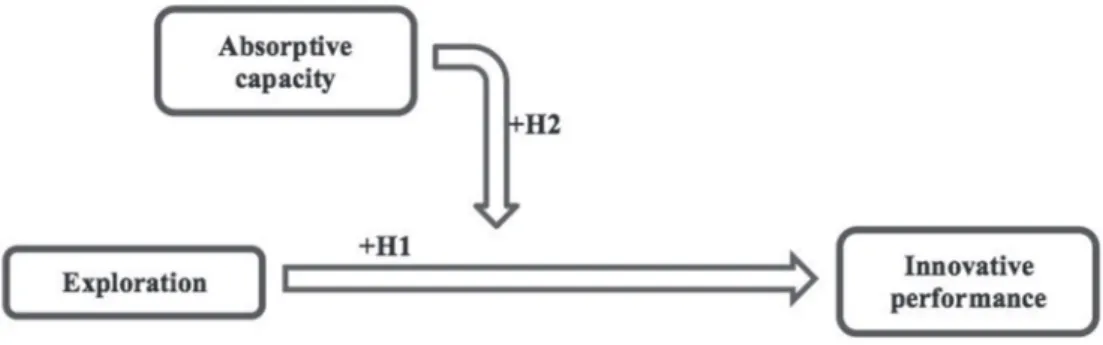
patent application and the granting of this patent. Figure 1 graphically shows the research variables, their relationships and hypotheses.
Figure 1. Graphic representation of the research model
Control variables – Cohen and Levinthal
(1990) included the idea of intensity in terms of time and eforts by irms to develop their own knowledge to enable them to assimilate and use innovation. his ability was also associated with their absorptive capacity, which will be more efective the more consistent their R&D investments are. herefore, this study considers the intensity of R&D investments as one of the control variables in the interaction environment between the firm’s exploration activities and its innovative performance. his variable was measured as the ratio between R&D spending and irm sales.
As in Laursen et al., (2010), this study employs two other important variables to control its statistical results. If prior knowledge is decisive to innovative capacity, especially its capacity to combine diverse knowledge, then the irm’s stock of patents and experience in this technological context (timeline during the study period, between the focal year of a particular patent and the year of the organization’s irst patent) can inluence the relationship between the irm’s exploration and innovative performance.
The exploration activity assumes open innovation practices that allow access
Table 1
Operational description of research variables
Variable Description
Dependent Variable
Innovative performance Number of patents attributed to the irm within a given year.
Independent Variable
Exploration Ratio between new annual citations and total citations of the irm, ranging between 0 and 1.
Moderating Variable
Absorptive Capacity Herindahl Index – degree of dispersion of technology ields of the patents produced by the irm, ranging between 0 and 1.
Control Variables
R&D Intensity Ratio between R&D spending and irm sales, ranging between 0 and 1. Patent Stock Firm’s cumulative total number of patents
Firm Experience Timeline between the focal year of a patent and the year of the irm’s irst patent Co-patent Number of patents developed by the irm in partnership with one or more irms. Firm Size Natural logarithm of annual irm sales.
3.3
Statistical model
Given the nature of the dependent variable, to estimate the coeicients applied here, this study used the Negative Binomial regression model. Previous studies addressing the same dependent variable (patents) have also used this model as a way to accommodate the speciicities referring to the use of patents as a dependent variable. Additionally, this study also used ixed efects to treat the non-observable characteristics between the sample irms. he ixed efects model was used because it allows dealing with possible correlations between non-observable invariant factors and independent variables (Wooldridge, 2009).
he negative binomial model relates to the application of the variable “patents” because it can accommodate count and integer values. Another reason is in regard to previous studies on counting the patents that incorporate the regression technique that includes many “zeros”, that is, many firms might respond they had not developed any patent over that period. he
alternative use of the Poisson model, although it can consistently specify coefficients, could underestimate the standard error, possibly leading to spurious signiicance levels, since its premises could be violated because the variance would be proportional to the average. his study used the negative binomial model, which is a generalization of the most indicated Poisson model under conditions of over-dispersion. hat is, it allows the variance of the dependent variable to exceed its average (Moreira, 2014). Another advantage of the negative binomial model when applied to longitudinal data is that it allows implementing the ixed efects model as well as the random or random efects model (Moreira, 2014). he reason for using ixed efects was made clear in the preceding paragraph.
3.4
Research design matrix
Table 2
Research Design
Objective To analyze (1) the relationship between the irm’s exploration strategy and its innovative performance and
(2) whether the irm’s absorptive capacity moderates this relationship.
Hypotheses
H1: the exploration activity has a positive impact on a irm’s innovation performance to a certain point.
From that point on, the risks and costs involved in this strategy will neutralize the beneits provided, characterizing a U-inverted curvilinear relationship between these two variables.
H2: AC moderates the existing U-inverted curvilinear relationship between the irm’s exploration activity and its innovative performance, so that high AC levels render the irm greater eiciency to identify, assimilate and exploit new knowledge, delaying the point when the risks and costs neutralize the beneits.
Variables
Firm’s innovative performance Exploration
Absorptive capacity R&D Intensity Patent Stock Firm Experience Co-patents Firm Size
Analysis techniques
Quantitative approach using multivariate data analysis technique. More speciically, it uses the Negative Binomial regression model. his model accommodates the count and integer values, and also its well when there are many “zeros” in the dependent variable. he unobserved heterogeneity between the sample irms is treated by the ixed efects estimation method.
4
Empirical results
Table 3 summarizes the descriptive statistics and correlations between all variables of the study. he average number of patents annually attributed per irm, considering the entire sample is of about 19 patents per year. However, there is a large variance in this item since 431 patents were granted to at least one irm in one year. When the sample irms have their patents granted annually, they declare on average that 60% of the citations for these patents are related to new knowledge, thus the strategy exploration represents a very signiicant proportion of the knowledge search activities.
Regarding the irm’s absorptive capacity the table shows an average dispersion degree of 0.51. This degree may vary between 0 and 1, i.e., zero may represent that the firm has no technological knowledge and no AC, and 1 if the irm has high AC and therefore dominates all possible technology ields within the biopharmaceutical industry, which are both very unlikely scenarios. However, considering all
irms in the sample, the index of 0.51 indicates a moderate average AC.
he correlation coeicient between the variables AC and irm size (0.21) is important, but only moderate. This condition does not state that irm size is crucial in developing AC. A similar condition is also found in the coeicient that relates AC to the number of patents (0.18). hus, while AC contributes positively, it does not have such a decisive role in the innovation performance of the irms in the sample. However irm size does in fact indicate that it inluences the capacity to create patents (0.57), although it is not a very strong relationship. With regard to the strategy exploration, although the coeicient is also moderate when compared to innovation performance, the average of 60% declared by the sample irms can be considered high.
a proportion that may not be monitored as it should. his is due to the fact that the irm’s average AC is only moderate. In other words, exploration strategies may be generating patents in technology ields that are not dominated by the
irms, which corroborates the theory of March (1991) which emphasizes a higher index of failure in terms of the exploration strategy related to the exploitation strategy.
Table 3
Descriptive statistics and correlation matrix
Mean S.D. Min. Max. 1 2 3 4 5 6 7 8
Number of Patents 18.65 48.91 0.00 431.00 1.00
Exploration 0.60 0.37 0.00 1.00 -0.16 1.00
Absorptive Capacity 0.51 0.32 0.00 1.00 0.18 -0.43 1.00
R&D Intensity 11.82 104.38 0.00 4.146.75 -0.04 0.01 0.01 1.00
Patent Stock 4.81 18.62 0.03 661.22 -0.06 -0.01 -0.03 0.01 1.00
Firm Experience 6.84 5.06 0.00 23.00 -0.07 0.13 -0.02 -0.02 -0.05 1.00
Co-patents 1.58 4.31 0.00 57.00 0.02 -0.05 0.10 -0.00 -0.01 0.17 1.00
Firm Size 3.26 3.01 -6.21 10.85 0.57 -0.14 0.21 -0.23 -0.16 0.04 0.04 1.00
Table 4 presents estimated regression models, from number 1 to number 4, in which the dependent variable is the irm’s innovative performance. he Chi-square test value (Wald chi2) is higher as it advances from the irst to the fourth model, indicating that the inclusion of the linear term and the quadratic term of the variable exploration increases the explanatory power of the models. Model 1 shows the relationships between the control variables and innovation performance. he irm size and intensity of R&D investments positively affect its innovation performance, while the irm’s patent stock and experience in developing patents were not signiicant.
As for the variable irm size, as it is deined in a logarithmic form it allows interpreting it as
Table 4
Binomial regressions explaining innovative performance
Dependent Variable: Number of Patents
Model 1 Model 2 Model 3 Model 4
R&D Intensity 0.002***(0.001)
Patent stock -0.003(0.002)
Firm Experience -0.020 (0.015)
Co-patents 0.002 (0.008)
Firm sales volume 0.051* (0.022)
Exploration 0.426*** (0.092) 0.348*** (0.100) 0.365*** (0.102)
Exploration squared -0.756* (0.331) -0.717* (0.333)
Absorptive Capacity (Herindahl index
_irm) 0.275** (0.100) 0.290** (0.101) 0.299* (0.123)
Exploration X Absorptive Capacity 0.245 (0.315)
Exploration squared X Absorptive
Capacity 0.214 (1.050)
Years (dummies) SIM SIM SIM SIM
Constant 0.392* (0.187) 0.211 (0.193) 0.483* (0.227) 0.495* (0.228)
N 1.725 1.725 1.725 1.725
II -2932.757 -2921.965 -2919.336 -2918.953
Wald chi2 333.386*** 364.901*** 369.367*** 370.099***
+ p<0.10, * p<0.05, **p<0.01, ***p<0.001
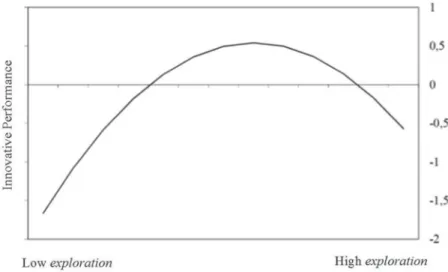
Hypothesis 1 states that the exploration activity has a positive effect on the firm’s innovative performance – but it also suggests that this efect is negatively afected after the point when
the risks and costs involved in this activity outweigh the beneits it provides, characterizing a curvilinear relationship. Plotting results shows this relationship in the graph of Figure 2.
he positive part of the curve was strongly supported by the positive and significant coeicients found in model 2 (0.426, p<0.001), in model 3 (0.348, p<0,001) and in model 4 (0.365, p<0.001). he negative part of the curve was also conirmed by the negative and signiicant coeicients representing the quadratic term of the exploration strategy, in model 3 (-0.756, p<0.10) and in model 4 (-0.717, p<0.10). he full curve shown in Figure 2 captures the relationship between the exploration strategy and number of patents developed by the irm. As the strategy intensiies, the number of patents will undergo a decreasing marginal efect. herefore, hypothesis 1 cannot be rejected.
Although AC was only analyzed based on its moderating efect on the second hypothesis, it should be noted that AC, as a linear term, is also seen as a variable that positively afects innovative performance. he coeicients representing this relationship are positive and signiicant, as shown in model 2 (0.275, p<0.01), in model 3 (0.290, p<0.01) and in model 4 (0.299, p<0.05). he directions and signiicance of the coeicients of variables in this study are stable in the models presented, indicating the robustness of the results.
Hypothesis 2 postulates that the organizational absorptive capacity exerts a moderating efect on the relationship between the irm’s exploration activity and innovative performance. he estimate in this speciic context suggests that the more consistent the irm’s capacity is to identify and assimilate the potential of new knowledge, the longer the positive segment of the curvilinear relationship will be, as mentioned in hypothesis 1. Hypothesis 2 was rejected as its result – in model 4 – did not exhibit statistical signiicance, in terms of the interaction between the independent variable (linear and quadratic) and the moderating variable. his inding will be analyzed in detail in the discussion of results.
5
Discussion and implications
This study investigates the role of strategy exploration in the firm’s innovative
per formance considering not only its implementation, but also its application level. In this context, it also investigates the consequence of this knowledge absorptive capacity. In this approach, some important empirical results associate the theory of open innovation and the irm’s knowledge based view, especially the absorptive capacity (AC) theory.
First, open innovation, recognized as a process that can access new knowledge within and beyond the organizational boundaries of the irm, provides advantages and disadvantages. he exploration strategy exempliies the open model and allows the irm to access new knowledge. Combinations and recombination of knowledge can emerge from this access, which can lead to increased innovation performance. However, high levels of exploration involve search and coordination costs – and these costs can undermine returns provided by this strategy, making it disadvantageous. his scenario relects the initial indings of this research and describes the irst hypothesis. When hypothesis 1 is not rejected, it indicates the complexity of the irm’s innovation activities and establishes considerable challenges in its management.
he exploration strategy in the context of open innovation assumes collaborative relationships with several organizations. herefore, the challenges faced by the organization involve the manager’s capability to know how to establish the optimal range of partnerships. he critical indicator here is that the exploration strategy should not be a tool to “ind and copy” research models of other organizations. here are two important work lines for the manager: a) to align the activities that explore new knowledge and those that exploit the irm’s current knowledge; b) to construct a portfolio of alliances aligned with the firm’s business model and its technology expansion plans.
irm’s current knowledge base. It is this stock of knowledge that allows new knowledge to be identiied, assimilated and combined. Although it was not proposed as a hypothesis, all regression models incorporated and conirmed the positive effect of AC on innovative performance. In practical terms, the firm’s AC is usually an attribution of the organization’s R&D. This perception is completely aligned with the seminal theory of AC (Cohen & Levinthal, 1990). As a result, the irm’s R&D ield is not only able to develop the organization’s knowledge base, but can also identify technological opportunities that can arise within and outside the firm. This condition can only be achieved if that ield receives systematic investments from the organization’s senior management.
he discussions mentioned in the above two paragraphs, although they bring important contributions, have already been widely discussed in literature. Nevertheless, they are fundamental to introduce and expand the discussion that addresses the efectiveness of AC in the search process for new knowledge. Therefore, the focus is not on discussing the overall positive impact of AC on the irm’s innovation strategy. We discuss here the second hypothesis of this article, which predicted more speciically that the AC automatically enhances the innovative performance by optimizing the exploitation of new knowledge. In other words, AC assists the organization’s management to deine the diversity of partnerships.
Hypothesis 2 proposed that high AC levels could not deinitely prevent, but could delay the negative efects caused by the research and coordination costs required by high exploration levels. This delay would give the firm the conditions to be more efective to explore new knowledge, while neutralizing part of these costs. his neutralization could occur either by the capacity to quickly understand a greater volume of new knowledge, or by the capacity to choose and understand only the volume of strictly necessary new knowledge. However, in this article
this theoretical condition was not empirically conirmed. hen, with the rejection of hypothesis 2, we discuss here the organizational factors and dimensions of AC that may have inluenced this result, which were unexpected.
Although not expected, this result already appeared when the correlation matrix showed only a moderate coeicient between AC and the size of the irm. he correlation coeicient between irm size and performance in the regression model 1 – although positive – was also quite modest. he moderate size of this coeicient contradicts the theoretical notion that a irm’s AC is higher when the systematic investments in qualiied personnel, facilities and research equipment in the R&D ield are higher. herefore, it was expected that irm size was highly correlated to AC, since all 275 sample irms are publicly traded irms. his attribute usually indicates they are large and inancially powerful irms. Such irms can usually aford these R&D investments.
Another important fact and also complementary to the irst one can be identiied if the concepts of upstream capabilities and downstream capabilities in the irm’s chain are understood. Accordingly, two theoretical views are connected here: reviewing the AC concept itself – highlighting its two dimensions: potential and realized (Zahra & George, 2002) – and the concept of diferent skills and competences throughout the irm’s value chain (Bruyaka & Durand, 2012). The connection of the two theoretical views can identify the potential AC at the beginning of the chain and the realized AC at the end of the chain. he skills of the irst one include the acquisition and assimilation of knowledge. hese skills account for the irm’s capacity to absorb technological opportunities. hese opportunities are raised by the exploration strategy. he skills of the second one include the transformation and exploitation of knowledge, making it applicable for distribution and marketing.
As already mentioned, in this article, focus is on potential AC skills at the beginning of the value chain. However, the efects of realized AC on the potential AC cannot be removed from analysis. Although located in diferent points, they are absolutely complementary, or should be. In other words, especially in sectors such as the goal of this study, the low of new knowledge would be efective from the beginning to the end of the chain, aligning the activities in order to identify, select and develop the accessed knowledge. However, the relationship between the two dimensions of AC is not linear. In the various development stages of a biopharmaceutical product, there are those that include testing and retesting activities. hese routines often determine the product should return to the previous stages to go through revisions and adaptations. hus, it is reasonable that there are misalignments between the two AC dimensions. For example, potential AC can acquire and assimilate a technology at the beginning of the chain, which prompts a rupture process of the competencies and skills of transformation and exploration, established
by the realized AC at the end of the chain. he consequence of this type of scenario were well explained by Chesbrough & Crowther (2006) and exempliied by Chesbrough (2003; 2006) which cited the case of Dow Chemical in which 25% of its patents in 1993 did not reach the marketing stage.
hus, considering the 275 irms in the sample, we emphasize that, in the industry studied, large irms are characterized by having well-established and mature distribution and marketing structures (downstream capabilities). herefore, the perception developed here is that potential AC – emphasized in this article – must undergo internal pressures imposed by the irm’s business model. his is the second fact that helps understand the rejection of hypothesis 2. hese pressures eventually diminish the efect that the potential AC could have on the relationship between the irm’s exploration and its innovative performance. his type of phenomenon has been tested and is empirically supported in the study of Kapoor & Klueter (2015). According to these authors, the pressures are called “inertial pressures”, imposed, among other factors, by the fact that the individual who performs the research is not the same one who decides whether it will continue.
he set of arguments in the preceding paragraphs validates the importance of open innovation, especially in dynamic sectors such as the biopharmaceutical sector. he strategy of looking for new knowledge from formal and informal relationships with other organizations and individuals enables the irm to increase the number of patents, but this also generates costs. he two absorptive capacity dimensions acting in alignment can neutralize some of these costs. If the potential AC acquires and assimilates a new technology, the realized AC should carry out its transformation and exploitation. If this technology is disruptive, the gains will be proportionate to the risks and may even be monopolistic.
not perceived as such. A likely consequence of this situation is the number of patents that remain “on the shelf ” of the irm. If the potential AC is operated as a moderator of the exploration strategy, even if a new patent does not suit the irm’s business model, it will not remain on the shelf. Even prior to acquiring it, the irm will know the partner it can be licensed to. his is the open innovation concept.
6
Final considerations
Particularly in dynamic environments, irms have already recognized the importance of open innovation. hey recognize that the R&D ield does not necessarily have to be within the irm. hus, these irms will concentrate their eforts on the exploration strategy. To better understand how this process takes place, this study examined the efect of this strategy on innovation performance, when it reaches high investment levels. It also examined the moderating role of the irm’s absorptive capacity (AC) in this relationship.
In general terms, this article advances the understanding of the open innovation strategy and the absorptive capacity theory. Unlike previous studies, this study contributes to understanding that AC will not moderate the relationship between exploration and performance in all contexts. he positive moderating efect depends on some important aspects. herefore this study suggests that AC cannot be understood as a sole and autonomous capacity, located only in the R&D field. AC comprises two interdependent dimensions, as proposed by Zahra & George (2002). Between these two dimensions there are important trade-ofs at the cognitive and spatial level. At the cognitive level, the synchronicity of exploring the new knowledge and the irm’s current knowledge requires investment alignments and adjustments. At the spatial level, the synchronicity of diferent competencies and skills at diferent points of the irm’s value chain requires integration and coordination. In short, at the strategic level, the relationship between the
two AC dimensions should be complementary, not a substitute. Otherwise, one sabotages the other, weakening their functions in the irm’s innovative processes.
Addressing these issues is the responsibility of the organization’s senior management. Consequently, these findings also provide managerial implications. The average results reported by the sample irms show that 60% of the citations that involve the patents developed by the irm are citations from technology ields that are new to the irm. However, the degree of dispersion of technology ields of the patents produced by the irm is 50%. his suggests that management can increase its innovative performance if it achieves higher levels of the degree of dispersion of technology fields dominated by the firm, which means increasing its potential AC. But not without irst establishing clear strategic policies that deine the irm’s technology expansion plan and the role of potential AC to achieve these goals. And inally, although this measured dispersion level is related to the potential AC at the beginning of the irm’s value chain, it can and should be encouraged by the realized AC at the end of the irm’s value chain, because as stated earlier, both are absolutely interdependent.
References
Ahuja, G., & Lampert, C. M. (2001). Entrepreneurship in the Large Corporation: A Longitudinal Study of How Established Firms Create Breakthrough Inventions. Strategic Management Journal, 22, 521-543.
Aloini, D. & Martini, A. (2013) Exploring the exploratory search for innovation: a structural equation modeling test for practices and performance. Int. J. Technology Management,
61(1).
Bawa, R. (2007). Nanotechnology patent proliferation and the crisis at the U.S. Patent Office. Albany Law Journal of Science and Technology, 17, 699–735.
Benner, M. J., & Tushman M. L. (2001). Exploitation, Exploration, and Process Management: The Productivity Dilemma Revisited. Academy of Management Review, 2, 238-256.
Berchicci, L. (2013) Towards an open R&D system: Internal R&D investment, external knowledge acquisition and innovative performance. Research Policy, 42(1), 117– 127.
Bruyaka, O. & Duran, R. (2012). Sell-of or shut-down? Alliance portfolio diversity and two types of high tech irms’ exit. Strategic Organization, 10(1), 7–30.
Chang, Y.; Gong, Y. & M. W. Peng (2012). Expatriate Knowledge Transfer, Subsidiary Absorptive Capacity, and Subsidiary Performance.
Academy of Management Journal, 55(4), 927–948.
Chesbrough, H. (2003). Open Innovation: New Imperative for Creating and Proiting from Technology. Cambridge, Massachusetts: Harvard Business Press.
Chesbrough, H. (2006). Open Business Models: How to hrive in the New Innovation Landscape.
Cambridge, Massachusetts: Harvard Business Press.
Chesbrough, H., & Crowther, A. K. (2006). Beyond High Tech: early adopters of open innovation in other industries. R&D Management,
36(3), 229-236.
Cockburn, I. M., & Henderson, R. M. (1998). Absorptive Capacity, Coauthoring Behavior, and the Organization of Research in Drug Discovery.
Journal of Industrial Economics, 46(2), 157-182.
Cohen, W. M., & Levinthal, D. (1990). Absorptive Capacity: A New Perspective on Learning and Innovation. Administrative Science Quarterly,
35(1), 128-152.
Enkel, E. & Heil, S. (2014). Preparing for distant collaboration: Antecedents to potential absorptive capacity in cross-industry innovation.
Technovation, 34(4), 242–260.
Escribano, A.; Fosfuri, A. & Tribó. J. A. (2009). Managing external knowledge flows: The moderating role of absorptive capacity. Research Policy, 38(1), 96–105.
Funk, R. J. (2014) Making the Most of Where You Are: Geography, Networks, and Innovation in Organizations. Academy of Management Journal,
57(1), 193–222.
Grant, R. (1996). Prospering in dynamically-competitive environments: Organizational capability as knowledge integration. Organization Science, 7(4), 375-387.
Gilsing, V., Nooteboom, B., Vanhaverbeke, W., Duysters, G., & van den Oord, A. (2008). Network embeddedness and the exploration of novel technologies: technological distance, betweenness centrality and density. Research Policy, 37, 1717-1731.
Lessons, Insights and Methodological Tools.
National Bureau of Economic Research, 3, working
paper 8498.
Henderson, R., & Clark, K. (1990) Architectural innovation: The reconfiguration of existing product technologies and the failure of established irms. Administrative Science Quarterly, 35, 9-30.
Hoang, H., & Rothaermel, F. T. (2010). Leveraging Internal and External Experience: Exploration, Exploitation, and R&D Project Performance. Strategic Management Journal, 31, 734-758.
Huizingh, E. K. R. E. (2011). Open Innovation: State of the art and future perspectives.
Technovation, 31, 2-9.
Jansen, J. J. P., Tempelaar, M. P., Van Den Bosch, F. A. J., & Volberda, H. W. (2009). Structural Diferentiation and Ambidexterity: he Mediating Role of Integration Mechanisms.
Organization Science, 20(4), 797-811.
Jung, H. J. & Lee, J. J. (2014). he Quest for Originality: A New Typology of Knowledge Search and Breakthrough Inventions. Academy of Management Journal, 0756.R3, pp. 1-53.
Kapoor, R. & Klueter, T. (2015). Decoding the Adaptability–Rigidity Puzzle: Evidence from Pharmaceutical Incumbents’ Pursuit of Gene herapy and Monoclonal Antibodies. Academy of Management Journal, 58(4), 1180–1207.
Katila, R., & Ahuja G. (2002). Something Old, Something New: A Longitudinal Study of Search Behavior and New Product Introdution. Academy of Management Journal, 45, 1183-1194.
Khanna, R,; Guler, I. & Nerkar, A. (2016). Fail Often, Fail Big, and Fail Fast? Learning from Small Failures and R&D Performance in the Pharmaceutical Industry. Academy of Management Journal, 59(2), 436–459.
Kogut, B., & Zander, U. (1992). Knowledge of the Firm, Combinative Capabilities, and the Replication of Technology. Organization Science, 3(3), 383-397.
Lane, P. J., Koka, B. R., & Pathak, S. (2006). he reiication of absorptive capacity: a critical review and rejuvenation of the construct. Academy of Management Review, 31(4), 833-863.
Laursen, K. (2011). User-producer Interaction as a Driver of Innovation: Costs and Advantages in an Open Innovation Model. Science and Public Policy, 38(9), 713-723.
Laursen, K. (2012). Keep Searching and you’ll Find: What do We Know about Variety Creation through Firm’s Search Activities for Innovation?
Industrial and Corporate Change, 21(5), 1181-1220.
Laursen, K., Leone, M. I., & Torrisi, S. (2010). Technological Exploration through Licencing: New Insights from the Licensee’s Point of View.
Industrial and Corporate Change, 19(3), 871-897.
Laursen, K. Moreira, S. & Markus, A. (2015). Knowledge Diversity, Transfer and Coordination: the Efect of Intrairm Inventor Networks on the Speed of External Knowledge Recombination. Paper to be presented at DRUID15, Rome, June 15-17
Laursen, K., & Salter, A. (2006). Open for Innovation: The Role of Openness in Explaining Innovation Performance among U.K. Manufacturing Firms. Strategic Management Journal, 2, 131-150.
Laursen, K. & Salter, A. J. (2014). he paradox of openness: Appropriability, external search and collaboration. Research Policy, 43, 867–878.
Lavie, D., & L. Rosemkopf. (2006). Balancing exploration and exploitation in alliance formation.
Academy of Management Journal, 49(4), 797-818.
efects of partner diversity on irm’s innovative performance and productivity. Journal of Business Research, 67, 1839–1849.
Levinthal, D. A., & March, J. G. (1993). he Myopia of Learning. Strategic Management Journal, 14, 95-112.
Lewin, A. Y.; Massini, S. & Peeters, C.; (2011). Microfoundations of internal and external absorptive capacity routines. Organization Science.
22, 81–98.
Li, Q.; Maggitti, P. G.; Smith, K. G.; Tesluk, P. E. & Katila, R. (2013). Top Management Attention to Innovation: the Role of Search Selection and Intensity in New Product Introductions. Academy of Management Journal, 56(3), 893–916.
March, J. G. (1991). Exploration and Exploitation in Organizational Learning. Organization Science, 2, 71-87.
Meyer, J., & Subramaniam, M. (2014). Appropriating Innovation’s Technical Value: Examining the Inluence of Exploration. Journal of Business Research, 67(1), pp. 2860-2866.
Mom, T. J. M., Van Den Bosch, F. A. J., & Volberda, H. W. (2007). Investigating Managers’s Exploration and Exploitation Activities: The Influence of Top-Down, Bottom-Up, and Horizontal Knowledge Inflows. Journal of Management Studies, 44(6), 910-931.
Moreira, S. (2014). Four Essays on Technology Licensing and Firm Innovation. Copenhagen
Business School, Institute for Innovation of Organisations økonomi Department of Innovation and Organizational Economics.
Mowery, D. C., Oxley, J. E., & Silverman, B. S. (1996). Strategic Alliances and Interfirm Knowledge Transfer. Strategic Management Journal, 17, 77-91.
Nambisan, S. (2013). Industry Technical Committees, Technological Distance, and
Innovation Performance. Research Policy, 42,
928-940.
Neil, S., & York, J. L. (2012). he Entrepreneurial Perceptions of Strategy Makers: Constructing an Exploratory Path in the Pursuit of Radical Growth.
Journal of Business Research, 65, 1003-1009.
Nelson, R., & Winter, S. (1982). An Evolutionary heory of Economic Change. Cambridge: Harvard
University Press.
Nooteboom, B., Vanhaverbeke, W., Duysters, G., Gilsing, V., & Van Den Oord, A. (2007). Optimal Cognitive Distance and Absorptive Capacity.
Research Policy, 36, 1016-1034.
Owen-Smith, J. & Powell, W. W. (2003). he Expanding Role of University Patenting in the Life Sciences: Assessing the Importance of Experience and Connectivity. Research Policy,32(9), 1695-1711.
Pavitt, K. (2005). Innovation Processes. In: Fagerberg, J., Mowery, D., & Nelson, R. (Eds.).
he Oxford handbook of innovation (86-114). Oxford: Oxford University Press.
Phelps, C. C. (2010). A Longitudinal Study of the Inluence of Alliance Network Structure and Composition on Firm Exploratory Innovation.
Academy of Management Journal, 53(4), 890-913.
Powell, W. W., & Grodal, S. (2005). Networks of Innovators. In: Fagerberg, J., Mowery, D., & Nelson, R. (Eds.). he Oxford handbook of innovation
(56-85). Oxford: Oxford University Press.
Ren, S.; Eisingerich, A. B. & Tsai, H. (2015). Search scope and innovation performance of emerging-market firms. Journal of Business Research, 68, 102–108.
Rosenkopf, L., & Nerkar, A. (2001). Beyond Local Search: Boundary-Spanning, Exploration, and Impact in the Optical Disk Industry. Strategic Management Journal, 22(4), 287-306.
Rothaermel, F. T., & Alexandre, M. T. (2009). Ambidexterity in technology sourcing: the moderating role of absorptive capacity.
Organization Science, 20, 759-780.
Rothaermel, F. T., & Deeds, D. L. (2004). Exploration and Exploitation Alliances in Biotechnology: A System of New Product Development. Strategic Management Journal, 25, 201-221.
Rothaermel, F. T., & Hess, A. M. (2007). Building Dynamic Capabilities: Innovation Driven By Individual-, Firm-, and Network-Level Efects. Organization Science, 18(6), 898-921.
Rothaermel, F. T., & hursby, M. (2007). he nanotech versus the biotech revolution: sources of productivity in incumbent irm research. Research Policy, 36, 832-849.
Stuart, T. E., & Poldony, J. M. (1996). Local Search and the Evolution of Technological Capabilities. Strategic Management Journal, 17, 21-38.
Sytch, M. & Tatarynowicz, A. (2014). Exploring the Locus of Invention: the Dynamics of Network
Communities and Firms’ Invention Productivity,
Academy of Management Journal, 57(1), 249–279.
Tzabbar, D.; Aharonson, B. S. & Amburgey, T. L. (2013). When does tapping external sources of knowledge result in knowledge integration?
Research Policy, 42, 481– 494.
Volberda, H. W., Foss, N. J., & Lyles, M. A. (2010). Absorbing the Concept of Absorptive Capacity: How to Realize Its Potential in the Organization Field. Organization Science, 21, 931-951.
Wooldridge, J. M. (2009). Introduction to Econometrics: A Modern Approach (4th Ed.).
Mason, OH: South-Western Cengage Learning.
Xia, T., & Roper, S. (2008). From Capability to Connectivity – Absorptive Capacity and Exploratory Alliances in Biopharmaceutical irms: A US-Europe Comparison. Technovation, 28, 776-785.
Zahra, S. A., & G. George, (2002). Absorptive capacity: a review, reconceptualization and extension. Academy of Management Review, 27(2), 185-203.