Fisioter. Mov., Curitiba, v. 30, n. 4, p. 691-701, Oct./Dec. 2017 Licenciado sob uma Licença Creative Commons DOI: http://dx.doi.org/10.1590/1980-5918.030.004.AO04
Comparison of three physical therapy interventions with an
emphasis on the gait of individuals with Parkinson’s disease
Comparação de três intervenções isioterapêuticas com
ênfase na marcha de indivíduos com doença de Parkinson
Maria Eduarda Brandão Bueno, Ana Carolina dos Reis Andrello, Marcelle Brandão Terra, Hevely Beatriz Celestino dos Santos, Júlia Marson Marquioli, Suhaila Mahmoud Smaili Santos*
Universidade Estadual de Londrina (UEL), Londrina, PR, Brazil
Abstract
Introduction: Gait impairments are one of the earliest signs reported by patients with Parkinson’s disease (PD) and cause an increased number of falls and decreased quality of life among these patients. Objective: To compare the effectiveness of three physical therapy interventions using Rhythmic Cues (RC), Swiss Ball (SB) and Dual Task (DT), with an emphasis on gait treatment (step and stride length, duration and veloc-ity), in individuals with PD. Methods: Quasi-randomized clinical trial addressing a sample composed of 45 individuals assigned to three groups. The individuals were assessed before and after the intervention
protocol using the following: Modified Hoehn and Yahr Scale (HY), Unified Parkinson’s Disease Rating Scale
(UPDRS), Footprint analysis, Video Gait analysis, and Timed Up and Go Test (TUG). The groups were
ho-mogeneous concerning age, HY and UPDRS. Statistical analysis was performed using SPSS, version 20.0. Results: Statistically significant differences were found in all the variables analyzed in the RC and SB groups when compared in the pre- and post-intervention. With the exception of the TUG variable, the DT group
presented statistically significant differences in all the remaining variables. Conclusion: The three inter-ventions were effective for the outcomes under study, but the SB group presented the greatest magnitude of
* MEBB: Master student, e-mail: [email protected]
692
change (effect size), while the RC group presented the greatest improvement in the temporal gait variables (duration and velocity) and TUG.
Keywords: Parkinson Disease. Physical Therapy Modalities. Gait.
Resumo
Introdução: As alterações na marcha são um dos sinais relatados mais precocemente pelos pacientes com do-ença de Parkinson (DP), ocasionando aumento do número de quedas e redução da qualidade de vida desses indi-víduos. Objetivo: Comparar a efetividade de três intervenções fisioterapêuticas utilizando Pistas Rítmicas (RC),
Bola Suíça (SB) e Dupla Tarefa (DT) com ênfase no tratamento da marcha (tamanho do passo, da passada, tempo e velocidade) em indivíduos com DP. Métodos: Foi realizado estudo do tipo ensaio clínico quase rando -mizado, com casuística composta por 45 indivíduos, divididos nos três grupos. Os indivíduos foram avaliados antes e após o protocolo de intervenção pelos seguintes instrumentos: Escala de Hoehn & Yahr Modificada (HY), Escala Unificada de Avaliação da doença de Parkinson (UPDRS), Teste de impressão plantar (footprint), Análise de marcha por vídeo e Teste Timed Up and Go (TUG). Os grupos eram homogêneos em relação à idade, HY e UPDRS. Para análise estatística foi utilizado o programa SPSS 20. Resultados: Foram encontradas diferenças estatis-ticamente significantes em todas as variáveis analisadas no RC e SB quando comparados os valores pré e pós intervenção. No DT, as variáveis também apresentaram diferenças estatisticamente significantes, exceto o TUG.
Conclusão: As três intervenções foram efetivas para os desfechos estudados, porém o grupo que apresentou
maior magnitude de mudança (tamanho do efeito) foi o SB, enquanto o RC apresentou maior porcentagem de melhora nas variáveis temporais da marcha (tempo e velocidade), bem como no TUG.
Palavras-chave: Doença de Parkinson. Modalidades de Fisioterapia. Marcha.
Introduction
Parkinson’s disease (PD) is a progressive neuro-logical disorder, the main symptoms of which include resting tremor, bradykinesia, plastic hypertonia and postural instability. In the more advanced stages of the disease, in which axial motor symptoms are evidenced, changes in posture and gait may occur. These are signs that are more frequently reported by patients and are characterized by disordered short steps that contribute to postural instability, narrower walking base, shorter stride length, difficulty in initiating and finalizing gait, and in overcoming obstacles and changing direction, which may freeze gait, cause festination, falls, and de-crease the quality of life of these individuals (1- 3).
In addition to motor symptoms, patients may de-velop non-motor symptoms, such as depression, au-tonomic dysfunction, sleep disorders, cardiorespira-tory disorders, and mainly cognitive disorders (4, 5), that hinder one’s ability to deal with multiple simul-taneous tasks, revealing the insufficiency of compen -satory motor mechanisms (6).
693 These tasks were required of three different groups
based on the principles of the Bobath concept. The first treatment proposed was Rhythmic Cues, as auditory and visual rhythmic cues are effective in improving the gait of individuals with PD; these improve step preparation (12) due to the greater attention demanded during the task (13). Studies reveal that rhythmic cues help PD patients to replace typical automatic gait control with a more conscious and perhaps, more discreet movement, making walk-ing easier. In this case, increased cortical activity ob-served during directed movement would compensate for striatal dysfunction (14). The use of this technique is associated with altered patterns of neural activity, more specifically, with improved activity in the lateral premotor cortex (15).
The second strategy chosen was Swiss Ball be-cause it is a tool that enables analyzing, assessing, and treating neurological patients, as it requires vestibu-lar and proprioceptive feedback to obtain appropriate adaptive responses (16). Few studies, however, use this resource to analyze its effectiveness in affecting gait variables of individuals with PD.
The third strategy was treatment including dual tasks as they are a prerequisite in the functional performance of various activities of daily living (17). Patients with PD present both motor and cognitive deficits when performing a dual task (18), and when the dual task is performed simultaneously with walk-ing, they present worsened motor performance, with a slower gait in which the phase of dual support is longer with a lower cadence, when compared to healthy people. This practice, however, offers the possibility of improving performance (19).
Therefore, this study’s objective was to compare the effectiveness of three physical therapy interventions using Rhythmic Cues (RC), Swiss Ball (SB) and Dual Task (DT) with exercises based on the Bobath concept, focusing on treating the gait (step length, stride length, velocity, and duration) of individuals with PD.
Methods
A quasi-randomized clinical trial was conducted with samples composed of the consecutive entry of patients, developed in the physical therapy out-patient clinic at the State University of Londrina in association with the Centro de Atendimento Social
Ágape [Agape Social Care Center] at the Parish of Nossa Senhora das Graças in Londrina, PR, Brazil.
The sample was composed of 45 individuals re-ferred by the neurological outpatient service of the Hospital das Clinicas, State University of Londrina. Participants were selected based on a statistical ar-chive and medical records service according to the following criteria: individuals with PD determined by medical diagnosis based on the London Brain Bank’s criteria (20): older than 50 years of age; with the PD between stages 1.5 and 3 as determined by the modified Hoehn and Yahr Scale.
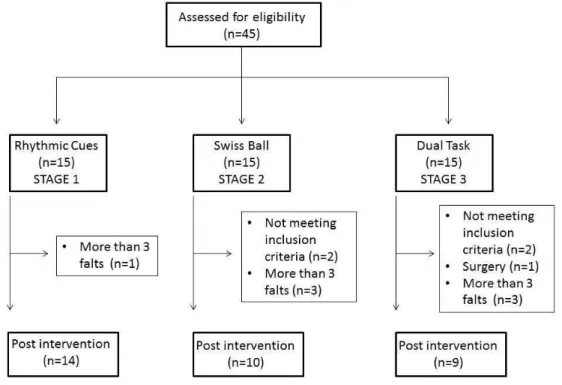
Individuals presenting other types of Parkinsonism or other associated neurological diseases, vestibular, cardiovascular, musculoskeletal, cognitive or com-prehension disorders, visual or auditory impairment that could affect motor performance, or individuals using walking orthosis or assistive devices, or under treatment other than drug therapy, were excluded. Individuals who missed therapy sessions more than three times or whose medication changed over the course of the study were considered losses.
Fifteen individuals were initially recruited for the Rhythmic Cues (RC) group. They were assessed and then received 24 physical therapy sessions (three months of intervention – Stage 1). The Swiss Ball (SB) group was composed of another 15 individuals, who were assessed and then received 24 sessions (three months of intervention – Stage 2) and finally, 15 in -dividuals were assessed and recruited for the Dual Task (DT) group, following the same procedures as with the others (Stage 3).
694
present mild to moderate impairment while stages 4 and 5 present severe impairment (21).2) Unified Scale of Parkinson’s Disease Rating Scale: assesses self-reported and clinically observed signs and symptoms of the disease. It is composed of 42 items divided into four domains: mental activity, behavior and mood; activities of daily living (ADLs); motor exploration and drug therapy complications. Scores in each item range from 0 to 4; the higher the score the greater the impairment caused by the disease. Only two domains were used in this study: II – ac-tivities of daily living (score from 0 to 52 points) and III – motor exam (score from 0 to 108 points), totaling 27 items (22). 3) Footprint analysis: assesses the linear variables of gait (walking base, step length and stride length). Each individual dips their feet in water-soluble paint and is encouraged to walk
a distance of 5 meters on a paper walkway (23). 4) Video gait analysis assesses temporal gait vari-ables (duration for the distance walked and gait ve-locity). The patient walks a 12-meter track and is in-structed to keep a normal and comfortable pace. The analysis considers the track’s 10 central meters so that the first and last meters are disregarded as they are considered acceleration and deceleration. The number of steps is counted and timed in seconds. Velocity is calculated by dividing space by time. 5) Timed Up and Go Test (TUG):assesses the patient’s agility in walking a short distance with changes of direction. It is a simple instrument that consists of analyzing the time spent by an individual to get up from a chair without arms, walk a 3-meter distance, turn and return to the chair. Longer times represent a greater risk of falls (24).
Figure 1 - Flowchart.
After each group was assessed according to the as-sessment protocol, the individuals received the thera-peutic intervention proposed for each group and, at the end of their respective treatments, patients were reassessed. The same physical therapist implemented the treatment for each of the three groups and was blind regarding assessments and reassessments. The intervention was implemented in-group and each participant was monitored by a trained physical
therapist. All the exercises were based on the Bobath concept, associated either with Rhythmic Cues, Swiss Ball or Dual Task, as follows:
Rhythmic Cues Training
695 sessions), which developed with increasing
complex-ity with two weekly sessions with a duration of 60 minutes each. Each session included three walking circuits using the following therapeutic devices: small ball, malleable stick, cones, hula-hoops, colored ob-stacles, horizontal ladders, step platform and chairs. The participants were supposed to perform the fol-lowing tasks: walk according to the rhythm dictated by the physical therapist; catch and toss a ball; walk according to horizontal marks on the floor; walk up and down the step platform; and walk bypassing or circumventing obstacles. The patients were always monitored by a physical therapist during the visual and auditory rhythmic cues interventions. This thera-pist used verbal commands to guide them on the cir-cuits as well as establish them the rhythm they were supposed to follow to perform the tasks.
Swiss ball Training
The training protocol consisted of 26 exercises; all included a Swiss ball as a therapeutic resource. There were two weekly sessions with a duration of 60 minutes, totaling 24 sessions. The exercises pro-gressed with increasing complexity. The exercises started in the supine position and mobility exercises of lower and upper limbs were performed, along with coordinated exercises of lower and upper limbs.
A more complex exercise included kneeling and semi-kneeling positions that emphasized move-ments that stretched the patient’s stability limita-tions, by oscillating the center of gravity, including trunk rotations, and position changes. Additionally, exercises that included sitting on the ball were im-plemented to improve strategies to maintain bal-ance associated with changes in the center of gravity, rotational movements, and changing the walking base. At the end of the protocol, gait exercises were performed with the Swiss ball such as holding the ball and hitting it on the floor alternating with the upper limb, then hit the ball, and the lower limb, then take the steps.
Dual Task Training
This protocol was divided into three phases, each composed of eight sessions (totaling 24 ses-sions), with two weekly sessions with a duration of
60 minutes. This intervention also gradually became more complex. The materials used included: chair, plastic soccer ball, cones, colored boxes, hula-hoops, malleable stick, horizontal ladder, and poly half cones, in addition to posters with pictures, words or arith-metic operations for the dual tasks.
Progressive exercises were performed in the sit-ting and standing positions, progressing from simple to dual tasks such as rotating the trunk to both sides and subtracting 10 from 100 (by 10s), changing sit-ting position to standing position in the Romberg position while simultaneously naming figures posi -tioned ahead, walking on a 12-meter circuit at maxi-mum velocity while simultaneously naming types of sports during the entire track, among others.
Statistical analysis
In the descriptive analysis, data were presented according to the distribution of normality according to the Shapiro-Wilk test (mean, standard deviation or median and interquartile interval). The paired t-test was used to compare between intra-groups pre- and post-assessments. As a complement to statistical significance, effect size measurements (Cohen’s d) were used to represent the magnitude of the results obtained in the procedures assessing the groups (25). To make inter-groups comparison, a variance analysis was performed using the Tukey posttest. Additionally, to verify the percentage of improvement, we divided the difference between the final-initial means (Δ) by the pre-intervention value. The statistical analysis was performed in the SPSS program, version 20, with significance value established at 5%.
Results
a) Intra-group results:
The participants’ characteristics at the beginning of the study are presented in Table 1. The groups were homogenous in regard to age and clinical staging of the disease.
696
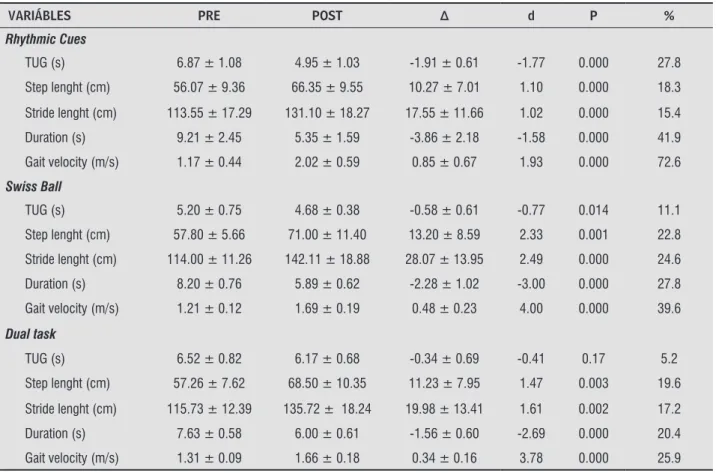
groups when comparing pre- and post-intervention values, except for the DT group in regard to the TUG variable (p = 0.17).
In regard to the effect of treatment, the effect size of all the groups was considered large (d > 0.80), ex-cept for the variable TUG in the SB and DT groups, though the group that presented the highest magni-tude of change, according to Cohen’s d test, was the SB
group when comparing pre- and post-intervention, with the exception of the variable TUG.
Note that for the temporal gait variables such as TUG, duration of distance walked, and gait velocity, the RC group experienced a more expressive im-provement while the SB group presented the highest percentage of change in regard to the variables that involve step and stride length.
Table 1 - Characteristics of participants
Rhythmic Cues (n = 14)
Swiss Ball (n = 10)
Double Task
(n = 9) P
Age (years) 69.92 ± 6.31 70.90 ± 7.65 72.77 ± 6.13 0.59
HY 2.17 ± 0.54 1.85 ± 0.33 2.38 ± 0.48 0.56
UPDRS (motor) 28.35 ± 10.03 25.30 ± 10.77 20.11 ± 10.04 0.61
UPDRS (ADL) 11.92 ± 6.25 9.70 ± 4.05 10.00 ± 5.09 0.17
UPDRS (total) 40.28 ± 15.06 35.00 ± 13.72 30.11 ± 13.47 0.24
Note: HY = Modified Hoehn & Yarh Scale; UPDRS = Unified Scale of Parkinson’s Disease Rating Scale; ADL = Activities of Daily Living.
Table 2 - Intra-group results
VARIÁBLES PRE POST Δ d P %
Rhythmic Cues
TUG (s) 6.87 ± 1.08 4.95 ± 1.03 -1.91 ± 0.61 -1.77 0.000 27.8
Step lenght (cm) 56.07 ± 9.36 66.35 ± 9.55 10.27 ± 7.01 1.10 0.000 18.3
Stride lenght (cm) 113.55 ± 17.29 131.10 ± 18.27 17.55 ± 11.66 1.02 0.000 15.4
Duration (s) 9.21 ± 2.45 5.35 ± 1.59 -3.86 ± 2.18 -1.58 0.000 41.9
Gait velocity (m/s) 1.17 ± 0.44 2.02 ± 0.59 0.85 ± 0.67 1.93 0.000 72.6
Swiss Ball
TUG (s) 5.20 ± 0.75 4.68 ± 0.38 -0.58 ± 0.61 -0.77 0.014 11.1
Step lenght (cm) 57.80 ± 5.66 71.00 ± 11.40 13.20 ± 8.59 2.33 0.001 22.8
Stride lenght (cm) 114.00 ± 11.26 142.11 ± 18.88 28.07 ± 13.95 2.49 0.000 24.6
Duration (s) 8.20 ± 0.76 5.89 ± 0.62 -2.28 ± 1.02 -3.00 0.000 27.8
Gait velocity (m/s) 1.21 ± 0.12 1.69 ± 0.19 0.48 ± 0.23 4.00 0.000 39.6
Dual task
TUG (s) 6.52 ± 0.82 6.17 ± 0.68 -0.34 ± 0.69 -0.41 0.17 5.2
Step lenght (cm) 57.26 ± 7.62 68.50 ± 10.35 11.23 ± 7.95 1.47 0.003 19.6
Stride lenght (cm) 115.73 ± 12.39 135.72 ± 18.24 19.98 ± 13.41 1.61 0.002 17.2
Duration (s) 7.63 ± 0.58 6.00 ± 0.61 -1.56 ± 0.60 -2.69 0.000 20.4
Gait velocity (m/s) 1.31 ± 0.09 1.66 ± 0.18 0.34 ± 0.16 3.78 0.000 25.9
697 b) Inter-groups results
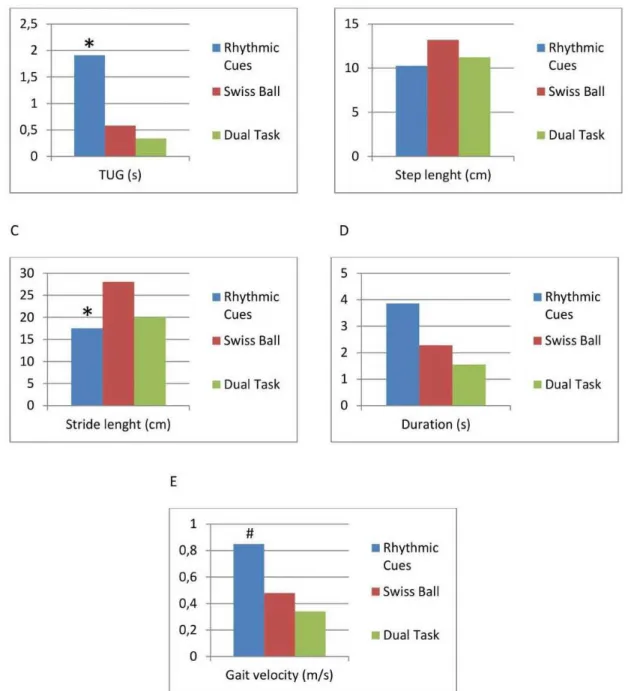
To make inter-groups comparisons, we verified the difference between the groups’ means and the sta-tistically significant difference for the variables TUG, duration of distance walked, and gait velocity. The RC group presented superior performance compared to
that of the SB and DT groups for the variables TUG and duration of distance walked. Differences in regard to the variable gait velocity were found only between the RC and DT groups. Hence, the group that stands out regarding the variables that relate to gait velocity was the RC group. These data are presented in Figure 2.
Figure 2 - Inter-group results.
698
Discussion
The inclusion of multidisciplinary rehabilitation in the drug and surgical treatment of PD has increased recently. Physical therapy for PD focuses on the pos-ture, transfers, the function of the upper limbs, bal-ance, gait, and physical capacity. The strategies used in the interventions aimed to keep or improve the indi-viduals’ independence, safety, and quality of life (26). There is well-established evidence in the literature showing that therapeutic exercise is able to delay the emergence of functional impairment in PD and a growing number of randomized clinical trials report that various types of exercises improve some aspects of balance and gait (27, 28).
There is, however, a difficulty in determining whether a specific type of exercise program is more efficacious than another because studies use differ -ent ways to measure results. Additionally, studies al-most always compare an intervention protocol with a placebo intervention or no intervention at all (29). Due to ethical considerations and the fact it is a pro-gressive neurodegenerative disease, we opted not to establish a control group since the assignment of patients to this group would harm their clinical progress, considering that the benefits of physical therapy for PD patients are well-established in the literature. Therefore, this study compared three physical therapy interventions to establish which would be the best approach to treat the gait of in-dividuals with PD.
This study presents statistically significant im -provement for almost all variables in all the groups, confirming that physical therapy is effective to man -age PD. When the effect size of interventions was analyzed (which takes into account the standard de-viation of the pre-intervention score), the SB group presented the highest magnitude of change. In the inter-groups comparison, the group that presented the highest percentage of improvement in compari-son to the remaining groups was the RC group.
In regard to the effects of the Swiss ball, there are few studies in the literature that specifically use this resource to treat the gait of individuals with PD. Randomized clinical trials addressing PD (30, 31), with experimental and control groups, which analyzed balance and gait variables and used the Swiss ball as a therapeutic tool during treatment, showed significant improvement in variables such as TUG, balance, and gait velocity. These results are
in agreement with this study’s findings as all the variables related to gait showed improvement.
In regard to the rhythmic cues, a group of re-searchers (32)conducted a study to verify whether the therapy with cues is effective in improving gait and lessening the severity of motor symptoms in individuals with PD. Auditory cues were performed using a metronome, which corrected the width and frequency of steps through the beats of the gaits dur-ing the performance of various tasks and everyday situations. Statistically significant improvement was observed in regard to step length and gait velocity, variables that also improved in this study among individuals guided by rhythmic cues, used as a thera-peutic resource.
In regard to the dual task treatment, Fok and collaborators (33) assessed the effects of dividing attention between walking and the performance of a secondary cognitive task in people with mild to moderate PD. The intervention group received a 30-minute training period divided between taking big steps and performing subtractions (by 3s) while the control group did not receive any treatment. Stride length, gait velocity and number of accurate enumeration were verified at the beginning, im -mediately after and 30 minutes after training that included simple tasks (walking only or subtracting only) and dual task (walking while subtracting). Similar to this study, statistically significant differ -ences were found in regard to stride length and gait velocity immediately after training.
699 suggest longer interventions promoting continuous
exercises to avoid inactivity (36).
One study conducted by Rochester and col-laborators (37)associated rhythmic cues with dual tasks to test the effects of training on motor learning among individuals with PD, establishing acquisition (simple task), automaticity (dual task), and retention of simple and dual tasks (follow-up). Training, including gait with cues, was implemented among 153 individuals with PD over the course of three weeks and changes in gait performance with three external rhythmic cues (auditory, visual and somatosensory) was measured during simple and dual tasks after training and during a six-week fol-low-up. Gait velocity, frequency, and stride length were recorded using an accelerometer. Similar to this study, gait velocity and stride length improved significantly in the three types of cues after train -ing dur-ing simple and dual tasks and such an effect remained after six weeks.
In summary, it is clear that the three groups expe-rienced significant improvement (significant effect size) in the variables under analysis after different protocols were implemented. The SB group pre-sented the greatest magnitude of change between pre- and post-intervention; however, comparison among groups revealed that the RC group’s perfor-mance was superior to that of the SB and DT groups in regard to the gait temporal variables.
A potential explanation for this fact is that sen-sory resources (rhythmic and auditory cues) were used along with resources that promote instability (ball), challenging and requiring more mechanisms to recover balance, fine postural adjustments and the use of better strategies to keep the body stable. Additionally, the activities also encouraged changes of position and weight transfers, which surely im-proved the patients’ perceptions regarding their stability limitations and gravity center adjustments. Possibly, together, these improved abilities positively impacted the individuals’ gait pattern, as these are prerequisites for a dynamic and functional gait.
This study’s limitations include lack of random-ization, and for this reason, allocation bias may have occurred. Follow-up studies are needed to verify and reinforce the effects of the protocols in the long term, as well as the benefits experienced by patients with PD, in order to produce greater levels of sci-entific evidence.
Conclusion
The three interventions were effective for the outcomes under study but the group that presented the greatest magnitude of change when the effect size is estimated for the outcomes that included gait (step length, stride length, duration and velocity) in this population was the SB group. The RC group, however, presented the greatest improvement in the gait temporal variables (TUG, duration and velocity) compared to the SB and DT groups.
References
1. Frazitta G, Bertotti G, Uccellini D, Boveri N, Rovescala
R, Pezzoli G, et al. Short- and long-term efficacy of
intensive rehabilitation treatment on balance and gait in parkinsonian patients: a preliminary study with a 1-year followup. Parkinsons Dis. 2013;2013:583278.
2. Nemanich ST, Duncan RP, Dibble LE, Cavanaugh JT, Ellis TD, Ford MP, et al. Predictors of gait velocitys and the relationship of gait velocitys to falls in men and women with Parkinson disease. Parkinsons Dis. 2013;2013:141720.
3. Klucken J, Barth J, Kugler P, Schlachetzki J, Henze
T, Marxreiter F,, et al. Unbiased and mobile gait analy-sis detects motor impairment in Parkinson’s disease. PLoS ONE. 2013;8(2):e56956.
4. Melo LM, Barbosa ER, Caramelli P. Declínio cognitivo e demência associados à doença de Parkinson: carac-terísticas clínicas e tratamento. Rev Psiquiatr Clín. 2007;34(4):176-83.
5. Trenkwalder, Kohnen R, Högl B, Metta V, Sixel-Döring
F, Frauscher B, et al. Parkinson’s disease sleep scale - validation of the revised version PDSS-2. Mov Disord. 2011;26(4):644-52.
6. Baggio JAO, Curtarelli MB, Rodrigues GR, Tumas V. Validation of the brazilian version of the clinical gait and balance scale and comparison with the berg bal-ance scale. Arq Neuropsiquiatr. 2013;71(9A):621-6.
700
8. Santos VV, Araújo MA, Nascimento OJM, Guimarães FS, Orsini M, Freitas MRG. Effects of a physical therapy home-based exercise program for Parkinson’s disease. Fisioter Mov. 2012;25(4):709-15.
9. Grabli D, Karachi C, Welter ML, Lau B, Hirsch EC, Vid -ailhet M, et al. Normal and pathological gait: what we learn from Parkinson’s disease. J Neurol Neurosurg Psychiatry. 2012;83(10):979-85.
10. Graham JV, Eustace C, Brock K, Swain E, Irwin-Car-ruthers S. The Bobath concept in contemporary clini-cal practice. Top Stroke Rehabil. 2009;16(1):57-68.
11. Pagnussat AS, Simon AS, Santos CG, Postal M,
Manace-ro S, Ramos RR. Atividade eletManace-romiográfica dos exten -sores de tronco durante manuseio pelo Método Neu-roevolutivo Bobath. Fisioter Mov. 2013;26(4):855-62.
12. Dias NP, Fraga DA, Cacho EWA, Oberg TD. Treino de marcha com pistas visuais no paciente com doença de Parkinson. Fisioter Mov. 2005;18(4):43-51.
13. El-Tamawy MS, Darwish MH, Khallaf ME. Effects of
augmented proprioceptive cues on the parameters of gait on individuals with Parkinson’s disease. Ann Indian Acad Neurol. 2012;15(4):267-72.
14. Vitorio R, Lirani-Silva E, Pieruccini-Faria F, Moraes R, Gobbi LTB, Almeida QJ. Visual cues and gait improve-ment in Parkinson’s disease: which piece of information is really important? Neuroscience. 2014;277:273-80.
15. Young WR, Rodger MW, Craig CM. Auditory obser -vation of stepping actions can cue both spatial and temporal components of gait in Parkinson’s disease patients. Neuropsychologia. 2014;57:140-53.
16. Carrière B. Bola suíça: teoria, exercícios básicos e aplicação clínica. São Paulo: Manole; 1999.
17. Floriano EN, Alves JF, Almeida IA, Souza RB, Christofole-tti G, Santos SMS. Dual task performance: a comparison between healthy elderly individuals and those with Parkinson’s disease. Fisioter Mov. 2015;28(2):251-8.
18. Yogev-Seligmann G, Giladi N, Brozgol M, Hausdorff
JM. A training program to improve gait while dual tasking in patients with Parkinson’s disease: a pilot study. Arch Phys Med Rehabil. 2012;93(1):176-81.
19. Marinho MS, Chaves PM, Tabaral TO. Dupla-tarefa na doença de Parkinson: uma revisão sistemática de ensaios clínicos aleatorizados. Rev Bras Geriatr Gerontol. 2014;17(1):191-9.
20. Hughes AJ, Daniel SE, Kilford L, Lees AJ. Accuracy
of clinical diagnosis of idiopathic Parkinson’s dis-ease. A clinico-pathological study of 100 cases. J Neu-rol Neurosurg Psychiatry. 1992;55(3):181-4.
21. Hoehn MM, Yahr MD. Parkinsonism: onset, progres -sion and mortality. Neurology. 1967;17(5):427-42.
22. Fahn S, Marsden CD, Calne D, Goldstein M, editors. Re-cent Developments in Parkinson’s Disease. Florham
Park, N.J.: Macmillan Healthcare Information; 1987.
p.153-63.
23. Romero VM. Análise das variáveis de distância da marcha de pacientes com acidente vascular encefálico. Consc Saúde. 2008;7(3):324-9.
24. Podsiadlo D, Richardson S. The timed up go: a test of basic functional mobility for elderly persons. J Am Geriatr Soc. 1991;39(2):142-8.
25. Cohen J. Statistical Power Analysis for the
Behav-ioral Sciences. Lawrence Earlbaum Associates: Hill -sdale; 1988.
26. Tomlinson CL, Patel S, Meek C, Herd CP, Clarke
CE, Stowe R, et al. Physiotherapy intervention in Parkinson’s disease: systematic review and meta-analysis. BMJ. 2012;345:e5004.
27. Ebersbach G, Ebersbach A, Edler D, Kaufhold O, Kusch
M, Kupsch A, et al. Comparing exercise in Parkinson’s disease - the Berlin LSVT BIG study. Mov Disord. 2010;25(12):1902-8.
28. Earhart GM, Williams AJ. Treadmill training for individuals with Parkinson disease. Phys Ther. 2012;92(7):893-7.
29. King LA, Salarian A, Mancini M, Priest KC, Nutt J, Ser-dar A, et al. Exploring Outcome Measures for Exercise Intervention in People with Parkinson’s Disease. Par-kinsons Dis. 2013;2013:572134.
30. Christofoletti G, Freitas RT, Cândido ER, Cardoso CS. Effectiveness of a physical therapy treatment on static and dynamic balance of subjects with Parkinson’s dis-ease. Fisioter Pesqui. 2010;17(3):259-63.
701
32. Rochester L, Rafferty D, Dotchin C, Msuya O, Minde V, Walker RW. The effect of cueing therapy on single and dual-task gait in a drug naive population of people with Parkinson’s disease in northern Tanzania. Mov Disord. 2010;25(7):906-11.
33. Fok P, Farrell M, McMeeken J. The effect of dividing attention between walking and auxiliary tasks in
people with Parkinson’s disease. Hum Mov Sci. 2012;
31(1):236-46.
34. Brauer SG, Morris ME. Can people with Parkinson’s disease improve dual tasking when walking? Gait Pos-ture. 2010; 31(2):229-33.
35. Hirsch MA, Iyer SS, Sanjak M. Exercise-induced neu -roplasticity in human Parkinson’s disease: What is the evidence telling us? Parkinsonism Relat Disord. 2016;22(Suppl 1):S78-81.
36. Hirsch MA, Farkey BG. Exercise and neuroplasticity
in persons living with Parkinson’s disease. Eur J Phys Rehabil Med. 2009;45(2):215-29.
37. Rochester L, Baker K, Hetherington V, Jones D, Wil -lems AM, Kwakkel G,, et al. Evidence for motor learning in Parkinson’s disease: Acquisition, au-tomaticity and retention of cued gait performance after training with external rhythmical cues. Brain Res. 2010;1319:103-11.
Received in 12/03/2015 Recebido em 03/12/2015