Posttraumatic pseudoaneurysm of medial plantar artery in a
child: treatment with percutaneous thrombin injection
Pseudoaneurisma pós-traumático de artéria plantar medial em criança:
tratamento percutâneo com injeção de trombina
Fabrício Neto Ladeira1, Antônio Henrique de Souza Quintella1, Leandro Toledo Carvalhido1, Liege Costa de Avelar Rezende1, Luciano Santa Bárbara de Abreu1, Paula Cardoso Diniz1, Francisco Lopes Pereira2
Abstract
Pseudoaneurysms of the medial plantar artery are rare. he authors describe a case of a pseudoaneurysm of the medial plantar artery of a child who had sufered a penetrating laceration injury. Diagnosis can be conirmed using Doppler ultrasound and magnetic resonance angiography. As an alternative to the conventional surgery technique, percutaneous Doppler ultrasound-guided thrombin injection is a safe and efective treatment.
Keywords: pseudoaneurysm; medial plantar artery; thrombin; Doppler ultrasound.
Resumo
O pseudoaneurisma da artéria plantar medial é raro. Os autores relatam um caso de pseudoaneurisma da artéria plantar medial após lesão perfurocortante em criança. O diagnóstico pode ser conirmado por ultrassom com Doppler e angiorressonância magnética. Em contraponto à técnica cirúrgica convencional, o tratamento pode ser feito de maneira efetiva e segura com a injeção percutânea de trombina assistida pelo ultrassom com Doppler.
Palavras-chave: pseudoaneurisma; artéria plantar medial; trombina; ultrassom Doppler.
1 Hospital Vila da Serra, Cirurgia Vascular, Nova Lima, MG, Brazil.
2 Hospital Municipal Odilon Behrens – HMOB, Cirurgia Vascular, Belo Horizonte, MG, Brazil.
Financial support: None.
Conlicts of interest: No conlicts of interest declared concerning the publication of this article. Received on: 08.11.13. Accepted on: 08.29.13.
Study carried out at Hospital Vila da Serra, Cirurgia Vascular, Nova Lima, MG, Brazil.
Physical examination revealed a pulsating mass, with a diameter of approximately 3 cm. The patient reported pain in response to palpation and the surrounding area was hyperemic, but there was no sign of active infection or bleeding. Femoral and distal pulses were present, there was no cyanosis, trophic lesions or decrease in capillary perfusion. Laboratory test results were within normal limits. Both sensitivity and motricity were preserved.
Magnetic resonance angiography of the right foot showed a pseudoaneurysm with a rounded shape,
regular outline and well-deined limits located in
the plantar region, between the abductor muscles
of the ifth toe and the short lexor of the toes. After
intravenous administration of contrast medium, the pseudoaneurysm was easily visible and measured at around 24 x 21 x 21 mm. Deeper, the structure extended to the plantar neurovascular bundle and, following the perforation injury to the plantar fascia,
there was edema of the short lexor muscles of the toes and of the abductor of the ifth toe, reaching the plantar fat pad and the cutaneous surface. All bones,
tendons and ligaments were spared (Figure 1).
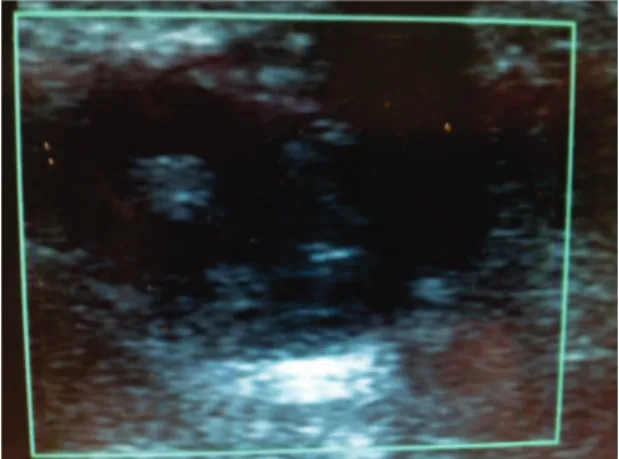
These indings were corroborated by a Doppler
ultrasound, which, in addition to the anatomic details, also showed the dynamics of the medial plantar artery pseudoaneurysm (Figure 2).
INTRODUCTION
Pseudoaneurysms are aneurysms whose walls are not comprised of the vessel’s own parietal structures, which is what differentiates them from true aneurysms. They are very often the result of a communication with an artery after direct trauma, in which the lumen remains in contact with the pulsating hematoma, causing it to rupture. During its evolution, the clot that forms in the periphery of the hematoma tends to organize and, in conjunction with the cicatricial reaction of adjacent tissues, will form the walls of the aneurysm sac which, in turn, does not therefore have the elements that are characteristic of the artery wall.1,2
After the posterior tibial artery leaves the inferior retinaculum of the lexor muscles, it divides to form
the medial plantar artery and the lateral plantar artery. The second of these is more developed and is accompanied by the plantar nerve. The medial plantar artery follows the medial plantar fascia and is accompanied by the medial plantar nerve.3
Vascular injuries leading to formation of a pseudoaneurysm in the plantar region of the foot are rare, despite the potential risk of localized trauma.4
Pseudoaneurysms of the lateral plantar artery have been reported after plantar fasciotomy,5,6osteotomy
of the calcaneus7, fracture of the calcaneus2 and after
laceration of the foot in children.8,9 There are more
publications dealing with pseudoaneurysms of the lateral plantar artery than of the medial plantar artery,
probably because of its more supericial location.10
Posttraumatic pseudoaneurysms of the medial plantar artery are rare and little has been published about them, but there are reports of onset after percutaneous implantation of pins to treat a Lisfranc fracture-luxation,11 and after lacerating trauma of
the foot.10 Time to diagnosis is variable and may be
anything from 3 days to 5 years after the trauma.12 In
this paper we report on the case of a medial plantar artery pseudoaneurysm secondary to a penetrating laceration trauma in a child.
CASE REPORT
The patient was an 8-year-old Caucasian male who suffered a trauma to the plantar surface of the right foot, caused by a sharp object (broken glass). The wound was sutured, bleeding was apparently controlled and there was no evidence of any residual foreign body.
Forty-ive days later, the patient suffered swelling
and pain in the right plantar foot that was exacerbated by bearing weight, walking and compression.
The plantar pseudoaneurysm was treated with a Doppler ultrasound guided percutaneous injection of 300 units of dilated thrombin under sedation and local anesthetic. The thrombin was injected carefully until
the low inside the pseudoaneurysm was observed
to cease. The thrombin dose administered was
suficient to totally and instantaneously occlude the
lesion while maintaining patency of the native artery (Figure 3). The patient was already able to walk with no limitations on the third day after treatment and was free from complications or relapse at 8 months’ follow-up (Figure 4).
DISCUSSION
S o m e p s e u d o a n e u r y s m s c a n r e s o l v e spontaneously,13 but early diagnosis and treatment are
nevertheless recommended to avoid potential harm; such as motor disorders or circulatory problems, ruptures and compression of bony structures, veins or adjacent nerves, leading to tarsal tunnel syndrome.10,14,15
Detailed clinical history taking and physical examination are of fundamental importance for early diagnosis and should take account of time and mechanism of trauma.8,10,16 Pain,
edema and hematoma are the initial symptoms of pseudoaneurysms. Persistence of pain after the trauma, a pulsating mass, systolic murmur, neurological signs and a fall in hemoglobin with no other obvious cause should suggest a diagnostic hypothesis of pseudoaneurysm.10,12
Imaging exams are indispensable to confirm and study these lesions. Diagnosis can be made by Doppler ultrasound, angiography and magnetic resonance angiography.4,12 Angiography is excellent
for studying arterial anatomy, but is invasive and demands iodine contrast. On the other hand, Doppler ultrasound is a noninvasive method that is a valuable tool for studying lesions in extremities, but it is operator-dependent. Finally, magnetic resonance angiography offers higher spatial resolution of the lesion and higher sensitivity and specificity than angiography for studying the arterial tree and detecting peripheral vascular disease.4,17,18
Surgical treatment of pseudoaneurysms may require ligature or arterial resection and repair with end-to-end anastomosis or vein grafts (generally from the great saphenous vein).10,15Damage to adjacent
structures and bleeding are possible complications of these techniques.
Non-surgical treatments, considered minimally invasive, can be accomplished using coils or percutaneous injection of thrombin or sclerosant Figure 2. Vascular echography scan, showing the
pseudo-aneurysm and its neck in the plantar region of the foot.
Figure 3. Image of pseudoaneurysm immediately after percutaneous thrombin injection, showing no blood low in the interior.
CONCLUSIONS
The Doppler ultrasound-assisted percutaneous thrombin injection technique used in this case of posttraumatic medial plantar artery pseudoaneurysm led to total resolution of the lesion and relief from
symptoms. After eight months’ follow-up, there have
been no signs of complications or relapse of the lesion and the patient remains entirely asymptomatic. We can therefore conclude, in consonance with published data, that this technique should be considered for treatment of similar cases.
REFERENCES
1. Brito CJ, Filho VLF, Silva RM. Aneurismas arteriais. In: Brito CJ, editor. Cirurgia Vascular, cirurgia endovascular, angiologia. 2. ed. Livraria e Editora Revinter Ltda; 2008. p. 501-7.
2. Agarwal M, Harkless L, Hagino RT, Toursarkissian B. Lateral plantar artery aneurysm: a case report. J Am Podiatr Med Assoc. 2007;97(6):480-2. PMid:18024844. [citado 2013 ago. 8]. http:// www.japmaonline.org/content/97/6/480.long.
3. Silva JLCN. Anatomia Médico-Cirurgica do Sistema Vascular. In: Brito CJ, editor. Cirurgia Vascular, cirurgia endovascular, angiologia. 2. ed. Livraria e Editora Revinter Ltda; 2008. p. 25-72.
4. Murakami AM, Chang A, Foo LF. Traumatic Lateral Plantar Artery Pseudoaneurysm and the Use of Time-Resolved MR Angiography. HSS J. 2010 Sept; 6(2):214-8. PMid:21886538 PMCid:PMC2926369. http://dx.doi.org/10.1007/s11420-010-9170-3
5. Nierenberg G, Hofman A, Engel A, Stein H. Pseudoaneurysm with an arteriovenous istula of the tibial vessels after plantar fasciotomy: a case report. Foot Ankle Int. 1997;18(8):524-5. PMid:9278750. http://dx.doi.org/10.1177/107110079701800814
6. Gentile AT, Zizzo CJ, Dahukey A, Berman SS. Traumatic pseudoaneurysm of the lateral plantar artery after endoscopic plantar fasciotomy. Foot Ankle Int. 1997 Dec;18(12):821-2. PMid:9429886. http://dx.doi.org/10.1177/107110079701801212
7. Ptaszek AJ, Aminian A, Schneider JR, Milos S. Lateral plantar artery pseudoaneurysm after calcaneal osteotomy: a case report. Foot Ankle Int. 2006;27(2):141-3. PMid:16487469. http://dx.doi. org/10.1177/107110070602700213
8. hornton BP, Minion DJ, Quick R, Vasconez HC, Endean ED. Pseudoaneurysm of the lateral plantar artery after foot laceration. J Vasc Surg. 2003;37(3):672-5. PMid:12618709. http://dx.doi. org/10.1067/mva.2003.31
9. 9 Economou P, Paton R, Galasko CS. Traumatic pseudoaneurysm of the lateral plantar artery in a child. J Pediatr Surg. 1993;28(4):626. http://dx.doi.org/10.1016/0022-3468(93)90674-A
10. Park SE, Kim JC, Ji JH, Kim YY, Lee HH, Jeong JJ. Post-traumatic pseudoaneurysm of the medial plantar artery combined with tarsal tunnel syndrome: two case reports. Arch Orthop Trauma Surg. 2013 Mar;133(3):357-60. PMid:23242453. http://dx.doi. org/10.1007/s00402-012-1672-7
11. Baeza L, Farrell ED, Salgado CJ. Medial plantar artery pseudoaneurysm following percutaneous pinning for Lisfranc fracture-dislocation. J Am Podiatr Med Assoc. 2009;99(1):58-60. Pmid:19141724. [citado 2013 ago. 8]. http://www.japmaonline. org/content/99/1/58.full.pdf+html.
12. Irarrazaval CA, Gross RS, Maritano AS, Diez CS. Posttraumatic Pedal Artery Pseudoaneurysm: A Case Report. Case Rep Vasc
substances (ethanol, for example), and have proven effective for resolving pseudoaneurysms.15,19,20
Endovascular treatments have also been used successfully,10 but the inherent risks of these
techniques must be considered: hemorrhage, pseudoaneurysm at the puncture site, ischemic complications and adverse reactions to the iodine contrast medium.
Ultrasound compression of the pseudoaneurysm neck alone can be technically challenging and uncomfortable for the patient, requiring compression times that vary from 10 to 300 minutes. In contrast, percutaneous ultrasound-guided thrombin injection requires simple compression of the aneurysm sac neck and offers rapid thrombosis.21
Thrombin is a powerful coagulation induction agent that acts by converting fibrinogen in to
ibrin, but dosages are not very well deined in the
literature.21 It is very much worth employing
real-time monitoring as the thrombin is injected into the
aneurysm sac, using color low ultrasound.22 The
injection should be stopped as soon as low into the
aneurysm sac has ceased; generally occurring in a
few seconds. If the injection is continued after low
has ceased within the aneurysm sac, there is a greater risk of thrombosis of the native artery caused by
retrograde low, exposing the artery to thrombin.21
A number of factors can impact on the method’s safety and eficacy. Firstly, it appears that if the needle is positioned supericially within the centre of
the aneurysm sac, at the pole most distant from the
communicating oriice, clots are more likely to form
and then migrate in the direction of the aneurysm neck.21,23 It is therefore preferable to inject into a
region in which low is predominantly inward, in
order to minimize the risk of arterial embolism.23
It appears that complications related to thrombin injections are infrequent, with few reported cases of local infection, thrombosis and/or arterial thromboembolism or allergic reactions to thrombin. The most threatening of the known complications described in literature are arterial thrombosis and/ or thromboembolism, which can be prevented by avoiding injecting the thrombin close to or at the pseudoaneurysm neck.21,23
postcatheterization femoral pseudoaneurysms. J Vasc Surg. 1998;6:1032-8. http://dx.doi.org/10.1016/S0741-5214(98)70006-0
23. Gioppato S, Munhoz A, Marins M, et al. Injeção de trombina guiada por ultrassom no tratamento de pseudoaneurisma da artéria femoral após procedimento percutâneo em pacientes com síndrome coronária aguda. Rev Bras Cardiol Invasiva. 2010;18(2):165-70. http://dx.doi.org/10.1590/ S2179-83972013000100006
Correspondence
Francisco Lopes Pereira Serviço de Cirurgia Vascular-HMOB Rua Formiga, 50, São Cristóvão CEP 31210-780 - Belo Horizonte (MG), Brazil Fone: +55 (31) 8848-5888 E-mail: [email protected]
Author’s information
FNL é cirurgião vascular do Hospital Vila da Serra (MG) e Hospital Odilon Behrens (BH); coordenador dos serviços de residência médica em cirurgia vascular do Hospital Odilon Behrens (BH) e de especialização em cirurgia vascular do Hospital Vila da Serra (MG); ecograista vascular do Laboratório Hermes Pardini (BH). AHSQ é coordenador dos serviços de cirurgia vascular dos Hospitais Vila da Serra (MG) e Universitário São José (BH). LCAR é cirurgiã vascular do Hospital Vila da Serra (MG). LTC é cirurgião vascular do Hospital universitário São José (BH) e ecograista vascular do Hospital Vila da Serra (MG). LSBA é médico especializando em cirurgia vascular do Hospital Vila da Serra (MG). PCD é médica especializando em cirurgia vascular do Hospital Vila da Serra (MG). FLP é médico residente em cirurgia vascular do Hospital Odilon Behrens (BH).
Author contributions
Conception and design: FNL Analysis and interpretation: FNL, FLP Data collection: FNL, AHSQ, LTC, LCAR, PCD Writing the article: FNL, LSBA, FLP Critical revision of the article: FLP Final approval of the article*: FNL, AHSQ, LTC, LCAR, LSBA, PCD, FLP Statistical analysis: N/A Overall responsibility: FNL Financial support: None.
*All authors have read and approved of the inal version of the article submitted to J Vasc Bras.
Med. 2012; 2012:234351. PMCid:PMC3420662. http://dx.doi. org/10.1155/2012/234351
13. Upponi SS, Solan M. Spontaneous resolution of a traumatic false aneurysm of the peroneal artery. Injury. 1998;29:787-8. http:// dx.doi.org/10.1016/S0020-1383(98)00156-9
14. Matsushita M, Nishikimil N, Sakurai T, Nimura Y. Pseudoaneurysm of the popliteal artery caused by exostosis of the femur: case report and review of the literature. J Vasc Surg. 2000;32:201-4. PMid:10876225. http://dx.doi.org/10.1067/mva.2000.105679
15. Spratt EM, Doran ML, Baird RJ. False aneurysms in the lower extremity. Surg Gynecol Obstet. 1967;124:562-6. PMid:6018518. [citado 2013 ago. 8]. http://www.nlm.nih.gov/medlineplus/ aneurysms.html.
16. Darwish A, Ehsan O, Marynissen H, Al-Khafaf H. Pseudoneurysm of the anterior tibial artery after ankle arthroscopy. Arthroscopy. 2004;20:63-64. PMid:6018518. [citado 2013 ago. 8]. http://www. arthroscopyjournal.org/article/S0749-8063(04)00554-7/fulltext.
17. Sueyoshi E, Sakamoto I, Matsuoka Y, et al. Aortoiliac and lower extremity arteries: comparison of three-dimensional dynamic contrast-enhanced subtraction MR angiography and conventional angiography. Radiology. 1999;210(3):683-8. PMid:10207467. http://dx.doi.org/10.1148/radiology.210.3.r99fe22683
18. Koelemay MJ, Lijmer JG, Stoker J, Legemate DA, Bossuyt PM. Magnetic resonance angiography for the evaluation of lower extremity arterial disease: a meta-analysis. JAMA. 2001;285(10):1338-45. PMid:11255390. http://dx.doi.org/10.1001/ jama.285.10.1338
19. Cho SE, Kim DH, Jeong ST, et al. Therapeutic embolization for pseudoaneurysm of the anterior tibial artery after tibial nailing. J Korean Orthop Assoc. 2010;45:238-242. http://dx.doi. org/10.4055/jkoa.2013.48.3.240
20. Walker TG, Geller SC, Brewster DC. Transcatheter occlusion of a profunda femoral artery pseudoaneurysm using thrombin. AJR. 1987;149:185-186. PMid:3495980. http://dx.doi.org/10.2214/ ajr.149.1.185
21. D ’A c h i l l e A , S eb b e n R A , D av i e s R P. Pe rc u t a n e o u s ultrasound-guided thrombin injection for coagulation of post-traumaticpseudoaneurysms. Australas Radiol. 2001 M a y ; 4 5 ( 2 ) : 2 1 8 - 2 1 . P M i d : 1 1 3 8 0 3 6 8 . h t t p : / / d x . d o i . org/10.1046/j.1440-1673.2001.00906.x