Evaluation of thromboprophylaxis in
medium-sized general hospital
Avaliação de tromboprofilaxia em hospital geral de médio porte
Cesar Roberto Busato1, Ricardo Zanetti Gomes2, Dieyson Martins de Melo Costa1, Tiago Francisco Meleiro Zubiolo1
Abstract
Context: Deep vein thrombosis (DVT) is a serious, common disease whose complications include pulmonary thromboembolism (PTE) and postthrombotic syndrome. he importance and beneits of correct and efective pharmacological prophylaxis for DVT are well documented. Objectives: he aims of this study were to evaluate adequacy of prophylaxis for DVT and PTE at the Santa Casa de Misericórdia de Ponta Grossa (SCMPG), Paraná, Brazil, and determine risk stratiication for patients hospitalized in this institution. Methods: A cohort study was conducted to assess DVT prophylaxis of patients hospitalized on May 15th, 2009. he study population consisted of a sample of 104 patients, subdivided into clinical and surgical groups and stratiied into diferent specialties. Correct use of DVT prophylaxis was evaluated according to recommendations published by he Brazilian Society for Angiology and Vascular Surgery and took into account prophylactic methods speciied explicitly in information found in each patient’s medical chart. Results: Of the 104 patients interviewed, 51 (49.04%) were clinical patients and 53 (50.96%) surgical. Based on risk stratiication, 17 (16.35%) were classiied as low risk, 37 (35.58%) as moderate risk, 46 (44.23%) as high risk and 4 (3.85%) as extremely high risk for DVT/PTE. A total of 68 patients (65.38%) received prophylaxis, but of these only 56 (53.85%) received the correct prophylaxis, and 36 (34.62%) did not receive any prophylaxis. Conclusion: he rates of prophylaxis use for DVT and PTE in this service are higher than rates published in the literature.
Keywords:venous thrombosis; venous thromboembolism; pulmonary embolism.
Resumo
Contexto: A trombose venosa profunda (TVP) é uma doença frequente e grave, tendo como complicações o tromboembolismo pulmonar (TEP) e a síndrome pós-trombótica. A importância e os benefícios de uma correta e efetiva proilaxia medicamentosa em relação à TVP estão bem documentados. Objetivos: Este trabalho tem por objetivos avaliar a adequação das proilaxias de TVP e TEP na Santa Casa de Misericórdia de Ponta Grossa (SCMPG), Paraná, e estratiicar o peril de risco. Métodos: Realizou-se um estudo de coorte, com a inalidade de avaliar a proilaxia da TVP nos pacientes internados no dia 15 de maio de 2009. Uma amostra de 104 pacientes foi dividida em grupos clínico e cirúrgico, e estratiicada em diferentes especialidades. A correta utilização da proilaxia para TVP foi avaliada segundo recomendações da Sociedade Brasileira de Angiologia e Cirurgia Vascular (SBACV), considerando-se métodos proiláticos preconsiderando-sentes nas informações explícitas encontradas na prescrição médica de cada paciente. Resultados: Dos 104 pacientes entrevistados, 51 (49,04%) eram pacientes clínicos e 53 (50,96%) eram cirúrgicos. De acordo com a estratiicação do risco, 17 (16,35%) foram classiicados como baixo risco, 37 (35,58%) como risco moderado, 46 (44,23%) como alto risco e 4 (3,85%) como altíssimo risco para TVP e TEP. Do total de pacientes, 68 (65,38%) receberam proilaxia, sendo que, deste número, apenas 56 (53,85%) receberam uma proilaxia correta e 36 (34,62%) não receberam nenhuma proilaxia. Conclusões: As proilaxias de TVP e TEP neste serviço apresentam uma aderência superior aos índices encontrados em trabalhos publicados na literatura.
Palavras-chave:trombose venosa; tromboembolia venosa; embolia pulmonar.
1 Universidade Estadual de Ponta Grossa – UEPG, Departamento de Medicina, Ponta Grossa, PR, Brazil. 2 Hospital Geral de Curitiba, Serviço de Cirurgia Vascular, Curitiba, PR, Brazil.
Financial support: None.
Conlicts of interest: No conlicts of interest declared concerning the publication of this article. Submitted on: 02.29.12. Accepted on: 06.06.13.
the Brazilian Medical Association (Associação Médica Brasileira), the Brazilian ministry of health and the Brazilian Society for Angiology and Vascular Surgery (SBACV - Sociedade Brasileira de Angiologia e Cirurgia Vascular), have proposed guidelines to combat PTE, putting emphasis on specific actions and addressing each of the risk factors.11,12
Spiropoulos et al., recently conducted a meta-analysis and concluded that VTE is still a significantly important cause of morbidity and mortality among hospitalized patients, even when prophylaxis protocols are used; this is probably due to underutilization and lack of awareness on the part of some health professionals.13
The objectives of our study were to investigate prophylaxis for DVT and PTE at the Santa Casa de Misericórdia de Ponta Grossa (SCMPG) and to
stratify risk proiles.
METHODS
A descriptive cohort study was conducted in order to assess prophylaxis for DVT of patients admitted to the SCMPG on the 15th of May, 2009.
The sample comprised all patients admitted on that day who were willing to answer the questionnaire, which was 104 patients from a total of 173 who had been admitted to one of the departments. Data collection was conducted by the medical resident, using the responses given to a questionnaire that had been approved in advance by the Research Ethics Committee of Universidade Estadual de Ponta Grossa and by analyzing electronic patient records. All participants were fully aware of and informed about the study and signed free and informed consent forms indicating their acceptance.
The sample was subdivided into a clinical and a
surgical subset and these were stratiied by specialty,
according to information contained in patient admission records.
Participants were interviewed on the single day chosen for data collection and were defined as surgical patients if they had undergone any type of operation during that hospital stay.
The 69 excluded patients were eliminated because the y did not meet the criterion of agreeing to complete the questionnaire or were patients who had undergone surgery but were discharged the same day.
The subsets were assessed and stratiied for risk
of DVT using SBACV recommendations and the guidelines developed at the 7th American College of Chest Physicians Conference on Antithrombotic and Thrombolytic Therapy7 (Table 1). It should
CONTEXT
The etiopathogenesis of deep vein thrombosis
(DVT) is related to a triad irst described in 1856 by Virchow: blood low stasis, endothelial injury and
hypercoagulability.1
Before Virchow, Brailie was probably the irst
person to associate blood flow stasis with the etiopathogenesis of DVT.2
Deep vein thrombosis is a common and serious condition that primarily occurs as a consequence of surgical or clinical procedures. The most common acute phase complication is pulmonary thromboembolism (PTE) and postthrombotic syndrome (PTS) is the most common chronic complication.
Global DVT incidence has been estimated at 50 cases per 100,000 inhabitants/year, and is slightly higher among women. It increases with age, from 20 to 30 cases per 100,000 people/year in the 30 to 49 age group, to 200 cases per 100,000 people/year among 70 to 79-year-olds.3
In Brazil, Maffei et al. reported an incidence of
60 cases of DVT conirmed by duplex mapping or
phlebography per 100,000 inhabitants/year.4,5
Pulmonary thromboembolism is also described as the most common cause of preventable hospital mortality, accounting for approximately 0.2% of all in-hospital deaths. Furthermore, chronic venous thromboembolism (VTE) causes countless cases of physical incapacity, incurring huge socioeconomic costs, as severe chronic venous insufficiency develops.6
The majority of VTE cases are associated with certain clinical and surgical situations that involve
well-deined risks, known as risk factors. Several
decades of clinical and epidemiological observations have made it possible to identify a series of these factors and the diseases that precede or accompany clinical DVT cases.7,8
Despite the fact that the risk factors for DVT and PTE were already known and empirical prophylactic methods for preventing them had been employed previously, it was only from the end of the 1970s onwards that concern became widespread and research began to concentrate on prophylactic methods.9
Important centers in America and Europe dedicated themselves to studying the clinical and surgical risk factors and to establishing international prophylaxis protocols that would guide and unify actions taken to avoid DVT and PTE cases.9,10
be pointed out that these guidelines only deal with
DVT in lower extremities and deine them either as
proximal, when the iliac, femoral and/or popliteal veins are involved, irrespective or thrombosis in leg veins, or distal, when only veins of the leg are involved.14
Correct use of DVT prophylaxis was evaluated according to recommendations published by the SBACV, the methods used and explicit information found on each patient’s medical chart.12
Similarly, the clinical subset was classiied by risk proiles, as low, medium or high risk of DVT and
PTE.12 Motor prophylaxis is recommended for the
low risk clinical and surgical subsets, while medium and high risk clinical and surgical patients should have both drug and motor prophylaxis (Table 2).
Motor physiotherapy is recommended for all patients with any level of risk of DVT, acting as an adjuvant treatment for patients on pharmacological
prophylaxis and also in cases with contraindications against using anticoagulants.3,6,7,13
Statistical analyses were conducted using InStat - 3.05, produced by GraphPad Software, Inc. This program was used to calculate the percentages of variables and data with p < 0.05 were considered validated. Fisher’s exact test was also used for univariate analysis.
RESULTS
One hundred and four patients from a total of 173 admissions were analyzed (60.1%). Sex distribution
was 43 (41.3%) males and 61 (58.7%) females. The age of the sample varied from 7 to 88 years, with a mean age of 50.8 years and a standard deviation of
32.6 years. Fifty-one (49.1%) cases were patients from clinical specialties and 53 (50.9%) were surgical specialty patients.
Table 1. Risk of thromboembolism in surgical patients and recommended strategies.
Level of risk Deep vein
thrombosis (%)
Pulmonary thromboembolism (%)
Proposed prevention strategies
Proximal* Distal** Clinical Death
Low risk
Minor surgery in patients under 40 with no other risk factors
2 0.4 0.2 <0.01 No pharmacological prophylaxis, early
mobility
Moderate Risk
- Minor surgery in patients with addi-tional risk factors
- Surgery in patients aged 40 to 60 with no additional risk factors
10-20 2-4 1-2 0.1-0.4
Low dose unfractionated heparin, Low molecular weight heparin at low dosage, elastic stockings, intermittent compres-sion devices
High risk
- Surgery in patients over 60, or aged 40 to 60 with risk factors
(prior deep vein thrombosis, cancer, hypercoagulability)
20-40 4-8 2-4 0.4-1.0
Unfractionated heparin 5,000 U every 8 hours, Low molecular weight heparin in high doses, elastic stockings, intermittent compression devices
Very high risk
- Surgery with multiple risk factors (age over 40, cancer, prior pulmonary throm-boembolism, severe thrombophilia, replacement of hip or knee joints)
40-80 10-20 4-10 0.2-5.0
Unfractionated heparin 5,000 U every 8 hours, Low molecular weight heparin in high doses, Fondaparinux, oral antico-agulants, elastic stockings, intermittent compression devices
* When the iliac and/or femoral and/or popliteal veins are involved, irrespective of thrombosis in leg veins. ** When only leg veins are involved. Adapted from Geerts et al.7
Table 2. Risk assessments and prophylaxis indicated for clinical patients at the Santa Casa de Misericórdia de Ponta Grossa (SCMPG), Paraná.
Risk Patient Prophylaxis
Low All patients Movement in bed; early walking, motor physiotherapy
Moderate Patients over 65, in bed because of clinical diseases, with
no other risk factors
5,000 U unfractionated heparin every 8 hours Low molecular weight heparin at lower dosage
High
Any disease linked with DVT / PTE, thrombophilias, acute myocardial infarction, stroke, spinal cord injuries, patients
in intensive care, neoplasms.
5,000 U unfractionated heparin every 8 hours Low molecular weight heparin at higher dosage Unfractionated heparin adjusted doses (aPTT=1.5 every
6 hours)
patients at moderate risk, 15 (28.3%) at high risk and
three (5.60%) surgical patients at very high risk of thromboembolic events were given pharmacological prophylaxis.
Patients were also subdivided by specialties and listed by use and correct administration of prophylaxis.
Table 5 lists the sample broken down by specialties, showing use of prophylaxis and the protocols employed.
DISCUSSION
At the end of the 1960s, Kakkar et al. demonstrated that diagnoses of DVT by clinical examination alone was unreliable and used methods such as labeled
ibrinogen and phlebography to show that 50% or more of conirmed DVT cases did not exhibit clinical
signs.16
This discovery emphasized the importance of prophylaxis for DVT and PTE, leading to the development of consensus statements and recommendations for different groups at risk from this nosological entity. Despite these efforts, and PTE remains the greatest cause of sudden death of patients with elevated risk in hospital settings.17
The risk of PTE is high both in surgical patients and in those who have been hospitalized for treatment of clinical diseases, particularly acute cases of conditions that can immobilize the patient or alter their coagulation mechanisms.18
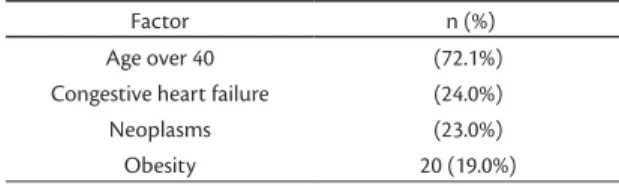
The principle risk factors observed in this study were: age over 40, congestive heart failure, neoplasms and obesity, all of which are in line
with indings published by Spiropoulos et al.13 and
Argawal et al.19
The importance and the beneits of correct and
effective pharmacological prophylaxis are well-documented and it is widely accepted that it reduces DVT and PTE incidence.18,20
In view of this, many societies, including the SBACV, have developed their own protocols for prevention of DVT/PTE.12,21-23 One of the most up
to date protocols that has been widely accepted by the scientific community was developed by Holbrook et al.24 and published in 2012 in the
When we analyzed the prophylaxis use data by surgical or clinical subset, we observed a statistically
signiicant difference between the two (p<0.05). The
percentage of patients in the clinical subset who were given thromboprophylaxis was 74.6%, out of a total of 51 patients, whereas 57.0% of a total of 53 surgical patients were prescribed prophylaxis.
Thirteen of the 51 patients in the clinical subset (25.4%) were not given thromboprophylaxis, while 23 of the 53 patients in the surgical subset (43%) went without prophylaxis for DVT/PTE.
One of the most common risk factors detected,
age over 40 (72.1%), was related to the proile of the
patients enrolled on the study, bringing with it the expected comorbidities, including: congestive heart failure (New York Heart Association class III)15 and
neoplasms, present in more than 20% of the sample (Table 3).
The results of the risk stratification were as
follows. Seventeen (16.3%) were classiied as low
risk; 37 (35.5%) as moderate risk; 46 (44.2%) as
high risk, and four (3.85%) were classiied as being
at very high risk of DVT or PTE (Table 4).
From the entire sample, 68 (65.3%) patients were given prophylaxis, but only 56 (53.8%) were
administered it correctly and 36 (34.6%) were not given any type of prophylaxis. Prophylaxis was correctly administered to five low risk patients (29.4%), to 27 moderate risk patients (72.9%) and to 32 high risk patients (69.3%).
Three of the clinical patients (5.88%) were given
pharmacological prophylaxis in the low risk subset, 17 (33.33%) in the moderate and high risk subsets, and one clinical patient (1.96%) in the very high risk subset was given pharmacological prophylaxis. Two (3.77%) surgical patients at low risk were given
pharmacological prophylaxis, ten (18.76%) surgical
Table 3. Principal risk factors identiied.
Factor n (%)
Age over 40 (72.1%)
Congestive heart failure (24.0%)
Neoplasms (23.0%)
Obesity 20 (19.0%)
Table 4. Classiication by risk of Deep vein thrombosis.
Patients Low (n-%) Moderate (n-%) High (n-%) Very high (n-%)
Surgical 9-16.98% 17-32.08% 24-45.28% 3-5.66%
Clinical 8-15.69% 20-39.22% 22-43.14% 1-1.96%*
Total 17-16.35% 37-35.50% 46-44.23% 4-3.85%
patients were administered prophylaxis in accordance with the recommendations of the relevant protocols.25
The patient sample from the SCMPG was
predominantly classiied as moderate or high risk,
accounting for 35.5% and 44.3% of the sample, respectively. The high-risk patients in the surgical subset accounted for 52.17% of all patients at high risk of DVT/PTE.
A possible factor in the decision not to use prophylaxis, especially with the surgical patients, may be fear of major bleeding, even though it has been shown that the use of prophylactic agents does not increase the risk of bleeding during operations.6,20
Anticoagulants such as fondaparinux25 and low
molecular weight heparins, offer more practical posology and lower risk of bleeding, even for patients undergoing major orthopedic surgery.26-28
A study published in 2009 demonstrated failures both in recognizing patient risk and in classifying patient risk. Risk factors such as immobility and obesity were recognized easily, but the risk of DVT associated with cancer, especially prostate cancer, tended to be underestimated, which is why prophylaxis was not administered adequately.25 In
our study, patients with moderate and high risk of DVT/PTE were being treated by certain specialties, such as clinical and surgical oncology, gynecologic oncology and heart surgery.
scientiic journal Chest. This system provides ten
major groups of recommendations, depending on the clinical or surgical status of the patient.
This study has shown that at the SCMPG the situation is better than has been observed at the hospitals investigated by other studies of the subject reviewed in this article. There were a total of 104 patients with indications for pharmacological or physical prophylaxis and 69% of high risk and 72% of moderate risk patients were indeed given prophylaxis.Although these igures are in line with what can be found in the literature, it should still be pointed out that just 53% of all of the patients enrolled on the study were given pharmacological prophylaxis correctly, according to the SBACV criteria.
Countless studies published in the world literature containing thromboprophylaxis rates well below those observed at this institution. Some of the most important include Agarwal et al., with a rate of 34.7%%; and Spiropoulos et al. who published a
rate of 44% for North-America and 38% for Europe.
Additionally, Tapson et al. conducted an international multicenter study, reporting a thromboprophylaxis rate for the United States of 52%.
In a study conducted at the Hospital de Clínicas de Porto Alegre, RS, Brazil, Castro et al. analyzed
265 patients, the majority of whom were classiied
as high or very high risk, and just 30.7% of those
Table 5. Use of thromboprophylaxis by specialty.
Specialties Number of patients
analyzed
Patients not on prophylaxis
Patients on prophylaxis
Patients on correctly administered prophylaxis
Heart surgery 10 00 10 09 (90%)
Cardiology 06 01 05 05 (83.33%)
Gynecology 17 16 01 01 (5.88%)
Gynecologic oncology 11 06 05 04 (36.36%)
General surgery 05 00 05 05 (100%)
Head and neck surgery 01 01 00 01 (100%)
horacic surgery 06 00 06 05 (83.33%)
Neurosurgery 02 01 01 00 (0.0%)
Clinical neurology 03 01 02 01 (33.33%)
Urology 08 04 04 02 (25%)
Nephrology 06 03 03 02 (33.33%)
Vascular surgery 10 00 10 10 (100%)
Hematology 03 01 02 02 (66.67%)
Gastroenterology 01 00 01 01 (100%)
Pulmonology/respiratory medicine 03 01 02 00 (0.0%)
Internal medicine 07 00 07 05 (71.43%)
Surgical oncology 05 01 04 03 (60%)
8. Pereira CA, Brito SS, Martins AS, Almeida CM. Deep venous thrombosis prophylaxis: practical application and theoretical knowledge in a general hospital. J Vasc Bras. 2008;7:1.
9. Engelhorn ALV, Garcia ACF, Cassou MF, Birckholz L, Engelhorn CA. Deep venous thrombosis prophylaxis: epidemiological study in a medical school hospital. J Vasc Bras. 2002;1:2.
10. Nicolaides AN, Breddin HK, Fareed J, et al. Prevention of venous thromboembolism. International Consensus Statement. Guidelines compiled in accordance with the scientiic evidence. Int Angiol. 2001;20(1):1-37. http://dx.doi. org/10.1177/000331970105200101
11. Rocha AT, Paiva EF, Lichtenstein A, et al. Tromboembolismo Venoso: Profilaxia em Pacientes Clínicos. Projeto Diretrizes. 2005. v. 1.
12. Mafei FHA, Caiafa JS, Ramacciotti E, Castro AA. Normas de orientação clínica para a prevenção, o diagnóstico e o tratamento da trombose venosa profunda. J Vasc Br 2005;4(Supl.3):S205-20.
13. Spyropoulos AC. Emerging Strategies in the Prevention of Venous Thromboembolism in Hospitalized Medical Patients. Chest. 2005;128:958-69. http://dx.doi.org/10.1378/chest.128.2.958
14. Cogo A, Lensing AW, Prandoni P, Hirsh J. Distribution of thrombosis in patients with symptomatic deep vein thrombosis. Implications for simplifying the diagnostic process with compression ultrasound. Arch Intern Med. 1993;153:2777-80. http://dx.doi.org/10.1001/archinte.1993.00410240085010
15. he Criteria Committee of the New York Heart Association. Nomenclature and Criteria for Diagnosis of Diseases of the Heart and Great Vessels. 9th ed. Boston, Mass: Little, Brown & Co; 1994:253-6.
16. Kearon C. Duration of Venous hromboembolismProphylaxis After Surgery. Chest. 2003;124:386-392. http://dx.doi.org/10.1378/ chest.124.6_suppl.386S
17. Chiasson TC, Manns BJ, Stelfox HT. An Economic Evaluation of Venous Thromboembolism Prophylaxis Strategies in Critically Ill Trauma Patients at Risk of Bleeding. PLoS Med. 2009;6(6):e1000098. doi:10.1371/journal.pmed.1000098. http:// dx.doi.org/10.1371/journal.pmed.1000098
18. Tapson VF, Spyropoulos AC, Decousus H, et al. Venous Thromboembolism Prophylaxis in Acutely Ill Hospitalized Medical Patients. Chest. 2007;132:936-45. http://dx.doi. org/10.1378/chest.06-2993
19. Agarwal S, Lee AD, Raju RS, Stephen E. Venous thromboembolism: A problem in the Indian/Asian population? Indian J Urol. 2009;25:11-6. http://dx.doi.org/10.4103/0970-1591.45531
20. Campbell C, Rayner CFJ, Coker RK. Guidelines on prevention of venous thromboembolism during long haul lights. horax. 2003;58:91-94. http://dx.doi.org/10.1136/thorax.58.1.91-a
21. Meza-Reyes GE, Cymet-Ramirez J, Esquivel-Gómez R, et al. Joint position statement of the Mexican College of Orthopedics and Traumatology: prophylaxis for venous thromboembolic disease in high-risk orthopedic surgery. Acta Ortop Mex. 2011;25(4):216-22.
22. Samama CM, Gafsou B, Jeandel T, et al. French Society of Anaesthesia and Intensive Care. Guidelines on perioperative venous thromboembolism prophylaxis. Ann Fr Anesth Reanim. 2011:30(12);947-51. http://dx.doi.org/10.1016/j. annfar.2011.10.008
23. Mandalà M, Falanga A, Roila F; ESMO Guidelines Working Group. Management of venous thromboembolism (VTE) in cancer patients: ESMO Clinical Practice Guidelines. Ann Oncol. 2011;22(Suppl 6):vi85-92. http://dx.doi.org/10.1093/annonc/ mdr392
When patients were subdivided by specialty, gynecology had low compliance with correct prophylaxis, as has been reported in other studies in the global literature.7,9
Gynecology was the specialty that least employed DVT and PTE prophylaxis methods, followed by gynecologic oncology and urology, in convergence with data published by Canonico et al., who, in
addition to tracing similar proiles with relation to
gynecological and gynecologic oncology patients, also emphasized the possibilities for employing prophylaxis with patients who are on hormone replacement therapy.29
Kawasaky et al., published a study in which they stressed the need for ongoing learning programs on VTE prevention, providing evidence of the importance of implementing action protocols and of the even greater need to follow existing protocols and guidelines.30
CONCLUSIONS
The proile of patients treated at the SCMPG
can be considered to be of moderate to high risk of VTE. Clinical patients were more likely to be given prophylaxis than surgical patients. Our rates of thromboprophylaxis are higher than average in both Brazilian and international literature.1,6,8,9,21,25
Notwithstanding, we must concentrate our efforts on increasing the number of health professionals who utilize the protocols for prophylaxis against DVT/PTE.
REFERENCES
1. Garcia ACF, Souza BV, Volpato DE, et al. Reality check: use of deep venous thrombosis prophylaxis: from theory to practice. J Vasc Bras. 2005;4(1):35-41.
2. Hobson RB, Wilson SE, Veith FJ. Vascular Surgery: Principles and Practice, hird Edition. New York: Marcel Dekker, Inc; 2004. 1270 p.
3. Fowkes FJ, Price JF, Fowkes FG. Incidence of diagnosed deep vein thrombosis in the general population: systematic review. Eur J Vasc Endovasc Surg. 2003;25:1-5. http://dx.doi.org/10.1053/ ejvs.2002.1778
4. Mafei FHA. Trombose venosa profunda dos membros inferiores: incidência, patologia, isiopatologia e diagnóstico. In: Mafei FHA, Lastoria S, Yoshida WB, Rollo HA. Doenças vasculares periféricas. 4. ed. São Paulo: Guanabara Koogan; 2008.
5. Baruzzi ACA, Nussbacher A, Lagudis S, Souza JAM. Trombose Venosa Profunda. Arq Bras Cardiol. 1996;67:3.
6. Pitta GBB, Leite TL, Silva MDC, Melo CFL, Calheiros GA. Evaluation of the use of prophylaxis for deep venous thrombosis in a teaching hospital. J Vasc Bras. 2007;6:4.
Correspondence
César Roberto Busato Rua Saldanha da Gama, 425 CEP 84015-130 – Ponta Grossa (PR), Brazil Fone: +55 (42) 3224-3288 E-mail: [email protected]
Author’s information
CRB é Doutor em Princípios da Cirurgia, Universidade Federal do Paraná (UFPR); Docente do Curso de Medicina, Universidade Estadual de Ponta Grossa (UEPG) e Membro da SBACV. RZG é Doutor em Princípios da Cirurgia, Universidade Federal do Paraná (UFPR); Docente do Curso de Medicina, Universidade Estadual de Ponta Grossa (UEPG) e Membro da SBACV. DMMC é Pós-Graduado em Cirurgia Vascular, Santa Casa de Misericórdia de Ponta Grossa e Cirurgião Vascular Hospital Geral de Curitiba. TFMZ é graduando em Medicina, Universidade Estadual de Ponta Grossa (UEPG).
Author’s contributions
Conception and design: CRB, DMMC Analysis and interpretation: CRB, DMMC Data collection: DMMC Writing the article: DMMC, TFMZ Critical revision of the article: CRB, RZG Final approval of the article*: DMMC, CRB, RZG, TFMZ Statistical analysis: DMMC Overall responsibility: CRB Obtained funding: Responsabilidade dos pesquisadores.
*All authors have read and approved of the inal version of the article submitted to J Vasc Bras.
24. Holbrook A, Schulman S, Witt DM, et al. Evidence-based management of anticoagulant therapy: Antithrombotic herapy and Prevention of hrombosis, 9th ed: American College of Chest Physicians Evidence-Based Clinical Practice Guidelines. Chest. 2012:141(2 Suppl);e152S-84S.
25. Castro DB, Reck LL, Silvestre OM, et al. Assessment of adherence to thromboprophylaxis protocol in Hospital de Clínicas de Porto Alegre in patients. Rev HCPA & Fac Med Univ Fed Rio Gd Sul. 2006;26(1):12-6.
26. DiGiovanni CW. Heparin-Induced Thrombocytopenia. Foot & Ankle International. 2008;29:1. http://dx.doi.org/10.3113/ FAI.2008.1158
27. Blann AD, Khoo CW. he prevention and treatment of venous thromboembolism with LMWHs and new anticoagulants. Vasc Health Risk Manag. 2009;5:693-704. http://dx.doi.org/10.2147/ VHRM.S4621
28. Geerts WH. Prevention of Venous Thromboembolism in High-Risk Patients. Hematology. 2006;6:462-6. http://dx.doi. org/10.1182/asheducation-2006.1.462
29. Canonico M, Plu-Bureau G, Lowe GDO, Scarabin PY. Hormone replacement therapy and risk of venous thromboembolism in postmenopausal women: systematic review and meta-analysis. BMJ. 2008;336:1227. http://dx.doi.org/10.1136/bmj.39555.441944. BE