159
J Vasc Bras. 2013 Jun; 12(2):159-162
C A S E
R E P O R T
Giant renal artery pseudoaneurysm
18 months after blunt trauma
Pseudoaneurisma gigante de artéria renal após 18 meses de trauma contuso
Rodrigo Andrade Vaz de Melo1,2,3, Márcio José de Magalhães Pires1,3, Leandro Moreno Silveira Da Silva4, Angélica Baptista Segóvia3,5
Abstract
Renal artery pseudoaneurysms are uncommon vascular lesions that require a high degree of suspicion because they are usually diicult to diagnose. Posttraumatic renal artery pseudoaneurysms should be treated because spontaneous resolution is extremely unusual, and the risk of aneurysm rupture is high. We describe the case of a patient who presented with a pulsatile mass in the right upper quadrant and recurrent abdominal pain 18 months after blunt trauma. Arteriography and multislice computed tomography angiography revealed a pseudoaneurysm measuring 22 cm in the right renal artery. he patient was successfully treated with conventional open surgery.
Keywords: giant pseudoaneurysm; renal artery; blunt trauma.
Resumo
Pseudoaneurismas de artéria renal são lesões vasculares pouco comuns, que geralmente demandam alto grau de suspeição, por serem de difícil diagnóstico. Considerando a baixa expectativa de resolução espontânea dos PARs pós-traumáticos, aliada ao importante risco de rotura, faz-se necessária a correção destas lesões. Apresentamos o caso de um paciente, vítima de trauma contuso há 18 meses, com queixa de massa pulsátil em hipocôndrio direito associado a dor abdominal recorrente. Depois da arteriograia e angiotomograia multislice, foi diagnosticado um pseudoaneurisma de artéria renal direita com 22 cm de extensão, sendo então submetido a tratamento cirúrgico por via aberta convencional, com sucesso terapêutico.
Palavras-chave: pseudoaneurisma gigante; artéria renal; trauma contuso.
1 Hospital Adventista Silvestre, Rio de Janeiro, RJ, Brazil. 2 Hospital Servidores do Estado, Rio de Janeiro, RJ, Brazil. 3 Hospital Universitário Antônio Pedro, Niterói, RJ, Brazil. 4 Instituto Nacional de Câncer - INCA, Rio de Janeiro, RJ, Brazil. 5 Universidade Federal Fluminense – UFF, Niterói, RJ, Brazil.
Financial support: None.
Conlicts of interest: No conlicts of interest declared concerning the publication of this article. Submitted: 02.20.12. Accepted: 03.25.13
Giant renal artery pseudoaneurysm after blunt trauma
160 J Vasc Bras. 2013 Jun; 12(2):159-162
INTRODUCTION
Renal artery pseudoaneurysms (RAP) are rare vascular lesions that require a high index of suspicion
because they are dificult to detect clinically and
usually difficult to diagnose1,2.Studies in the
literature suggest several etiologies, such as partial nephrectomy, percutaneous procedures, renal biopsy, penetrating trauma and, more rarely, blunt trauma1,3.
The risk of hemorrhage due to rupture is high, and surgical treatment is indicated because there are few reports of cases of spontaneous resolution of posttraumatic RAP4,5.
This study describes the case of a patient with a 22-cm pseudoaneurysm diagnosed using arteriography and CT angiography 18 months after blunt trauma and treated using conventional open surgery.
CASE REPORT
A 70-year-old men had suffered blunt trauma due to a fall from a height of 4 meters about 18 months before presentation. At the time, he had a hip fracture and acute inferior vena cava thrombosis, treated
with external ixation and a vena cava ilter with a
satisfactory clinical outcome.
In March 2009 he sought the Adventista Silvestre Hospital (Rio de Janeiro, Brazil) because of a pulsatile mass in the right upper quadrant and recurrent abdominal pain.
Examinations showed that the patient was
hemodynamically stable; other indings were normal
skin color and cardiac tests, swollen abdomen and
collateral caval low distribution (Figure 1). There
was a large pulsatile mass in the right upper quadrant and no edema in lower extremities. He underwent
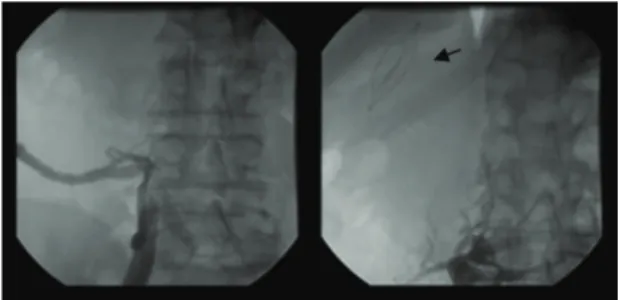
diagnostic tests using arteriography (Figure 2) and
selective angiography of visceral branches, which did not show any aneurysm formation, although the ostium of the right renal artery was not detected, and
phlebography (Figure 3). After that, multislice CT angiography (Figure 4) revealed a giant aneurysm (22
cm) in the right renal artery and a non-functioning right kidney.
The team responsible for the case chose the conventional treatment of renal artery pseudoaneurysm using midline laparotomy. Access
to the inframesocolic aorta was especially dificult due to excessive collateral blood low resulting for
the occlusion of the infrarenal vena cava at the time of trauma. Therefore, proximal repair of the renal artery (Scott maneuver) was not feasible. The medical team chose access and exposure of the supraceliac aorta at the hiatus for later clamping and dissection of the anterior surface of the right renal artery
Figure 1. Swollen abdomen and important collateral blood low.
Figure 2. (a) left renal artery; (b) superior mesenteric artery; (c) hepatic artery; (d) hepatic artery; right renal artery ostium was not detected.
Figure 3. No low in inferior vena cava, and vena cava ilter displaced due to space-occupying process (arrow).
Rodrigo Andrade Vaz de Melo, Márcio José de Magalhães Pires et al.
161
J Vasc Bras. 2013 Jun; 12(2):159-162
thrombus, followed by internal suture of the right
renal artery aortic at the ostium (Figures 5 and 6).
Clamping time was about 3 minutes, and there was no
signiicant hemodynamic repercussion. Postoperative
progression was extremely satisfactory. The patient was discharged three days after admission.
DISCUSSION
Pseudoaneurysms of the renal artery due to trauma are rare entities. In general, the incidence of this type of lesion as a consequence of penetrating trauma is higher than that resulting from blunt trauma6,7.
The mechanism of lesion is often the violation of the abdominal cavity during partial nephrectomy, percutaneous procedures, renal biopsy or penetrating trauma1,3.However, in blunt trauma, a sudden
deceleration force may cause partial or full rupture of the renal artery walls. Adjacent structures, such as
the Gerota’s fascia and even the renal parenchyma, may help to contain the hematoma.Pseudoaneurysm formation is a consequence of recanalization between the extra- and intravascular spaces as a consequence of the deterioration of clots and necrotic tissues in the site8. As normal hemodynamics is restored, RAP may
grow and even rupture, which stresses the importance of treating these lesions.
The most common clinical signs and symptoms
are gross hematuria, lank and lower back pain,
hypertension and pulsatile abdominal mass. RAP should be part of the differential diagnosis for any patient with a history of trauma, surgery or renal biopsy that presents with flank pain and hematuria1,7.Currently, several imaging tests may be
used for the diagnosis, such as Doppler ultrasound, CT angiography, renal scintigraphy and MRI. However, no test equals the diagnostic sensitivity of arteriography, with is currently the criterion standard to investigate these lesions8,9.
The chances of spontaneous resolution of posttraumatic RAP are low according to the literature, and there is a high risk of rupture. Therefore, these lesions should be repaired.
The treatment options to repair RAP are conventional open surgery and arterial embolization. However, no consensus about which procedure should be chosen was found in our review of the literature. Arterial embolization is often the procedure of choice for the treatment of small pseudoaneurysms in hemodynamically stable patients10,11.Some
authors reported on the success of treatments using embolization for larger pseudoaneurysms, as in the cases reported by Albani et al.2 and Pastorín et al.,1
in which case the lesion measured 10 cm. Others, as Ansari et al.,12 for example, chose open surgery
for a RAP of the same size. We identiied some
Figure 4. CT angiogram shows renal artery pseudoaneurysm. Arrow – renal artery ostium.
Figure 5. Right renal artery pseudoaneurysm and inferior vena
Giant renal artery pseudoaneurysm after blunt trauma
162 J Vasc Bras. 2013 Jun; 12(2):159-162
8. Lee DG, Lee SJ. Delayed hemorrhage from a pseudoaneurysm after blunt renal trauma. Int J Urol. 2005 Oct;12(10):909-11. http:// dx.doi.org/10.1111/j.1442-2042.2005.01179.x
9. Saad NEA, Saad WEA, Davies MG, Waldman DL, Fultz PJ, Rubens DJ. Pseudoaneurysmsand the role of minimally invasive techniques in their management. Radiographics. 2005;25:S173-S189. http:// dx.doi.org/10.1148/rg.25si055503
10. Patterson DE, Segura WJ, LeRoy AJ, Benson RC Jr, May G. The etiology and treatment of delayed bleeding following percutaneous lithotripsy. J Urol. 1985;133:447-451.
11. Wright JL, Porter JR. Renal artery pseudoaneurysm after laparoscopic partial nephrectomy. Urology. 2005 Nov;66(5):1109. http://dx.doi.org/10.1016/j.urology.2005.05.043
12. Ansari MS, Dodamani D, Seth A. Giant pseudoaneurysm of posterior division of renal artery: a rare complication of pyelolithotomy. Int Urol Nephrol. 2001;32(3):337-40. http:// dx.doi.org/10.1023/A:1017525620121
Correspondence
Leandro Moreno Silveira Da Silva Rua Viçoso Jardim, 89 – Cubango, CEP 24140-169 – Niterói (RJ) Brazil
E-mail: [email protected]
Author information
RAVM is a vascular surgeon at Hospital Adventista Silvestre, Hospital Servidores do Estado – RJ, and Hospital Universitário Antônio Pedro. MJMP is a vascular surgeon at and head of the Vascular Surgery Service of Hospital Adventista Silvestre. He is also a physician at Hospital Universitário Antônio Pedro. LMSS is a resident physician in Clinical Oncology at Instituto Nacional do Câncer -INCA. ABS is a resident physician in General Surgery at Hospital Universitário Antônio Pedro.
Author’s contributions
Conception and design: RAVM, MJMP Writing the article: LMSS, ABS Critical revision of the article: RAVM, MJMP, LMSS, ABS Final approval of the article*: RAVM, MJMP, LMSS, ABS Overall responsibility: RAVM
**All authors have read and approved the inal version submitted to J Vasc Bras.
resistance to the use of embolization of large RAP due to the complexity of the anatomic region and the risk of complications, such as aneurysm rupture and parenchymal ischemia. Our patient had a 22-cm pseudoaneurysm and a non-functioning kidney. Treatment was conventional open surgery because of the large size of the lesion, greater than all the others found in our review of the literature.
Although arterial embolization is a widely used technical resource to repair RAP, open surgery remains a safe and satisfactory option in case of giant pseudoaneurysms.
REFERENCES
1. Pastorín R, Rodríguez N, Polo AM, Vicente JM, Luján M. Posttraumatic giant renal pseudoaneurysm. Emerg Radiol. 2007 Jun;14(2):117-21. http://dx.doi.org/10.1007/s10140-007-0573-5
2. Albani JM, Novick AC. Renal artery pseudoaneurysm after partial nephrectomy: three case reports and a literature review. Urology. 2003 Aug;62(2):227-31. http://dx.doi.org/10.1016/ S0090-4295(03)00364-9
3. Shapiro EY, Hakimi AA, Hyams ES, Cynamon J, Stifelman M, Ghavamian R. Renal artery pseudoaneurysm following laparoscopic partial nephrectomy. Urology. 2009 Oct;74(4):819-23. 4. Madhusudhan KS, Sharma S, Seth A. Spontaneous closure of
a traumatic intrarenal pseudoaneurysm. J Postgrad Med. 2009 Apr-Jun;55(2):124-6. http://dx.doi.org/10.4103/0022-3859.52844
5. Lee RS, Porter JR. Traumatic renal artery pseudoaneurysm: Diagnosis and management techniques. J Trauma 2003;55:972-8.
6. Jebara VA, El Rassi I, Achouh PE, Chelala D, Tabet G, Karam B. Renal artery pseudoaneurysm after blunt abdominal trauma. J Vasc Surg. 1998;27:362-365. http://dx.doi.org/10.1016/ S0741-5214(98)70368-4