A case of renal recovery in atypical hemolytic uremic
syndrome treated with eculizumab
Um caso de recuperação da função renal na síndrome
hemolítico-urêmica tratada com eculizumab
Authors
João Samuel de Holanda Farias 1
João Pedro Pereira da Cunha 1
Caio Cesar Cervi Lagana 1 Maíra Carvalho Gallucci 2 Domingos Candiota Chula 1
Maria Fernanda Soares 1 Marcelo Mazza Nascimento 1
1 Universidade Federal do
Paraná.
2 Pontifícia Universidade
Católica do Paraná.
Submitted on: 08/18/2015. Approved on: 10/04/2015.
Correspondence to:
João Samuel de Holanda Farias. Hospital de Cínicas da Universidade Federal do Paraná.
Rua Julia Wanderley, nº 168, Curitiba, PR, Brazil. CEP: 80430-030. E-mail: [email protected]
DOI: 10.5935/0101-2800.20160020
A síndrome hemolítico-urêmica atípica (SHUa) é uma doença grave, pouco preva-lente, com acometimento em qualquer idade e apresentação esporádica ou familiar. A SHUa é causada por uma ativação descontrolada do sistema complemento. A plasmaférese foi o tratamento padronizado por anos, com resul-tados desfavoráveis, levando à doença renal crônica terminal ou morte em aproximada-mente 40% dos pacientes durante as primei-ras manifestações clínicas. O Eculizumab é um anticorpo monoclonal humanizado con-tra o componente C5 do complemento e nos últimos anos vem sendo utilizado como novo arsenal terapêutico com resultados promis-sores. O presente caso descreve uma paciente adulta tratada com eculizumab em que se obteve resultados satisfatórios evitando-se po-tenciais riscos e aumento da morbidade com o procedimento de plasmaférese.
R
ESUMOPalavras-chave: lesão renal aguda; micro-angiopatias trombóticas; síndrome hemo-lítico-urêmica.
Atypical Hemolytic Uremic Syndrome (aHUS) is a rare, life-threatening disease that can occur at any age and be sporadic or familial. aHUS is caused by an uncontrolled activation of the complement system. Plasma Exchange (PE) has been the standard treatment for years with poor results, leading approximately 40% of patients to end-stage renal disease (ESRD) or death during the first clinical manifestation. Eculizumab, an humanized monoclonal antibody directed against complement component C5, has emerged in the last few years as a new therapheutic aproach with promising results. Our goal is to present a case of an adult patient where eculizumab was sucessfully used as upfront therapy avoiding the potential significant morbidity of PE.
A
BSTRACTKeywords: acute kidney injury; hemolytic-uremic syndrome; thrombotic microangi-opathies.
I
NTRODUCTIONThe thrombotic microangiopathy (TMA) syndromes are extremely diverse in its presentation, could be acquired or hereditary and may affect children and adults.1 The pathological process of microangiopathic haemolytic anemia (MAHA), consumptive thrombocytopenia and microvascular thrombosis are the cardinal clinical features present in this condition, leading to organ injury. Patients mostly have acute kidney disease and brain dysfunction; cardiac, gastrointestinal and other organ injury may be present though.1,2 The histological features are vascular damage that comprise arteriolar
and capillary thrombosis, altered vessel walls and endothelium surfaces.1-3
TABLE 1 DIFFERENTIAL DIAGNOSIS OF MAHA AND
THROMBOCYTOPENIA
Systemic Infections: viral (HIV, cytomegalovirus), fungal (Aspergillus), bacterial
Systemic cancer, cancer chemotherapy, ionizing radiation
Pregnancy: HELLP syndrome, severe preeclampsia, eclampsia
Malignant Hypertension
Autoimmune disorders: systemic lupus erythematosus, antiphospholipid syndrome, systemic sclerosis, vasculitis
Hematopoietic stem-cell or organ transplantation
Note: table adapted from George et al.1, Barbour et al.2, Tsai et al.3
Atypical haemolytical uraemic syndrome is a complement-mediated TMA caused by and uncontrolled terminal complement activation of the alternative pathway.1-4 Mortality and end-stage renal disease (ESRD) approaches 33-40% of acute phase aHUS cases.4 Despite plasma exchange or plasma infusion, 65% of all patients have at least one of these complications in the first year after the diagnosis: requirement of dialysis, ESRD or death.3,5
Anticomplement therapy is an important tool currently available for management of aHUS.1-9 Eculizumab is the first recombinant humanized monoclonal anti-C5 antibody that prevents the activation of the terminal complement pathway, preserving the proximal pathway.1-9 It is an effective therapy and it emerges as a first-line treatment for aHUS.1-9 Here, we report a case of aHUS successfully treated with eculizumab as upfront therapy.
C
ASE REPORTFemale, 35 years-old, presented complaining with dyspnea, nausea and oliguria initiated 6 days before admission. She referred flu-like symptoms 15 days before. Her past medical history was unremarkable. At admission into the Emergency Department the patient’s vital signs was a blood pressure of 160/90 mmHg, pulse rate of 120 beats/min, respiratory rate of 26 breaths/min, oxygen saturation in room air of 94%, axillary temperature of 36,5 °C. On physical examination, she presented jaundice in sclera, pale mucous membranes and a mild edema in legs bilaterally. The cardiac and pulmonary auscultation were normal. The laboratory tests on admission are illustrated at Table 2.
Acute renal failure was managed with hemodialysis and clinical support was maintained. Laboratory tests collected to investigate viral hepatitis, human immunodeficiency virus, pregnancy, ANA (antinuclear antibody), direct Coombs, lupus anticoagulante, anticardiolipin antibodies, ANCA (anti neutrophil cytoplasmic antibodies), anti-glomerular basement membrane antibodies, leptospirosis IgG and PCR (polymerase chain reaction) and stool cultures were negative. The quantitative dosage of the complement fractions (C3- Beta 1C e C4-Beta 1E) was at normal range. An abdominal ultrasound evidenced normal morphology of the kidneys, diffuse increased echogenicity of renal parenchyma billaterally and loss of corticomedullary differentiation, signs suggestive of parenchymal nephropathy and the renal artery doppler ultrasound was normal. In view of the clinical and laboratory data, this case suggested the diagnosis of thrombotic microangiopathy. The sequencial investigation included serum ADAMTS13 activity - disintegrin and metalloproteinase with a thrombospondin type 1 motif, member 13 - and renal biopsy. The result of ADAMTS 13 activity was 55% (reference value > 70%) and the histological findings on renal biopsy was thrombotic microangiopathy), presence of crescents in two of the thirteen glomerulus and absence of chronic tubule-interstitial damage (Figure 1 and 2). The immunofluorescence staining panel revealed granular and diffuse segmental IgM deposits in glomerular capillary loops. IgA, IgG and C3 analysis was negative.
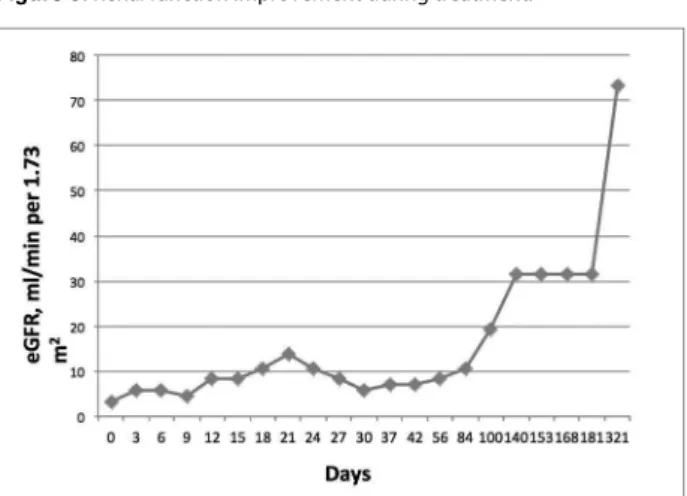
Supported by the diagnosis workup the patient received the diagnosis of aHUS and we choose to use eculizumab as upfront therapy. After meningococcal prophylaxis, we started the patient on eculizumab 1200 mg weekly for 4 weeks and after 900 mg every 15 days. During the first months of treatment there was complete hematological remission and continuous improvement of the renal function (Figure 3). The patient discontinued hemodialysis and the current estimated glomerular filtration rate is 73.2 mL/min per 1.73 m2. She maintains outpatient treatment with eculizumab 900 mg every 15 days.
D
ISCUSSIONThere is no objective diagnostic criteria for aHUS and this disease could share clinical manifestations
with other TMA syndromes.1,10 The promptly
TABLE 2 LABORATORY TESTS ON ADMISSION
Laboratory Test Result Reference Value
Hemoglobin (g/dL) 3.9 12 - 16,5
Leukocytes (cel/mm3) 11590 4.500 - 11.000
Platelets (mm3) 83000 150.000-450.000
Peripheral Blood Smear Schistocytes +/4+
-Reticulocytes (%) 11.39% 0.5-2.5%
Lactate Dehydrogenase (U/L) 875 125 -220
Creatinine (mg/dL) 13.7 0.57-1.11
Urea (mg/dL) 167 15-44
Prothrombin Time (RNI) 1.02 0.8-1,2
Activated Partial Thromboplastin Time (ratio) 0.77 0.8-1.2
Albumin (g/dL) 3.4 2.9-5.2
Total Bilirubin (mg/dL) 7.07 0.1-1.2
Indirect Bilirubin (mg/dL) 5.25 < 0.20
Total Calcium (mg/dL) 8.3 8.6-10.3
Inorganic Phosphorus (mg/dL) 4.4 2.3-4.7
Sodium (mEq/L) 132 136- 145
Potassium (mEq/L) 4.5 3.5-5.1
Aspartate Aminotransferase (U/L) 35 5-34
Alanine Aminotransferase (U/L) 31 2-55
Urinalysis Protein +, Hb+++, Bilirubin+
-Figure 1. Glomerulus showing mesangiolysis and peripheral loops
containing fragmented erythrocytes and luminal microthrombi. There is proliferation of parietal epithelium with incipient crescent formation.
Figure 2. Arteriole showing intense fragmentation of erythrocytes in
the lumen and wall and signs of mucinous degeneration of media.
specific management of aHUS and it modifies clinical outcomes for patients.4,10 Recent studies reported that some laboratory data can accurately predict patient’s pretreatment ADAMTS13 (a disintegrin
Figure 3. Renal function improvement during treatment.
2.25 mg/dL have been associated with severe deficient ADAMTS 13 activity.10
It remains useful to obtain pretreatment ADAMTS 13 activity, because it helps clinicians in the correct management of patients in the majority of cases. However, this exam should not be used alone to guide treatment.10 The current management of aHUS consists in plasma exchange (PE), eculizumab, liver and kidney transplant.11 Historically, PE has been the standard of care in patients with aHUS, but PE proved beneficial for short term hematologic remissions in aHUS, however end stage renal disease rates still high.7,12,13 It remains a treatment option which brings to the patient possible serious morbidities such as transfusion related adverse events and usually requires a central venous line that raises the rates of sepsis and thrombosis in patients submitted to the procedure.
Recently, the physiopathological basis of many kidney diseases is linked to complement cascade dysregulation and the complement system is now recognized as an important mediator of transplant injury. Blocking the complement cascade in kidney transplant recipientes could be an option to improve graft and patient survival rate. Some pathogenetic similarities with aHUS indicate anti-C5 therapy as treatment option for C3 glomerulopathies.14
Eculizumab is a humanized monoclonal antibody that blocks the proinflammatory and the cytolytic effects of terminal complement activation. It binds to complement C5, block the cleavage of C5 into C5b, hinders the generation of proinflammatory C5a and the potentially lytic C5b-9 (membrane attack) complex.1-4
The anticomplement therapy with eculizumab in aHUS proved to achieve hematological remission, promoted stabilization or improvement in renal
function with reported cases of discontinuation of dialysis, increased the TMA event-free status for patients and it reduced mortality.7,11,13 The most frequently reported adverse reactions with this treatment were headache, hypertension, cough, upper respiratory tract infections, urinary tract infections, nausea, vomiting, diarrhea, abdominal pain, anemia and leukopenia.8,11 Eculizumab therapy augment the risk of meningococal infections and the vaccination against Neisseria meningitidis should be done at least two weeks prior the treatment. Patients usually need promptly therapy and a 2-week course of antibiotics may be administered.8,11 The optimal duration of long-term treatment with eculizumab remais to be definied.7,8,10 The very high probability of aHUS in this case, even without results of genetic tests, guide us to initiate eculizumab as first-line therapy without previous plasmapheresis.15 The anticomplement therapy needs to be started as soon as possible to stop TMA progression and to avoid irreversible organ damage, improving patient’s prognosis.4,7,10,15
In conclusion, eculizumab clearly modified the clinical course of the disease, with improvement of hematological and renal dysfunctions, without severe adverse effects. The anticomplement therapy was a landmark in aHUS management and more studies have to be done with eculizumab as initial treatment for aHUS.
R
EFERENCES1. George JN, Nester CM. Syndromes of thrombotic microangio-pathy. N Engl J Med 2014;371:654-66. PMID: 25119611DOI: http://dx.doi.org/10.1056/NEJMra1312353
2. Barbour T, Johnson S, Cohney S, Hughes P. Thrombotic mi-croangiopathy and associated renal disorders. Nephrol Dial Transplant 2012;27:2673-85. DOI: http://dx.doi.org/10.1093/ ndt/gfs279
3. Tsai HM. A mechanistic approach to the diagnosis and ma-nagement of atypical hemolytic uremic syndrome. Transfus Med Rev 2014;28:187-97. DOI: http://dx.doi.org/10.1016/j. tmrv.2014.08.004
4. Thajudeen B, Sussman A, Bracamonte E. A case of atypical he-molytic uremic syndrome successfully treated with eculizumab. Case Rep Nephrol Urol 2013;3:139-46. DOI: http://dx.doi. org/10.1159/000357520
5. Nguyen MH, Mathew JJ, Denunzio TM, Carmichael MG. Diagnosis of atypical hemolytic uremic syndrome and res-ponse to eculizumab therapy. Hawaii J Med Public Health 2014;73:22-4. PMID: 25285252
6. Tschumi S, Gugger M, Bucher BS, Riedl M, Simonetti GD. Eculi-zumab in atypical hemolytic uremic syndrome: long-term clinical course and histological findings. Pediatr Nephrol 2011;26:2085-8. DOI: http://dx.doi.org/10.1007/s00467-011-1989-4
8. Nayer A, Asif A. Atypical Hemolytic-Uremic Syndrome: A Cli-nical Review. Am J Ther. 2014. [Epub ahead of print] 9. Vaisbich MH, Henriques LS, Watanabe A, Pereira LM,
Me-tran CC, Malheiros DA, et al. Uso do eculizumab na síndro-me hemolítica urêmica atípica - relato de caso e revisão da literatura. J Bras Nefrol 2013;35:237-41. DOI:http://dx.doi. org/10.5935/0101-2800.20130037
10. Cataland SR, Wu HM. Diagnosis and management of complement mediated thrombotic microangiopathies. Blood Rev 2014;28:67-74. DOI: http://dx.doi.org/10.1016/j. blre.2014.01.003
11. Kaplan BS, Ruebner RL, Spinale JM, Copelovitch L. Current treatment of atypical hemolytic uremic syndrome. Intractable Rare Dis Res 2014;3:34-45. DOI: http://dx.doi.org/10.5582/ irdr.2014.01001
12. Vaisbich MH. Hemolytic-Uremic Syndrome in childhood. J Bras Nefrol 2014;36:208-20. DOI:http://dx.doi.org/10.5935/0101-2800.20140032
13. Verhave JC, Wetzels JF, van de Kar NC. Novel aspects of aty-pical haemolytic uraemic syndrome and the role of eculizumab. Nephrol Dial Transplant 2014;29:iv131-41.
14. Salvadori M, Rosso G, Bertoni E. Complement involvement in kidney diseases: From physiopathology to therapeutical tar-geting. World J Nephrol 2015;4:169-84. DOI: http://dx.doi. org/10.5527/wjn.v4.i2.169