Low-Dimensional Non-Linear Dynamical
Systems and Generalized Entropy
Crisogono R.da Silva,Heb er R. da Cruz and Marcelo L.Lyra Departamento de Fsica,
Universidade Federal de Alagoas, 57072-970 Maceio-AL, Brazil
Received 07 December, 1998
Low-dimensional non-linear maps are prototype models to study the emergence of complex behavior in nature. They may exhibit power-law sensitivity to initial conditions at the edge of chaos which can be naturally formulated within the generalized Tsallis statistics prescription which is characterized by the entropic indexq. General scaling arguments provide a direct relation between the entropic
index q and the scaling exponents associated with the extremal sets of the multifractal critical
attractor. The above result comes in favor of recent conjectures that Tsallis statistics is the natural frame for studying systems with a fractal-like structure in the phase-space. Power-law sensitivity in high-dimensional dissipative and Hamiltonian systems are also discussed within the present picture.
I Introduction
Low-dimensional non-linear maps are the prototype models to study the emergence of complex behavior in dynamical systems. Their typical behavior include the occurrence of bifurcation instabilities, long-range cor-related sequences, fractal structures and chaos, which are commonly observed in a great variety of systems ranging from uids, magnetism, biology, social sciences and many others[1].
The study of the sensitivity to initial conditions of non-linear systems is one of the most important tools used to investigate the nature of the phase-space attrac-tor. It is usually characterized by the Liapunov expo-nent, dened for the simple case of a one-dimensional dynamical variablexas
x(t)x(0)e
t (
x(0)!0; t!1) (1) where x(0) is the distance between two initially nearby orbits (in an equivalent point of view, it is the uncertainty on the precise initial condition). If >0 the system is said to be strongly sensitive to the ini-tial condition with the uncertainty on the dynamical variable growing exponentially in time and this char-acterizes a chaotic motion in the phase-space. On the other hand, if < 0 the system becomes strongly in-sensitive to the initial condition which is expected for
any state whose dynamical attractor is an orbit with a nite period.
The problem of the sensitivity to initial conditions can be reformulated in an entropic language as a process of information loss (in the case of chaotic behavior) or recovery (for periodic attractors). Within this context, it is useful to introduce the Kolmogorov-Sinai entropy K. It is basically the rate of variation of the Boltzmann-Gibbs (BG) entropy S = ,
P W i=1
p iln
p i where
W is the total number of possible congurations and fp
i g the associated probabilities[2]. Considering the evolu-tion of an ensemble of identical copies of the system under investigation, p
i stands for the fractional num-ber of points of the ensemble that are in the icell of a suitable partition of the phase space in cells of size l. The Kolmogorov-Sinai entropy can be represented as
Klim !0
lim l!0
lim N!1
1 N
[S(N),S(0)] ; (2) where S(0) andS(N) are the entropies of the system evaluated at timest= 0 andt=N (for maps = 1). With the simplifying assumption that at timet there areW(t) occupied cells with the same occupation num-ber, we have from equation (2) that
W(t) =W(0)e Kt
; (3)
equality,K=[3].
However, the above picture does not suitably de-scribe the sensitivity to initial conditions at bifurca-tion points and at the threshold to chaos which are the marginal cases where = 0. At these points, the BG entropy does not vary at a constant rate and there-fore does not provide a useful tool to characterize the rhythm of information loss or recovery. The failure of the above prescription to characterize these points is re-lated to the fact that the extensive BG entropy can not properly deal with the underlying fractality (and there-fore non-extensivity) of the phase-space attractor. In this work we will review some recent works which have shown that the Tsallis generalized q-entropies can give a proper description of these marginal points. Further-more they have provided some enlightening relations between the q-entropic factor and the scaling proper-ties of the dynamical attractor[4, 5, 6, 7, 8]
This work is organized as follows. In section 2, we numerically illustrate the behavior of BG entropy and sensitivity to initial conditions in the standard logistic map. In section 3, we show how the power-law sen-sitivity at bifurcation and critical points can be natu-rally derived within the generalized Tsallis entropy for-malism characterized by the index q which is associ-ated with the degree of non-extensivity. In section 4, we review the scaling properties of critical dynamical attractors that can be characterized as a multifractal measure. In section 5, we show how scaling arguments can be used to predict a direct relationship between the entropic index q and the scaling exponents asso-ciated with the extremal sets of the critical attractor. We also illustrate the accuracy of the predicted scaling relation using two distinct families of one-dimensional dissipative maps. In section 6, we discuss the emer-gence of power-law sensitivity in high dimensional dis-sipative and Hamiltonian systems. Finally, in section 7, we summarize and draw some perspectives on future developments.
II BG entropy and Sensitivity
to initial conditions in the
lo-gistic map
From the Kolmogorov-Sinai entropic representation of the sensitivity to initial conditions problem, we learn that the exponential sensitivity to initial conditions is directly associated to the fact that the
Boltzmann-Gibbs-Shannon entropy exhibits a constant asymptotic variation rate per unit time. Lets illustrate the above mentioned point using the standard logistic map
x t+1= 1
,ax 2
t (4)
withx t
2[,1;1];a2[0;2];t= 0;1;2;:::. The dynam-ical attractor as a function of a is shown in Fig. 1a. For smalla it exhibits periodic orbits which bifurcate as a increases and the bifurcation points accumulate at a critical value a
c = 1
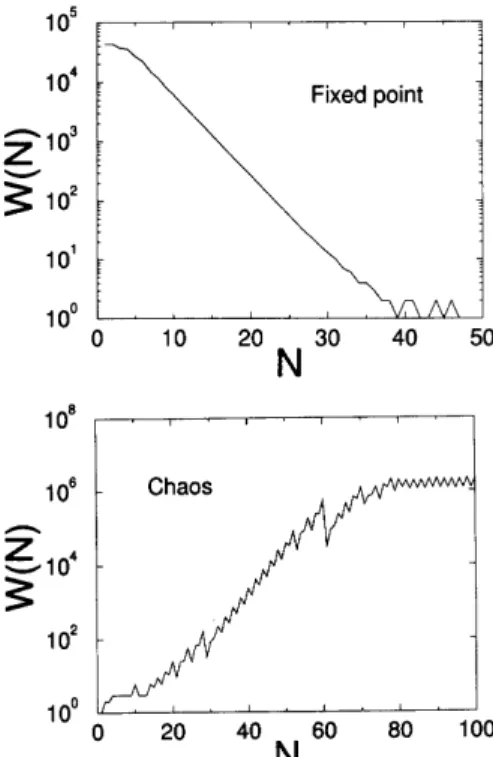
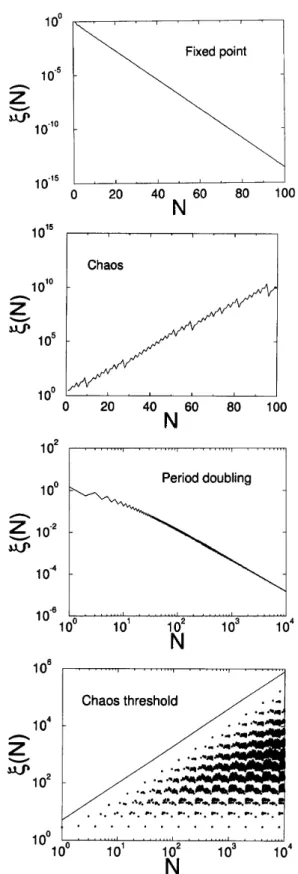
:40115518909:::above which chaotic orbits emerge. The Liapunov exponent as a function of the parametera is displayed in Fig. 1b. The predicted trend, i.e., < 0 ( > 0) for periodic (chaotic) orbits is clearly observed. Notice that= 0 describes indistinctly the bifurcation points and chaos threshold. To numerically estimate the BG entropy, we perform a ne partitioning of the phase space. Then we follow the temporal evolution of a large number of initial conditions regularly distributed around x = 0 which corresponds to the extremal point of this map. Assuming equiprobability, we can directly estimate the BG entropy as a function of the number of iterations of the map by recording the number of distinct parti-tions visited by these systems and using thatS= lnW. Therefore, an exponential time dependence of W will be equivalent to a constant rate of variation of BG en-tropy. In Fig. 2 we show some numerical estimates of W(N) for the logistic map at values ofafor which the dynamical attractor is a xed point and a chaotic orbit. Notice that the exponential time dependence is veried at the points were the Liapunov is expected to be -nite. However, for marginal cases were = 0, as for example in a period doubling bifurcation point and at the chaos threshold (see Fig. 3), we observe a power-law time evolution of the phase space volume visited by the ensemble. Therefore, the BG entropy form fails in providing a good information measure that exhibits a constant variation rate at these marginal points.
An equivalent but numerically more precise study can be made directly on the sensitivity to initial condi-tions. The sensitivity function is dened as
(t) lim x(0)!0
x(t)=x(0) dx(t) dx(0)
; (5)
Figure 1. a) The dynamical attractor of the logistic map as a function of the parameter a. The attractor exhibits
a series of bifurcations as a increases that accumulate at ac = 1:40115518909:::, above which chaotic orbits emerge;
b) The Liapunov exponent versusa. Notice that <0
for periodic orbits, > 0 for chaotic orbits and = 0 at
bifurcation and critical points. Strong uctuations offor a>acreects the presence of periodic windows at all scales.
Figure 2. The temporal evolution of the phase space vol-ume visited by an ensemble of logistic maps with initially nearby initial conditions for typical values of the nonlinear parameter a at which the Liapunov is nite. a)a = 0:5,
corresponding to a xed point attractor ( <0,
exponen-tially converging orbits). Data were obtained from 105
ini-tial conditions distributed in the interval [,0:2;0:2] using
a partition with 107 boxes. b)
a= 1:45, corresponding to
a chaotic attractor (>0, exponentially diverging orbits).
Data were obtained from 107initial conditions spread in the
interval [,10 ,4
;10
4] using a partition with 107 boxes. The
saturation for large times is due to the nite partition of the phase space.
Figure 3. The temporal evolution of the phase space vol-ume visited by an ensemble of logistic maps with initially nearby initial conditions for typical values of the nonlinear parameteraat which the Liapunov is zero. a)a= 0:75,
cor-responding to a period doubling bifurcation (power-law con-verging orbits). Data were obtained from 105 initial
condi-tions distributed in the interval [,0:2;0:2] using a partition
with 106 boxes. b)
a= 1:40115518909:::, corresponding to
the onset of chaos (power-law diverging orbits). Data were obtained from 105 initial conditions spread in the interval
[,10 ,3
;10
3] using a partition with 107 boxes. The pattern
observed reects the fractal-like structure of the critical at-tractor.
III Power-law sensitivity and
generalized entropies
Power-law sensitivity, as observed at bifurcation and critical points, has been shown to be naturally de-rived from the assumption that a proper non-extensive entropy exhibits a constant variation rate at these points[4, 5]. Namely, using Tsallis entropy form
S q = 1
, P
W i=1
p q i q,1
(6) a generalized Kolmogorov-Sinai entropy can be dened as
K q
lim !0
lim l!0
lim N!1
1 N
[S q(
t),S q(0)]
Figure 4. The sensitivity function at typical points of the logistic map. a) a= 0:5 which has a xed point attractor;
b)a= 1:45 which has a chaotic attractor; c)a= 0:75 which
is a period doubling bifurcation; d) a = 1:401155:::
corre-sponding to the chaos threshold. The trends are similar to the ones shown in Figures 2 and 3 forW(N).
Assuming equiprobability and a constantK
q, it can be readily obtained that the volume on the phase space shall evolve in time as
W(t) =W(0)[1 + (1,q)K q
t]
1=(1,q ) (8) consistent with the asymptotic power-law behavior at marginal points where = 0. Assuming a generalized Pesin equalityK
q =
q, we can also write the sensitiv-ity function within the present formalism as
(t) = [1 + (1,q) q
t] 1=(1,q )
: (9)
The above relation provides a direct relationship be-tween the entropic indexqand the sensitivity power-law exponent. Forq>1 the system becomes weakly insen-sitive to the initial conditions once the visited volume on the phase space slowly shrinks as the system evolves in time. This is the case for period doubling bifurcation points of the logistic map where 1=(1,q) =,3=2 and thereforeq= 5=3. On the other hand, forq<1 the sys-tem becomes weakly sensitive to the initial conditions asW(t) slowly grows with time. This is observed at the onset of chaos of the standard logistic map, where it was obtained 1=(1,q) = 1:325 and thereforeq= 0:2445[4]. The close relationship between the entropic index qof Tsallis entropies and the sensitivity to initial con-ditions at the onset of chaos of such non-linear low-dimensional dissipative maps provides a useful recipe to estimate the proper entropic index from the sys-tem dynamical rules. This relationship has been fur-ther used to investigate a recent conjecture that the non-extensive Tsallis statistics is the natural framework for studying systems with a fractal-like structure in the phase space[9]. The critical dynamical attractor of such non-linear dissipative systems can be associated with a multifractal measure whose scaling exponents can be obtained from traditional methods. Therefore, both the entropic indexqand the scaling properties of the criti-cal attractor can be estimated independently and their relation revealed.
IV Multifractal scaling of
criti-cal attractors
In order to completely describe the scaling behavior of critical dynamical attractors it is necessary to intro-duce a multifractal formalism[10]. The partition func-tion
Q( N) =
P N i=1
p Q
this formalism, wherepirepresents the probability (in-tegrated measure) on thei-th box among theN boxes of the measure (we use Qinstead of the standard no-tation q in order to avoid confusion with the entropic indexq).
In chaotic systemspiis the fraction of times the tra-jectory visits the boxi. In the N !1 limit, the con-tribution to Q(N)/N
,(Q), with a given
Q, comes from a subset of all possible boxes, whose number scales with N as NQ /Nf
(Q), where
f(Q) is the fractal di-mension of the subset (f(Q= 0) is the fractal dimen-siondf of the support of the measure). The content on each contributing box is roughly constant and scales as PQ / N
,(Q). These exponents are all related by a Legendre transformation
(Q) = Q(Q),f(Q) (10) (Q) =
d dQ
(Q): (11)
The multifractal object is then characterized by the continuous function f(), which reects the dierent dimensions of the subsets with singularity strength . f() is usually shaped like an asymmetric \. The values at the end points of the f() curve are the singularity strength associated with the regions in the set where the measure is most concentrated (min = (Q= +1)) and most rareed (max=(Q=,1)). Halsey et al have shown how the singularity spec-trum of measures possessing an exact dynamical rule can be obtained from a simple procedure[10] that con-siders a non-uniform grid of the phase space. First, one shall consider the original support with normal-ized measure and size. Then, one divides the region in N pieces, each one with measure pi and size li. The proper values of N are dictated by the natural scaling factor inherent to the recursive relations. After that, it is computed the partition function
,(Q;;l) = X
i
(pi)Q (li)
: (12)
From the recursive structure of the measure, it can be shown that the proper (Q) is dened by ,(Q;(Q);l) = 1, and the singularity spectrum follows from the Legendre relations.
The end points of the f() curves of the critical attractor of one-dimensional dissipative maps can be inferred theoretically from well known scaling proper-ties related to the most concentrated and most rar-eed intervals in the attractor. Feigenbaum has shown
that, after N = !n iterations (! is a natural scaling factor inherent to the recursive relations), the size of these intervals scale respectively asl
,1 [F]
,nand l
+1
[F(z)]
,zn, where
F is a universal scaling fac-tor [11] and z is the inexion at the vicinity of the extremal point of the map. Since the measures in each box are simply pi = 1=N = !
,n, the end points are expected to be
max = lnpi=lnl
+1= ln
! lnF(z)
(13)
min = lnpi=lnl
,1 = ln
! zlnF(z)
(14)
V The entropic index and the
extremal sets
Scaling arguments applied to the most rareed and most concentrated regions of the attractor provide a precise relationship between the singularity spectrum extremals and the entropic index q[6, 7]. Considers an ensemble of identical systems whose initial condi-tions spread over a region of the order of the typical box size in the most concentrated regionl
+1. In other words, we are considering that our uncertainty on the precise initial conditions is x(t= 0)l
+1. After N time steps these systems will be spread over a region whose size is at most of the order of the typical size of the boxes in the most rareed region (x(N)l
,1). Therefore, assuming power-law sensitivity on the initial conditions on the critical state, we can write Eq. 9 for largeN as
(N) lim x())!0
x(N) x(0) =
l ,1 l
+1
N
1=(1,q)
; (15) and using Eqs. (13-14) it follows immediately that
1 1,q
= 1 min , 1 max : (16)
The above relation indicates that the proper nonex-tensive statistics can be inferred from the knowledge of the scaling properties associated with the extremal sets of the dynamical attractor. This relation follows from very usual and general scaling arguments and therefore shall be applicable to a large class of nonlinear dynam-ical systems irrespective of the underlying topologdynam-ical and metrical properties.
xt+1= 1
,ajxtjz ;(z > 1 ; 0 < a < 2 ; t = 0;1;2;::: ; xt2[,1;1]) : (17) Here z is the inexion of the map in the neighborhood of the extremal point x = 0. These maps are well known[12, 13] to have the topological properties (such as the sequence of bifurcations while varying the param-eter a) not dependent of z, but the metric properties (such as Feigenbaum's exponents and multifractal sin-gularity spectra of the attractors) do depend on z. The scaling relation has also been checked to hold for the family of circular maps[8]
t+1= + K
t, 1
2 sin(2t) z=
3
; mod(1); (17)
with 0 < < 1 ; 0 < K <1. For K = 1 these maps exhibit critical orbits for which the renormalized wind-ing number ! = limt!1(t+1
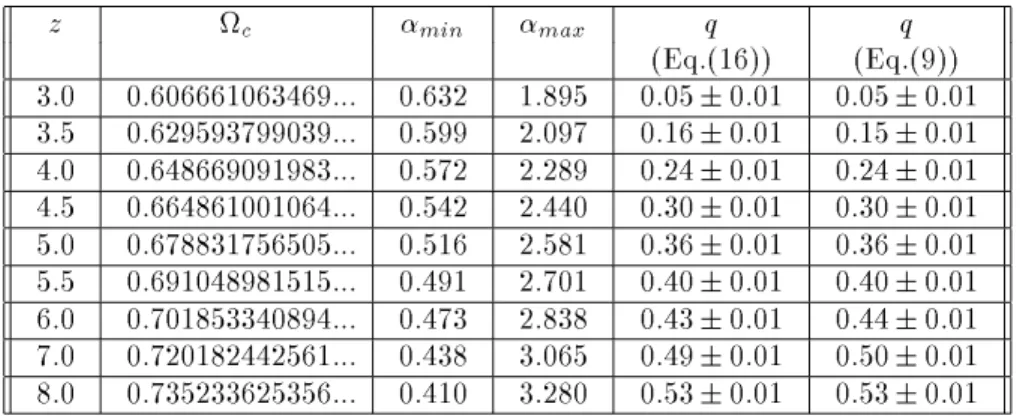
,t) equals to the golden mean[14]. The above two family of maps belong to dis-tinct universality classes and therefore exhibit disdis-tinct scaling behavior for the same value of the inexion z. The multifractal singularity spectra for these two fami-lies were numerically obtained and the extremal values of the singularity strength minand maxestimated for
a wide range of z values (see Fig. 5). From the power-law exponent of the sensitivity function the value of 1=(1,q) could be independently estimated. In the ta-bles, we summarize the results obtained for both fam-ilies which show that the proposed scaling relation is satised.
Table1- z-generalized family of logistic maps. Numerical values for several inexions z of:i) the critical parameter ac at the onset of chaos; ii) min; iii) max; iv) q as predicted by the scaling relation Eq. 16 and v) q from the sensitivity function.
z ac min max q q
(Eq.(16)) (Eq.(9)) 1:10 1:1249885::: 0:302 0:332 ,2:340:02 ,2:330:02 1:25 1:2095137::: 0:355 0:443 ,0:790:01 ,0:780:01 1:50 1:2955099::: 0:380 0:568 ,0:150:01 ,0:150:01 1:75 1:3550607::: 0:383 0:667 0:100:01 0:110:01 2:00 1:4011551::: 0:380 0:755 0:230:01 0:240:01 2:50 1:4705500::: 0:367 0:912 0:390:01 0:390:01 3:00 1:5218787::: 0:354 1:054 0:470:01 0:470:01 5:00 1:6455339::: 0:315 1:561 0:610:01 0:610:01
Table2- z-generalized family of circle maps. Numerical values for several inexions z of: i) the critical parameter c at the onset of chaos; ii) min; iii) max; iv) q as predicted by the scaling relation Eq. 16 andv) q from the sensitivity function.
z c min max q q
VI Power-law sensitivity in
higher dimensional
dissipa-tive and Hamiltonian
sys-tems
The predicted scaling relation between the entropic in-dexqof generalized entropies and the scaling exponents related to the most extremal sets in the dynamical at-tractor provides an important clue for how to estimate the proper non-extensive entropy for systems with long-range spatio-temporal correlations. For these systems, one shall expect a power-law sensitivity to initial condi-tions whose exponent is directly related toq. Therefore, qcan be estimated if we are able to follow a critical dy-namical trajectory. Furthermore, if only the dydy-namical attractor is accessible, qcan also be obtained from its multifractal singularity spectrum.
Usually, for systems with a large number of degrees of freedom, the scaling properties of the dynamical at-tractor in the phase space are hardly accessible due to computational limitations. However, a dynamical tra-jectory can be easily followed and the sensitivity to ini-tial conditions estimated by computing the time evolu-tion of the distance between two initially nearby orbits.
Power-law sensitivity to initial conditions has been ob-served in a series of high dimensional dissipative sys-tems which are naturally driven to a critical attrac-tor, usually referred in the literature as self-organized critical systems. These systems range from the Bak-Sneppen model of biological evolution[15], the rice pile model[16] and coupled logistic maps[17]. Therefore, in all these dissipative extended model systems, there is a proper non-extensive generalized entropy that during the dynamical evolution exhibits a constant variation rate.
On the other hand, Hamiltonian systems are ex-pected to be ergodic in the thermodynamical limit whenever the interactions are short-ranged. In other words, all trajectories becomes chaotic in the thermo-dynamical limit. However, Hamiltonian systems with just a few degrees of freedom may have a nite volume of the phase-space on which quasi-periodic orbits exist. In this case, one expects power-law sensitivity to initial conditions to take place. Usually, as further degrees of freedom are included and short-range interactions are present, the phase space volume with quasi-periodic or-bits vanish. Let's illustrate the power-law sensitivity to initial conditions in the Hamiltonian map[18, 19]
c
x i(
t+ 1) = x i(
t) +y i(
t) (18)
y i(
t+ 1) = y i(
t) +Ksinx i(
t+ 1) +CKsin[x i(
t+ 1),x i,1(
t+ 1)] +CKsin[x
i(
t+ 1),x i+1(
t+ 1)] (19)
d where the indices go from 1 to N, periodic boundary conditions are assumed and x
i, y
i are taken modulo 2. HereC is the coupling parameter between nearest neighbors. ForN = 1 the system is regular and the Li-apunov exponent is zero for any initial condition. For N = 2 it has been observed that, forC= 0:5 andK= 0:15, 40% of the phase space still has a zero Liapunov exponent (quasi-periodic orbits)[19]. In Fig. 6 we show some results for the sensitivity function for distinct ini-tial conditions. Notice that, besides the exponenini-tially
diverging ones, some orbits exhibit a power-law (lin-ear) time evolution. For these initial conditions S
i.e., power-law diverging orbits, even in the thermody-namic limit[20]. This fact may be related to the break-down of the standard BG prescription in describing some statistical distributions of a variety of long-range interacting Hamiltonian systems[21, 22, 23, 24, 25].
VII Summary and perspectives
We briey revised some recent results concerning the power-law sensitivity to initial conditions of dynamical systems at criticality and how it can be naturally for-mulated within the Tsallis nonextensive statistics pre-scription. The power-law sensitivity has been shown to provide a simple tool for estimating the proper entropic indexqof critical systems tuned at criticality as well as of systems exhibiting a self-organized critical state.
The critical dynamical attractor of nonlinear dy-namical systems usually presents a multifractal char-acter. It has been shown that quite general scaling arguments applied to the most rareed and most con-centrated regions of the attractor provide a direct link between the entropic indexqand the critical exponents associated with the scaling behavior of the extremal sets of the attractor. This result gives support for the recent conjecture that Tsallis statistics is the natural frame for studying systems with a fractal-like structure in the phase-space[9].
Figure 5. Multifractal singularity spectra of the critical at-tractor of generalized logistic and circle maps with z = 3.
The maximum of the f() curves gives the fractal
dimen-sion of the support (df = 0:605 for the (z= 3)-logistic map
and d
f = 1 for the circle map). The curves were obtained
after N = 2048 (logistic) and N = 2584 (circle) iterations
starting from the extremal point x= 0 and following Halsey et alprescription[10]. For details see also[6, 7, 8].
Figure 6. The sensitivity function for two coupled Hamil-tonian maps as described in Eqs. 18-19 for C = 0:5 and K= 0:15 and several initial conditions. For these
param-eters there are regions (of the order of 0:40 of the
four-dimensional phase-space) with zero Liapunov exponent at which power-law sensitivity is observed, as shown in the main gure. The inset shows the same data in Linear-Log scale which explicitly exhibit the exponential sensitivity of chaotic orbits.
The predicted scaling relation has been numerically checked to hold in one-dimensional dissipative maps independently of the topological and metrical proper-ties of the dynamical attractor and is expected to hold for a very large class of non-linear dynamical systems. Particularly, it would be of great interest to verify its validity for Hamiltonian systems with few degrees of freedom where power-law sensitivity has been observed as well as for Hamiltonian systems with long-range in-teractions for which the non-extensive Tsallis statistics has successfully reproduced some unusual distribution functions. Further work along these directions would certainly be valuable.
This work was partially supported by the Brazilian research agencies - CNPq, CAPES and FINEP - and by the Alagoas state research agency - FAPEAL.
References
[1] F.C. Moon,Chaotic and Fractal Dynamics: An Intro-duction for Applied Scientists and Engineers(Wiley, New York 1992).
[2] A.N. Kolmogorov, Dok. Acad. Nauk SSSR 119, 861
(1958); Ya. G. Sinai, Dok. Acad. Nauk. SRRR 124,
768 (1959).
[4] C. Tsallis, A. R. Plastino and W.-M. Zheng, Chaos, Solitons & Fractals8, 885 (1997).
[5] U. M. S. Costa, M. L. Lyra, A. R. Plastino and C. Tsallis, Phys. Rev. E56, 245 (1997).
[6] M. L. Lyra and C. Tsallis, Phys. Rev. Lett. 80, 53
(1998).
[7] M.L. Lyra, Ann. Rev. Comp. Phys.6, (1998), in press.
[8] U. Tirnakli, M.L. Lyra and C. Tsallis, preprint 1998 (cond-mat/9809151).
[9] P. Alemany, Phys. Lett. A235, 452 (1997); C. Tsallis,
L. R. da Silva, R. S. Mendes, R. O. Vallejos and A. M. Mariz, Phys. Rev. E56, 4922 (1997).
[10] T. A. Halsey, M. H. Jensen, L. P. Kadano, I. Procac-cia and B. I. Shraiman, Phys. Rev. A33, 1141 (1986).
[11] M. J. Feigenbaum, J. Stat. Phys. 19, 25 (1978); 21,
669 (1979); See also P. Coullet and C. Tresser, J. Phys. (Paris) Colloq.5, C25 (1978).
[12] P. R. Hauser, C. Tsallis and E. M. F. Curado, Phys. Rev. A30, 2074 (1984).
[13] Hao Bai-lin, Elementary Symbolic Dynamics (World Scientic, Singapore, 1989).
[14] M. H. Jensenet al, Phys. Rev. Lett.55, 2798 (1985).
[15] F. Tamarit, S. A. Cannas and C. Tsallis, European Phys. J. B1, 545 (1988).
[16] K. Christensen, private communication (1996). [17] A. R. R. Papa and C. Tsallis, Phys. Rev. E 57, 3923
(1998).
[18] M. Falcioni, U.M.B. Marconi and A. Vulpiani, Phys. Rev. A44, 2263 (1991).
[19] L. Hurd, C. Grebogi and E. Ott,Hamiltonian Mechan-ics, Edited by J. Siemenis (Plenum Press, New York, 1994), page 123.
[20] C. Anteneodo and C. Tsallis, Phys. Rev. Lett.80, 5313
(1998).
[21] A. R. Plastino and A. Plastino, Phys. Lett. A174, 384
(1993).
[22] A. Lavagno, G. Kaniadakis, M. Rego-Monteiro, P. Quarati and C. Tsallis, Astrophysical Letters and Com-munications 35, 449 (1998).
[23] A.R. Plastino and A. Plastino, Phys. Lett. A193, 251
(1994); G. Kaniadakis, A. Lavagno and P. Quarati, Phys. Lett. B369, 308 (1996); F. Pennini, A. R.
Plas-tino and A. PlasPlas-tino, Physica A255, 250 (1997).
[24] B. M. Boghosian, Phys. Rev. E 53, 4754 (1996); C.
Antenodo and C. Tsallis, J. Mol. Liq.71, 255 (1997).
[25] C. Tsallis and A. M. C. de Souza, Phys. Lett. A 235,