Influence of artificial lights on the orientation of hatchlings of
Eretmochelys imbricata in Pernambuco, Brazil
Thyara Noely Simões
1, Arley Candido da Silva
2, Carina Carneiro de Melo Moura
31Universidade Estadual de Santa Gruz, Programa de Pós-graduação em Ecologia e Conservação da Biodiversidade. Rodovia Jorge Amado, km 16, Salobrinho, 45662-900 Ilhéus, BA, Brazil.
2Ecoassociados NGO – Conservação de tartarugas marinhas, baobás e recifes de corais. Rua das Caraúnas, Porto de Galinhas, 55590-000 Ipojuca, PE, Brazil.
3Department of Biology, Institute of Pharmacy and Molecular Biotechnology, Heidelberg University. Heidelberg, Im Neuenheimer Feld 364, 69120, Heidelberg, Germany.
Corresponding author: Thyara Noely Simões ([email protected])
http://zoobank.org/B1E05B5F-628B-43F0-8645-33C3BE373B4C
ABSTRACT. Sea turtle hatchlings, in natural abiotic conditions, emerge from their nests at night and go directly to the sea, following the moonlight’s reflection in the ocean. Increased human activities such as tourism and artificial lights on the coasts, however, have interfered with the ability of sea turtle neonates to find their correct destination, negatively affecting their survival rates. Here we endeavored to assess the influence of artificial lights on the hatchlings of the sea turtle Eretmochelys imbricata
(Linnaeus, 1766) in the south coast of the state of Pernambuco, Brazil. To that end, 10 experiments were conducted with 15 hatchlings/test subjects. Five experiments took place in artificially illuminated areas and five in non-illuminated areas. Circles with a 2 m radius were drawn on the sand a small 2–3 cm depression was made at the center of each circles. The neonates were then placed in the depressions to simulate their coming from a nest. After the neonates crossed the edge of the circles, their tracks were photographed and drawn on a diagram. To ascertain if the trajectories of the neonates differed between the two groups (hatchlings from illuminated versus non-illuminated nests), the Rayleigh test was used. The significance of those differences was tested using ANOVA. To evaluate similarities and significance of clusters, a Multi-Dimensional Scaling was used. The tracks of 86.67% (N = 65) of the hatchlings from nests at illuminated areas departed from their correct trajectory. The distribution of trajectories was considered random (V = 19.4895, p > 0.05) only for tracks originating from artificially illuminated areas. The movement patterns of hatchlings from illuminated and non-illuminated areas differed significantly (F < 0.0001, p < 0.01). Consistent with this, two distinct groups were identified, one from illuminated and one from non-illumi-nated areas. Therefore, we conclude that artificial illumination impacts the orientation of hawksbill hatchlings. This suggests that in order to protect this species it is necessary to safeguard its nesting areas from artificial lights.
KEY WORDS. Anthropogenic impacts, cheloniidae, conservation, hawksbill turtle, light pollution.
INTRODUCTION
Sea turtle hatchlings, after emerging from their nest at night, are immediately oriented to the ocean in environments without light pollution. The main signs for their orientation are visual, and are primarily associated with light intensity and relief elevation (Salmon et al. 1992, Witherington and Martin 2003). The hatchlings move towards the brightest regions, usu-ally following the reflection of the moonlight over the ocean, a mechanism known as phototaxy (Mrosovsky and Shettleworth
1968, Mrosovsky 1970, 1972, Van Rhijn and Van Gorkom 1983, Lohmann and Lohmann 1996).
An increase in tourist activities and the development of small towns along the Brazilian coast have contributed to an increase in the amount of artificial light pollution on beaches (Witherington and Bjorndal 1991b). This has altered the ability of hatchlings to follow the natural light from the moon, which is what orients them toward the sea (Witherington 2000, Silman et al. 2002, Salmon 2003, Tuxbury and Salmon 2005, Deem et al. 2007).
RESEARCH ARTICLE
According to Verheijen (1960), artificial lights are stronger stimuli than natural light, although they are less intense than celestial sources, they have more glare. In order to mitigate the impact of artificial lights on beaches, the Ordinance #11 of Instituto Brasileiro do Meio Ambiente e dos Recursos Naturais Renováveis (IBAMA), implemented in Brazil on January 30, 1995, prohibits the use of artificial lights on beaches where sea turtles nest. Despite this ordinance, the use of artificial lighting is still common and is responsible for the death of thousands of hatchlings of hawksbill turtles, Eretmochelys imbricata (Linnaeus, 1766), green turtles, Chelonia mydas (Linnaeus, 1758), and log-gerhead turtles, Caretta caretta, every year (Witherington 1997). The presence of artificial lights causes several problems to turtle hatchlings, for instance dehydration, and increased predation and mortality (Limpus 1971, Philibosian 1976, Mann 1978, Mortimer 1979, Peters and Verhoeven 1994, Witherington and Martin 2003). Even when the hatchlings are able to reach the ocean despite the stimuli from artificial lights, they might be already significantly weakened by then, since the energy be required for their first few hours of swimming is reduced (Krae-mer and Bennett 1981).
These impacts, associated with other anthropogenic inter-ferences such as fishing activities (Gallo et al. 2006, Marcovaldi et al. 2009), pollution and degradation of nesting environment, have contributed to a reduction in the numbers of sea turtles (Hamann et al. 2010). As a consequence, all sea turtle species are, to some degree, under threat of extinction. The hawksbill, which will be addressed in this study, is classified by the In-ternational Union for Conservation of Nature (IUCN 2016) as “critically endangered”.
In order to contribute useful information for the proper management and conservation of the hawksbill turtle at the coast of the state of Pernambuco, this study aimed to verify the influence of artificial light sources and moon phases on the ability of hatchlings to orient themselves.
MATERIAL AND METHODS
The study area is located in Ipojuca, 57 km from Recife, with geographic coordinates 08°24’06”S, 35°03’45”W. It com-prises 32 km of coastal area. Sea turtles nestings are recorded by the Ecoassociados Non-governmental organization (institution working in the monitoring and conservation of sea turtles) in Muro Alto, Cupe, Merepe, Porto de Galinhas, Maracaípe and Pontal de Maracaípe, totaling 12 km.
The Merepe beach, where the experiments were conducted (coordinates 08°27’15”S, 34°59’52”W), has a coastal length of
3.47 km. There is a great concentration of nesting in this area. The conditions are favorable for nesting because the area is free from reef barriers and the strip of sand is wide. In addition, the coastal vegetation and the terrain are flattered where compared to the other beaches. Along the Merepe beach there is a great number of hotels and resorts, generating a great amount of
arti-ficial lighting, but there are still some areas without interference of artificial illumination.
The data was collected under the authorization number 22741-1 issued by the ICMBio (Instituto Chico Mendes de Con-servação da Biodiversidade). The experiments were conducted from March to May, 2012. To record the paths of hatchlings, ten experiments were performed with 15 hatchlings/tests at a time. Five experiments were conducted in areas without artifi-cial illumination and five experiments were carried out in areas with the interference of artificial lighting, such as LED reflectors (methodology modified from Salmon and Witherington (1995). For each experiment, hatchlings were randomly selected during the nesting period from 10 nests. The hatchlings were kept in thermal containers until we conducted the experiments and were shortly released near the sea. Circles with a 2 m radius were drawn on the sand. At the center, a small depression of 2–3 cm was made to simulate the natural conditions of emer-gence of the hatchlings. First, 15 hatchlings were placed in the center of the circles in order for us to observe how artificial light, or the absence thereof, influences their capacity to orient themselves towards the ocean.
After neonates crossed the edge of the circles, the tracks were photographed and drawn on a diagram to record the circular motion or the change of direction. For the diagram, a compass and a 360° protractor were used to estimate the
orien-tation angles of each hatchling from the center of the circle to its edge in relation to the sea.
The direction of the hatchlings in relation to the ocean was considered deviated when it departed from it by more than 30° (Salmon and Witherington 1995).
Later, the data were subjected to circular statistical analyses using the Rayleigh V test (Zar 1999) and the software Bioestat version 5.0 to verify whether the orientation of the trajectories of neonates significantly differed from random. A uniform dis-tribution of neonates around the circumference was considered the null hypothesis. The percentage of deviation of hatchlings was determined in illuminated and non-illuminated areas in relation to the lunar phase. The significant differences between the movement of the hatchlings from illuminated and non-il-luminated nests were processed using the BioEstat 5.0 software, the ANOVA variance test and Tukey test conducted a posteriori. The Primer 6.0 software (Clarke and Gorley 2001) was used to evaluate the significance and similarities of groups formed using Multi-Dimensional Scaling (MDS).
RESULTS
Figures 1–2. Trajectory deviations of hatchlings of the species Eretmochelys imbricata in (1) illuminated nests and (2) non-illuminated made in Merepe Beach, coast of Ipojuca, Pernambuco, Brazil.
The distribution of trajectories was considered random (V = 19.4895, p>0.05) for simulated nests located in artifi-cially illuminated areas (Fig. 1). However, the experiments conducted in non-illuminated areas had an irregular distri-bution around the circumference, although the hatchlings’ tracks were directed towards the sea (Z = 63.4377, p < 0.01) (Fig. 2). Movement patterns of hatchlings in illuminated areas were significantly different from non-illuminated areas (F < 0.0001, p < 0.01).
Through the Multi-Dimensional Scaling, it was possible to observe a separation of the two groups of hatchlings regarding the presence or absence of artificial light (Stress = 0.02) with a 75% similarity (Fig. 3).
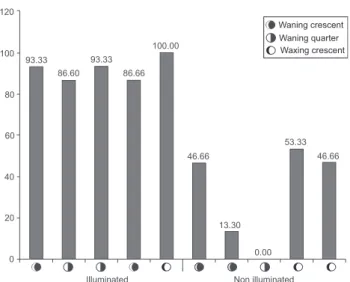
We observed that during the crescent and first quarter moon for both illuminated and non-illuminated experiments the percentage of deviation was lower in comparison with the experiments conducted during the waning moon, which showed 77% of deviation (Fig. 4).
DISCUSSION
When the levels of artificial light are high, hatchlings may either ignore the natural light or be unable to perceive it (Lohmann and Lohmann 1996). This problem occurs in Florida’s beaches, USA, where hatchlings originating from nests in illu-minated areas had their trajectories changed in approximately 83% of the cases (McFarlane 1963, Salmon and Witherington 1995). This is similar to the results of the present study, in which
changes in the trajectories of hatchlings were observed in 86% of the cases (Fig. 1).
The largest angular variation reinforces the strong attraction that artificial lights exert on neonates. Similar results were recorded in experiments with C. caretta (Salmon and Witherington 1995), C. mydas (Mrosovsky and Carr 1967),
Figure 4. Percentage of emergence events diverted in function of the lunar phase and in illuminated and non-illuminated areas. Data based on ten experimental events in different lunar conducted in Merepe Beach, coast of Ipojuca, Pernambuco, Brazil.
Lepidochelys olivacea (Eschscholtz, 1829) (Mrosovsky and Carr
1967) and Dermochelys coriacea (Vandelli, 1761) (Bourgeois et al. 2009). In all of those studies, severe hatchling disorientation and increased disruption in their ability to find the sea were recorded. The disruption caused by artificial lights on neonate behavior includes crawling in the opposite direction of the ocean (Witherington and Martin 2003), or walking in circular paths, or abrupt changes in direction (Witherington and Bjorndal1991a, Salmon and Witherington 1995, Witherington and Martin 2003).
In addition, according to Wyneken (2000), disoriented hatchlings spend more energy to find the ocean and by doing that they become more vulnerable to predators. Nevertheless, the characteristics of the light influences the level of hatchling disorientation (Witherington and Bjorndal 1991b). In the ab-sence of strong light stimulus, the hatchling will walk toward a dispersed light stimulus. The turtle C. mydas, for example, is attracted by light that has smaller wavelengths, while C. caretta
not follows light with color yellow, like the ones with low sodi-um pressure (Mrosovsky and Shettleworth 1968, Witherington and Bjorndal 1991b).
Therefore, besides the fact that hatchlings are attracted to artificial illumination, we also know that the light’s wavelength plays a role in the disorientation of sea turtles. Since is not known which wavelengths affect E. imbricata, more strongly, studies addressing this specific topic are needed to complement our findings.
According to Salmon and Witherington (1995), the lu-nar cycles are correlated with the trajectory of marine turtle hatchlings heading towards the sea. The highest number of path disruption occurs at night during periods close to the
new moon (darker nights), while during the full moon, which is characterized by brighter nights, the hatchlings are oriented directly to the sea. However, when the levels of artificial light are high, hatchlings ignore these natural stimuli (Lohmann and Lohmann 1996).
Light pollution occurs mainly in highly developed locations with a higher population density. The coast of Ipojuca is one of the most developed beaches of Pernambuco and has a great number of hotels and resorts along its waterfront, which direct their lights toward the sea at night. Our findings reinforce the idea that the lights commonly used in this area is inadequate and harmful to E.
imbricata hatchlings’, contributing to their death by precipitating
exhaustion, dehydration and increasing the risk of predation. As a mitigation measure, the Ordinance #11 of 30 January 1995 was implemented in Brazil. It reads as follows:
“Article 1-Prohibit light sources that cause a light intensity higher than zero LUX in a strip of beach between the highest low-water mark up to 50 m (fifty meters) above the highest tide of the year (syzygy tide).”
Even though the ordinance covers the Fernando de Noronha District, and beach Boldro, Conceição, Caieira, America-no, Bode, Cacimba do Padre and Baía de Santo Antonio beaches in the state of Pernambuco, it does not cover Ipojuca’s beaches.
In conclusion, the artificial lights in the studied region are negatively impacting the orientation of E. imbricata hatchlings’ towards the sea and are affecting their survival in this region. We highlight the necessity for including Ipojuca’s beaches within the protected area under Ordinance No. 11 and reinforce the need to control the level of light pollution in this turtle’s nesting area.
ACKNOWLEDGEMENTS
We thank the Ecoassociados Non Governmental Orga-nization for the logistical support in the development of the study and the Instituto Chico Mendes de Conservação da Biodiversidade for allowing the realization of the experiments under the license 22741-1.
LITERATURE CITED
Bourgeois S, Gilot-Fromont E, Viallefont A, Boussamba F, Deem SL (2009) Influence of artificial lights, logs and erosion on leath-erback sea turtle hatchling orientation at Pongara National Park, Gabon. Biological Conservation 142: 85–93. https://doi. org/10.1016/j.biocon.2008.09.028
Clarke KR, Gorley RN (2001) PRIMER Version 6 User Manual/Tutorial. Primer-Ltd, Plymouth.
Deem SL, Boussamba F, Nguema AZ, Sounguet G, Bourgeois S, Cianciolo J, Formia A (2007) Artificial lights as a significant cause of morbidity of leatherback sea turtles in Pongara Na-tional Park, Gabon. Marine Turtle News 116: 15–17.
feed-ing area with incidental capture in coastal fisheries. Chelonian Conservation and Biology 5: 93–101. https://doi.org/10.2744/ 1071-8443(2006)5[93:STCIUS]2.0.CO;2
Hamann M, Godfrey MH, Seminoff JA, Arthur K, Barata PCR, Bjorn-dal KA, Bolten AB, Broderick AC, Campbell LM, Carreras C, Ca-sale P, Chaloupka M, Chan SKF, Coyne MS, Crowder LB, Diez CE, Dutton PH, Epperly SP, Fitz Simmons NN, Formia A, Giron-dot M, Hays GC, Cheng IJ, Kaska Y, Lewison R, Mortimer JA, Nichols WJ, Reina RD, Shanker K, Spotila JR, Tomás J, Wallace BP, Work TM, Zbinden J, Godley BJ (2010) Global research pri-orities for sea turtles: informing management and conservation in the 21st century. Endangered Species Research 11: 245–269.
https://doi.org/10.3354/esr00279
IUCN (2016) Red List status assessment hawksbill turtle. Conserva-tion InternaConserva-tional, and NatureServe. Available online at: http:// www.iucnredlist.org/search [Accessed 13/01/20016]
Kraemer JE, Bennett SH (1981) Utilization of post-hatching yolk in the loggerhead sea turtles, Caretta caretta. Copeia 1981: 406–411. https://doi.org/10.2307/1444230
Limpus CJ (1971) Sea turtle ocean finding behaviour. Search 2: 385–387.
Lohmann KJ, Lohmann CMF (1996) Orientation and open-sea navigation in sea turtles. The Journal of Experimental Biology 199: 73–81.
Mann TM (1978) Impact of developed coastline on nesting and hatchling sea turtles in Southeastern Florida. Florida Marine Re-search Publications 33: 53–55.
Marcovaldi MA, Giffoni BB, Becker H, Fiedler FN (2009) Sea Turtle Interactions in Coastal Net Fisheries in Brazil. In: Proceedings of the Technical Workshop on Mitigating Sea Turtle By catch in Coastal Net Fisheries. IUCN, Regional Fishery Management Council, Hawaii.
McFarlane RW (1963) Disorientation of loggerhead hatchlings by artificial road lighting. Copeia 1963: 153. https://doi. org/10.2307/1441283
Mortimer JA (1979) Ascension Island: British jeopardize 45 years of conservation. Marine Turtle Newsletter 10: 7–8.
Mrosovsky N (1970) The influence of the sun’s position and elevated cues on the orientation of hatchling sea turtles. Animal Behaviour 18: 648–651. https://doi.org/10.1016/0003-3472(70)90 0 08-4 Mrosovsky N (1972) The Water-finding ability of Sea
Tur-tles. Brain, Behavior and Evolution 5: 202–225. https://doi. org/10.1159/00 0123748
Mrosovsky N, Carr A (1967) Preference for light of short wave-lengths in hatchling green sea turtles, Chelonia mydas, test-ed on their natural nesting beaches. Behaviour 28: 217–231. https://doi.org/10.1163/156853967X00019
Mrosovsky N, Shettleworth SJ (1968) Wavelength preferences and bright ness cues in the water finding behaviour of sea turtles. Beha-viour 32: 211–57. https://doi.org/10.1163/1568539 68X00216 Peters A, Verhoeven KJF (1994) Impact of artificial lighting on the
seaward orientation of hatchling loggerhead turtles. Journal of Herpetology 28: 112–114. https://doi.org/10.2307/1564691
Philibosian R (1976) Disorientation of hawksbill turtle hatchlings,
Eretmochelys imbricata, by stadium lights. Copeia 1976: 824. https://doi.org/10.2307/1443476
Salmon M (2003) Artificial night lighting and sea turtles. The Biolo-gist 50: 163–168.
Salmon M, Witherington BE (1995) Artificial lighting and seafind-ing by loggerhead hatchlseafind-ings: evidence for lunar modulation. Copeia 1995: 931–938. https://doi.org/10.2307/1447042 Salmon M, Wyneken J, Fritz E, Lucas M (1992) Seafinding by
hatchling sea turtles: role of brightness silhouette and beach slope as orientation cues. Behaviour 122: 56–57. https://doi. org/10.1163/156853992X00309
Silman R, Vargas I, Troëng S (2002) Tortugas marinas. Guía Edu-cativa. Corporación Caribeña para la Conservación, San Pedro, 38 pp. Available online at: http://www.lasecomujeres.org/files/ SeaTurtleEducatorsGuide_esp.pdf [Accessed: 01/05/0217] Tuxbury SM, Salmon M (2005) Competitive interactions between
artificial lighting and natural cues during seafinding by hatch-ling marine turtles. Biological Conservation 121: 311–316. https://doi.org/10.1016/j.biocon.2004.04.022
Van Rhijn FA, Van Gorkom JC (1983) Optic orientation in hatch-lings of the sea turtle Chelonia mydas III. Sea-finding behaviour: the role of photic and visual orientation in animals walking on the spot under laboratory conditions. Marine Behaviour and Physiology 9: 211–228. https://doi.org/10.1080/1023-62483 09378594
Verheijen FJ (1960) The mechanisms of the trapping effect of artificial light sources upon animals. Archives Néerlandaises de Zoologie 13: 1–107. https://doi.org/10.1163/036551660X00017 Witherington BE (1997) The problem of photopollution for sea
turtles and other nocturnal animals. In: Clemmons JR, Buchholz R (Eds) Behavioral Approaches to Conservation in the Wild. Cambridge University Press, Cambridge, 303–328.
Witherington BE (2000) Reducción de las amenazas al hábitat de anidación. In: Eckert KL, Bjorndal KA, Abreu-Grobois FA, Don-nelly M (Eds). Técnicas de investigación y manejo para la con-servación de las tortugas marinas. UICN/CSE Grupo especialista en Tortugas Marinas, Blanchard, 201–210.
Witherington BE, Bjorndal KA (1991a) Influences of Wavelength and Intensity on Hatchling Sea Turtle Phototaxis: implications for sea-finding behavior. Copeia 1991: 1060–1069. https://doi. org/10.2307/1446101
Witherington BE, Bjorndal KA (1991b) Influences of artificial light-ing on the seaward orientation of hatchllight-ing loggerhead turtles
Caretta caretta. Biological Conservation 55: 139–149. https:// doi.org/10.1016/0006-3207(91)90053-C
Witherington BE, Martin RE (2003) Understanding, assessing and resolving light-pollution problems on sea turtle nesting beaches. Florida Marine Research Institute Technical Report TR 2: 73. Wyneken J (2000) The migratory behavior of hatchling sea turtles
Submitted: 26 May 2016
Received in revised form: 7 September 2016 Accepted: 29 November 2016
Editorial responsibility: Darren Norris
Author Contributions: TNS and CCMM designed the experiments; TNS and ACS conducted the experiments; TNS and CCMM analyzed the data; TNS, CCMM and ACS wrote the paper; TNS, CCMM and ACS conducted the paper review.