The effects of knee extensor eccentric training
on functional tests in healthy subjects
Os efeitos do treino isocinético excêntrico dos extensores do joelho nos testes
funcionais em sujeitos saudáveis
Heleodório H. Santos1, Mariana A. Ávila2, Daniela N. Hanashiro2, Paula R. Camargo2, Tania F. Salvini2
Abstract
Background: It is well known that eccentric training increases muscle strength and promotes greater neural activation, and therefore has been used in the recovery of knee extensors. The hypothesis of this study was that there would be a strong correlation between knee extensor torque and functional tests. Objectives: To investigate the relationship between knee extensor peak torque and functional tests of agility (runs) and propulsion (hop for distance) after short-term isokinetic eccentric training. Methods: Twenty healthy and active male undergraduate students (age 22.5±2.1 years; height 1.72±0.10 m; weight 67.8±9.5 kg; body mass index: 22.5±2.0 kg/m2), with no
abnormalities or history of injury of the limbs, performed an isokinetic assessment of the knee extensors and flexors and also functional tests before and after isokinetic training, which consisted of 3 sets of 10 MVECs at 30o/s, with 3 minutes of rest between sets, twice a
week for 6 weeks. Results: The eccentric training increased the extensor peak torque (16, 27 and 17%; P<0.01) and decreased the H/Q ratio (10, 20 and 13%; P<0.01) for the isometric and eccentric modes at 30°/s and 120°/s, respectively. It also decreased the time in two of the five agility tests (carioca and pivot diagonal; P<0.01), and increased the distance in the hop tests, for both dominant and non-dominant limbs (P<0.01). Conclusions: Although the eccentric training led to an increase in extensor peak torques as well as an improvement in most of the functional tests, the hypothesis that a strong correlation would be observed between peak torques and functional tests was not confirmed.
Article registered in the Australian New Zealand Clinical Trials Registry (ANZCTR) under the number 12607000590460.
Keywords: hop tests; agility tests; torque; knee; eccentric training; H/Q ratio.
Resumo
Contextualização: Sabe-se que o treino excêntrico aumenta a força muscular, promovendo uma maior ativação neural e, portanto, tem sido usado na recuperação do torque extensor. A hipótese deste estudo foi a de que possa existir uma forte correlação entre o torque extensor do joelho e os testes funcionais. Objetivos: Correlacionar o torque extensor do joelho com os testes funcionais de agilidade (corridas) e impulsão (saltos em distância) após o treino isocinético excêntrico de curta duração. Métodos: Vinte homens universitários, ativos e saudáveis (22,5±2,1 anos; 1,72±0,10 m; 67,8±9,5 kg; IMC 22,5±2,0 kg/m2), sem reportar anormalidades ou história de lesão
no membro inferior, realizaram avaliação isocinética do torque extensor e flexor do joelho e testes funcionais antes e depois do treino isocinético que consistiu em três séries de 10 CEVM a 30º/s, com 3 minutos de repouso entre as séries, realizado duas vezes por semana, durante seis semanas. Resultados: O torque extensor aumentou (16, 27 e 17%; P<0,01), a razão I/Q diminuiu (10, 20 e 13%; p<0,01) para os modos: isométrico e excêntrico a 30°/s e 120°/s, respectivamente; diminuiu o tempo em dois dos cinco testes de corridas (carioca e pivô diagonal; P<0,01) e aumentou a distância nos testes de saltos tanto para o membro dominante quanto para o não dominante (P<0,01). Conclusões: Embora o treino excêntrico tenha aumentado o torque dos extensores do joelho, bem como melhorado a maioria dos testes funcionais, a hipótese de uma forte correlação entre essas variáveis não se confirmou.
Artigo registrado no Australian New Zealand Clinical Trials Registry (ANZCTR) sob o número 12607000590460.
Palavras chave: testes de saltos; testes de agilidade; torque; joelho; treino excêntrico; razão I/Q.
Received: 06/10/2008 – Revised: 22/04/2009 – Accepted: 15/09/2009
1 Physical Therapy Department, Universidade Federal da Paraíba (UFPB), João Pessoa (PB), Brazil 2 Physical Therapy Department, Universidade Federal de São Carlos (UFSCar), São Carlos (SP), Brazil
Introduction
Due to its anatomic and functional characteristics, the knee is one of the most overloaded joints in the mus-culoskeletal system1. Many studies have demonstrated the efectiveness of resistance training2 in improving physi-cal performance and treating musculoskeletal injuries to this joint1,3,4. Because eccentric exercise promotes greater neural activation compared to isometric and concentric contractions5, it is considered to be a powerful stimulus to hypertrophy6 and muscle strength7. However, the extent of these morphofunctional changes depends on the intensity, frequency and duration of training8,9.
Regular exercise programs with heavy loads have led to muscle hypertrophy, but the strength gain acquired before the hypertrophy has been attributed to increased neural activity10. Widrick et al.11 observed an increase of more than 60% in the strength of the vastus lateralis muscle after short-term resistance training, which changed the muscle’s functional properties. Some studies that evaluated the knee flexors and extensors recorded higher torque during the eccentric12,13 and concentric14 contraction, respectively, at low speeds.
he most common tool to evaluate the efects of resistance training is isokinetic dynamometry because it allows the con-trol of signiicant movement variables, such as range of mo-tion, angular velocity, work load, exercise mode (isometric, concentric or eccentric) and identiies the agonist/antagonist ratio1,2,4,13,15,16. Additionally, the functional tests of agility (runs) and hop for distance17-19 provide security and eiciency param-eters, being extensively used to assess the athlete’s capacity to resume training after injury20.
Although these functional tests are considered reliable (>80%) and sensitive (>82%), their relationship with the muscle torque of knee extensors and lexors is still controver-sial in the literature21, given that the methodologies difer in: concentric2,15,22-24 and/or eccentric mode13,16,25; velocity of move-ment (30, 60, 70, 90, 120, 150, 180, 240, 270, 300 and 400°/s)13,16,25 and muscle group (extensors25,26 and/or lexors2,13,15,16).
In light of the above considerations, the hypothesis of the present study was that the strengthening of knee extensors would lead to an improvement in joint function, which could be evidenced by the agility and hop for distance tests. Due to the fact that eccentric movement at low speed generates higher torque than the other contraction modes12-14, this study analyzed the short-term efects of isokinetic eccentric training at low speed (30°/s) on the knee extensors in healthy subjects with the aim of verifying a possible linear correlation between knee torque and performance in functional tests.
Methods
Subjects
he initial sample consisted of 25 healthy and active male undergraduate students selected from a school of physical ther-apy. Five of them were excluded from the study: three due to knee pain during training and two due to absence. A total of 20 sub-jects completed the study (age 22.5±2.1 years; height 1.72±0.10 m; weight 67.8±9.5 kg; body mass index/BMI 22.5±2.0kg/m2). After answering a questionnaire, the subjects were selected accord-ing to the followaccord-ing criteria: a) no regular muscle strength training; b) BMI below 24 kg/m2; and 3) no musculoskeletal injuries or balance disorders (Lachman test, varus and valgus tests at 0 and 30º).
he study was conducted in accordance with the Human Re-search Ethics Committee of Universidade Federal de São Carlos (UFSCar), São Carlos (SP), Brazil, and all subjects signed an informed consent form (approval number 144/2004 – CEP/UFSCar).
Torque evaluation
he dominant leg (right=5; left=15) was identiied before the torque evaluation by asking the subject which leg he would use to kick a ball and by asking the subject to hop over an obstacle. he tests were conducted on the non-dominant leg because it is the one used for postural support and propulsion27,28. Initially, the subjects warmed up on a stationary bicycle (75W) for 5 min at 20 km/h, followed by a set of three 30-s stretches ( followed by 30-s intervals) focused on knee lexors, knee extensors and plantar lexors. Next, the subjects were positioned in an isoki-netic dynamometer (Biodex Multi-Joint System 3, Shirley, NY) with the backrest reclined 5º from vertical and knees lexed at 90º. To avoid compensatory movements, straps were positioned across the subject’s trunk, pelvis, and thigh. he dynamometer axis was aligned with the axis of rotation of the knee joint (lat-eral femoral epicondyle) and the dynamometer lever arm was attached to the distal leg (5 cm above the medial malleolus) so as to allow full ankle dorsilexion29. he familiarization period consisted of three submaximal eccentric contractions of the knee extensors, followed by a 3-min rest period. he efect of gravity on torque was corrected with the knee lexed at 60°, and the adjustment for correction was calculated by using the instrument’s software, according to Dvir29.
he knee extensor and lexor torques were evaluated under isometric and eccentric isokinetic (30º/s and 120º/s) condi-tions. To measure the maximal isometric torque, the dynamom-eter lever arm was ixed at 60º for knee extension25 and at 30º for knee lexion30. he evaluation consisted of one set of three
maximal voluntary isometric contractions (MVIC) lasting 5s each, with 1-min rest intervals31. he mean peak torque (MPT) of the three contractions was calculated for each subject7,8.
he range of motion (ROM) for the eccentric isokinetic evaluations was set to 70° (extension from 20° to 90°, and lex-ion from 90° to 20°). Each test (30º/s and 120º/s) consisted of one set of ive consecutive maximal voluntary eccentric con-tractions (MVEC) with a 1-min rest period between velocities29. he MPT obtained for the 5 contractions of knee extensors and lexors was calculated at the end of each set.
During the evaluations and training, the subjects received verbal stimulation provided by the same examiner in a stan-dardized manner to encourage maximal contraction. Addition-ally, the subjects were provided with visual feedback displayed as a graph on the instrument’s screen22. he conventional ham-string/quadriceps (H/Q) ratio was calculated by dividing the lexor peak torque by the extensor peak torque and multiplying this result by 10032 for all contraction modes (isometric and ec-centric) and velocities (30o/s and 120o/s).
Isokinetic training
Prior to each training session, the equipment was calibrated and the subjects underwent the same warm-up and stretch pro-tocols as previously described. Afterwards, they followed an ec-centric (bilateral) training protocol focused on the strengthening of the knee extensors. his consisted of three sets of 10 MVECs23 at 30º/s, with a 3-min rest period between sets9. Studies that ex-amined eccentric contraction in the knee lexors and extensors at
low speeds13,16 found higher torque. Training was performed twice a week for six weeks (12 sessions), alternating dominant and non-dominant limbs, with an interval of at least 48h between sessions.
Functional tests
Initially, the subjects performed a brief warm-up that con-sisted of running around the court at low velocity (trotting) for 5 minutes. Afterwards, they followed the same stretch protocol as the one used for torque evaluations. Functional tests were carried out before and after the eccentric isokinetic training of the knee extensors (pre- and post-training) and consisted of ive agility tests (shuttle run, lateral run, carioca, pivot diagonal run and igure-eight) at maximal velocity, and two hop for distance tests (single and triple). One- and two-min rest intervals were al-lowed between the sets of the agility and hop tests, respectively.
For the shuttle and lateral runs, and carioca, a 6-m distance was marked with two cones placed one in front of the other. In the shuttle run (Figure 1.1), the subjects were instructed to run back and forth. For the pivot diagonal run (zigzag), two parallel columns were demarcated by two cones on each side, keeping a 6-m distance between the cones on the same side and a 5m distance between the cones on opposite sides placed diagonally (Figure 1.2). he subjects were instructed to run from one cone to the opposite cone, then turn around (pivot) to the right or the left, alternately, and run diagonally toward another cone, thus completing a distance of 15 m33. For the igure-eight run (Figure 1.3), two parallel columns were placed 4 m apart. Each column was formed by three cones positioned 1 m apart. he subjects were instructed to run around the two columns so as to form a igure eight33,34. he lateral run (Figure 1.4) was in a straight line, but the sub-jects had to run sideways from right to left (round trip). In the carioca (Figure 1.5), the displacement was also performed sideways from right to left, but the subjects used a cross over step, alternating one leg in front of the other18,19. In all agility tests, verbal commands (i.e. “ready, set, go!”) were given to the subjects with the aim of standardizing the beginning of the test and the time-keeping process.
For the hop for distance tests (single and triple), the subjects were instructed to stand on one foot, behind the starting line, ind their balance and then perform the hop when they felt ready. For the single hop for distance test (Figure 1.6), the distance between the starting point and the landing point of the tested foot was measured35-39. For the triple hop for distance test (Figure 1.7), the same procedure was used to calculate the distance relative to three consecutive hops18,19,40. For each type of hop, three attempts were performed, alternating right and left legs.
In both pre- and post-training, all subjects performed the functional tests (agility and hop for distance) in the same Figure 1. Functional tests: shuttle run (1); pivot diagonal run (2);
sequence (runs: shuttle, lateral, carioca, pivot diagonal and igure-eight; hop for distance test: single and triple). For the post-training, a 72-h interval was allowed after the last session of isokinetic training. With the purpose of standardizing the procedures, all the tests were initiated by the non-dominant limb. hree attempts were performed for each of the functional tests of agility and horizontal propulsion, and the means of the three attempts were calculated for both time and distance variables.
Data analysis
he Statistical Package for the Social Sciences (SPSS) was used for the statistical analysis (mean, standard deviation, paired t-test, Wilcoxon, one-way ANOVA, and ICC). he MPT and the variance of the conventional H/Q ratio for peak torque were analyzed for all modes and velocities evaluated in pre- and post-training. he functional tests were used to investigate the diferences between pre- and post-training means and to in-vestigate a possible relationship with MPT (ICC). With regard to the correlation tests (ICC), values ranging from 0 to 0.5 were considered weak, values ranging from 0.51 to 0.75 were consid-ered moderate, and values above 0.75 were considconsid-ered strong. A signiicance level of 5% (P<0.05) was used for all analyses.
Results
Isokinetic dynamometry
MPT
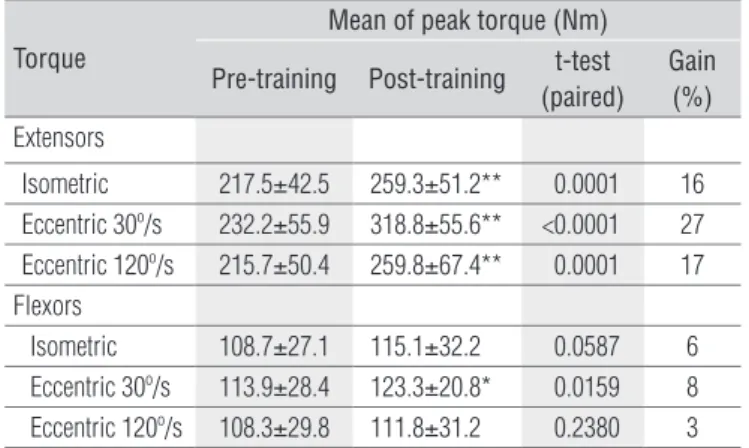
For the comparisons of MPT for knee extensors between pre- and post-training, there was a gain of 16% (P<0.01) for the isometric mode, 27% (P<0.01) for the eccentric mode at 30º/s and 17% (P<0.01) at 120º/s. Also, the knee lexors had an increase of 8% (P<0.05) for MPT in the eccentric mode at 30°/s, although this mode did not compose the training protocol (Table 1).
Time to peak torque (TPT)
In general, the means of the TPT tended to decrease, al-though it was only statistically signiicant in the eccentric mode at 30º/s (P<0.01; Table 2).
Hamstring/Quadriceps Ratio (H/Q)
As shown in Table 3, there was a significant decrease in the conventional H/Q ratio after training in all modes and velocities analyzed, but the greatest decrease percentage (20%) was observed in the eccentric mode at 30°/s, followed by the eccentric mode at 120°/s (13%), and the isometric mode (10%).
he one-way ANOVA test showed that the training protocol used in the study increased the diference in the H/Q ratio be-tween contraction modes. For pre-training, there was a diference between isometric mode and eccentric mode at 120°/s (P<0.05). For post-training, there was a diference between isometric mode and eccentric mode at 30º/s (P<0.05), and a diference between the velocities of 30º/s and 120º/s in the eccentric mode (P<0.01).
Torque
Mean of peak torque (Nm)
Pre-training Post-training t-test (paired)
Gain (%)
Extensors
Isometric 217.5±42.5 259.3±51.2** 0.0001 16 Eccentric 30º/s 232.2±55.9 318.8±55.6** <0.0001 27 Eccentric 120º/s 215.7±50.4 259.8±67.4** 0.0001 17 Flexors
Isometric 108.7±27.1 115.1±32.2 0.0587 6 Eccentric 30º/s 113.9±28.4 123.3±20.8* 0.0159 8 Eccentric 120º/s 108.3±29.8 111.8±31.2 0.2380 3
Table 1. Comparisons of the means of peak torque (Nm) before and after 6 weeks of isokinetic eccentric training of the knee extensors.
Nm=Newton.meter; * significant difference at P<0.05; ** significant difference at p<0.01.
Torque Time to peak torque (ms) Pre-training Post-training
Extensors
Eccentric 30º/s 2723±755 2185±219* Eccentric 120º/s 951±368 775±236 Flexors
Eccentric 30º/s 2343±541 2259±636 Eccentric 120º/s 555±113 528±75
Table 2. Time to Peak Torque (ms) between pre- and post-training after 6 weeks of isokinetic eccentric training of knee extensors.
* P=0.003 (Wilcoxon).
Contraction Modes Hamstrings/quadriceps ratios (%)
Pre-training Post-training t-test (paired) Difference (%)
Isometric 49.8±8.3 45.1±7.8 0.0057 10
Eccentric 30º/s 50.4±7.5 40.3±7.0 <0.0001 20 Eccentric 120º/s 54.8±10.3 47.7±12.3 0.0023 13
Table 3. Hamstrings/Quadriceps ratio between pre- and post-training in non-dominant limb.
Functional tests
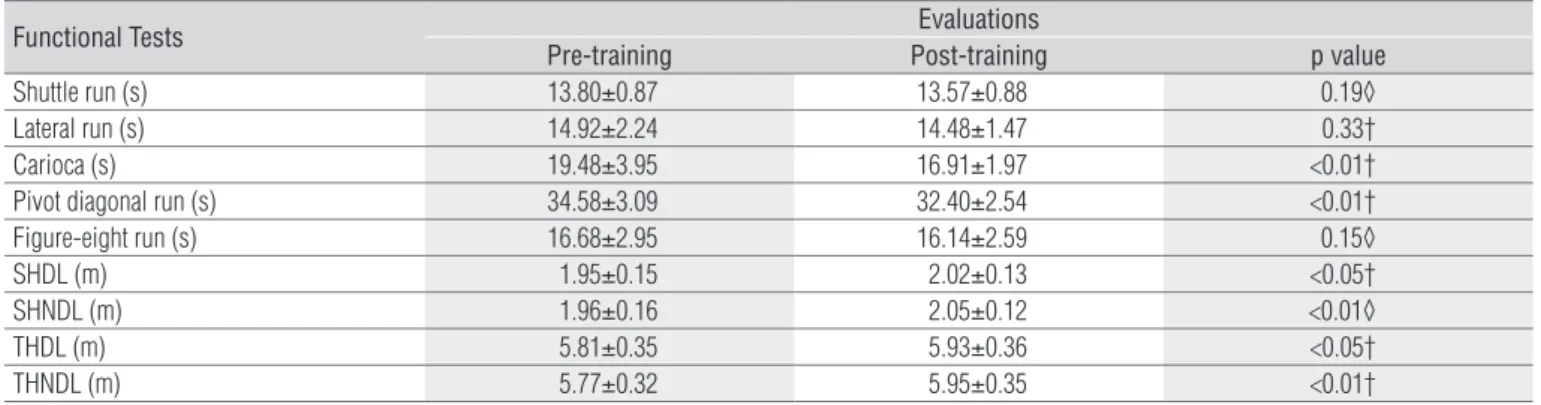
here were signiicant diferences (P<0.01) for two of the ive agility tests (carioca and pivot diagonal run) when comparing the means of functional tests in pre- and post-eccentric training of the knee extensors (Table 4). For the hop for distance tests, there were signiicant diferences in the single and triple hop for distance tests for both limbs, however the non-dominant limb showed greater signiicance (P<0.01) than the dominant limb.
Correlation: MPT versus functional tests
here were weak correlations (r≤0.5) between the MPT of knee extensors and lexors and the functional agility tests for all modes and velocities, in both pre- and post-training. he correlations for the hop for distance tests in pre- and post-training for both test types (single and triple) were generally weak (r≤0.5). However, there was a weak and moderate corre-lation, in pre-training, between the MPT of knee extensors and the single hop for distance test in the eccentric mode at 30º/s and 120º/s (r=0.50 and 0.53, respectively). here was also a moderate correlation between the MPT of knee extensors and the triple hop for distance test in the eccentric mode at 30º/s (r=0.56). Moderate and strong correlations were also observed between the MPT of knee lexors in the eccentric mode at both velocities and the single hop for distance test (r=0.63 and 0.78, respectively). In the post-training, the correlation between the MPT of knee lexors, in the eccentric mode, at 120°/s was also moderate (r=0.60), although it was shown to be lower than the correlation seen for the pre-training.
Discussion
he results of the present study showed that peak torque increased after isokinetic eccentric training in all of the
contraction modes and velocities analyzed (isometric, and eccentric at 30º/s and 120º/s), therefore in agreement with several authors9,28,41-46. he greatest torque gain was observed in the eccentric mode at 30°/s, as supported by previous studies25,26, however a torque increment was also observed in the isometric mode and eccentric mode at 120°/s, a fact also evidenced by Blazevich47.
According to several studies, resistance training promotes changes in the neurological system, leading to force gain43,46, especially in the irst eight weeks, without signiicant increase in the cross-sectional area of the muscle28. Using functional magnetic resonance imaging, Duchateau and Enoka48 showed an increase in the modulation of the motor cortex area on muscles of the hand after 3 weeks of training. Although vari-ables such as number, iring rate and synchronization of the active motor units were not analyzed in the current study, it is possible to assume that the torque gained in response to the training protocol (6 weeks) is a result of the changes in muscle recruitment patterns9,44,45.
he lexor peak torque was also increased in the eccentric mode at 30°/s, which indicates that this muscle group plays a role in the eccentric contraction of the extensors. his gain may be explained by the active (isometric) exercise of the con-tralateral lexors during the eccentric training of the extensors. Although the exercise was not monitored by electromyography, it was possible to visually identify an isometric contraction of the contralateral lexors during the eccentric training of the extensors.
he results showed that, although TPT tended to decrease in all analyzed modes and velocities, the relationship was spe-ciic to the mode and velocity of training (eccentric at 30°/s). his is probably associated with force gain and improved mo-tor unit recruitment, because a low TPT at the beginning of training was followed by a substantial peak torque gain in the eccentric mode at 30°/s. In a study on the activation patterns of knee extensors, McHugh et al.49 veriied that a lower TPT
Functional Tests Evaluations
Pre-training Post-training p value
Shuttle run (s) 13.80±0.87 13.57±0.88 0.19◊ Lateral run (s) 14.92±2.24 14.48±1.47 0.33† Carioca (s) 19.48±3.95 16.91±1.97 <0.01† Pivot diagonal run (s) 34.58±3.09 32.40±2.54 <0.01† Figure-eight run (s) 16.68±2.95 16.14±2.59 0.15◊ SHDL (m) 1.95±0.15 2.02±0.13 <0.05† SHNDL (m) 1.96±0.16 2.05±0.12 <0.01◊ THDL (m) 5.81±0.35 5.93±0.36 <0.05† THNDL (m) 5.77±0.32 5.95±0.35 <0.01†
Table 4. Comparison of the means of the functional tests before and after 6 weeks of isokinetic eccentric training of the knee extensors.
is related to the fact that isokinetic eccentric exercise requires higher recruitment of type II muscle ibers. Similarly, Miller et al.50 demonstrated that TPT was signiicantly lower after eccentric training when compared to concentric training for both knee extensors and lexors, indicating improved neuro-muscular function.
he conventional H/Q ratio was used because it was not possible to calculate the functional H/Q ratio due to the lack of records for concentric peak torques during evaluations. he conventional H/Q is used as a standard test of knee muscle balance2,12,13,16,32,50-53. For the comparison of the H/Q ratio be-tween pre- and post-training, the training protocol lead to a decrease of 20%, 13% and 10% in the eccentric mode at 30º/s, 120º/s and isometric mode, respectively. hese decreases in H/Q ratio were due to the increased extensor peak torque rather than the decreased lexor peak torque. Although there was a gain in the knee lexor torque, this gain was lower than the gain recorded for the knee extensors, therefore leading to a decrease in the antagonist/agonist ratio. In a review study on the contribution of the eccentric contraction to injury, pre-vention, rehabilitation and sports, LaStayo et al.5 reported that this contraction, when exclusively applied to a single muscle group, may compromise knee stability due to changes in the H/Q ratio.
Despite this signiicant decrease, the lower rate of lexor torque represented 40% of the extensor torque for all analyzed contraction modes. However, this percentage is within the range of variability (40-80%) described in many other studies on H/Q ratio, depending on the studied population, age and gender7,52. herefore, in spite of the fact that the current proto-col only elicited the knee extensors and lead to a decrease in H/Q ratio, the percentage of the ratio seen here (<40%) does not compromise the stability of the knee joint.
It can be observed in the present results that the three torque variables (MPT, TPT and H/Q ratio) showed more sig-niicant diferences for the speciic training mode and speed of eccentric training at 30°/s, which characterizes the principle of training speciicity when compared to the other assessed modes and speeds25,54. Duchateau and Enoka48 corroborate the results of the current study by demonstrating that the perfor-mance in functional tests is improved to a maximum level in similar tasks and can be afected by contraction mode, load, velocity and posture. Indeed, the distances in both types of hop for distance (single and triple) may have increased due to a greater similarity to the task of the training protocol (high force, low velocity). In contrast, an improved performance was only observed in two (carioca and pivot diagonal run) of the ive agility tests. Furthermore, Kraemer et al.9 demonstrated that strength training alone elicits no signiicant improvement in running performance. Also, these same authors veriied that
tests conducted at velocities above 180°/s were better indica-tors of agility, thus being more closely related to knee joint function.
In light of these considerations, it is possible that the re-sults obtained after training would have been more signiicant, especially for the agility tests, if the training protocol had been conducted at a medium velocity (≅180º/s) in the concentric and eccentric modes because positive (shortening) and nega-tive (lengthening) work of the knee muscles was observed in the completion of all the functional tests used in the present study. Sheppard and Young20 argue that the ability to perform an agile movement involves not only physical but also cogni-tive factors, suggesting that the decreased time in functional tests (such as the carioca and pivot diagonal run) as well as the increased distance in the hop for distance tests may be due to a combination of both factors. However, this hypothesis may be rejected as the subjects performed the tests only twice (pre- and post-training), with a 6-week interval between them. Fur-thermore, in the post-training evaluation, the subjects asked the examiner to show them how to perform the test as they could not remember how to do it.
he manual timing used for the agility tests, although re-corded by the same examiner, probably inluenced the results because it is an evaluator-dependent measure, therefore not as reliable as a record obtained by an electronic synchronization system or photo-cells. Another factor that may also have in-luenced the results of this study was the total number of tests (5 runs and 2 hops), because each of the tests was performed three times consecutively. Unlike the present study, most of the studies found in the literature34-39,48,55 used only one or two tri-als, while a few18,19,33 used a maximum of ive trials to combine activities of agility and hop.
There is considerable disagreement in the literature regarding which muscle group is most involved in the func-tional movements of the knee. Li et al.56 found correlations between the knee flexor forces and functional abilities, while other authors57,58 found this correlation only with the exten-sors. However, these correlations were classified as weak or moderate.
he results of the present study are in agreement with the literature because there were weak correlations between func-tional tests and torque for both knee extensors and lexors, however most studies included subjects with deicient or re-constructed ACLs. Other studies included healthy subjects23 or athletes13,16,24 in their sample, and although they found similar results to those of the present study (weak and moderate cor-relation), the discussion is hampered by diferences in method-ology such as closed kinetic chain23 or open kinetic chain13,16,24, linear isokinetic test23 or angular isokinetic test13,14,16,24, train-ing protocol (mode of contraction, muscle group, number of
repetitions, frequency, duration, time to rest, speed of contrac-tion, etc.) and quantity and type of functional tests used in the relationship analysis59.
he fact that isokinetic tests are performed in open kinetic chain and functional tests are performed in closed kinetic chain may have inluenced the relationship analysis, which suggests that the muscles of the joints proximal and distal to the knee (hip and ankle) could increase the performance of functional tests49. he low speed of contraction used in the training protocol (30°/s) when compared with the veloci-ties of contraction developed in the various functional tests (≥60°/s)2,13,15,50,51 and the lack of evaluation in the concentric mode15,23,24 may also have inluenced the results. Another fac-tor in our study that could justify the moderate correlations between the torque and hop tests would be the similarity be-tween the speed of movement in the training (30°/s) and the speciic hop task. hus, the weak correlations with the agility tests (runs) can also be explained by the diference in speed between the tasks.
Conclusions
Although the training protocol elicited a substantial in-crease in the extensor peak torque, especially at 30°/s, along with improved performance in most of the functional tests (ca-rioca and pivot diagonal run, and single and triple hop), the hy-pothesis that a strong correlation would be observed between these variables was not conirmed. his suggests that the func-tional tests and isokinetic tests assess diferent measures, and it seems that the combination of measures is important for a full assessment of functional capacity.
Acknowledgements
To Fundação de Amparo à Pesquisa do Estado de São Paulo (FAPESP), Conselho Nacional de Desenvolvimento Cientíico e Tecnológico (CNPq) and Coordenação de Aperfeiçoamento de Pessoal de Nível Superior (CAPES) for their inancial support.
References
1. Aquino MA, Leme LE, Amatuzzi MM, Greve JM, Terreri ASAP, Andrusaitis FR, et al. Isokinetic assessment of knee flexor/extensor muscular strength in elderly women. Rev Hosp Clin Fac Med Univ São Paulo. 2002;57(4):131-4.
2. Rosene JM, Forgarty TD, Mahaffey BL. Isokinetic hamstrings: quadriceps ratios in intercollegiate athletes. J Athl Train. 2001;36(4):378-83.
3. Kannus P. Isokinetic evaluation of muscular performance: implications for muscle testing and rehabilitation. Int J Sports Med. 1994;15 Suppl 1:S11-8.
4. Siqueira CM, Pelegrini FR, Fontana MF, Greve JM. Isokinetic dynamometry of knee flexors and extensors: comparative study among non-athletes, jumper athletes and runner athletes. Rev Hosp Clin Fac Med Univ São Paulo. 2002;57(1):19-24.
5. LaStayo PC, Woolf JM, Lewek MD, Snyder-Mackler L, Reich T, Lindstedt SL. Eccentric muscle contractions: their contribution to injury, prevention, rehabilitation and sport. J Orthop Sports Phys Ther. 2003;33(10):557-71.
6. Goldspink G. Molecular mechanisms involved in the determination of muscle fiber mass and phenotype. Adv Exerc Sports Physiol. 1999;5(2):27-39.
7. Seger JY, Thorstensson A. Effects of eccentric versus concentric training on thigh muscle strength and EMG. Int J Sports Med. 2005;26(1):45-52.
8. Clebis NK, Natali MRM. Lesões musculares provocadas por exercícios excêntricos. Rev Bras Ciênc Mov. 2001;9(4):47-53.
9. Kraemer WJ, Adams K, Cafarelli E, Dudley GA, Dooly C, Feigenbaum MS, et al. Progression models in resistance training for healthy adults. Med Sci Sports Exerc. 2002;34:364-80.
10. Fitts RH. Effects of regular exercise training on skeletal muscle contractile function. Am J Phys Med Rehabil. 2003;82(4):320-31.
11. Widrick JJ, Stelzer JE, Shoepe TC, Garner DP. Functional properties of human muscle fibers after short-term resistance exercise training. Am J Physiol Regul Integr Comp Physiol. 2002;283(2):R408-16.
12. Kellis E, Baltzopoulos V. Muscle activation differences between eccentric and concentric isokinetic exercise. Med Sci Sports Exerc. 1998;30(11):1616-23.
13. Dauty M, Potiron-Josse M. Correlations and differences of performance between soccer players, professionals, young players and amateurs, from the 10-meter sprint test and knee isokinetic assessment. Sci Sports. 2004;19(2):75-9.
14. Newton RU, Gerber A, Nimphius S, Shim JK, Doan BK, Robertson M, et al. Determination of functional strength imbalance of the lower extremities. J Strength Cond Res. 2006;20(4): 971-7.
15. Croce RV, Pitetti KH, Horvat M, Miller J. Peak torque, average power, and Hamstrings/Quadriceps ratios in nondisabled adults and adults with mental retardation. Arch Phys Med Rehabil. 1996;77(4):369-72.
16. Jidovtseff B, Croisier JL, Mordant B, Crielaard JM. Isokinetic profile of knee flexors and extensors in a jumpers population. Sci Sports. 2005;20(5-6):304-7.
17. Keskula DR, Duncan JB, Davis VL, Finley PW. Functional outcome measures for knee dysfunction assessment. J Athl Train. 1996;31(2):105-10.
18. Keays SL, Bullock-Saxton JE, Keays AC, Newcombe P. Muscle strength and function before and after anterior cruciate ligament reconstruction using semitendonosus and gracilis. Knee. 2001;8(3):229-34.
19. Keays SL, Bullock-Saxton JE, Newcombe P, Keays AC. The relationship between knee strength and functional stability before and after anterior cruciate ligament reconstruction. J Orthop Res. 2003;21(2):231-7.
20. Sheppard JM, Young WB. Agility literature review: classifications, training and testing. J Sports Sci. 2006;24(9):919-32.
21. Phillips N, Benjamin M, Everett T, Van Deursen RWM. Outcome and progression measures in rehabilitation following anterior cruciate ligament injury. Phys Ther Sport. 2000;1(1): 106-18.
22. Campenella B, Mattacola CG, Kimura IF. Effect of visual feedback and verbal encouragement on concentric quadriceps and hamstrings peak torque of males and females. Isokinet Exerc Sci. 2000;8:1-6.
23. Manske RC, Smith BS, Rogers ME, Wyatt FB. Closed kinetic chain (linear) isokinetic testing: relationships to functional testing. Isokinet Exerc Sci. 2003;11:171-9.
24. D’Alessandro RL, Silveira EAP, Anjos MTS, Silva AA, Fonseca ST. Análise da associação entre dinamometria isocinética da articulação do joelho e o salto horizontal unipodal, hop test, em atletas de voleibol. Rev Bras Med Esporte. 2005;11(5):271-5.
283 26. Kellis E, Baltzopoulus V. The effects of the antagonist muscle force on intersegmental loading
during isokinetic efforts of the knee extensors. J Biomech. 1999;32(1):19-25.
27. Gobbi LTB, Secco CR, Marins FHP. Preferência pedal: comportamento locomotor em terreno regular. In: Teixeira LA. Avanços em comportamento motor. São Paulo: Movimento; 2001. p. 225-47.
28. Knight CA, Kamen G. Adaptations in muscular activation of the knee extensor muscles with strength training in young and older adults. J Electromyogr Kinesiol. 2001;11(6): 405-12.
29. Dvir Z. Isokinetics: muscle testing, interpretation and clinical applications. Edinburgh: Churchill Livingstone; 2004.
30. Davies GJ, Ellenbecker TS. Aplicação da isocinética nos testes e na reabilitação. In: Andrews JR, Harrelson GL, Wilk KE. Reabilitação física das lesões desportivas. 2ª ed. Rio de Janeiro: Guanabara Koogan; 2000. p. 160-88.
31. Wilk KE, Arrigo CA, Andrews JR. Standardized isokinetic testing protocol for the throwing shoulder: the throwers series. Isokinet Exerc Sci. 1991;1:63-71.
32. Aagaard P, Simonsen EB, Magnusson SP, Larsson B, Dyhre-Poulsen P. A new concept for isokinetic hamstring: quadriceps muscle strength ratio. Am J Sports Med. 1998;26(2): 231-37.
33. Ortiz A, Olson SL, Roddey TS, Morales J. Reliability of selected physical performance tests in young adult women. J Strength Cond Res. 2005;19(1):39-44.
34. Hasebe Y, Tanabe Y, Yasuda K. Anterior-Cruciate-Ligament reconstruction using doubled hamstring-tendon autograft. J Sport Rehabil 2005;14(4):279-93.
35. Augustsson J, Thomeé R, Karlsson J. Ability of a new hop test to determine functional deficits after anterior cruciate ligament reconstruction. Knee Surg Sports Traumatol Arthrosc. 2004;12(5):350-6.
36. McDevitt ER, Taylor DC, Miller MD, Gerber JP, Ziemke G, Hinkin D, et al. Functional bracing after anterior cruciate ligament reconstruction – a prospective, randomized and multicenter study. Am J Sports Med. 2004;32(8):1887-92.
37. Swanik CB, Lephart SM, Swanik KA, Stone DA, Fu FH. Neuromuscular dynamic restraint in women with anterior cruciate ligament injuries. Clin Orthop Relat Res. 2004;425: 189-99.
38. Pollet V, Barrat D, Meirhaeghe E, Vaes P, Handelberg F. The role of the Rolimeter in quantifying knee instability compared to the functional outcome of ACL-reconstructed versus conservatively-treated knees. Knee Surg Sports Traumatol Arthrosc. 2005;13(1):12-8.
39. O’Donnell S, Thomas SG, Marks P. Improving the sensitivity of the hop index in patients with an ACL deficient knee by transforming the hop distance scores. BMC Musculoskelet Disord. 2006;7(9):1-6.
40. Holm I, Fosdahl MA, Friis A, Risberg MA, Myklebust G, Steen H. Effect of neuromuscular training on proprioception, balance, muscle strength, and lower limb function in female team handball players. Clin J Sport Med. 2004;14(2):88-94.
41. Hickson RC, Hikada K, Foster C. Skeletal muscle fiber type, resistance training, and strength-related performance. Med Sci Sports Exerc. 1994;26(5):593-8.
42. Ploutz LL, Tesch PA, Biro RL, Dudley GA. Effect of resistance training on muscle use during exercise. J Appl Physiol. 1994;76(4):1675-81.
43. Staron RS, Karapondo DL, Kraemer WJ, Fry AC, Gordon SE, Farkel JE, et al. Skeletal muscle adaptations during early phase of heavy-resistance training in men and women. J Appl Physiol. 1994;76(3):1247-55.
44. Carroll TJ, Stephan R, Carson RG. Neural adaptations to resistance training: implication for movement control. Sports Med. 2001;31(12):829-40.
45. Lieber RL. Skeletal muscle: structure, function and plasticity – the physiological basis of rehabilitation. 2ª ed. Baltimore: Willians & Willians; 2002.
46. Tomiya A, Aizawa T, Nagatomi R, Sensui H, Kokubun S. Myofibers Express IL-6 after eccentric exercise. Am J Sports Med. 2004;32(2):503-8.
47. Blazevich AJ. Effect of movement pattern and velocity of strength training exercise on training adaptations during concurrent resistance and sprint/jump training [thesis]. Lismore (NSW): School of Exercise Science and Sport Management – Southern Cross University; 2001.
48. Duchateau J, Enoka RM. Neural adaptation with chronic activity patterns in able-bodied humans. Am J Phys Med Rehabil. 2002;81(11 Suppl):S17-27.
49. McHugh MP, Tyler TF, Greenberg SC, Gleim GW. Differences in activation patterns between eccentric and concentric quadriceps contractions. J Sports Sci. 2002;20(2):83-91.
50. Miller LE, Pierson LM, Nickols-Richardson SM, Wootten DF, Selmon SE, Ramp WK, et al. Knee extensor and flexor torque development with concentric and eccentric isokinetic training. Res Q Exerc Sport. 2006;77(1):58-63.
51. Calmels PM, Nellen M, van der Borner I, Jourdin P, Minaire P. Concentric and eccentric isokinetic assessment of flexor-extensor torque ratios at the hip, knee, and ankle in a sample population of healthy subjects. Arch Phys Med Rehabil. 1997;78(11):1224-30.
52. Hiemstra LA, Webber S, MacDonald PB, Kriellaars DJ. Hamstring and quadriceps strength balance in normal and hamstring anterior cruciate ligament-reconstructed subjects. Clin J Sport Med. 2004;14(5):274-80.
53. Tourny-Chollet C, Leroy D. Conventional vs. dynamic hamstrings-quadriceps strength ratios: a comparison between players and sedentary subjects. Isokinet Exerc Sci. 2002;10:183-92.
54. Folland JP, Williams AG. The adaptations to strength training: morphological and neurological contributions to increased strength. Sports Med. 2007;37(2):145-68.
55. Aune AK, Holm I, Risberg MA, Jensen HK, Steen H. Four-strand hamstring tendon autograft compared with patellar tendon-bone autograft for Anterior Cruciate Ligament reconstruction: a randomized study with two-year follow-up. Am J Sports Med. 2001;29(6):722-8.
56. Li RC, Maffulli N, Hsu YC, Chan KM. Isokinetic strength of the quadriceps and hamstrings and functional ability of anterior cruciate ligament deficient knees in recreational athletes. Br J Sports Med. 1996;30:161-4.
57. Wilk KE, Romaniello WT, Soscia SM, Arrigo CA, Andrews JR. The relationship between subjective knee scores, isokinetic testing and functional testing in the ACL- reconstructed knee. J Orthop Sports Phys Ther. 1994;20(2):60-73.
58. Itoh H, Kurosaka M, Yoshiya S, Ichihashi N, Mizuno K. Evaluation of functional deficits determined by four different hop tests in patients with anterior cruciate ligament deficiency. Knee Surg Sports Traumatol Arthrosc. 1998;6(4):241-5.