O
RIGINALA
RTICLE Revista Brasileira de FisioterapiaAssessment of global motor performance and
gross and fine motor skills of infants attending
day care centers
Avaliação do desempenho motor global e em habilidades motoras axiais e
apendiculares de lactentes frequentadores de creche
Carolina T. Souza1, Denise C. C. Santos1, Rute E. Tolocka2, Letícia Baltieri3, Nathália C. Gibim3, Fernanda A. P. Habechian3
Abstract
Objective: To analyze the global motor performance and the gross and fine motor skills of infants attending two public child care centers
full-time. Methods: This was a longitudinal study that included 30 infants assessed at 12 and 17 months of age with the Motor Scale of the Bayley Scales of Infant and Toddler Development, Third Edition (Bayley-III). This scale allows the analysis of global motor performance, fine and gross motor performance, and the discrepancy between them. The Wilcoxon test and Spearman’s correlation coefficient were used.
Results: Most of the participants showed global motor performance within the normal range, but below the reference mean at 12 and 17
months, with 30% classified as having “suspected delays” in at least one of the assessments. Gross motor development was poorer than fine motor development at 12 and at 17 months of age, with great discrepancy between these two subtests in the second assessment. A clear individual variability was observed in fine motor skills, with weak linear correlation between the first and the second assessment of this subtest. A lower individual variability was found in the gross motor skills and global motor performance with positive moderate correlation between assessments. Considering both performance measurements obtained at 12 and 17 months of age, four infants were identified as having a “possible delay in motor development”. Conclusions: The study showed the need for closer attention to the motor development of children who attend day care centers during the first 17 months of life, with special attention to gross motor skills (which are considered an integral part of the child’s overall development) and to children with suspected delays in two consecutive assessments.
Key words: day care centers; infant; child development.
Resumo
Objetivo: Analisar o desempenho motor global em habilidades motoras axiais e apendiculares de lactentes que frequentavam, em tempo
integral, duas Escolas Municipais de Educação Infantil. Métodos: Estudo longitudinal do qual participaram 30 lactentes avaliados aos 12 e 17 meses de vida com a escala motora das Bayley Scales of Infant and Toddler Development-III, que possibilita a análise do desempenho motor global, apendicular e axial e a discrepância entre eles. Utilizaram-se o teste de Wilcoxon e o Coeficiente de Correlação de Spearman. Resultados: A maioria dos participantes apresentou desempenho motor global dentro dos limites de normalidade, porém abaixo da média de referência aos 12 e 17 meses, com 30% classificados como suspeitos de atraso em pelo menos uma das avaliações. O desempenho motor axial foi inferior ao apendicular aos 12 e aos 17 meses, com grande discrepância entre eles especialmente na 2ª avaliação. Observou-se marcada variabilidade individual nas habilidades motoras apendiculares, com fraca correlação linear no desempenho entre a 1ª e a 2ª avaliações nesse domínio. Nas habilidades axiais e no desempenho motor global, encontrou-se menor variabilidade individual, com correlações moderadas e positivas entre a 1ª e a 2ª avaliações. Identificaram-se quatro lactentes com suspeita de atraso no desenvolvimento motor em ambas as avaliações. Conclusões: O estudo aponta necessidade de maior atenção ao desenvolvimento motor durante os primeiros 17 meses de crianças que frequentam creches, com especial vigilância à motricidade axial (considerando que ela é parte integrante do desenvolvimento global da criança) e às crianças com desempenho suspeito de atraso em duas avaliações consecutivas.
Palavras-chave: creches; lactente; desenvolvimento infantil.
Received: 27/02/2009 – Revised: 24/08/2009 – Accepted: 21/10/2009
1 Graduate Program in Physical Therapy, Faculdade de Ciências da Saúde (FACIS), Universidade Metodista de Piracicaba (UNIMEP), Piracicaba (SP), Brazil 2 Graduate Program in Physical Education, FACIS, UNIMEP
3 Physical Therapy Course, FACIS, UNIMEP
Introduction
References to child day care centers worldwide are unani-mous in stating that these centers were created to provide care to infants whose mothers began to work outside the home. his change in the style of rearing and educating children started during the Industrial Revolution in 18th-century Eu-rope and spread throughout the Western world. Until today, the women-work-children triadis responsible for a large part of the demand for placement in day care centers or early child-hood education centers1.
In several parts of the world, researchers and governments have become concerned with non-maternal care and its reper-cussions for children’s development, combined with the inclu-sion of infants in collective care institutions or day care centers. In the United States, this concern increased in the 1980s, when studies irst began to report undesirable results in child behav-ior and in mother-child relationships related to day care center attendance2. hese indings, combined with the growing reality
of American children attending day care centers, were the driv-ing force behind the largest study conducted up to that point on the impact that this scenario can have on child development, the Study of Early Child Care (SECC) by the National Institute of Child Health and Human Development. From 1991, more than 1200 infants had longitudinal follow-up from birth until adolescence. he results of the SECC highlight that exposure to quality day care is predictive of functional advance in cognitive and language areas. In contrast, in the irst four years of life, a higher exposure (in hours) to day care environments, even quality ones, is related to high levels of behavioral problems2.
Similar results were observed in another wide study performed in England, known as the EPPE Study (Early Efective Provision of Preschool Education), which followed up 3000 infants3.
he international literature shows signiicant concern for the impact of long hours of day care on increasingly younger children in terms of cognitive, linguistic, social, emotional, and behavioral development2-4. Nevertheless, foreign studies
in particular do not include motor development as an aspect to be investigated. In Brazil, however, there has been increas-ing concern with this model of care and its repercussions for children’s motor development, possibly due to the number of studies that point to issues related to the professionals’ qualii-cation, infrastructure, strict routines focused mainly on feeding and hygiene, and greater exposure to infectious processes5-8.
Santos et al9 pointed out that, in Brazil, several studies have
reported suspected delays in development, including motricity; however, the results are inconclusive because the prevalence of delays or suspected delays is very heterogeneous among the studies, ranging from 10% to 43%10-15. Other prominent aspects
in the literature are the common discrepancies or diferences in performance between the gross and ine motor subtests11,13,15,16,
in addition to reports that the learning environment does not al-ways promote infant motor development17,18. he Brazilian
stud-ies reviewed in this article pointed to delays or suspected delays in motor development, however they did not analyze the process of this development in infants that attend day care centers, and the majority of studies performed only one developmental as-sessment (cross-sectional design). It is accepted that only lon-gitudinal studies allow the comprehension of the emergence pattern of developmental functions19 and the identiication of
the inconsistent, non-linear nature of child development20.
In this context, the present study aimed to analyze the overall motor development and the gross and ine motor skills of infants enrolled full time in two public child care centers in the city of Piracicaba, SP, Brazil. he infants were assessed lon-gitudinally at 12 and 17 months of age. he speciic objectives of the study were: (a) to analyze the global motor performance and compare gross and ine motor skills at 12 and 17 months of age to identify discrepancies between them; (b) to analyze the process of overall, gross and ine development from the 12th
to the 17th month of age; (c) to identify infants with suspected
delays in motor development considering the two assessments of overall motor development.
Methods
his was a descriptive and longitudinal study that assessed 30 infants (50% female) attending two public day care centers of Piracicaba, SP, Brazil. heir overall motor development and gross and ine motor skills were assessed at 12±0.61 months (1st assessment) and 17±0.33 months (2nd assessment). he
present study was approved by the Research Ethics Commit-tee of Universidade Metodista de Piracicaba, Piracicaba (SP), Brazil (protocol no. 61/06).
he participating day care centers were recommended by the city’s Education Secretary, considering the interest ex-pressed by the local managers and the regional supervisors in taking part in this project and because they did not have any physical therapy, physical education or other intervention ac-tivities. In order to select the study group, the following inclu-sion criteria were considered: a) full-time attendance at day care center; b) chronological age or corrected age for preterm infants between 11 and 13 months (1st assessment) and 17-18
months (2nd assessment); c) informed consent form signed
Infant and Toddler Development, hird Edition (Bayley-III)21,
which allows the analysis of overall, gross, and ine motor de-velopment, in addition to the analysis of possible discrepan-cies between the last two. he performance in the gross and ine subtests was expressed through a standard score that ranges from 1 to 19 points, with a reference mean of 10±3. he global motor performance is the result of the gross and ine performances and is expressed through a standardized score that ranges from 40 to 160 points, with a reference mean of 100±15. Considering the possible variations above or below the reference mean, the scale recommends that the overall motor development be classiied as high superior (score equal to or above 130 points), superior (120-129 points), high average (110-119 points), average (90-109 points), low average (80-89 points), borderline (70-79 points) and extremely low (score equal to or below 69). In the present study, the cutof score established for the classiication of suspected delay in global motor performance was a score below 90. In other words, the children considered to have suspected delays were those with a performance classiied as low average, border-line or extremely low.
Each child was assessed by two raters considering the chronological age or corrected age for preterm infants. One rater was responsible for the test application, and the other for recording the results. he raters received Bayley-III training and took part in a reliability study including 15 infants assessed independently by each rater. he inter-rater correlation coef-icient and the corresponding conidence interval (95%) for the ine, gross and global motor performances were 0.98 (0.95-0.99), 0.99 (0.98-(0.95-0.99), and 0.99 (0.98-(0.95-0.99), respectively. For the assessment sessions, we used a mat, a table and chair, and the original Bayley-III kit. he assessed child had to be alert and should not be wearing clothing that could restrain movement. he test was scheduled around the day care center’s feeding, bathing and nap times.
Data were stored and processed using the Statistical Package for Social Sciences (version 11.0). For the normal-ity analysis, the Shapiro-Wilk test was used for the gross (p=0.019), ine (p=0.002) and overall (p=0.792) motor perfor-mances. Considering that only the global motor performance showed a normal distribution, non-parametric data analysis was used. he group characterization was performed through descriptive analysis. he continuous variables were expressed by measures of central tendency and dispersion, and the cat-egorical variables by frequencies. he Wilcoxon test was used for the analysis of the paired data, Spearman’s rank correla-tion coeicient (r) was used for the correlacorrela-tion analysis, and the scatter plot was analyzed. he level of signiicance set in the present study was of 5%.
Results
he study included 30 infants, of whom four (13.8%) were born preterm (less than 37 weeks) and two (7%) were born with low birth weight (below 2500 grams). With regard to Apgar scores, the lowest score was eight at the 1st minute of
life. None of the infants showed clinical complications at birth. Participants attended two public day care centers full time. At these centers, the child:staf ratio was 7:1 in the studied age groups, with 14 children per room.
Considering the classiication recommended by the scale, most participants showed global motor performance within normal range (above 80) but below the reference mean (100) at 12 months (median = 97, minimum = 70, maximum = 121) and 17 months (median = 98, minimum = 79, maximum = 124) with nine (30%) participants classiied as having suspected delays, according to the cutof score adopted for the study (low average performance or borderline) in at least one of the assessments (Figure 1A). More speciically, four infants were classiied as having suspected delays only in the 1st assessment, four in the
1st and 2nd assessments and only one in the 2nd assessment. In
both assessments, none of the children had an extremely low performance (score ≤69).
he comparison of the performances in the gross and ine motor subtests (Wilcoxon test) showed signiicant dif-ferences, with poorer gross performance both in the 1st
as-sessment at 12 months (p=0.008) and in the 2nd assessment at
17 months (p<0.001) with great discrepancy between them, especially in the 2nd assessment, in which 63.3% of the infants
showed signiicant diference between the gross and ine sub-tests (Figure 1B).
The trajectory of overall, fine and gross motor develop-ment between the 1st and 2nd assessments was analyzed
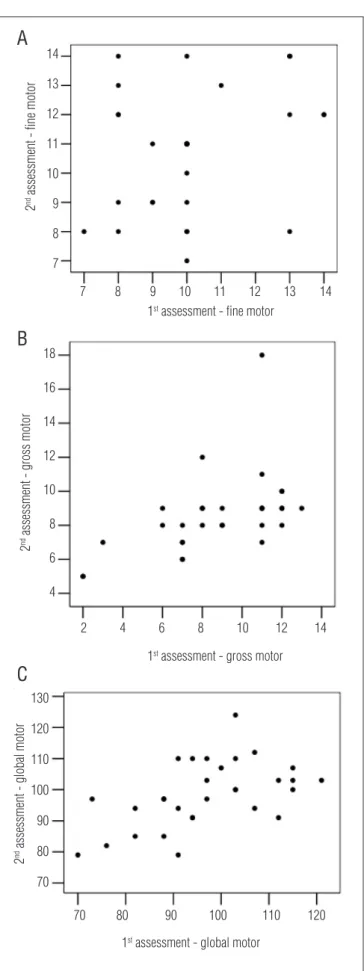
using Spearman’s correlation coefficient and scatter plots (Figure 2). The first scatter plot (Figure 2A) showed a signifi-cant variability in individual performances between the 1st
and 2nd assessments of fine motor skills and a weak
correla-tion in this area (r=0.291, p=0.119). There was less variability in gross motor skills and in global motor performance, as indicated by the moderate and positive linear correlations between 1st and 2nd assessments in the gross motor subtest
(r=0.616, p<0.001) and in overall performance (r=0.543, p=0.02; Figures 2B and 2C).
In the 1st assessment, 22 infants were classiied as having
adequate performance and eight as having suspected delays. Of the 22 infants with adequate performance in the 1st
assess-ment, only one was classiied as having a suspected delay in the 2nd assessment. In contrast, of the eight infants with
in the 2nd assessment, while the others showed adequate
mo-tor performance. hus, of the 30 infants followed up in the present study, four (13%) had suspected delays in overall performance (scores below 90) in both assessments. Of these, only one was born preterm (32 weeks gestation) and with low birth weight (1670g). he others were born at term weighing over 2500 grams.
Discussion
In the present study, although most participants presented global motor performance within normal range, 30% were
Figure 1. Motor performance on 1st and 2nd assessments.
Global motor performance
70 80 90 100 110 120
1st assessment 2nd assessment
Global motor performance
A
*54
2 6 8 10 12 14 16 18
4
1st assessment 2nd assessment
Fine motor performance Gross motor performace
B
A) Global motor performance. B) Fine and gross motor performance. Continuous line (average reference). Dashed line highlights the cutoff score for the classification of suspected delay.
Figure 2. Scatter plot.
1st assessment - fine motor
2
nd assessment - fine motor
7 8 9 10 11 12 13 14
7 8 9 10 11 12 13 14
1st assessment - gross motor
2
nd assessment - gross motor
4
2 4
6
6 8
8 10
10 12
12 14
14 16
18
1st assessment - global motor
2
nd assessment - global motor
70
70 80
80 90
90 100
100 110
110 120
120 130
A) Fine motor performance (r=0.291; p=0.119). B) Gross motor performance (r=0.616; p<0.001). C) Global motor performance (r=0.543; p=0.02).
A
B
classiied as having suspected delays in global motor perfor-mance in at least one of the assessments. he gross motor per-formance was poorer than the ine motor perper-formance at 12 and 17 months of life, and there was great discrepancy between them, especially in the 2nd assessment. Corroborating the
ind-ings of the present study, the reviewed literature indicates frequent cases of suspected or actual developmental delays among children attending day care centers. In general, these studies indicate the multiplicity of possible factors afecting motor development, including biological hazards (i.e. low birth weight, preterm birth), unfavorable socioeconomic conditions, poor parental education, multiple stress situations, and poor stimulation, often due to the day care environment10,12,14,22.
Also supporting the indings of the present study, the re-viewed literature highlights frequent situations of discrepancy or diference between gross and ine motor performances, with better ine motor performance in some instances and better gross motor performance in others11,13,15,16.In addition to the
disadvantage in gross motor skills compared to ine motor skills, the present study showed greater individual variability in the trajectory of ine motor performance compared to the gross and global motor performances, e.g. the poorest perfor-mance (gross) also showed less individual variability between 12 and 17 months of age.
hese indings corroborate other studies that show that the course of development is characterized by intense variability in which periods of developmental quiescence or stability are followed by periods of high rates of acquisition, resulting in variability in intra-individual and inter-individual scores and between diferent domains of development. Contemporary researchers have reinforced the premise that variability, not linearity, is a characteristic of typical development19,20,23,24.
hese assumptions make it more diicult to correctly identify instances of delay or change in development. Darrah et al.19
examined intra-individual stability in the gross motor perfor-mance scores of typical infants during the irst 18 months of life and found that the individual scores varied considerably, which made it impossible to identify a systematic pattern of changes among them. his inding corroborates the result of the present study, especially regarding ine motor skills for which there was great individual variability.
In 2003, Darrah et al.23 investigated the stability of scores
in the areas of ine and gross motor development and com-munication in a longitudinal study on infants between 9 and 21 months of age. he authors found a high variability in intra-individual scores, between individuals and between the diferent areas studied. he authors emphasize that the development process is marked by a typical non-linearity, rather than at a constant rate, with little correlation between
the gross and ine motor development, suggesting that these two motor areas are developed independently, contradicting the assumptions of ipsative or intra-individual stability.
Considering the challenge of the early diagnosis of abnormalities, Rosenbaum24 suggests that the
identifica-tion of differences and variaidentifica-tions in development should be interpreted with caution, keeping in mind that normal variations occur in early childhood and that there is always the possibility of monitoring the child’s development rather than basing a decision on a single assessment. The concept of monitoring development was also emphasized in a study that followed the trajectory of the gross and fine motor de-velopment of a group of children from 9 months until 5 years of age20. The results of the study from Darrah, Senthilselvan
and Magill-Evans20 support the hypothesis that the
trajec-tory of acquisition of gross and fine motor skills is charac-terized by intra-individual variability and by fluctuation in their rate of emergence.
he diference between the motor domains of infants in the present study can also be justiied by the low level of en-vironmental stimulation or lack of opportunities to reach the developmental potential. he National Curriculum Reference for Children’s Education17 points to evidence that, in many
institutions, infants spend most of the day in their cribs, which limits the opportunities to explore the environment and interact with other children, with possible efects on mo-tor skills.
A study conducted by Barros, Halpern and Menegon25
aimed to verify the operational practices of day care centers in aspects related to child care (health control, hygiene, and nutrition), organization (supervisors, training, minimum staf and child:staf ratio), and infrastructure ( facilities and mini-mum areas, building standards). he results showed that the number of children in public day care centers was greater than the number of children in private ones, and that each employee is responsible for six children aged zero to two years. In the day care centers that took part in the present study, the child:staf ratio was 7:1, with groups of up to 14 children, sometimes reaching 15. Although in Brazil, the ratio in municipal day care centers is acceptable26, the National Center for Education in
Maternal and Child Health27, in line with the American Public
Health Association and the American Academy of Pediatrics, recommends that the child:staf ratio during the irst year of life should be 3:1 with groups of up to six children and that, in the age group of 13-30 months, this ratio should be 4:1 with groups of up to eight children.
Other studies11,14,22 have also reported unfavorable
for motor development in healthy children attending private or public day care centers. he authors pointed to a) the use of inappropriate toys for the children’s age, b) the inadequacy of the places where the children were kept at a premature age, c) the lack of pedagogic supervision, d) premature extra-famil-ial socextra-famil-ialization, and e) low familextra-famil-ial socioeconomic status. he results indicated that the development of biologically healthy children may be negatively inluenced by environmental risk factors. In the study by Eickmann et al.22, the fall in development
rates (after weekly iron supplementation) in children aged four to 24 months was attributed to the low level of stimulation re-ceived, resulting from poor socioeconomic and environmental conditions, in addition to long hours in day care with an insuf-icient number of caregivers. Maciel14 indicates that, in child
care centers, work overload combined with a lack of knowledge about developmental stimulation techniques can afect the quality of psychosocial stimulation provided to children and, consequently, their mental and motor development.
Another result to be discussed in the present study was the identiication of four infants with suspected delays in motor development when considering both assessments at 12 and 17 months of age. Although this result must be ob-served with caution due to the fact that there were only two assessments over the course of the study, it is important to emphasize that it stemmed from a diagnostic tool designed for assessing child development. Diagnostic tests are more expensive and time-consuming, however they are considered the gold standard for measuring developmental outcomes and providing objective, valid, and reliable measures of child development28. herefore, this result is relevant in terms of
prevention as it identiied four (13%) children with sus-pected delays in two repeated measures, and it showed the importance of developmental monitoring and follow-up as a strategy for identifying risk, which has been strongly recom-mended by the literature20,23,24.
It is worth noting that, for at least one of the four children with suspected delay in both assessments, the motor perfor-mance scores may have been inluenced by preterm birth and low birth weight. Although the inluence of neonatal risk fac-tors in motor development is widely recognized, the present study did not ind medical complications, and the preterm in-fants were evaluated according to their corrected age. here is evidence that, in the absence of clinical complications and with age correction for preterm infants, their motor develop-ment may be similar to that of full-term children29.
Rosenbaum24 highlights at least two reasons that justify
developmental monitoring. First, most developmental disor-ders manifest themselves over time, and second, the diagnosis
of these disorders is based on the observation of phenomena or on a judgment of the child’s history and evaluation. Darrah et al.23 point out that the combined results of repeated
as-sessments may elucidate low scores by determining whether they represent a true delay or just a period of developmental quiescence.
Although the results for the motor performance of the group studied are not alarming, it is noteworthy that the mo-tor domain with the poorest outcome (gross) also showed less variability from 12 to 17 months of age. For a reliable diagno-sis of motor development, the presence of three conditions20
is recommended: a) unfavorable results in the assessment(s); b) expressions of concern by the family regarding the child’s development (in this case, concerns on the part of the care-givers should also be considered); c) the rater’s observation and clinical impression. Of the four children with suspected delays in both assessments, two of them met these three conditions, which together contribute to the identiication of changes in development.
Overall, the present study suggests the need for greater attention to motor development during the irst 17 months of life in infants attending public day care centers full time, with particular surveillance of gross motor development (consid-ering that this is part of the child’s overall development) and of children with suspected delays in motor performance in consecutive assessments. A clinical implication of this sug-gestion would be surveillance by specialists in early childhood education institutions, which would allow the analysis of the trajectory of development during the irst months and years of life, the identiication of children at risk of delay, and hence the establishment of intervention strategies to promote de-velopment. his implication is in line with the guidelines for the establishment of developmental surveillance outlined in the literature in the areas of pediatrics, physical therapy, and rehabilitation sciences20,23,24,28. he limitations of the present
study were the short follow-up only until 17 months of age, the use of only two measures of motor performance, and the lack of investigation of the quality of care given to the children at the day care centers and in the household.
Acknowledgements
References
1. Didonet V. Educação infantil: a creche um bom começo. INEP/MEC Instituto Nacional Estudos e Pesquisas Educacionais. 2001;18(73):1-161.
2. Belsky J. Early child care and early child development: Major findings of the NICHD study of early child care. Eur J Dev Psychol. 2006;3(1):95-110.
3. Sylva K, Melhuish E, Sammons P, Siraj-Blatchford I, Taggart B. The Effective Provision of Pre-School Education (EPPE) Project: Findings from Pre-school to end of Key Stage1. London: Institute of Education/DfES. 2004. Retrieved from http://www.dcsf.gov.uk/research/data/ uploadfiles/SSU_SF_2004_01.pdf.
4. Belsky J, Vandell DL, Burchinal M, Clarke-Stewart KA, McCartney K, Owen MT; NICHD Early Child Care Research Network. Are there long-term effects of early child care? Child Dev. 2007; 78(2):681-701.
5. Amorim KS, Rossetti-Ferreira MC. Análise crítica de investigações sobre doenças infecciosas respiratórias em crianças que freqüentam creche. J Pediatr. 1999;75(5):313-20.
6. Maranhão DG. O processo-saúde-doença e os cuidados com a saúde na perspectiva dos educadores infantis. Cad Saúde Publica. 2000;16(4):1143-8.
7. Veríssimo MLOR, Fonseca RMGS. O cuidado da criança segundo trabalhadoras de creches. Rev Lat Am Enferm. 2003;11(1):28-35.
8. Fisberg RM, Marchioni DML, Cardoso MRA. Estado nutricional e fatores associados ao déficit de crescimento de crianças freqüentadoras de creches públicas do município de São Paulo. Cad Saúde Publica. 2004;20(3):812-7.
9. Santos DCC, Tolocka RE, Carvalho J, Heringer LRC, Almeida CM, Miquelote AF. Desempenho motor grosso e sua associação com fatores neonatais, familiares e de exposição à creche em crianças até três anos de idade. Rev Bras Fisioter. 2009;13(2):173-9.
10. Paula CS. Atrasos de desenvolvimento mental e motor em crianças de creches de comunidade urbana de baixa renda e fatores de risco associados [dissertação]. São Paulo: UNIFESP; 2001.
11. De Barros KM, Fragoso AG, de Oliveira AL, Cabral Filho JE, de Castro RM. Do environmental influences alter motor abilities acquisition? A comparison among children from day-care centers and private schools. Arq Neuropsiquiatr. 2003;61(2A):170-5.
12. Souza SC. Avaliação do desenvolvimento neuropsicomotor do pré-escolar de creches públicas de Cuiabá-MT [dissertação]. São Paulo: Universidade de São Paulo; 2004.
13. Rezende MA, Beteli VC, dos Santos JL. Folow-up of the child’s motor abilities in day- care centers and pre-schools. Rev Lat Am Enfermagem. 2005;13(5):619-25.
14. Maciel AMS. Desenvolvimento mental e motor de crianças em creches da rede municipal do Recife [dissertação]. Pernambuco: Universidade Federal de Pernambuco; 2006.
15. Biscegli TS, Polis LB, Santos LM, Vicentin M. Avaliação do estado nutricional e do desenvolvimento neuropsicomotor em crianças freqüentadoras de creche. Rev Paul Pediatr. 2007;25(4):337-42.
16. Sabatés AL, Mendes LCO. Perfil do crescimento e desenvolvimento de crianças entre 12 e 36 meses de idade que freqüentam uma creche municipal da cidade de Guarulhos. Ciênc Cuid Saúde. 2007;6(2):164-70.
17. Brasil. Ministério da Educação e do Desporto. Secretaria de Educação Fundamental. Referencial Curricular nacional para educação infantil/ Ministério da Educação e do Desporto, Secretaria de Educação Fundamental [Internet book]. Brasília: MEC/SEF; 1998. Retrieved on Nov 10 2007 from http://portal.mec.gov.br/seb/index.php?option= content&task=view&id=556.
18. Batista R. A rotina no dia-a-dia da creche: entre o proposto e o vivido [dissertação]. Florianópolis (SC): Universidade Federal de Santa Catarina; 1998.
19. Darrah J, Redfern L, Maguire TO, Beaulne AP, Watt J. Intra-individual stability of rate of gross motor development in full-term infants. Early Hum Dev. 1998;52(2):169-79.
20. Darrah J, Senthilselvan A, Magill-Evans J. Trajectories of serial motor scores of typically developing children: Implications for clinical decision making. Infant Behav Dev. 2009;32(1):72-8.
21. Bayley N. Bayley scales of infant and toddler development. Third Edition. San Antonio: Harcourt Assessment; 2006.
22. Eickmann SH, Brito CMM, Lira PIC, Lima MC. Efetividade da suplementação semanal com ferro sobre a concentração de hemoglobina, estado nutricional e o desenvolvimento de lactentes em creches do Recife, Pernambuco, Brasil. Cad Saúde Publica. 2008;24(Suppl 2):303-11.
23. Darrah J, Hodge M, Magill-Evans J, Kembhavi G. Stability of serial assessments of motor and communication abilities in typically developing infants: Implications for screening. Early Hum Dev. 2003;72(2):97-110.
24. Rosenbaum P. Classification of abnormal neurological outcome. Early Hum Dev. 2006;82(3): 167-71.
25. Barros AJD, Halpern R, Menegon OE. Creches públicas e privadas de Pelotas, RS: aderência à norma técnica. J Pediatr. 1998;74(5):397-403.
26. Vitória T, Rossetti-Ferreira MC. Processos de adaptação na creche. Cad Pesqui. 1993;86: 55-64.
27. American Academy of Pediatrics, American Public Health Association, and National Resource Center for Health and Safety in Child Care and Early Education. Caring for Our Children: National Health and Safety Performance Standards: Guidelines for Out-of-Home Child Care Programs, 2nd edition. [Internet book]. Elk Grove Village, IL: American Academy of Pediatrics and Washington, DC: American Public Health Association; 2002. Retrieved Feb 10 2009 from http://nrc.uchsc.edu/ CFOC/ PDFVersion/list.html and http://nrc.uchsc.edu/CFOC/PDFVersion/Chapter%201.pdf.
28. Johnson S, Marlow N. Developmental screen or developmental testing? Early Hum Dev. 2006; 82(3):173-83.