
Article
J. Braz. Chem. Soc., Vol. 27, No. 2, 349-362, 2016. Printed in Brazil - ©2016 Sociedade Brasileira de Química 0103 - 5053 $6.00+0.00
A
*e-mail: [email protected], [email protected]
#Present address: Department of Chemical Engineering, College of
Engineering, Qatar University, 2713, Doha, Qatar
Self-Organization in Ionic Liquids: From Bulk to Interfaces and Films
Karina Shimizu,*,a,b Mohammad Tariq,#,b Adilson A. Freitas,a Agílio A. H. Páduac and
José N. C. Lopes*,a,b
aCentro de Química Estrutural, Instituto Superior Técnico, Universidade de Lisboa,
1049-001 Lisbon, Portugal
bInstituto de Tecnologia Química e Biológica, Universidade Nova de Lisboa,
2780-157 Oeiras, Portugal
cLaboratoire Thermodynamique et Interactions Moléculaires, CNRS/Université Blaise Pascal,
Clermont-Ferrand, France
In this contribution we present an overview on the relation between the complex structure of ionic liquids (ILs) and its impact in the field of surface science. The results herein described result mainly from modeling and simulation work carried out at Centro de Química Estrutural, Universidade de Lisboa, complemented in some cases by experimental results obtained at Instituto de Tecnologia Química e Biológica, Universidade Nova de Lisboa or elsewhere. The overview starts with the description of nano-segregation and self-aggregation phenomena experienced by pure ionic liquids in bulk phases (bi-continuous structures in the isotropic liquid or the formation of liquid-crystal phases). This is followed by the analysis of IL self-aggregation in molecular solvent solutions (micelle or gel formation). The second part of the overview is devoted to the study of the structuration of ILs at the IL/vacuum, IL/liquid or IL/solid interfaces. The final part deals with thin IL films stabilized between air/solid, air/liquid or solid/solid boundaries.
Keywords: molecular dynamics, nano-segregation, micelle, structure factor, nanostructured fluid
Introduction
Ionic liquids (ILs) are a new class of salts with unusually low melting point temperatures (100 ºC is the commonly accepted upper limit). Since their introduction in the last
decade of the 20th century, there has been an enormous
interest from the academic and industrial communities that resulted on a vast amount of fundamental and applied research work. Many industrial applications are currently
being developed or are already implemented.1 ILs are
considered potential substitutes for traditional solvents due to a unique set of properties such as negligible vapor pressure, high thermal stability, non-flammability, wide electrochemical window, enhanced solvent quality and easy recycling.
Despite the recent widespread use of ILs for different types of application, including many where interfaces
play a central role, they have not yet been fully subjected to the same level of molecular scrutiny experienced by
more traditional surfaces or interfaces.2-6 For instance,
ILs are finding use as gas-capture media. This process involves collisions between gas-phase molecules and the IL surface, which is an important mass transfer step leading to equilibrium. This elementary process is highly dependent on the chemical/structural nature of the liquid surface.7
Ionic liquids are salts, substances composed essentially of cations and anions. This fact differentiates them from simple ionic solutions, where ions are dissolved in a molecular medium. The lack of a molecular solvent has a profound impact in the structure of the ionic fluid near a surface boundary. This overview encompasses our most recent efforts in the investigation of such behavior.
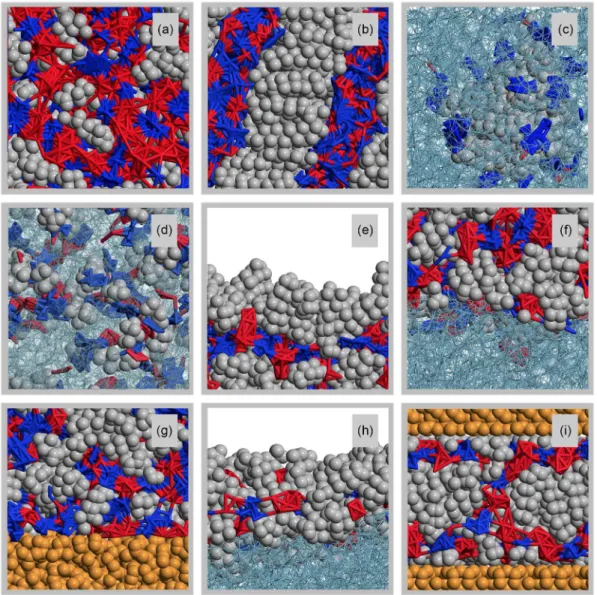
with molecular solvents (Figures 1c and 1d); the three central sub-sections focus on ILs at the IL/air, IL/liquid or IL/solid interface, respectively (Figures 1e-1g); the three final sub-sections analyze the behavior of IL thin films stabilized between two boundaries: air/solid, air/liquid, solid/solid (Figures 1g-1i), respectively.
Experimental
Molecular dynamics (MD) of condensed phases of different pure ILs, molecular solvents (water) and solid substrates (silica, alumina, mica) were carried out using the
DLPOLY package.8 All IL molecular ions were modeled
using a previously described all-atom non-polarizable force field (CL&P),9-14 which is based on the optimized
potentials for liquid simulations, all atom (OPLS-AA)
framework15 and specifically developed to encompass entire
IL homologous series. OPLS-AA parameterizations were employed for the other species. Some of the MD trajectories used in this work originated from previous works on the same or similar systems.16-21 Nevertheless, all discussions
are based on new analyses performed on new or prolonged MD runs.
When studying nanostructured fluids, the size of the systems and the duration of the simulations are of particular importance since periodic boundary conditions can induce artificial finite-size effects on the length scales of the observed nanostructures. Most system sizes were chosen as to contain at least 13,000 atoms, which correspond to cutoff distances above 1.6 nm. Due to the slow dynamics of IL systems, special care was taken to ensure the attainment of equilibrium conditions: (i) equilibrations started from
Figure 1. Simulation snapshots depicting different types of structural/boundary features discussed in this work. All images have been represented in the same scale, the side of each square measuring 3.5 nm. The polar moieties of the IL are represented as dark and light coarse mesh (cations and anions, respectively), the non-polar alkyl side chains of the cations as light grey space-filled atoms, water molecules as a fine mesh, air/vacuum phases as a white background and solid substrates (mica, alumina) as dark space-filled atoms. Details concerning the nature of the different ILs are given in each subsection.
initial low-density configurations, with ions placed at random in periodic cubic boxes; (ii) typical equilibrations were implemented for more than 1 ns under isothermal-isobaric (N-p-T) ensemble conditions (under the action
of Nosé-Hoover barostat and thermostat); (iii) multiple
re-equilibrations through the use of temperature annealing and switching off and on of the Coulomb interactions were performed; (iv) further simulation runs were used to produce equilibrated systems at the studied temperatures. The equilibrated systems were used in production runs of at least 4 ns. Electrostatic and repulsive-dispersive interactions were explicitly calculated for distances below the 1.6 nm cutoff. In the case of repulsive-dispersive interactions, long-range corrections were applied assuming the system had a uniform density beyond this cutoff radius. Long-range electrostatic interactions were treated using the Ewald summation method considering six reciprocal-space vectors. Special boundary conditions/corrections were applied to systems with slab geometries (explicit interfaces).
Structural analyses involved the calculation of radial, cylindrical and spatial pair distribution functions (RDFs, CDFs and SDFs, respectively), structure factor functions (S(q)) and aggregation analyses based on five especially defined statistical tools that allow the estimation of (i) average aggregation numbers; (ii) and (iii) number of contact neighbors in average and within a given aggregate,
respectively; (iv) aggregate length and (v) aggregate
volume.
Complementary experimental results were obtained via different methods, ranging from diffraction, microscopy and spectroscopy techniques (small and wide-angle X-ray scattering-SWAXS, atomic force microscopy-AFM) to the determination of thermophysical properties (densimetry, calorimetry, tensiometry, solubility).22-34
Results and Discussion
Pure ILs in the bulk phase
The notion that the structure of ILs is complex and can exhibit nanoscale segregation started to be investigated
almost ten years ago via molecular modeling studies,35-37
with the pioneering study in this area performed in Brazil
by Urahata and Ribeiro.35 The existence of mesoscopic
structures composed by different moieties of the molecular ions of ILs was confirmed experimentally in 2007 by X-ray diffraction33 and the interpretation of the corresponding
spectra has been an area of intense debate since then.26,38-41
Experimental evidence linking the structure of ILs to their macroscopic properties has also been interpreted in terms of the underlying nanoscale segregation.42,43
The nano-structuration in pure ILs in the bulk phase can be summarized as the superimposition of two types of ordering of the liquid phase with two distinct characteristic wavelengths: (i) the ionic character of the fluid imposes some sort of charge ordering which induces the development of a polar network formed by ions of alternating sign —the first contact shell of a given ion is
always composed by its counter-ions, Figure 2b; (ii) the
existence in many ILs of non-polar moieties associated to the molecular ions (generally alkyl side chains) causes the segregation between the polar network and non-polar domains. When the volume occupied by the alkyl chains is large enough, those non-polar domains form a second continuous sub-phase, Figure 2c. The structure factor function of a given IL will exhibit charge-ordering peaks (COPs) and polar-non-polar peaks (PNPPs) that correspond to these two types of structuration, Figure 2d.
The preferred solvation of different molecular solutes in different regions of the IL (within the polar network, in the non-polar domains, or even at the interface between the polar and non-polar regions) is one of the most interesting and useful outcomes of the nano-segregated nature of ILs in the bulk liquid phase.44
Another possible outcome arises when the size of the non-polar moieties and the nature of the polar network allow the formation of a liquid-crystal phase. Figure 3a shows a MD simulation snapshot of the liquid crystalline structure of 1-dodecyl-3-methylimidzoliun tetrafluoroborate, [C12C1im][BF4], an IL that exhibits a smectic phase between
318 and 358 K. Order is still maintained in the direction normal to the planes/strata but disrupted in the two in-plane directions. The corresponding g(r) functions shown in Figures 3b and 3c depict, on one hand, the existence of a 2D network of alternating ions within each polar layer and, on the other hand, the organization of the dodecyl chains in non-polar strata where chains originating from two different polar layers adopt interdigitated configurations relative to each other.
Self-aggregation in IL solutions
Given the propensity of a pure IL to structure itself in different types of ordered domains, the ensuing question is what happens if an IL is mixed with a molecular solvent? The answer depends, of course, on the mutual solubility of
the components andtheir relative amounts in the mixture.
Diluted aqueous solutions of ILs containing ions with long alkyl side chains (typically larger than octyl chains) can exhibit self-aggregation phenomena45,46 similar to that
of conventional surfactants, Figure 4a.25,47-49 In these cases
melting point or their rather sophisticated solvency effects,
become minor or of no consequence.50
In this context, isothermal titration calorimetry (ITC), a powerful technique for the quantitative investigation of the aggregation properties of surfactants, was used to study the temperature dependent aggregation behavior of three dilalkylpryrrolidinium bromide ILs in aqueous solutions
namely: N-methyl-N-dodecylpyrrolidinium bromide,
[C1C12Pyrr]Br, N-butyl-N-dodecylpyrrolidinium bromide,
[C4C12Pyrr]Br, and N-butyl-N-octylpyrrolidinium bromide,
[C4C8Pyrr]Br. These systems are structurally very close
to tetra-alkylammonium salts that are used as traditional ionic surfactants and the similarities or differences to be encountered can contribute to elucidate the mechanisms and the structures responsible for the aggregation of ILs in aqueous solutions, namely micelle formation.
The values of critical micelle concentration, CMC, and micellization enthalpy, ∆micH, determined at different
temperatures using ITC (Figure 4b) of the above mentioned
ILs allowed the rationalization of the self-aggregation phenomena in those systems and their correlation with the behavior of analogous traditional surfactants.51 One of the
main conclusions was that [CnC1Pyrr]Br surfactants act
exactly like the corresponding conventional single-chained surfactants, of the N-alkyl-N,N,N-trimethylammonium
bromide family, CnTAB, with similar free energies of
transfer of one surfactant molecule from the aqueous to the micellar environment. This conclusion could even be extended to surfactants with two long alkyl chains such as the [CmCnPyrr]Br ILs and surfactants of the N,N
-dialkyl-N,N-dimethylammonium bromide family, CmCnDAB.
context we have performed a study on the determination of volumetric data which allows a direct understanding of the relations between the self-aggregation phenomena (micelle formation in this case), the concomitant structural changes that occur in the aqueous solutions and the corresponding consequences at a volumetric level (Figure 4c).
The three ILs selected for such study24 were members
of the 1-alkyl-3-methylimidazolium chloride homologous series-[C8C1im]Cl, [C10C1im]Cl and [C12C1im]Cl-and are
hydrophilic ILs that form micelles in aqueous solutions at quite distinct concentration ranges, the choice of these ILs also reflected the emphasis given to the measurement of volumetric properties: their specific densities are all very close to that of pure water: at 298 K [C8C1im]Cl is slightly
more dense than water, whereas the other two are slightly less dense than water. These two sets of properties (different CMCs, similar densities) imposed a rather stringent test
to the capability of evaluating micelle formation using volumetric data in the corresponding diluted aqueous solutions.
The global volumetric behavior at 298 K of the three aqueous solutions containing the three ILs under analysis is depicted in Figure 4c, which shows the expected density profiles of each solution if all mixtures exhibited null excess molar volumes (ideal volumetric behavior, i.e.,
ρid = (x1M1 + x2M2)/(x1V1 + x2V2), with Mi and Vi the molar
mass and molar volume of the ith component of the mixture).
Figure 4c also shows that, whereas [C8C1im]Cl is around 1%
more dense than pure water, [C10C1im]Cl and [C12C1im]Cl are
less dense than pure water by around 1 and 3%, respectively. The inset shows the experimental density data (also at 298 K) for very diluted IL solutions of [C10C1im]Cl superimposed
on the corresponding ideal behavior lines. Some general comments are possible: (i) the experimental density data are Figure 3. Structuration of a pure IL as a liquid crystalline phase. (a) MD simulation snapshot of 1-dodecyl-3-methylimidazolium tetrafluoroborate, [C12C1im] [BF4]; (b) pair radial distribution functions, g(r), between selected interaction centers belonging to the charged parts of the [C12C1im]+ and [BF4]– ions. Curve 1: g(r) between the centroid of the imidazolium ring (im) and the boron atom of the anion (B); curve 2: B–B g(r); curve 3: im–im g(r). The polar network is present within each polar layer; (c) g(r)s between carbon atoms in the same position of the alkyl side chains of the [C12C1im]+ ion. The higher g(r) first peaks for the C6 and C7 carbon atoms corroborate the interdigitation of the alkyl chains.
always larger than the corresponding ideal values; (ii) for the most diluted concentrations, the slopes of the experimental data are almost constant and always larger than the slope of the corresponding ideal lines; (iii) at a certain point and for slightly more concentrated solutions, the experimental data slopes start to change and approach the corresponding values (slopes) of the ideal lines. These last trend shifts can be correlated with the attainment of the CMC. For the shown system, the positive deviation between the experimental and ideal values implies that aqueous solutions between 0 and 0.001 mole fraction in the IL exhibit densities that are larger than the densities of both pure water and the pure IL: the density measurements are directly giving a measure of the excess volumetric properties of the mixtures.
The volumetric data show that is indeed possible to estimate the position of the CMC based solely on volumetric data. Moreover, compared to other methods (surface tension, fluorometry, nuclear magnetic resonance) that are frequently used to estimate CMCs, such analysis also provides some insights concerning the behavior of the solute in the midst of the water molecules. The initial increase in the solutions density is caused by the partial break-up of the hydrogen-bonded network of water molecules due to the intrusion of the solute ions, specially the aliphatic moieties that cause the existence of hydrophobic effects. From the CMC region onwards most of the chains will be “hidden” from the water molecules due to micelle formation, which means that the collapse of the water structure will be less pronounced and the density slopes with concentration will become similar.
The last part of this sub-section deals with volumetric measurements performed at more concentrated regimes of similar aqueous solutions (Figure 5).
In case of [C8C1im]Cl solutions we have observed
gel-like structures in the 0.2 > xIL > 0.4 concentration
range at room temperature. At higher temperatures and IL concentrations, the solutions became clear and fluid again. Figure 5b presents the corresponding volumetric data, expressed as the excess volume of the solutions. The gap in the measurements corresponds to the formation of gel-like systems. For [C10C1im]Cl, the solutions become
very viscous (solid-like) above xIL = 0.06 concentrations
thereby precluding volumetric measurements in the whole composition range. The presence of gel or solid-like phases may indicate the formation of different mesophases in these water-IL systems and is an area currently under investigation.
Another research area where some degree of structuration in bulk aqueous solutions of different ILs occurs is that related to hydrotrope effects. In this case, short-chained hydrophilic ILs such as 1-butyl-3-methylimidazolium dicyanamide, [C4C1im][N(CN)2], are able to increase the
solubility of hydrophobic substances in aqueous media by more than one order of magnitude. Although hydrotropes are used to improve the solubility of poorly soluble compounds in water they are not surfactants; the non-polar side chains of hydrotropes are smaller than those of traditional surfactants and they do not form micelles or present a critical micelle
concentration (CMC) in the absence of a solute.47,48
Figure 5a highlights the structure of diluted solutions of [C4C1im][N(CN)2] in water: the continuous polar network
that is the hallmark of most pure ILs is broken into smaller aggregates, which nevertheless can still incorporate in some cases a few tens of alternating ions —the size distribution probability functions, P(na), of those polar aggregates can
be seen in the graph (cat-an) in Figure 5c. In other words, the “dissolved and diluted”IL is not simply a set of isolated
ions solvated by water molecules, but rather a series of small (and not so small) filamentous ionic strands incorporated within the liquid water matrix. Aggregate analyses of those strands show that the number of neighbors of each ion in a given strand is never much larger than two, which confirms the non-branched and filamentous nature of the aggregates. Moreover, their estimated volume-to-length ratio is generally below 0.03, which means that their shapes can be approximated to elongated prolate ellipsoids. The incorporation of such strands in the aqueous solution can be further probed by the analysis of anion-water aggregates (graph an-w in Figure 5c) that show that the interactive centers of the anions (the nitrogen atoms of dicyanamide) undergo specific H-bond-type interactions with the hydrogen atoms of the water molecules and help to create small networks of alternating water molecules and anions that can contain a few tens of species. It is interesting to note that whereas around 80% of the water molecules do not contact any anion (at the tested concentrations the IL only occupies less than 20% of the total volume of the solution), the remainder 20% of the water molecules becomes part of clusters that are composed of several anions. In fact, the size distribution of the clusters mimics the distribution of the IL clusters present in the solution. In other words, the interactions between the anions and the water molecules help to stabilize those filamentous IL clusters in the midst of the aqueous solution. This complex and unique structure plays an important role in terms of hydrotropy.
The free surface of pure ILs (IL/vacuum interfaces)
The two previous sub-sections dealt with the nano-segregated structure of ILs in bulk phases. The next three
sub-sections deal with the rearrangement of those complex structures when they meet a 2D boundary such as the IL/gas, IL/liquid or IL/solid interface. The simpler IL/gas boundary will be considered first (Figure 6).
We start at the free surface of ILs by discussing their surface tension. Among the many unique properties of ILs, their surface tension plays a special role for different reasons. Even at conditions well above room temperature, ILs typically exhibit extremely low vapor pressure values.52
This fact is a consequence of their ionic nature and makes it difficult to accurately determine the cohesive forces present in the liquid. The use of corresponding states principles and other powerful correlation techniques commonly used for molecular fluids5 are also difficult to implement. Surface
tension values are a way to circumvent an issue that is hard to solve for the bulk fluid but it is possible to access at the liquid-gas boundary —surface tension is a measure of cohesive forces between liquid molecules present at the surface and it represents the quantification of force per unit length of free energy per unit area. Thus, the measurement of surface tension of ILs is one of the most effective ways to (indirectly) access the intrinsic energetics that are involved in the interactions between the ions. Such measurements are also vital to anchor theoretical models that are able to describe realistically, at a molecular level, the fluid properties and structural nature of ILs.
As we saw, a distinctive characteristic of ILs is their nano-segregated nature. The lack of fluid isotropy already present in the bulk is also present (and sometimes enhanced) at the surface.53 This means that surface tension data are also a
powerful means to explore the different types of segregation/ orientation that occur at an ionic/molecular level and how these influence the interactions with other molecules.54
For liquids composed of spherical molecules, e.g., liquid argon or methane, the surface ordering effects are negligible and the surface tension correlates well with the intermolecular interactions in the bulk. In contrast, for liquids composed of non-spherical molecules with polar and non-polar groups, the molecules at the interface may be strongly oriented. According to the Langmuir’s principle of independent surface action, each part of a molecule that is actually present at the interface contributes with its own surface free energy to the surface tension of the liquid. In the case of spherical molecules the liquid surface should represent a random truncation of the bulk, in contrast for non-spherical molecules, where the interface is different from the bulk and the surface tension results from the contributions of the groups that form the outer layer of the interface. Langmuir’s principle was successfully applied to the surface tension of ILs55-57 but its application demands
the knowledge of the surface tensions of the separated ions and their moieties. Analysis of a large set of experimental values of surface tension of ILs led Kolbeck et al.57 to
conclude that the “observed behavior can be explained in a consistent way considering Langmuir’s principle, namely that the surface composition is determined by the interplay of cohesive energy and surface orientation”. This means for instance that ILs with long alkyl side chains on either the cation or the anion have the surface region dominated by these tails, which are oriented away from the bulk. However, if the alkyl chains are short or functionalized different effects may occur.
On a first set of experimental determinations, we have measured liquid density and surface tension data in temperature ranges up to 473 K and 532 K, respectively, for
1-alkyl-3-methylimidazolium bis(trifluoromethylsulfonyl)
amide ILs, [CnC1im][Ntf2] with n= 2-10, 12, and 14.23 The
aim was to test the validity of the above-mentioned theories. Figure 6 shows that the surface tension decreases with increasing temperature and with the increase of the alkyl side chain length along the [CnC1im][Ntf2] family.
The decrease is more significant from [C2C1im][Ntf2]
to [C5C1im][Ntf2], less so in the [C6C1im][Ntf2] to
[C12C1im][Ntf2] range, and shows a noticeable drop from
[C12C1im][Ntf2] to [C14C1im][Ntf2]. Part of this irregular
behavior can be attributed to the overall uncertainty of the data, including the fact that the surface tension is a property sensitive to the presence of small amounts of impurities. Nevertheless one can always speculate that part of the observed trends are a manifestation of different types of arrangements at the surface as the ratio of the non-polar to polar moieties of the ILs is altered by the increase in length of the alkyl side chains. Interestingly this could also be a reflection of what is happening in the bulk
phase: MD simulations and X-ray diffraction studies32,58
have shown that in the case of the [CnC1im][Ntf2] family,
there is a transition in the bulk structure of the ILs around
[C6C1im][Ntf2] (formation of non-polar continuous
domains). It is also known that with alkyl side chains above 12 carbon atoms long there is the possibility of a transition from an isotropic (albeit nano-structured) fluid to a partially layered (more smectic-like) fluid,59 although in the case of
[CnC1im][Ntf2] (n = 12-18) ILs no evidence of liquid crystal
formation was ever found.60
The [CnC1im][Ntf2] series highlights two important
features of ILs in terms of their surface tension: for ILs with small side chains (where the influence of the polar network is dominant and direct at the free surface) the surface tension values at 298 K lie in a range (25-60 mN m-1) which
is a no man’s land between the idiosyncratic value of water
(72 mN m-1) and the values of most molecular solvents
(usually below 25 mN m-1); on the other hand, as the alkyl
side chains become longer, the surface tension values tend to decrease or become constant.
From the structural point of view, such findings can be easily rationalized taking into account the density profiles along the normal to the surface of the different moieties present in the systems. Figure 6c shows one such profile for the free surface of 1,3-didecylimidazolium
bis(trifluoromethylsulfonyl)imide, [C10C10im][Ntf2]. As
one approaches the surface from the vacuum sides, the first layer to be found is composed of the alkyl side chain(s) of the cation. This is immediately followed by a (polar) layer enriched in the charged parts of the ions that compose the IL (the imidazolium ring and the atoms directly attached to it and the bis-triflamide anion). The main difference between the system under discussion with dual and symmetrical alkyl side chains in the cations and previous atomistic simulations of members of the [CnC1im][Ntf2] series (with a
single long alkyl side chain),61 is that in the former example
the polar layer is followed by a second well-defined layer enriched in alkyl side chains, whereas in the latter cases such secondary nonpolar layer is almost absent (Figure 6c, image on the right). The numerical density profiles also show that this layering continues to be noticeable (albeit subdued) further away from the free surface (alternation between chain rich and polar-head-rich layers). This kind of situation has been previously observed in coarse-grained simulations of single-chained cations (10 or 12 carbon
atoms long chains) combined with small and rigid anions.62
ILs at the IL/liquid interface
immiscible. One of the most studied molecular solvents studied in this context is water, which means that instead of using the hydrophilic ILs given as examples in “self-aggregation in IL solutions”, one must switch back to more hydrophobic ILs. Figure 7a exemplifies this with a simulation snapshot of the [C18mim][Ntf2]-water interface.
The most striking difference relative to the IL-vacuum interface is that the charged parts of the ions get closer to the interface, instead of the alkyl side chains. The layering patterns already observed for the IL-vacuum interface are also present in this case (Figure 7b), although their intensity and dampening when moving away from the surface is strongly dependent on the size of the alkyl side chains attached to the ions and the nature of the anion. Such structures at the interface between two liquids are particularly difficult to probe experimentally, and several studies derived from the collaboration between experimental and modeling techniques are currently being developed.63-68
On the other hand, this type of systems, where liquid-liquid demixing occurs, are particularly important in terms of separation processes. A specially relevant case is the formation of aqueous biphasic systems (ABS) where an IL is mixed with an aqueous solution containing a salting-out agent such as an inorganic salt (K3[PO4] is one
of the most commonly used), Figure 7c. The name biphasic stems from the fact that when the IL is salted-out from the aqueous solution it usually carries with it a relatively high proportion of water molecules (both hydrophilic and hydrophobic ILs are hygroscopic). The partition of a solute molecule between the two phases of an ABS system must necessarily pass through the “IL-rich”-“water-rich” interface and the modeling described in the previous paragraphs can be an important tool in designing and
optimizing such separation processes.69
ILs adsorbed at a solid surface
The adsorption of surfactants on solid surfaces has been the subject of numerous studies. This phenomenon has widespread technological applications in wetting, adhesion, nano-fabrication, cleaning and degreasing of metal surfaces. The adsorbed layers (typically of nanometric size) are known to play a key role in the development of new electronic devices, sensor materials and surfaces with special wetting properties. Several attempts have been made to understand the nanoscopic features of the adsorbed layers which are required for the design of interfaces with desired characteristics, such as wetting, agglomeration and friction properties.70 Particularly relevant are studies related
to the self-organization of amphiphilic molecules (anionic, cationic, zwitterionic and mixed micellar systems) and the factors responsible for the alteration of the corresponding structures. The resulting shapes of the adsorbed aggregates are considered to be a compromise between packing effects and specific constraints due to molecule-substrate interactions. The micelles of conventional surfactants adsorbed at the solid-liquid interface are generally considered to be stable only in the presence of the solution —the ordered structure may be lost when the solvent is taken out from the system. However, some cases have been reported, where the regular packing of two-dimensional aggregates formed by amphiphilic molecules at the solid-liquid interface have been successfully preserved at the solid substrate after solvent removal.71 The behavior
of ILs at solid surfaces has been the focus of different works.17,22,72-74
Figure 8a shows the IL 1-methyl-3-octylimidazolium
tetrafluoroborate adsorbed at an alumina surface.19 The
objective of that work was to clarify the nature of the lamellar
structure reported by several authors76-82 for ILs at solid
interfaces. The interfacial structure was investigated using atomic force microscopy imaging and MD simulations. It concluded that the behavior of the IL adsorbates is strongly dependent on time and concentration of the IL solution used to deposit the IL at the surface. Structures can vary from liquid-like structures, coexisting liquid and solid phases, and solid-like (ziggurat-type) structures.
On the other hand, a similar study conducted exclusively by MD of 1-(2-hydroxyethyl)-3-methylimidazolium tetrafluoroborate, [(OH)C2C1im][BF4] at the surface of
amorphous silica (Figure 8b), concluded that the adsorption and stratification process of ILs over solid substrates can be correctly modeled using a realistic rendition of a non-uniform amorphous substrate such as a glass material and that the stratification occurs even in the absence of long alkyl side chains. The resulting layered structures can be seen as a consequence of the compact and alternate packing of the ions at the solid surface, which is dominated by charge-template effects produced by the amorphous substrate.
Finally, the adsorption behavior of 1-alkyl-3-methylimidazolium chloride ILs on a gold surface was investigated via the measurement of dissipation factors using a quartz crystal microbalance (QCM) and the observation of the morphology and structural patterns formed by diluted IL surfactant solutions dried on the surface. Comparison of the height profile of the [C10C1im]
Cl layer (2-3 nm, Figure 8c) with the hydrodynamic diameter, 1.4 nm83 for this IL suggests that the uppermost
part of this layer reflects the structure of cylindrical micelle structures. We should stress that the AFM images only
provide information about the topography of the outer surface and does not allow the estimation of the thickness of all adsorbed layers.
IL Langmuir films at the air/water interface
The knowledge of the structure and packing of ILs at interfaces is of utmost importance for the rational design of such media. A key aspect in the design and preparation of functional materials is the control of intermolecular interactions and molecular packing in the first few monolayers at the surface.84
The air-liquid interface is an ideal model surface that is easy to prepare in a pure and well-characterized state and whose surface coverage can be smoothly adjusted using trough techniques. IL Langmuir films are thus extremely important in this context.
The behavior of trihexyl(tetradecyl)phosphonium
bis(trifluoromethylsulfonyl)imide, [P6 6 6 14][Ntf2], at the
water-air interface was investigated using the Langmuir trough technique (Figure 9a). The obtained surface pressure
versus mean molecular area (MMA) isotherms, π-A, show
distinct regimes (Figure 9b). The results were interpreted at a molecular level using molecular dynamics simulations: the different compression regimes along the [P6 6 6 14][Ntf2]
isotherm correspond to the self-organization of the ions at the water surface into compact and planar monolayers
that coalesce at a MMA value of ca. 1.85 nm2 per
ion-pair to form an expanded liquid-like layer. Upon further
compression the monolayer collapses at around 1.2 nm2per
ion-pair to yield a progressively thicker and less organized
Figure 8. ILs adsorbed on solid substrates. (a) MD simulation snapshot of the interface between 1-methyl-3-octylimidazolium tetrafluoroborate, [C8C1im] [BF4], and an alumina, Al2O3, amorphous surface; (b) top view of the IL-glass interface of 1-(2-hydroxyethyl)-3-methylimidazolium tetrafluoroborate adsorbed on amorphous silica. The contour graphs in the top row show the electric fields generated by the glass atoms (graph on the left) and the IL ions (two graphs on the right). Selected carbon atoms from the imidazolium ring of the cation (C2, gray spheres) and boron atoms from the anion (green spheres, light gray in the print version) contained in the 0.5 nm thick layer closest to the glass surface are also presented in the two right graphs. The color scale is in electric field units of 1.44 × 10¹¹ J C-1 m-1. The bottom graph represents number density profiles of the [BF
Figure 9. IL Langmuir film at the air/water interface. (a) MD simulation snapshot of a Langmuir film of trihexyl(tetradecyl)phosphonium
bis(trifluoromethylsulfonyl)imide, [P6 6 6 14][Ntf2], at the air-water interface; (b) room-temperature isotherms of the [P6 6 6 14][Ntf2] system at the air water-interface: (top) surface pressure versus mean molecular area (MMA) data, π-A;(bottom) compressional modulus, (1/CS), versus MMA data; (c) (top) MD simulation snapshots of the [P6 6 6 14][Ntf2] systems with a surface MMA value of 1.44 nm2per ion pair. The left image highlights the positions of the anions (red – light gray space-filled atoms in the print version) and the central charged cores of the cation (blue – dark gray spheres in the print version). The right image uses CPK colors (anions in dark gray and non-polar alkyl chains in light gray space-filled atoms in the print version. Bottom numerical and charge density profiles along the direction normal to the water-vacuum surface. Anion density as curve 1; imidazolium ring densitiy as curve 2; hexyl and tetradecyl terminal carbon atom densitiy as curves 3 and 4, respectively; water molecule density as curve 5. Charge density is represented as curve 6.
Figure 10. IL film confined between two solid surfaces. (a) MD simulation snapshot of a film of N-decyl-N-methylpyrrolidinium bis(trifluoromethylsulfonyl) imide, [C10C1pyrr][Ntf2], confined between two mica plates ca. 2.4 nm apart; (b) and (c) numerical profiles along the direction normal to the mica surfaces. Color codes (grayscale in the print version) given by the different moieties of the molecules in the graph insets.
layer. The numerical density profiles obtained from the MD simulation trajectories are also able to emphasize the very unusual packing of the four long alkyl side chains of the cation above and below the ionic layer that forms at the water surface (Figure 9c).
IL thin films between solid substrates
ILs containing short alkyl side chains form layered structures at charged surfaces, as seen both from
experiments85-88 and simulations,89-93 consisting of
alternating cation/anion monolayers (“Section: ILs adsorbed at a solid surface”). This layering is also observed
in confinement between two extended charged surfaces.94-99
On the other hand, ILs with long alkyl side chains can self-assemble to form lamellar bilayers in confinement.97,98
With the ongoing miniaturization of devices, they are prospective lubricants for nano/microelectromechanical
systems (NEMS/MEMS), where lubrication must be achieved with films with only a few molecular layers. At such small length scales, surface forces dominate, and it becomes critical to understand molecular friction, adhesion, and wear mechanisms at such scales.
Figure 10a shows a simulation snapshot of the
system N-decyl-N-methylpyrrolidinium bis
(trifluoro-methylsulfonyl)imide, [C10C1pyrr][Ntf2], confined between
two mica plates a few nanometers apart. The structure of the modeled system is probed via the numerical density profiles depicted in Figures 10b and 10c. The layered structure is emphasized by the presence of the two 2D boundaries and subtle effects such as anion orientation or alkyl side chain interdigitation must take place in order to accommodate all species both from the charge ordering and packing points of view.
similar molecular mechanisms that occur in other types of structured phases that we have discussed in the present overview, from liquid crystals to surfactant solutions at high concentration.
Conclusions
Ionic liquids are highly structured fluid media that respond in a quite versatile way to the presence of different types of constraints.
The nano-segregation that already exists in bulk pure ILs between a polar network and non-polar domains is responsible for the unique solvation properties of ILs towards different classes of molecular solutes, or, conversely, the formation of IL micelles or other types of aggregate in aqueous solution.
When a second phase is present, the IL stratifies itself at the 2D interface in order to accommodate its moieties according to the interactions present in the other phase: the non-polar moieties point towards the vacuum phase at the free-surface of an IL; the charged moieties point towards an associative solvent like water or a charged surface like a solid substrate. The nature of the stratification will depend on both the nature of the IL and of the other phase.
Finally, when a molecular-thin film of an ionic liquid is positioned between two interfaces (air-water and solid-solid were given as possible examples), the structuration imposed on the ionic liquid from the dual interface present above and below the film must be taken into account. This leads in some cases to the formation of stable Langmuir films or in other cases to the development of symmetrical arrangements that must match the charge templating and packing effects caused by the system geometry.
All these IL features can be probed and quantified at a molecular level using molecular dynamics simulations and statistical analysis techniques, anchored and validated by relevant experimental data.
Acknowledgements
Financial support provided by Fundação para a Ciência e Tecnologia (FCT) through projects FCT-ANR/ CTM-NAN/0135/2012, PTDC/QUI-QUI/117340/2010 and UID/QUI/00100/2013. K. S. and A. A. F. acknowledge the postdoctoral grants SFRH/BPD/94291/2013 and SFRH/ BPD/94299/2013, respectively.
References
1. Plechkova, N. V.; Seddon, K. R.; Chem. Soc. Rev.2008, 37, 123.
2. Bunton, C. A.; Nome, F.; Quina, F. H.; Romsted, L. S.; Acc. Chem. Res.1991, 24, 357.
3. Quina, F. H.; Alonso, E. O.; Farah, J. P. S.; J. Phys. Chem.1995,
99, 11708.
4. Freitas, A. A.; Quina, F. H.; Carroll, F. A.; J. Phys. Chem. B
1997, 101, 7488.
5. Freitas, A. A.; Quina, F. H.; Carroll, F. A.; Langmuir2000, 16, 6689.
6. Quina, F. H.; Carroll, F. A.; Cheuy, D. M.; J. Braz. Chem. Soc.
2005, 16, 1010.
7. Lovelock, K. R. J.; Phys. Chem. Chem. Phys. 2012, 14,5071. 8. Smith, W.; Forester, T. R.; The DL_POLY Package of Molecular Simulation Routines (v.2.2); The Council for The Central Laboratory of Research Councils; Daresbury Laboratory, Warrington, 2006.
9. Lopes, J. N. C.; Deschamps, J.; Pádua, A. A. H.; J. Phys. Chem. B2004, 108, 2038.
10. Lopes, J. N. C.; Pádua, A. A. H.; J. Phys. Chem. B2004, 108, 16893.
11. Lopes, J. N. C.; Pádua, A. A. H.; J. Phys. Chem. B2006, 110, 19586.
12. Lopes, J. N. C.; Pádua, A. A. H.; Shimizu, K.; J. Phys. Chem. B2008, 112, 5039.
13. Shimizu, K.; Almantariotis, D.; Gomes, M. F. C.; Pádua, A. A. H.; Lopes, J. N. C.; J. Phys. Chem. B2010, 114, 3592. 14. Lopes, J. N. C.; Pádua, A. A. H.; Theor. Chem. Acc.2012, 131,
1129.
15. Jorgensen, W. L.; Maxwell, D. S.; Tirado-Rives, J.; J. Am. Chem. Soc.1996, 118, 11225.
16. Shimizu, K.; Bernardes, C. E. S.; Lopes, J. N. C.; J. Phys. Chem. B2014, 118, 567.
17. Shimizu, K.; Pensado, A. S.; Malfreyt, P.; Pádua, A. A. H.; Lopes, J. N. C.; Faraday Discuss.2012, 154, 155.
18. Cláudio, A. F. M.; Neves, M. C.; Shimizu, K.; Lopes, J. N. C.; Freire, M. G.; Coutinho, J. A. P.; Green Chem.2015, 17, 3948. 19. Köhler, R.; Restolho, J.; Krastev, R.; Shimizu, K.; Lopes,
J. N. C.; Saramago, B.; J. Phys. Chem. Lett.2011, 2, 1551. 20. Almeida, H. F. D.; Freire, M. G.; Fernandes, A. M.;
Lopes-da-Silva, J. A.; Morgado, P.; Shimizu, K.; Filipe, E. J. M.; Lopes, J. N. C.; Santos, L. M. N. B. F.; Coutinho, J. A. P.;
Langmuir2014, 30, 6408.
21. Shimizu, K.; Lopes, J. N. C.; da Silva, A. M. P. S. G.; Langmuir
2015, 31, 8371.
22. Tariq, M.; Serro, A. P.; Colaço, R.; Saramago, B.; Lopes, J. N. C.; Rebelo, L. P. N.; Colloids Surf., A2011, 377, 361. 23. Tariq, M.; Serro, A. P.; Mata, J. L.; Saramago, B.; Esperança,
J. M. S. S.; Lopes, J. N. C.; Rebelo, L. P. N.; Fluid Phase Equilib.
2010, 294, 131.
24. Tariq, M.; Moscoso, F.; Deive, F. J.; Rodriguez, A.; Sanromán, M. A.; Esperança, J. M. S. S.; Lopes, J. N. C.; Rebelo, L. P. N.;
25. Tariq, M.; Podgorsek, A.; Ferguson, J. L.; Lopes, A.; Gomes, M. F. C.; Pádua, A. A. H.; Rebelo, L. P. N.; Lopes, J. N. C.;
J. Colloid Interface Sci. 2011, 360,606.
26. Hardacre, C.; Holbrey, J. D.; Mullan, C. L.; Youngs, T. G. A.; Bowron, D. T.; J. Chem. Phys.2010, 133, 74510.
27. Kashyap, H. K.; Santos, C. S.; Murthy, N. S.; Hettige, J. J.; Kerr, K.; Ramati, S.; Gwon, J.; Gohdo, M.; Lall-Ramnarine, S. I.; Wishart, J. F.; Margulis, C. J.; Castner, E. W.; J. Phys. Chem. B2013, 117, 15328.
28. Yamaguchi, T.; Mikawa, K.; Koda, S.; Fujii, K.; Endo, H.; Shibayama, M.; Hamano, H.; Umebayashi, Y.; J. Chem. Phys.
2012, 137, 104511.
29. Gontrani, L.; Russina, O.; lo Celso, F.; Caminiti, R.; Annat, G.; Triolo, A.; J. Phys. Chem. B2009, 113, 9235.
30. Bodo, E.; Gontrani, L.; Caminiti, R.; Plechkova, N. V.; Seddon, K. R.; Triolo, A.; J. Phys. Chem. B2010, 114, 16398. 31. Rocha, M. A. A.; Neves, C. M. S. S.; Freire, M. G.; Russina, O.;
Triolo, A.; Coutinho, J. A. P.; Santos, L. M. N. B. F.; J. Phys. Chem. B2013, 117, 10889.
32. Russina, O.; Triolo, A.; Gontrani, L.; Caminiti, R.; Xiao, D.; Hines Jr, L. G.; Bartsch, R. A.; Quitevis, E. L.; Plechkova, N.; Seddon, K. R.; J. Phys.: Condens. Matter2009, 21, 424121. 33. Triolo, A.; Russina, O.; Bleif, H.; di Cola, E.; J. Phys. Chem.
B2007, 111, 4641.
34. Triolo, A.; Russina, O.; Fazio, B.; Triolo, R.; di Cola, E.; Chem. Phys. Lett.2008, 457, 362.
35. Urahata, S. M.; Ribeiro, M. C. C.; J. Chem. Phys.2004, 120, 1855.
36. Wang, Y.; Voth, G. A.; J. Am. Chem. Soc.2005, 127, 12192. 37. Pádua, A. A. H.; Lopes, J. N. C.; J. Phys. Chem. B2006, 110,
3330.
38. Annapureddy, H. V. R.; Kashyap, H. K.; de Biase, P. M.; Margulis, C. J.; J. Phys. Chem. B2010, 114, 16838.
39. Bhargava, B. L.; Devane, R.; Klein, M. L.; Balasubramanian, S.; Soft Matter2007, 3, 1395.
40. Castner, E. W.; Wishart, J. F.; J. Chem. Phys.2010, 132, 120901. 41. Rocha, M. A. A.; Lima, C. F. R. A. C.; Gomes, L. R.;
Schröder, B.; Coutinho, J. A. P.; Marrucho, I. M.; Esperança, J. M. S. S.; Rebelo, L. P. N.; Shimizu, K.; Lopes, J. N. C.; Santos, L. M. N. B. F.; J. Phys. Chem. B2011, 115, 10919. 42. Hardacre, C.; Holbrey, J. D.; Nieuwenhuyzen, M.; Youngs,
T. G. A.; Acc. Chem. Res.2007, 40, 1146.
43. Castner, E. W.; Wishart, J. F.; Shirota, H.; Acc. Chem. Res.2007,
40, 1217.
44. Freitas, A. A.; Shimizu, K.; Lopes, J. N. C.; J. Chem. Eng. Data
2014, 59, 3120.
45. Blesic, M.; Marques, M. H.; Plechkova, N. V.; Seddon, K. R.; Rebelo, L. P. N.; Lopes, A.; Green Chem.2007, 9, 481. 46. Galgano, P. D.; el Seoud, O. A.; J. Colloid Interface Sci.2010,
345, 1.
47. Greaves, T. L.; Drummond, C. J.; Chem. Rev.2008, 108, 206.
48. Lee, C. K.; Huang, H. W.; Lin, I. J. B.; Chem. Commun.2000,
19, 1911.
49. Ali, M.; Sarkar, A.; Tariq, M.; Ali, A.; Pandey, S.; Green Chem.
2007, 9, 1252.
50. Angell, C. A.; Byrne, N.; Belieres, J. P.; Acc. Chem. Res.2007,
40, 1228.
51. Quina, F. H.; Nassar, P. M.; Bonilha, J. B. S.; Bales, B. L.;
J. Phys. Chem.1995, 99, 17028.
52. Earle, M. J.; Esperanca, J. M. S. S.; Gilea, M. A.; Lopes, J. N. C.; Rebelo, L. P. N.; Magee, J. W.; Seddon, K. R.; Widegren, J. A.;
Nature2006, 439, 831.
53. Santos, C. S.; Baldelli, S.; Chem. Soc. Rev.2010, 39, 2136. 54. Lockett, V.; Sedev, R.; Harmer, S.; Ralston, J.; Horne, M.;
Rodopoulos, T.; Phys. Chem. Chem. Phys.2010, 12, 13816. 55. Restolho, J.; Serro, A. P.; Mata, J. L.; Saramago, B.; J. Chem.
Eng. Data2009, 54, 950.
56. Law, G.; Watson, P. R.; Langmuir2001, 17, 6138.
57. Kolbeck, C.; Lehmann, J.; Lovelock, K. R. J.; Cremer, T.; Paape, N.; Wasserscheid, P.; Fröba, A. P.; Maier, F.; Steinrück, H.-P.; J. Phys. Chem. B2010, 114, 17025.
58. Pádua, A. A. H.; Gomes, M. F. C.; Lopes, J. N. C.; Acc. Chem. Res.2007, 40, 1087.
59. Blesic, M.; Swadzba-Kwasny, M.; Holbrey, J. D.; Lopes, J. N. C.; Seddon, K. R.; Rebelo, L. P. N.; Phys. Chem. Chem. Phys.2009, 11, 4260.
60. Hardacre, C.; Holbrey, J. D.; McMath, S. E. J.; Nieuwenhuyzen, M. In Ionic Liquids-Industrial Applications for Green Chemistry; Rogers, R. D.; Seddon, K. R., eds.; ACS Symposium Series, American Chemical Society: Washington, DC, USA, 2002, pp. 400-412.
61. Pensado, A. S.; Costa Gomes, M. F.; Lopes, J. N. C.; Malfreyt, P.; Pádua, A. A. H.; Phys. Chem. Chem. Phys.2011, 13, 13518. 62. Jiang, W.; Wang, Y.; Yan, T.; Voth, G. A.; J. Phys. Chem. C2008,
112, 1132.
63. Wertz, C.; Tschersich, A.; Lehmann, J. K.; Heintz, A.; J. Mol. Liq.2007, 131-132, 2.
64. Ahosseini, A.; Sensenich, B.; Weatherley, L. R.; Scurto, A.;
J. Chem. Eng. Data2010, 55, 1611.
65. Fitchett, B. D.; Rollins, J. B.; Conboy, J. C.; Langmuir2005,
21, 12179.
66. Lynden-Bell, R. M.; Kohanoff, J.; del Pópolo, M. G.; Faraday Discuss.2005, 129, 57.
67. Chaumont, A.; Schurhammer, R.; Wipff, G.; J. Phys. Chem. B
2005, 109, 18964.
68. Sieffert, N.; Wipff, G.; J. Phys. Chem. B2007, 111, 4951. 69. Freire, M. G.; Claúdio, A. F. M.; Araújo, J. M. M.; Coutinho,
J. A. P.; Marrucho, I. M.; Canongia Lopes, J. N.; Rebelo, L. P. N.; Chem. Soc. Rev.2012, 41, 4966.
70. Paria, S.; Khilar, K. C.; Adv. Colloid Interface Sci.2004, 110, 75.
72. Bovio, S.; Podestà, A.; Lenardi, C.; Milani, P.; J. Phys. Chem. B
2009, 113, 6600.
73. Atkin, R.; el Abedin, S. Z.; Hayes, R.; Gasparotto, L. H. S.; Borisenko, N.; Enders, F.; J. Phys. Chem. C2009, 113, 13266. 74. Bovio, S.; Podestà, A.; Milani, P.; Ballone, P.; del Pópolo, M. G.;
J. Phys.: Condens. Matter2009, 21, 424118.
75. Gutowski, K. E.; Broker, G. A.; Willauer, H. D.; Huddleston, J. G.; Swatloski, R. P.; Holbrey, J. D.; Rogers, R. D.; J. Am. Chem. Soc.2003, 125, 6632.
76. Rollins, J. B.; Fitchett, B. D.; Conboy, J. C.; J. Phys. Chem. B
2007, 111, 4990.
77. Mezger, M.; J. Chem. Phys.2009, 131, 094701.
78. Hayes, R.; Warr, G. G.; Atkin, R.; Phys. Chem. Chem. Phys.
2010, 12, 1709.
79. Liu, Y.; Zhang, Y.; Wu, G.; Hu, J.; J. Am. Chem. Soc.2006, 128, 7456.
80. Yokota, Y.; Harada, T.; Fukui, K.; Chem. Commun.2010, 46, 8627.
81. Wang, S.; Li, S.; Cao, Z.; Yan, T.; J. Phys. Chem. C2010, 114, 990.
82. Sha, M.; Wu, G.; Dou, Q.; Tang, Z.; Fang, H.; Langmuir2010,
26, 12667.
83. Bai, G.; Lopes, A.; Bastos, M.; J. Chem. Thermodyn.2008, 40, 1509.
84. Dong, B.; Li, N.; Zheng, L.; Yu, L.; Inoue, T.; Langmuir2007,
23, 4178.
85. Atkin, R.; Warr, G. G.; J. Phys. Chem. C2007, 111, 5162. 86. Mezger, M.; Schroder, H.; Reichert, H.; Schramm, S.;
Okasinski, J. S.; Schoder, S.; Honkimaki, V.; Deutsch, M.; Ocko, B. M.; Ralston, J.; Rohwerder, M.; Stratmann, M.; Dosch, H.;
Science2008, 322, 424.
87. Hayes, R.; el Abedin, S. Z.; Atkin, R.; J. Phys. Chem. B2009,
113, 7049.
88. Zhang, X.; Zhong, Y.-X.; Yan, J.-W.; Su, Y.-Z.; Zhang, M.; Mao, B.-W.; Chem. Commun.2012, 48, 582.
89. Reed, S. K.; Lanning, O. J.; Madden, P. A.; J. Chem. Phys.
2007, 126, 084704.
90. Fedorov, M. V.; Kornyshev, A. A.; J. Phys. Chem. B2008, 112, 11868.
91. Lynden-Bell, R. M.; Frolov, A. I.; Fedorov, M. V.; Phys. Chem. Chem. Phys.2012, 14, 2693.
92. Merlet, C.; Rotenberg, B.; Madden, P. A.; Salanne, M.; Phys. Chem. Chem. Phys.2013, 15, 15781.
93. Fedorov, M. V.; Kornyshev, A. A.; Chem. Rev.2014, 114, 2978. 94. Perkin, S.; Albrecht, T.; Klein, J.; Phys. Chem. Chem. Phys.
2010, 12, 1243.
95. Ueno, K.; Kasuya, M.; Watanabe, M.; Mizukami, M.; Kurihara, K.; Phys. Chem. Chem. Phys.2010, 12, 4066. 96. Bou-Malham, I.; Bureau, L.; Soft Matter2010, 6, 4062. 97. Perkin, S.; Crowhurst, L.; Niedermeyer, H.; Welton, T.; Smith,
A. M.; Gosvami, N. N.; Chem. Commun.2011, 47, 6572. 98. Smith, A. M.; Lovelock, K. R. J.; Gosvami, N. N.; Licence, P.;
Dolan, A.; Welton, T.; Perkin, S.; J. Phys. Chem. Lett.2013, 4, 378.
99. Espinosa-Marzal, R. M.; Arcifa, A.; Rossi, A.; Spencer, N. D.;
J. Phys. Chem. C2014, 118, 6491.
![Figure 2. Dual structuration of a pure IL in the bulk phase. (a) MD simulation snapshot of 1-hexyl-3-methylimidazolium bis-(trifluoromethylsulfonyl) imide, [C 6 C 1 im][Ntf 2 ]; (b) pair radial distribution functions, g(r), between selected interaction cen](https://thumb-eu.123doks.com/thumbv2/123dok_br/19000379.463556/4.892.157.709.115.600/structuration-simulation-snapshot-methylimidazolium-trifluoromethylsulfonyl-distribution-functions-interaction.webp)
![Figure 4c also shows that, whereas [C 8 C 1 im]Cl is around 1%](https://thumb-eu.123doks.com/thumbv2/123dok_br/19000379.463556/5.892.159.762.113.334/figure-c-shows-c-c-im-cl.webp)
![Figure 5. IL strands in aqueous solution. (a) MD simulation of an aqueous solution of 1-butyl-3-methylimidazolium dicyanamide, [C 4 C 1 im][N(CN) 2 ] with 0.021 IL mole fraction; (b) volumetric results (excess molar volume data) on aqueous solutions of 1-](https://thumb-eu.123doks.com/thumbv2/123dok_br/19000379.463556/6.892.127.741.776.1001/solution-simulation-solution-methylimidazolium-dicyanamide-fraction-volumetric-solutions.webp)
![Figure 6. The IL-vacuum interface. (a) MD simulation snapshot of the free surface of 1,3-didecylimidazolium bis-(trifluoromethylsulfonyl)imide, [C 10 C 10 im]](https://thumb-eu.123doks.com/thumbv2/123dok_br/19000379.463556/7.892.173.743.779.991/figure-vacuum-interface-simulation-snapshot-surface-didecylimidazolium-trifluoromethylsulfonyl.webp)

![Figure 8. ILs adsorbed on solid substrates. (a) MD simulation snapshot of the interface between 1-methyl-3-octylimidazolium tetrafluoroborate, [C 8 C 1 im]](https://thumb-eu.123doks.com/thumbv2/123dok_br/19000379.463556/10.892.147.717.735.944/figure-adsorbed-substrates-simulation-snapshot-interface-octylimidazolium-tetrafluoroborate.webp)
![Figure 10. IL film confined between two solid surfaces. (a) MD simulation snapshot of a film of N-decyl-N-methylpyrrolidinium bis(trifluoromethylsulfonyl) imide, [C 10 C 1 pyrr][Ntf 2 ], confined between two mica plates ca](https://thumb-eu.123doks.com/thumbv2/123dok_br/19000379.463556/11.892.157.767.833.1055/figure-confined-surfaces-simulation-snapshot-methylpyrrolidinium-trifluoromethylsulfonyl-confined.webp)
