Schematic Coupled-Channel Calculations for Nuclear
Reactions with Unstable Beams
W.H.Z. C´ardenas,
Instituto de F´ısica, Universidade de S˜ao Paulo, C.P. 66318, 05389-970, S˜ao Paulo, Brazil
L.F. Canto,
Instituto de F´ısica, Universidade Federal do Rio de Janeiro, C.P. 68528, 21941-972 Rio de Janeiro, Brazil
R. Donangelo,
Instituto de F´ısica, Universidade Federal do Rio de Janeiro, C.P. 68528, 21941-972 Rio de Janeiro, Brazil
N. Carlin, and M.S. Hussein
Instituto de F´ısica, Universidade de S˜ao Paulo, C.P. 66318, 05389-970 S˜ao Paulo, Brazil
Received on 12 March, 2004
We study nuclear reactions in collisions of unstable projectiles with heavy targets. For this purpose, we use a simple approximation for the breakup channel and treat two-neutron halos as a single particle. We then evaluate cross sections for collisions of6He projectiles with targets of238U and209Bi. Comparing our results with recently measured fusion cross sections, we conclude that the large enhancement observed in6He+238U
fusion at sub-barrier energies cannot be explained by the coupling with the breakup channel. The effects of the halo on other reaction channels are also investigated. Coulomb-nuclear interference in the breakup channel is discussed.
1
Introduction
The influence of channel-coupling on fusion reactions has been studied by several authors [1, 2, 3]. In collisions of stable nuclei, the main conclusion of these studies is that the coupling leads to a strong enhancement of the fusion cross section at sub-barrier energies. The discovery that some neutron-rich unstable nuclei, such as11Li or6He, ex-hibit a neutron halo renewed the interest in this theme [4]. The presence of a halo in the nuclear density contributes to the reduction of the Coulomb barrier and, therefore, to an increase of the fusion cross section. This is an effect of static nature. On the other hand, there are important dy-namic effects. The weak binding of the halo neutrons leads to a strong coupling between the elastic and breakup chan-nels, which strongly affects the fusion process. In the first place, the concept of fusion becomes ambiguous. There is the possibility of fusion through the formation of a com-pound nucleus containing all the projectile’s and target’s nucleons, like in collisions of strongly bound nuclei. This process is called complete fusion and we denote the cor-responding cross section by σCF. However, there is also
the possibility that fusion follows the breakup process. In this case, one or more of the fragments may emerge from the interaction region, with the compound nucleus being
formed by the target and the remaining projectile’s frag-ments. This process is named incomplete fusion and we denote the cross section associated to it by σICF. For
in-stance, in the6He +238U collision the fragmentation of the
6He (6He−→2n+4He) can be followed by the incomplete
fusion reaction4He+238U−→242Pu.
The first theoretical works in the area of fusion with un-stable nuclei [5, 6, 7, 8] have appeared in the beginning of the last decade, for collisions involving11Li. These works were based on schematic models that focused different as-pects of the problem. For this reason, they led to conflicting conclusions. Husseinet al.[6] and Takigawaet al.[7] took into account the effects of the breakup on the elastic chan-nel through a polarization potential. These authors made the hypothesis that the breakup was a direct (not a reso-nant) process and that this channel would only contribute to incomplete fusion. Its contribution to the complete fu-sion cross section would come from a sequential process of higher order and for this reason it could be neglected. In this way,σCF would be determined exclusively by the
poten-tial had been calculated in an exact way, the results obtained with this model would be identical to those of the coupled-channels method. However, their polarization potential [11] contained several approximations. Among them was the ne-glect of the real part of the potential, which produces a re-duction of the fusion barrier and, consequently, an increase of the cross section at sub-barrier energies. Although this effect has been taken into account in an approximate way, the adopted procedure is unsatisfactory at energies close to the Coulomb barrier. The model of Dasso and Vitturi [8] is of a diametrically opposite nature. These authors treated the breakup channel as a bound channel and cal-culated the fusion cross section adding contributions from all channels. If the breakup process is direct and the se-quential complete fusion can be neglected, as assumed in [6, 9, 7], the cross section of [8] corresponds to the total fusion σT F = σCF +σICF and, therefore, should not be
compared withσCF. On the other hand, if the breakup
oc-curs through a resonance of much larger half-life than the collision time, incomplete fusion does not exist. In this case, σT F = σCF and the comparison would be
appro-priate. Some of these questions found answers in the re-cent calculations by Haginoet al. [12] and Diaz-Torreset al. [13, 14]. These calculations use the coupled-channels method, approximating the breakup channel by a finite set of states in the continuum. This procedure is known as Contin-uum Discretized coupled-channels (CDCC). Its implemen-tation has as starting point the FRESCO code [15] and the continuum discretization method described in [16]. There are two differences between the calculations of refs. [12] and [13]. The first one is that Diaz-Torres and Thompson use a wider continuum discretization mesh, reaching higher en-ergies. The second is that these authors take into account the coupling among continuum states, which has been neglected in [12]. In this way, the results of ref.[13] are the most ac-curate presently available. They lead to two important con-clusions. The first is that in collisions with heavy targets the coupling with the breakup channel leads to a substantial increase of the complete fusion cross section at sub-barrier energies and to a strong suppression above the barrier. The second conclusion is that the results are very sensitive to the set of states used to describe the continuum and also to the continuum-continuum coupling. It is important to observe, however, that the CDCC method still presents limitations. It has not been implemented in the case of halos with more than one nucleon. Therefore, it cannot be applied to impor-tant cases such as fusion reactions induced by11Li and6He beams.
Several experimental studies of reactions with unstable beams have been carried out in the last few years. Fu-sion cross sections have been measured in experiments with beams of11Be [17, 18, 19, 20],6He [21, 22],17F [24] and
28S [25]. The experimental separation of σ
CF andσICF
presents difficulties, specially when uncharged fragments are produced in the breakup of the projectile. For this rea-son, most of the experimental works ignore the distinction betweenσCF andσICF and measure the total fusion cross
section, σT F = σCF +σICF. Some authors use a
differ-ent concept of complete fusion, defining it as the process
where the compound nucleus contains the total charge of projectile and target. In some cases, as in the fusion after the breakup6Li−→4He + d, the two definitions are equiv-alent. However, after breakups like6He−→4He + 2nor
11Li
−→9Li + 2nthe two definitions are different. There-fore, for comparisons between experimental data and the-oretical predictions it is important to make sure that corre-sponding cross sections are being taken. A good summary of the current experimental situation is presented by Ala-manoset al.[23]. The fusion cross sections for collisions of
6He and11Be are compared with results for the
correspond-ing stable isotopes and the same targets. This comparison leads to two conclusions. The first is that the cross sections for the unstable projectiles present pronounced differences with respect to the results for the corresponding stable iso-topes. The second is that it is not possible to establish a pattern for these differences. In the6He+238Ucollision at sub-barrier energies the observed cross section is dramati-cally larger than that for4He+238U [22]. At energies above
the barrier the cross section for the6He+238Usystem re-mains higher but the difference is not so large. In collisions of the same projectiles on a209Bi target [21] a similar be-havior is observed below the barrier. However, the6He and
4He cross sections are approximately the same at energies
above the barrier. For9,11Be beams and209Bi targets the situation is very different [19]. Above the Coulomb bar-rier, the cross section for the unstable isotope11Be is larger than that for the stable one,9Be. On the other hand, these cross sections are very similar at energies below the barrier. The total fusion cross sections measured in the38S+181Ta collisions [25] (neutron-rich projectile) and17F+208Pb [24] (proton-rich projectile) did not show significant differences when compared with results obtained for stable projectiles.
From the above discussion, it is clear that further theoret-ical and experimental studies are needed for an appropriate understanding of the nuclear reactions induced by unstable beams. In the present paper we use a simple approxima-tion for the breakup channel proposed in a previous paper [26] to carry out coupled-channel calculations for fusion, breakup, reaction and elastic cross sections. In particular, we calculate the fusion cross sections for the4,6He +238U and4,6He +209Bi systems, which have recently been mea-sured [22, 21]. The rest of this paper is organized as fol-lows. In section 2 we derive optical potentials by the folding method and present the details of our coupled-channel cal-culations. In section 3 we perform numerical calculations for the6He +238U and6He +209Bi systems and discuss the importance of the static and the dynamic effects of the6He halo. Finally, in section 4 we present the conclusions of this work.
2
Coupled-channel calculations in the
schematic model
solution of the coupled radial equations.
2.1
The optical potential
The optical potential for a nuclear collision can be deter-mined with the help of some theoretical model or by a phe-nomenological procedure. In the present work we use the single folding method [27], where the real part of the optical potential is given by the integral
VN(r) =
Z
vn−AT(r−r
′ )ρ(r′
)d3
r′
. (1)
Above, vn−AT is an appropriate nucleon-target interaction
andρ(r′
)is the projectile’s density. Firstly, we look for a nucleon-target interaction that leads to a good description of the reactions with the stable4Heprojectiles. The static ef-fects of the halo are then introduced into the optical potential through the folding of this interaction with a realistic density for6He.
The full optical potential is
U(r) =VN(r) +VC(r)−iW(r), (2)
whereVC(r)is the Coulomb potential
⌋
VC(r) =
Z1Z2e2
2RC
³ 3−Rr22
C
´
, r≤RC= 1.2(A11/3+A
1/3 2 )
Z1Z2e2
r , r≥RC
(3)
⌈
and W(r) is the absolute value of a strongly absorptive imaginary potential with small radius and diffusivity. We use a Woods-Saxon parametrization withW0 = 50 MeV,
ri= 1.0 fmandai = 0.10 fm.
In the calculation of the folding potential we use the nucleon-target interaction of Madland and Young [28] (dropping the spin-orbit part),
vn−AT(r−r
′
) =−V0fr(x), (4)
wherex=|r−r′
|,
V0=
·
50.378−27.073 µN
−Z
A

−0.354ELab
¸ (MeV)
(5) and
fr(x) =
1
1 + exp [(x−Rr)/ar]
. (6)
The interaction parameters are
Rr= 1.264AT1/3fm e ar= 0.612 fm.
However, as we will discuss below, we leave room for slight adjustments of these parameters in order do get a good de-scription of the fusion cross sections for collisions of the stable isotope4Hewith the238Uand209Bitargets.
For4Heprojectiles, we use the Gaussian form factor
ρ(r) =Cexp(−r2/γ2). (7)
The parametersCandγare obtained by the condition that the norm and the r.m.s radius have the correct values. That is
Z
ρ(r)d3r=N; 1
N Z
r2ρ(r)d3r=r2rms. (8)
In the present case we setN = 4andrrms= 1.49fm [29].
15 20 25 30
E
c.m.(MeV)
10-1 100 101 102 103
σ
F(mb)
Exp. Data
σopt
F
15 20 25 30 35 40
E
c.m.(MeV)
10-1 100 101 102 103
Exp. Data
σopt
F
4
He +
238U
4He +
209Bi
(a)
(b)
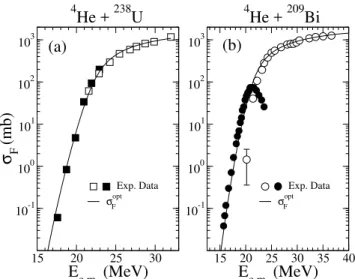
Figure 1. Fusion cross sections in collisions of4Hewith (a)238U
and (b)209Bi.The solid lines represent calculations with the op-tical potentials given by the folding model. The squares and cir-cles are the experimental data of [34] (open squares), [22] (solid squares), [35] (open circles) and [36] (solid circles).
In Fig. 1 the calculated fusion cross sections for the
4He+238U
(Fig. 1(a)) and4He+209Bi(Fig. 1(b)) collisions are compared with the experimental values. In both cases the folding potentials lead to very accurate description of the data. For the4He+238Ucollision, the calculations were performed without any modification of the original parame-ters of the Madland and Young interaction. For the209Bithe radius parameter was slightly modified, as indicated below
We now consider the collisions of6He projectiles with the same targets. If all the 6He nucleons where strongly bound, like in4He, the density would be given by a Gaus-sian parametrization with new values of the constantsCand
γ.They would be given by eq.(8) with
N = 6; rrms¡6He¢=rrms¡4He¢×
µ6
4 ¶1/3
= 1.71 fm.
(9)
However, the Gaussian shape is not appropriate for a halo nucleus. One should use instead a realistic parametriza-tion, consistent with the halo of6He [29]. This parametriza-tion is based on the symmetrized Fermi distribuparametriza-tion of [30],
⌋
ρSF(r) =ρ0
" µ
1 + exp µr
−R
a
¶¶−1 +
µ 1 + exp
µ −r−R
a
¶¶−1 −1
#
, (10)
⌈
with
ρ0= 3A
4πR3
·
1−³πaR´2 ¸−1
,
A = 6, R = 1.23 A1/3 fm and a = 0.57 fm. This
parametrization leads to the r.m.s. radiusrrms = 2.30 fm,
which is appreciably larger than the one in eq.(9), obtained without the halo. In this way, one obtains a lower barrier as shown in table I.
2.2
The channel space in the schematic model
Including the breakup channel in coupled-channel calcula-tions is a very hard task. The difficulty arises from the fact that the breakup channel is represented by an infinite set of three or more particles in the continuum. For practical pur-poses it is necessary to represent the continuum by a finite set of states. In the case of one neutron halos, this can be done by the CDCC method [12, 13, 14]. However, the im-plementation of this procedure is very complicated. In the present work we use a qualitative model based on two ap-proximations. The first one is to replace the two neutrons of the 6He halo by a single particle, the di-neutron. This ap-proximation, which lead to reasonable results in the breakup of11Li [31], amounts to neglecting the relative motion be-tween the two neutrons. The second approximation consists of replacing the infinite set of breakup states by a single channel, which represents them in an effective way [32]. Since the coupling is dominated by the electric dipole term, and the6He ground state has spin zero, we assume that the
effective channel has spin 1. We neglect the relative energy of the fragments in the breakup channel and adopt for the effective channel the breakup threshold energy,ǫ1 = 0.975
MeV.
The approximation of the continuum by a single effec-tive channel would be fully justified in the case of breakup through a sharp resonance, with a lifetime much longer than the collision time. However, for direct breakup, this ap-proximation would not be justified and it would lead to wrong predictions forσCF.In this case, the effective
chan-nel would dominantly contribute to the incomplete fusion cross section. An approximate way to take this into account is to use the effective channel approximation but neglect-ing its contribution toσCF.Using the notationσF(α)for the
contribution from channel-αto the fusion cross section, this procedure yields
σCF ≃σ(0)F . (11)
On the other hand, the consequences of this approximation on σT F should be less important since the contributions
from all channels are summed, independently of the reaction mechanism. This is the cross section that will be compared with the experimental data of [22] and [21].
2.3
The radial equations and the coupling
matrix-elements
The coupled radial equations are
⌋
·
Eα+
~2
2µ
µ d2
dr2 −
l(l+ 1)
r2
¶ −U(r)
¸
uJαl,α0l0(kα, r)
=X
α′l′
UJαl,α′l′(r)uJα′l′,α
whereαtakes the values 0 (elastic channel) and 1 (effective breakup channel). We use the same optical potential of the previous sections for both channels.
The large values of the breakup cross section in colli-sions of halo nuclei with heavy targets indicate that the long
range electric dipole coupling dominates. In our calcula-tions we take into account both the Coulomb and the nuclear couplings and approximate them by their dipole terms. The electric dipole matrix elements are given by [27]
⌋
UJ1l,0l
0(r) = (−)
J+1il−l0ˆ lˆl0
r 4π
3 FC(r) µ
l 1 l0
0 0 0
¶ ½
J 1 l
1 l0 0
¾
, (13)
⌈
with the notationˆl =√2l+ 1³ˆl0=√2l0+ 1
´
.The elec-tric dipole form factor is approximated as
FC(r) =
A r
R3
C
³ 4− 3r
RC
´
, r < RC
A 1
r2 , r≥RC.
(14)
Above, µ
l 1 l0
0 0 0
¶ and
½
J 1 l
1 l0 0
¾
are the usual 3J and 6J symbols [33] and the strengthAis
A= e ZT
p
B(E1,0→1). (15)
In this way, the matrix-elementsUJ
1l,0l0(r)are completely
determined in terms of the reduced transition probability
B(E1,0 → 1). We adopt theB(E1,0 → 1)value of the cluster model,
B(E1,0→1) = 3~e
2
16πǫ1µ2n−4He
= 1.37 e2fm2.
(16)
Above, ǫ1 is the breakup threshold for 6He and µ2n−4He
is the reduced mass for the relative motion between the di-neutron and the4He-core.
Recently, Hagino et al. [12] pointed out that the nu-clear coupling to the breakup channel plays a very impor-tant role in the fusion of weakly bound nuclei. However, the inclusion of the corresponding nuclear matrix-elements in our schematic model presents some difficulties. Since we neglect the kinetic energy of the fragment-fragment mo-tion, the normalization factor of the effective channel goes to zero. Therefore, the matrix-elements between the elas-tic and the effective channel vanish. To avoid this problem we follow the procedure introduced in ref. [26], which is described below. The nuclear part of the coupling interac-tion,V,is obtained by summing the interaction between the
4Hefragment and the target (V4He) with that between the
di-neutron and the target (V2n) and subtracting the
projectile-target potential,VN(r). That is
V(r,x) =V4He(r−x/3) +V2n(r−2x/3)−VN(r), (17)
wherexis the vector going from the di-neutron to the4 He-core. The potential V2n is the nucleon-target interaction
multiplied by two while V4He and VN(r) ≡ V6He are
re-spectively the folding potentials for4He and6He, discussed in the previous sub-section. Carrying out partial-wave ex-pansions and keeping only the dipole term (as we did for the Coulomb coupling), we get
V(r,x) =X
µ
Y1µ(ˆr)Y
∗
1µ(ˆx)V1(r, x). (18)
The matrix-element between the projectile statesφi(x)and φj(x)may be calculated with the help of Wigner-Eckart’s
theorem. We are interested in the case where one of these states is the ground state, with angular momentum 0 and in-trinsic wave functionugs(x).The other is some state in the
continuum with angular momentum 1, energyεand radial wave functionuε(x).The desired matrix-element is given
in terms of the nuclear form factor
FN(ε, r) =
∞
Z
0
dr ugs(x)V1(r, x)uε(x). (19)
The radial wave functionsugsanduεare solutions of the
ra-dial equation associated with the absolute value of the vector x. The depth of the potential well giving the interaction be-tween the fragments is determined by the condition that its second S-state (the first is excluded by Pauli’s principle) has binding energy−0.975MeV. Owing to the normalization of
uε(x),the form factor goes to zero in the limitε→0,which
was assumed for the effective breakup channel. To avoid this difficulty, we adopt the radial dependence obtained in eq.(19) but treat its normalization as a free parameter. That is
FN(r) =F0g(r) (20)
with
g(r) = lim
ε→0
·F
N(ε, r) FN(ε,0)
¸
. (21)
To estimate the strengthF0, we adopt the following
resulting Coulomb form factor is then compared with the nuclear one. For the6He+238Usystem, the two form fac-tors have the same strength atr ≃16fm. In our coupled-channel calculations we use the Coulomb form factor given by eqs.(14) to (16) and chooseF0by imposing that the
nu-clear and the Coulomb form factors have the same value at
r ≃ 16fm. Further details of this procedure are given in ref. [26]. Since the nuclear form factor for the6He+209Bi system should be very similar to that for6He+238U,we use the same nuclear form factors in both calculations.
Solving the coupled-channel equations, we evaluate the scattering amplitudesf¯α(θ),forα = 0and 1. The elastic
and the breakup cross sections are then given by
dσel(θ)
dΩ =
¯
¯fC(θ) + ¯f0(θ)¯¯
2
(22)
dσBup(θ)
dΩ =
k1
k0
¯ ¯f¯1(θ)
¯ ¯
2
. (23)
The total fusion cross section can be written
σT F =σ(0)F +σ
(1)
F (24)
with1
σF(α)= (2π)3k0
E
D
ψα(+)|Wα|ψα(+)
E
, (25)
forα= 0,1.
3
Application: study of the
6H e
+
238U
and
6H e
+
209Bi
collisions
3.1
Fusion cross sections
In Fig. 2, we present fusion cross sections for collision of
6He projectiles with 238U (a) and 209Bi (b) targets. The
lines were obtained with our schematic model with different approximations. These results are compared with the data of Trottaet al.[22] (squares) and Kolataet al.[21] (circles). The dotted and the dashed lines are results of optical model calculations, without channel-coupling. In the former, the optical potential is calculated by the folding method with a density without the halo. In the latter, the density includes the6Hehalo. The dot-dashed and the solid lines are results
of coupled-channel calculations with the optical potential containing the static effects of the halo. In the former the coupling is purely Coulomb while the latter includes both the Coulomb and the nuclear couplings, as discussed in the previous section.
15 20 25 30
E
c.m.(MeV)
101 102 103
σ
F(mb)
Data of Trotta et al.
20 25 30
E
c.m.(MeV)
101 102 103
Data of Kolata et al.
σopt
F (without Halo) σopt
F (with Halo) σopt
TF (CC - Coulomb) σTF (CC - Coul + Nuc)
6
He + 238U 6He + 209Bi
(a)
(b)
↓
↓
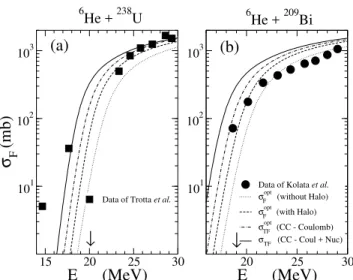
Figure 2. Experimental and theoretical fusion cross sections in the collisions of6He projectiles with (a)238U and (b)209Bi. The data are from [22] (squares) and [21] (circles). The results obtained without channel-coupling are represented by dotted (optical poten-tial without halo) and dashed (optical potenpoten-tial with halo) lines. The results from coupled-channel calculations are represented by dot-dashed (Coulomb coupling) and solid (Coulomb plus nuclear coupling) lines.
The trends of the calculations for the two targets (figures 2(a) and 2(b)) are basically the same. Comparing the optical model calculations without (dotted line) and with (dashed lines) the static effects of the halo, we conclude that the halo produces large enhancements of the fusion cross sections above and below the Coulomb barrier. The dynamic effects arising from channel-coupling lead to further enhancements, specially at sub-barrier energies.
Comparing the calculations with the experimental data, we reach different conclusions for the238Uand the209Bi targets. In the case of238U, the optical model calculation without effects of the halo (dotted line) yields results much below the data, in the whole energy range. The three re-maining calculations are much closer to the experiment at above barrier energies. However, none of these calculations provides a good description of the data at sub-barrier ener-gies. The result of the coupled-channel calculation with the Coulomb plus nuclear couplings is close to the sub-barrier data point at∼17MeV but it is much lower than the one at
∼15MeV. Since our model tends to overestimate the fusion cross section, this result suggests that the large enhancement of the experimental data at these energies cannot arise from the6Hehalo.We should also call attention to the possibility of these data being inaccurate, owing the experimental tech-nique used in the experiment of ref.[22]. Since fission is the only relevant channel in the decay of the coupound nucleus, the fusion cross section was measured through the detection of fission events. However, the 1n- and 2n-transfer channels also lead to fission. Trottaet al. tried to eliminate the con-tributions from these processes through an anti-coincidence with the alpha-particle produced in the transfer processes. However, some residual contributions from these processes, which would be relevant at very low energies, may have been left out. In this way, the high cross sections observed at
1We assume thatψ(+)
very low energies may correspond to transfer-fission rather than fusion-fission events. This possibility is presently being investigated by these authors [37].
We now consider the fusion cross section for the209Bi target. In this case the data set [21] does not include ener-gies much below the barrier, as does that of [22]. Fig. 2(b) indicates that the agreement between theory and experiment is much poorer. In this case the results of the optical model calculation without any halo effect (dotted line) are close to the data at above-barrier energies. However, they fall much below the data at energies near and below the barrier. The re-maining three calculations, which include halo effects, over-estimate the data at above barrier energies. At lower ener-gies the best results are obtained with the optical model cal-culations with static effects of the halo. The results of our best calculation - the coupled-channel calculations with the Coulomb plus nuclear coupling - are much above the data in the whole energy region.
We should emphasize that our schematic model overes-timates the total fusion cross section. Firstly because it can-not include continuum-continuum coupling, which reduces it substantially [13]. Furthermore, the contribution from the breakup channel to the fusion cross section may be overesti-mated, specially if the projectile breakup is a direct process. In this case, fusion following breakup will be dominantly the incomplete fusion of the4He fragment with the target. The cross section for incomplete fusion should be much smaller than that for the complete fusion of the6
Heprojectile. The
4
Hefragment faces a higher barrier (this is illustrated in Table I) while it carries only a fraction of the collision en-ergy (about 2/3, if the relative enen-ergy of the fragments is ne-glected). Since in our model the effective channel is bound, the contribution from this channel is evaluated as complete fusion and, therefore, is overestimated. It may be a better procedure to neglect the contribution of the effective chan-nel to the total fusion cross section and writeσT F ≃σF(0).
Since we do not have reliable information about the breakup mechanism (direct or resonant) our model can only predict that the total fusion cross section should be within the range
σ(0)F +σF(1)&σT F &σF(0).
In Fig. 3 we compare the data with the curves giving the upper and the lower limits indicated in the above equation. The results for the 238U target, shown in figure 3(a), are consistent with the data, except for the lowest data point, where the theoretical prediction is much smaller than the experimental value. In the case of the209Bitarget, the sit-uation is worse. Only the data points at the highest ener-gies fall within the predicted limits. This may be a limi-tation of our schematic model since it does not contain the continuum-continuum coupling which would substantially reduce the complete fusion cross section [13]. In this way, the dashed line in Fig. 3(b) would be moved down and the agreemente with the data would be better. We should re-mark that there is an additional discrepancy between theory and the experiment, which occurs for both targets. The ex-perimental slopes of the fusion cross section at low energies are always smaller than the theoretical predictions. In this case, it is unlikely that the discrepancy can be traced back to
the limitations of our model. The inclusion of continuum-continuum coupling does not seem to reduce this slope [13].
15 20 25 30
E
c.m.(MeV)
101 102 103
σ
F(mb)
Data of Trotta et al.
20 25 30
E
c.m.(MeV)
101 102 103
Data of Kolata et al.
σCF σTF 6
He + 238U 6He + 209Bi
(a)
(b)
↓
↓
Figure 3. Upper (solid line) and lower (dashed line) limits pre-dicted by our coupled-channel calculations in comparison with the data of [22] (squares) and [21] (circles).
3.2
Breakup and reaction cross sections
In Fig. 4 we show angular distributions for the breakup of
6He in collisions with a238U target. Since the results for the 209Bi target are basically the same, we do not show them in
this section. These angular distributions are functions of the deflection angle for the center of mass of the projectile. Usu-ally, this angle must be expressed in terms of the momenta of the fragments. However, the situation is simpler in the present calculation since the breakup channel is treated as a bound state. The calculations were performed for a collision energy about 30% above the Coulomb barrier. Since there are no data available, we compare results obtained with dif-ferent approximations.
0 20 40 60 80 100
θ (deg.)
1000 2000 3000 4000
d
σ Bup
/d
Ω
(mb/sr) CC - Coulomb CC - Nuclear CC - Coul + Nuc
6
He +
238U
Ec.m. = 26 MeV
The dashed, dot-dashed and solid lines correspond re-spectively to coupled-channel calculations with Coulomb, nuclear and Coulomb plus nuclear couplings. A compar-ison of these curves gives relevant information about the roles of these couplings. Firstly, we notice that Coulomb breakup is important over a broad angular region. A sec-ond interesting point is that nuclear breakup is negligible at small angles. These angles are associated with distant collisions, for which the short range nuclear form factor is vanishingly small. Nuclear breakup reaches a maximum at the grazing angleθ ≃60◦
and falls off slowly above, ow-ing to fusion absorption. The dashed and the dash-dotted lines cross atθ ≃ 60◦
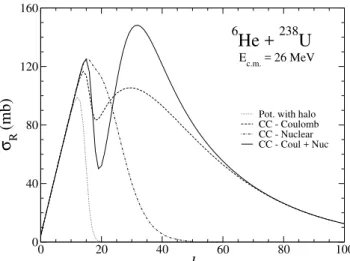
. Nuclear breakup dominates above this angle and Coulomb breakup dominates below. Compar-ing the cross sections for each of these processes with that for the coulomb plus nuclear couplings (solid line) one con-cludes that there is constructive interference below∼ 50◦ and destructive interference above. It is important to remark that Coulomb breakup completeley dominates the angle-integrated cross section. Owing to the factor (2l+ 1), ap-pearing in the partial-wave expansion, the main contribu-tions forσBupcome from large partial-waves, where nuclear
breakup is very small.
In our two-channel calculations, the reaction cross sec-tion is given by
σR=σT F +σBup.
It can be expanded in partial-waves as
σR=
X
l
σR(l), (26)
with
σR(l) = π
k2 (2l+ 1)
h 1−¯
¯S0ll,0l ¯ ¯
2i
. (27)
In Fig. 5 we showl−projectedcross sections,σR(l),as
functions of l.They were obtained with the different ap-proximations discussed in the previous section. The dotted line gives the results of an optical model calculation with the optical potential including the static effects of the halo. In this case there is no coupling with the breakup channel so that the only contribution toσRcomes from fusion. For this
reason,σR(l)is only relevant at low partial-waves. These
waves are associated with close collisions, where the pro-jectile is absorbed by the imaginary potential. In this way, the partial-wave summation of eq.(26) may be truncated at
lmax≃20.The dot-dashed line are the results of a
coupled-channel calculation with only nuclear coupling. Now, the re-action cross section has also contributions from the nuclear breakup. Although the nuclear form factor has a short range, it reaches further than the imaginary potential. The sum in eq.(26) should then include contributions from higher partial-waves, with the truncation value being extented to
lmax≃50.The dashed line corresponds to a couple-channel
calculation with only Coulomb coupling. Now the partial-wave expansion converges very slowly. The cut-off angu-lar momentum should be aboutlmax ≃500.The solid line
was obtained with a coupled-channel calculation with both Coulomb and nuclear couplings. Comparing this curve with those for Coulomb and nuclear coupling separately, we find
destructive interference for angular momenta in the range 15.l .25and constructive interference for angular mo-mental & 25. Since large angular momenta are associ-ated with small deflection angles and the other way around, these conclusions are consistent with those reached through Fig. 4.
0 20 40 60 80 100
l
040 80 120 160
σ
R(mb)
Pot. with haloCC - CoulombCC - Nuclear CC - Coul + Nuc
6
He +
238U
Ec.m. = 26 MeV
Figure 5. Partial-wave components of the reaction cross section. The dotted line was obtained with an optical model calculation while the remaining lines are results of coupled-channel calcula-tions with different couplings. For details see the text.
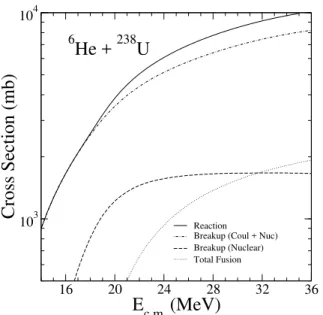
We now show, in Fig. 6, the excitation functions ob-tained by integration of the different contributions shown in Fig. 5. We notice that while the Coulomb breakup is the main contributor to the reaction cross section, there is a cross-over between the fusion and nuclear breakup terms. For the optical model parameters and the nuclear coupling strength employed in this calculation, breakup dominates at energies below≃32MeV. Two points are worth emphasiz-ing here. One is that for systems for which the Coulomb breakup contribution is small, these two excitation curves indicate the regions where breakup dominates over fusion, or viceversa. Such systems are those for which the dipole contribution to the Coulomb potential is zero,e.g.6Li→4He +2H. The second point is that the cross-over does not take place at the Coulomb barrier, but a value of the energy which depends on the system, in particular on the binding energy of the fragmenting nucleus, the optical model parameters and the nuclear coupling strength.
3.3
Elastic Scattering
The solid line corresponds to a coupled-channel calculations including both Coulomb and nuclear couplings.
16 20 24 28 32 36
E
c.m.
(MeV)
103104
Cross Section (mb)
Reaction
Breakup (Coul + Nuc) Breakup (Nuclear) Total Fusion 6
He +
238U
Figure 6. Components of the reaction cross section for the same system and optical model parameters as in Fig. 5.
0 40 80 120
θ
(deg.)
0.20.4 0.6 0.8 1 1.2
σ/σ
Ruth
Pot. without Halo Pot. with Halo CC - Coulomb CC - Coul + Nuc
6
He +
238U
Ec.m. = 26 MeV
Figure 7. Elastic angular distribution in the6He+238Ucollision. The collision energy is 26 MeV and the results are normalized with respect to the Rutherford cross section. For details, see the text.
The two optical model calculations show some differ-ences. Firstly, the cross section obtained with the halo is smaller at large angles. This results from the reduction of the Coulomb barrier when the halo is taken into account (see table I). A lower Coulomb barrier leads to larger fu-sion absorption at low partial-waves (large scattering angles) and, thus, to smaller elastic cross sections. The two curves also show differences at smaller angles, between20◦
and the main maximum atθ≃60◦
,where the cross sections oscil-late. Since the potential with the halo has a longer range the
main maximum is shifted to a smaller angle and the interfer-ence between trajectories is slightly intensified.
We now consider the dynamic effects of the halo con-tained in the coupled-channel calculations. Due to the long range of the electric dipole coupling, the convergence of the calculations requires a very large matching radius (∼ 360 fm) and the inclusion of very high partial waves (lmax ∼
800). We notice that the electric dipole coupling leads to a strong reduction of the elastic cross section, even at small angles. A similar reduction, although less pronounced, is encountered in collisions of deformed nuclei with heavy col-lision partners [38]. In this case, the loss of flux in the elastic channel arises from Coulomb excitation of rotational states through the electric quadrupole coupling. Comparing the solid and the dot-dashed lines, we conclude that the nuclear coupling leads to further reduction of the cross section over a broad angular region. In spite of its short range, this effect is very important even at angles as low as50◦
.
We should mention that elastic scattering measurements of6He on209Bi [39] and208Pb [40] have recently been re-ported. The trend of these data follow the one shown in Fig. 7, namely a reduction of the elastic scattering cross sec-tion from Rutherford even at small angles. The energies at which these measurement were taken are, respectively
Elab =22.5 MeV and 29.6 MeV respectively. These
en-ergies correspond to 1.2Eband 1.39Ebis the barrier height
of the system under study. The data in fact show that at, sayθCM = 25◦,σ/σR = 0.6 in the case of6He+ Pb, to
be compared to about unity for the similar, non-exotic sys-tem,6Li +208Pb. In the case of6He +209Bi at the lower of the energies cited above, the corresponding ratio is about 0.9 compared to unity for6Li +209Bi. It is important to men-tion that the analyses of the above data were performed with the full CDCC. It is gratifying that our schematic calcula-tion seems to capture the essential physics of the scattering of exotic nuclei.
4
Conclusions
We have used the schematic model of ref.[26] to investigate the importance of static and dynamic effects of the6He halo in collisions with heavy targets. In this model, the two neu-trons in the6He halo are treated as a single particle, the di-neutron, and the breakup channel is approximated by a sin-gle effective state. Although this model leads to an overesti-mation of the fusion cross section, it can be used in a qual-itative analysis. The coupled-channel calculations used op-tical potentials derived by the folding method and included Coulomb and nuclear couplings within the dipole approxi-mation.
• TABLE I: Potential barriers in the collisions4,6He+238Uand4,6He+209Bi.In the case of6Hethe table shows the potential barriers for the folding potential with gaussian density (no halo) and with a density that includes a contribution from the halo (with halo).
System 4He +238U 6He +238U(no halo) 6He +238U(with halo)
VB(MeV) 21.8 21.4 20.1
System 4
He +209Bi 6
He +209Bi(no halo) 6
He +209Bi(with halo)
VB(MeV) 21.2 20.1 19.2
The static effects of the halo on the fusion cross sec-tion were shown to be very important above and below the Coulomb barrier. The dynamic effects associated with channel-coupling are more important at sub-barrier ener-gies. Comparing theoretical fusion cross sections with data for the 6He +238U system, we found that the experimental results are consistent with the upper and lower limits deter-mined in our calculation, except at a very low energy, where the experimental value is much larger that predicted by the theory. In the case of the 6He +209Bi system, the agree-ment is worse. The experiagree-mental results fall below our lower limit except for energies well above the barrier. We believe that this disagreement is a consequence of the absence of continuum-continuum coupling in our model.
Our calculations of the breakup cross section have shown that Coulomb breakup dominates at angles below
∼ 60◦
while the nuclear coupling is more important above this angle. We have also shown that Coulomb-nuclear inter-ference is constructive below∼ 50◦
and destructive above this angle. In the case of elastic scattering, the dynamic ef-fects of the halo were shown to be much more important than the static ones.
The authors are grateful to Prof. H. D. Marta, from the Instituto de F´ısica, Facultad de Ingenier´ıa, Montevideo, Uruguay, for his help in the calculation of the nuclear form factors. We thank Drs. Christian Beck and Monica Trotta for communicating the features of their new experimental results prior to their publication. This work was supported in part by CNPq and the MCT/FINEP/CNPq(PRONEX) un-der contract no. 41.96.0886.00. L.F.C. acknowledges par-tial support from the FAPERJ, and M.S.H. and W.H.Z.C. acknowledge support from the FAPESP.
References
[1] C.H. Dasso, S. Landowne, and A. Winther, Nucl. Phys. A
432, 495 (1985).
[2] S.G. Steadman, ed., “Fusion Reactions Below the Coulomb Barrier”, Springer Verlag, Berlin Heidelberg New York Tokyo, 1984.
[3] M. Beckerman, Rep. Prog. Phys.51, 281 (1993).
[4] C.A. Bertulani, L.F. Canto, and M.S. Hussein, Phys. Rep.
226, 281 (1993); C.A. Bertulani, M.S. Hussein, and G. M¨unzenberg, “Physics of Radioactive Beams” (Nova Sci-ence, New York, 2001); M. S. Hussein, L.F. Canto, and R. Donangelo, Nucl. Phys. A722, 321c (2003).
[5] N. Takigawa and H. Sagawa, Phys. Letters B265, 23 (1991). [6] M.S. Hussein, M.P. Pato, L.F. Canto, and R. Donangelo,
Phys. Rev. C46, 377 (1992); C47, 2398 (1993).
[7] N. Takigawa, M. Kuratani, and H. Sagawa, Phys. Rev. C47
R2470 (1993).
[8] C.H. Dasso and A. Vitturi, Phys. Rev. C50, R12 (1994). [9] L.F. Canto, R. Donangelo, Lia M. Matos, M.S. Hussein, and
P. Lotti, Phys. Rev. C58, 1107 (1998).
[10] M. Dasguptaet al., Phys. Rev. C66, 041602R (2002). [11] L.F. Canto, R. Donangelo, M.S. Hussein, and M.P. Pato,
Nucl. Phys. A542, 131 (1992).
[12] K. Hagino, A. Vitturi, C.H. Dasso, and S. Lenzi, Phys. Rev. C61, 037602 (2000).
[13] A. Diaz-Torres and I.J. Thompson, Phys. Rev. C65,024606 (2002).
[14] A. Diaz-Torres, I.J. Thompson, and C. Beck, Phys. Rev. C68, 044607 (2003).
[15] I.J. Thompson, Comput. Phys. Rep.7, 167 (1988).
[16] Y. Sakuragi, M. Yashiro, and M. Kamimura, Prog. Theo. Phys. Suppl.89, 136 (1986).
[17] V. Fekou-Youmbiet al., Nucl. Phys. A538, 811 (1995). [18] A. Yoshidaet al., Phys. Letters B389, 457 (1996). [19] C. Signoriniet al., Eur. Phys. J. A2, 227 (1998). [20] C. Signoriniet al., Eur. Phys. J. A13, 129 (2000). [21] J.J. Kolataet. al., Phys. Rev. Lett.81, 4580 (1998). [22] M. Trottaet al.,Phys. Rev. Lett.84,11 (2000). [23] N. Alamanos,et al., Phys. Rev. C65, 054606 (2002). [24] K.E. Rehmet. al., Phys. Rev. Lett.81, 3341 (1998). [25] K.E. Zyromskiet al., Phys. Rev. C55, R562 (1997). [26] W.H.Z. C´ardenas, L.F. Canto, R. Donangelo, H.S. Hussein,
and N. Carlin Filho, Phys. Rev. C68, 054614 (2003). [27] G.R. Satchler, “Direct Nuclear Reactions”, Oxford
Univer-sity Press, 1983.
[28] D.G. Madland and P.G. Young, Los Alamos Report No. LA7533-mb (1978) (unpublished).
[29] G.D. Alkhazovet al. Phys. Rev. Lett.782313 (1997). [30] Yu. N. Eldyshev, V. N. Lukyanov, and Yu. S. Pol., Sov. J.
Nucl. Phys.16, 282 (1973).
[32] A.M.S. Breitschaftet al., Ann. of Phys.243, 420 (1995). [33] A.R. Edmonds, “Angular Momentum in Quantum
Mechan-ics”, Princeton University Press, Princeton, New Jersey, 1974.
[34] V.E. Viola and T. Sikkeland, Phys. Rev.128, 767 (1962). [35] W.J. Ramleret al. Phys. Rev.114, 154 (1959).
[36] A.R. Barnett and J.L. Lilley, Phys. Rev. C9, 2010 (1974). [37] M. Trotta, private communication.
[38] W.G. Love, T. Terasawa, and G.R. Satchler, Phys. Rev. Let-ters39, 6 (1977).
[39] N. Keeley, J. M. Cook, K. W. Kemper, B. T. Roeder, W. D. Weintrap, F. Marechal, and K. Rusek, Phys. Rev. C68, 054601 (2003).
![Figure 3. Upper (solid line) and lower (dashed line) limits pre- pre-dicted by our coupled-channel calculations in comparison with the data of [22] (squares) and [21] (circles).](https://thumb-eu.123doks.com/thumbv2/123dok_br/18980381.456808/7.892.502.854.142.422/figure-upper-coupled-channel-calculations-comparison-squares-circles.webp)