Article
Printed in Brazil - ©2012 Sociedade Brasileira de Química0103 - 5053 $6.00+0.00
A
*e-mail: [email protected], [email protected]
#Dedicated to Prof. José Barluenga for his many achievements in synthetic organic chemistry.
Dichloroiodoisocyanuric Acid: A New Reagent for Regioselective Coiodination of
Alkenes and Iodination of Activated Arenes
#Rodrigo da Silva Ribeiro, Pierre M. Esteves* and Marcio C. S. de Mattos*
Instituto de Química, Universidade Federal do Rio de Janeiro, CP 68545, 21945-970 Rio de Janeiro-RJ, Brazil
O ácido dicloro-iodo-isocianúrico foi preparado em 93% de rendimento através do aquecimento do ácido tricloro-isocianúrico com 1,05 equiv. mol de iodo. Esse novo reagente se mostrou bastante eficiente para a iodação regiosseletiva de arenos ativados. Os alquenos reagem com o ácido dicloro-iodo-isocianúrico na presença de solventes nucleofílicos oxigenados (água, álcoois, ácido acético) para gerar, respectivamente, iodoidrinas, β-iodoéters e β-iodoacetatos em menos de um minuto de reação e em alto grau de regiosseletividade. Enol-éteres levam à formação regiosseletiva dos iodo-dialquilacetais correspondentes. Os resultados experimentais juntamente com os cálculos por DFT mostraram que, para reações com sistemas insaturados, o ácido dicloro-iodo-isocianúrico é mais reativo do que o ácido triiodo-isocianúrico.
Dichloroiodoisocyanuric acid was prepared in 93% by heating trichloroisocyanuric acid with 1.05 mol equiv. of iodine. This new reagent is very efficient for regioselective electrophilic iodination of activated arenes. Alkenes react with dichloroiodoisocyanuric acid in the presence of oxygenated nucleophiles (water, alcohols, and acetic acid), leading to the corresponding iodohydrins, β-iodoethers and β-iodoacetates with reaction times of less than one minute and with a high degree of regioselectivity. Enol ethers resulted in the regioselective formation of the corresponding iodine-dialkylacetals. Experimental results and DFT calculations showed that dichoroiodoisocyanuric acid is more reactive with unsaturated systems than triiodoisocyanuric acid.
Keywords: alkenes, arenes, electrophilic addition, electrophilic aromatic substitution,
halogenation
Introduction
Iodo-organic compounds are valuable and versatile synthetic intermediates that have found diverse applications in polymer chemistry, pharmacology, medicine, etc.1 Aside
from their principal application in organic synthesis,2 the
discovery of the bioactivity of naturally organic iodides3
has increased the interest in such compounds. The introduction of an iodine atom into organic molecules is frequently an important step in organic synthesis as the iodine atom can easily be replaced by another group in a nucleophilic process, free radical substitution4 or a
transition metal catalyzed reaction, for example, the Heck and related Pd catalyzed cross-couplings.5 However, the
poor electrophilicity of molecular iodine, compared with molecular bromine and chlorine, makes direct iodination
difficult in many cases.6 Hence, many different synthetic
methods (direct and indirect), or their improvements, have been reported for the preparation of iodo compounds.7
Recently, we have introduced trihaloisocyanuric acids (Figure 1) as efficient halogenating reagents for organic compounds. Thus the cohalogenation of alkenes (halogenation in the presence of a nucleophilic solvent8)
with trichloroisocyanuric (TCCA),9 tribromoisocyanuric
(TBCA),10 or triiodoisocyanuric (TICA)11 acids led
to the formation of β-halo-substituted alkanes in high regioselectivity. These reagents have also proved to be useful for the halogenation of activated12,13 and deactivated14
arenes, β-dicarbonyl compounds,15 and halofluorination of
alkenes.16 The trihaloisocyanuric acids containing different
halogen atoms are also of great interest and in a previous study we showed that bromodichloroisocyanuric acid (BDCCA) is also a very good regioselective brominating agent.17
investigate its application towards alkene coiodination and arene iodination reactions.
Results and Discussion
Dichloroiodoisocyanuric acid was prepared in 93% yield from the commercially available trichloroisocyanuric acid (Scheme 1). The reaction was performed in a sealed tube by heating TCCA with 1.05 mol equiv. of I2 at 170 oC
for 18 h, followed by distillation of ICl and another heating for 24 h at 220 oC.
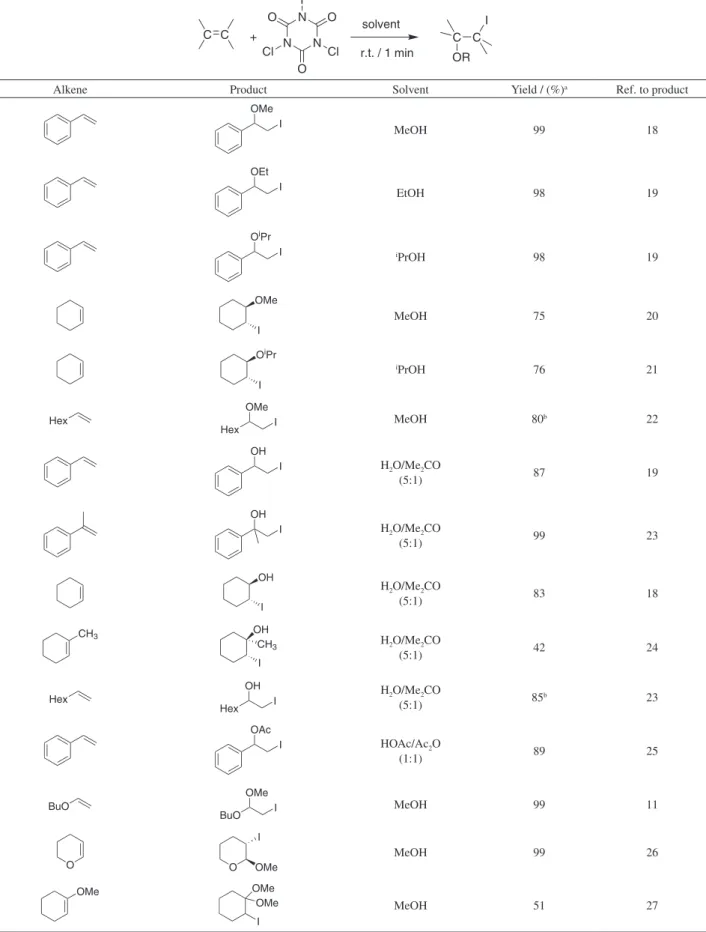
The scope of the coiodination reactions using DCICA in oxygenated nucleophilic solvents was explored with simple alkenes (cyclohexene, 1-methylcyclohexene, styrene,
α-methylstyrene, and 1-octene) and with activated alkenes (enol ethers, such as butyl vinyl ether, dihydropyran and 1-methoxycyclohexene), being the results shown in Table 1. The reactions were carried out in less than 1 min using 2 mmol of alkene and 2 mmol of DCICA at room temperature and led to the vicinal iodo functionalized products.
The reaction of alkenes with an equimolar amount of DCICA in the presence of alcohols (MeOH, EtOH, and iPrOH), aqueous acetone and acetic acid/acetic
anhydride resulted in the respective β-iodoethers, iodohydrins, and β-iodoacetates. The reactions with styrene, α-methylstyrene, and 1-methylcyclohexene were highly regioselective, and products were formed in accordance with Markovnikoff additions; no regioisomers could be detected on analyzing the crude reaction products by HRGC-MS, 1H and 13C NMR spectroscopy. Enol ethers
also produced the corresponding iodo-dialkylacetals in a regioselective manner. As previously observed in similar reactions,28 exceptions were observed in the reactions using
1-octene where a mixture of regioisomers was produced, with the primary iodide being preferentially formed.
Furthermore, as previously observed in the reactions with bromodichloroisocyanuric acid,17 no chlorinated products
that could arise from electrophilic chlorine transfer from DCICA were detected by the analytical methods employed.
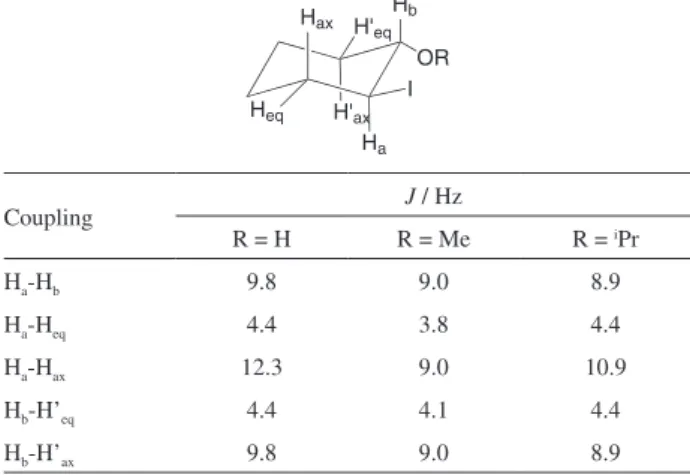
High trans-stereoselectivity was also observed for additions to cyclohexene, 1-methycyclohexene and dihydropyran, as can be seen by the values of the vicinal coupling constants for the methine hydrogen atoms CHOR and CHI in the iodohydrin and β-iodoethers derived from cyclohexane (Table 2). In these cases the obtained values of J greater than 9.0 Hz indicate they are in an antiperiplanar position.29 Furthermore, the additional vicinal couplings
depicted in Table 2 support the trans-selectivity of the reaction. In the case of the reaction of DCICA with 1-methylcyclohexene, the iodohydrin formed shows the methine CHI hydrogen with vicinal couplings Jax-ax 12.1 Hz
and Jax-eq 4.3 Hz, clearly indicating that the iodine is in the
equatorial position.29
Iodination of some activated arenes were carried out at room temperature using equimolar amounts of the substrate and DCICA in acetonitrile (Table 3). After work-up, the corresponding iodinated products were obtained in excellent yields and with high regioselectivity, as observed the formation of 4-substituted monoiodo arenes and 1-iodo-2-methoxynaphthalene. Even weakly activated arenes, such as toluene, were iodinated after 1.5 h. Diiodination products can also be obtained by using 2 mol equiv. of DCICA in the case of durene. On the other hand, non-activated arenes, e.g. benzene reacted very slowly. Once again, no chlorinated products could be detected by HRGC-MS and
1H and 13C NMR spectroscopy.
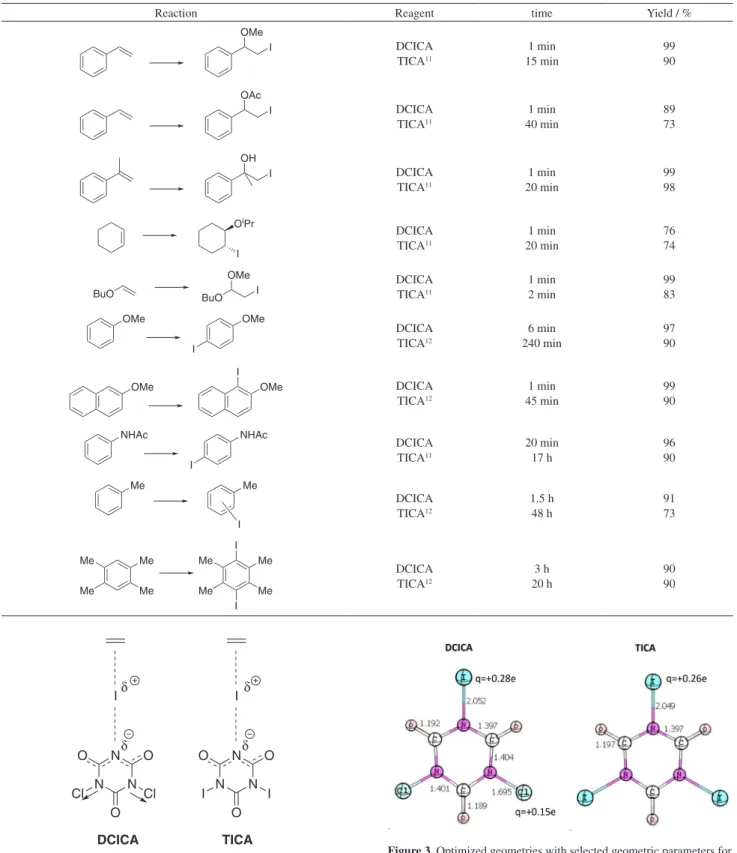
In previous studies using triiodoisocyanuric acid (TICA, Figure 1), the iodination reactions of the same arenes12 or
the coiodination of the same alkenes11 were found to require
longer reaction times than those observed in this present study with DCICA, as shown in Table 4.
Comparing the reactivity of DCICA with TICA towards iodenium ion (I+) transfer to alkenes and arenes,
we observed that DCICA is far more reactive. This could be explained in terms of the greater electronegativity of chlorine in relation to iodine. This would result in the N−I bond of DCICA being more electrophilic in comparison to the N−I bonds of TICA (Figure 2).
In order to better understand the reactivity differences between TICA and DCICA, we have performed DFT calculations on these structures and on their complexes with ethylene and benzene. All calculations were performed at M06-2X/6-311++G(d,p)//M06-2X/6-311++G(d,p) level using the program Gaussian 09.35 Charges were computed
using the CHELPG scheme,36 considering the radii of
2.20 Å for iodine.37
N N N
O O
O X1
X2 X3
X1 = X2 = X3 = Cl (TCCA) X1 = X2 = X3 = Br (TBCA)
X1 = X2 = X3 = I (TICA) X1 = Br, X2 = X3 = Cl (BDCCA)
X1 = I, X2 = X3 = Cl (DCICA) Figure 1. The trihaloisocyanuric acids.
N N N
O O
O Cl
Cl Cl
(a), (b), (c)
N N N
O O
O I
Cl Cl
93 %
(a) I2 / 170 °C / 18 h; (b) distillation of ICl; (c) 220 °C / 24 h
Table 1. Coiodination of alkenes with DCICA and oxygenated nucleophiles
C C
N N N
O O
O I
Cl Cl
+
solvent
r.t. / 1 min
C C I
OR
Alkene Product Solvent Yield / (%)a Ref. to product
OMe
I MeOH 99 18
OEt
I EtOH 98 19
OiPr
I iPrOH 98 19
OMe
I
MeOH 75 20
OiPr
I
iPrOH 76 21
Hex
Hex OMe
I MeOH 80b 22
OH
I H2O/Me2CO
(5:1) 87 19
OH
I H2O/Me2CO
(5:1) 99 23
OH
I
H2O/Me2CO
(5:1) 83 18
CH3 OH
I
CH3 H2O/Me2CO
(5:1) 42 24
Hex
Hex OH
I
H2O/Me2CO
(5:1) 85b 23
OAc
I HOAc/Ac2O
(1:1) 89 25
BuO
BuO OMe
I MeOH 99 11
O O OMe
I
MeOH 99 26
OMe OMe
OMe
I
MeOH 51 27
Table 3. Iodination of activated arenes with DCICA
N N N
O O
O I
Cl Cl
+
r.t. Ar-H
CH3CN
Ar-I
Substrate Product t / min Yielda / % Ref. to product
OMe OMe
I
6 97 30
OMe
OMe I
1 99 31
NHAc NHAc
I
20 96 30
Me
Me
I
Me
I +
(3 : 2)b
100 91 12
I 150 99 32
I 72 h
67 days
trace
31 33
Me
Me Me
Me Me
Me Me
Me I
I
180 90c 34
aYield of pure product based on arene. bDetermined by HRGC-MS. cReaction using 2 mol equiv. of DCICA.
Table 2. Coupling constants for the iodo-alkoxycyclohexanes prepared
Hax
Ha H'ax
H'eq Hb
Heq
OR I
Coupling J / Hz
R = H R = Me R = iPr
Ha-Hb 9.8 9.0 8.9
Ha-Heq 4.4 3.8 4.4
Ha-Hax 12.3 9.0 10.9
Hb-H’eq 4.4 4.1 4.4
Hb-H’ax 9.8 9.0 8.9
Figure 3 shows the optimized geometries, with selected geometric parameters. One can observe that the charge on the iodine atoms is slightly more positive and the N−I bond is larger for DCICA than for TICA, which suggests
its higher electrophilicity. However, more differences are found on their π-complexes with ethylene (Figure 4) and benzene (Figure 5). The DCICA is more closely attached to the olefin in relation to TICA and the dissociation enthalpies of these complexes are 6.8 kcal mol-1 and 5.6 kcal mol-1
for DCICA and TICA, respectively. This shows that the interaction of ethylene with DCICA is slightly stronger than with TICA, reflecting the higher electrodeficiency of its compared to TICA. On the other hand, the enthalpy for dissociation of both complexes of DCICA and TICA with benzene is 6.7 kcal mol-1.
We have also carried out calculations of the transition states for I+ transfer of both reagents and the results
are shown in Figure 6. One can see from the enthalpies of activation that the chlorine within the isocyanuric moiety leads to a decrease in the activation barrier from 20.2 kcal mol-1 (TICA) to 17.7 kcal mol-1 (DCICA). This
Table 4. Comparison of electrophilic iodination reactions using DCICA and TICA
Reaction Reagent time Yield / %
OMe
I DCICA
TICA11
1 min 15 min
99 90
OAc
I DCICA
TICA11
1 min 40 min
89 73
OH
I DCICA
TICA11
1 min 20 min
99 98
OiPr
I
DCICA TICA11
1 min 20 min
76 74
BuO OMe
I BuO
DCICA TICA11
1 min 2 min
99 83
OMe OMe
I
DCICA TICA12
6 min 240 min
97 90
OMe OMe
I
DCICA TICA12
1 min 45 min
99 90
NHAc NHAc
I
DCICA TICA11
20 min 17 h
96 90
Me Me
I
DCICA TICA12
1.5 h 48 h
91 73
Me
Me Me
Me
Me
Me Me
Me I
I
DCICA TICA12
3 h 20 h
90 90
N N
N O
O O
Cl Cl
I
δ
N N
N O
O O
I I
I
δ
δ δ
DCICA TICA
Figure 2. Transfer of I+ from DCICA and TICA to an unsaturated system.
Figure 3. Optimized geometries with selected geometric parameters for DCICA and TICA obtained at M06-2X/6-311++G(d,p) level.
in the transition state of I+ transfer in relation to TICA.
These findings are also in agreement with the experimental results, which indicate DCICA being the most reactive of the two compounds.
Figure 4.π-Complexes between ethylene and DCICA and TICA obtained at M06-2X/6-311++G(d,p) level.
Figure 5.π-Complexes between benzene and DCICA and TICA obtained at M06-2X/6-311++G(d,p) level.
Figure 6. Transition states for I+ transfer of DCICA and TICA obtained
at M06-2X/6-311++G(d,p) level.
useful for the iodination of alkenes and arenes in clean and fast reactions.
Experimental
General
Trichloroisocyanuric acid (commercial grade, 98%), and other chemicals and solvents were used as received. The 1H and 13C NMR spectra were recorded on a Bruker
AC-200 (200 MHz and 50 MHz, respectively) spectrometer in CDCl3 or DMSO-d6 solutions with TMS as internal
standard. 13C MAS-NMR spectrum was obtained on a
Bruker DRX300 spectrometer (75MHz). High-resolution gas chromatography (HRGC) was performed on a HP-5890-II gas chromatograph with FID using a 30 m (length), 0.25 mm (ID), and 25 µm (phase thickness) RTX-5 capillary column and H2 (flow rate 50 cm s-1) as carrier
gas (split: 1:10). HRGC-MS analyses were performed on a Shimadzu GCMS-QP2010S gas chromatograph with electron impact (70 eV) by using a 30 m DB-5 silica capillary column. IR spectra were recorded on a Nicolet 740 FT-IR spectrometers (NaCl film). Elemental analysis was determined on a Perkin-Elmer 2400 apparatus. All reactions involving DCICA must be performed in the absence of light.
Dicloroiodoisocyanuric acid (DCICA)
Crushed iodine (26.65 g, 105 mmol) and trichloro-isocyanuric acid (23.25 g, 100 mmol) were added to a 100 cm3 sealed tube and heated in a sand bath at 170 oC.
After 18 h, the ICl produced was distilled off under reduced pressure and the sealed tube was heated again at 220 oC
during 24 h. Evaporation of ICl under reduced pressure and heating gave a solid that was crushed and washed with CH2Cl2 to produce dichloroiodoisocyanuric acid
(DCICA) as a beige solid (30.13 g) in 93% yield. This reagent must be stored in the dark as some decomposition occurs in the presence of light; mp > 300 oC. Anal. Calc.
for C3N3O3Cl2I: C, 11.11, N, 12.96. Found: C, 10.74, N,
12.48. 13C MAS-NMR: d 150.1 ppm. IR ν
max/cm-1: 1837,
1716, 1697, 1662, 1457, 1362, 762, 534.
General procedure for coiodination of alkenes with DCICA in oxygenated nucleophilic solvents
To a stirred solution of the alkene (2 mmol) in an appropriate solvent (10 cm3 of acetone/2 cm3 of H
2O for
iodohydrins, or 10 cm3 of alcohols for β-iodoethers, or
5 cm3 acetic acid/5 cm3 Ac
2O for β-iodoacetates), DCICA
(2 mmol) was added at room temperature and in the absence of light. After 1 min, CH2Cl2 (10 cm3) was added, cyanuric
with 10% aq. NaHSO3 (50 cm3). The aqueous phase was
washed with CH2Cl2 (2 × 10 cm3), the organic extract was
dried (anhydrous Na2SO4) and filtered. The solvent was
evaporated on a rotatory evaporator to give the product.
General procedure for iodination of activated arenes with DCICA
To a stirred solution of the arene (2 mmol) in acetonitrile (10 cm3), was added DCICA (2 mmol) at room temperature
and in the absence of light. The reaction was monitored by HRGC-MS and after the specified time showed in Table 3, CH2Cl2 (10 cm3) was added, cyanuric acid was filtered
off and the resulting solution was treated with 10% aq. NaHSO3 (60 cm3). The aqueous phase was extracted with
CH2Cl2 (2 × 10 cm3), the combined organic extract was
washed with H2O (60 cm3), dried (anhydrous Na2SO4) and
filtered. The solvent was evaporated in a rotatory evaporator to give the product.
Supplementary Information
Experimental procedure, data spectra and spectra of synthesized compounds are available free of charge at http://jbcs.sbq.org.br
Acknowledgments
The authors thank CNPq, CAPES, and FAPERJ for the financial support.
References
1. David, G.; Boyer, C.; Tonnar, J.; Ameduri, B.; Lacroix-Desmazens, P.; Boutevin, B.; Chem. Rev. 2006, 108, 3936; Adam, M. J.; Wilbur, D. S.; Chem. Soc. Rev.2005, 34, 153; Maziere, B.; Loc’h, C.; Curr. Pharm. Des. 2001, 7, 1931. 2. Bohlmann, R. In Comprehensive Organic Synthesis, Vol 6;
Trost, B. M.; Fleming, I., eds.; Pergamon Press: Oxford, 1991, p. 203.
3. Gribble, G. W.; Prog. Chem. Org. Nat. Prod.2010, 91, 1; Gribble, G. W.; Chemosphere2003, 52, 289.
4. Spargo, P. L.; Contemp. Org. Synth.1994, 1, 113.
5. Trzeciak, A. M.; Ziólkowski, J. J.; Coord. Chem. Rev.2007,
251, 1281.
6. de Mattos, M. C. S.; Sanseverino, A. M.; J.Chem. Res. (S)1994, 440.
7. Stavber, S.; Jereb, M.; Zupan, M.; Synthesis 2008, 1487.; Kolvani, E.; Ghorbani-Choghamarani, A.; Salehi, P.; Shirini, F.; Zolfigol, M. A.; J. Iran. Chem. Soc.2007, 4, 126; de Souza, S. P. L.; da Silva, J. F. M.; de Mattos, M. C. S.; Quim. Nova2006,
29, 1061; Villegas, R. A. S.; Santo Jr., J. L. E.; de Mattos, M. C. S.; de Aguiar, M. R. M. P.; Guarino, A. W. S.; J. Braz. Chem. Soc.2005, 16, 565.
8. Rodrigues, J.; Dulcere, J.-P.; Synthesis1993, 1177; Sanseverino, A. M.; da Silva, F. M.; Jones Jr., J.; de Mattos, M. C. S.; Quim. Nova2001, 24, 637; da Silva, F. M.; Jones Jr., J.; de Mattos, M. C. S.; Curr. Org. Synth.2005, 2, 393.
9. Mendonça, G. F.; Sanseverino, A. M.; de Mattos, M. C. S.; Synthesis2003, 45; de Souza, A. V. A.; Mendonça, G. F.; Bernini, R. B.; de Mattos, M. C. S.; J. Braz. Chem. Soc.2007, 18, 1575. 10. de Almeida, L. S.; Esteves, P. M.; de Mattos, M. C. S.; Synlett
2006, 1515.
11. Ribeiro, R. S.; Esteves, P. M.; de Mattos, M. C. S.; Tetrahedron Lett.2007, 48, 8747.
12. Ribeiro, R. S.; Esteves, P. M.; de Mattos, M. C. S.; J. Braz. Chem. Soc.2008, 19, 1239.
13. Mendonça, G. F.; de Mattos, M. C. S.; Quim. Nova2008, 31, 798; de Almeida, L. S.; Esteves, P. M.; de Mattos, M. C. S.; Synthesis2006, 221.
14. Mendonça, G. F.; Senra, M. R,; Esteves, P. M.; de Mattos, M. C. S.; Appl. Catal., A 2011, 401, 176; da Ribeiro, R. S.; Esteves, P. M.; de Mattos, M. C. S.; Synthesis2011, 739; de Almeida, L. S.; Esteves, P. M.; de Mattos, M. C. S.; Tetrahedron Lett.2009, 50, 3001; Mendonça, G. F.; Magalhães, R. R.; de Mattos, M. C. S.; Esteves, P. M.; J. Braz. Chem. Soc.2005, 16, 695. 15. Mendonça, G. F.; Sindra, H. C.; de Almeida, L. S.; Esteves, P.
M.; de Mattos, M. C. S.; Tetrahedron Lett.2009, 50, 473. 16. Crespo, L. T. C.; Ribeiro, R. S.; de Mattos, M. C. S.; Esteves,
P. M.; Synthesis2010, 2379.
17. de Almeida, L. S.; Esteves, P. M.; de Mattos, M. C. S.; Synlett
2007, 1687.
18. Barluenga, J.; Rodriguez, M. A.; Campos, P. J.; J. Chem. Soc., Perkin Trans. 11990, 2807.
19. Villegas, R. A. S.; Santo Jr., J. L. E.; de Mattos, M. C. S.; de Aguiar, M. R. M. P.; Guarino, A. W. S.; Catal. Commun. 2007, 8, 97.
20. Cambie, R. C.; Hayward, R. C.; Roberts, J. L.; Rutledge, P. S.; J. Chem Soc., Perkin Trans. 11974, 1858.
21. Villegas, R. A. S.; Santo Jr., J. L. E.; Sanseverino, A. M.; de Mattos, M. C. S.; de Aguiar, M. R. M. P.; Guarino, A. W. S.; Synth. Commun.2005, 35, 1627.
22. Davidson, R. I.; Kropp, P. J.; J. Org. Chem.1982, 47, 1904. 23. Villegas, R. A. S.; de Aguiar, M. R. M. P.; de Mattos, M. C.
S.; Guarino, A. W. S.; Barbosa, L. M.; Assumpção, L. C. F. N.; J. Braz. Chem. Soc.2004, 15, 150.
24. Sanseverino, A. M.; de Mattos, M. C. S.; Synthesis1998, 1584. 25. de Mattos, M. C. S.; Sanseverino, A. M.; J. Chem. Res.2004,
638.
26. Jereb, M.; Zupan, M.; Stavber, S.; Green Chem.2005, 7, 100. 27. D’Auria, M.; D’Onofrio, F.; Piancatelli, G.; Scettri, A.; Synth.
28. Wengert, M.; Sanseverino, A. M.; de Mattos, M. C. S.; J. Braz. Chem. Soc. 2002, 13, 700; de Souza, S. P. L.; da Silva, J. F. M.; de Mattos, M. C. S.; J. Braz. Chem. Soc.2003, 14, 832; Sanseverino, A. M.; de Mattos, M. C. S.; Synth. Commun.1998,
28, 559.
29. Silverstein, R. M.; Bassler, G. C.; Morrill, T. C.; Spectrometric Identification of Organic Compounds, 5th ed.; John Wiley &
Sons: Singapore, 1991, p. 221.
30. Vaghei, R. G.; Tetrahedron Lett. 2003, 44, 7529. 31. Iskra, J.; Stavber, S.; Zupan, M.; Synthesis2004, 1869. 32. Branystska, O. V.; Neumann, R.; J. Org. Chem.2003, 68, 9510. 33. Aldrich Handbook of Fine Chemicals, Aldrich Chemical Co.,
http://www.sigmaaldrich.com, accessed in July 2011. 34. Yusubov, M. S.; Funk, T. V.; Chi, K.-W.; Cha, E. H.; Kim, G.
M.; Kirschning, A.; Zhdankin, V. V.; J. Org. Chem.2008, 73, 295.
35. Frisch, M. J.; Trucks, G. W.; Schlegel, H. B.; Scuseria, G. E.; Robb, M. A.; Cheeseman, J. R.; Scalmani, G.; Barone, V.; Mennucci, B.; Petersson, G. A.; Nakatsuji, H.; Caricato, M.; Li, X.; Hratchian, H. P.; Izmaylov, A. F.; Bloino, J.; Zheng, G.; Sonnenberg, J. L.; Hada, M.; Ehara, M.; Toyota, K.;
Fukuda, R.; Hasegawa, J.; Ishida, M.; Nakajima, T.; Honda, Y.; Kitao, O.; Nakai, H.; Vreven, T.; Montgomery Jr., J. A.; Peralta, J. E.; Ogliaro, F.; Bearpark, M.; Heyd, J. J.; Brothers, E.; Kudin, K. N.; Staroverov, V. N.; Kobayashi, R.; Normand, J.; Raghavachari, K.; Rendell, A.; Burant, J. C.; Iyengar, S. S.; Tomasi, J.; Cossi, M.; Rega, N.; Millam, J. M.; Klene, M.; Knox, J. E.; Cross, J. B.; Bakken, V.; Adamo, C.; Jaramillo, J.; Gomperts, R.; Stratmann, R. E.; Yazyev, O.; Austin, A. J.; Cammi, R.; Pomelli, C.; Ochterski, J. W.; Martin, R. L.; Morokuma, K.; Zakrzewski, V. G.; Voth, G.A.; Salvador, P.; Dannenberg, J. J.; Dapprich, S.; Daniels, A. D.; Farkas, O.; Foresman, J. B.; Ortiz, J. V.; Cioslowski, J.; Fox, D. J.; Gaussian 09, Revision A.1, Gaussian, Inc.: Wallingford CT, 2009. 36. Breneman, C. M.; Wiberg, K. B.; J. Comput. Chem.1990, 11,
361.
37. Reiling, S.; Besnard, M.; Bopp, P. A.; J. Phys. Chem. A1997,
101, 4409.
Submitted: July 29, 2011