221 www.scielo.br/rsbmt
Address to: Dra. Regina Maria Pinto de Figueiredo. FMTHVD. Av. Pedro Teixeira 25, 69040-000 Manaus, AM, Brasil.
Phone: 55 92 2127-3447
e-mail: [email protected]; [email protected]
Received 28 January 2011
Accepted 18 October 2011
Revista da Sociedade Brasileira de Medicina Tropical 46(2):221-222, Mar-Apr, 2013
http://dx.doi.org/10.1590/0037-8682-1096-2013
Short Communication
Identiication of dengue viruses in naturally infected
Aedes aegypti
females captured with BioGents
(BG)-Sentinel traps in Manaus, Amazonas, Brazil
Regina Maria Pinto de Figueiredo
[1], Maria Paula Gomes Mourão
[1],
Yasmin Emile Conte Abi-Abib
[1], Cintia Mara de Oliveira
[1], Rosemary Roque
[2],
Tatiana de Azara
[3], Jorg Ohly
[4], Carolin Degener
[5], Martin Geier
[5]and Álvaro Eduardo Eiras
[3][1]. Gerência de Virologia, Fundação de Medicina Tropical Dr. Heitor Vieira Dourado, Manaus, AM. [2]. Departamento de Pós- Graduação, Universidade Nilton Lins, Manaus, AM. [3]. Laboratório de Entomologia, Universidade Federal de Minas Gerais, Belo Horizonte, MG. [4]. Departamento de Pós- Graduação, Universidade do Estado do Amazonas, Manaus, AM. [5]. Laboratory of Molecular Biology, University of Regensburg, Alemanha.
ABSTRACT
Introduction: In Manaus, the irst autochthonous cases of dengue fever were registered in 1998. Since then, dengue cases were diagnosed by the isolation of viruses 1, 2, 3, and 4. Methods: One hundred eighty-seven mosquitoes were collected with BioGents (BG)-Sentinel traps in 15 urban residential areas in the Northern Zone of Manaus and processed by molecular tests. Results: Infections with dengue viruses 1, 2, 3, and 4 and a case of co-infection with dengue viruses 2 and 3 were identiied. Conclusions: These indings corroborate the detection of dengue in clinical samples and reinforce the need for epidemiological surveillance by the Health authorities.
Keywords:Aedes aegypti. Dengue. Virus. Molecular tests.
Manaus, Amazonas (AM) was infested by Aedes aegypti in 1996 and the irst autochthonous cases of dengue fever were registered in March 19981. Since then, dengue fever cases were
diagnosed in the following years with the isolation of dengue viruses (DENV) 1, 2, 3, and 4 in 20082. In the present work,
all 4 serotypes of the virus were detected in naturally infected
A. aegypti by reverse transcription-polymerase chain reaction (RT-PCR), the amplicon sequence of DENV-4 was analyzed, and these indings were corroborated with the detection of DENV-4 in clinical samples of patients residing in the northern zone of Manaus, AM.
A total of 187 mosquitoes were collected with BioGents (BG)-Sentinel traps3 from January 2009 to June 2010 in 15 urban
residential areas in the northern zone of Manaus, AM, Brazil. Sixty BG-Sentinel traps (4 traps in each of the 15 areas) were installed in each area every 2 weeks for a 24-h time period. The captured mosquitoes were identiied and sexed. Cephalothoraxes of A. aegypti were separated for each area and each collection date in 2-mL Eppendorf cups (pool size: 1-10 mosquitoes) and maintained at -70°C until analysis.
The pooled samples were pulverized and macerated on ice with 300mL Trizol reagent (Invitrogen,Brazil). Viral RNA
extraction was performed according to the manufacturer’s instructions and reverse transcription was performed using Superscript III (Invitrogen, Brazil) and random primers. Based on the previously described protocol4, semi-nested PCR was
conducted to amplify a region of the viral genome that contains the capsid-premembrane (C-prM) genes, with primers designed to amplify 119-bp DENV-2, 290-bp DENV-3, and 392-bp DENV-4. The generated amplicon of DENV-4 was sequenced in both directions using the BigDye Terminator cycle sequence kit (Applied Biosystems, Foster City, CA, USA).
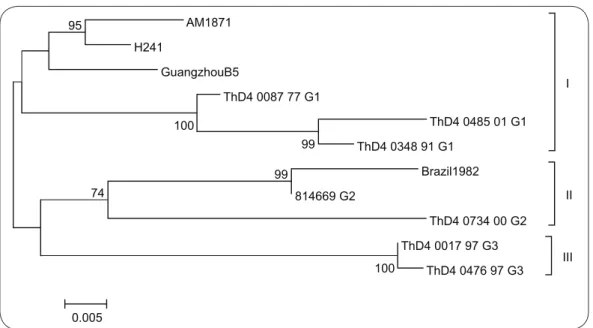
Of the total of 187 pools of Aedes aegypti that were processed between August 2009 and July 2010, which each contained 10 females, 1 pool was positive for DENV-1, 4 pools were positive for DENV-2, 3 were positive for DENV-3, and 2 were positive for DENV-4. One pool was co-infected with DENV-2 and 3. The obtained sequence DENV-4 was submitted to a basic local alignment search tool (BLAST; http://www.ncbi.nlm.nih.gov.entrez) analysis, which uses the megablast algorithm optimized for highly similar sequences. By using this approach, sequences of DENV-4 showed a similarity of 98% with the standard sequence H241-P, which represents genotype I of DENV-4. A phylogenetic tree (Figure 1) was generated using neighbor-joining analysis with molecular evolutionary genetics analysis (MEGA) 45. The
nucleotide sequence from A. aegypti was deposited in GenBank under the accession number HQ840706.
222
www.scielo.br/rsbmt
Figueiredo RMP et al - Identiication of dengue viruses in naturally infected Aedes aegypti
REFERENCES
The authors declare that there is no conlict of interest. CONFLICT OF INTEREST
ACKNOWLEDGMENTS
FINANCIAL SUPPORT AM1871
H241
GuangzhouB5
ThD4 0087 77 G1
ThD4 0485 01 G1
ThD4 0348 91 G1
I
Brazil1982
814669 G2
ThD4 0734 00 G2 II
ThD4 0017 97 G3
ThD4 0476 97 G3 III 99
100
100 95
74
99
0.005
FIGURE 1 - Phylogenetic tree of dengue type 4 sequence references and the sequence from Aedes aegypti mosquitoes obtained in Manaus, Amazonas, Brazil. The tree was generated using neighbor-joining analysis with MEGA 4. MEGA: molecular evolutionary genetics analysis.
in 20086. The presence of this genotype in Brazil, especially
Manaus, could be explained by existing economic relationships between the industrial pole of Manaus and Asian countries. To date, no dengue fever epidemic caused by DENV-4 has occurred in Brazil. Studies suggest that the introduction of a DENV to an area with a population that is susceptible can immediately lead to an epidemic7.
The presence of DENV has been previously detected in
A. aegypti and other mosquito species8, and DENV co-infections
have been reported in clinical samples9. These indings of the
present study in A. aegypti mosquitoes corroborate the detection of DENV in clinical samples and reinforces the need for strengthened epidemiological surveillance of dengue infection by the Health authorities.
Rajendranath Ramasawmy, Felipe Gomes Naveca, Luzia Mustafá, Ricardo Passos and Fundação de Vigilância em Saúde
(FVS).
World Bank, Conselho Nacional de Desenvolvimento Cientíico e Tecnológico (CNPq), Fundação de Amparo a Pesquisa do Amazonas (FAPEAM), and Universidade do Estado do Amazonas (UEA).
1. Figueiredo RMP, Thatcher BD, Lima ML, Almeida TC, Alecrim WD, Guerra MVF. Doenças exantemáticas e primeira epidemia de dengue ocorrida em Manaus, Amazonas no período de 1998 -1999. Rev Soc Bras Med Trop 2004; 37:476-479.
2. Figueiredo RM, Naveca FG, Bastos SM, Melo MN, Viana SS, Mourão MP, et al. Dengue virus type 4, Manaus, Brazil. Emerg Infect Dis 2008; 14: 667-669.
3. Kroeckel U, Rose A, Eiras AE, Geier M. New tools for surveillance of adult yellow fever mosquitoes: comparison of trap catches with human landing rates in an urban environment. J Am Mosq Control Assoc 2006; 22:229-238. 4. Lanciotti RS, Calisher CH, Gubler DJ, Chang GJ, Vorndam AV. Rapid detection
and typing of dengue viruses from clinical samples by using reverse transcriptase polymerase chain reaction. J Clin Microbiol 1992; 30:545-551.
5. Tamura K, Dudley J, Nei M, Kumar S. MEGA4: molecular evolutionary genetics analysis (MEGA) software version 4.0. Mol Biol Evol 2007; 24:1596-1599. 6. Melo FL, Romano CM, Andrade-Zanotto PM. Introduction of Dengue virus 4
(DENV-4) genotype I in Brazil from Asia? PloS Negl Trop Dis 2009; 3:390. 7. Fine P. Herd immunity: history, theory, practice. Epidemiol Rev 1993; 15:265-301. 8. Figueiredo MLG, Gomes AC, Amarilla AA, Leandro AS, Orrico AS,
Araújo RF, et al. Mosquitoes infected with dengue viruses in Brazil. Virol J 2010; 7:152.