1Universidade Federal de Minas Gerais, Instituto de Ciências Biológicas, Departamento de Fisiologia e Biofísica. Av. Antônio Carlos, 6627, Pampulha, 31270-010, Belo Horizonte, MG, Brasil. Correspondence to/Correspondência para: EL BORGES. E-mail: <[email protected]>.
2Universidade Federal de Minas Gerais, Escola de Enfermagem, Departamento de Enfermagem Básica. Belo Horizonte, MG, Brasil.
Cytokine profile of rats fed a diet
containing shrimp
Perfil das citocinas de ratos alimentados
com dieta de camarão
Elizabeth Lage BORGES1
Dirce Ribeiro de OLIVEIRA2
Lucíola da Silva BARCELOS1
Jorge Luiz PESQUERO1
A B S T R A C T
Objective
Studies have shown that shrimps reduced the tensile strength of scars in rat skin. The aim of the present study was to assess the cytokine profile of rats fed shrimp.
Methods
Group 1 (control) received a regular diet and Group 2 (experimental) received a diet containing 33% shrimp for nine days. The two diets contained the same amounts of proteins, fats and carbohydrates. Serum cytokine levels were determined by ELISA and a segment of the jejunum was taken to investigate its histological morphology and eosinophil infiltrate.
Results
The experimentalgroup had lower serum levels of interleukin-4 (IL-4) (14.4±1.9 versus 18.11±2.6pg/mL; p<0.05) and IL-10 (5.0±0.98 versus 7.5±1.2pg/mL; p<0.05) and higher levels of IL-6 (17.8±2.3 versus 3.2±0.4pg/mL, p<0.001) than controls. Morphologically, the shrimp-based diet caused an architectural disorganization of the intestinal mucosa and a greater amount of eosinophils in the jejunal villus.
Conclusion
Our data suggests that shrimp consumption leads to a significant increase in the cytokine IL-6, a decrease in the immunomodulatory cytokine IL-10 in the serum of rats, and high eosinophil infiltration in the jejunum. The cytokine profile typical of inflammation and the histological aspect of the jejunum are compatible with food allergy.
R E S U M O
Objetivo
Estudos mostraram que a dieta suplementada com camarão reduziu a resistência cicatricial na pele de ratos. Nesse contexto, o objetivo do presente estudo foi avaliar o perfil das citocinas de ratos que receberam dieta adicionada com camarão.
Métodos
Foram comparados um grupo controle e um grupo experimental, que receberam uma dieta enriquecida com camarão (33%) durante nove dias. As duas dietas continham quantidades semelhantes de proteínas, lipídeos, e carboidratos. Os níveis séricos de citocinas foram avaliados por ELISA, assim como um segmento de jejuno foi obtido para exame histológico da morfologia e infiltrado de eosinófilos.
Resultados
A dieta adicionada com camarão diminuiu os níveis séricos de IL-4 (14,4±1,9 versus 18,11±2,6pg/mL, p<0,05) e IL-10 (5,0±0,98 versus 7,5±1,2pg/mL, p<0,05 e aumentou os níveis séricos de IL-6 (3,2±0,4 versus 17,8±2,3pg/mL, p<0,001) quando comparada com os animais controle. Morfologicamente, a dieta adicionada com camarão causou uma desorganização da arquitetura da mucosa intestinal, juntamente com uma abundância de eosinófilos nas vilosidades jejunais.
Conclusão
Os dados sugerem que a ingestão de dieta adicionada com camarão leva a um aumento significativo da citocina IL-6, juntamente com uma diminuição da citocina imunomoduladora IL-10 no soro de ratos e um infiltrado de eosinófilos no jejuno. O padrão inflamatório das citocinas e o aspecto histológico do jejuno são compatíveis com alergia alimentar.
Termos de indexação: Citocinas. Dieta. Eosinófilos. Interleucinas.
I N T R O D U C T I O N
Allergen-specific T cells can be isolated from the blood, skin and mucosal sites of patients with food allergy and they characteristically express the allergen-reactive type-2 T helper (Th2) cell phenotype, releasing interleukins (IL) IL-4, IL-5, and IL-131. These cytokines play a central role in
the induction and maintenance of allergic responses by regulating IgE synthesis, and in the chemoattraction of inflammatory cells, such as mast cells and eosinophils2-5. IL-10 can be
cross-regulated by Th1-related cytokines, such as IL-1E, IL-6, inflammatory cytokines. Concurrently, the inflammatory cytokine IL-6 is capable of promoting Th2 differentiation dependent upon endogenous IL-46. On the other hand, IL-10,
initially considered a Th2-related cytokine, is a regulatory cytokine known to inhibit allergic and inflammatory events7-9.
Clinical manifestations of allergic reactions to food may also be seen in the gut because of morphological changes in the intestinal mucosa. Migration leads to significant T lymphocyte
accumulation in villus microvessels and in the Peyer’s patches via mucosa, in a cell adhesion molecule 1-dependent process. The increased migration of lymphocytes to the intestines might play a key role in the development of intestinal mucosal injury in food allergies10,11.
The influence of a shrimp-based diet on the skin wound healing resistance in rats has already been studied12. The tensile strength of the
scar on the fifth postoperative day was lower in the animals fed shrimp than in the controls. However, the mechanism by which shrimp ingestion affects tensile strength is not clear. The present study considered the hypothesis that this effect may be associated with an allergic process. Therefore, the aim of this study was to determine if the cytokine pattern of rats fed shrimp suggests an allergic process.
M E T H O D S
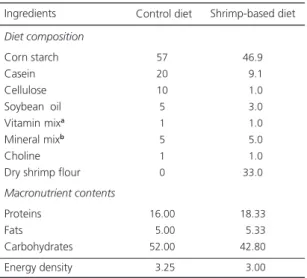
animals were maintained under standard laboratory conditions of a 12/12-hour light-dark cycle and temperature of 23±2°C. The present investigation was in agreement with the Ethical Principles for Animal Experimentation, used by the local Ethics Committee for Animal Experimentation. The composition of the experimental and control diets was described by Borges et al.12 and is shown
in Table 1. The protein concentration in the dry shrimp flour (made using the shell and flesh of the shrimp) was 33.5mg/100mg according to the Lowry et al.13 method. Both diets contained the
same amounts of protein, fats and carbohydrates. The shrimp flour was made by drying commercial shrimp and grinding it until a fine flour was obtained, which was then added to the other components of the diet. The diets were prepared sanitarily, stored at -20°C and removed from the freezer right before use.
Fourteen male Wistar rats were randomly divided into two groups: Group 1 (control) received a regular diet and Group 2 (experimental) received a diet containing 33% shrimp flour for nine days. Intake of food and water was assessed during the entire experimental period. On the ninth day after initiation of the shrimp-based diet, all rats were anesthetized with thionembutal (40mg/kg intraperitoneally) and submitted to intracardiac puncture. Serum samples were collected and kept frozen at -80°C until analysis. Then, the animals were submitted to laparotomy and segments of the jejunum, below the duodenojejunal ligament were removed. Tissue fragments were rinsed with 0.9% saline and collected for histological studies after fixation in 10.0% PBS-buffered formalin.
Cytokines
Serum samples were quantitatively assayed for IL-1E, IL-4, IL-6, and IL-10 by capture Enzyme-Linked Immunosorbent Assay (ELISA) using eBioscience (Iceland, Ireland, United Kingdom) kits. Wells coated with capture antibodies (100µL per well at appropriate dilution) were incubated with premixed standards or sample supernatants (50µL) in 96-well filter plates. Plates were shaken for 30 sec at 1000rpm and then incubated at room temperature for one hour at 300rpm. After incubation, detection antibodies (1µg/mL) were added and the plates were shaken and incubated as before. After rinsing with a vacuum device (Millipore Corp., Billerica, MA), avidin-HRP (2µg/mL) was added to the wells, and the plates were shaken for 30 minutes at room temperature. A substrate solution was added (100µL per well at appropriate dilution) and incubated at room temperature for another 15 minutes. After addition of a stop solution, the optical density was determined at 450nm.
Histological analysis of the jejunum
A segment of the jejunum was stored in 10% buffered formalin and embedded in paraffin. Table 1. Diet composition (%), nutrient contents (g/100g) and
energy density (kcal/g).
Diet composition
Corn starch Casein Cellulose Soybean oil Vitamin mixa
Mineral mixb
Choline Dry shrimp flour
Macronutrient contents Proteins Fats Carbohydrates Energy density 57 20 10 5 1 5 1 0 16.00 05.00 52.00 03.25 46.9 09.1 01.0 03.0 01.0 05.0 01.0 33.0 18.33 05.33 42.80 03.00
aComposition: 30mg niacin, 15mg pantothenic acid, 6mg vitamin
B6, thiamin, 6mg riboflavin, 2mg folic acid, 750µg vitamin K, 200µg D-biotin, 25µg vitamin B12, 4000µg; vitamin A, 1000µg vitamin D3 and 75µg vitamin E.
bComposition of the essential minerals: 35mg iron, 5000mg calcium,
1561mg phosphate, 3600mg potassium, 300mg sulfur, 1019mg sodium, 1571mg chlorine, 507mg magnesium, 30mg zinc, 10mg manganese, 5mg copper, 0.2mg iodine, 0.15mg molybdenum, 0.15mg selenium and potentially beneficial minerals: 5mg silicone, 1mg chromium, 1mg fluorine, 0.5mg nickel, 0.1mg lithium and 0.1mg vanadium.
Sections of 4Pm were prepared and stained with hematoxylin-eosin.
Statistical analysis
Results are presented as mean ± Standard Error of Measurement (SEM). The groups were compared by the Student’s t test for unpaired data and the level of significance was set at pe0.05.
R E S U L T S
The shrimp-based diet did not change food intake (37.04±4.09 versus 47.22±24.86g) for the control and experimental groups, respectively, (p>0.05) or animal weight (254.0±38.2 versus
264.0±40.6g) for the control and experimental groups, respectively (p>0.05). The nutritional status of the animals fed shrimp did not change. There was no weight loss, stunting, thinner and more fragile skin, lethargy or hair loss.
Figure 1 shows the serumconcentrations of IL-4 and IL-10. The levels of IL-4 (14.4±1.9pg/mL) and IL-10 (5.0±0.98pg/mL) in the serum of the experimental rats were significantly lower than those of the controls (18.11±2.6pg/mL and 7.5±1.2pg/mL for IL-4 and IL-10, respectively;
p<0.05).
Figure 2 shows the serum levels of the inflammatory cytokine IL-6. The levels of IL-6 in samples from the experimental group (17.8±2.3pg/mL) are significantly higher than those of the control group (3.2±0.4pg/mL,
p<0.001).
The shrimp-based diet did not change the serum levels of IL-1E (53.1±4.8 and 50.4±5.2pg/ mL for the control and shrimp-based diet, respectively).
Figure 3 illustrates the histological assessment of the control group’s jejuna (Figures 3A and 3B) and experimental group’s jejuna (Figures 3C and 3D). The shrimp-based diet caused an architectural disorganization of the intestinal
0 5 10 15 20 25
* *
IL-4 IL-10
E E
C C
Sermun IL (pg/mL)
0 5 10 15 20 25
*
C E
Serum IL-6 (pg/mL)
Figure 1. Serum concentrations of IL-4 and IL-10 in rats fed a re-gular diet (C) or a shrimp-based diet (E).
Note: The data are expressed as means ± Standard Error of Measurement (SEM) of 7 animals per group.*p<0.05 vs. control group.
Figure 2. Serum concentrations of IL-6 in rats fed a regular diet (C) or a shrimp-based diet (E).
Note: The data are expressed as means ± Standard Error or Measurement (SEM) of 7 animals per group.*p<0.001 vs. control group.
mucosa, with inflammatory infiltrate, stressed hyperplasia of calyciform cells (short arrows in C and D) and greater abundance of eosinophil cells in the jejunal villi (long arrows in D) in comparison with the control rats.
D I S C U S S I O N
the decrease in IL-10, an important regulatory cytokine, in the serum of rats after daily consumption of a shrimp-based diet. No difference in food intake or body weight was observed between the groups and the diet caused a jejunal histological aspect compatible with food allergy.
The high levels of the proinflammatory cytokine IL-6 in the serum of animals in the experimental group could be explained by a number of possibilities, such as an immune-specific effect of some shrimp component or infection by intestinal microbiota. Among these possibilities, the most plausible would be an allergic sensitization caused by the diet. Regulatory T-cells (Treg) might represent a normal braking mechanism leading to tolerance. An emerging hypothesis is that allergic sensitization may result partially from a lack of appropriate IL-10-producing Treg activity, which is either defective or is overcome in those who develop an allergy14.
Accordingly, an interesting role for IL-6 in
determining Th2 effector and Treg cell function was described by Doganci et al.15, who identified
IL-6 as an important factor that may expand Th2 responses to allergen and prevent the proliferation of Treg cells in the allergic airway. On the other hand, the allergy in rats fed shrimp-based diet could be facilitated by intestinal bacterial penetration due to intestinal rupture that may accompany a food allergy process as evidenced by the jejunal histology of those animals.
Contrary to IL-6, IL-10 is a regulatory cytokine known to inhibit allergic and inflammatory events7-9. IL-10 suppresses macrophage activity
and reduces their cytokine production16.
Temporally, IL-10 expression follows the early proinflammatory cytokine response, probably to limit both the magnitude and the duration of the inflammatory response17. In addition, IL-10 may
protect children from allergic polysensitization18.
Therefore, the development of new sensitizations as that caused by the shrimp-based diet may be
A B
C D
encouraged by low production of some cytokines, especially IL-10, and possibly be related to functional defects of the Treg cells18.
While a greater abundance of eosinophils in the jejunal villi of rats in the experimental group was seen, suggesting the occurrence of an allergic food process, there were also low levels of the Th2-related cytokine IL-4. The lower levels of IL-4 could be accounting for an impairment of Treg activity. Indeed, it has been shown that IL-4 can induce the proliferation, as well as prevent Treg apoptosis19,20.
Proinflammatory cytokines, including IL-1D and IL-1E, IL-6, and TNF-D, play an important role in wound repair, influencing processes at the wound site, including stimulation of keratinocyte and fibroblast proliferation, synthesis and breakdown of extracellular-matrix proteins, fibroblast chemotaxis, and regulation of the immune response21. Polymorphonuclear leukocytes
and macrophages have been shown to be the major source of these cytokines22,23. Normal repair
seems to occur by the coordinated expression of these cytokines, since expression of these genes was strongly reduced in healing-impaired glucocorticoid-treated mice22.
It has been shown that wounds of IL-6-knock-out animals took up to three times longer to reepithelialize than those of wild-type controls24. The delay in that process and the
impairment of granulation tissue formation were probably caused by IL-6 deficiency25. Conversely,
the opposite effect was observed by administration of recombinant murine IL-6 protein one hour before wounding, eliminating wound healing impairment, and producing a mitogenic effect on keratinocytes and a chemoattractive effect on neutrophils. Thus, it appears that IL-6 is crucial for kick-starting the healing response. Interestingly, excessive levels of IL-6 have been associated with skin scarring, and this cytokine increased the most with the shrimp-based diet.
Anti-inflammatory cytokines have also been shown to be important regulators of wound repair. In particular, IL-10 is thought to play a major
role in the healing response. This cytokine acts in inflammatory response termination. Moreover, it regulates growth and/or differentiation of various immune cells, but also of keratinocytes and endothelial cells26. Based on these activities, a role
of IL-10 in wound healing appeared later. In the present study, its serum levels in the experimental rats were lower, which would correspond to the earliest phase of wound repair.
In conclusion, rats receiving a shrimp-based diet display a cytokine profile compatible with allergic processes. This could be contributing to the lower tensile strength of scars observed in those animals after the ingestion of a shrimp-based diet.
A C K N O W L E D G M E N T S
The authors thank Dr. Denise Carmona Cara--Machado for the histological analysis.
C O N T R I B U T O R S
EL Borges coordinated and designed the study, performed the statistical analysis and data interpretation, and prepared the manuscript. DR Oliveira prepared the diets and took care of the animals. LS Barcelos aided in the discussion and preparation of the manuscript. JL Pesquero performed the biochemical analysis and preparation of the manuscript.
R E F E R E N C E S
1. Cribbs RK, Harding PA, Luquette MH, Besner GE. Endogenous production of heparin-like EGF-like growth factor during murine partial-thickness burn wound healing. J Burn Care Rehabil. 2002; 23(2): 116-25.
2. Crowe MJ, Doestschman T, Greenhalgh DG. Delayed wound healing in immunudeficient TGF-beta 1 knockout mice. J Invest Dermatol. 2000; 115(1):3-11.
4. Danilenko DM, Ring BD, Lu JZ, Tarpley JE, Chang D, Liu N, et al. New differentiation factor upregulates epidermal migration and integrin expression in excisional wounds. J Clin Invest. 1995; 95(2):842-51.
5. Danilenko DM, Ring BD, Tarpley JE, Morris B, Van GY, Morawiecki A, et al. Growth factoring porcine full and partial thickness burn repair. Differing targets and effects of keratinocyte growth factor, platelet derived growth factor-BB, epidermal growth factor, and neu differentiation factor. Am J Pathol. 1995; 147(5):1261-77.
6. Diehl S, Rincón M. The two faces of IL-6 on Th1/Th2 differentiation. Mol Immunol. 2002; 39(9):531-6. 7. Bundoc VG, Keane-Myers A. IL-10 confers protection from mast cell degranulation in a mouse model of allergic conjunctivitis. Exp Eye Res. 2007; 85(4): 575-9.
8. Koulis A, Robinson DS. The anti-inflammatory effects of interleukin-10 in allergic disease. Clin Exp Allergy. 2000; 30(6):747-50.
9. Tournoy KG, Kips JC, Pauwels RA. Endogenous interleukin-10 suppresses. Allergy. 2000; 30(6): 775-83.
10. Knippels LMJ, Wijk FW, Penninks AH. Food allergy: what do we learn from animal models? Curr Opin Allerg Clin Immunol. 2004; 4(3):205-9.
11. Ogawa T, Miura S, Tsuzuki Y, Ogino T, Teramoto K, Inamura T, et al. Chronic allergy to dietary ovalbumin induces lymphocyte migration to rat small intestinal mucosa that is inhibited by MAdCAM-1. Am J Physiol Gastrointest Liver Physiol. 2004; 286(5):G702-10.
12. Borges EL, Pereira FKS, Alvarez-Leite JI, Alberti LR, Ferreira MAND, Petroianu A. Shrimp diet and skin healing strength in rats. Rev Nutr. 2007; 20(3):257-63. doi: 10.1590/S141552732007000300004. 13. Lowry OH, Rosenbrough NJ, Farr AL, Randal AL.
Protein measurement with the Folin phenol reagent. J Biol Chem. 1951; 193(1):265-75. 14. Ahern DJ, Robinson DS. Regulatory T cells as a
target for induction of immune tolerance in allergy. Curr Opin Allergy Clin Immunol. 2005; 5(6):531-6. 15. Doganci A, Eigenbrod T, Krug N, De Sanctis GT, Hausding M, Erpenbeck VJ, et al. The IL-6RD chain controls lung CD4+CD25+ Treg development and function during allergic airway inflammation in vivo. J Clin Invest. 2005; 115(2):313-25. 16. Sato Y, Ohshima T, Kondo T. Regulatory role of
endogenous interleukin-10 in cutaneous inflammatory
response of murine wound healing. Biochem Biophys Res Commun. 1999; 265(1):194-9. 17. Zubaidi A, Buie WD, Hart DA, Sigalet D. Temporal
expression of cytokines in rat cutaneous, fascial, and intestinal wounds: a comparative study. Dig Dis Sci. 2010; 55(6):1581-8.
18. Prigione I, Morandi F, Tosca MA, Silvestri M, Pistoia V, Ciprandi G, et al. Interferon-gamma and IL-10 may protect from allergic polysensitization in children: preliminary evidence. Allergy. 2010; 65(6):740-2.
19. Chuang YH, Yang YH, Wu SJ, Chiang BL. Gene therapy for allergic diseases. Curr Gen Ther. 2009; 9(3):185-91.
20. Tay SS, Plain KM, Bishop GA. Role of IL-4 and Th2 responses in allograft rejection on tolerance. Curr Opin Organ Transplant. 2009; 14(1):16-22.
21. Werner S, Grose R. Regulation of wound healing by growth factors and cytokines. Physiol Rev. 2003; 83(3):835-70.
22. Hübner G, Brauchle M, Smola H, Madlener M, Fassler R, Werner S. Differential regulation of pro-inflammatory cytokines during wound healing in normal and glucocorticoid-treated mice. Cytokine. 1996; 8(7):548-56.
23. Feiken E, Romer J, Eriksen J, Lund LR. Neutrophils express tumor necrosis factor-alpha during mouse skin wound healing. J Invest Dermatol. 1995; 105(1): 120-3.
24. Gallucci RM, Simeonova PP, Matheson JM, Kommineni C, Guriel JL, Sugawara T, et al. Impaired cutaneous wound healing in interleukin-6-deficient and immunosuppressed mice. FASEB J. 14(15): 2525-31.
25. Sato M, Sawamura D, Ina S, Yaguchi T, Hanada K, Hashimoto I. In vivo introduction of the interleukin 6 gene into human keratinocytes: induction of epidermal proliferation by the fully spliced form of interleukin 6, but not by the alternatively spliced form. Arch Dermatol Res. 1999; 291(7-8):400-4. doi: 10.1007/s004030050429.
26. Moore KW, De Waal Malefyt R, Coffman RL, O’Garra A. Interleukin-10 and interleukin-10 receptor. Annu Rev Immunol. 2001; 19:683-765.