RE
VIE
W
1 Escola de Enfermagem, Departamento de Saúde Coletiva, Universidade de São Paulo. Av. Dr. Enéas de Carvalho Aguiar 419, Cerqueira César. 05403-000 São Paulo SP Brasil. [email protected]
2 Faculdade de Enfermagem, Universidade Paulista.
Primary health care assessment tools:
a literature review and metasynthesis
Abstract This study comprises a systematic re-view and metasynthesis of qualitative literature on national and international databases to iden-tify the main tools used to assess Primary Health Care (PHC). A total of 3,048 results were returned for literature written in Portuguese, Spanish and English published between 1979 and 2013. Thir-ty-three articles/studies were selected after thor-ough reading and analysis. Eight of these studies addressed the use of one or more of the following validated PHC assessment tools: the WHO Pri-mary Care Assessment Tool (PCET); the ADHD Questionnaire for Primary Care Providers (AQ-PCP); the General Practice Assessment Question-naire (GPAQ), PACOTAPS (primary health care software); and the PCAT (Primary Care Assess-ment Tool). The study showed that the majority of these tools were used internationally. The PCAT and EUROPEP were used in Brazil and the most commonly used tool in this country was the PCAT. The results show that the use of research tools to assess PHC may assist in the creation of new proposals to improve family healthcare and that PCAT is the most adequate tool for this purpose. Key words Health assessment, Primary health care, Public health, Health services
Lislaine Aparecida Fracolli 1
Maria Fernanda Pereira Gomes 1
Fabiana Rodrigues Zequini Nabão 2
Mariana Souza Santos 2
Verusca Kelly Cappellini 2
F
r
a
c
Introduction
The worldwide debate about Primary Health Care (PHC) strategies has intensified over recent decades and measures to strengthen primary care are an integral part of the reorganisation of healthcare in various European and Latin Amer-ican countries1.
The International Conference on Primary Health Care (the Alma – Ata Conference) held in 1978 marked a major milestone in the de-velopment of the concept of PHC by calling for “Health for all by 2000”and a broader vision of healthcare that encompassed the sectoral dimen-sions of health and participation of the popula-tion2.
According to the Alma-Ata Declaration, PHC is the central function of national health systems and forms an integral part of a permanent pro-cess of sanitary assistance that includes preven-tion, promopreven-tion, cure and rehabilitapreven-tion, and of the overall social and economic development of the community, involving cooperation with oth-er sectors to promote social development and confront the social determinants of health2.
In Brazil, PHC is called basic health care and is characterised by a series of actions and sanitary practices in both the individual and collective spheres that encompass health promotion and protection, prevention of problems, diagnosis, treatment, rehabilitation and maintenance. The approach to basic health care is based on demo-cratic and participative management and actions are focused on populations of well defined geo-graphical region staking into account the specific characteristics of each area3.
Studies show that a given country’s PHC framework depends on its approach to social health protection. In most European countries, outpatient services form an integral part of a universal health care system where the right to health is guaranteed at all levels through publi-cally funded comprehensive universal systems in which PHC is seen as a gateway to the wider system.
However, in periphery countries, such as those in Latin America, PHC is selective and nar-rowly focussed on particular health problems. The expansion of health coverage depends on the private health insurance market that attends spe-cific groups such as maternal and infant health. Health coverage in the majority of countries in Latin America is therefore segmented, with the coexistence of different schemes for different so-cial groups. Primary care is incorporated only in
the public sector through the implementation of selective programs, thus resulting in significant inequalities in access to health care1.
The context of the Brazilian health system is rather complex when it comes to approaches to primary care. Although the technically universal health system offers a diverse range of services and has expanded coverage to a large portion of the population previously without access, it co-exists with private health schemes for the middle class thus creating a segmented and effectively dual system of healthcare which still remains in-sufficient. Although the population covered by the Unified Health System (SUS) is by no means small, the reach of services that should be guar-anteed by the public system is questionable1.
The existence of different concepts of PHC shows that there are no set national or interna-tional standards, but rather a number of diverse models adapted to the social, economic and po-litical context of a given country within a gen-eralised tendency to embody a managed care approach under different politico-institutional contexts1.
According to Ibañez et al.4, research that
fo-cuses on organisational evaluations and care performance assessments of primary health care services and provides a critical insight into insti-tutional mechanisms for monitoring and assess-ing primary health care is rare.
Given the nuanced understanding of the con-cept of PHC and the lack of research addressing primary care assessment, are view of literature on the current use of primary care assessment tools across health systems in different countries is considered of utmost importance.
Furthermore, the use of assessment tools to take a closer look at health systems allows a greater understanding of the following aspects of PHC in Brazil and other countries: perceptions of health service users, health professionals and managers; different health care frameworks; in-dividual and collective care practices; and man-agement practices.
The objective of this study is to therefore to carry out a review of literature on national and international databases to identify the tools cur-rently used to assess Primary Health Care.
Methodology
e C
ole
tiv
a,
19(12):4851-4860,
2014
a research method which allows the researcher to group primary studies and extract the best scien-tific evidence5.
Since it synthesises all high quality research on a given question, the method provides the highest possible level of evidence for deci-sion-making related to issues of therapy or treat-ment5. Furthermore, metasynthesis allows the
researcher to interpret primary data and deepen his/her understanding of the phenomenon, thus facilitating the use of knowledge and research in decision making, to help set health policies and to define practices6.
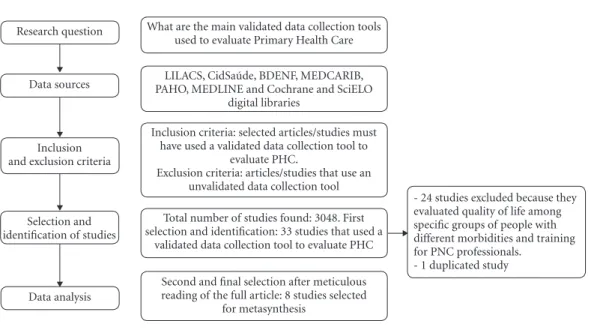
The following research question was formu-lated using the PICO method which is used to select a specific intervention or phenomenon of interest: “What are the main validated data col-lection tools used to evaluate Primary Health Care?”
The identification and selection of articles/ studies was carried out in the following stages detailed in Figure 17:
1. Identification of the theme and formula-tion of research quesformula-tion;
2. Definition of data sources;
3. Establishment of study inclusion and ex-clusion criteria;
4. Data selection and processing;
5. Data analysis: evaluation of the quality of studies and interpretation of results.
This study used the following inclusion crite-ria: selected articles/studies must have used a val-idated data collection tool to evaluate PHC. The following exclusion criteria were also used: all ar-ticles/studies which did not use a validated data collection tool; articles/studies which addresses PHC but which evaluated quality of life of the population rather than the quality of PHC ser-vices; duplicated articles/studies; articles/studies that evaluated training and capacity building of PHC professionals.
The study considered articles/studies written in Portuguese, Spanish and English published between 1979 and 2013and indexed on the LI-LACS, CidSaúde, BDENF, IBECS, MEDCARIB, PAHO, MEDLINE databases and Cochrane and SciELO digital libraries as shown in Table 1.
The following keywords were used for the search of the LILACS (Latin American and Ca-ribbean Health Sciences Literature) database: “Evaluation of Health”, “Primary Health Care Evaluation”, “Public Health”, and “Health Ser-vice”. After meticulous reading of the eight select-ed studies, six were excludselect-ed because they usselect-ed unvalidated data collection tools.
The following key words were used for the search of the CidSaúde database (Literature about Healthy Cities/Municipalities): “Evaluation of Health”, “Primary Health Care Evaluation”, and “Health Service”. The only article found was read
Research question
Data sources
Inclusion and exclusion criteria
Selection and identification of studies
Data analysis
What are the main validated data collection tools used to evaluate Primary Health Care
LILACS, CidSaúde, BDENF, MEDCARIB, PAHO, MEDLINE and Cochrane and SciELO
digital libraries
Inclusion criteria: selected articles/studies must have used a validated data collection tool to
evaluate PHC.
Exclusion criteria: articles/studies that use an unvalidated data collection tool Total number of studies found: 3048. First selection and identification: 33 studies that used a
validated data collection tool to evaluate PHC
Second and final selection after meticulous reading of the full article: 8 studies selected
for metasynthesis
- 24 studies excluded because they evaluated quality of life among specific groups of people with different morbidities and training for PNC professionals.
- 1 duplicated study
Figure 1. Stages in the identification and selection of articles/studies for metasynthesis.
F
r
a
c
and it was found that the study used a validated data collection tool to evaluate PHC.
The following keywords were used for the search of the BDENF database (Nursing Data): “Evaluation of Health” and “Primary Health Care Evaluation”. Two articles were found which were excluded after reading because neither used a val-idated data collection tool to evaluate PHC.
The following keywords were used for the search of the IBECS database (the Spanish Bib-liographic Index of the Health Sciences): “Health Evaluation” and “Primary Health Care”. The four studies found did not use a validated data collec-tion tool to evaluate PHC.
The following keywords were used for the search of the MEDCARIB database: “Health Evaluation” and “Primary Health Care”. Only one of the 40 results used a validated data collection tool to evaluate PHC. However, this study was not included in the metasynthesis because its di-rect focus was not PHC, but an evaluation of the severity of symptoms of diabetes within a PHC scenario.
The following key words were used for the search of the PAHO database: “Health Evalua-tion” and “Primary Health Care”. After reading the summaries, none of the 90 studies found used a validated data collection tool to evaluate PHC.
The following MeSH terms were used for the search of the MEDLINE database (Medical Literature Analysis and Retrieval System On-line): “health evaluation”, “primary health care”, “health services”, “public health” and “question-naires”. Twenty-two of the 2,761 search results used a data collection tool to evaluate PHC. Meticulous reading of the 22 studies resulted in the selection of four articles/studies. Seventeen articles/studies were excluded because they did
not deal directly with PHC, but rather evaluat-ed quality of life among groups of people with different morbidities such as neoplasm, arterial hypertension and mental health disorders.
The term “evaluation” was used for the search of the Cochrane Library, resulting in 75 articles, which were all excluded because none dealt with PHC assessment tools.
The key words “Evaluation of Health”, “Pri-mary Health Care Evaluation”, “Public Health” and “Health Service” were used for the search of SciELO (Scientific Electronic Library Online). After meticulous reading of the eight studies found by this search, two were found to use a validated data collection tool to evaluate PHC. However, these studies were duplicated because they had been found through the search of the LILACS database.
Results
The eight studies selected for the metasynthe-sis were published in national and internation-al journinternation-als. Study participants were either PHC professionals or PHC service users and research used secondary data obtained from primary health centres.
The main methods used by the studies were interviews with the use of validated tools, as well as self-administered questionnaires as detailed in Chart 1.
Discussion
The search identified the use of five main assess-ment tools: the WHO Primary Care Assessassess-ment Tool (PCET); the ADHD Questionnaire for
Pri-Data source
BDENF IBECS MEDCARIB PAHO MEDLINE BDENF IBECS MEDCARIB PAHO
Total number of studies
67
1 2 4 40 90
2.761
75 8
Table1. Studies selected by data source (1979 to 2013).
Studies selected for metasynthesis
2 1 0 0 0 0 4 0 2
Studies using assessment tools
8 1 0 0 1 0 22 0 2
Search date
20 Sep 2013 20 Sep 2013 20 Sep 2013 14 Oct 2013 06 Nov 2013 01 Nov 2013 01 Nov 2013 22 Sept 2013 20 Sept 2013
e C ole tiv a, 19(12):4851-4860, 2014
mary Care Providers (AQ-PCP); the General Practice Assessment Questionnaire (GPAQ); PA-COTAPS (primary health care software); and the PCAT (Primary Care Assessment Tool).
The WHO Primary Care Assessment tool (PCET) has been used in a number of coun-tries that are undergoing deep and wide-ranging health reforms related to the social function and essential values that underpin healthcare pro-vision. Reforms in primary health care are not
always based on evidence, and progress may be
driven by political arguments or the interests of specific professional groups.
However, health policy-makers today de-mand scientific evidence that health reforms are really making progress. The WHO therefore cre-ated the PCET with the aim of providing a struc-tured approach to assessment based on specific aspects of the health system, such as governance, funding and resource generation, as well as fac-tors that characterise good primary health care, including access, comprehensiveness,
coordina-tion and continuity8.
The PCET has three components: a national questionnaire regarding organisation and fund-ing of primary health care; a questionnaire for
Number and reference
number
1 (10)
2 (11)
3 (12)
4 (13)
Method
Secondary data provided by the Brazilian Institute for Geography and Statistics Foundation Interviews with physicians and nurses from primary health centres in Porto Alegre (State of Rio Grande do Sul) using the PCAT
Interviews of patients in primary health centres located in the north and centre-west of the municipality of São Paulo using the PCAT
Interviews with service usersand health professionals using the PCAT
Participants
45 urban and rural primary health centres in Pelotas (State of Rio Grande do Sul)
PHC professionals in Porto Alegre (181 working in UBS centres, 88 working in ESF centres, 23 working in CSEM centres and 77 working in SSC centres)
90 Family Health Programme patients and 90 without links to the Family Health Programme
100 users with tuberculosis and 14 health professionals (physicians and nurses
Chart 1. Main characteristics of the studies selected for metasynthesis (1979 to 2013).
Data collection tool used PACOTAPS (primary health care software) PCAT (Primary Care Assessment Tool) PCAT (Primary Care Assessment Tool) PCAT (Primary Care Assessment Tool) Country Brazil Brazil Brazil Brazil
Evaluation of Primary Health Care
Using PACOTAPS to systemise information facilitates decision-making, especially in primary health centre management
Evaluation of the cardinal and related domains of PHC according to Starfield
Evaluation of comprehensiveness in PHC in centres in the municipality of São Paulo based on “gateway” criteria, links, range of services, coordination, family centeredness, and community orientation
F
r
a
c
family doctors; and a questionnaire for service users8.
The ADHD Questionnaire for Primary Care Providers (AQ-PCP) was developed to evaluate the perceptions of primary care providers regard-ing their role, the challenges associated with di-agnosis of attention deficit hyperactivity disorder (ADHD), and clinical activities specific to the care
of children with ADHD. The items of this ques-tionnaire were developed based on the following criteria: a careful revision of the recommenda-tions for performing an evaluation of the disorder contained in the American Academy of Paediat-rics Guidelines for treatment of ADHD; a revision of the role of primary health care providers; and focus groups of primary health care providers9.
Number and reference
number
5 (8)
6 (9)
7 (14)
8 (16)
Método
Use of an
assessment tool with three components: a national questionnaire regarding organisation and funding of primary health care, a questionnaire for family doctors, and questionnaire for family health centre patients
Focus groups of PHC professionals and use of AQ-PCP
Use of the self-administered GPAQ
Interviews with parents and guardians of children under two years
Participants
1,548 family health centre users (738 in Bolu and 810 in Eskisehir), 78 family doctors (37 in Bolu and 41 in Eskisehir)
181 PHC professionals (134 in rural areas and 46 in urban areas)
2,600 patients of the Family Medicine Clinic
468 parents and guardians of children registered in 18 primary health centres in Porto Alegre
Chart 1. continuation
Data collection tool used
WHO Primary Care
Assessment tool (PCET)
ADHD Questionnaire
for Primary Care Providers
(AQ-PCP)
General Practice Assessment Questionnaire
(GPAQ)
PCAT (Primary Care
Assessment Tool)
Country
Turkey
United States
Thailand
Brazil
Evaluation of Primary Health Care
Evaluation of primary health care in the cities of Bolu and Eskiseirin Turkey
Evaluation of the perceptions of PHC professionals with respect to their role and management challenges, and differences between professionals working in rural areas and those working in urban areas
Evaluation of
PHCincluding care access, continuity of care, doctor communicationand medical knowledge, and general level of satisfaction
Validation of the PCAT-CE to evaluate child PHC
Source: produced by the authors (2014).
Data source
LILACS
Medline
Medline
e C
ole
tiv
a,
19(12):4851-4860,
2014
PACOTAPS is a primary health care software developed using the programming language Vi-sual Basic 5.0. The secondary data and outpatient care demand modules of this program were test-ed in a primary health centre in Pelotas in the State of Rio Grande do Sul. The tool proposes an interface between two fields of knowledge: epidemiology and information technology. By processing the information contained on patient forms, PACOTAPS provides secondary data on the age and sex distribution of a specific popu-lation, outpatient care demand, and all patient
attendances at a given primary health centre10.
The General Practice Assessment Question-naire (GPAQ) was developed by the National Primary Care Research and Development Cen-tre at the University of Manchester for the 2003 GP contract. The GPAQ helps practices find out what patients think about the care provided by doctors and focuses on specific features of gen-eral practice, such as access, the interpersonal
as-pects of care, and continuity of care14.
This study observed that the PCAT (Primary Care Assessment Tool) and European Task Force on Patient Evaluation of General Practice Care (EUROPEP) are tools currently used in Brazil. The most commonly used tool in Brazil is the PCAT, since it is widely accepted and validated in the United States, Spain and other countries.
O PCAT was developed by Starfield et al.15
at the Johns Hopkins Populations Care Policy Center for the Underserved Populations in Bal-timore, Maryland based on a theoretical frame-work of primary care domains and characteris-tics. It measures the presence and extent of four cardinal domains and three related domains of primary care and user affiliation with the care source15.
Starfield et al.15 defined four cardinal primary
care domains: first-contact access, longitudinal-ity, comprehensiveness, and coordination. The same authors also proposed three related do-mains: family centeredness, community orienta-tion, and cultural competence.
The PCAT, originally made up of 77 ques-tions (items) about the seven primary care do-mains, was created based on a health service quality assessment model proposed by Don-abedian17 which uses a structure, process and
outcome framework17. Based on a Likert-type
response scale, each domain is scored on a scale of one to four. The final score for each domain is represented by the average of the scores assigned to each of the items related to each domain. Some of the domains are made up of subdomains, for
example: first-contact access (first contact and use), comprehensiveness (services received and services available) and coordination (informa-tion system and flow of service users). The es-sential primary health score is represented by the sum of the final average score assigned to each of the four cardinal primary care domains and their subdomains and the average extent of affil-iation score. The overall primary health score is represented by the sum of the final average score assigned to each of the four cardinal primary care domains and the final average scores assigned to each of the three related domains16.
This tool also has a child version (PCAT-CE with 55 items), adult version used only with in-dividuals aged over 18 years (PCAT-AE with 87 items), and provider version (PCAT-PE with 77 items)18.
The EUROPEP was developed to provide feedback on practice, performance and organiza-tion of care among family health professionals. The EUROPEP has three components: 1) Key indicators (relationship and communication, medical care, information and support, continu-ity and cooperation, and service organisation); 2) indicators of specific areas of satisfaction (con-sultations, appointments and accessibility, char-acteristics of doctors, conditions at the health centre, and the services provided); 3) user in-formation (socioeconomic and health data, and post-questionnaire attitudes)19.
The PCAT and EUROPEP are used in Brazil along with another tool for assessing PHC called the Program for Improvement in Access and Quality of Primary Care (Programa Nacional de Melhoria do Acesso e da Qualidade da Atenção Básica - PMAQ-AB). Although the search did not return any results mentioning the PMAQ-AB, it is important to describe the development of this tool in the Brazilian context.
The aim of the PMAQ is to widen the capac-ity of health managers, at the federal, state and municipal level, and primary healthcare teams to deliver services that ensure greater access to quality healthcare that meets the concrete needs of the population. The tool also aims to promote greater access to quality PHC that guarantees minimum standards of service at national, re-gional and local level, and greater transparency and effectiveness in government actions focussed on PHC across the country20.
develop-F
r
a
c
ment, external assessment, and recontractualisa-tion)20.
The analysis of the data collection tools used by the studies selected by our search shows that the most adequate tool for assessing essential as-pects of primary health care service provision is the PCAT. This tool measures the presence and extent of the essential characteristics of primary care and at the same time assess indicators which address aspects related to the care process, such as the performance of family health teams. The tool is particularly appropriate to the Brazilian context and the work of family health teams be-cause it enables the researcher to address family centeredness, community orientation, and cul-tural competence. These additional aspects of primary care are in line with Brazil’s National Primary Health Care Policy whose main strategy for expanding and strengthening PHC is family health2.
Conclusion
The search for the “most adequate” tool for as-sessing PHC reveals that the fundamental aim of developing such instruments is the production of reliable scientific knowledge to support decision making21.
The choice of an adequate assessment tool should therefore consider aspects of PHC that need to be revised and improved by health man-agers and the results of assessments of PHC using these tools should provide concrete information to support the creation of new proposals that contribute to improvements in family health.
e C
ole
tiv
a,
19(12):4851-4860,
2014
Collaborations
LA Fracolli, MFP Gomes and FRZ Nabão carried out the literature review and data analysis, pro-duced the tables, and helped draft the final ver-sion of this article. MS Santos, VK Capellini and ACC Almeida were responsible for data interpre-tation and drafting and revising the final version of this article.
References
Giovanella L. Atenção Primária à Saúde seletiva ou abrangente? Cad Saude Publica. 2008; 24(Supl. 1):21-23.
Brasil. Ministério da Saúde (MS). Promoção da saúde: carta de Ottawa, declaração de Adelaide, Sundsvall e
Santa Fé de Bogotá. Brasília: MS; 1996.
Brasil. Ministério da Saúde (MS). Secretaria de Atenção à Saúde. Departamento de Atenção Básica. Política
Na-cional de Atenção Básica. Brasília: MS; 2012.
Ibañez N, Rocha JSY, Castro PC, Ribeiro MCSA, Fors-ter AC, Novaes MHD, Viana ALD. Avaliação do desem-penho da atenção básica no Estado de São Paulo. Cien
Saude Colet 2006; 11(3):683-703.
Lopes ANM, Fracolli LA. Revisão sistemática de litera-tura e metassíntese qualitativa: considerações sobre sua aplicação na pesquisa em enfermagem. Texto contexto
- enferm. 2008; 17(4):771-778.
Atallah AN. Revisão sistemática da literatura e metaná-lise. Diagnóstico e Tratamento 1997; 2(2):12-15. Sandelowski M, Barroso J. Handbook for synthesizing
qualitative research. New York: Springer; 2007.
Kringos DS, Boerma WG, Spaan E, Pellny M. A snap-shot of the organization and provision of primary care in Turkey. BMC Health Services Research 2011; 11:90. Poder TJ, Mautone JÁ, Manz PH, Frye L, Blum NJ. Ma-naging attention-deficit/hyperactivity disorder in pri-mary care: a systematic analysis of roles and challenges.
Pediatrics 2008; 121(1):65-72.
Tomasi E, Facchini LA, Osorio A, Fassa AG. Aplicati-vo para sistematizar informações no planejamento de ações de saúde pública. Rev Saude Publica 2003; 37(6):800-806
Castro RCL, Knauth DR, Harzheim E, Hauser L, Dun-can BB. Avaliação da qualidade da atenção primária pe-los profissionais de saúde: comparação entre diferentes tipos de serviços. Cad Saude Publica 2012; 28(9):1772-1784.
Sala A, Luppi CG, Simões O, Marsiglia RG. Integralida-de e Atenção Primária à SaúIntegralida-de: avaliação na perspecti-va dos usuários de unidades de saúde do município de São Paulo. Saude soc 2011; 20(4):948-960.
Silva EM, Assis MMA, Villa TCS, Scatenae LM. Coor-denação dos serviços de atenção primária em saúde no controle da tuberculose em um município da Bahia, Brasil. Rev. Baiana de Saúde Pública 2010; 34(2):227-239.
1.
2.
3.
4.
5.
6. 7. 8.
9.
10.
11.
12.
F
r
a
c
Jaturapatporn D, Hathirat S, Manataweewat B, Dellow AC, Leelaharattanarak S, Sirimothya S, Dellow J, Udomsubpayakul U. Reliability and validity of a Thai version of the General Practice Assessment Question-naire (CPAQ). J Med Assoc Thai 2006; 89(9):1491-1496. Starfield B, Xu J, Shi L. Validating the Adult Primary Care Assessment Tool. The Journal of Family Practice
2001; 50(2):161-175.
Harzheim E, Starfield B, Rajmil L, Alvarez-Dardet C, Stein AT. Internal consistency and reliability of Primary Care Assessment Tool (PCATool-Brasil) for child heal-th services. Cad Saude Publica 2006; 22(8):1649-1659. Donabedian, A. The Quality of Care: How Can It Be Assessed? JAMA 1988; 260(12):1743-1748.
Brasil. Ministério da Saúde (MS). Secretaria de Aten-ção em Saúde. Departamento de AtenAten-ção Básica. Ma-nual do Instrumento de avaliação da atenção primária
à saúde: primary care assessment tool pcatool – Brasil.
Brasília: MS; 2010.
Brandao ALRBS, Giovanella L, Campos CEA. Avaliação da atenção básica pela perspectiva dos usuários: adap-tação do instrumento EUROPEP para grandes centros urbanos brasileiros. Cien Saude Colet 2013; 18(1):103-114.
Brasil. Ministério da Saúde (MS). Secretaria de Aten-ção à Saúde. Departamento de AtenAten-ção Básica. PMAQ:
Manual instrutivo para as equipes de Atenção Básica.
Brasília: MS; 2013.
Novaes HMD. Avaliação de programas, serviços e tec-nologias em saúde. Rev Saude Publica 2000; 34(5):547-559.
Article submitted on 05/03/2014 Approved 27/05/2014
Final version submitted on 29/05/2014 14.
15.
16.
17. 18.
19.
20.