Cost-Effectiveness of Implantable Cardioverter Defibrillators in Brazil
in the Public and Private Sectors
Rodrigo Antonini Ribeiro, Steffan Frosi Stella, Leandro Ioschpe Zimerman, Maurício Pimentel, Luis Eduardo Rohde,
Carisi Anne Polanczyk
Universidade Federal do Rio Grande do Sul, Porto Alegre, RS - Brazil
Mailing address: Rodrigo Antonini Ribeiro •
Avenida Alegrete 373/402 - Petrópolis - 90460-100 - Porto Alegre, RS - Brazil E-mail: [email protected]
Manuscript received March 24, 2009; revised manuscript received March 11, 2010; accepted March 25, 2010.
Abstract
Background: Many randomized clinical trials have demonstrated the effectiveness of the implantable cardioverter– defibrillator (ICDs) in death reduction of chronic heart failure (CHF) patients. Some developed countries studies have evaluated its cost-effectiveness, but these data are not applicable to Brazil.
Objective: To evaluate the cost-effectiveness of ICD in CHF patients under two perspectives in Brazil: public and supplementary health systems.
Methods: A Markov model was developed to analyze the incremental cost-effectiveness ratio (ICER) of ICD compared to conventional therapy in patients with CHF. Effectiveness was measured in quality-adjusted life years (QALYs). We searched the literature for data regarding effectiveness and complications. Costs were retrieved from public and health insurances reimbursement codebooks and from mean cost of admissions from a public and a private hospital. One-way sensitivity analysis was performed in all variables of the model.
Results: ICER was R$ 68,318/QALY in the public and R$ 90,942/QALY in the private perspective. These values are much higher than the one suggested by the World Health Organization of 3 times the gross domestic product per head (R$ 40,545 in Brazil). The results were sensitive to the cost of the device, battery replacement interval and ICD effectiveness. In a simulation resembling MADIT-I population survival and ICD benefit, ICER was R$ R$ 23,739/QALY in the public and R$ 33,592/QALY in the private perspective.
Conclusion: The ICER of ICD is elevated in the general ICC population, in either the public or private perspective. A more favorable result occurs in patients with a high sudden death risk. (Arq Bras Cardiol 2010; 95(5): 577-586)
Keywords: Defibrillators, implantable; cost-benefit analysis; Brazil.
such as MADIT-II and SCD-HeFT, which evaluated almost 4,000 patients, expanded the ICD indication for patients with heart failure with both ischemic and non-ischemic etiology, with no history of severe arrhythmia in the past8,9.
In total, ten clinical trials evaluated the use of ICD in the primary prevention of events in CHF and two meta-analyses that reviewed these studies found a decrease in total mortality of around 25%10,11.
However, considering the increasing costs in healthcare currently observed worldwide, it is crucial to assess not only the effectiveness but also the costs before approving new inputs in health systems, especially in high-cost technology such as the ICD. Although some cost-effectiveness studies on this therapy have been carried out in international settings12-16, the
obtained results are scarcely applicable to our reality, especially considering the large difference in costs in healthcare sectors among different countries. To date, there had been no description in the literature on the cost-effectiveness of this device using Brazilian data.
Therefore, the aim of this study was to estimate the incremental cost-effectiveness ratio (ICER) of the implantable cardioverter defibrillator (ICD), when compared to the
Introduction
Congestive heart failure (CHF) is currently a public health problem, with increasing incidence and mortality in the last years1-4, currently being among the main causes of hospital
admission at the Brazilian Public Health System (Sistema Único de Saúde - SUS)5. The implantable cardioverter defibrillator
(ICD) has been broadly studied in this group of patients, as this device has the potential to interrupt life-threatening arrhythmias, which account for up to 50% of the mortality in this pathology6.
conventional therapy in the primary prevention of events, considering two perspectives in Brazil: the public health system (SUS) and the supplementary health systems. Secondly, the aim of the present was also to perform sensitivity analyses in order to estimate the most influent parameters in the cost-effectiveness ratio.
Methods
A more detailed description of the methodology has been published elsewhere17. The main points are discussed next.
Description of the economic assessment
A Markov model was constructed, considering a population of patients with left ventricular dysfunction and left ventricular ejection fraction (LVEF) < 35%. This model was built to analyze the cost-effectiveness ratio of the ICD in a population with general heart failure and in a subgroup of patients at higher risk for arrhythmias. When constructing both models, the methodological patterns recommended by the Panel on Cost-Effectiveness in Health and Medicine18-20 were employed. Model
assumptions and included costs were based on the the third-party payer perspective, assessed through the viewpoint of the public and the private healthcare system. The time horizon was 20 years and the adopted discount rate was 3% in the base-case.
Population model
The hypothetical target population consisted of individuals with heart failure and clinical characteristics similar to those studied in the clinical trials: systolic dysfunction (LVEF< 35%), of both ischemic and non-ischemic etiology; initial age of 60 years; NYHA functional class (NYHA-FC) II and III and clinical and surgical conditions for the ICD implantation. The patients
had no history of malignant arrhythmias and the model was established as a primary event prevention one.
Description of the clinical-decision model
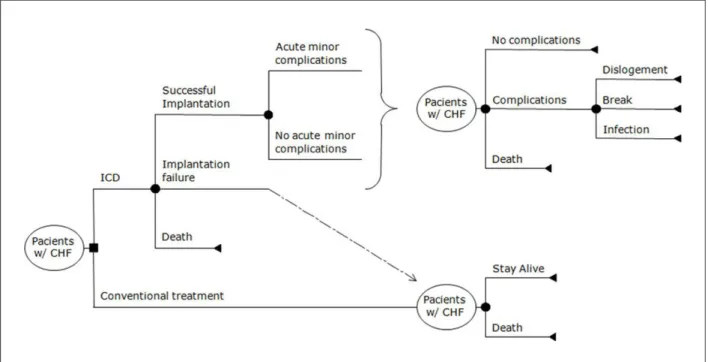
The decision tree, created using the Data Treeage software (release 5.0), was divided in two strategies: defibrillator + conventional therapy versus conventional therapy only. A schematic representation of the tree is depicted in Figure 1.
The clinical model followed the following assumptions: after the implant, procedure-related complications can occur, including mild complications (such as brachial thrombosis, deep venous thrombosis and pneumothorax), as well as severe ones, with the latter capable of causing perioperative death. The patients that survived the implant entered a transition state model, the Markov model. At each annual cycle, the patients could remain stable, die or present complications, such as lead break or systemic infection, in addition to lead displacement (this complication only occurred during the first year post-implantation or lead replacement). The patients undergoing conventional therapy could remain stable or die at each cycle, as well as those who were initially in the defibrillator group and present implantation failure or had to have the device removed during the follow-up.
The defibrillator analyzed in the model was the single-chamber type, due to the lower rate of complications of this kind of device, as well as the lower cost and similar effectiveness. The defibrillator generator replacement occurred every five years in the base-case.
Clinical outcome measurements
The clinical outcomes considered in the assessment were life-years saved (LYS) and quality-adjusted life years(QALY).
The main model used the quality-adjusted outcome, according to the recommendation of the Panel on Cost-effectiveness20.
Data from a cohort of 386 patients with CHF from a specialized outpatient clinic, from Hospital de Clínicas de Porto Alegre, were used for the survival projection in an usual population of CHF aged 60 years in the baseline, incorporating data from life tables of the Brazilian Institute of Geography and Statistics (IBGE). This cohort consisted of 63% men, with a mean age of 59 years, with an interquartile range (IQR) of 49 to 68 and a mean follow-up of 35 months (IQR = 18-60). These patients presented hypertension (53% of the sample), diabetes (33%) and current smoking status (13%); 89% used ACE inhibitors and 73%, beta-blockers21,22.
Analysis of effectiveness
A search in the Medline database was carried out for clinical trials and meta-analyses that had evaluated the use of ICD in CHF, in order to obtain data on effectiveness. The effectiveness data of the meta-analysis performed by Nanthakumar and cols.11 was used, which showed a decrease in the risk of death
associated with the ICD of 26% (95%CI: 17%-33%, I2 = 5.2%),
based on the compilation of seven clinical trials. Considering the lack of data on long-term effectiveness of the ICD, it was considered to be constant throughout time, in accordance with other cost-effectiveness studies that evaluated this device.
Complication data
Regarding data on ICD-related complications, the search was carried out in both clinical trials and observational studies, especially international cohort and registry studies. A meta-analysis carried out by Ezekowitz et al23 provided rates
of systemic infection (total number of patients = 12,436), perioperative mortality (N = 39,858) and ICD implantation failure (N = 11,129). The values adopted in the base-case for lead displacement and mortality due to infection were the result of a meta-analysis of incidences of values that were found in the clinical trials and cohorts, using the method of random effects by DerSimonian and Laird. In order for the study to be eligible for inclusion in the meta-analysis, the ICD leads should have been implanted via the transvenous route and the generator had to be located in the chest. Studies with less than 10% of abdominal implants were also included. Moreover, the devices used in the studies had to be, in the majority, the single-chamber type. In total, four studies that reported lead displacement24-27 and four that reported
mortality due to infection24,25,28,29 were included.
Regarding the data on lead complications that required lead replacement (such as break or isolation defect), we used data from a single article, which was considered the most reliable among the identified ones, as it was the only one that performed a long-term follow-up of the studied cohort (ten years)30.
The values used in the model were the following: up to the 7th year, in which there were 168 patients under follow-up30,
we used the values supplied by the study for each year. After the 7th year, in which the lead replacement rate was around
6.7%, we chose to maintain the rate constant at this value, as
the number of patients in the study decreased significantly, reducing the reliability of estimates.
Utility data
Due to the lack of Brazilian data on the utility of patients with heart failure, international data were used. The estimate of utility for the base-case was 0.88, with no difference between the defibrillator group and the conventional therapy group, in accordance with several previously published studies13,14,16,31. At the sensitivity analysis, the values that ranged
between the findings in other literature studies32-35 were used.
Cost analysis
Regarding the costs of the procedures related to the ICD implantation and the associated complications, values from the reimbursement table of the Hospital Admission Authorization (AIH - Autorização para Internação Hospitalar) of SUS were used in the public perspective. From the perspective of the health insurance companies, the mean values of hospital admissions for these procedures (n=17) in a private hospital in the city of Porto Alegre, state of Rio Grande do Sul, Brazil, in the year 2007, were used.
Regarding the annual costs of heart failure, the study by Araújo et al carried out in 2002, of 70 patients being followed due to this pathology in the city of Niteroi, state of Rio de Janeiro, Brazil, was used as the basis36. This study computed
all direct costs in the annual management of patients with this disease. As this study provides tables with details on all inputs used by the patients (days of hospitalization, exams, used medications, number of consultations), we recalculated some cost portions:
• For the public perspective, we extracted the costs of exams from the SUS table and for the health insurance companies, we used the costs included in the study, from the List of Medical Procedures in the year 1999. • For the public perspective, we computed only
the costs of medications that are available in the public healthcare system. For the health insurance companies, we did not use the cost of medications, as there is no reimbursement for them in most healthcare plans.
• We used the costs of hospitalizations by SUS in a public hospital and a private hospital in the city of Porto Alegre, state of Rio Grande do Sul, Brazil, in the year 2007. The values used were R$ 1,596.00 for the public perspective and R$ 6,593.00 for the health insurance companies.
After these calculations, we arrived at a mean annual cost per patient of R$ 3,160.00 for the public perspective and R$ 7,045.00 for that of the health insurance companies.
Finally, the following costs were also computed:
• In cases of death, an additional cost was computed, related to hospital admission due to heart failure. • The annual cost of ICD maintenance was calculated
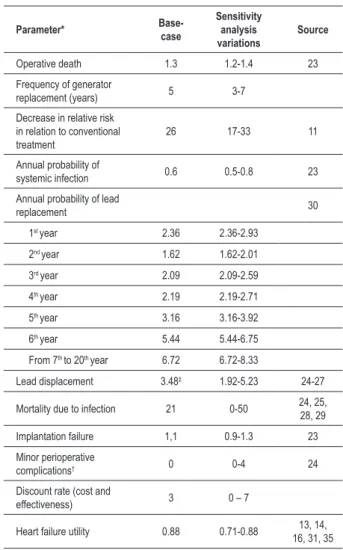
Table 1 - Parameters of effectiveness of the base-case and variations used in the sensitivity analysis
Parameter*
Base-case
Sensitivity analysis variations
Source
Operative death 1.3 1.2-1.4 23
Frequency of generator
replacement (years) 5 3-7 Decrease in relative risk
in relation to conventional treatment
26 17-33 11
Annual probability of
systemic infection 0.6 0.5-0.8 23
Annual probability of lead
replacement 30
1st year 2.36 2.36-2.93
2nd year 1.62 1.62-2.01
3rd year 2.09 2.09-2.59
4th year 2.19 2.19-2.71
5th year 3.16 3.16-3.92
6th year 5.44 5.44-6.75
From 7th to 20th year 6.72 6.72-8.33
Lead displacement 3.48‡ 1.92-5.23 24-27
Mortality due to infection 21 0-50 24, 25, 28, 29 Implantation failure 1,1 0.9-1.3 23
Minor perioperative
complications† 0 0-4 24
Discount rate (cost and
effectiveness) 3 0 – 7
Heart failure utility 0.88 0.71-0.88 13, 14, 16, 31, 35
*Expressed in % unless otherwise stated. ‡This value is considered only after the irst year of lead implantation, either on the irst year post ICD-implantation or
the 1st year after lead replacement. †Minor complications include pneumothorax,
brachial thrombosis and deep venous thrombosis. Sensitivity analyses
Univariate sensitivity analyses were carried out in all parameters of the model. The parameters of effectiveness and complications oscillated within the confidence intervals of their estimates. Costs ranged 50% higher and lower than their values in the base-case. The interval for generator replacement ranged between 3 and 7 years. The discount rate, for both cost and effectiveness, ranged from 0 to 7%. The basal values and their variations at the sensitivity analyses are shown in Table 1 (measures of clinical effectiveness, occurrence of complications) and in Table 2 (costs).
With the objective of simulating the model in a population with a more severe disease, such as that in the MADIT study - in which all patients presented ventricular fibrillation or sustained ventricular tachycardia non-suppressed by procainamide in a electrophysiological study - a survival curve similar to the one in that clinical trial was designed, using the ICD effectiveness attained in the same study.
Results
The analysis of the base-case found a mean survival projection of 6.99 years for the treatment with the ICD and 5.95 years for the conventional treatment. When adjusted for quality, these values were 6.15 and 5.23, respectively (Figure 2). The absolute cost difference between the treatments was higher in the health insurance company scenario (R$ 83,894) than in public perspective (R$ 62,723), generating a higher incremental cost-effectiveness ratio in the first case: R$ 90,942 per QALY in the perspective of the health insurance companies versus R$ 68,318 per QALY in public
perspective (Table 3).
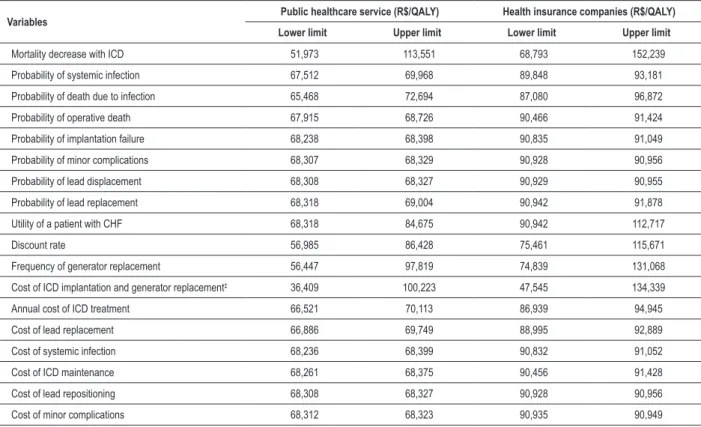
In the univariate sensitivity analysis, the parameters with the highest impact on results - in both perspectives - were the decrease in mortality with the ICD, the frequency of generator replacement and the cost of ICD implantation. The discount rate and the utility of a patient with CHF also presented significant influence; the other parameters had minimal impact on the results (Table 4).
Table 2 - Parameters of costs of the base-case, in SUS and supplementary health costs, with their variations used in the sensitivity analysis.
All monetary values are expressed in Brazilian Reais (R$)
Parameters of costs Base-case - public
healthcare service
Variation in the sensitivity analysis
Base-case - health insurance companies
Variation at sensitivity analysis
ICD implantation 30,460 15,230 - 45,690 41,428 20,714-62,142
Generator replacement 29,408 14,704 - 44,112 39,997 19,998-59,995
Hospitalization for lead replacement 7,594 3,797 - 11,391 10,328 5,164-15,492
Hospitalization for lead repositioning 393 196 - 589 534 267-801
Hospitalization due to systemic
infection (additional)† 1,500 0 - 3,000 2,040 1,020-3,060
Annual cost of ICD treatment 3,160 1,580 - 4,741 7,045 3,522-10,567
Annual cost of ICD follow-up 22 15 - 30 129 64-193
†Additional cost per infection, considering that the patient admitted due to such complication will have, at least, the cost of the implantation of a new ICD device. The
Table 3 - Cost, effectiveness and incremental cost-effectiveness of the assessed strategies
Total Cost: Public healthcare
services
Total Cost: Health insurance
companies
Effectiveness Incremental cost-effectiveness: public healthcare service
Incremental cost-effectiveness: health insurance companies
R$ R$ Mean LYS Mean QALY R$/LYS R$/QALY R$/LYS R$/QALY
Conventional
treatment 33,408 101,330 5.95 5.23 - - -
-ICD treatment 96,131 184,824 6.99 6.15 60,121 68,318 80,029 90,942
ICD - implantable cardioverter deibrillator; LYS - Life Years Saved; QALY - quality-adjusted life year.
Figure 2 -Survival predicted by the model for the ICD strategies and conventional treatment in the base-case and in the model based on the population of the MADIT-I study.
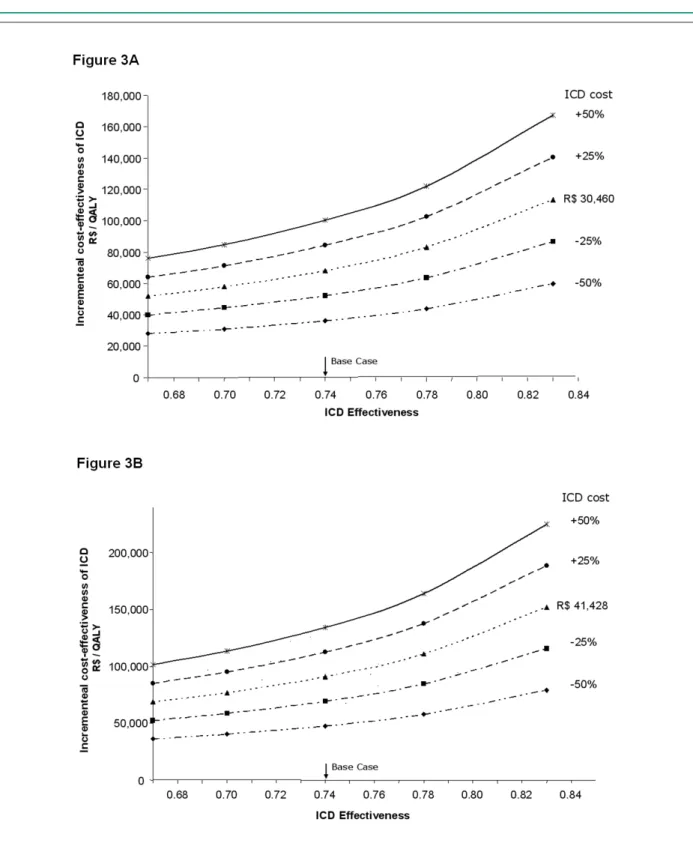
In the bivariate sensitivity analysis, it was possible to observe that the more effective the ICD was in reducing mortality in patients with CHF and the less costly the device, the higher the cost-effectiveness of this strategy. For instance, in the public perspective, if the cost of ICD was 25% lower and the device granted a decrease in mortality > 30%, the ICD use could be an attractive strategy from this point of view (Figure 3A). It is interesting to observe that, when comparing with the data from the health insurance companies, the interrelation between the variables is similar, although the absolute values are higher (Figure 3B). In both scenarios, the longer the time period between generator replacement, the lower the additional cost-effectiveness ratio (Figure 4).
At the analysis of the scenario projected to depict the reality of the MADIT-I study, in which the patients were more severe and presented higher arrhythmic mortality (and consequently, higher benefit of the ICD), the incremental
cost-effectiveness ratio was R$ 23,739 per QALY in SUS and R$ 33,592 per QALY in health insurance companies. At the analysis per life-years saved, these values were R$ 20,890 and R$ 29,561, respectively.
Discussion
Heart failure is a very prevalent condition in Brazil and it presents high morbidity and mortality. Among recent therapies aiming at decreasing the disease-associated death rate, the implantable cardioverter defibrillator (ICD) is a remarkably important strategy, with a mean decrease in general mortality of around 25%. The costs, however, constitute an impediment to its large-scale use, especially at the Brazilian Public Health System (SUS).
Table 4 - Univariate sensitivity analysis of all parameters included in the model
Variables Public healthcare service (R$/QALY) Health insurance companies (R$/QALY)
Lower limit Upper limit Lower limit Upper limit
Mortality decrease with ICD 51,973 113,551 68,793 152,239
Probability of systemic infection 67,512 69,968 89,848 93,181
Probability of death due to infection 65,468 72,694 87,080 96,872
Probability of operative death 67,915 68,726 90,466 91,424
Probability of implantation failure 68,238 68,398 90,835 91,049
Probability of minor complications 68,307 68,329 90,928 90,956
Probability of lead displacement 68,308 68,327 90,929 90,955
Probability of lead replacement 68,318 69,004 90,942 91,878
Utility of a patient with CHF 68,318 84,675 90,942 112,717
Discount rate 56,985 86,428 75,461 115,671
Frequency of generator replacement 56,447 97,819 74,839 131,068
Cost of ICD implantation and generator replacement‡ 36,409 100,223 47,545 134,339
Annual cost of ICD treatment 66,521 70,113 86,939 94,945
Cost of lead replacement 66,886 69,749 88,995 92,889
Cost of systemic infection 68,236 68,399 90,832 91,052
Cost of ICD maintenance 68,261 68,375 90,456 91,428
Cost of lead repositioning 68,308 68,327 90,928 90,956
Cost of minor complications 68,312 68,323 90,935 90,949
ICD - implantable cardioverter deibrillator; CHF - congestive heart failure.
under two different perspectives: the Brazilian public health system and health insurance companies. The incremental cost-effectiveness ratios were R$ 68,318 and R$ 90,942 per QALY in the two scenarios, respectively. Although some countries - such as the United States and England - have already adopted limits to establish cost-effectiveness ratios considered either attractive or unfavorable, there is no consensus about this value in Brazil.
Whereas studies performed in the USA mention a limit of US$ 50,000 per QALY, in Canada, between Can$ 20,000 and Can$ 40,000, and in England, £ 30,000, these values are not applicable to our reality. According to the World Health Organization (WHO), for countries with a level of economic development such as the one in Brazil, values of up to three times the per capita gross domestic product, approximately R$ 40,545 in 2007, would be considered attractive. The cost-effectiveness ratios for the ICD found in these studies are above this value. However, it is important to remember that these limits (suggested by the WHO as well as those adopted by some developed countries) have been developed for the societal perspective or, possibly, for the public perspective, with the comparison of values under the perspective of a third-party payer, such as health insurance companies, being a more delicate issue. In our second scenario, which evaluated a hypothetical cohort of more severe patients and that presented higher arrhythmic mortality, the values were significantly more favorable, being below the limit suggested by the WHO in both perspectives.
The cost-effectiveness studies in Brazil are scarce and most of them focus only on one perspective, normally the public one. This is the second study by our group that performed a cost-effectiveness analysis of a technology from the perspective of SUS and health insurance companies. In our previous study, an economic assessment that compared the rapamycin-coated stent with the conventional stent, the ICER was more attractive in the private healthcare scenario, differently from the present study, which showed more favorable values in the public health system. The reason for this phenomenon is that the ICD, differently from the coated stent, does not decrease costs of disease management (re-stenosis, in that case), when compared to the conventional treatment. In the developed CHF model, the technology being studied has a global effect on mortality, but no reduction in disease morbidity is expected; on the contrary, the device-related complications potentially add hospitalization and secondary costs. Considering that the parameter with the highest impact on the univariate sensitivity analysis was the ICD cost and that the device costs approximately 35% more for health insurance companies than for SUS, it is possible to observe that this isolated parameter accounts for almost all the difference between the ICER of the two perspectives.
Some articles published in the international literature that evaluated the cost-effectiveness of the ICD are noteworthy. In the study by Sanders et al16, carried out with data from the
Figure 3 -Bivariate sensitivity analysis, simultaneously assessing the impact of different costs of the ICD (lines) and the variation of effectiveness (abscissae) on the
incremental cost-effectiveness ratio (ordinate), from the perspective of the Brazilian Public Health System - SUS - (3A) and health insurance companies (3B).
individually for each one of the published clinical trials. The ratios ranged between US$ 34,000 and US$ 70,200, and the MADIT-I scenario (US$ 34,900) was below the cutoff more often accepted in the USA, that is, US$ 50,000, whereas the
Figure 4 -Bivariate sensitivity analysis, assessing simultaneously the impact of different ICD costs (lines) and the frequency of generator replacement (abscissae)
on the incremental cost-effectiveness ratio (ordinate), from the perspective of the Brazilian Public Health System - SUS - (4A) and health insurance companies (4B).
a hypothetical population similar to the two last studies and the alternative model, to the MADIT-I study. Our results are in agreement with this study, if one considers the cutoff suggested by the WHO as the reference.
In Europe, the English studies published to data have not clearly individualized primary and secondary prevention34,37
concluded to date. The most interesting European study available to date was carried out in Belgium, of which model used clinical and effectiveness parameters from the SCD-HeFT38. The gain in QALY, of 1.03, was quite similar to that
found in our study (0.92), with an ICER of around € 70,000, which probably reflects, as expected, higher direct medical costs in that country, when compared to Brazil. It is noteworthy that the sensitivity analysis of the present study showed a decrease in the cost-effectiveness ratio of 20% when the generator replacement interval increased from 5 to 7 years, a figure similar to that found in our study. This fact suggests that, although the costs are higher in that country, their proportionality does not differ from the one observed in the Brazilian scenario.
Some limitations of the present study must be mentioned. Firstly, the benefit of the ICD was considered to be constant throughout time, in agreement with other cost-effectiveness studies in the area, although the clinical trials did not follow the patients for more than 5 years, in their majority. If the benefit decreased throughout time, which is reasonable if we imagine an increase in other causes of death that are non-preventable by the ICD, the cost-effectiveness ratios would be even higher. Secondly, the utility data of patients with CHF that were used in the present study were obtained from the international literature, due to the lack of Brazilian data. Additionally, not even the international literature showed a definitive conclusion on the impact of the ICD on the quality of life, with opinions on the worsening due to inappropriate shocks, as well as improvement in the quality of life, as the patient can feel safer due to the protection provided by the device.
Conclusion
The data of the present study show that, from the public as well as the private perspective in Brazil, the cost of the implantable cardioverter defibrillator in the primary prevention of death is high in proportion to its benefit. Strategies to improve this ratio must be pursued, especially the decrease in the cost of the ICD and the increase of its effectiveness.
Acknowledgements
The authors wish to thank CNPq and the Ministry of Health of Brazil for their support of this project, as disclosed by Official Notice published in the area of Economic Analysis in Healthcare.
Potential Conflict of Interest
No potential conflict of interest relevant to this article was reported.
Sources of Funding
This study was funded by CNPq.
Study Association
This article is part of the thesis of master submitted by Rodrigo Antonini Ribeiro, from Universidade Federal do Rio Grande do Sul.
References
1. McMurray JJ, Petrie MC, Murdoch DR, Davie AP. Clinical epidemiology of heart failure: public and private health burden. Eur Heart J. 1998; 19 (Suppl P): P9-16.
2. Hoes AW, Mosterd A, Grobbee DE. An epidemic of heart failure? Recent evidence from Europe. Eur Heart J. 1998; 19 (Suppl L): L2-9.
3. Krum H, Stewart S. Chronic heart failure: time to recognize this major public health problem. Med J Aust. 2006; 184 (4): 147-8.
4. Stewart S, MacIntyre K, Capewell S, McMurray JJ. Heart failure and the aging population: an increasing burden in the 21st century? Heart. 2003; 89 (1): 49-53.
5. Ministério da Saúde. Datasus. [Acesso em 2006 jun 20]. Disponível em: http:\ www.datasus.gov.br.
6. Sociedade Brasileira de Cardiologia. Grupo de Estudos de Insuficiência Cardíaca (GEIC). Revisão das II Diretrizes da Sociedade Brasileira de Cardiologia para o diagnóstico e tratamento da insuficiência cardíaca. Arq Bras Cardiol. 2002; 79 (supl 4): 1-30.
7. Moss AJ, Hall WJ, Cannom DS, Daubert JP, Higgins SL, Klein H, et al. Improved survival with an implanted defibrillator in patients with coronary disease at high risk for ventricular arrhythmia. Multicenter Automatic Defibrillator Implantation Trial Investigators. N Engl J Med. 1996; 335 (26): 1933-40. 8. Moss AJ, Zareba W, Hall WJ, Klein H, Wilber DJ, Cannom DS, et al. Prophylactic
implantation of a defibrillator in patients with myocardial infarction and reduced ejection fraction. N Engl J Med. 2002; 346 (12): 877-83.
9. Bardy GH, Lee KL, Mark DB, Poole JE, Packer DL, Boineau R, et al. Amiodarone or an implantable cardioverter-defibrillator for congestive heart failure. N Engl J Med. 2005; 352 (3): 225-37.
10. Al-Khatib SM, Sanders GD, Mark DB, Lee KL, Bardy GH, Bigger JT, et al. Implantable cardioverter defibrillators and cardiac resynchronization therapy in patients with left ventricular dysfunction: randomized trial evidence through 2004. Am Heart J. 2005; 149 (6): 1020-34.
11. Nanthakumar K, Epstein AE, Kay GN, Plumb VJ, Lee DS. Prophylactic implantable cardioverter-defibrillator therapy in patients with left ventricular systolic dysfunction: a pooled analysis of 10 primary prevention trials. J Am Coll Cardiol. 2004; 44 (11): 2166-72.
12. Boriani G, Biffi M, Martignani C, Camanini C, Grigioni F, Rapezzi C, et al. Cardioverter-defibrillators after MADIT-II: the balance between weight of evidence and treatment costs. Eur J Heart Fail. 2003; 5 (4): 419-25. 13. Sanders G, Hlatky M, Owens D. Cost-effectiveness of implantable
cardioverter-defibrillators in a MADIT-II population. Technol Eval Cent Asses Program Exe Summ. 2004; 19 (3): 1-26.
14. Al-Khatib SM, Anstrom KJ, Eisenstein EL, Peterson ED, Jollis JG, Mark DB, et al. Clinical and economic implications of the Multicenter Automatic Defibrillator Implantation Trial-II. Ann Intern Med. 2005; 142 (8): 593-600.
15. Zwanziger J, Hall WJ, Dick AW, Zhao H, Mushlin AI, Hahn RM, et al. The cost effectiveness of implantable cardioverter-defibrillators: results from the Multicenter Automatic Defibrillator Implantation Trial (MADIT)-II. J Am Coll Cardiol. 2006; 47 (11): 2310-8.
16. Sanders GD, Hlatky MA, Owens DK. Cost-effectiveness of implantable cardioverter-defibrillators. N Engl J Med. 2005; 353 (14): 1471-80. 17. Ribeiro RA, Stella SF, Camey SA, Zimerman LI, Pimentel M, Rohde LE, et al.
18. Russell LB, Gold MR, Siegel JE, Daniels N, Weinstein MC. The role of cost-effectiveness analysis in health and medicine: panel on cost-cost-effectiveness in health and medicine. JAMA. 1996; 276 (14): 1172-7.
19. Siegel JE, Weinstein MC, Russell LB, Gold MR. Recommendations for reporting cost-effectiveness analyses: panel on cost-effectiveness in health and medicine. JAMA. 1996; 276 (16): 1339-41.
20. Weinstein MC, Siegel JE, Gold MR, Kamlet MS, Russell LB. Recommendations of the panel on cost-effectiveness in health and medicine. JAMA. 1996; 276 (15): 1253-8.
21. Rohde LE, Beck-da-Silva L, Goldraich L, Grazziotin TC, Palombini DV, Polanczyk CA, et al. Reliability and prognostic value of traditional signs and symptoms in outpatients with congestive heart failure. Can J Cardiol. 2004; 20 (7): 697-702.
22. Rohde LE, Clausell N, Ribeiro JP, Goldraich L, Netto R, William Dec G, et al. Health outcomes in decompensated congestive heart failure: a comparison of tertiary hospitals in Brazil and United States. Int J Cardiol. 2005; 102 (1): 71-7.
23. Ezekowitz JA, Rowe BH, Dryden DM, Hooton N, Vandermeer B, Spooner C, et al. Systematic review: implantable cardioverter defibrillators for adults with left ventricular systolic dysfunction. Ann Intern Med. 2007; 147 (4): 251-62.
24. Alter P, Waldhans S, Plachta E, Moosdorf R, Grimm W. Complications of implantable cardioverter defibrillator therapy in 440 consecutive patients. Pacing Clin Electrophysiol. 2005; 28 (9): 926-32.
25. Schoels W, Swerdlow CD, Jung W, Stein KM, Seidl K, Haffajee CJ. Worldwide clinical experience with a new dual-chamber implantable cardioverter defibrillator system. J Cardiovasc Electrophysiol. 2001; 12 (5): 521-8. 26. Bardy GH, Yee R, Jung W. Multicenter experience with a pectoral unipolar
implantable cardioverter-defibrillator. Active Can Investigators. J Am Coll Cardiol. 1996; 28 (2): 400-10.
27. Takahashi T, Bhandari AK, Watanuki M, Cannom DS, Sakurada H, Hiraoka M. High incidence of device-related and lead-related complications in the dual-chamber implantable cardioverter defibrillator compared with the single-chamber version. Circ J. 2002; 66 (8): 746-50.
28. Bansch D, Antz M, Boczor S, Volkmer M, Tebbenjohanns J, Seidl K, et al. Primary prevention of sudden cardiac death in idiopathic dilated cardiomyopathy: the Cardiomyopathy Trial (CAT). Circulation. 2002; 105 (12): 1453-8.
29. Rosenqvist M, Beyer T, Block M, den Dulk K, Minten J, Lindemans F. Adverse events with transvenous implantable cardioverter-defibrillators: a prospective multicenter study. European 7219 Jewel ICD investigators. Circulation. 1998; 98 (7): 663-70.
30. Kleemann T, Becker T, Doenges K, Vater M, Senges J, Schneider S, et al. Annual rate of transvenous defibrillation lead defects in implantable cardioverter-defibrillators over a period of >10 years. Circulation. 2007; 115 (19): 2474-80.
31. Sanders GD, Hlatky MA, Every NR, McDonald KM, Heidenreich PA, Parsons LS, et al. Potential cost-effectiveness of prophylactic use of the implantable cardioverter defibrillator or amiodarone after myocardial infarction. Ann Intern Med. 2001; 135 (10): 870-83.
32. Mark DB, Nelson CL, Anstrom KJ, Al-Khatib SM, Tsiatis AA, Cowper PA, et al. Cost-effectiveness of defibrillator therapy or amiodarone in chronic stable heart failure: results from the Sudden Cardiac Death in Heart Failure Trial (SCD-HeFT). Circulation. 2006; 114 (2): 135-42.
33. Owens DK, Sanders GD, Heidenreich PA, McDonald KM, Hlatky MA. Effect of risk stratification on cost-effectiveness of the implantable cardioverter defibrillator. Am Heart J. 2002; 144 (3): 440-8.
34. Buxton M, Caine N, Chase D, Connelly D, Grace A, Jackson C, et al. A review of the evidence on the effects and costs of implantable cardioverter defibrillator therapy in different patient groups, and modelling of cost-effectiveness and cost-utility for these groups in a UK context. Health Technol Assess. 2006; 10 (27): iii-iv, ix-xi, 1-164.
35. Chen L, Hay JW. Cost-effectiveness of primary implanted cardioverter defibrillator for sudden death prevention in congestive heart failure. Cardiovasc Drugs Ther. 2004; 18 (2): 161-70.
36. Araujo DV, Tavares LR, Verissimo R, Ferraz MB, Mesquita ET. Cost of heart failure in the Unified Health System. Arq Bras Cardiol. 2005; 84 (5): 422-7.
37. Bryant J, Brodin H, Loveman E, Clegg A. Clinical effectiveness and cost-effectiveness of implantable cardioverter defibrillators for arrhythmias: a systematic review and economic evaluation. Int J Technol Assess Health Care. 2007; 23 (1): 63-70.