DOI: 10.1590/0004-282X20150111
ARTICLE
Clinical and epidemiological profile of
patients diagnosed with multiple sclerosis in
João Pessoa, Paraíba, Brazil
Perfil clínico-epidemiológico de pacientes com diagnóstico de esclerose múltipla na
cidade de João Pessoa, Paraíba, Brasil
André Augusto Lemos Vidal de Negreiros, Rilva Lopes de Sousa-Munõz, Bianca Etelvina Santos de Oliveira, Paulo Virgolino da Nóbrega, Laíse Leilane Dias Monteiro
Multiple sclerosis (MS) is an inlammatory, demyelinat
-ing and degenerative disease of the central nervous system and whose etiology is still unknown1,2,3,4, but supposedly as
-sociated with the interaction of genetic, infectious and envi
-ronmental factors1
. his disease is characterized by repeated episodes of neurological and wide variety of signs and symp
-toms3,5,6, afecting more young adults, caucasians and females2.
he prevalence of MS varies considerably worldwide. It is estimated that South America has low prevalence (less than 5 cases per 100,000 population), while in the Northern Hemisphere, the prevalence is greater than 30 cases per
100,000 inhabitants3,6. Although Brazil is considered an area
of low prevalence, there are regions of medium prevalence (between 5 and 30 cases per 100,000 population), as shown by studies in cities in the Southeast region of Brazil3,4,7,8,9,10. he
few studies conducted in the Northeast also corroborate this low prevalence estimate1,6. Systematic review study on the
prevalence of in the South America indicate that MS preva
-lence rate ranging from 1.48 to 17 per 100.000 inhabitants11,12.
João Pessoa is the capital of the state of Paraíba, located on the coast of northeastern Brazil, the eastern end of the state, with southern latitude 7 ° 06’54’’ and west longitude 34 ° 51’46’’.
Universidade Federal da Paraíba, Joao Pessoa PB, Brazil.
Correspondence: André Augusto Lemos Vidal de Negreiros; Rua Presidente Arthur Bernardes, 433/casa 102; 58035-300 João Pessoa PB, Brasil;
E-mail: [email protected]
Conflict of interest: There is no conlict of interest to declare.
Received 25 August 2014; Received in inal form 24 April 2015; Accepted 15 May 2015.
ABSTRACT
Prevalence rates of multiple sclerosis (MS) suggest an interrelationship between genetic and environmental factors, ranging worldwide. Objectives: Clinical and epidemiological characterization of MS patients in João Pessoa, Paraíba city. Methods: Study involving patients treated in ive services in the city. Results: It included 87 patients with MS, representing a prevalence of 12.0 cases/100,000 population, mainly women (77%) and white people (66.7%) with mean age of 43 years and average age of the irst outbreak of 32.2 years. Motor symptoms (65.5%) and relapsing-remitting clinical form (78.2%) predominated; the average of the Expanded Disability Status Scale (EDSS) scores was 3.5 and 72% used a type of immunomodulatory drug. There was a positive correlation between the number of outbreaks and the duration of the disease with EDSS scores. Conclusions: The prevalence of the disease is considered average. The clinical and epidemiological characteristics are in line with most similar Brazilian studies.
Keywords: multiple sclerosis, epidemiology, prevalence.
RESUMO
As taxas de prevalência da esclerose múltipla (EM) sugerem uma inter-relação entre fatores genéticos e ambientais, variando mundialmente. Objetivos: Caracterização clínico-epidemiológica dos pacientes com EM na cidade de João Pessoa, Paraíba. Métodos: O estudo envolveu pacientes atendidos em cinco serviços da cidade. Resultados: Incluíram-se 87 pacientes com EM, que representou a prevalência de 12,0 casos/100.000 habitantes, com predomínio no sexo feminino (77%) e em brancos (66,7%), idade média de 43 anos e idade média do primeiro surto de 32,2 anos. Predominaram os sintomas motores (65,5%) e a forma clínica remitente-recorrente (78,2%); a média dos escores da Escala de Status de Incapacidade Expandida (EDSS) foi de 3,5 e 72% utilizava imunomoduladores. Houve correlação positiva entre o número de surtos e dos anos de doença com o escore EDSS. Conclusões: A prevalência da doença no município é considerada média. As características clínico-epidemiológicas estão em consonância com a maioria dos estudos brasileiros semelhantes.
Its population consists of 723,515 inhabitants13, in an area of
211 475 km². Much of the city is situated on low-lying coastal plains, with an approximate elevation of 20 meters above the sea. According to the Brazilian Institute of Geography and Statistics (IBGE), its location is the Mesoregion of the Paraíba Forest, João Pessoa microrregion14.
he prevalence rates of MS in the world suggest the role of the interrelation between genetic and environmental fac -tors5. Given the broad geographical spread and ethnic diver
-sity of Brazil, it is believed that the frequency of MS varies be
-tween diferent regions5. In the state of Paraíba, there are no
published studies to date on the epidemiological and clinical proile of multiple sclerosis. However, there are various eth
-nic groups that formed Paraíba’s population. Before the ar
-rival of the Portuguese, Paraiba was occupied by Potiguara and Tabajara Indians, and from the early sixteenth century, Europeans, predominantly Portuguese, colonized Paraíba. At the time of the Dutch invasion, between 1634 and 1654, there are reports of many inter-racial marriages. he black popu
-lation had less presence in the formation of Paraíba popu
-lation when compared to other states in the Northeast15,16.
According to the last census conducted by IBGE in 2010, from an ethnic-racial point-of-view, Paraíba has a population with a prevalence of mixed races (52.3%), followed by whites (42.6%), blacks (3.9%) and, inally, indigenous and yellows (0.36%), and those with no racial statement (0.79%)13.
he aim of this study is to describe the clinical and epide
-miological characteristics of patients diagnosed with MS liv
-ing in the city of João Pessoa, Paraíba, Brazil.
METHOD
he model of this study was observational and retrospec
-tive descrip-tive, involving patients followed in the following care services to patients with multiple sclerosis in the city of João Pessoa, Paraíba: Reference Center for Multiple Sclerosis Paraíba (CREMPB), Paraiba Association of Patients with Multiple Sclerosis (APBEM), Neurology clinics of the Lauro Wanderley University Hospital and two private clinics in neu
-rology. According to a study conducted by the Federal Board of Medicine, there are seven clinical neurologists in João Pessoa17.
he study was conducted between November 2012 and November 2013. Patients were classiied according to the revised McDonald criteria in 201018. Only those patients dwelling in João
Pessoa at the moment of theur diagnosis of MS were included in this study. herefore, the geographical unit considered in this sur
-vey was the city of João Pessoa and its metropolitan area. Data were collected according to the method proposed by the Latin American Committee for Treatment and Research in Multiple Sclerosis (LACTRIMS)19, from a review of medi
-cal records of patients. Participants were informed about the objectives and procedures of the study, and included in it af
-ter signing the consent form. Data were also collected from
the IBGE14. his study was approved by the Ethics Committee
in Research of the Lauro Wanderley University Hospital, under CAE 10897812.1.0000.5183, with the approval opinion no. 211 367.
he variables analyzed were gender, age, ethnicity, clinical presentation, patient age at diagnosis, patient age at irst on
-set, time since diagnosis, duration of clinical manifestation of the disease, number of relapses, predominant symptoms, use of disease-modifying drugs and symptomatic drugs. he clin
-ical presentation was deined based on the study of Lublin, in the categories relapsing-remitting (RR), secondary progres
-sive (SP) and primary progres-sive (PP).
he assessment of functional capacity of patients was per
-formed by the Expanded Scale of Incapacity State (Expanded Disability Status Scale or EDSS), the scale most often used to evaluate patients with multiple sclerosis. his scale has 20 items, with scores ranging from 0 to 10, and whose score increases along with the degree of patient impairment, with greater focus on the ability to ambulate19,20,21.
We calculated mean and standard deviation for continu
-ous variables, absolute and relative frequencies of categorical variables, calculus of the prevalence rate in the period, and its gender ratio. he prevalence day for analysis was July 27,2013. An analysis of simple linear Spearman correlation for quanti
-tative variables was performed. Analyses were performed us
-ing the SPSS software, version 20.0 for Windows.
RESULTS
In the services for the care of patients with MS, there was a record of 164 patients diagnosed with the disease. Ouf of this number, 77 were excluded from the study due to their not living in the considered geographic unit, the City of João Pessoa, at the moment of diagnosis.
João Pessoa has an area of 211 475 km2 and 723,515 inhab
-itants estimated on the prevalence day. A total of 87 patients were identiied among the inhabitants of the city of João Pessoa, representing a prevalence of 12.0 cases/100,000 in
-habitants. Out of 87 patients who were included in the study, 67 were women, verifying a ratio between females and males 3.3. Regarding ethnicity, 58 were white, 26 pheodermic and black 3. It was found that the most common clinical form of the disease in the sample relapsing-remitting (RR), 68 cas
-es (78.2%), followed by the way secondary progr-essive (SP) (21.8%), and no patient had primary progressive (PP) manner.
he age, at which the diagnosis, was done age of irst on
-set, and the time of diagnosis and duration of disease (clinical signs) was performed are shown in Table 1.
Motor symptoms were most often presented by patients (65.5%), followed by cerebellar symptoms (35.6%), sensitive (33.3%), visual (32.2%) and those related to the brainstem (10.3%). We observed a positive correlation statistically sig
-niicant of moderate magnitude between the number of out
Scale (EDSS) (rho = 0.38, p < 0.0005). here was a signiicant positive correlation, but small in magnitude, between this score and duration of disease (rho = 0.271, p = 0.011).
Table 2 shows the clinical and demographic characteristics of patients according to ethnicity. here were no statistically sig
-niicant diferences between the clinical categories evaluated. However, there was greater distribution of women among white patients, while the opposite occurred among pheodermic.
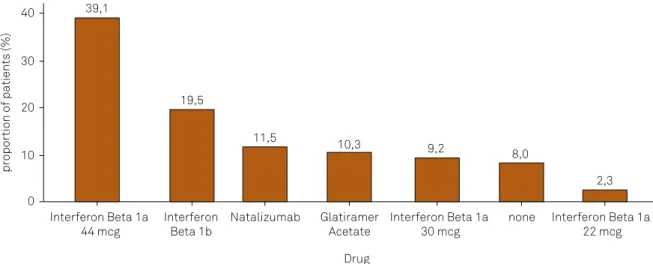
he disease modifying drug most used by the patients was beta interferon at various doses (Figure). Most patients did not use any symptomatic medication (78.2%) to allevi
-ate the symptoms of the disease like depression, paresthesia, spasticity and urinary incontinence. hose using symptom
-atic drugs used amantadine hydrochloride (5.7%), luoxetine (4.0%), baclofen (3.4%) and gabapentin (1.7%). Other medi
-cations, at lower frequencies, were used by 6.9% of patients.
DISCUSSION
In the city of João Pessoa, the prevalence of MS was found to be 12 cases per 100,000 inhabitants, conforming an area of average prevalence of the disease, according to studies
by Kurtzke21,22,23, and in line with studies conducted in cit
-ies in Southeastern Brazil2,3,4,5,10,,24,25, however, it is not com
-patible with the indings of the study conducted in Recife, Pernambuco, Brazil, 130 km north of João Pessoa, in 2004 by presenting the latter a rate signiicantly below the other re
-ported in the literature (Table 3).
his low prevalence found in the study by Ferreira et al. may be related to the fact that this research was conducted at a single referral center in the geographical unit considered6.
Moreover, one can also consider that there are diiculties in accessing health services and referral to specialist neurolo
-gists, beyond the problem of obtaining additional tests to support the diagnosis of MS, factors that may underestimate the actual number of cases. In addition, the comparisons be
-tween the capital, one should take into account the difer
-ences in the periods of data collection.
White ethnicity was predominant, corroborating most epi
-demiological studies in Brazil2,3,4,5,10,24,25,26, except for the study
of Ferreira et al.6, in which 93.2% were mixed race (African de
-scent). In this respect, classifying patients according to their ethnicity in a country with great miscegenation as Brazil is not an easy task. We had diiculty in classifying patients as pheo
-dermic, black or mulatto1,3. he calculation of the sex ratio also
indicated a greater predisposition of females to MS. A similar inding is reported in other studies on clinical and epidemio
-logical proile of patients with the disease.
he age average and the irst outbreak average of pa
-tients, the average disease duration in years, the average number of outbreaks, the average of the EDSS global score, as well as the predominance of RR are consistent with the lit -erature2-5,10,24,26. he diagnosis time in years was greater than
the Swedish study Skoog et al.27, in which the time was two
years, while in this study it was 3.9 years. However, this date can be explained by the fact that Sweden is a country with wide access to health and wide availability of complemen
-tary tests, compared to those observed in Brazil. Nowadays
Table 1. Clinical and demographic characteristics of patients diagnosed with multiple sclerosis in the city of João Pessoa, Paraíba, Brazil, between November 2012 and November 2013 (n = 87).
Variables Averages Standard deviation
Age (years) 43.0 13.3
Age at the diagnosis (years) 36.1 11.6
Age at 1st onset (years) 32.2 11.6
Time of diagnosis (years) 3.9 5.9
Disease Duration (years) 10.6 8.0
Number of outbreaks 3.3 1.2
EDSS Score 3.5 1.95
EDSS: Expanded Disability Status Scale.
Table 2. Clinical and epidemiological characteristics of patients diagnosed with multiple sclerosis in the city of João Pessoa, Paraíba, Brazil, between November 2012 and November 2013 (n = 87).
Characteristcs White Ethnicity Pheodermic Black p
Gender (%) 0.015
Male 40.0 55.0 5.0
Female 74.6 22.4 3.0
Clinical presentation (%) NS
RR 66.2 30.9 2.9
SP 68.4 26.3 5.3
PP - -
-EDSS (average, SD) 3.7 ± 2.2 3.4 ± 1.5 2.2 ± 1.3 NS
Age (average, SD) 44.0 ± 14 39.0 ± 12 48 ± 18 NS
Disease duration (years – average, SD) 12 ± 9 8 ± 5 13 ± 11 NS
Number of outbreaks (average, SD) 3 ± 1 3 ± 1 3 ± 1 NS
Age at 1st onset (average, SD) 32 ± 12 32 ± 10 35 ± 16 NS
Time of diagnosis (years – average, SD) 5 ± 7 2 ± 3 8 ± 10 NS
the diagnosis is more easily performed due to more access di
-agnostic tools. In addition there is increased life expectancy, that contributes for increased of prevalence rate.
he prevalence of motor, cerebellar, sensory and visual symptoms was also observed in other samples2,4. he correla
-tions observed between functional capacity assessed by the EDSS score, despite not reaching statistical signiicance in studies of Arruda et al.24. and Ferreira et al.6. he correlation
observed in this study corroborates most international stud
-ies, which shows that the natural course of multiple sclerosis over the years, if not promptly treated with disease-modifying drugs, is associated to the accumulation of neurological def -icits20. Patients with the RR form may develop neurological
disabilities gradually, often due to the inability to complete recovery of an outbreak20. In the study cohort, Skoog et al.,
202 patients having the relapsing-remitting clinical form progressed to secondary progressive form, at an interval of 12 years, progressing with increased EDSS score27. However,
in this same study, it is suggested that the best parameter to predict the disabilities that the disease can cause is the dis
-ease progression index, not the EDSS, considering the latter, after several outbreaks of the disease, can sufer inluence of random factors23,27,28.
Regarding the distribution of disease modifying drugs among patients, there were similar results when compared to those found in the study by Cardoso et al.1
We did not ind, even in the most recent studies of clinical and epidemio
-logical proile of MS, the use of Natalizumab, a humanized monoclonal antibody, a drug already in use by the partici
-pants of this study, since it is a drug with recent availability in the market.
It is important to emphasize the limitations of this study, especially the fact that it is a retrospective study and conve
-nience sampling may reduce its external validity. Since these estimates are based on data from a capital, they do not relect the situation of the state or the region as a whole. However, the aim of this study was to describe the clinical and epidemi
-ological characteristics of patients with MS in the city of João Pessoa, where there is a major referral center for the treat
-ment of MS for patients from all over the state, which allowed to cover the observation of the vast majority of patients with the disease in the city. We expect to contribute to the descrip
-tive epidemiological study of MS, and encourage researchers to develop more studies on this disease in diferent regions of Brazil, especially in the Northeast, a region with limited re
-search on this topic and its wide ethnic diversity.
Table 3.Comparison between the results of epidemiological studies on multiple sclerosis performed in Brazil.
Studies (authors, year) Geographic unit Number of patients Gender ratio F:M Prevalence
Moreira et al. (2000) SP 302 3.5:1
-Arruda et al. (2001) PR 200 1.8:1
-Ferreira et al. (2004) PE 118 4.1:1 1.36
Fragoso e Peres (2005) SP 81 3.3:1
-Cardoso et al. (2006) BA 121 4.0:1
-Grzesiuk (2006) MT 20 3.1:1
-Santos et al. (2006) SP 283 3.7:1
-Finkelsztejn et al. (2009) RS 67 2.9:1
-Ribeiro et al. (2011) MG 35 2.5:1 12.5
Lana-Peixoto et.al (2012) MG 409 3.3:1 18.1
Present Study (2013) PB 87 3.3:1 12.0
proportion of patients (%)
Drug 30
39,1 40
20
10
0
Interferon Beta 1a 44 mcg
Interferon Beta 1b
19,5
Natalizumab 11,5
Glatiramer Acetate
10,3
Interferon Beta 1a 30 mcg
9,2
none 8,0
Interferon Beta 1a 22 mcg
2,3
References
1. Cardoso E, Fukuda T, Pereira J, Seixas J, Miranda R, Rodrigues B et al. Clinical and epidemiological proile of multiple sclerosis in a reference center in the State of Bahia, Brazil. Arq Neuropsiquiatr. 2006;64(3B):727-30. doi:10.1590/S0004-282X2006000500005
2. Grzesiuk, A. K. [Clinical and epidemiologic characteristics of 20 patients with multiple sclerosis in Cuiabá - Mato Grosso, Brazil]. Arq Neuropsiquiatr. 2006;64(3A):635-8. Portuguese. doi:10.1590/S0004-282X2006000400022
3. Ribeiro SBF, Maia DF, Ribeiro JB, Cardoso FAG, Silva C. Clinical and epidemiological proile of patients with multiple sclerosis in Uberaba, Minas Gerais, Brazil. Arq Neuropsiquiatr. 2011;69(2A):184-7. doi:10.1590/S0004-282X2011000200008
4. Lana-Peixoto MA., Frota ERC., Campos GB., Monteiro LP.The prevalence of multiple sclerosis in Belo Horizonte, Brazil. Arq Neuropsiquiatr. 2012;70(2):102-7. doi:10.1590/S0004-282X2012000200006
5. Moreira, MA, Felipe E, Mendes, MF, Tilbery, CP. [Multiple sclerosis: descriptive study of the clinical forms in 302 cases]. Arq Neuropsiquiatr. 2000;58(2B):460-6. Portuguese. doi:10.1590/S0004-282X2000000300010
6. Ferreira MLB, Machado MI, Vilela ML, Guedes MJ, Ataíde Juniorr L, Santos S et al. [Epidemiology of 118 cases of multiple sclerosis after 15 years of follow-up on the reference Center of Hospital of Restauração, Recife, Pernambuco, Brazil]. Arq Neuropsiquiatr. 2004;62(4):1027-32. Portuguese. doi:10.1590/S0004-282X2004000600018
7. Callegaro D, Goldbaum M, Morais L, Tilbery CP, Moreira MA, Gabbai AA et al. The prevalence of multiple sclerosis in the city of São Paulo, Brazil, 1997. Acta Neurol Scand. 2001;104(4):208-13. doi:10.1034/j.1600-0404.2001.00372.x
8. Polman CH, Reingold SC, Banwell B, Clanet M, Cohen JA, Filippi M, et al. Diagnostic criteria for multiple sclerosis: 2010 revisions to the McDonald criteria. Ann Neurol. 2010;69(2):292-302. doi:10.1002/ana.22366
9. Rocha F, Herrera LC, Morales RR. Multiple sclerosis in Botucatu, Brazil: a population study. Mult Scler. 2002;8 Suppl:S41.
10. Gama PD, Trigo LX, Andrade CRR, Sala CR. Epidemiological study of multiple sclerosis in the city of Sorocaba, Brazil. Arq Neuropsiquiatr. 2004;62 Suppl1:S13.
11. Cristiano E, Patrucco L, Rojas JI. A systematic review of the epidemiology of multiple sclerosis in South America. Eur J Neurol 2008;15(12):1273-8. doi:10.1111/j.1468-1331.2008.02330.x
12. Cristiano E, Rojas J, Romano M, Frider N, Machnicki G, Giunta D et al. The epidemiology of multiple sclerosis in Latin America and the Caribbean: a systematic review. Mult Scler. 2013;19(7):844-54. doi:10.1177/1352458512462918
13. Fragoso YD, Peres M. Prevalence of multiple sclerosis in the city of Santos SP. Rev Bras Epidemiol. 2007;10(4):479-82. doi:10.1590/S1415-790X2007000400005
14. Instituto Brasileiro de Geograia e Estatística. Contagem populacional. Rio de Janeiro: Instituto Brasileiro de Geograia e Estatística; 2010 [cited 2013 Aug 15). Avaiable from: http://cidades. ibge.gov.br/painel/painel.php?codmun=250750
15. Ochotorena MJ. Uma breve análise da dinâmica demográica da Cidade de João Pessoa [monograia]. João Pessoa: Universidade Federal da Paraíba; 2006.
16. Guedes PHMQ. A colonização do sertão da Paraíba: agentes produtores do espaço e contatos interétnicos (1650-1730). Okara Geogr Debate. 2007;1:128-30.
17. Oliveira CMS, Menezes MV, Gonçalves RC. Ensaios sobre a América portuguesa. João Pessoa: Editora Universitária/UFPB; 2009.
18. Scheffer M, Biancarelli A, Cassenote A, coordinators. Demograia médica no Brasil: dados gerais e descrições de desigualdades: relatório de pesquisa. São Paulo: Conselho Federal de Medicina; 2011.
19. Latin American Committee for Treatment and Research in Multiple Sclerosis-LACTRIMS. Metodologia para a realização de estudo epidemiológico. Available from: http://www.bctrims.org.br/
20. Lublin FD. Clinical features and diagnosis of multiple sclerosis. Neurol Clin. 2005;23(1):1-15. doi:10.1016/j.ncl.2004.09.003
21. Kurtzke JF. Rating neurologic impairment in multiple sclerosis: an expanded disability status scale (EDSS). Neurology. 1983;33(11):1444-52. doi:10.1212/WNL.33.11.1444
22. Felipe E, Mendes MF, Moreira MA, Tilbery CP. [Comparative analysis of two clinical scales for multiple sclerosis: review of 302 cases]. Arq Neuropsiquiatr. 2000;58(2A):300-3. Portuguese. doi:10.1590/S0004-282X2000000200016
23. Kurtzke JF, Page WF. Epidemiology of multiple sclerosis in US veterans: VII. Risk factors for MS. Neurology. 1997;48(1):204-13. doi:10.1212/WNL.48.1.204
24. Arruda WO, Scola RH, Teive HAG, Werneck LC. Multiple sclerosis: re-port on 200 cases from Curitiba, Southern Brazil and comparison with other Brazilian series. Arq Neuropsiquiatr. 2001;59(2A):165-70. doi:10.1590/S0004-282X2001000200002
25. Santos EC, Yokota M, Dias NFR. [Multiple sclerosis: study of patients with relapsing-remitting form registered at Minas Gerais Secretary State for Health]. Arq Neuropsiquiatr. 2007;65(3B):885-88. Portuguese. doi:10.1590/S0004-282X2007000500032
26. Finkelsztejn A, Cristovam RA, Moraes GS, Lopes MG, Silva AV, Garcia MS et al. Clinical features of multiple sclerosis in the south of Brazil: a partial analysis. Arq Neuropsiquiatr. 2009;67(4):1071-5. doi:10.1590/S0004-282X2009000600021
27. Skoog B, Runmarker B, Winblad S, Ekholm S, Anderson O. A representative cohort of patients with non-progressive multiple sclerosis at the age of normal life expectancy. Brain. 2012;135(3):900-11. doi:10.1093/brain/awr336